
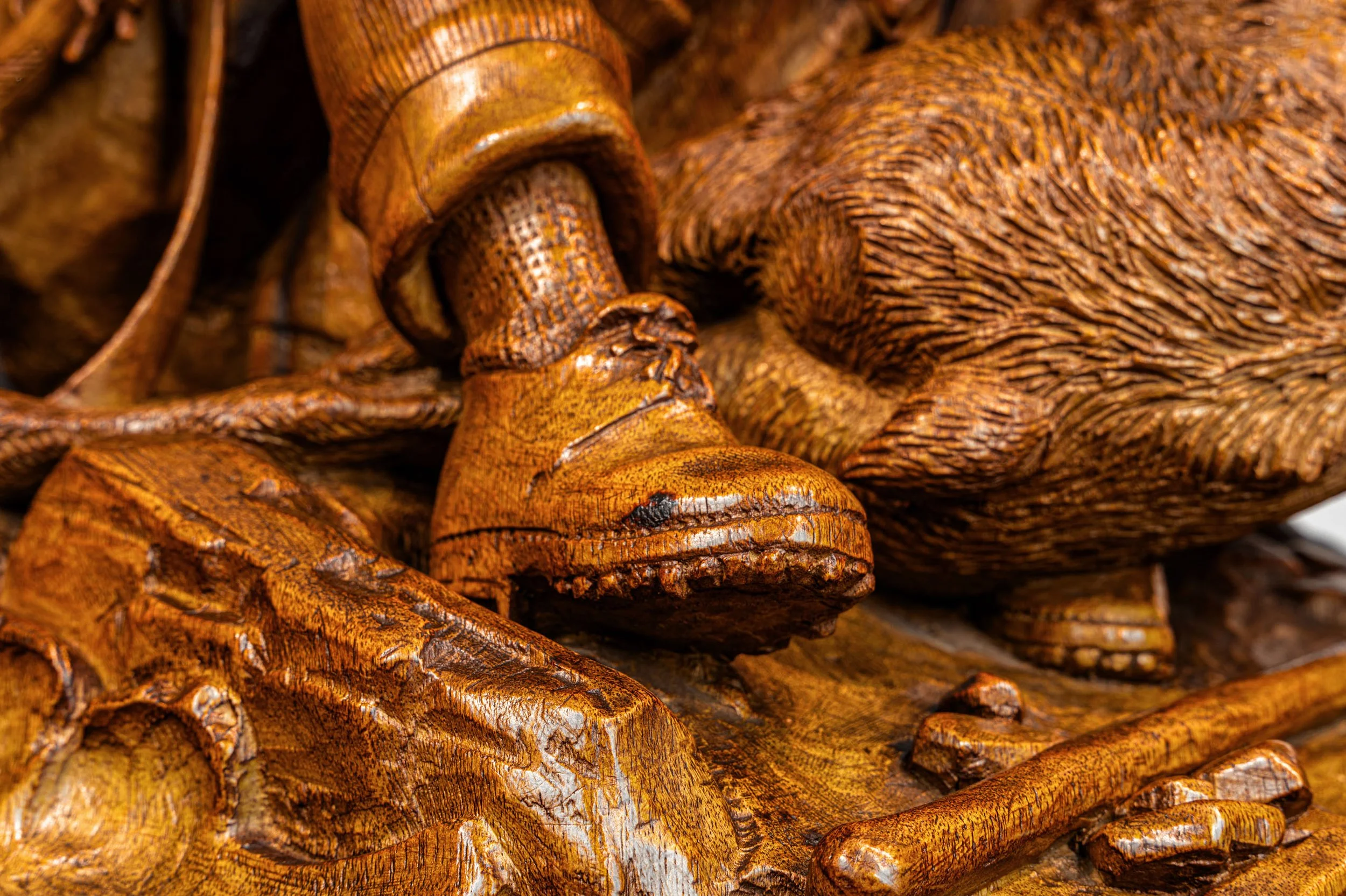
Swiss Black Forest Carvings
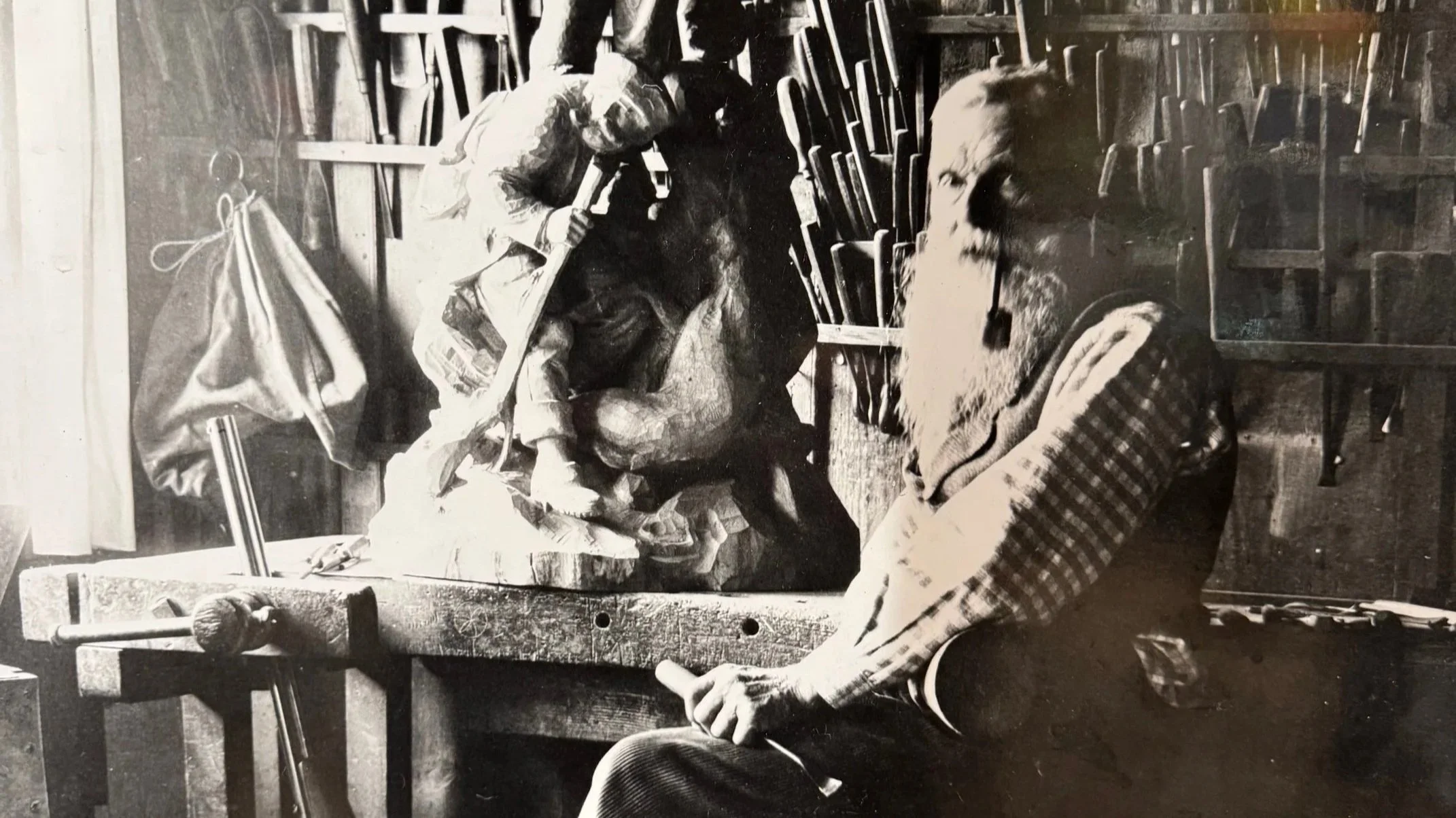
Daniels Antiques has been collecting and dealing in Swiss Black Forest carvings for over four decades. Simon Daniels is co-author of Swiss Carvings: The Art of the Black Forest, 1820–1940 (2006), the standard reference work on the subject, and every piece in the collection is selected on the basis of specialist research and first-hand connoisseurship.

Swiss Black Forest Carvings
Black Forest carving is the great sculptural achievement of nineteenth-century Switzerland, produced in the workshops of Brienz, in the Bernese Oberland, from the 1820s through the early twentieth century. Working in walnut and linden, the Brienz carvers brought a naturalism and technical command to animals, hunting subjects, furniture, and figural groups that set them apart in European wood sculpture. Their work was shown at the international expositions in London, Vienna, Philadelphia, Paris, and Chicago, and American collectors were among its most devoted buyers. The leading carvers, Johann Huggler, Hans Huggler-Wyss, Walter Mader, and the Ruef Brothers, sold through retailers such as Binder and Company and Bergen of Interlaken, whose labels remain important evidence of a piece's history.
The collection includes signed and attributed works by Johann Huggler and Walter Mader, pieces with documented exhibition histories, and examples illustrated in Swiss Carvings. Inquiries are welcome, and pieces may be viewed by appointment at the gallery in Aspen, Colorado. We also purchase fine Black Forest carvings, and owners are invited to contact the gallery.
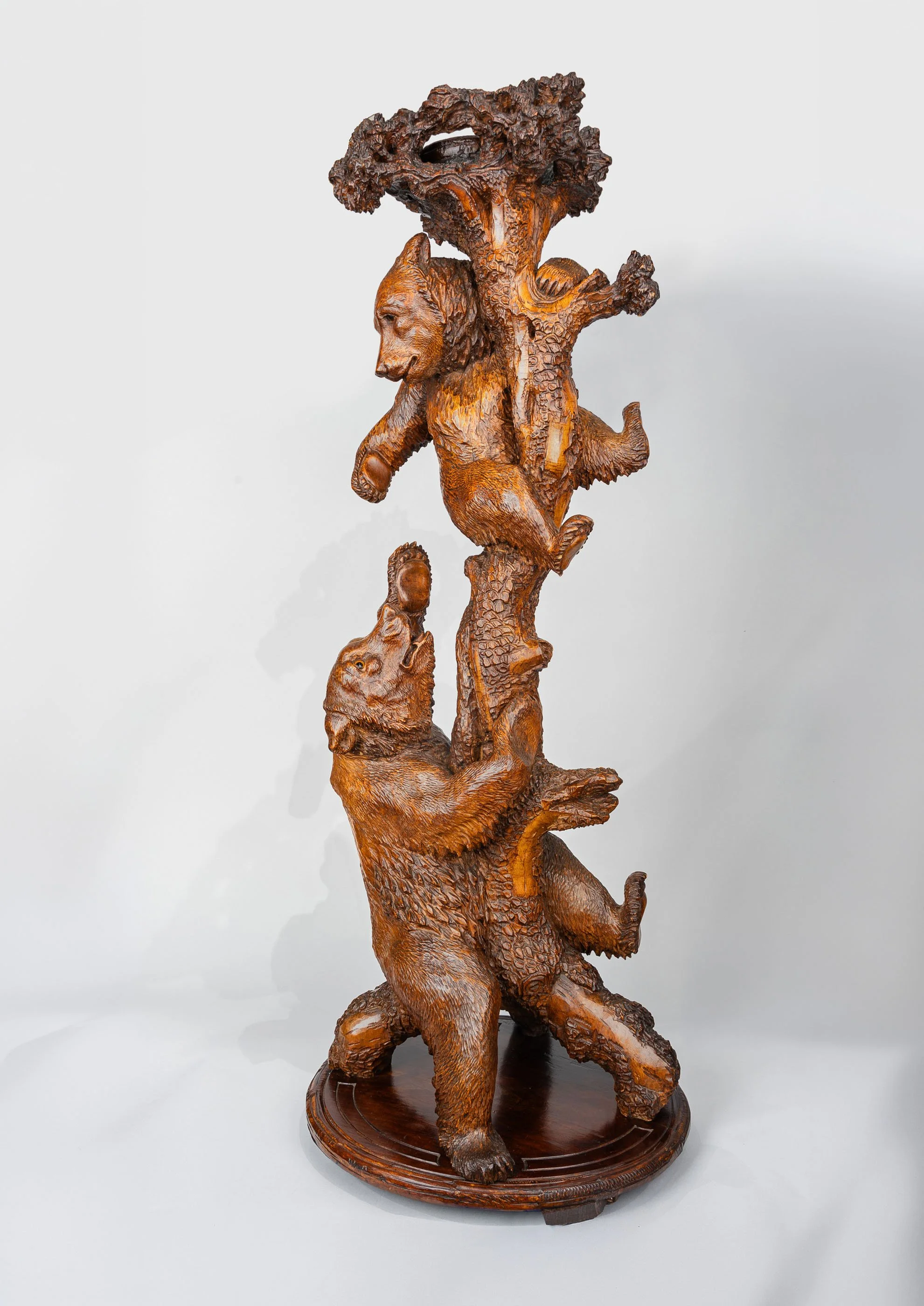
A large and theatrical Swiss Black Forest jardinière in carved linden wood, circa 1870, formed as two bears at a gnarled tree, the crown of which opens into a naturalistic basin for a plant or palm.
A young bear scrambles up the trunk, forelegs thrown over a branch, glancing back at the adult below, who rears upright against the tree, head thrown back and mouth open, one forepaw raised toward the escaping climber. Both bears carry inset glass eyes, and the carving moves confidently between textures, the dense fur of the animals, the scaled bark of the trunk, and the burled, leafy crown of the basin, the whole rising from a molded circular base.
The bear is the emblematic subject of Brienz carving, and jardinières of this scale belong to the upper end of its production, sculptural furniture made for the salons and winter gardens of the hotel age. A single-bear jardinière of similar style is illustrated on page 121 of Swiss Carvings; the present example, over three and a half feet tall and fully carved from every angle, holds a room as few functional objects of the period can.
Dimensions: 43"height
Literature
Jay Arenski, Simon Daniels, and Michael Daniels, Swiss Carvings: The Art of the Black Forest, 1820–1940 (2006), p. 121, where a single-bear jardinière of similar style is illustrated.
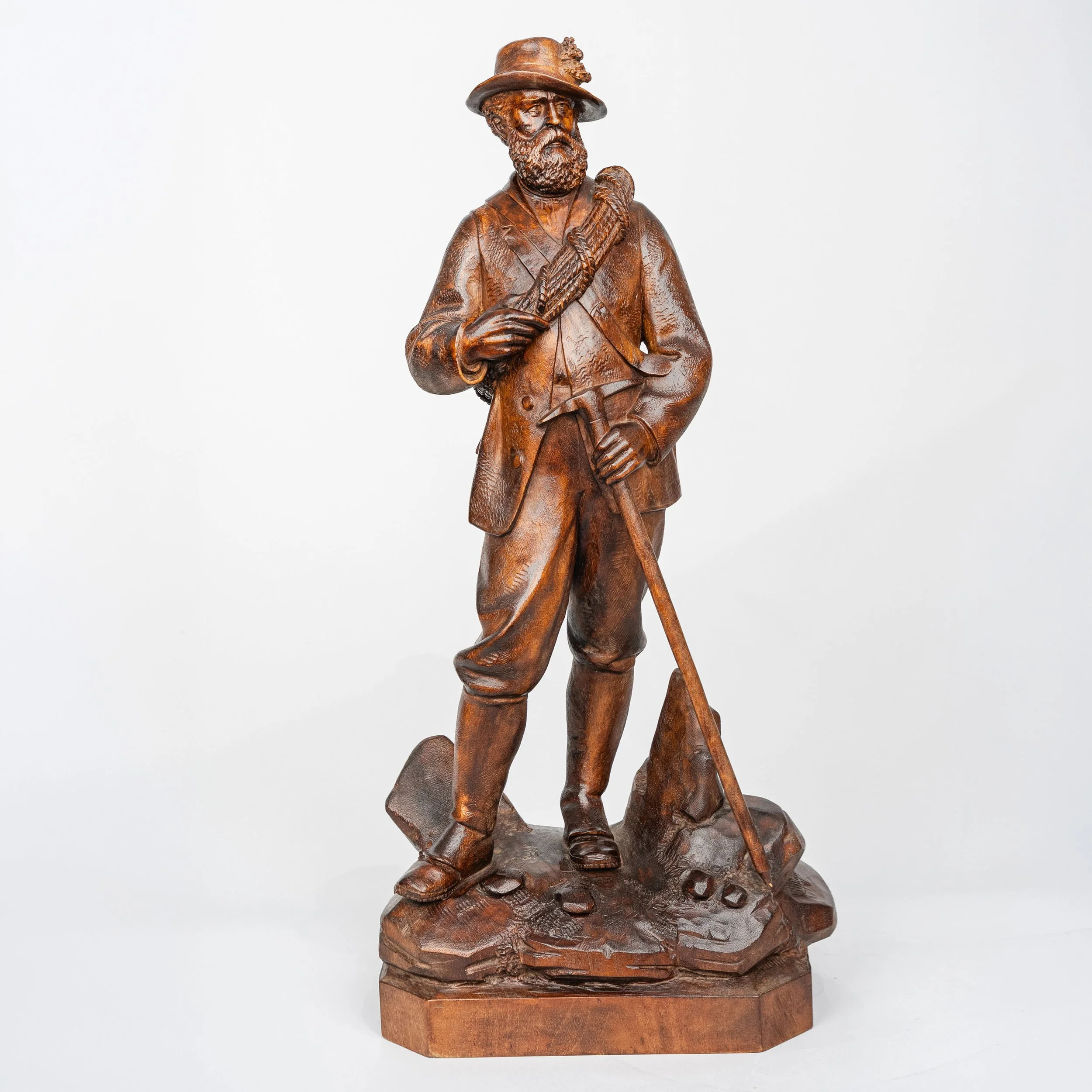
A fine carved walnut figure of an alpine hunter by Johann Huggler of Brienz, the pre-eminent master of the Swiss Black Forest carving tradition, stamped with his initials JH to the rear of the boot, circa 1870.
The hunter stands at ease on a naturalistic rocky outcrop, a bearded man of the mountains caught in a moment of rest rather than pursuit. He wears a hat dressed with traditional alpine flowers, an open jacket over a buttoned waistcoat, breeches, and tall boots, a mountaineering staff planted against the rocks in his right hand, a coiled rope slung over his shoulder, and a binocular case carried at his hip. The carving holds its quality through every surface: the varied texturing of jacket, waistcoat, and breeches, the weave of the coiled rope, the individually rendered stones of the base, and above all the face, alert, weathered, and fully characterized, a portrait of a type Huggler knew from life in the Bernese Oberland.
The rear of the hunter's boot bears a stamped JH, the mark Johann Huggler used in the early period of his career, before the Huggler family began retailing their own work. Stamped examples from these years are rare, and the mark places the figure firmly in the 1870s, the decade of Huggler's finest independent carving. Huggler stands at the summit of the Brienz school; his works were shown at the great international exhibitions of the nineteenth century, and signed or stamped examples consistently represent the highest standard of the tradition. We have had the privilege of handling deeply personal works by Huggler, and the present figure shows the same authority brought to a subject at the heart of alpine life.
Dimensions: 19"height
Condition: Very good overall.
Literature
Jay Arenski, Simon Daniels, and Michael Daniels, Swiss Carvings: The Art of the Black Forest, 1820–1940 (2006).
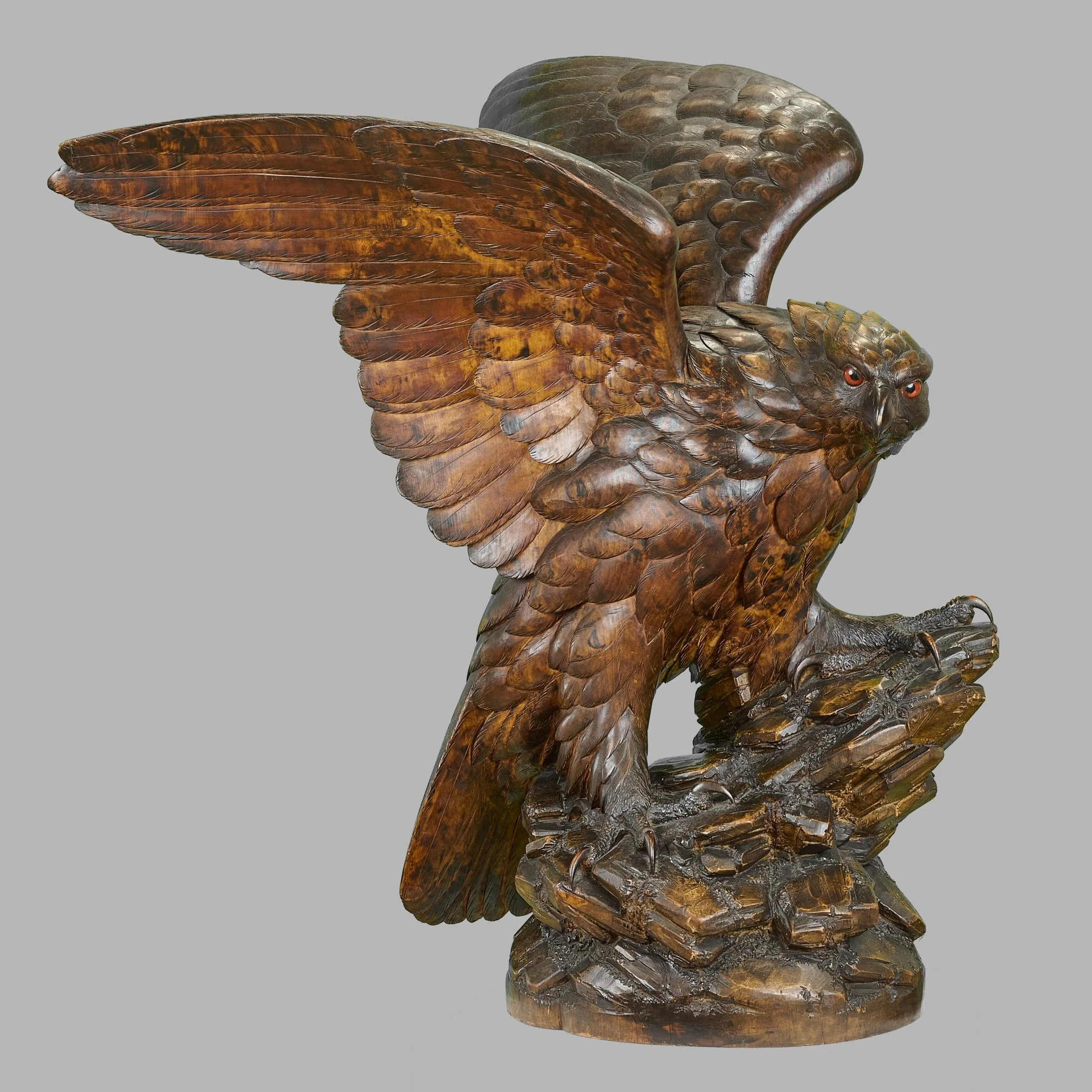
A large and powerfully modeled Swiss Black Forest carving of a golden eagle, attributed to the Ruef Brothers of Brienz and carved from linden wood, the bird shown alighting on a rocky outcrop with wings raised and head turned, with inset glass eyes. The eagle ranks with the bear and the owl among the defining subjects of the Brienz tradition, demanding both anatomical command and sustained technical control across a single block of work, and stands among the most ambitious forms the workshops produced.
The carving is worked with exceptional attention to the plumage, each feather individually defined and layered from the fine covert feathers of the breast to the broad primaries of the outstretched wings. The graduated coloring of the plumage was achieved not by applied stain but by scorching the surface of the wood with heated irons, a characteristic Brienz technique that produced the warm tonal transitions seen across the wings and body. The head is finely detailed, with a sharply hooked beak and inset glass eyes that lend the bird its alert, arresting expression, and the figure is raised on a naturalistically carved base of rocky strata.
The Ruef Brothers were among the most accomplished of the Brienz carvers, recorded alongside the Huggler family among the workshops whose work defined the finest period of the tradition and documented in the standard literature, including Swiss Carvings: The Art of the Black Forest, 1820–1940. The present eagle is attributed to them on the strength of its scale, the confidence of its modeling, and the quality of its finish, each consistent with their documented work in this subject.
The carving is in excellent original condition, retaining its surface and glass eyes, with the crisp definition of the featherwork fully preserved and the warm coloring undisturbed. Wear is minor and consistent with age.
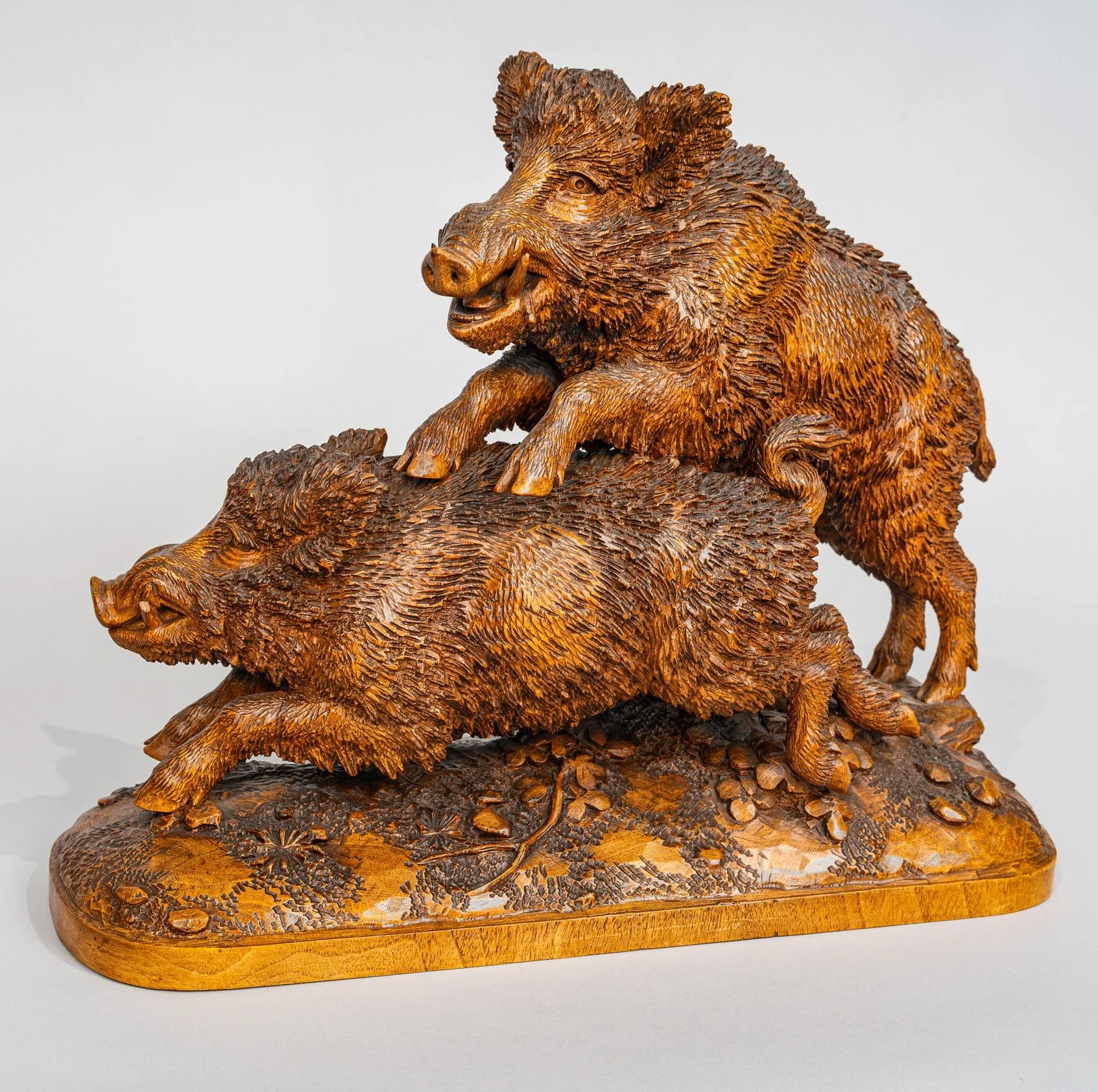
Two wild boars startled into sudden flight, one leaping across the back of the other in a single explosive instant, carved in walnut at Brienz, circa 1870.
The composition captures the precise moment of alarm. The lower animal lunges forward, forelegs extended, head thrust low to the ground, while the second vaults across its back, unable to stop or turn — the two figures locked together in motion, compact yet charged, conveying with remarkable economy the raw urgency of the animals.
Each bristled coat is articulated through dense, directional toolwork, thousands of individual marks describing the coarse, layered hair and the shifting musculature beneath. Tusks, alert eyes and flared snouts are sharply defined, and the depth of cutting varies deliberately across the surfaces, producing the contrasts of light and shadow that animate the group and reward close examination. The figures stand on an integrally carved base of forest undergrowth — stones, moss and ground cover — and the warm walnut patina deepens the relief throughout.
The group belongs to the height of the Brienz industry's reputation, around 1870, when the workshops of Huggler, Binder and their contemporaries were showing at the great world's fairs and collected across Europe and America. Animal subjects of this naturalistic ambition represented the apex of the tradition, and groups of this quality are rare on the market.
Condition: Very good; rich original patina, surface carving complete and crisp, no restorations or repairs noted, minor wear consistent with age.
Dimensions: 14 in. width x 12 in. height x 5 in. depth
Literature: Jay Arenski, Simon Daniels, and Michael Daniels, Swiss Carvings: The Art of the Black Forest, 1820–1940 (2006).
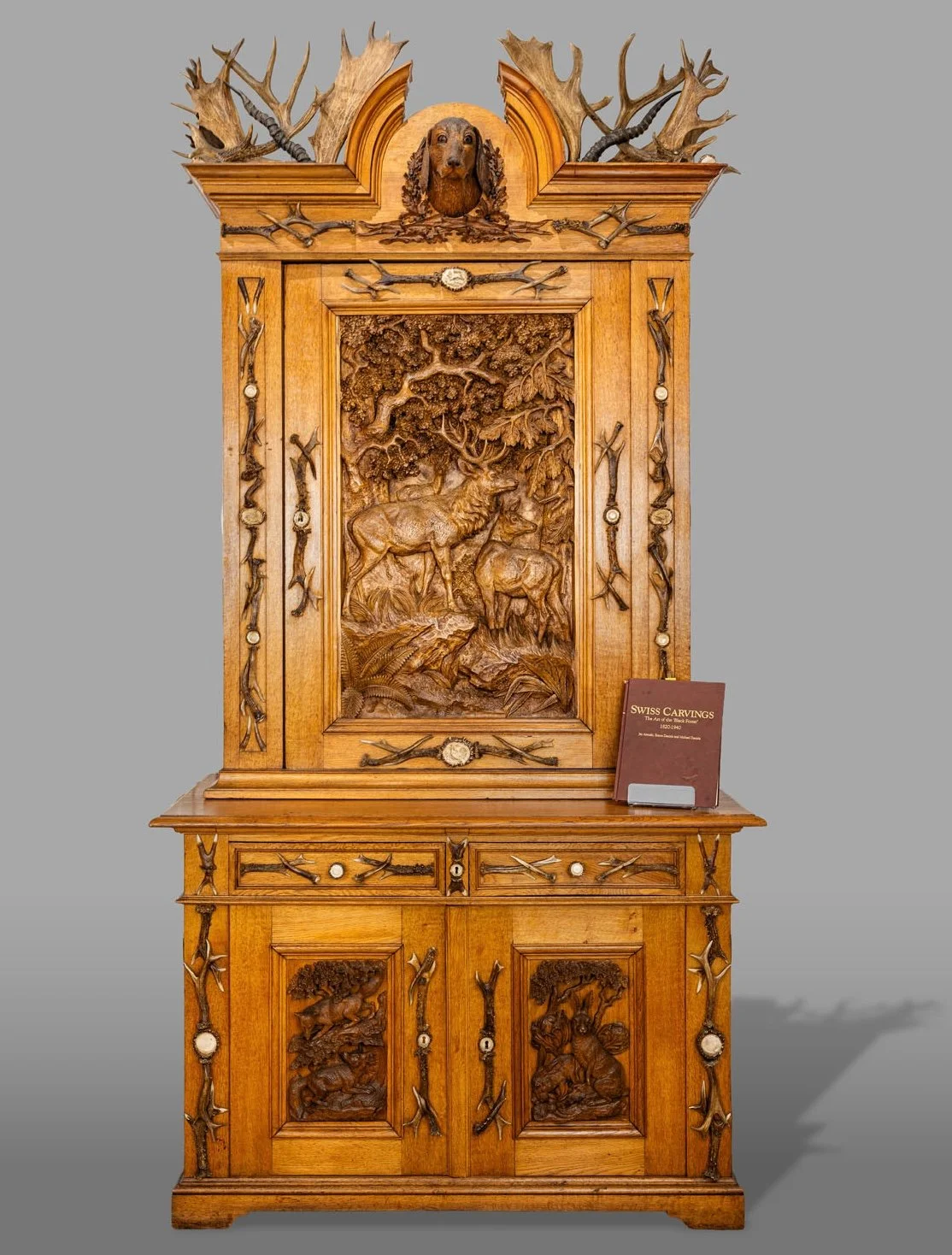
A hunting cabinet of exceptional ambition, nine feet tall, in two parts — among the most complete expressions of the Black Forest Jagdschrank to appear on the market in recent years.
The upper case is dominated by a deeply carved high-relief panel of a stag, hind and fawn in a dense Alpine forest, the composition built in layered planes — foreground undergrowth, mid-ground figures, a receding canopy of oak and pine — that draw the eye continuously through the scene. The stag stands alert and full-antlered, the hind attentive at his shoulder, the fawn part-sheltered in the undergrowth, and the surface textures of coat, bark, leaf and mossy ground are achieved through the fine, varied tool work that separates the best Brienz production from the broader regional trade.
The surround matches the panel. Antler-mounted columns frame the case, set at intervals with carved bone medallions of miniature wildlife subjects, among them a capercaillie. The cornice carries a hound's head with glass eyes within an arched pediment, flanked by two pairs of full stag antlers, and a further antler branch between cornice and panel bears one more medallion. Below, two cupboard doors carry their own relief panels — foxes in woodland to the left, hares beneath a tree to the right — framed by antler handles, with a pair of drawers above set with bone escutcheons to match.
The Jagdschrank — the Black Forest gun cabinet — was purpose-built to house firearms and hunting equipment, and served equally as a prestige display in the hunting lodges and great interiors of the late nineteenth century — the meeting point of fine furniture-making and sculptural carving. The most ambitious examples were made for a clientele of European aristocracy and American collectors, and shown at the international exhibitions in Paris, Vienna and Chicago; demand for them has never lapsed.
Condition: Very good for the scale and age; warm original patina to the oak, carved panels complete and crisp, antler and horn mounts intact, glass eyes to the hound's head present, minor age-consistent wear, no significant losses or restorations noted.
Dimensions: 52 in. width x 26 in. depth x 108 in. height
Literature: Jay Arenski, Simon Daniels, and Michael Daniels, Swiss Carvings: The Art of the Black Forest, 1820–1940 (2006).
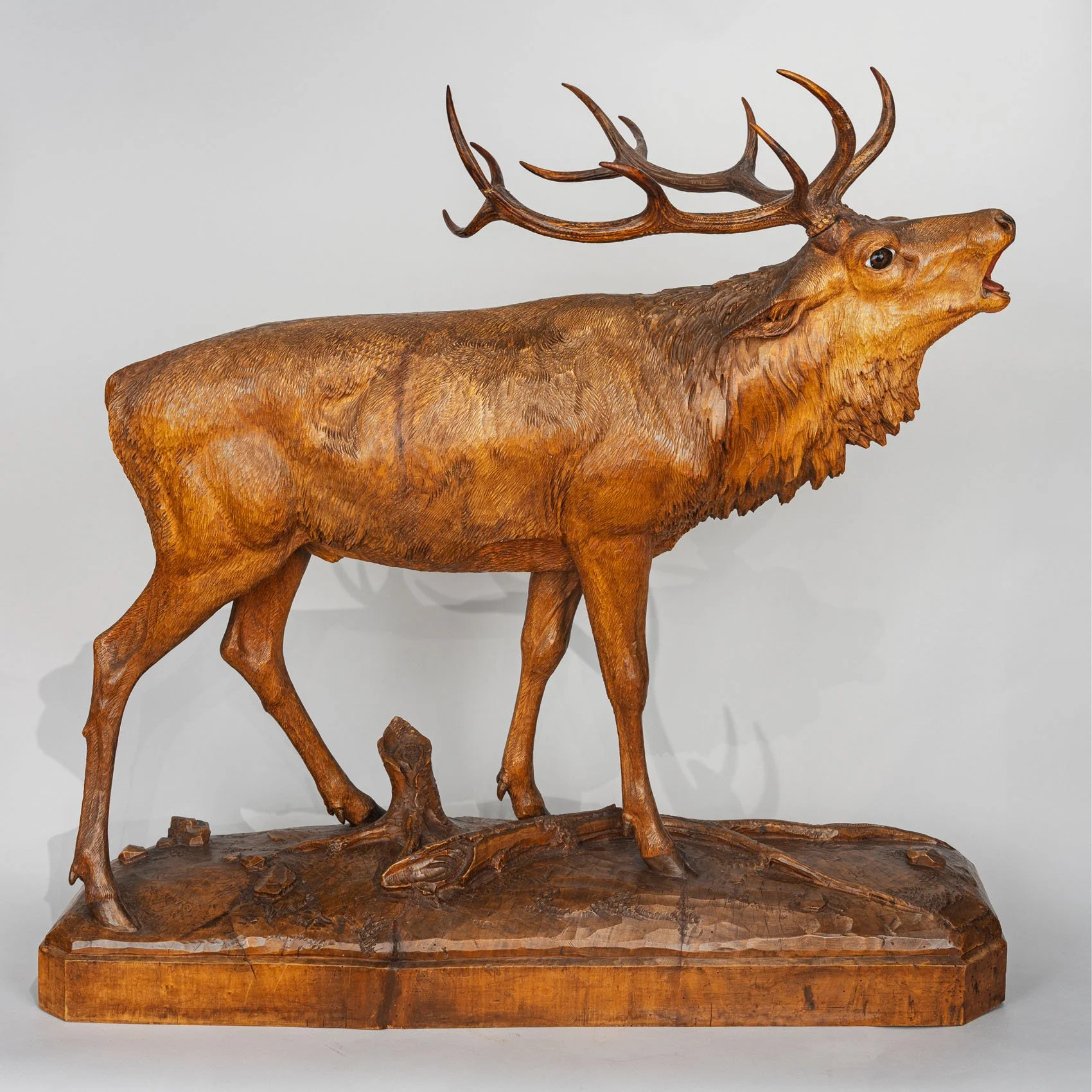
A monumental carving of a bellowing red deer stag, standing in full arrest with head raised and mouth open at the height of the rut, one of the most demanding subjects in the Brienz repertoire. It is worked in linden wood on a base of rocky Alpine terrain, the coat articulated across the entire surface in dense, directional tool marks that shift in depth and orientation from the neck mane to the flank, the musculature of the shoulders and haunches modeled with sculptural authority. The eyes are inset glass, a hallmark of the finest Brienz work; the open mouth has a painted interior, and the separately made antlers render each tine, burr, and beam with naturalistic precision.
The pose is one of three through which the workshops defined the red deer, alongside the startled stag, alert upon detecting danger, and the Monarch of the Glen, statant after Landseer's painting of 1851. All three are documented in the standard reference on the subject: Huggler Frères exhibited both a Monarch of the Glen and a stag of the present pose at the Paris international exhibition of 1900, reproduced in The Art Journal Illustrated Catalog of that year, and a life-size example of the startled pose, c.1870, completes the record. The present carving invites direct comparison with that exhibited stag, singled out by contemporary reviewers as a quite remarkable piece of realistic work.
Though unsigned, it is consistent with the leading Brienz workshops of the closing decades of the nineteenth century, when firms of this rank, Ed. Binder & Co. among them, supplied the great country houses of Britain and the collectors of the Gilded Age. Carvings of this scale and quality are rarely encountered today.
Condition: Excellent. Minor historic repairs to the antlers, consistent with age and handling. Warm, even patina throughout.
Dimensions: 35 in. length x 10 in. depth x 34 in. height
Literature: Jay Arenski, Simon Daniels and Michael Daniels, Swiss Carvings: The Art of the Black Forest, 1820–1940, 2006, cf. figs. 51–52, p. 54 (Huggler Frères, Paris 1900); fig. 115, p. 82 (life-size startled stag, c.1870)
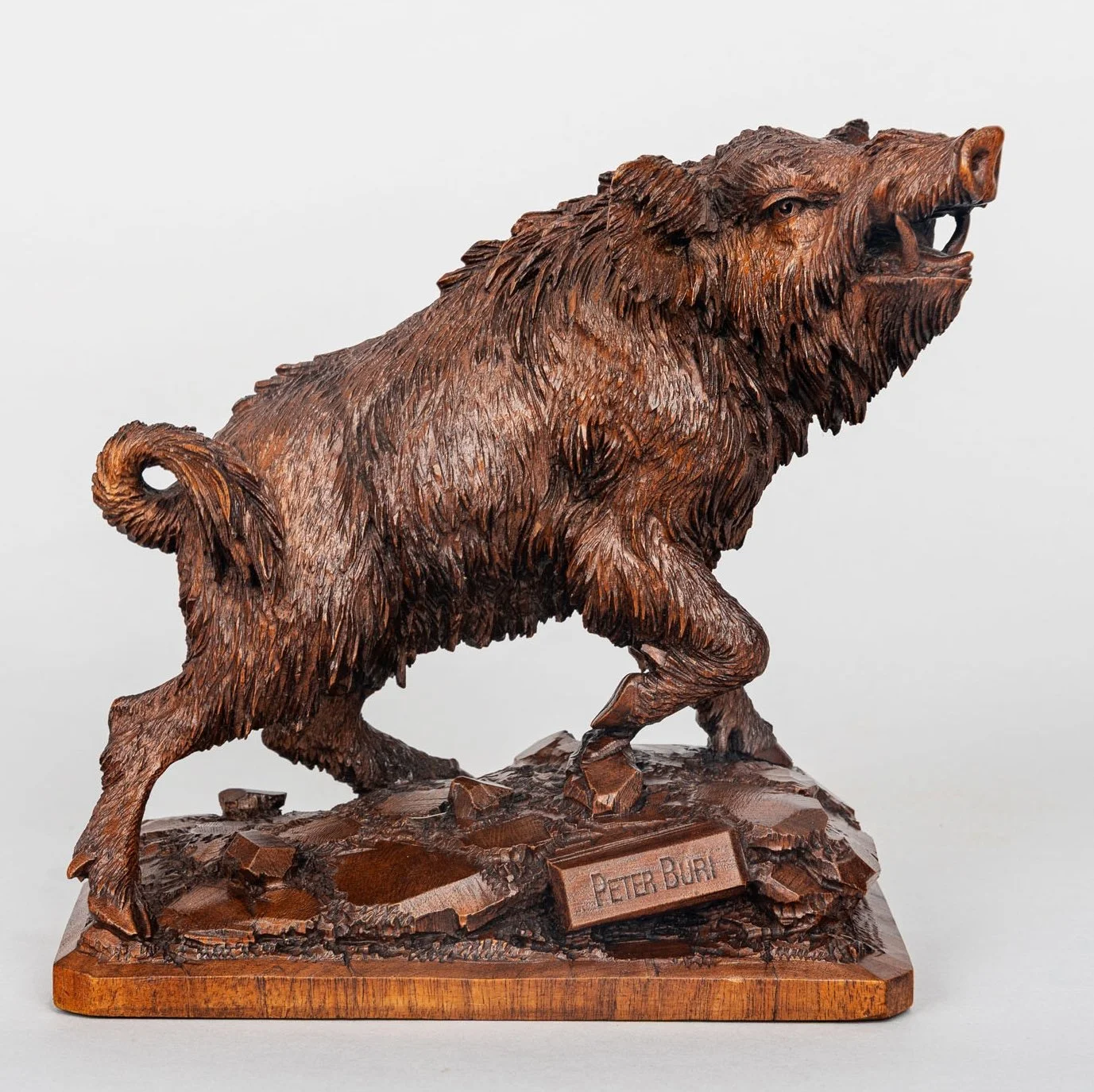
A rare and exceptionally fine signed work by Johann Huggler, the pre-eminent master of the Swiss Black Forest carving tradition: a walnut wild boar striding with head raised and jaws open.
The animal is powerfully modeled. Dense, directional toolwork describes the coarse bristles of the coat, deeply undercut at the belly and legs, over musculature that is fully understood, and the head, with its open jaws, tusks, and alert eye, carries the animal's character with real force. The integrally carved rocky base is stamped J. HUGGLER LAUTERBRUNNEN on one side and the retailer Peter Buri on the other, with paired marks that record both the carver and the piece's passage through the Swiss retail trade of the period.
Johann Huggler (1834–1912) stands at the summit of the Brienz school. His works were shown at the great international exhibitions of the nineteenth century, and signed examples of his animal sculpture appear only rarely on the market. The present boar is directly related to the exhibition model illustrated on page 57 of Swiss Carvings, thereby placing it among his most celebrated works.
Condition:
Very good overall. The walnut retains a rich original patina throughout. Carving complete and crisply preserved. Both stamps, J. HUGGLER, LAUTERBRUNNEN and Peter Buri, clear and legible. Minor wear consistent with age; no restorations noted.
Dimensions: 8” long, 7.5” tall.
Literature
Jay Arenski, Simon Daniels, and Michael Daniels, Swiss Carvings: The Art of the Black Forest, 1820–1940 (2006), p. 57, where a closely related exhibition model of a wild boar is illustrated.
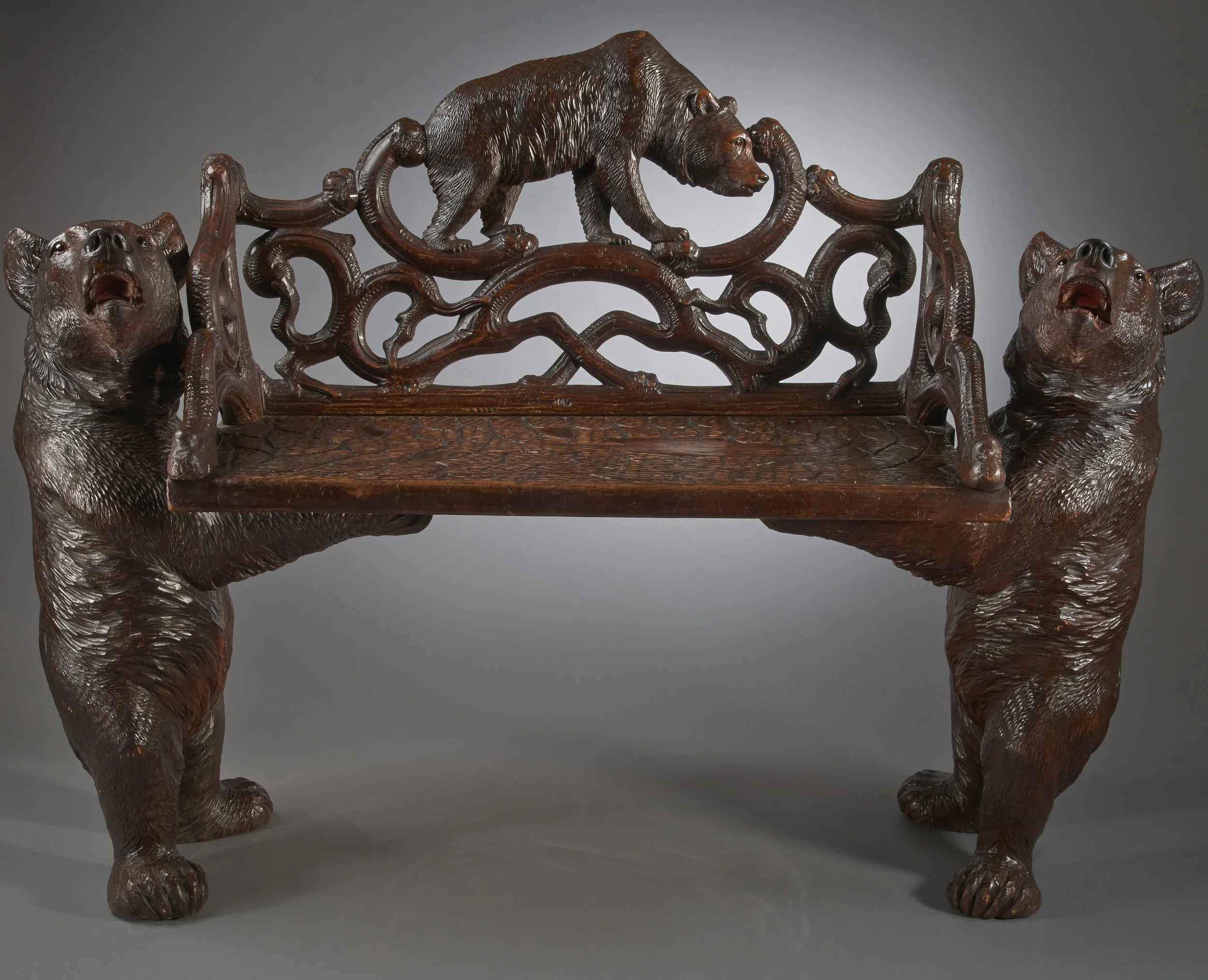
Among the most celebrated productions of the Brienz workshops, the bear bench stands as a supreme test of the carver's art — at once functional and entirely sculptural. This fine linden wood example, circa 1870, meets both demands with distinction.
At either end, a standing bear, carved fully in the round with commanding anatomical authority, rises on its hind legs to receive the seat rail — head thrown back, mouth open, the teeth and red-stained tongue rendered with disconcerting naturalism, the dense fur differentiated to follow the musculature and the coat's directional growth. Between them, the seat is carved to simulate woven cane.
The back is a tour de force of pierced work: deeply undercut, interlaced branches forming a scrolling openwork panel, presided over by a strolling bear in high relief along the crest rail — head lowered, weight forward, utterly self-possessed. The contrast between the energy of his stride and the fluid ornament beneath shows genuine sophistication.
Benches of this quality drew sustained attention at the international exhibitions of the late 19th century, where Swiss carvers demonstrated their technical supremacy to collectors and institutional buyers across Europe and America. Comparable examples are illustrated in Swiss Carvings: The Art of the Black Forest, 1820–1940.
Condition: Excellent, commensurate with age. Linden wood mellowed to a deep, even tone. Glass eyes intact on all three bears. Pierced back and branch-work complete with no losses. Teeth and stained tongues intact on both supporting bears. No restoration noted.
Literature: Jay Arenski, Simon Daniels and Michael Daniels, Swiss Carvings: The Art of the Black Forest, 1820–1940, Antique Collectors' Club, Woodbridge, Suffolk, 2006 — see fig. 225 (p. 140) and fig. 241 (p. 146) for closely comparable examples.
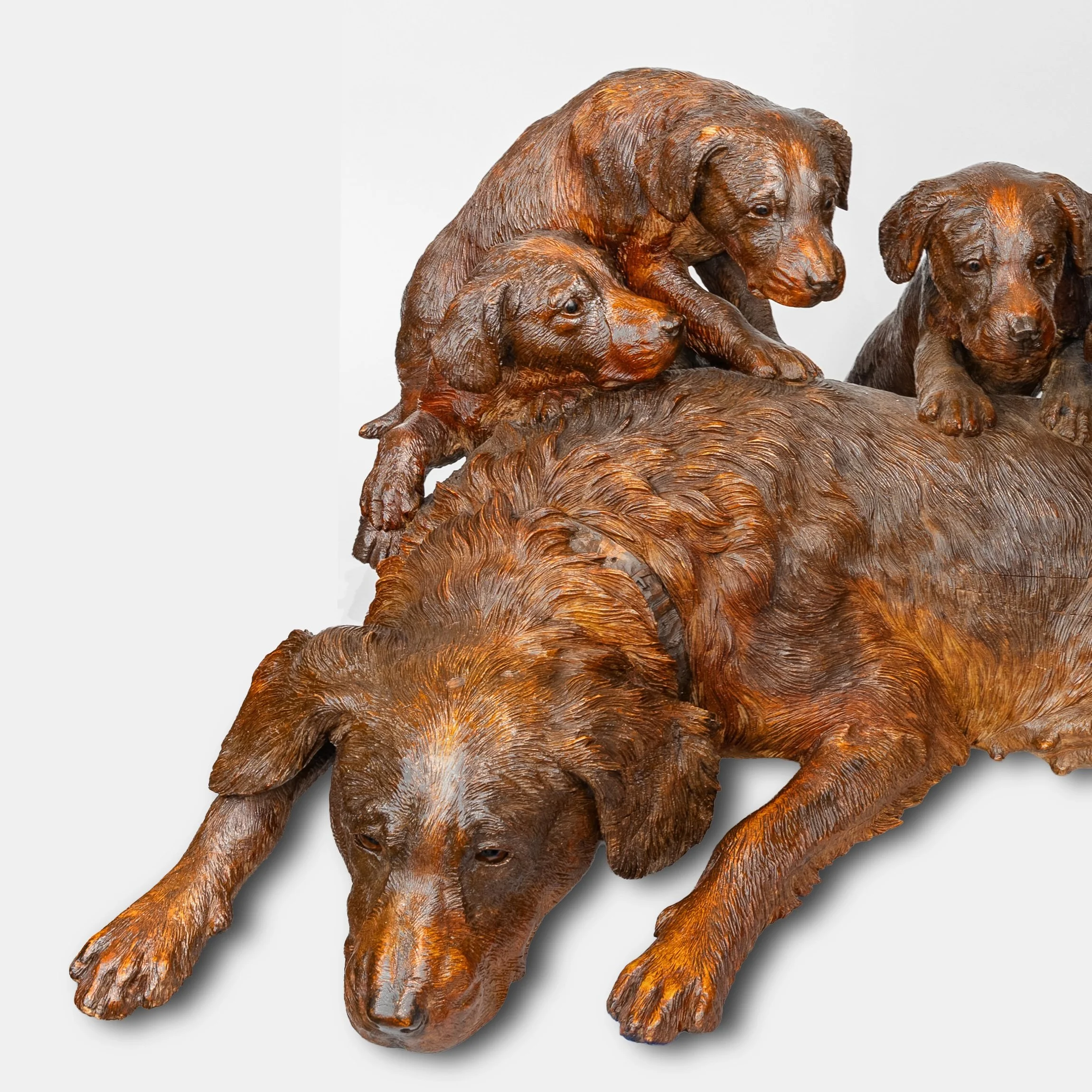
A fine and rare sculptural group by Walter Mader of Brienz, one of the most accomplished masters of the Swiss Black Forest carving tradition, depicting a recumbent hound with four puppies clambering across her back, carved in mountain maple on an exceptional scale.
The mother lies stretched at rest, her head sunk between extended forelegs with the patient, weary calm of a nursing animal. Her coat is built up in long, sweeping tool strokes that follow the lie of the fur, and a studded collar is carved at her neck with the same care given to the figures themselves, placing her firmly in the working life of a real dog. Her teats are visible along the underside, the carver recording the plain truth of a mother with a litter, without sentiment or evasion.
Across her back the four puppies pile and jostle, each with inset glass eyes and each individually observed: one rests its chin drowsily against her shoulder, another braces a forepaw and noses forward mid-climb, a third stares out with wide, unguarded curiosity, and the fourth cocks its head as if deciding whether to join the game. The soft modeling of their faces, the paws and ears falling every which way, all speak to observation from life rather than workshop formula.
The group is unsigned, as is common for Brienz work of this period; the attribution rests on its direct correspondence in model, composition, and handling to Mader's documented dog groups, including a closely related example of the same subject previously sold by Daniels Antiques. Mader's feeling for dogs was no workshop convention: his lifelong friendship with Johann Huggler, the pre-eminent master of the Brienz school, was bound up with the loss of his own beloved dog, Nase, in the Alpine tragedy of 1871, commemorated in Huggler's carved portrait of the animal, which we have also had the privilege of handling. That intimacy with his subject carried Mader's dog groups to the international exhibitions of the nineteenth century in London, Paris, and the United States, and it is felt in every figure of the present work, among the most compelling dog subjects of the Black Forest tradition.
Dimensions: 36"length x 20"depth x 15"height
Literature
Jay Arenski, Simon Daniels, and Michael Daniels, Swiss Carvings: The Art of the Black Forest, 1820–1940 (2006).
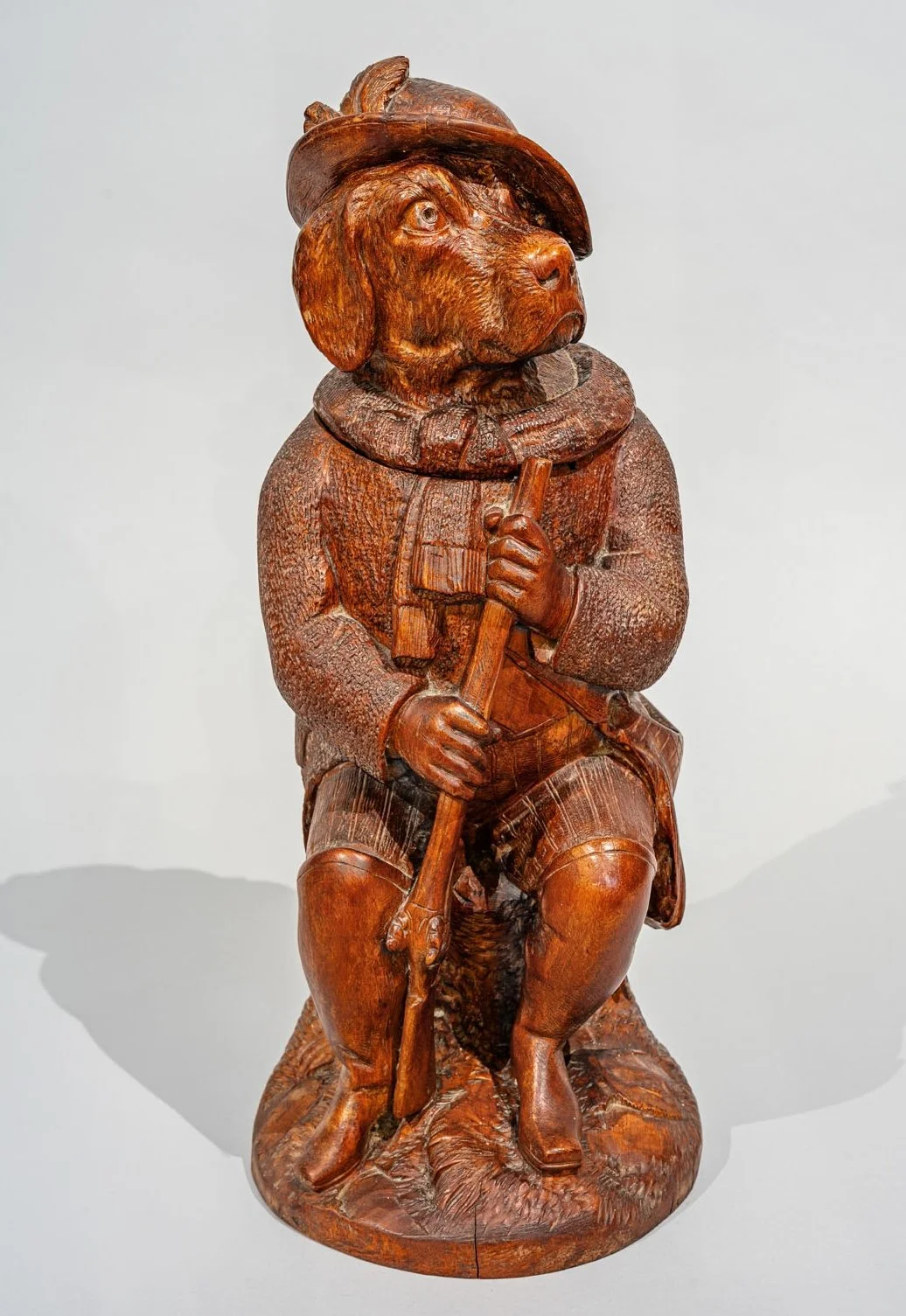
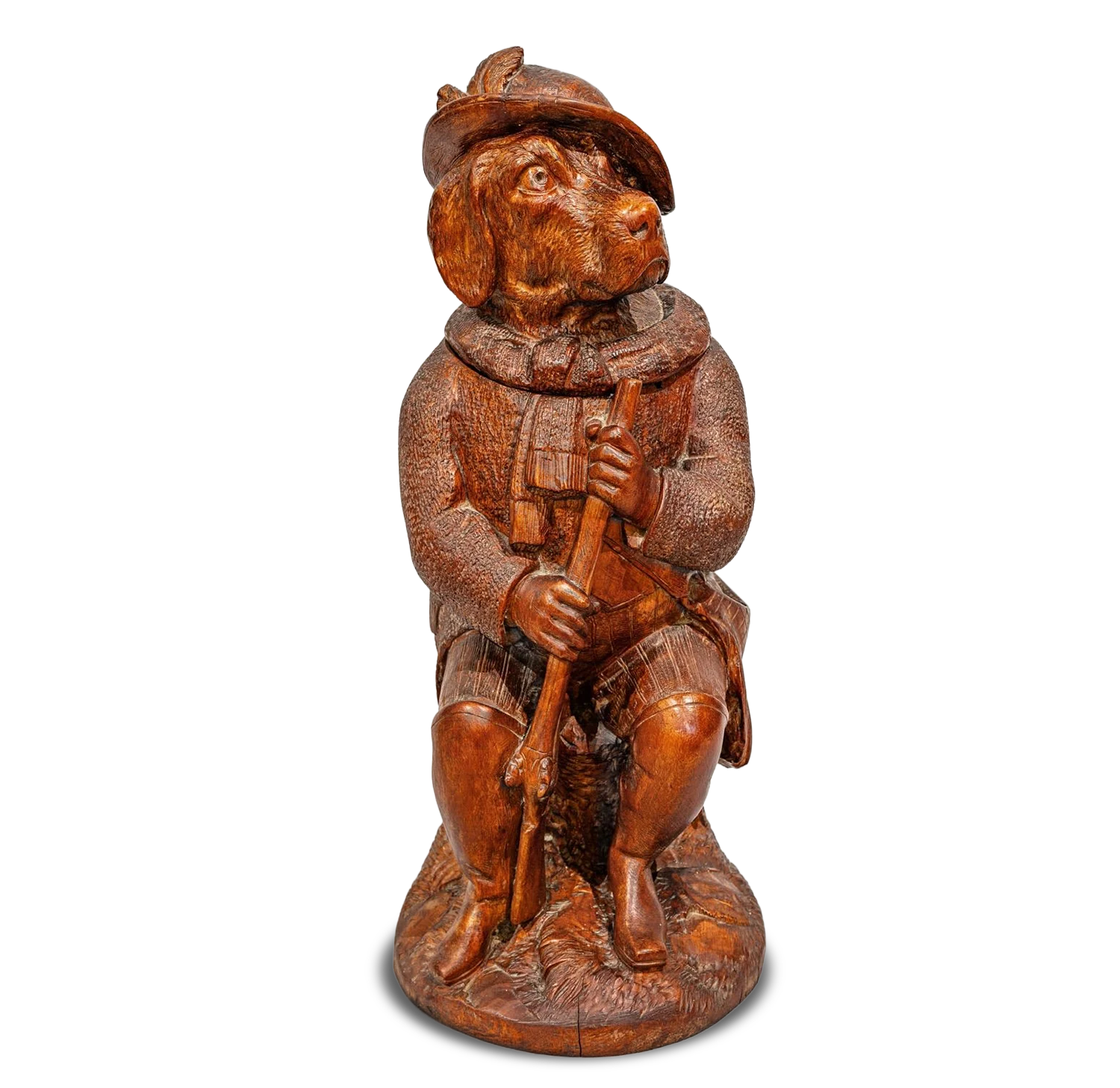
An exceptional example of Black Forest carving at its most inventive: an anthropomorphic hound dressed as a hunter, seated on a tree stump, forming a figural tobacco jar with the head as a removable lid, carved in walnut at Brienz and dated 1870.
The hound sits on a carved tree stump on a naturalistic oval base, in a caped hunting coat and feathered hat, a rifle held at his side, a fringed game bag at his flank rendered in precise crosshatch that plays against the rougher texture of the coat — cloth, fur and leather each given its own surface treatment.
The expression is the piece's great achievement. Where the companion fox hunter carries a quality of knowing cunning, this hound is altogether different: world-weary, slightly doleful, the eyes drooping with the resignation of a dog who has been out in all weathers and expects nothing better — comic sympathy achieved through affectionate observation rather than caricature.
The head lifts cleanly at the collar to reveal the tobacco compartment, the join concealed in the cape's modeling so that, when closed, the figure reads as a complete sculptural whole. The walnut retains a warm patina that deepens the contrasts and shows off the toolwork. Dated 1870, it was produced at the height of the Brienz industry's reputation, when the workshops of the Bernese Oberland were exhibiting at the world fairs and collected across Europe and America.
A companion piece, an anthropomorphic fox tobacco jar also dated 1870, is available separately; the two share the subject, date, and evident workshop origin.
Condition: Very good; rich original patina.
Height: 17 in.
Literature: Jay Arenski, Simon Daniels, and Michael Daniels, Swiss Carvings: The Art of the Black Forest, 1820–1940 (2006).
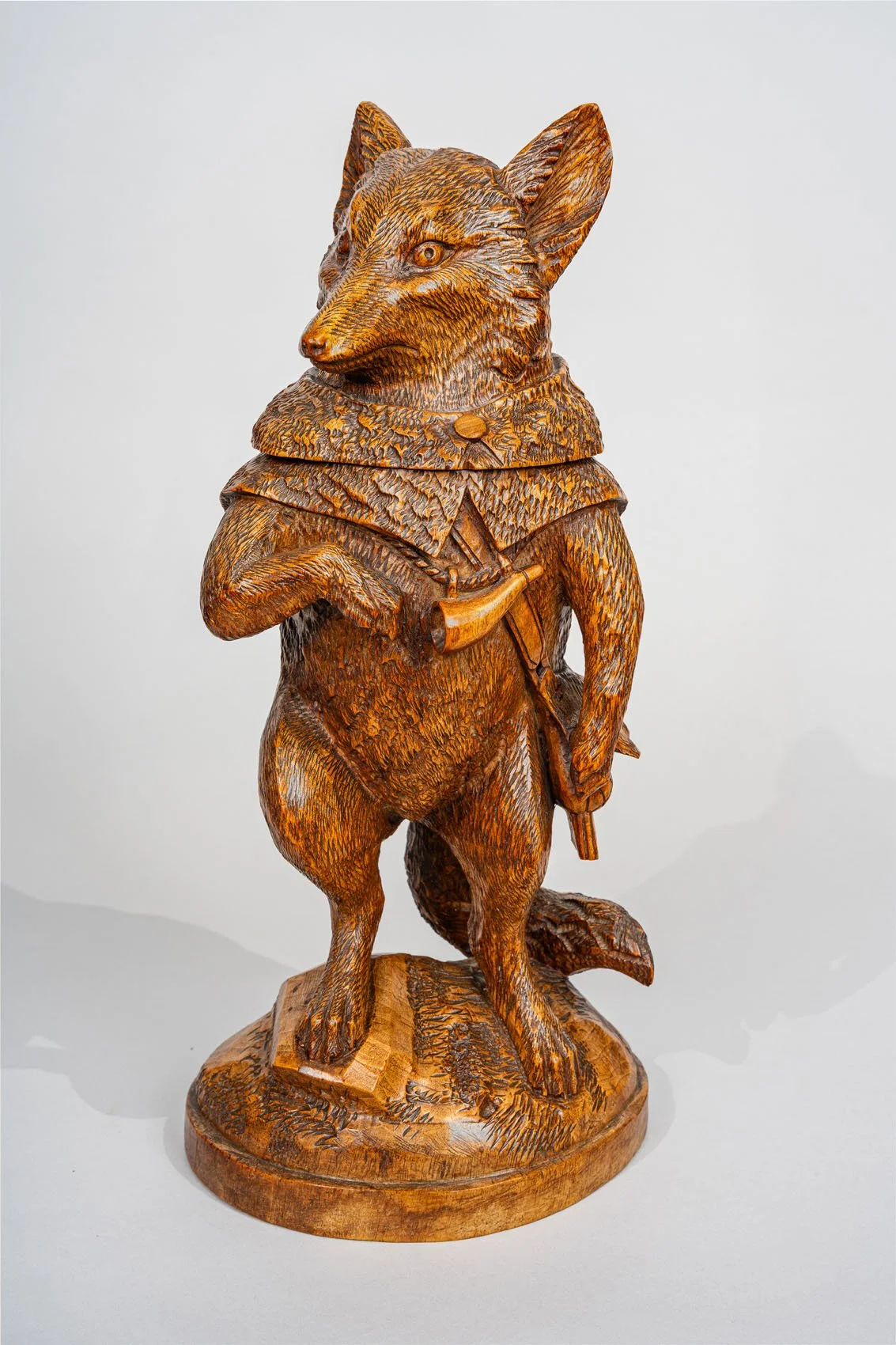
A rare and entirely captivating example of Black Forest carving at its most inventive: an anthropomorphic fox dressed as a hunter, standing upright as a figural tobacco jar, the head forming a hinged lid, carved in walnut at Brienz and dated 1870.
The fox stands on a circular naturalistic base in a short hunter's cape, a hunting horn at his side, the accessories of the chase rendered in miniature with the same precision as the figure itself. The posture is composed and self-possessed, the weight carried with the easy authority of a carver who understood both animals and human movement. The fur is worked in dense, directional tool marks that convey texture and underlying volume, the garments differentiated through smoother, more restrained modeling — the contrast between cloth and fur handled with the subtlety that marks the best Brienz work. The face is sharply individualized: alert, watchful, carrying the knowing character the fox owes to the medieval cycle of Reynard, whose cunning protagonist gave nineteenth-century collectors the imaginative context for figures like this one, produced at Brienz for both the domestic market and for export to Britain and America, where the hunting culture that animates the piece was equally well understood.
The head opens on a hinge at the collar to reveal the tobacco compartment, the join disguised in the modeled fur of the cape collar so that, closed, the figure reads as a seamless sculptural whole; the hinge is original and fully functional, a detail that speaks to the construction as much as the carving. The walnut retains a warm patina developed over a century and a half. Dated 1870, the piece comes from the height of the Brienz industry's reputation, when the workshops of Huggler, Binder and their contemporaries were exhibiting at the great world's fairs.
A companion piece, an anthropomorphic hound-hunter tobacco jar also dated 1870, is available separately; the two share the subject, date, and evident workshop origin.
Condition: Very good; rich original patina, carving complete and crisp, hinged head lid fully functional, eyes original, all elements original, interior in original unlined state, minor wear consistent with age, no restorations noted.
Height: 16 in.
Literature: Jay Arenski, Simon Daniels, and Michael Daniels, Swiss Carvings: The Art of the Black Forest, 1820–1940 (2006).
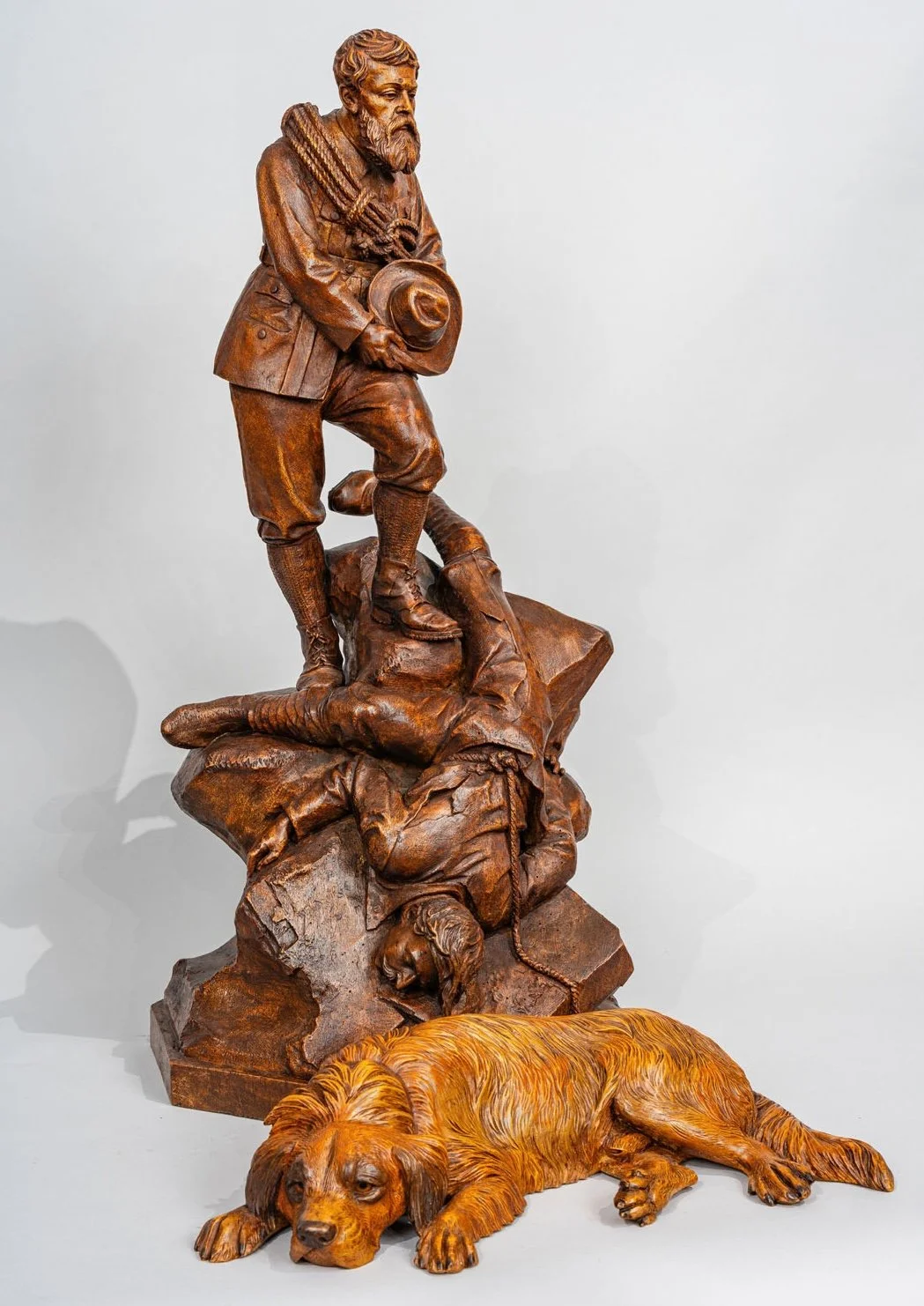
These two works are inseparable: made by the same hand, they carry a single story.
In the winter of 1871, Johann Huggler's younger brother Albert — his closest companion, collaborator and fellow carver — was lost in a climbing accident in the mountains above Brienz. The search was long and desperate; among those who joined it was Huggler's friend and fellow carver, Walter Mader, with his dog Nase, and when it ended, it had brought only loss: Albert was gone, and Nase, too, had been lost on the mountain. Around 1873, Johann returned to carving with a memorial. He stands at the summit of a rocky ledge, rope coiled at his shoulder, hat held at his chest, the posture of a man pausing in the aftermath of something irreversible; below him Albert lies fallen across the rocks, limbs slack, bound with rope, head lowered to the stone. The composition rises on a strong vertical axis, restrained and devoid of theatricality — not a scene but an act of remembrance, every detail of rope, boot lacing and rock grain carved from the deepest personal necessity.
The loss was shared, and so was the answer. At Christmas 1873, Mader, knowing Johann was not naturally drawn to dogs, presented him with a pup — said to be part wild dog, perhaps part wolf — which Johann named Gestank, and through that companionship came to understand what his friend had lost. He responded the only way he truly could: he carved Nase and placed the carving in Walter's hands. The long-haired hound lies at rest, the coat rendered in flowing tool strokes, the expression that of a portrait made from observation and affection — an individual, not a type. Huggler famously left his work unstained; here, in a quiet concession to Mader, who stained his, he introduced subtle coloration in the natural tones of the dog. On the underside he burned a simple mark, two mountain slopes crossed by two vertical lines: Albert and Nase, taken by the mountain.
Walter recorded the visit in his journal: "He comes early in the year… and as we sit by the fire, he places in my hands a wrapped cloth. Inside I hold what I have missed — Nase. He has carved my dear dog back to life… beneath, the slopes of two, marked twice — for Albert and for Nase, taken by the mountain…"
Johann Huggler (1834–1912) is the pre-eminent master of the Brienz tradition, whose work was exhibited at the Exposition Universelle in Paris and the World's Columbian Exposition in Chicago. These two works, made for private reasons and never intended for the market, reveal a dimension of his art that exhibition pieces cannot. They will be highlighted in the updated edition of Swiss Carvings: The Art of the Black Forest.
Condition: Both in walnut, very good overall; original patina, carving complete and crisp, burn mark present and legible on the underside of the Nase carving; minor wear consistent with age, no restorations noted.
Literature: Jay Arenski, Simon Daniels, and Michael Daniels, Swiss Carvings: The Art of the Black Forest, 1820–1940 (2006).
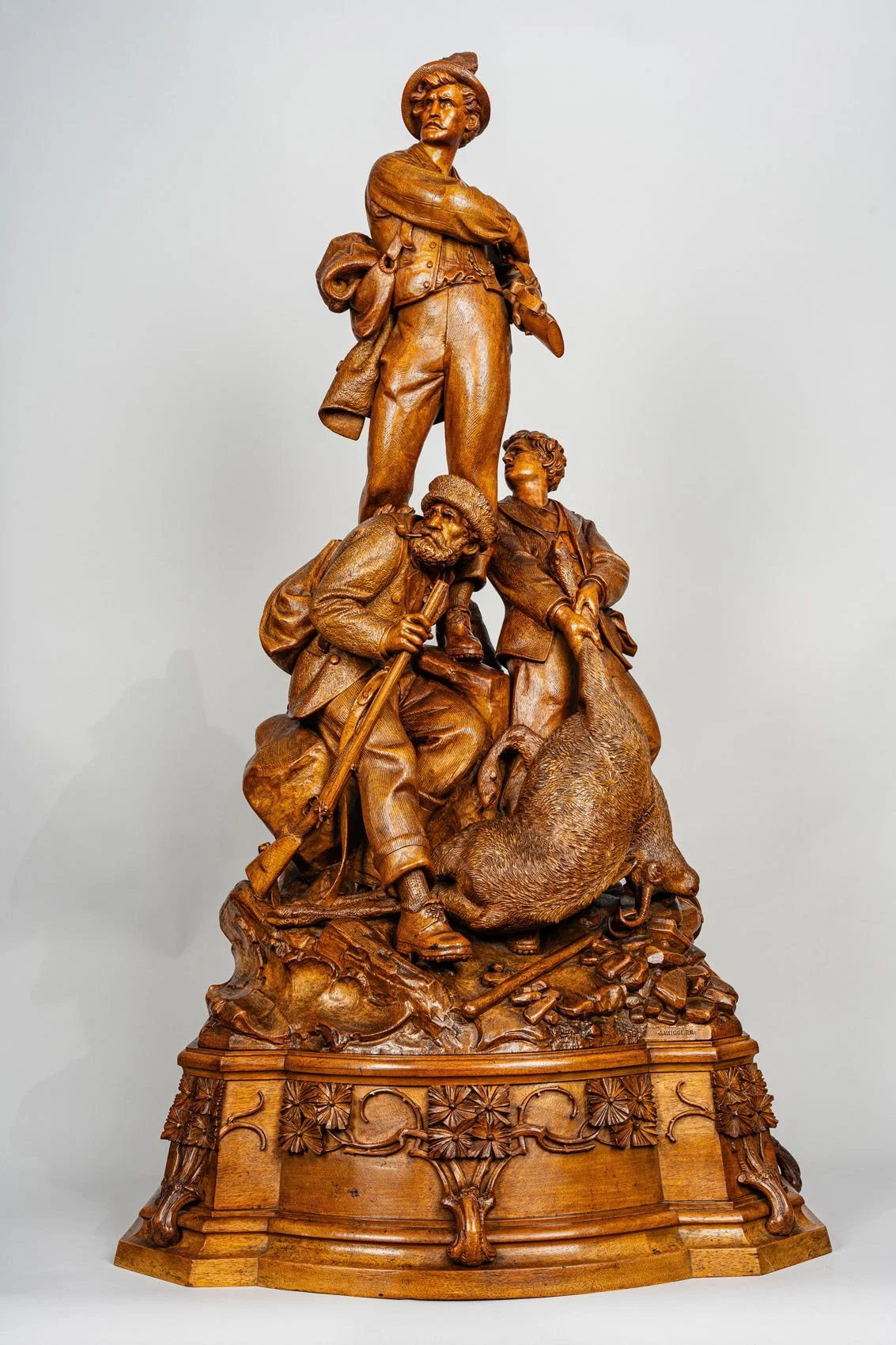
A monumental walnut group by Johann Huggler (1834–1912), the pre-eminent master of the Brienz carving tradition, conceived as a meditation on the three ages of man within an Alpine chamois hunt. It carries two forms of the master's signature: the stamped J. HUGGLER on the plinth edge, and his cursive autograph scratched into the underside of the base — a personal mark, distinct from the workshop stamp, that speaks to what this work meant to its maker.
The composition rises 48 inches as a vertical narrative. At the summit, a young hunter stands triumphant, arms crossed, feathered hat, game bag full of birds; below to the left an older bearded figure crouches with pipe and rifle, watching upward with a lifetime's experience; a second younger figure completes the generational triangle; and at the base the chamois lies fallen among rocks, scattered equipment and a carved woodcock. Each surface takes its own tool treatment — the knitted stocking of the elder's leg, the chamois fur, the feathers, the rock grain — and the carved rosette-and-scrollwork plinth signals exhibition-level ambition. The subject was personal: Huggler was known in Brienz not only as the master carver but as an unapologetic poacher, and he is believed to have cast himself and his companions in the group, the figures glancing outward with the alertness of hunters who remain aware of authority even in triumph.
The carving was purchased directly from the family firm, Huggler Huggler of Interlaken, on 14 March 1925 by Herr Walter Ords of Remscheid, and the original receipt survives with the work: catalog number H.H. 468, Jägergruppe 3 Jäger, 1,000 Swiss Francs, the Canton Bern revenue stamp intact. It then passed by descent through three generations of the same family — among the most complete provenances recorded for any Swiss Black Forest carving.
Huggler exhibited at the great international exhibitions, the Exposition Universelle in Paris and the World's Columbian Exposition of 1893, where Brienz work was judged not as craft but as sculpture. Large figural groups of this ambition, doubly signed and documented to the day of sale, stand at the summit of the tradition.
Condition: Very good for the scale and age; warm original patina, all figures complete and crisp, both signatures legible, minor wear consistent with age, no significant losses or restorations noted.
Provenance: Purchased from Huggler Huggler, Interlaken, by Walter Ords, Remscheid, 14 March 1925 (original receipt, H.H. 468); thence by direct descent through three generations.
Literature: Jay Arenski, Simon Daniels, and Michael Daniels, Swiss Carvings: The Art of the Black Forest, 1820–1940 (2006).
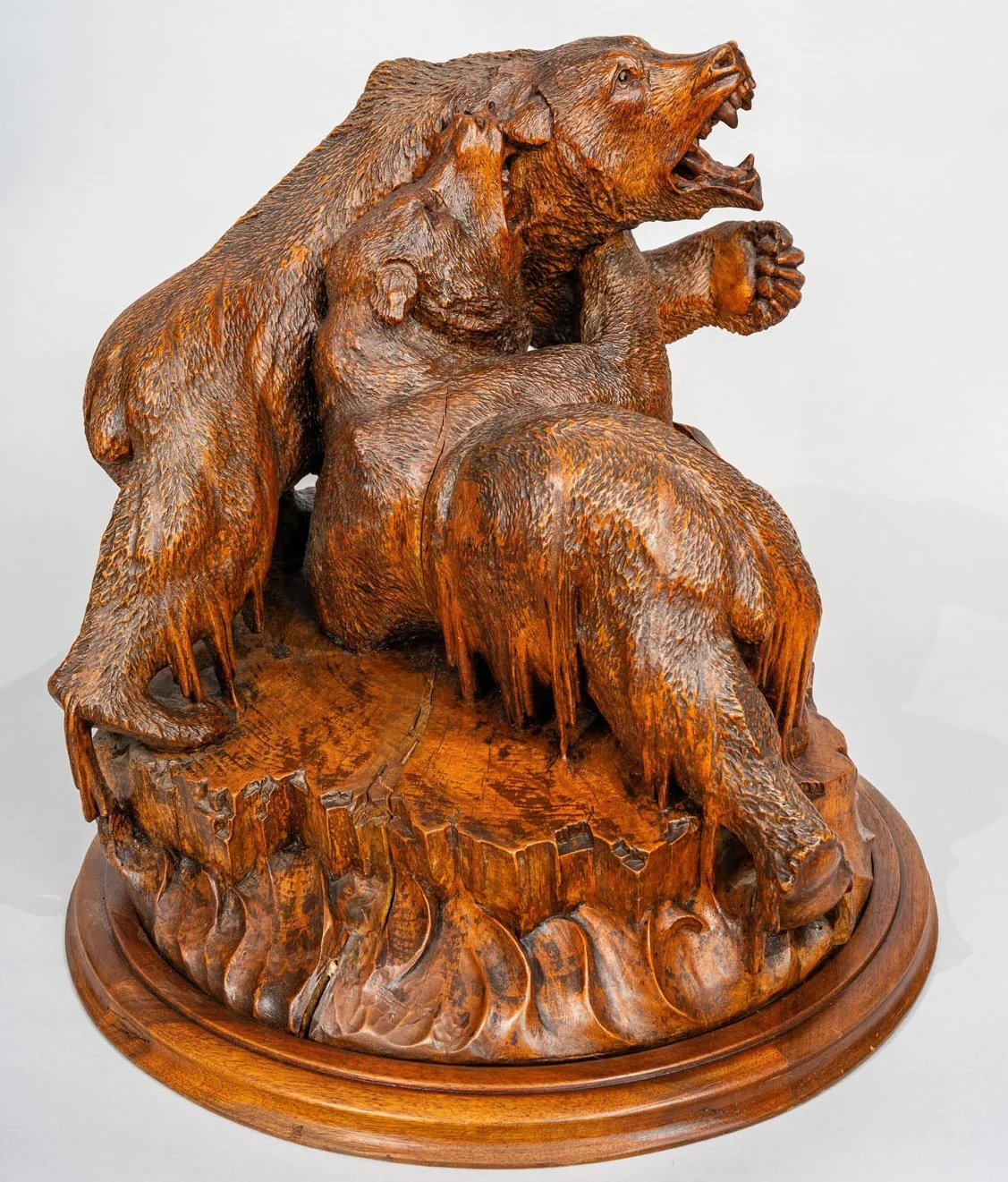
Two bears locked in combat on a fractured ice floe, carved fully in the round in walnut at Brienz, circa 1870.
The subject is unusual. Brienz bears are most often shown at rest, climbing, or at play; here two animals fight in earnest, bodies interlocked, weight pressing against weight. One rears with jaws thrown open, the mouth articulated with individual teeth and tongue — anatomical work few masters of the tradition attempted at this scale — while the second braces forward, forelimbs raised, the pair forming a taut, compressed composition.
The fur is the master stroke. Instead of the dry, bristled coat of the standard Brienz bear, the hair is carved wet: elongated, downward strokes along the undersides of both animals suggest coats plastered flat, matted and dripping from a fight in the water. It is observation, not formula, and it turns an accomplished animal sculpture into the record of a specific moment. The base completes the story, a fractured floe whose angular planes and fissures set off the dense organic texture of the animals above, and the group sits on a turned oval plinth, rewarding examination from every angle. The walnut carries a warm, deep patina throughout.
Work of this ambition came from a small number of masters in the later nineteenth century, shown at the great international exhibitions and collected across Europe and America. Groups of this intensity are rare on the market.
Condition: Very good; rich, even original patina, carving complete and crisp across all principal elements, minor age-consistent wear, no significant losses or restorations noted.
Height: 15 in.
Literature: Jay Arenski, Simon Daniels, and Michael Daniels, Swiss Carvings: The Art of the Black Forest, 1820–1940 (2006).
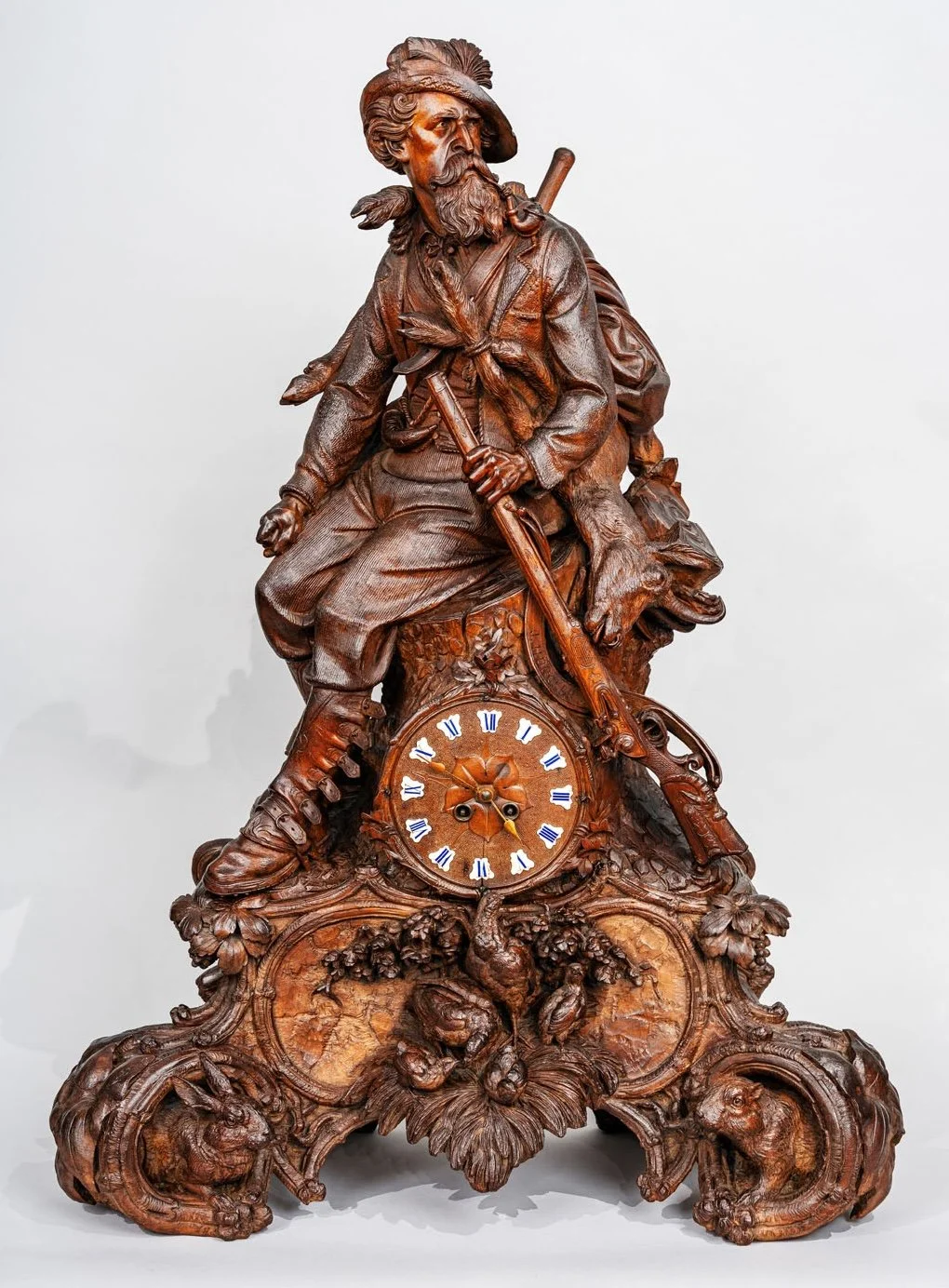
A figural mantel clock of exceptional scale by Johann Huggler of Brienz, among the most celebrated masters of Swiss Black Forest carving, signed on the rifle stock.
A bearded hunter sits above the dial, rifle resting diagonally across his figure, a pipe at his lips. He wears a feathered hat, layered hunting garments, and buckled leather boots, each rendered with the close observation that distinguishes Huggler's finest work from the broader Brienz production. The strongly individualized face reflects the tradition of Huggler modeling his hunters on his own likeness. A chamois, slung in the bag at his back, is the day's quarry carried home from the high Alps.
Below, oak leaves, pine cones, acorns, and woodland foliage fill every surface, with partridge and chicks clustered beneath the dial in high relief. The base extends outward through scrolling rocaille forms, each terminating in a cartouche: a rabbit to the left, a ground squirrel to the right. The enamel dial is set with individual petal-shaped chapter rings, blue Roman numerals on white against the warm walnut.
Johann Huggler and the Brienz Tradition
Johann Huggler (1834–1912) stands among the foremost figures of the Brienz school, and his hunter figures were his most admired productions. Signed examples are rare on the market and consistently represent the highest level of achievement in the medium.
A near-identical clock was exhibited by the Huggler workshop at the Paris Exposition Universelle of 1900, where it was photographed for The Art Journal; that example is illustrated in Swiss Carvings: The Art of the Black Forest, 1820–1940, the standard reference on the subject, co-authored by Simon Daniels of this gallery. The present clock is an earlier rendering of the same model, one the workshop held in such regard that it remained its showpiece at the close of the century.
Condition: Very good overall. The walnut retains a rich, original patina. The carving is complete and crisply preserved across all principal elements. The movement is present and in working order. Enamel dial intact.
Dimensions: 27" width x 37" height x 11" depth
Signature: Signed J. Huggler on the rifle stock.
Literature: cf. Jay Arenski, Simon Daniels, and Michael Daniels, Swiss Carvings: The Art of the Black Forest, 1820–1940 (2006), pl. 52, illustrating the near-identical clock exhibited by Huggler Bros. at the Paris Exposition Universelle of 1900, photographed for The Art Journal.
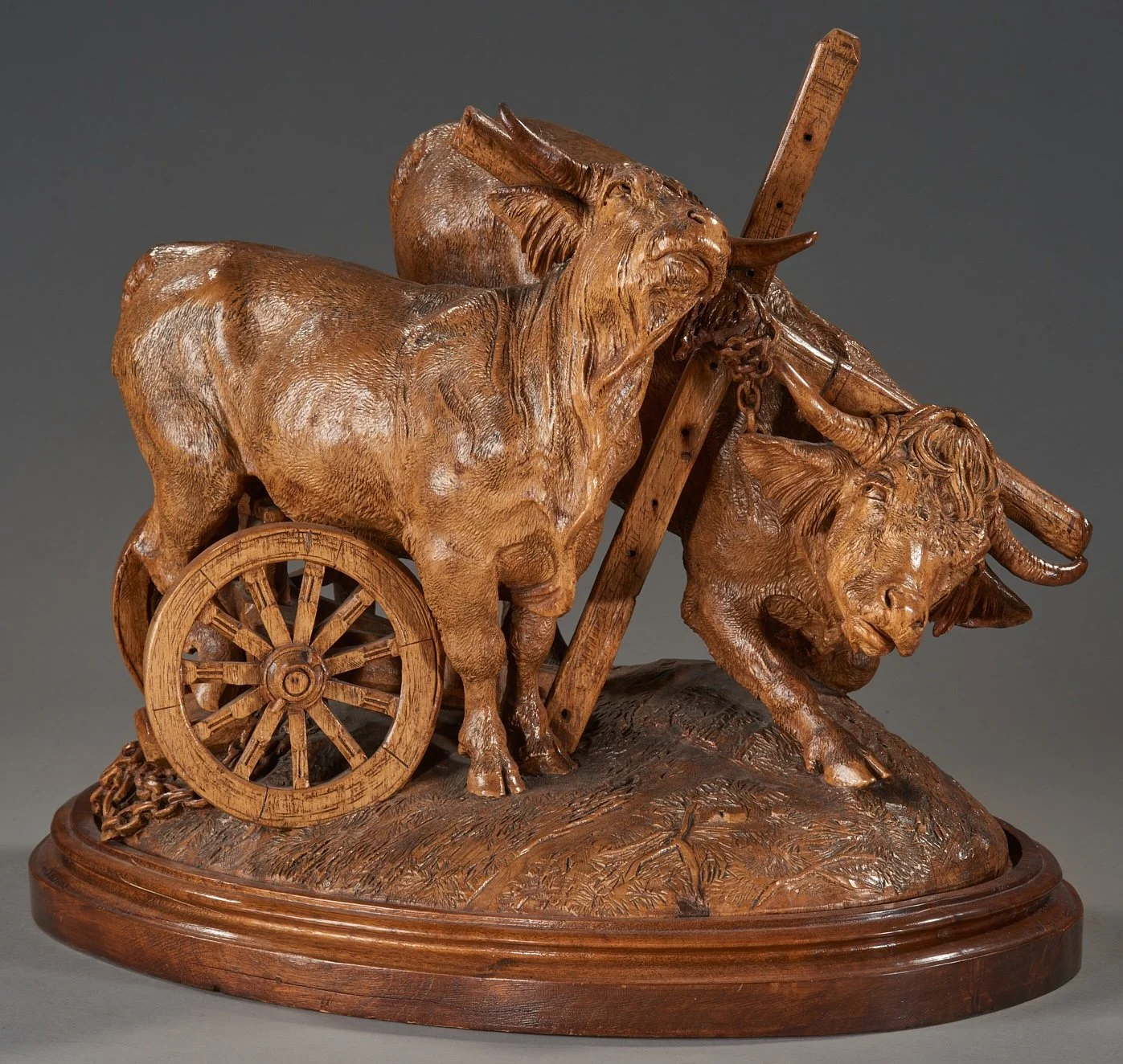
A powerful and technically accomplished sculptural group depicting two yoked oxen straining in harness, their shared effort conveyed through the pronounced forward lean of both animals, the taut lines of the wooden yoke between them, and the carver's acute observation of musculature under tension. The composition is animated by contrast: the rear ox stands with head raised, neck extended beneath the yoke bar, while the lead ox drives forward with head lowered and legs braced, the strain of the load registered across every surface of his body. A carved cart wheel and chain complete the working context, grounding the group in the agricultural life of the Swiss alpine valleys that the Brienz carvers knew intimately.
The carving throughout is of exceptional quality. The coats of both animals are rendered through dense, directional tool marks that differentiate the smooth flanks from the rougher growth around the poll, dewlap, and ears. The hooves, muzzles, and horn forms are precisely observed, and the facial expressions — one straining forward, one upturned and alert — convey individual character within a unified composition. The naturalistic oval base is carved with field grasses and ground texture, situating the animals in their working environment without distracting from the figures themselves.
The group is attributed to Johann Huggler of Brienz (1834–1912), the foremost figure in the Brienz carving tradition, based on its close correspondence with documented examples of his work. Huggler's yoked cattle subjects are among the most closely studied of his works. In Swiss Carvings: The Art of the Black Forest, 1820–1940, a directly comparable group of yoked cattle on a naturalistic base — stamped J. Huggler of Brienz, c.1870 — is illustrated at fig. 121, p. 85, alongside an original preparatory charcoal sketch attributed to Huggler himself (fig. 120), demonstrating the discipline of study and design that underpinned his finest work. The present group, larger in scale and more elaborate in composition than the published example, represents the subject at a higher level of ambition.
Huggler exhibited at the great international expositions of the era — the Exposition Universelle in Paris in 1867 and 1900, and the World's Columbian Exposition in Chicago in 1893 — where his work attracted the attention of collectors and institutions worldwide. His cattle subjects are among the most sought-after of his productions, and examples of this quality and scale are seldom encountered on the market.
Condition: Very good overall. Walnut retains a warm, even original patina throughout. Carving is complete and crisply preserved across both figures, the yoke, cart wheel, chain, and naturalistic base. Minor surface wear consistent with age and handling; no significant losses or restorations observed.
Dimensions: 17”width x 15”depth x 15.5”height
Literature: Jay Arenski, Simon Daniels, and Michael Daniels, Swiss Carvings: The Art of the Black Forest, 1820–1940 (2006), figs. 120–121, pp. 84–85 (comparable group and preparatory sketch illustrated).
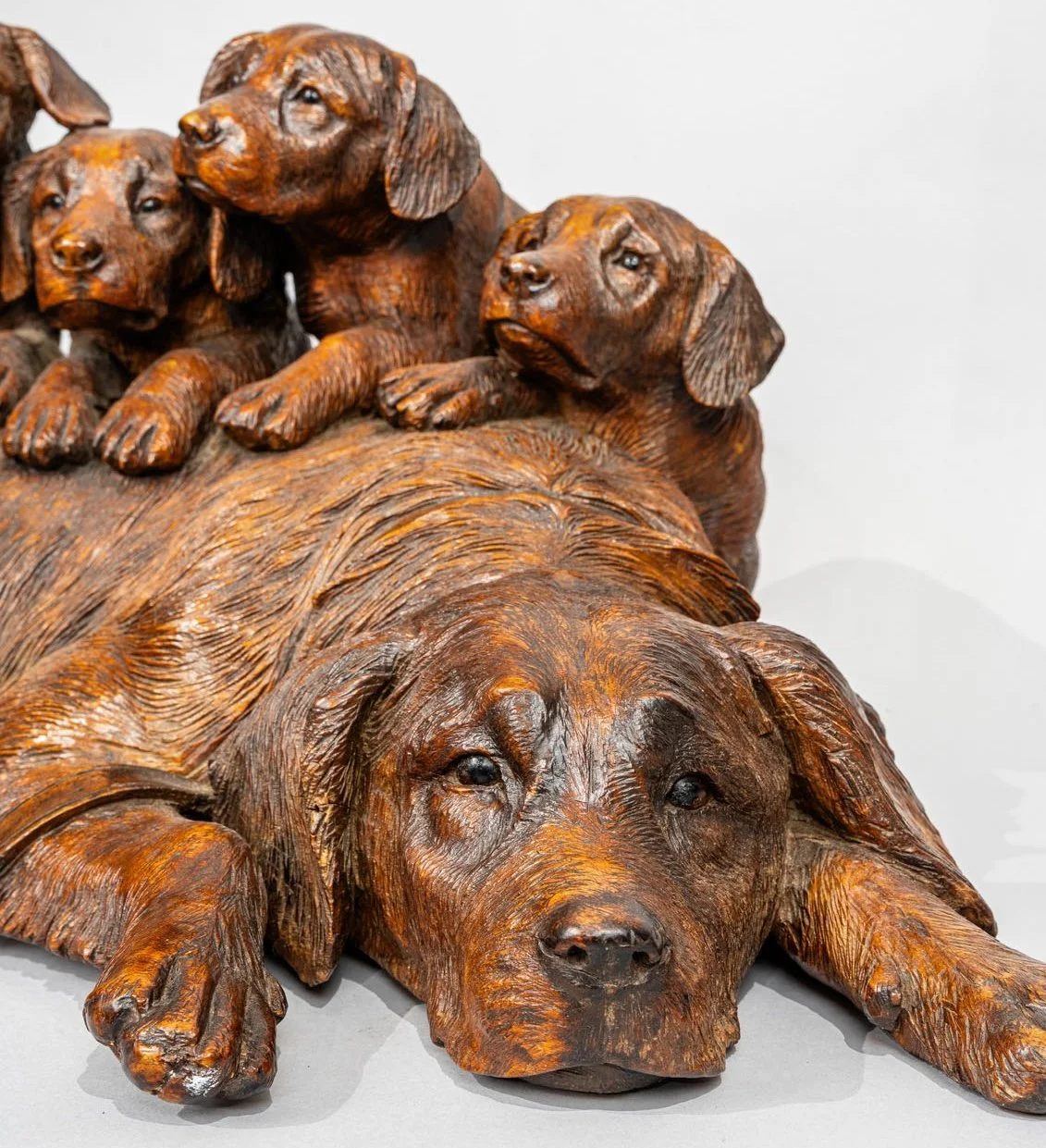
A fine and rare sculptural group by Walter Mader of Brienz, depicting a recumbent hound with four puppies clambering across her back, carved in mountain maple with the refined naturalism that defines his finest work.
The mother lies at rest, her weight settled fully into the ground, forelegs extended, head lowered with the patient, weary calm of an animal that has given everything. Her coat is rendered in long, flowing tool strokes that follow the natural lie of the fur, a braided rope lead is carved at her neck with the same attention given to the figures themselves, and her teats are visible along the underside — the carver recording the full physical truth of a nursing mother without sentiment or evasion.
Across her back the four puppies tumble in an overlapping group, no two faces alike: one gazes forward with open curiosity, another tilts its head in mild bewilderment, a third presses close beside its sibling, a fourth peers sideways in drowsy contentment. The soft, rounded faces with the slightly oversized features of young animals, the paws draped over the mother's back, the ears falling at different angles — all speak to sustained, affectionate observation rather than formula.
Mader stands among the foremost figures of the Brienz school in its golden period, and his dog groups are regarded as among the most accomplished expressions of the tradition, combining deeply undercut multi-figure composition with a sensitivity to animal character few carvers matched. Work of this rank was shown at the great international exhibitions in London, Paris and the United States, where the carvers of the Bernese Oberland won their international audience.
Condition: Very good; rich original patina, carving complete and crisp across all figures including the lead and base, minor wear consistent with age, no significant losses or restorations noted.
Dimensions: 30 in. length x 18 in. depth x 11 in. height
Literature: Jay Arenski, Simon Daniels, and Michael Daniels, Swiss Carvings: The Art of the Black Forest, 1820–1940 (2006).
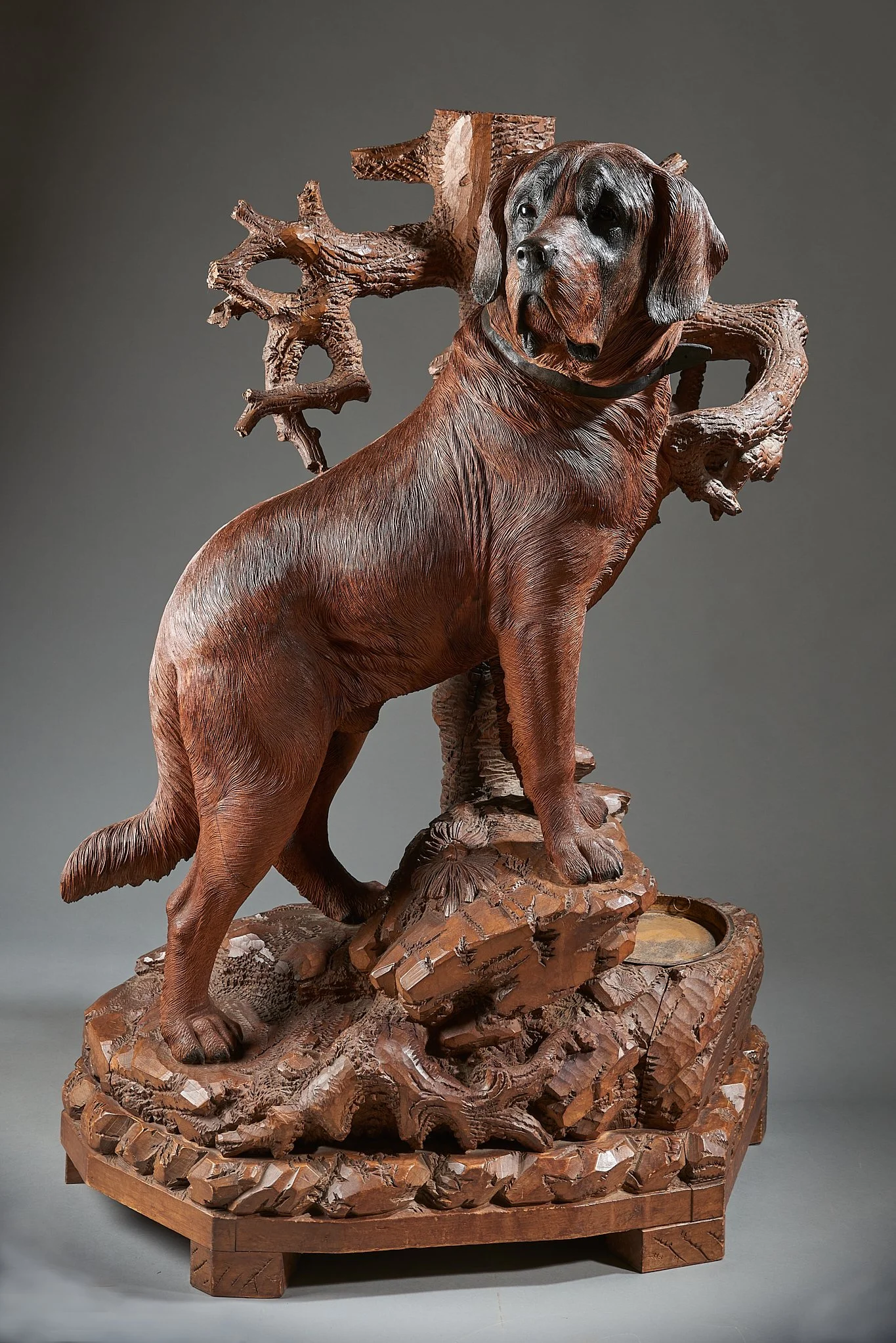
A life-sized carved mountain maple St. Bernard umbrella stand by Walter Mader of Brienz, circa 1870, is among the most accomplished examples of his celebrated dog carvings.
Walter Mader and his son Heinrich were the pre-eminent dog carvers of the entire Black Forest tradition, their understanding of canine anatomy, character, and expression placing their work in a category apart from all contemporaries. As noted in Swiss Carvings: The Art of the Black Forest, 1820–1940, their ability to capture a dog's expression and movement compares favorably with that of the great French bronze animalier sculptors Mêne, Barye, and Jaquemart. The St. Bernard — the great rescue animal of the Alpine passes, whose combination of massive physical presence and legendary gentleness had made it one of the most celebrated animals in the world by the second half of the nineteenth century — was a natural subject for a carver of Mader's ambitions and Alpine sensibility.
The figure depicts a life-sized St. Bernard standing alert on a naturalistic rocky base, head turned with the watchful, attentive readiness characteristic of the working breed. The massive head is rendered with exceptional anatomical precision — the heavy jowls, broad muzzle, and the breed's characteristic facial markings rendered through Mader's distinctive polychrome staining technique, bringing the dog's expression to life with exceptional naturalism. The long coat of the flanks and hindquarters is worked in flowing, directional strokes, while the shorter fur of the muzzle and forelegs is handled with corresponding precision. The collar is carved and rendered in a naturalistic style throughout.
Mountain maple — chosen by Mader for its fine, close grain and its capacity for sustained precision on a large scale — provides both the material authority and the warm, rich surface that his staining technique demanded. A gnarled tree stump forms the compositional backdrop, its branch structure wrapping above to support the umbrellas, the functional receptacle integrated into the base with characteristic ingenuity. The naturalistic base is carved with rocky ground, roots, and alpine flora of considerable delicacy.
Condition: Very good, commensurate with age. Mountain maple is structurally sound throughout. Polychrome staining present and well-preserved, reflecting the originality of the piece. Fur carving is crisp across all surfaces. Collar, raised foreleg, and tree stump backdrop with branch structure all intact. Umbrella receptacle present at the base. Rocky naturalistic base with alpine flora intact. Rich warm patina consistent with Mader workshop production.
Literature: Jay Arenski, Simon Daniels and Michael Daniels, Swiss Carvings: The Art of the Black Forest, 1820–1940, Antique Collectors' Club, Woodbridge, Suffolk, 2006 — see pp. 114–117 for comparable Mader dog umbrella stands and extended discussion of the Mader workshop.
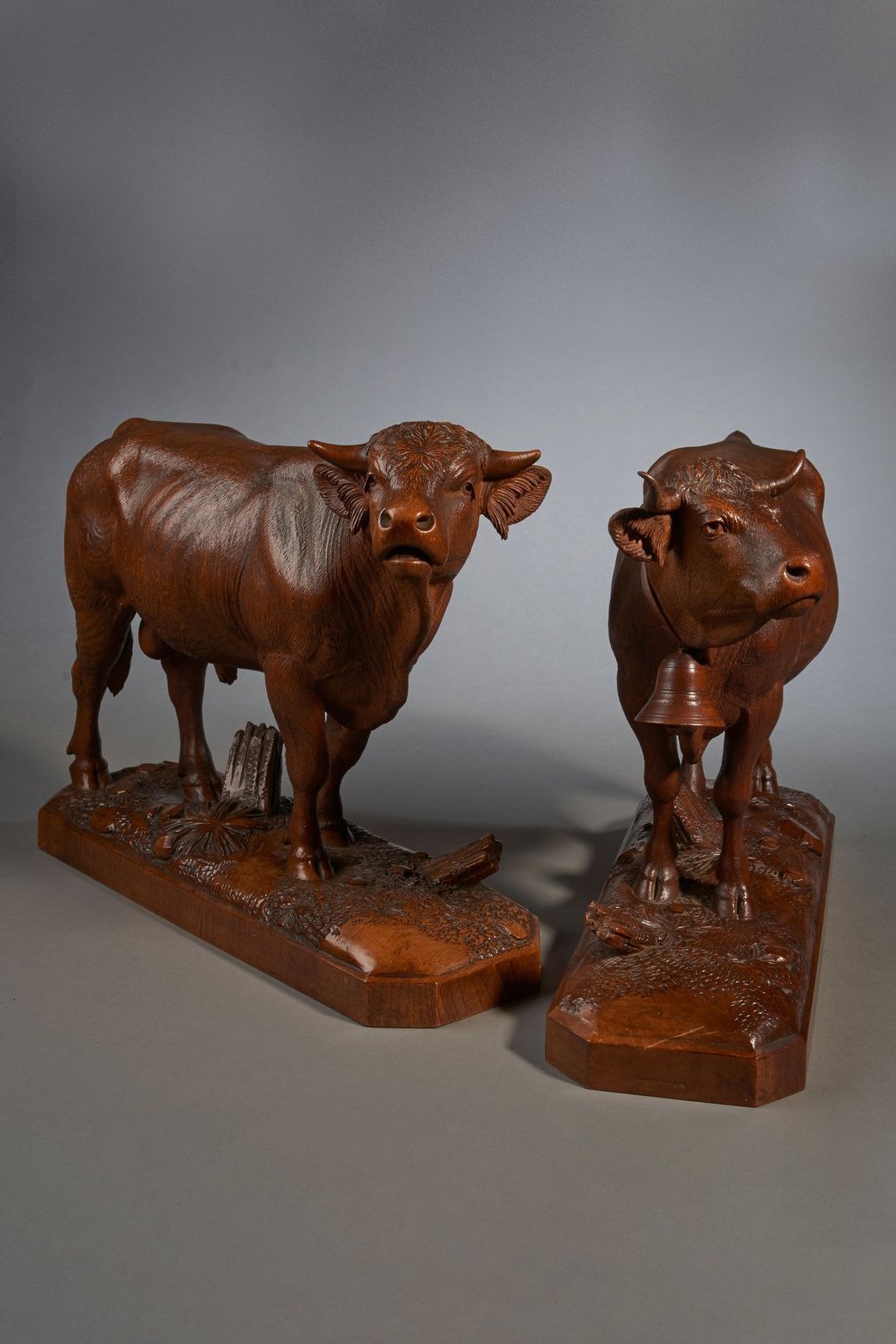
Few subjects engaged the master carvers of Brienz with greater ambition than the cattle of the Swiss alpine pastures — the Simmental and Eringer breeds that defined the agrarian life of the Bernese Oberland and whose forms challenged the carver's skill in rendering weight, musculature, and presence in lindenwood. This exceptional pair, attributed to Johann Huggler of Brienz, represents the category at its very finest: a bull and a bell cow, naturalistically carved in the round, standing in easy counterpoint on shaped elliptical bases enriched with finely observed alpine flora and broken timber.
The bull is rendered with commanding authority. His broad shoulders, powerful neck, and short curved horns are carved with anatomical precision, the surface of the coat rendered in subtly differentiated textures that distinguish the smooth flanks from the rougher, curling growth around the poll and ears. The glass-inset eyes — a hallmark of the finest Brienz workshops — lend the figure an arresting vitality, fixing the viewer with an expression of quiet self-possession. The base is enriched with carved pine cones, alpine grasses, and fragments of fallen timber, providing a naturalistic setting without distracting from the animal himself.
The cow presents a complementary study in feminine temperament. She stands in easy repose, her neck extended, a carved cowbell suspended at her throat — the defining mark of the leading animal in an alpine herd. Her musculature is rendered with equal precision, the ribbing of her flanks and the gentle sway of her body speaking to a carver intimately familiar with his subject. The surface patination of both figures has mellowed to a rich warm walnut tone, consistent with age and handling across more than a century.
Together, the pair forms a composition of rare completeness and balance. Huggler's cattle subjects were among the most admired in the Brienz trade, sought by international visitors and exported in quantity to Britain, America, and the Continent following the Swiss national and international exhibitions of the later 19th century. Examples of this quality and scale — carved fully in the round with inset eyes, naturalistic bases, and the bell cow detail intact — are seldom encountered today outside institutional collections.
Condition: Both figures in excellent condition commensurate with age. The surfaces display an even, warm patination throughout. Glass eyes intact on both figures. Bases complete with no losses to the carved flora or timber detail. Minor surface wear consistent with age and handling; no restoration or repair observed.
Dimensions: 16”width x 13”height x 5.5”depth
Literature: Jay Arenski, Simon Daniels and Michael Daniels, Swiss Carvings: The Art of the Black Forest, 1820–1940, 2006 — see relevant entries on Huggler cattle subjects and Brienz naturalistic carving.
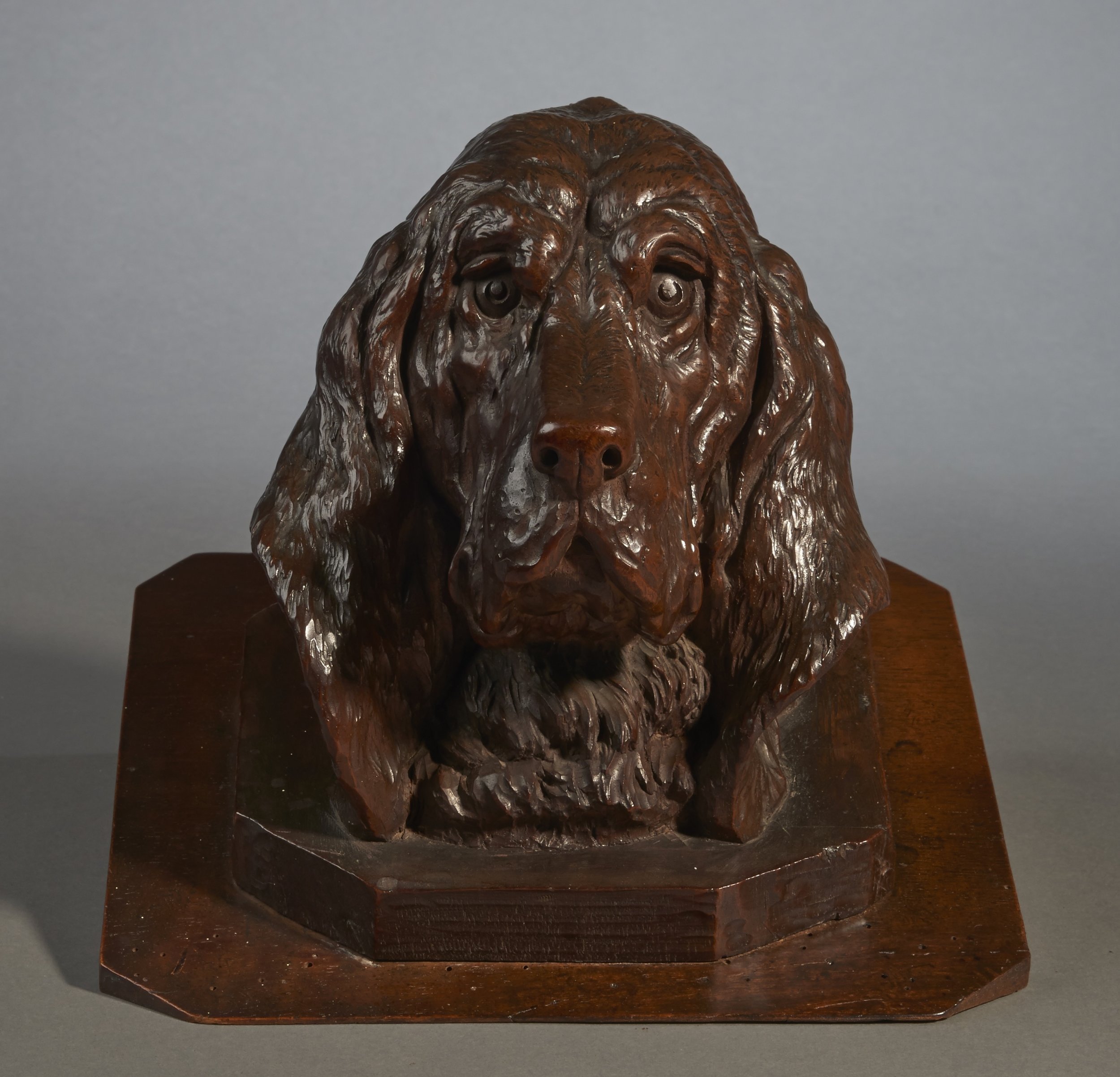
A finely carved walnut bird-dog head, Black Forest, circa 1870, mounted on an octagonal, stepped walnut base.
The head is modeled with exceptional anatomical authority — the broad domed skull, long wavy ears falling heavily to either side, and a carefully observed muzzle all speak to a carver working from close study of the living animal. The expression, at once alert and melancholy, is captured with a subtlety that elevates this beyond workshop production into the realm of portraiture. The wavy coat is rendered with confident, fluid toolwork, with texture convincingly varied between the smoother planes of the skull and the looser fall of the ears.
Particularly notable are the carved eyes, executed not in the glass typical of Brienz workshop production but in the classical manner of the Italian marble carvers — iris drilled, pupil raised — lending the head an intensity of gaze that glass could not replicate. It is the mark of a carver with broader sculptural ambitions.
A distinguished piece for a library, study, or hunting room.
Condition: Excellent, commensurate with age. Walnut mellowed to a deep, even tone. No losses or restoration observed. Minor wear consistent with age and original use.
Dimensions: 8”depth x9”width x7.5”height

The bull is among the most demanding subjects in the entire repertoire of the animal carver — a form that requires, above all else, a command of mass. Where the bear invites drama and the dog invites sentiment, the bull demands something harder to achieve: the convincing representation of sheer physical weight, of muscle under tension, of an animal that carries within its body an almost geological density. The finest bull carvings of the Swiss tradition achieve this not through exaggeration but through observation — through the patient study of the living animal and the translation of that study into wood with the precision and confidence of a sculptor who understands what he is looking at.
The present work, signed by A. Spring of Interlaken and dating to circa 1900, belongs to that category. Carved in finely grained walnut — a material whose density and close grain permits the kind of sustained, precise work that this subject demands — the bull is depicted in a characteristic posture of alert, forward-weighted engagement: the massive head lowered, the neck muscled and tense, the shoulders bunched, the hindquarters gathered. It is the posture of an animal that has seen something and has not yet decided what to do about it — the moment of maximum potential energy, captured in wood with the authority of an artist who has observed his subject from life with the attentiveness that only genuine understanding produces.
The anatomical detail throughout is of the first order. The deeply curled poll — the dense, tight fleece of the bull's forehead — is carved with a precision that contrasts deliberately with the smoother, more taut surfaces of the neck and shoulders. The dewlap hangs with the weight of the living animal. The nostrils are flared. The eyes carry the focused, slightly alarmed expression of the beast at attention. The hooves — individually defined, pressing into the naturalistically carved grass and rocky ground of the base — are handled with the same quality of observation as the head. The tail curves upward at the rear with the characteristic restless movement of the alert animal. Every surface has been considered; nothing has been generalised.
The figure stands on an oblong naturalistically carved base — the ground rendered with grasses, pebbles, and rock — which is itself mounted on the original circular column pedestal, its shaft carved with vine and foliate ornament wrapping the full circumference, its capital handled in a stylised palm-leaf form of considerable decorative refinement. The column stands on a square plinth with moulded base. The whole composition — figure, base, column, and plinth — is an original and unified object, and its survival complete and intact is of considerable rarity.
A. Spring of Interlaken worked in the tradition of the great named Brienz masters — carvers whose animal studies were produced for exhibition and for the most demanding private commissions of the period, and whose signatures on a piece of this quality transform it from a fine decorative object into a documented work of art.
Carver: A. Spring, Interlaken, Switzerland Material: Walnut Dimensions: [INSERT: overall H × base W × base D] Circa: 1900
Condition: Very good. Walnut structurally sound throughout — bull figure, base, column, and plinth all intact with no cracks or losses of significance. Carving fully intact across all surfaces — poll, dewlap, musculature, hooves, and tail all crisp and complete. Naturalistic base with grasses and pebbles intact. Column shaft with vine ornament present throughout. Palm-leaf capital intact. Square plinth moulding intact. Deep, rich patina consistent with age and quality of original surface. Signature of A. Spring present.
Literature:
Jay Arenski, Simon Daniels, and Michael Daniels, Swiss Carvings: The Art of the Black Forest, 1820–1940, 2006

There is a point at which Swiss Black Forest carving ceases to be a decorative art and becomes architecture — where the scale of the object demands not a cabinet or a mantelpiece but a hall, a staircase, a gallery, or the entrance rotunda of a great house. The present eagle stands at that threshold. At almost eight feet in height, with wings fully outstretched in the posture of an eagle that has just taken its summit perch, this is not a carving that inhabits a space — it is a carving that defines one. It was made for a specific kind of client, in a specific kind of house, and its original context — the châteaux and mansions of the American Northeast that received the grandest commissions of the Swiss carving workshops in the final decades of the nineteenth century — was entirely equal to its ambition.
The subject is the American eagle — the bald eagle of the United States, the bird of national symbolism whose selection as subject speaks directly to the American market for which pieces of this scale and character were produced. The Brienz workshops understood their international clientele with precision, and a life-size American eagle at nearly eight feet was a statement that only one category of American patron could make: the industrialist, the financier, the railroad magnate, the man for whom a house in the Hudson Valley or the Adirondacks was itself a declaration of position. An eagle of this scale, commissioned from the finest Swiss carvers and installed in the entrance hall, was the sculptural equivalent of a Vanderbilt staircase or a Carnegie library wing.
The eagle is carved fully in the round in linden wood, perched at the summit of a monumentally conceived rocky outcrop — the angled rock slabs rendered in the bold, confident manner of the finest Brienz rockwork, the surfaces broken and stratified, the junctions between the rock planes animated with carved alpine flora. The whole base rises in a dramatic diagonal thrust that gives the composition its ascending energy, the bird at the apex the inevitable resolution of a movement that begins at the floor and ends eight feet above it.
The wings are outstretched and swept back in the posture of the moment of landing or the moment before launch — the position of maximum span and maximum tension, in which every feather is fully displayed. The individual flight feathers are deeply undercut and rhythmically layered across the full extent of both wings, the carving maintaining its quality and precision to the outermost tips. The head is turned slightly, the beak open, the eye alert — the expression of the apex predator entirely at ease with its own dominance. The talons grip the rocky summit with the conviction of a bird that has perched on this particular crag many times before.
As illustrated in Swiss Carvings: The Art of the Black Forest, 1820–1940 by Jay Arenski, Simon Daniels, and Michael Daniels (pp. 88–90), monumental eagle carvings of this type represent some of the most ambitious productions of the Brienz workshops — objects conceived for exhibition and for the grandest private commissions of the period. An example of this scale, in this condition, is without meaningful parallel in the current market.
Height: Approximately 8 feet (circa 244 cm) Provenance: Commissioned for American private collection; châteaux and mansions, upstate New York Circa: 1890
Condition: Very good overall for a work of this scale and age. Linden wood structurally sound throughout — no cracks or losses of significance to the main figure. Wings fully intact — flight feather carving crisp and complete across the full extent of both wings with no losses to tips or extremities. Head with open beak intact. Talons gripping summit intact. Rocky outcrop base structurally sound throughout — rock plane carving and alpine flora at junctions intact. Rich, warm honey-brown patina consistent with age and quality of original surface.
Literature:
Jay Arenski, Simon Daniels, and Michael Daniels, Swiss Carvings: The Art of the Black Forest, 1820–1940, 2006, pp. 88–90.

There are two bear clocks in the Swiss Black Forest canon, and they are not the same object twice. The clock in which bears animate a rocky alpine outcrop is one conception — theatrical, comic, the bears as performers upon a stage. The clock in which the bear himself becomes the mountain — in which the great standing animal is the structural and compositional centre, the tree his axis, and the cubs his ornament — is another conception entirely, and a more ambitious one. In the present clock, the carver has chosen the more difficult path: the bear does not merely inhabit the composition, he constitutes it. Everything else — the cubs, the tree, the clock face — is disposed around him, and it is his mass and presence that gives the whole its authority.
The composition rises from a shaped oval naturalistic base to a height that commands any room in which it is placed. The dominant figure — a large bear standing on his hind legs, his body forming the central trunk of the composition — is carved with exceptional naturalistic force. The fur is worked in sweeping, deeply undercut planes, darker and more dramatically rendered than the lighter Brienz production, the overall patina having deepened over a century and a half into an almost bronze-like depth of tone that gives the piece a sculptural gravity approaching that of cast metal. The face of the large bear — seen in close-up in the detail photographs — is a masterwork of the carver's art: the amber glass eyes, set deep beneath the brow, carry a quality of focused, slightly wary intelligence that is far from the conventional bear of the decorative tradition. This animal has been observed.
Around and above the central bear, the tree structure rises — the trunk and branches providing the armature for a programme of climbing cubs that animates the upper composition with a contrasting energy of movement and play. Two cubs engage at the upper level — one grasping a branch, one reaching — while further bears are disposed on the mid-level, each individually posed and individually characterised. The clock face is set into the tree structure at the centre of the composition — a circular face with Arabic numerals on a black chapter ring, brass hands with decorative gilt work, and an original brass bezel — the eight-day striking movement housed within the body of the carved tree. A further bear appears at the lower right of the composition, climbing the base of the tree with the concentrated effort of an animal engaged entirely in its own purpose.
The present clock is illustrated in Swiss Carvings: The Art of the Black Forest, 1820–1940 by Jay Arenski, Simon Daniels, and Michael Daniels at page 160 — the definitive reference work on the tradition — confirming its status as one of the documented masterworks of the Swiss Black Forest clock-making and carving tradition.
Movement: Eight-day striking movement, original Dial: Arabic numeral chapter ring, black ground, brass hands, original brass bezel Circa: 1870–1880
Condition: Very good overall. Linden wood structurally sound throughout. Central standing bear fully intact — fur carving, facial detail, and amber glass eyes all present and in excellent condition. All subsidiary bear figures structurally sound — ears, paws, and extremities intact throughout. Tree structure and branch elements intact. Clock face present with original Arabic numeral chapter ring and brass hands. Eight-day striking movement present. Original brass bezel present. Deep, dark patina consistent with age and of exceptional richness.
Literature:
Jay Arenski, Simon Daniels, and Michael Daniels, Swiss Carvings: The Art of the Black Forest, 1820–1940, 2006, p.

Among the subjects that defined Walter Mader's reputation as the pre-eminent dog carver of the Brienz school, none was more celebrated or more frequently sought by his international clientele than the hound with pups — a composition that allowed him to demonstrate simultaneously his command of the adult animal and his ability to render, with equal conviction, the quite different anatomy, texture, and character of the young dog at various stages of alertness and repose. The finest examples of this subject by Mader are recognised immediately by specialists: the quality of fur carving, the sensitivity of the facial modeling, and above all the quality of psychological observation — the sense that each animal in the group has been watched and understood before it was carved.
The present group is a masterwork of the form. The mother — a long-coated gundog of the setter or retriever type — lies at ease on a carved mat base, her head turned slightly in a posture of relaxed alertness, her collar and ring carved with the same precision as every other detail of the piece. Around her, three pups are disposed with the natural informality of the nursery: one has climbed onto her back and surveys the world from this elevated position with the confidence of youth; two more are nestled at her chest and flank, their smaller bodies conveying the rounded, slightly unformed quality of the very young animal with a fidelity that speaks to direct observation. Each pup is individually characterised — the climber alert and curious, the nestled pair content and absorbed — and each is carved to the same standard as the mother, without the diminution of quality that lesser carvers allowed themselves in the subsidiary figures of a composition.
The fur throughout is worked in the deeply incised, rhythmic manner of Mader's finest dog work — the direction and depth of the cuts varying between the longer coat of the mother's flanks and ears, the shorter fur of her muzzle, and the different, softer texture of the pups' coats. The mother's face carries the calm, self-possessed expression of an animal entirely at ease with her circumstances — the expression of a dog who has been observed, not imagined.
The base is carved to simulate a woven rush mat or hay-covered stable floor, the texture rendered in the characteristic parallel striations of the Brienz workshops, with a moulded rectangular stepped surround that provides a resolved and architecturally considered platform for the group. The whole composition — the disposition of the figures, the quality of the individual characterisation, the resolution of the base — is that of a carver working at the height of his powers.
As discussed in Swiss Carvings: The Art of the Black Forest, 1820–1940 by Jay Arenski, Simon Daniels, and Michael Daniels, Walter Mader's dog groups represent the pinnacle of the Brienz animal carving tradition — works produced for an international clientele of the highest discernment and recognised today as among the most artistically refined objects the tradition produced.
Carver: Walter Mader, Brienz, Switzerland (attributed) Dimensions: [INSERT: H × L × W] Circa: 1870
Condition: Very good. Wood structurally sound throughout — no cracks or losses. Mother figure fully intact — collar and ring, fur carving, facial detail, and paws all crisp and complete. All three pups present and structurally sound — fur carving and facial detail intact on each figure. Carved mat base with parallel straw/rush texture intact throughout. Moulded stepped surround structurally sound. Rich, warm patina consistent with age and Mader workshop production.
Literature:
Jay Arenski, Simon Daniels, and Michael Daniels, Swiss Carvings: The Art of the Black Forest, 1820–1940, 2006

Among the carvers of the Brienz school, Walter Mader occupied a position of particular distinction in the rendering of dogs — a subject that demands from the sculptor not only technical command of fur and anatomy but a quality of psychological observation that separates the merely accomplished from the genuinely great. The dog is not a decorative subject in the way that a bear or an eagle is decorative: it is a subject that invites — indeed requires — a portrait, in the fullest sense of that word. The finest dog carvings by Mader are recognised immediately by specialists for precisely this quality: the sense that one is looking at a specific animal, observed with care and rendered with affection, rather than a generalised type.
The present umbrella stand is among the most accomplished examples of Mader's work in this subject. The dog — a large, long-coated gundog of the setter or retriever type, depicted seated and alert — is carved in mountain maple, a material whose fine, close grain permits a precision of surface detail that linden wood cannot match, and whose warm, honey-brown tone provides the ideal ground for the polychrome surface treatment that distinguishes Mader's finest animal work. The face is handled with exceptional sensitivity: the grey of the muzzle, rendered in polychrome surface work, contrasts with the warm auburn of the coat; the nose is black and precisely modeled; the glass eyes — dark, deep, and direct — give the face a quality of attentive presence that is, quite simply, without parallel in the Black Forest dog carving tradition.
The dog is leashed to a naturalistically carved tree stump, the chain — original iron, hanging freely from the carved collar — a detail of extraordinary survival that connects the sculptural figure to the working world from which it comes. The collar itself is carved with the precision of a craftsman who has studied the object it represents. The chain, individually linked and fully functional in its movement, speaks to the same standard of observation and execution that characterises every other detail of this piece.
The tree stump, which forms both the compositional anchor and the functional element of the stand, is handled with the bold, confident naturalism of the best Brienz workshop production — the bark texture, root formations, and branch stubs rendered with the same attention to surface as the dog itself. Integrated within the stump base is the original umbrella receptacle, its circular metal liner present and intact. The whole stands on an oval naturalistic base carved with pebbles, roots, and forest-floor detail of considerable delicacy.
As illustrated in Swiss Carvings: The Art of the Black Forest, 1820–1940 by Jay Arenski, Simon Daniels, and Michael Daniels (p. 114), closely related examples by Mader confirm both the rarity and the desirability of sculptural umbrella stands of this quality — objects produced for the most demanding clientele of the period and recognised today as among the finest functional sculptures the Swiss tradition produced.
Carver: Walter Mader, Brienz, Switzerland Material: Mountain maple with polychrome surface detail Eyes: Glass Chain & Collar: Original iron, present and intact Umbrella Receptacle: Original metal liner, present Circa: 1870
Condition: Very good overall. Mountain maple structurally sound throughout — no cracks or losses. Dog figure fully intact with polychrome surface treatment present — grey muzzle, warm coat tones, and black nose all well-preserved. Glass eyes present and secure in both sockets. Fur carving crisp and fully intact across all surfaces. Original iron collar and chain present and intact — chain hanging freely. Tree stump structurally sound with bark and root detail crisp throughout. Umbrella receptacle with original metal liner present. Oval naturalistic base intact. Rich, deep patina consistent with age.
42”height
Literature:
Jay Arenski, Simon Daniels, and Michael Daniels, Swiss Carvings: The Art of the Black Forest, 1820–1940, 2006, p. 114

Swiss Black Forest furniture occupies a category of its own within the decorative arts of the nineteenth century — objects that transform the functional into the fully sculptural, in which every structural element becomes an opportunity for carving and every surface a field for narrative. The bear armchair is the supreme expression of this ambition: a form in which the chair itself disappears into a composition of branches, foliage, climbing cubs, and the presiding figure of the bear, and in which the act of sitting becomes an act of inhabiting a carved forest.
The present example, dating to circa 1880 and executed in linden wood by the Brienz workshops at the height of their powers, is a piece of exceptional quality and completeness. The back is centred by a standing bear, carved fully in the round and raised on the back splat as though emerging from the forest behind — his fur deeply worked in the characteristic incised and layered technique of the finest Brienz carving, his posture confident and alert. Around him, the back is framed within an arched canopy of intertwined branches and deeply undercut oak leaves, the acorns and foliage rendered with the botanical precision that distinguishes the best workshop production from the merely competent. The crest rail is a composition in its own right — gnarled timber, carved branches crossing and recrossing, the whole forming a naturalistic arch that provides the standing bear with a setting of complete conviction.
The arms are fashioned as gnarled tree limbs — the branch-work handled with the same confidence as the back, the surface texture of bark and knots rendered throughout with an attention to naturalistic detail that makes the structural elements inseparable from the decorative. The front legs carry the composition's most charming narrative detail: a bear cub climbing each leg, the small figures carved with the same quality of observation as the presiding bear above, their paws gripping the timber of the legs with the concentrated effort of young animals entirely absorbed in the business of ascent.
The seat is carved with a landscape or forest floor scene in low relief — a detail that ensures every surface of the chair participates in the overall composition. The seat rail is carved with oak leaf and foliate ornament in the characteristic Brienz manner. The rear legs are simpler in treatment, providing a resolved and stable base for the elaborately carved front.
A closely related example is illustrated in Swiss Carvings: The Art of the Black Forest, 1820–1940 by Jay Arenski, Simon Daniels, and Michael Daniels (p. 142), confirming the rarity and desirability of elaborate figural furniture of this type — objects produced for the great exhibitions and for the most ambitious private commissions of the late nineteenth century, and collected today as among the most distinctive and characterful pieces that the Swiss tradition produced.
Material: Linden wood Circa: 1880
Condition: Very good overall. Linden wood structurally sound and fully functional as a seat. Central standing bear on back splat fully intact — fur carving crisp and complete. Arched canopy of branches and oak leaves intact throughout — no losses to foliage, acorns, or branch elements. Branch-work arms structurally sound. Climbing bear cubs on front legs present and intact on both legs. Carved seat landscape scene present and legible. Seat rail foliate carving intact. Rich, deep patina consistent with age and quality of original surface.
Literature:
Jay Arenski, Simon Daniels, and Michael Daniels, Swiss Carvings: The Art of the Black Forest, 1820–1940, 2006, p. 142
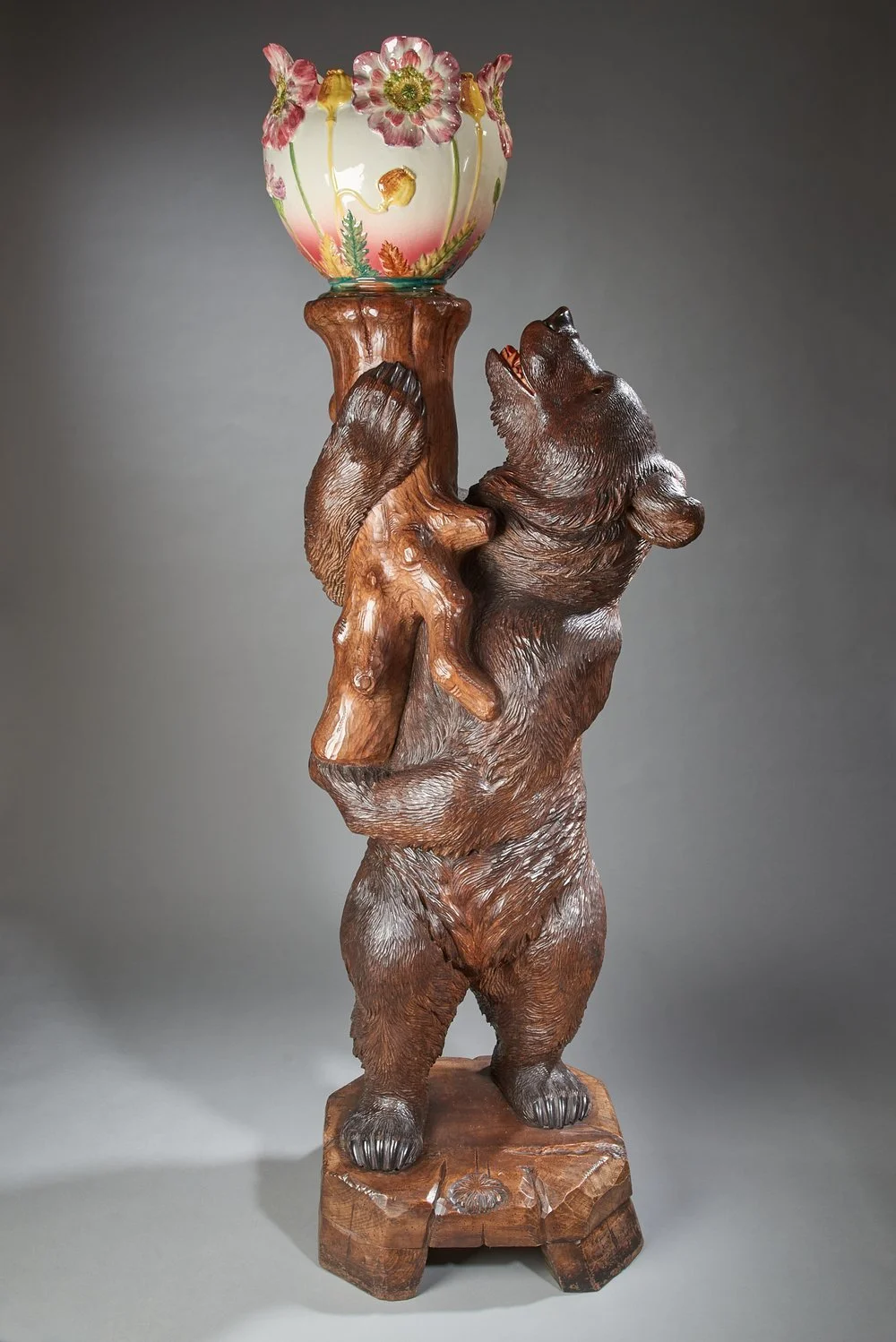
A Swiss-carved linden-wood bear jardinière stand, probably by Rudolf Linder (1885–1972) of Brienz, circa 1905–1935, surmounted by a polychrome glazed earthenware jardinière signed by Delphin Massier (1836–1907) of Vallauris, France.
The bear is carved standing upright, grasping a naturalistic tree trunk with both forepaws, the head thrown back and the gaze directed upward toward the jardinière above, a posture that turns a functional support into a composition with real expressive character. The fur is worked throughout with deeply incised, rhythmic cutting, the texture varying between the dense ruff of the neck, the longer coat of the flanks, and the shorter fur of the muzzle and paws. The two-toned glass eyes, a feature found only on the better carvings of the period, give the face a lifelike directness. The tree trunk is carved with bark texture, knots, and surface variation that integrate it into the composition while providing a structurally resolved column to support the weight above. The whole stands on a substantial base carved to suggest a rocky outcrop. Monumental bear carvings of this type, as illustrated in Swiss Carvings: The Art of the Black Forest, 1820–1940 by Jay Arenski, Simon Daniels, and Michael Daniels (p. 31), were the showpieces of the Brienz workshops, made for the international exhibitions and the grandest private commissions.
The jardinière is by Delphin Massier of the Massier pottery dynasty of Vallauris, one of the leading names in late nineteenth-century French decorative ceramics. The globular form is modeled and painted with poppies, ferns, and botanical ornament in the painterly manner of the Massier workshops, in vivid pinks, greens, and yellows against a cream-and-blush ground, with applied flowers rising from the rim. The contrast between the warm, patinated linden wood and the glazed ceramic gives the composition its balance, each material defining the other by opposition.
The bear comes with an unusually complete history. For decades, it was the centerpiece of the Zryd "Diana" woodcarving store in Interlaken, a business founded in 1837 and run by successive generations of the Zryd family until the early 2000s. A handwritten account by Eveline Nobs-Zryd, dated December 2003 and accompanying the piece, records that the bear was already in the store when the family prepared their centenary catalog in 1935–36, that it always stood at the entrance of the shop where it was seen by many thousands of visitors, and that it was never offered for sale. The family attributes the carving to Rudolf Linder of Brienz and notes that it took the carver more than a year to complete. The letter also records that the bear originally had a pendant, a second bear looking to the right, which was sold to an American buyer before 1953. The present bear was sold by the family only when they decided to wind down the business.
Condition is very good overall. The linden wood is structurally sound throughout, with no cracks, splits, or losses to the bear, tree trunk, or base. The fur carving is fully intact and crisp across all surfaces, and the glass eyes are present and secure. The Massier jardinière is intact, the polychrome decoration is vivid and complete, the applied floral rim elements are undamaged, and the signature of Delphin Massier is present on the base. The carving is unsigned.
Literature: Jay Arenski, Simon Daniels, and Michael Daniels, Swiss Carvings: The Art of the Black Forest, 1820–1940, 2006, p. 31

There is a category of Swiss Black Forest carving that transcends the decorative arts entirely and demands to be considered as sculpture — works conceived not for the mantelpiece or the collector's cabinet but for the great international exhibitions of the second half of the nineteenth century, where the Brienz carving industry presented itself to the world and where the ambitions of its finest craftsmen were given the space, literally and figuratively, to be fully realised. The present pair of life-size bears — each standing approximately six feet tall, carved fully in the round from linden wood, and depicting the brown bear of the Swiss Alps in a posture of full alert — belongs without question to that category.
Bears occupied a special place in the iconography of the Brienz workshops. They were the animal most immediately associated with Switzerland in the imagination of the international visitor — the symbol of Bern, the creature of the high forests, the subject that allowed the Brienz carver to demonstrate simultaneously his command of naturalistic anatomy, his technical mastery of deeply undercut fur, and his ability to communicate, in wood, the raw physical power of one of nature's most formidable animals. Small bears had been a staple of the trade since the early nineteenth century. Bears of this scale — life-size, exhibition quality, conceived as pendant compositions — were produced in vanishingly small numbers, for a clientele and a context that demanded the absolute maximum of what the tradition could achieve.
Each bear stands upon a naturalistically carved rocky base, the rough-hewn stone rendered with the same attention to surface and texture as the figures themselves. The poses are subtly differentiated — one bear turning slightly to his left with a forepaw raised to the chest, the other facing more directly forward with both paws raised in a posture of alert confrontation — a deliberate compositional decision that creates a dynamic dialogue between the pair, preventing the symmetry from becoming static and ensuring that the two figures read as a conversation rather than a repetition. Viewed together, they fill a room with presence; viewed individually, each is a complete and resolved work of sculpture in its own right.
The carving is of outstanding quality throughout. The fur is worked in sweeping, rhythmic planes of deeply undercut linden wood, the direction and depth of the cuts varying across the body to suggest the different textures of the muzzle, the dense ruff of the neck, the longer coat of the flanks, and the shorter pile of the paws. The open mouths — each revealing individually carved teeth, the tongue, and the interior of the jaw — are handled with a precision that speaks to a carver of exceptional confidence and technical control. The glass eyes of each bear catch the light with a directness that gives the faces an unsettling vitality. The claws, individually delineated, are fully articulated on all four paws.
As discussed in Swiss Carvings: The Art of the Black Forest, 1820–1940 by Jay Arenski, Simon Daniels, and Michael Daniels, works of this monumental scale and ambition were not produced for the general market but were conceived specifically for exhibition at the great international fairs that brought worldwide recognition to the Brienz carving industry — events at which the leading workshops competed for prizes and commissions before audiences of European royalty, American industrialists, and the international press. A pair of life-size bears of this quality would have ranked among the most impressive objects at any such exhibition, and their survival as a matched pair in this condition is of the greatest rarity.
Condition: Excellent overall for works of this age, scale, and ambition. Linden wood structurally sound throughout on both figures — no cracks, splits, or losses of significance. Fur carving fully intact on both bears with deeply undercut passages clean and crisp. Open mouths with carved teeth, tongues, and jaw interiors intact on both figures. Glass eyes present and secure in both bears. Claws fully articulated and intact. Rocky bases structurally sound. Patina deep, rich, and even — the dark, burnished surface that only decades of handling and natural oxidation produce. A matched pair of extraordinary quality and completeness.
Literature:
Jay Arenski, Simon Daniels, and Michael Daniels, Swiss Carvings: The Art of the Black Forest, 1820–1940, 2006
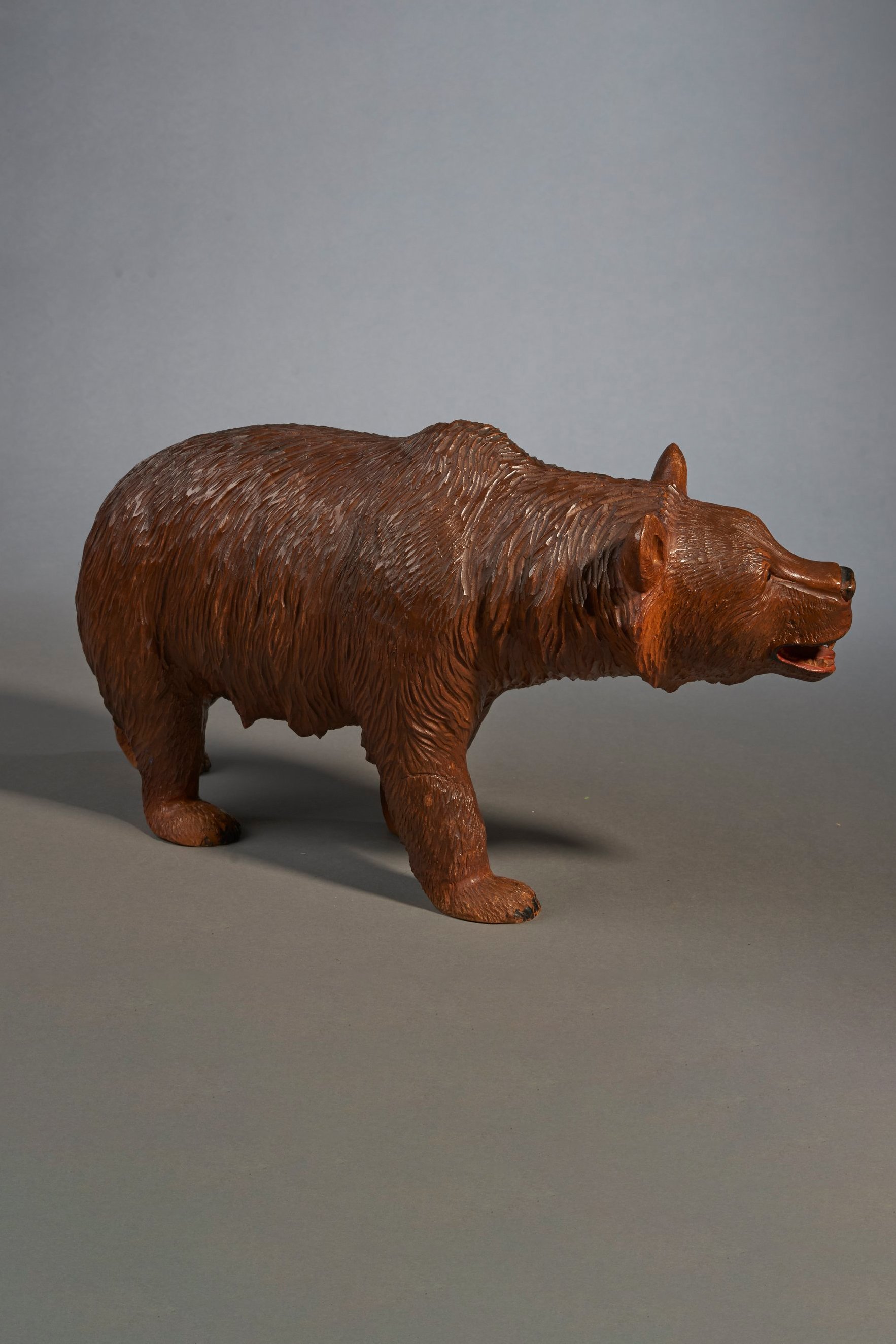
If the standing bear on his hind legs represents Swiss Black Forest carving in its most theatrical register — the animal at the moment of maximum drama — then the walking bear is its counterpart in restraint: a subject that asks more of the carver, not less. Here the challenge is not power or confrontation but movement, weight, and the quiet truth of an animal at ease in its own landscape. The bear in mid-stride, head slightly extended, jaws just parted as if scenting the air, is a composition that rewards the eye in proportion to the skill with which it is observed — and the present example is observed with considerable skill.
The figure is carved fully in the round in linden wood, the bear depicted in a natural walking pose with the characteristic rolling gait of the species conveyed through the displacement of weight between the fore and hind quarters. The head is turned very slightly, the nose raised, the mouth parted just enough to reveal the tongue — a detail that animates the face without tipping the composition into drama. It is a moment of attentive movement, caught and held in wood with the assurance of a carver who has studied his subject closely.
The surface is worked throughout in finely incised fur, the strokes controlled and rhythmic, following the natural contours of the body — shorter and tighter across the muzzle and legs, longer and more fluid across the shoulders and flanks — in a manner that demonstrates both technical command and genuine anatomical understanding. The patina is a warm, honey-brown tone, lighter and less worked than the deep burnish of the exhibition-scale pieces, and entirely consistent with an unrestored example of this period in fine original condition. The four paws are well-resolved, the claws individually delineated, and the bear stands with a stability that speaks to the structural intelligence of the carver's approach to the pose.
As illustrated in Swiss Carvings: The Art of the Black Forest, 1820–1940 by Jay Arenski, Simon Daniels, and Michael Daniels (p. 75), walking bear studies of this type formed a core and consistently celebrated element of the Black Forest tradition — works prized by the international clientele who visited the Brienz workshops and the great exhibitions of the period for their realism, their craftsmanship, and the quiet authority with which the finest examples rendered the most iconic animal of the Swiss Alps. This example, in its restraint and its quality of observation, is characteristic of the tradition at its most accomplished.
Condition: Very good. Linden wood structurally sound throughout with no cracks or losses. Fur carving fully intact and crisp — incised strokes clean and well-preserved across all surfaces. Muzzle, tongue, and mouth detail intact. Claws individually delineated and intact on all four paws. Patina warm, even, and unrestored — the characteristic honey-brown tone of a well-preserved Brienz walking bear in original condition.
Literature:
Jay Arenski, Simon Daniels, and Michael Daniels, Swiss Carvings: The Art of the Black Forest, 1820–1940, 2006, p. 75
Related Articles
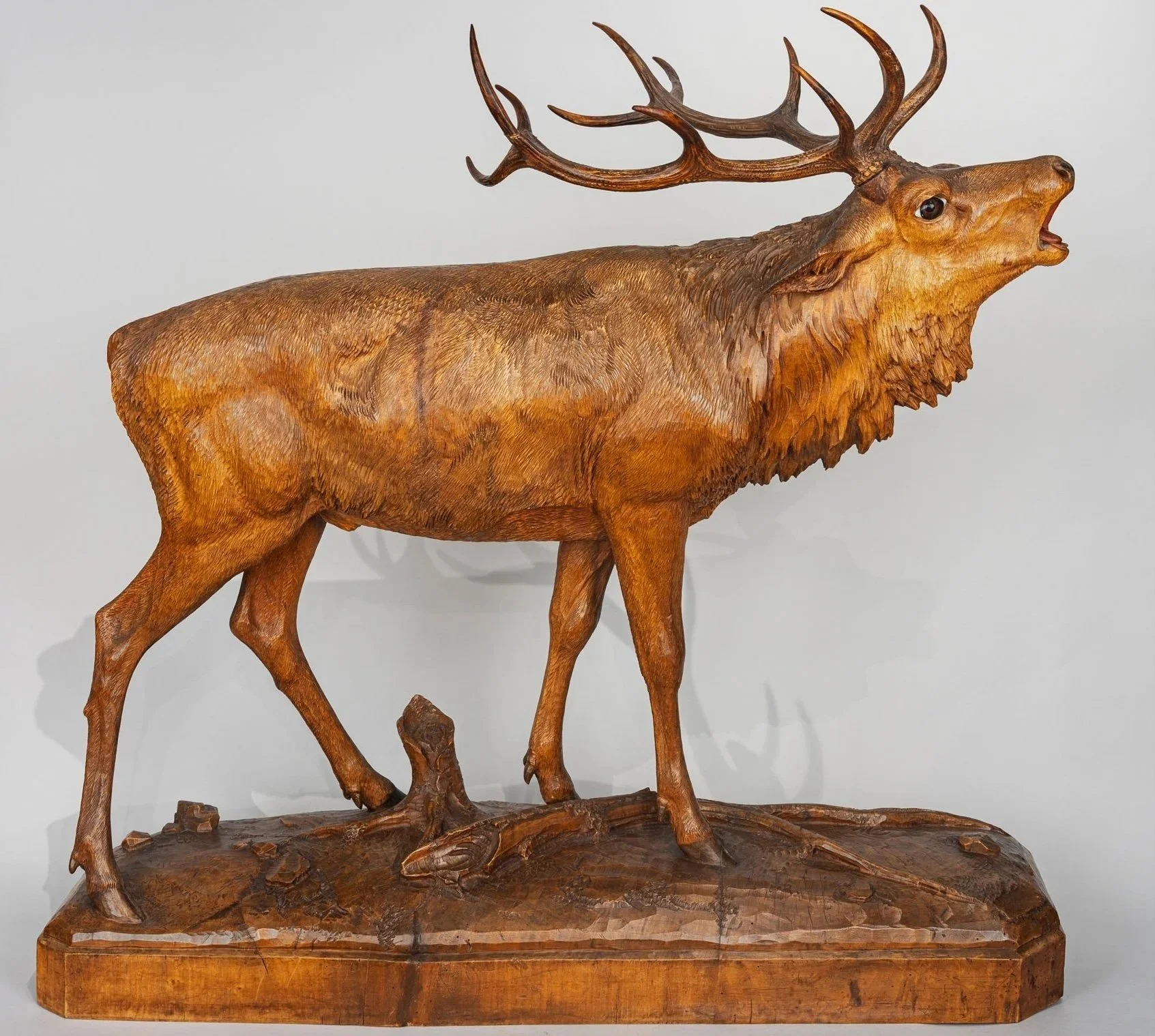
The story of Switzerland's great wood carvers, from the workshops of Brienz to gold medals at the world's fairs of Paris, Chicago, and beyond. A collector's guide to the finest Black Forest carvings, their masters, and what makes them remarkable.
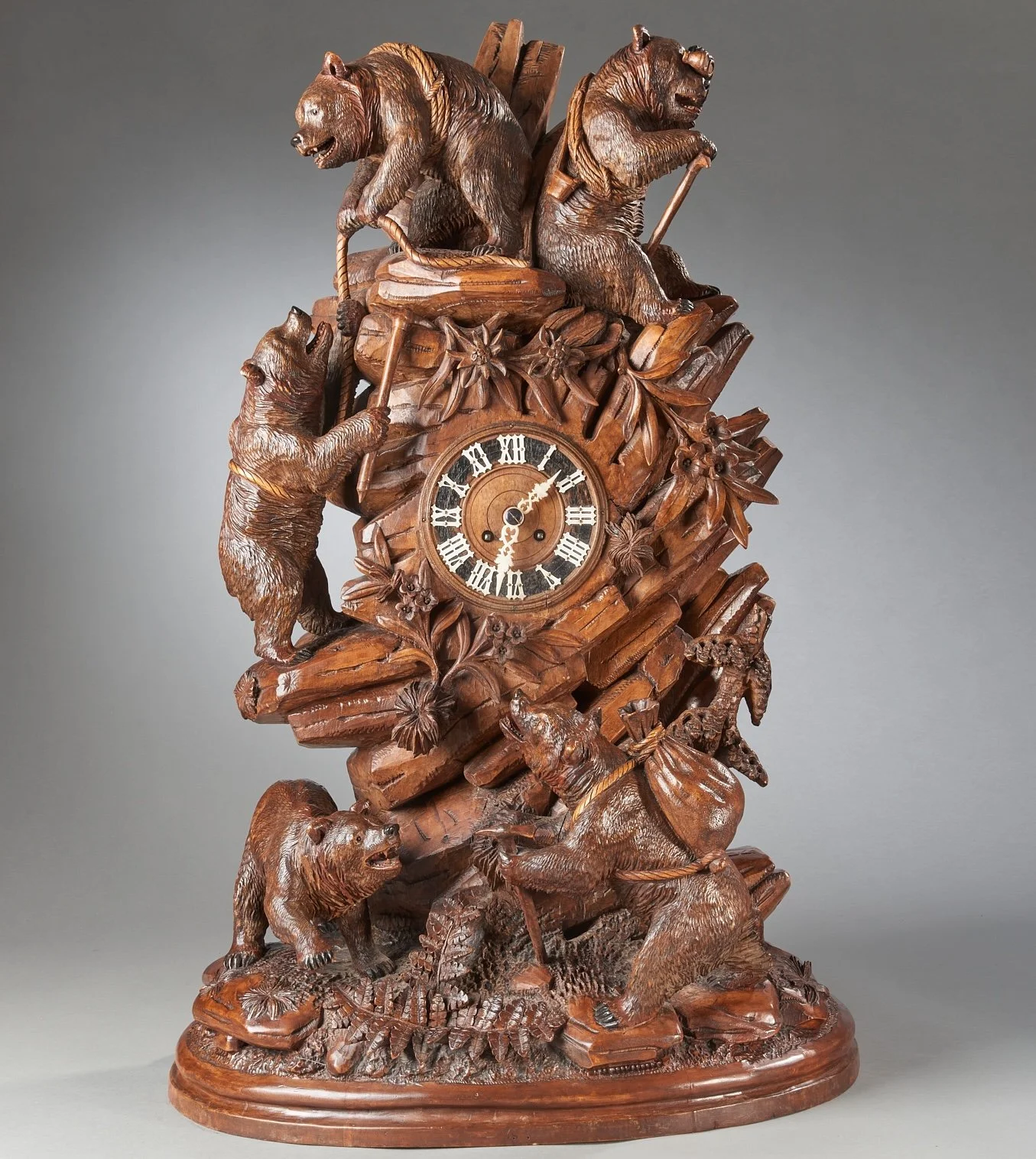
The bear, the boar and the fox — three animals, three registers, one extraordinary tradition. An essay on character, naturalism and comic invention in Swiss Black Forest carving at its height.

A life-sized carved eagle owl, attributed to the Ruef Brothers of Brienz, Switzerland, circa 1880, standing 28 inches high. The bird is carved in linden wood and perched upright on a cut branch rising from a rocky outcrop, the whole cut from a single block with a turned circular base. Ear tufts raised, wings folded, talons gripping the branch, it fixes the viewer with yellow glass eyes set into deeply carved facial discs.
What distinguishes this owl is the treatment of the plumage. Every feather is carved individually and then worked with a heated iron, the edges and barring scorched into the wood so that the graduated breast, the mottled crown, and the darker flight feathers read in tone as well as relief. This burning of the surface is the technique most closely associated with the Ruef workshop, whose birds of prey were a specialty of the Brienz trade, and the attribution rests on that handling together with the composition and the scale. The piece is unsigned.
The head is made separately and lifts off at the neck, a construction the carver has concealed within the ruff of feathers at the throat. It is not hinged, and the body is not hollowed out for use as a tobacco jar or humidor, which is consistent with the piece's size. The separate head allowed the carver to work the face and the body from blocks of different grain, and it is a feature worth knowing when a piece of this model is examined.
Carving of this ambition came out of Brienz in the Bernese Oberland, where the Ruef Brothers worked alongside Johann Huggler, Hans Huggler-Wyss, and Walter Mader in the decades when the international exhibitions at Vienna, Philadelphia, Paris, and Chicago carried Swiss carving to an American and English clientele. We discuss the Ruef workshop and the scorching technique in our article on the masters of the Black Forest, and in the reference we co-authored on the subject, Swiss Carvings: The Art of the Black Forest, 1820 to 1940.