A Swiss-carved linden-wood bear jardinière stand, probably by Rudolf Linder (1885–1972) of Brienz, circa 1905–1935, surmounted by a polychrome glazed earthenware jardinière signed by Delphin Massier (1836–1907) of Vallauris, France.
The bear is carved standing upright, grasping a naturalistic tree trunk with both forepaws, the head thrown back and the gaze directed upward toward the jardinière above, a posture that turns a functional support into a composition with real expressive character. The fur is worked throughout with deeply incised, rhythmic cutting, the texture varying between the dense ruff of the neck, the longer coat of the flanks, and the shorter fur of the muzzle and paws. The two-toned glass eyes, a feature found only on the better carvings of the period, give the face a lifelike directness. The tree trunk is carved with bark texture, knots, and surface variation that integrate it into the composition while providing a structurally resolved column to support the weight above. The whole stands on a substantial base carved to suggest a rocky outcrop. Monumental bear carvings of this type, as illustrated in Swiss Carvings: The Art of the Black Forest, 1820–1940 by Jay Arenski, Simon Daniels, and Michael Daniels (p. 31), were the showpieces of the Brienz workshops, made for the international exhibitions and the grandest private commissions.
The jardinière is by Delphin Massier of the Massier pottery dynasty of Vallauris, one of the leading names in late nineteenth-century French decorative ceramics. The globular form is modeled and painted with poppies, ferns, and botanical ornament in the painterly manner of the Massier workshops, in vivid pinks, greens, and yellows against a cream-and-blush ground, with applied flowers rising from the rim. The contrast between the warm, patinated linden wood and the glazed ceramic gives the composition its balance, each material defining the other by opposition.
The bear comes with an unusually complete history. For decades, it was the centerpiece of the Zryd "Diana" woodcarving store in Interlaken, a business founded in 1837 and run by successive generations of the Zryd family until the early 2000s. A handwritten account by Eveline Nobs-Zryd, dated December 2003 and accompanying the piece, records that the bear was already in the store when the family prepared their centenary catalog in 1935–36, that it always stood at the entrance of the shop where it was seen by many thousands of visitors, and that it was never offered for sale. The family attributes the carving to Rudolf Linder of Brienz and notes that it took the carver more than a year to complete. The letter also records that the bear originally had a pendant, a second bear looking to the right, which was sold to an American buyer before 1953. The present bear was sold by the family only when they decided to wind down the business.
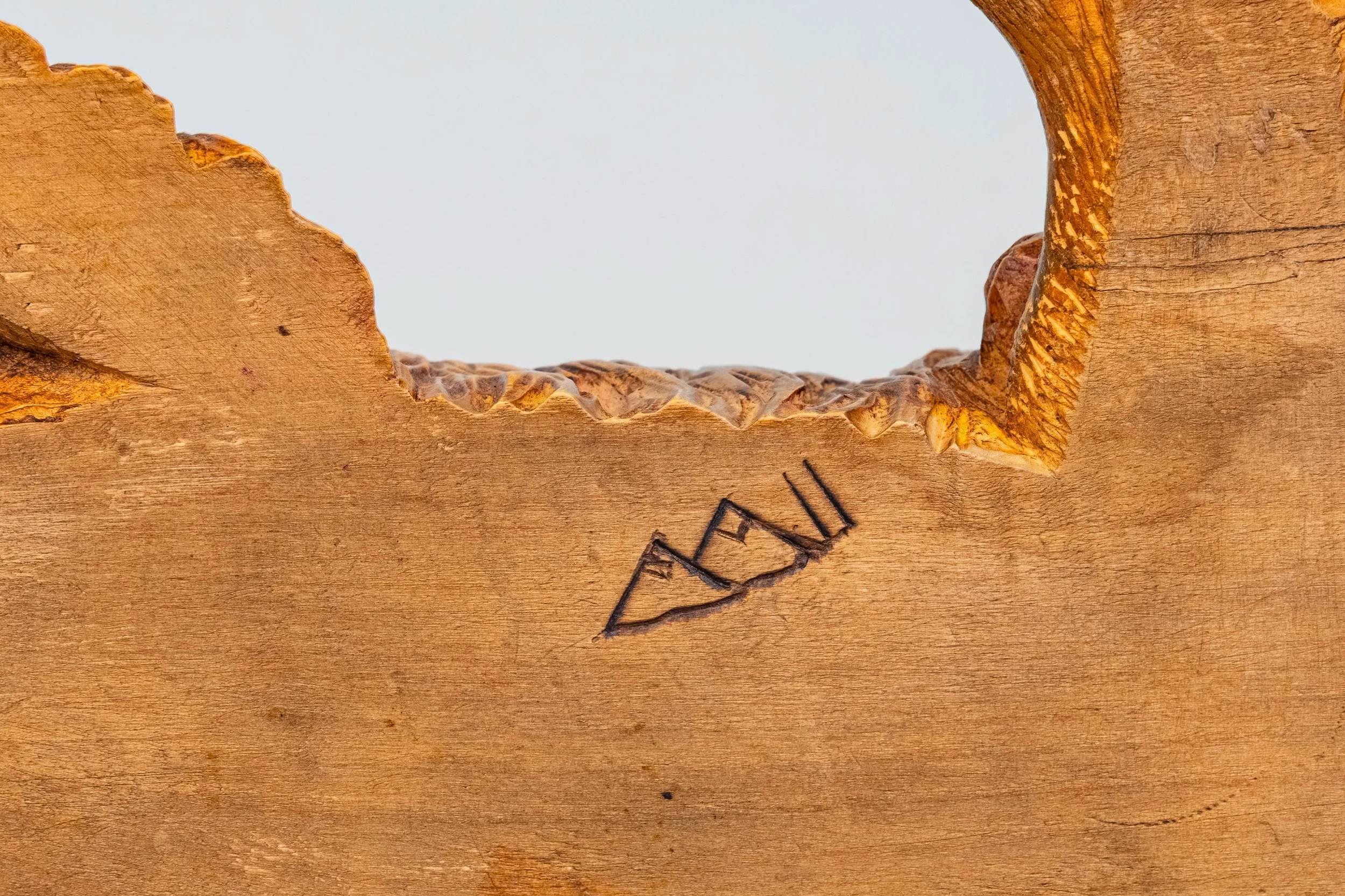
Condition is very good overall. The linden wood is structurally sound throughout, with no cracks, splits, or losses to the bear, tree trunk, or base. The fur carving is fully intact and crisp across all surfaces, and the glass eyes are present and secure. The Massier jardinière is intact, the polychrome decoration is vivid and complete, the applied floral rim elements are undamaged, and the signature of Delphin Massier is present on the base. The carving is unsigned.
Literature: Jay Arenski, Simon Daniels, and Michael Daniels, Swiss Carvings: The Art of the Black Forest, 1820–1940, 2006, p. 31
A Swiss-carved linden-wood bear jardinière stand, probably by Rudolf Linder (1885–1972) of Brienz, circa 1905–1935, surmounted by a polychrome glazed earthenware jardinière signed by Delphin Massier (1836–1907) of Vallauris, France.
The bear is carved standing upright, grasping a naturalistic tree trunk with both forepaws, the head thrown back and the gaze directed upward toward the jardinière above, a posture that turns a functional support into a composition with real expressive character. The fur is worked throughout with deeply incised, rhythmic cutting, the texture varying between the dense ruff of the neck, the longer coat of the flanks, and the shorter fur of the muzzle and paws. The two-toned glass eyes, a feature found only on the better carvings of the period, give the face a lifelike directness. The tree trunk is carved with bark texture, knots, and surface variation that integrate it into the composition while providing a structurally resolved column to support the weight above. The whole stands on a substantial base carved to suggest a rocky outcrop. Monumental bear carvings of this type, as illustrated in Swiss Carvings: The Art of the Black Forest, 1820–1940 by Jay Arenski, Simon Daniels, and Michael Daniels (p. 31), were the showpieces of the Brienz workshops, made for the international exhibitions and the grandest private commissions.
The jardinière is by Delphin Massier of the Massier pottery dynasty of Vallauris, one of the leading names in late nineteenth-century French decorative ceramics. The globular form is modeled and painted with poppies, ferns, and botanical ornament in the painterly manner of the Massier workshops, in vivid pinks, greens, and yellows against a cream-and-blush ground, with applied flowers rising from the rim. The contrast between the warm, patinated linden wood and the glazed ceramic gives the composition its balance, each material defining the other by opposition.
The bear comes with an unusually complete history. For decades, it was the centerpiece of the Zryd "Diana" woodcarving store in Interlaken, a business founded in 1837 and run by successive generations of the Zryd family until the early 2000s. A handwritten account by Eveline Nobs-Zryd, dated December 2003 and accompanying the piece, records that the bear was already in the store when the family prepared their centenary catalog in 1935–36, that it always stood at the entrance of the shop where it was seen by many thousands of visitors, and that it was never offered for sale. The family attributes the carving to Rudolf Linder of Brienz and notes that it took the carver more than a year to complete. The letter also records that the bear originally had a pendant, a second bear looking to the right, which was sold to an American buyer before 1953. The present bear was sold by the family only when they decided to wind down the business.
Condition is very good overall. The linden wood is structurally sound throughout, with no cracks, splits, or losses to the bear, tree trunk, or base. The fur carving is fully intact and crisp across all surfaces, and the glass eyes are present and secure. The Massier jardinière is intact, the polychrome decoration is vivid and complete, the applied floral rim elements are undamaged, and the signature of Delphin Massier is present on the base. The carving is unsigned.
Literature: Jay Arenski, Simon Daniels, and Michael Daniels, Swiss Carvings: The Art of the Black Forest, 1820–1940, 2006, p. 31

 Image 1 of 3
 Image 2 of 3
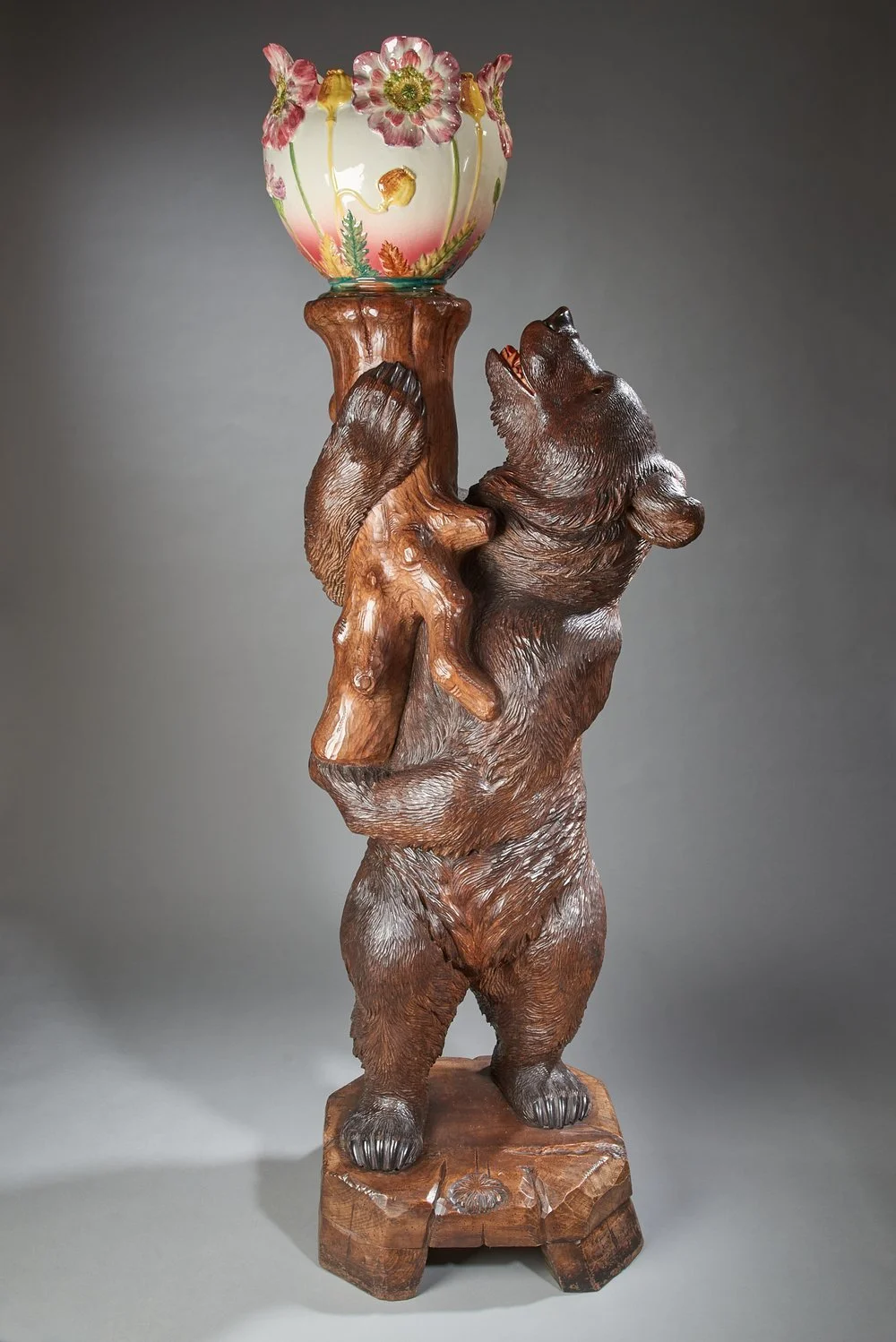 Image 3 of 3