

French Industrial clocks

French Industrial & Antique Clocks
The French industrial clock represents one of the most inventive and visually spectacular achievements of nineteenth-century decorative art — a category in which the mechanics of timekeeping were subordinated to a larger ambition: to celebrate the age of industry, exploration, and science through animated sculptural form. At the forefront of the tradition stood André-Romain Guilmet, the Paris-based clockmaker whose automaton clocks — driven by the pendulum to animate working steam engines, revolving lighthouse lamps, and the rolling decks of battleships — transformed the mantel clock into a kinetic work of art. Guilmet's subjects were shaped by the era's most powerful imaginative forces, Jules Verne above all: the hot air balloon of Around the World in Eighty Days, the submarine of Twenty Thousand Leagues Under the Sea, and the nautical and industrial machinery that defined the age all found expression in his extraordinary clocks. Beyond Guilmet, the broader French industrial tradition encompasses beam engine clocks, windmill clocks, helmsman clocks, lighthouse automata, and the full range of mechanical ingenuity that characterized Parisian clockmaking in the second half of the nineteenth century.
Daniels Antiques has specialized in French industrial and automaton clocks for over twenty years, with particular depth in Guilmet — including beam engine, lighthouse, battleship, and hot air balloon examples — as well as related French industrial forms. Each piece is selected for the quality and functioning of its movement, the completeness of its automaton mechanism, and its overall condition and originality. Pieces are available for viewing by appointment at our galleries in Aspen, Colorado, and Fort Lauderdale, Florida.
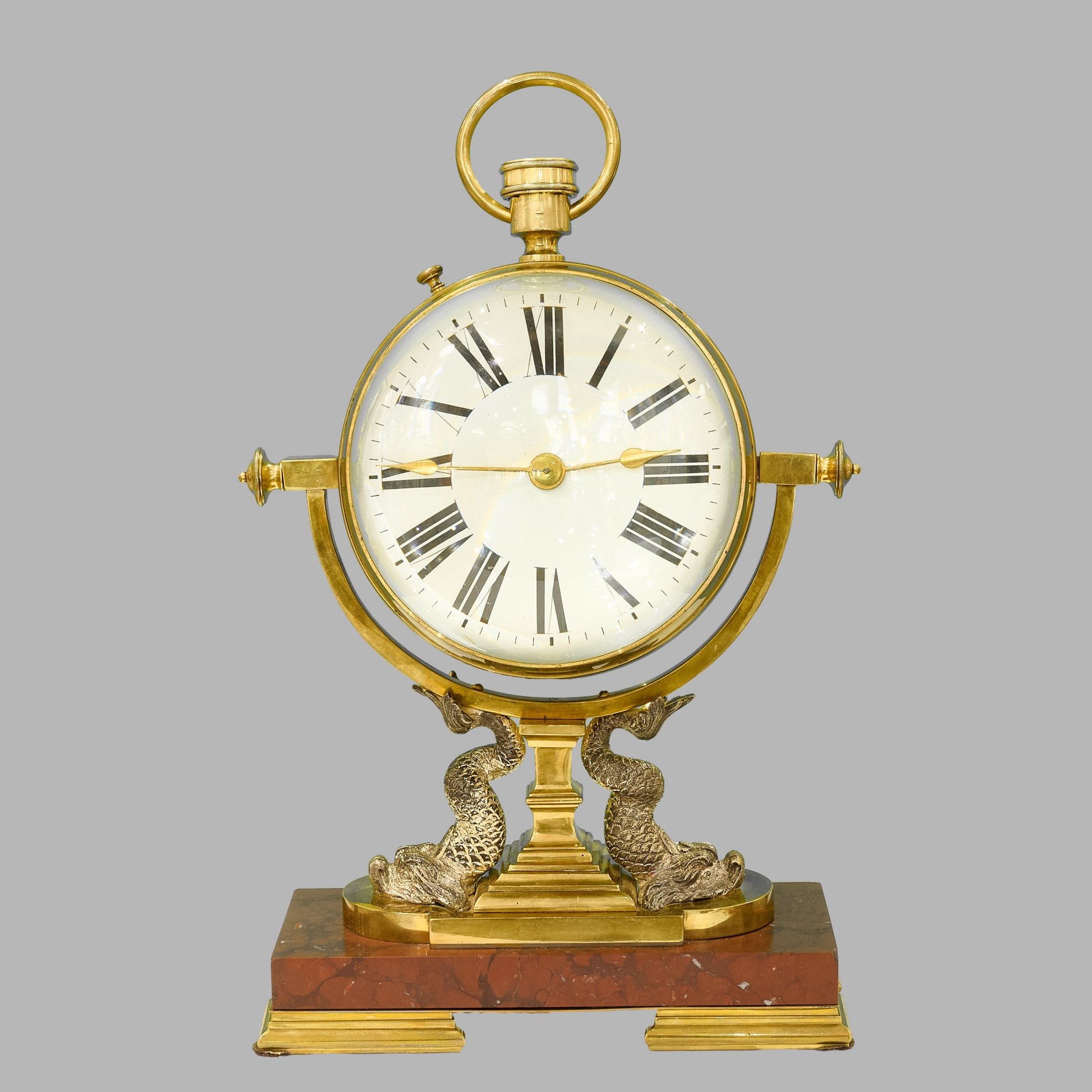
Ball clock, the spherical case glazed to front and back with beveled glass and held within a gilt-brass gimbal ring, raised on twin cast dolphins above a stepped brass plinth, the whole set on a rouge marble base with gilt-brass bracket feet.
The white enamel dial carries black Roman numerals and gilt spade hands within a knurled bezel, the case surmounted by a carrying ring above a turned collar and pivoting between turned finials at the sides. The reverse reveals the gilt spring-driven movement, with the going barrel, gear train, lever escapement, and large balance all visible through the rear glass, a deliberate display of mechanism that places the clock within the period's industrial taste.
Clocks of this kind, taking their subject from machinery and engineering, form the group known to collectors as industrial clocks. They emerged in the second half of the nineteenth century, when a widening public took a keen interest in technical innovation and modernization, and much of their appeal lay in displaying the workings that ordinary clocks kept hidden.

Guilmet French Industrial Automaton Beam Engine Clock, c. 1878
The bell striking movement is by Japy Frères and the beam forms the upper part of a compound pendulum and thus continually rocks to and fro.
Dimensions: H: 9 3?4 (25 cms) Circa: 1878

Automaton Windmill with Barometer and Thermometers. A separate movement in the base drives the sails at will.
Heigh: 21” (53 cms)

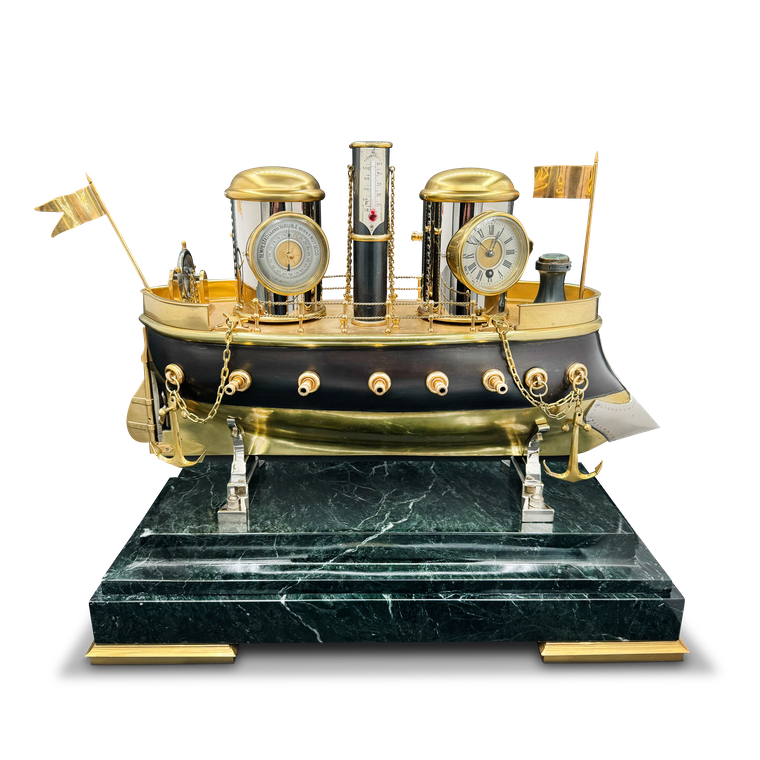
A French Industrial Series compendium in the form of an ironclad battleship, attributed to A.R. Guilmet of Paris, the eight-day clock and aneroid barometer housed in the twin silvered engine drums amidships, a mercury thermometer mounted on the black central funnel between them.
The ship is complete from ram to rudder. The hull, patinated black between polished brass wales, carries a run of brass gun muzzles along each side; the bow ends in a riveted and silvered armored prow of the kind that gave the ironclad ram its menace, and brass anchors hang on their chains at bow and stern. The deck is fitted with rope-twist railings, a capstan, a ventilator cowl, and a pair of brass pennants at the masts, with the clock and barometer drums under domed brass caps, reading as the ship's engine housings. The whole rests on silvered stanchion supports above a stepped verde antico marble base with gilt brass feet.
The Industrial Series was Paris horology's love letter to the machine age: clocks in the form of steam engines, lighthouses, locomotives and warships, produced in the 1880s and 1890s and associated above all with Guilmet, whose nautical group — quarterdeck, lighthouse, torpedo boat, battleship, submarine — stands at the summit of the genre. They were luxury objects from the first, made for the man who wanted the modern world on his mantelpiece, and they remain among the most theatrical of all nineteenth-century clocks. The battleship, bristling with guns and armored at the prow, captures the naval moment exactly: the decade when the world's fleets traded sail for steam and steel.
Condition: Exceptional - restored condition.
Literature: Derek Roberts, Mystery, Novelty and Fantasy Clocks, Atglen, 1999, pp. 253–270, for the Industrial Series.

Set on a square red marble base, the lighthouse, of truncated pyramidical form, is in bronze 'architectural brickwork', housing the circular enamel clock face, (the hours delineated in Roman numerals); false doors and window to the front, surmounted by a. spindled gallery and the domed rotating glass lighthouse.
The two train, 8 day movement houses a Brocot power-saving escapement, regulated by a torsion pendulum driving a helical spring, which spins the rotating red and green warning lights, operating when the hours are struck, on the gong.
Numbered GLT/1415, it is complete with the original key
Andre Romain Guilmet ( 1827-1892)
A horologist, noted for his Mystery' and 'Industrial design' clocks was employed by the prestigious Maison Christofle, as a gilder and jeweller, before starting his own business.
An exhibitor at the Paris Univeral Exhibition of 1867, his 'Industrial Design and Mystery' clocks were lauded.
Guilmet was obviously inspired by Jules Verne, as Balloons, Locomotives and Submarines as well as early cars are included in his oeuvre, which feature in '20,000 Leagues Under the Sea' & 'Around the World in 80 Days'.
The Victoria & Albert Museum, British Museum and the Royal Museum Greenwich show examples of his oeuvre.
Circa 1885
Bibliography;
'Mystery, Novelty and Fantasy Clocks' by David Roberts published Schiffer, 1999.

A splendid functioning automaton clock of a hot air Balloon made by Andre Romain Phileas Guilmet of Paris
Andre Romain Phileas Guilmet !1818-1892) was a horologist famed for his' 'Mystery' and ''Industrial Automata Clocks'. He exhibited at the 1867 Paris Exposition Universelle, to great acclaim.
His rangle of 'Industrial Automata ' clocks included our Hot Air Balloon, a train and a boat- all of which feature in Jules Verne's 'Around the World in 80 Days' published in Paris in 1872- and, the hero of the book, Phileas Fogg, echoed his own rather unusual Christian name!. And, following Verne's fiction, he made an Industrial Automata clocks involving Captain Nemo's submarine 'The Nautilus' from ''20,000 Leagues Under the Sea'.
Parisian directories of the period record him as a 'watchmaker, clockmaker, jeweller, gilder, as well as a prominent member of the Chambre Sydnicale, the overseeing body to ensure good Parisian business practice.( Phew Simon, I had better have a lie down- all that work made me feel exhausted)
Our clock has a clock set into one side of the balloon, and rotates to display a barometer on the other.
We date it to circa 1880

An Automaton “Locomotive” with barometer on the boiler and thermometer and compass on the funnel.
DIMENSIONS: H: 17.5” (44.5 cms) CIRCA: 1910

Guilmet French Industrial Mortar Clock. With Marble Base And Brass Accents. Circa 1880’s

Clock with automated steam pump. It has a large flywheel with piston and a governor on top which are driven by a substantial movement housed in the base.
DIMENSIONS: H: 16.5 in (42 cms)
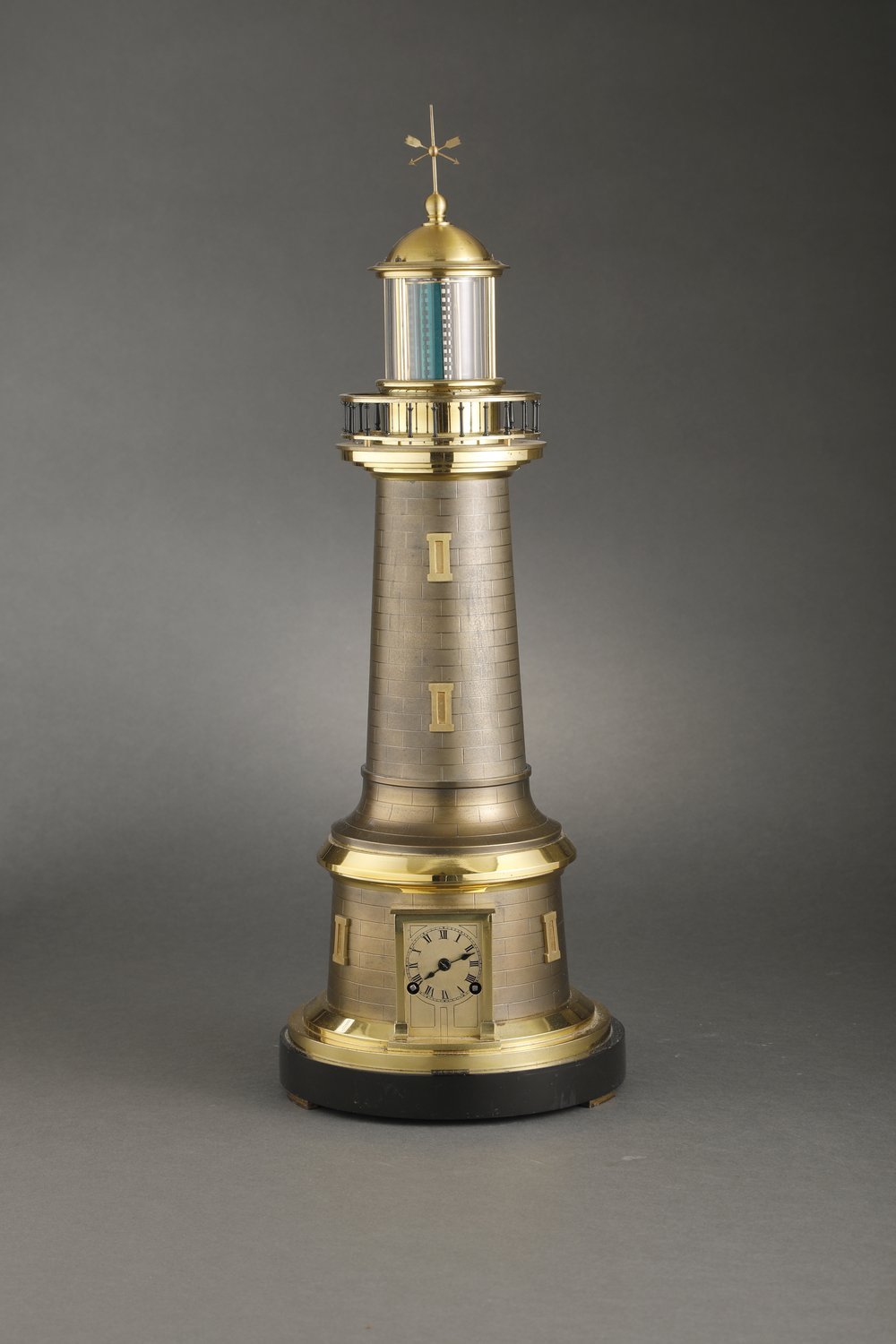
Guilmet No. 1246 A Lighthouse Clock. Circa 1885. The bell striking movement with Brocot escapment employs a helical torsion spring pendulum set with colored glass to simulate the flashing light.
H: 21” (53 cms)
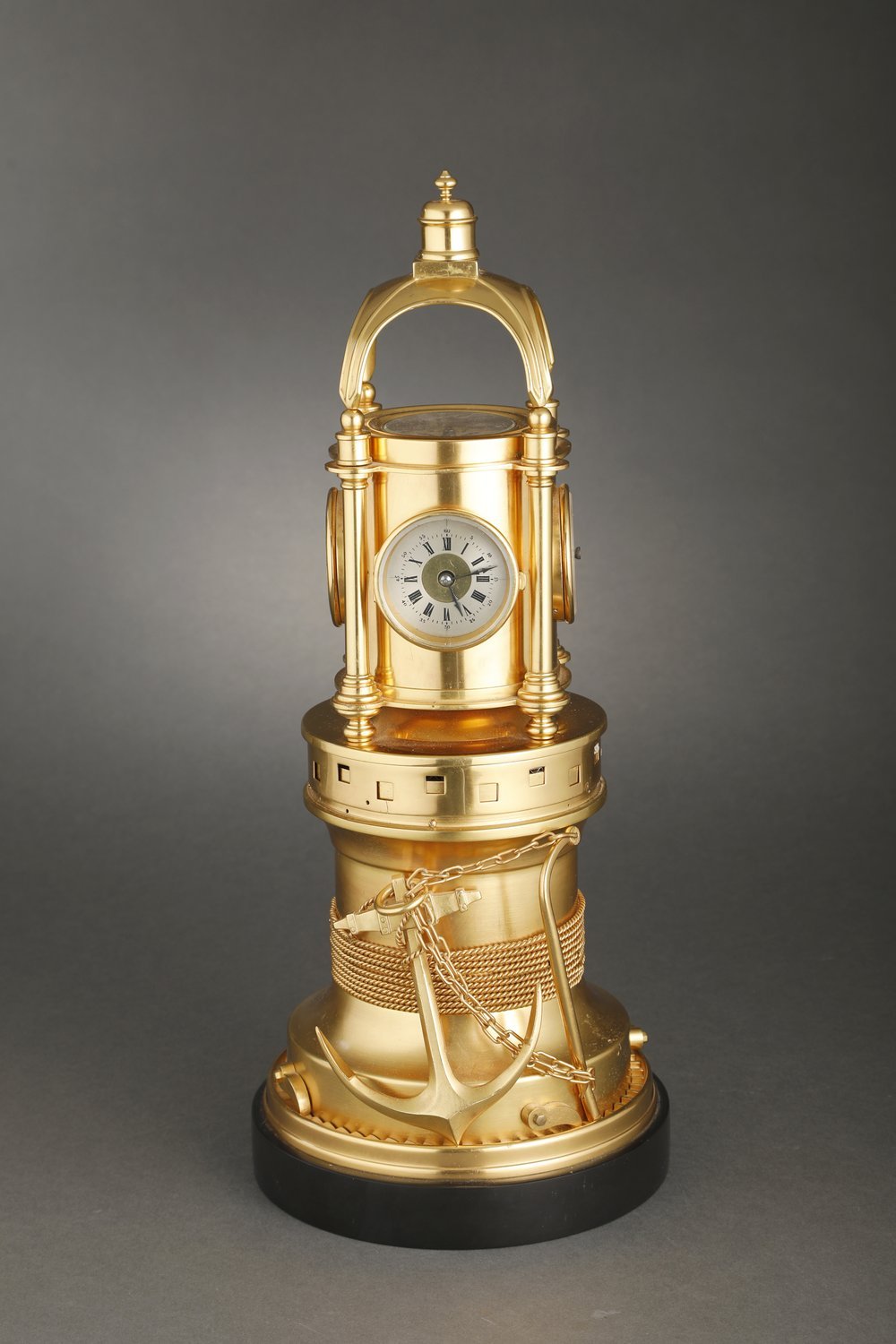
Silvered and Bronze Mantel Time Piece With Revolving Lanter. Circa 1890. The Bollard, wrapped with a hawser and mounted with an anchor, lifebelt, davits and ratchet mechanism has mounted above it a lantern which rotates, containing a double dialled timepiece, barometer, thermometer and compass.
Height: 20” (51 cms)

Automaton French Industrial Helmsman Clock, c. 1893. “A Ships Stern” or “Quarter Deck” clock. Examples of these have been seen dated 1880 and 1886.

Constructed in the form of a Dockside Winch Crane loading a barrel, which houses the enamel face clock, with hours delineated in Roman numeralsclock, all mounted on a polished mahogany platorm dressed with ogee bronze feet.
Andre Romain Guilmet ( 1827-1892)
A horologist, noted for his Mystery' and 'Industrial design' clocks, was employed by the prestigious Maison Christofle, as a gilder and jeweller, before starting his own business.
An exhibitor at the Paris Univeral Exhibition of 1867, his 'Industrial Design and Mystery' clocks were lauded.
Guilmet was obviously inspired by Jules Verne, as Balloons, Locomotives and Submarines, as well as early cars are included in his oeuvre, which feature in '20,000 Leagues Under the Sea' & 'Around the World in 80 Days'.
The Victoria & Albert Museum, British Museum and the Royal Museum Greenwich show examples of his oeuvre.
Circa 1885
Bibliogarphy;
'Mystery, Novelty and Fantasy Clocks' by David Roberts published Schiffer, 1999.
A French Industrial Series automaton clock in the form of a submarine, by André Guilmet, Paris, circa 1890. The black patinated hull, riveted throughout, rides atop a cast-bronze sea on an oval plinth of green onyx with a gilt rim. The silvered conning tower houses the movement behind a gilt-bezelled enamel dial, and the deck carries a full complement of fittings in gilt and silvered bronze: boarding ladders, railings, an anchor with chains, a copper vent cowl, a binnacle compass, and a stern davit crane with a winding wheel. A funnel-form thermometer stands amidships, its scale printed in English, indicating an example made for the export market. It measures 23 inches long, 15 inches high, and 10 inches deep, 58.5 by 38 by 25.5 cm.
The clock is a two-motion automaton. When wound, the conning tower rotates, and the stern propeller turns beneath the counter, both driven by the same train that powers the clock, so the vessel is animated whenever it is running.
The submarine is the rarest subject in Guilmet's nautical group, which also included a quarterdeck, a lighthouse, and a battleship. When this model was designed, no such vessel existed in service yet, and its true ancestor is literary. Jules Verne's Twenty Thousand Leagues Under the Sea of 1870 gave the public the Nautilus, an elongated cigar-shaped hull of riveted plates with a raised pilot house and a platform where Captain Nemo takes the air, and the illustrations by Alphonse de Neuville and Édouard Riou for the first illustrated Hetzel edition fixed that image in the popular imagination. The clock reads as the Nautilus made domestic, the same spindle hull, raised tower, and railed deck, translated to the drawing room. Reality only caught up afterward: France launched the Gymnote, her first working electric submarine, in 1888, and the larger Gustave Zédé followed in 1893. This is a mythical ship assembled from the fittings of real ones, machinery presented as spectacle.
The example survives in exceptional condition, the gilding bright, the patina unrubbed, and the chains and deck fittings complete. The series is discussed in Derek Roberts, Mystery, Novelty and Fantasy Clocks, 1999, pp. 253-270.