

Weaponry & Armor
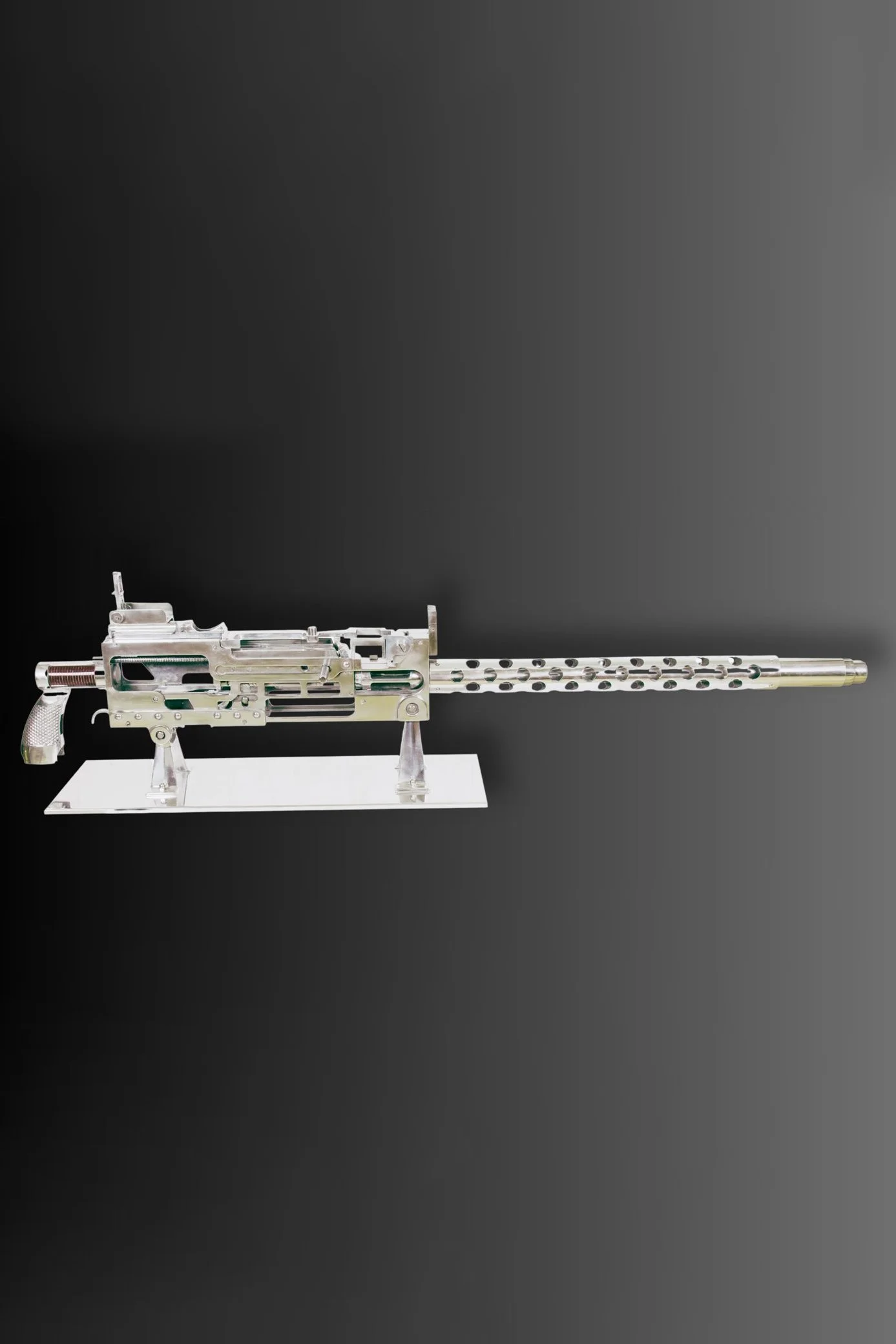
Hand-Polished Browning Machine Gun, the piece been stripped of any paint and has been expertly hand-polished, in its original state this gun was color coded to highlight and better reveal the circle of operation of the gun and the movement of the active parts. Now, this piece serves as a piece of artwork in its beautiful metallic finish. This sculptural, historical, and functional piece will work in most decors, as even though its history qualifies it as mid-century vintage, the metallic polished look gives it a contemporary edge. (2 in Stock)

A Pair of English Miniature Brass Cannons, dated 1880. Each cannon is stamped No 1 & 2, London GB. Dimensions: L:11”

Cast at the Kiangnan Arsenal, Dated (in translation of the Daoist cyclical system) June 1866 and January 1867 respectively. Each of non-tapering tubular construction, with a prominent raised muzzle-ring carrying the fore-sight, a recessed reinforce with drilled vent and terminating in a base-ring. The base-rings of each barrel engraved with a lengthy inscription in both complex and simplified Chinese characters, including the arsenal inspector’s name “JIANG NAN ZHI ZAO ZONG JU” together with the respective dates of inspection. The base-rings also each fitted with adjustable back- sight retained by a small bronze bracket and knurled threaded screw. Each with prominent button cascable, a pair of trunnions at the median point, and each preserved in fine crisp unpolished condition with a natural light green patina throughout. Each on its original brass-mounted carved hardwood truck carriage, with bronze cap- squares over the trunnions, elevating screw on a bronze spool-shaped casing, and the sides of the carriages carved in relief with elaborate panels of scrolling dragons emerging against a field of stylized clouds.
PROVENANCE: Lowther castle, Cumbria, seat of the Earls of Lonsdale. Included in the five-part dispersal auction of the castle contents conducted by Maple & Co., 17th April 1947, lot 558, sold for £140.
DIMENSIONS: Overall length: 122 cm / 48 in Height: 60 cm / 23.6 in Width: 52 cm / 20.5 in
A cased pair of flintlock dueling pistols by John Manton of Dover Street, London, 1794, illustrated in Neal and Back's standard work on the Mantons. Each browned octagonal barrel is signed in inlaid gold MANTON LONDON, with finely checkered butts, silver oval escutcheons at the wrists, and the restrained, perfectly balanced architecture for which Manton duellers were prized: instruments built for a steady hand at first light, without ornament to distract from function.
The pair carries Manton's "secret" scratch rifling — the grooving of the bore is too shallow to be seen at the muzzle, giving the accuracy of a rifled barrel while the pistol passes as a smoothbore. A dueling pistol with visible rifling was considered unsporting; the scratch-rifled Manton was the connoisseur's quiet advantage, and surviving pairs are keenly sought.
The pistols are housed in their mahogany case, lined in green baize, the lid bearing the trade label of John Manton & Son, Gun Makers to the Prince Regent and the Duke of York, No. 6 Dover Street — the firm's later label — the case having remained in service with the pistols. The case retains its loading rod with brass worm, two lidded compartments with turned bone pulls, and bone diamond escutcheons to the front. Dueling pistols by the Manton brothers stand at the summit of English gunmaking, and a published, cased pair of this completeness ranks among the most desirable of all antique arms.
Condition: exceptional.
Literature: W. Keith Neal and D.H.L. Back, The Mantons: Gunmakers, London, 1966, this pair illustrated.