

vintage lighting
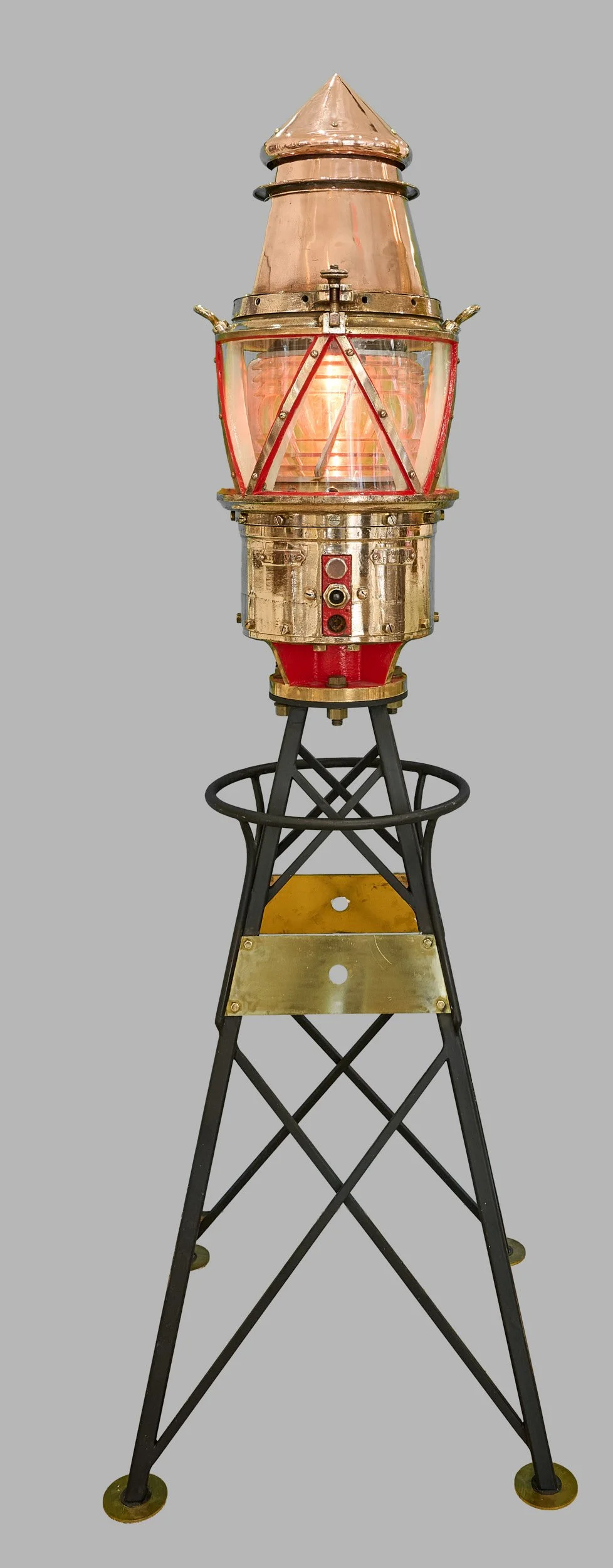
A matched pair of antique harbor channel marker beacon lights — red to port, green to starboard — in brass and copper with original painted ironwork, retaining the international color convention that has governed safe navigation into harbors and channels for over a century. Together, they constitute a complete navigational installation, and their survival as a pair in original condition makes this an exceptional acquisition.
Each beacon is constructed with a hand-raised copper conical chimney above a brass collar and rotating mount, the lamp housing glazed with triangular Fresnel panels in original red and green, respectively, the lower body in brass with original red-painted cast-iron fittings and a control mechanism. The original kerosene burner assemblies have been preserved. The beacons have been sympathetically electrified for display while retaining full original integrity.
The red and green channel marker convention — port to left, starboard to right — was codified in international maritime law in the nineteenth century and remains the global standard. These beacons were manufactured at the height of the great age of harbor engineering, when the expansion of commercial shipping across European and colonial ports drove demand for precision navigation equipment of the highest order. A matched red-and-green pair in this state of preservation, retaining original paint and burner mechanisms, is an exceptional survivor.
Presented on a later sympathetic iron-lattice display stands with brass fittings.
Electrified. Original kerosene burner mechanisms preserved. Original paint throughout.
Dimensions: Lamp head approximately 36”. Overall height on stand 73”.
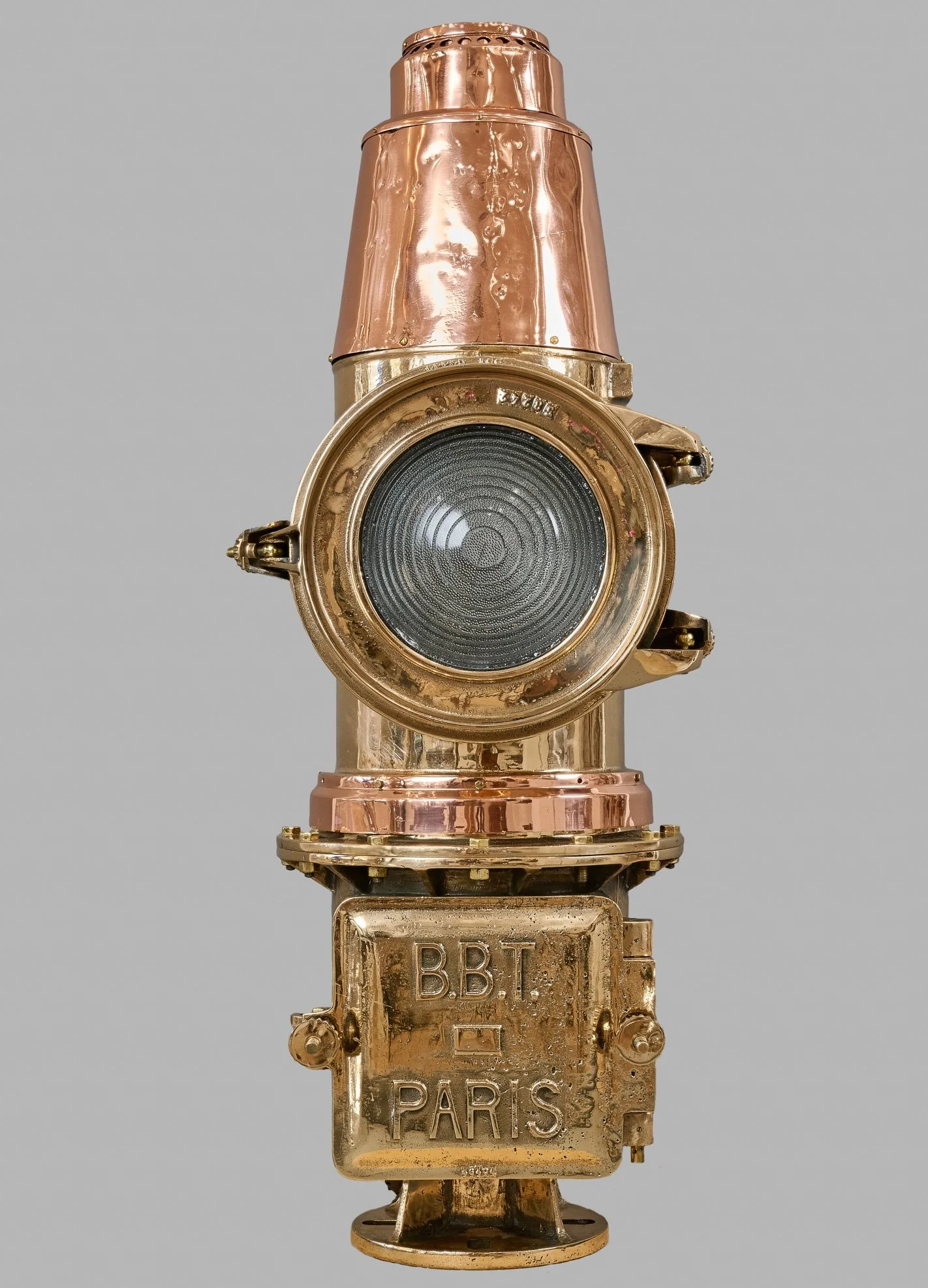
A monumental port leading light in brass and copper by Barbier, Bénard et Turenne of Paris — the world's pre-eminent manufacturer of lighthouse optics and maritime navigation equipment from the late nineteenth century until the firm's dissolution in 1982 — retaining its original Fresnel bullseye lens in perfect condition and all original fittings throughout. A piece of exceptional scale, presence, and historical significance.
The leading light was one of the most critical instruments for safe harbor navigation. Positioned at fixed points onshore — typically in pairs, at different elevations — leading lights guided vessels through channels and into port by alignment: when a mariner kept the two lights in vertical register, the vessel was on the correct approach. The Fresnel bullseye lens, with its characteristic concentric stepped rings ground to concentrate and project a beam of maximum intensity over the greatest possible distance, was the optical technology that made this possible. The lens in the present example is in remarkable original condition — the concentric ring formation crisp and undamaged, the glass clear, the brass housing retaining its serial number, 58242, stamped into it.
The construction is of the highest order. The upper section is formed in hand-raised copper — the conical chimney with its vented crown managing heat from the kerosene burner below, above a rotating brass collar, and the substantial brass lens housing with its hinged adjustment brackets. The lower body is a cylindrical brass fuel reservoir with a pressure gauge, adjustment valves, and service fittings, all intact, seated on a cast brass mounting flange pierced with bolt holes, attesting to the light's former installation on a harbor structure. The combination of polished brass and copper produces a visual authority entirely appropriate to an instrument designed to be seen and trusted at a distance in all weathers.
Barbier, Bénard et Turenne — founded in Paris in 1862 by Frédéric Barbier and Stanislas Fenestre, and reaching its final name in the early twentieth century — supplied lighthouse and harbor navigation equipment to ports across France and the French empire, and was the world leader in lighthouse construction in the late nineteenth century. Their equipment guided ships into every major French port for over a century.
Height approximately 45 inches. All original, including the Fresnel lens. The brass and copper have been polished. The mounting flange retains its original bolt holes, confirming active port installation. The lens housing is stamped with the original serial number 58242, which may be traceable in French maritime records to a specific port installation.
Marks: B.B.T. Paris, cast into the brass fuel housing.
Dimensions: Height approximately 48”.
Comparable: A 6th order copper and brass navigation light by B.B.T., circa 1900, made for the harbor of Rouen, 137 cm, Hatchwell Antiques, London.
Literature:La lumière au bout du monde: Barbier, Bénard, et Turenne, Constructeurs de Phares, Ecomusée d'Ouessant; Philippe Bénard and Francis Dreyer, Une aventure industrielle française: BBT 1862–1984, Du Palio (the full company history covering equipment records and serial number ranges by period).
Research note: The serial number 58242 stamped on the lens housing may be traceable through the archives of the Service des Phares et Balizes (1685–2008), held at the Archives Nationales, Paris, under catalog references F/14. Inquiries may establish the specific port installation for which this light was manufactured.
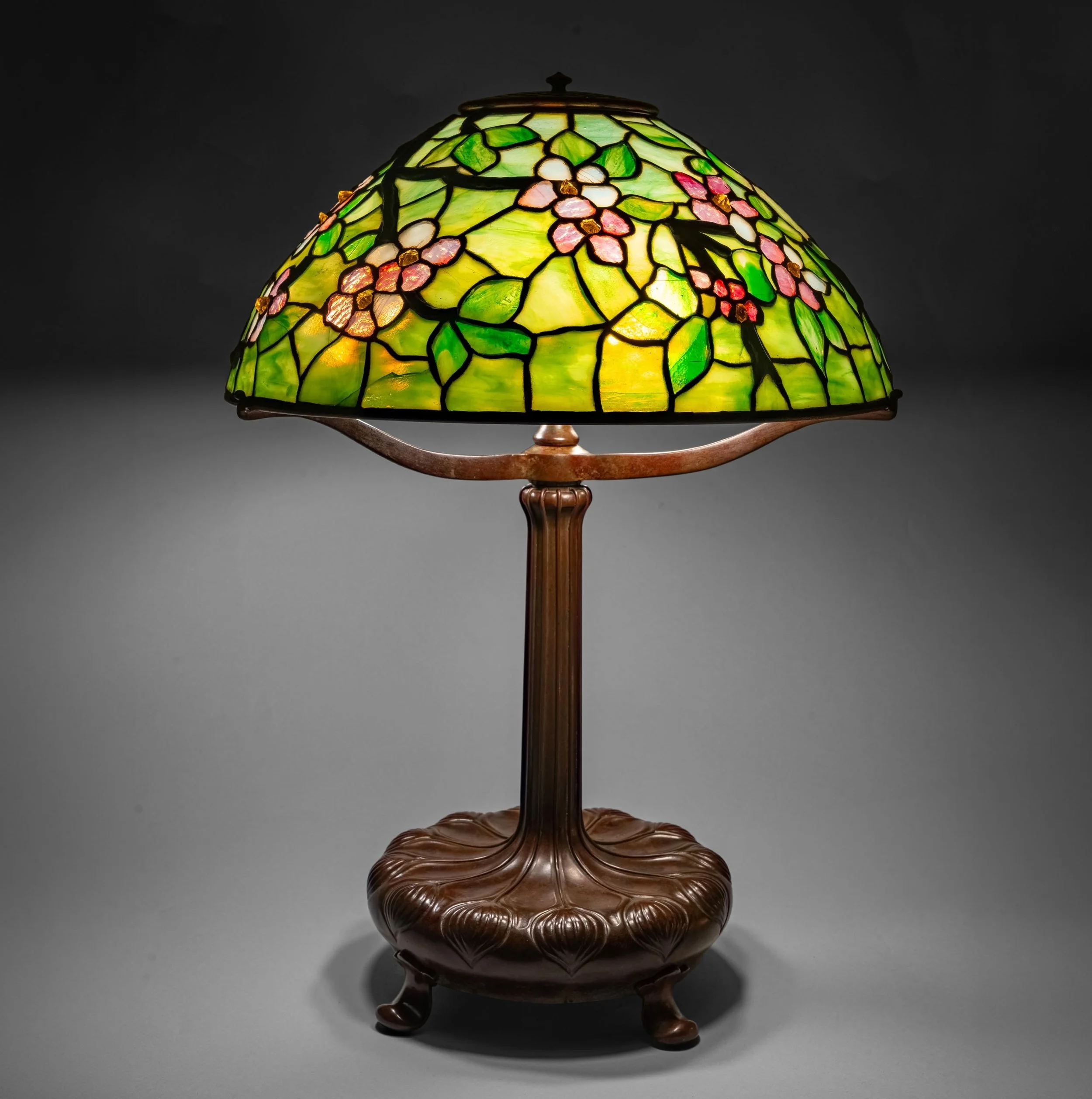
A leaded glass and patinated bronze Apple Blossom table lamp by Tiffany Studios, the domed 16-inch shade with raised branches against a ground of opalescent glass graduating from milky white at the crown to apple green at the base. The flowers are rendered in granite-backed glass, with petals transitioning from white to pink, deeper-pink buds, and rare yellow chunk-jewel glass centers of exceptional brilliance — a combination of techniques indicating a special-order piece of considerably higher specification than standard production. The patinated bronze cushion is on four feet. Stamped to the shade rim: Tiffany Studios New York
Shade diameter: 16 in.
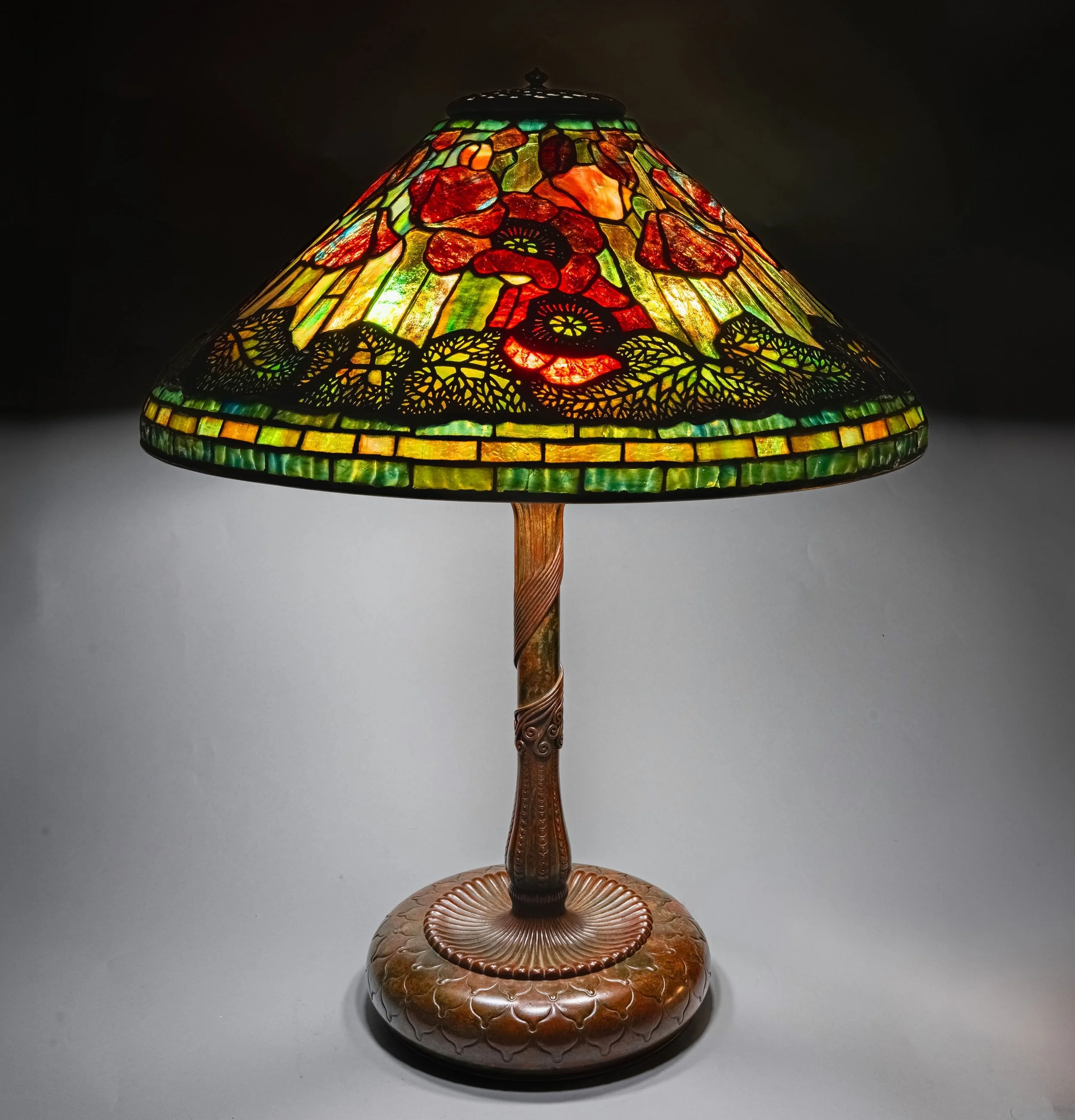
A leaded-glass and patinated-bronze Poppy table lamp by Tiffany Studios, the conical 20-inch shade set with large open poppy blooms in deep crimson and scarlet, through orange and amber, the petals rendered in granite-backed glass of exceptional reflective depth, against radiating background panels in golden yellow shifting to green and blue. A lower border of densely leaded poppy seedheads and foliage in olive and yellow-green completes the composition above a geometric iridescent apron. The shade carries two distinct compositions on opposite sides — a practice Tiffany employed in his finest floral lamps so that the piece could be rotated with the seasons. The twisted rope stem rises from a heavily chased circular foot decorated with poppy leaves, the original patina of rich brown and verdigris green of exceptional quality. Stamped to the shade rim: Tiffany Studios New York, no. 1531-24.
Shade diameter: 20 in
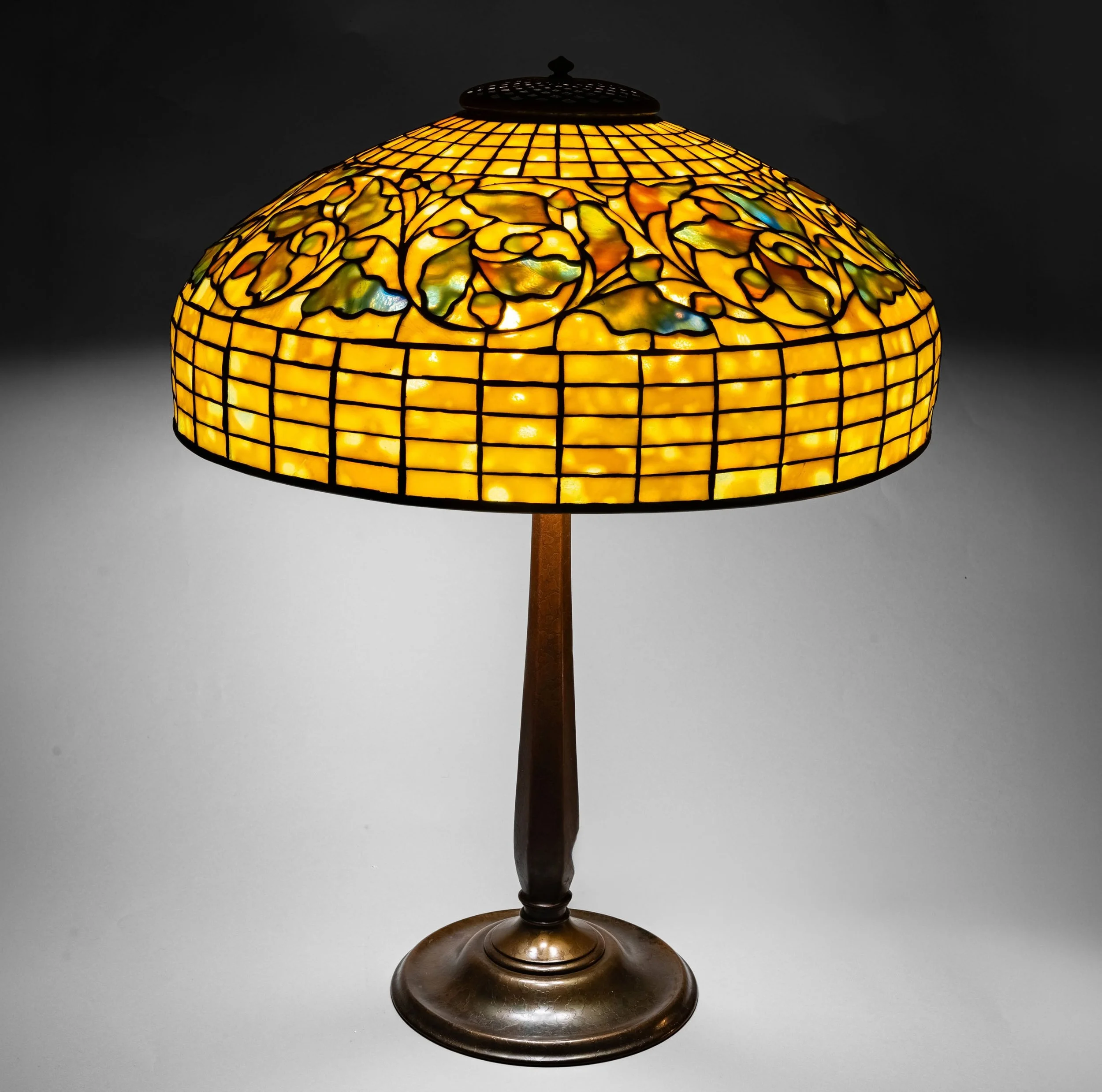
A leaded glass and patinated bronze Swirling Oak Leaf table lamp by Tiffany Studios, the domed 18-inch shade set with richly mottled amber glass tiles in a geometric grid, with a broad swirling border of oak leaves and acorns rendered in extraordinary iridescent glass ranging from deep amber and orange through olive green to flashes of cobalt blue. The quality of the glass is exceptional — each leaf individually selected for color and texture, the iridescent surface shifting and deepening as the light moves across it. The slender patinated bronze column base rises from a stepped circular foot. Stamped to the shade rim: Tiffany Studios New York, no. 600.
Shade diameter: 18 in. (45.7 cm.)
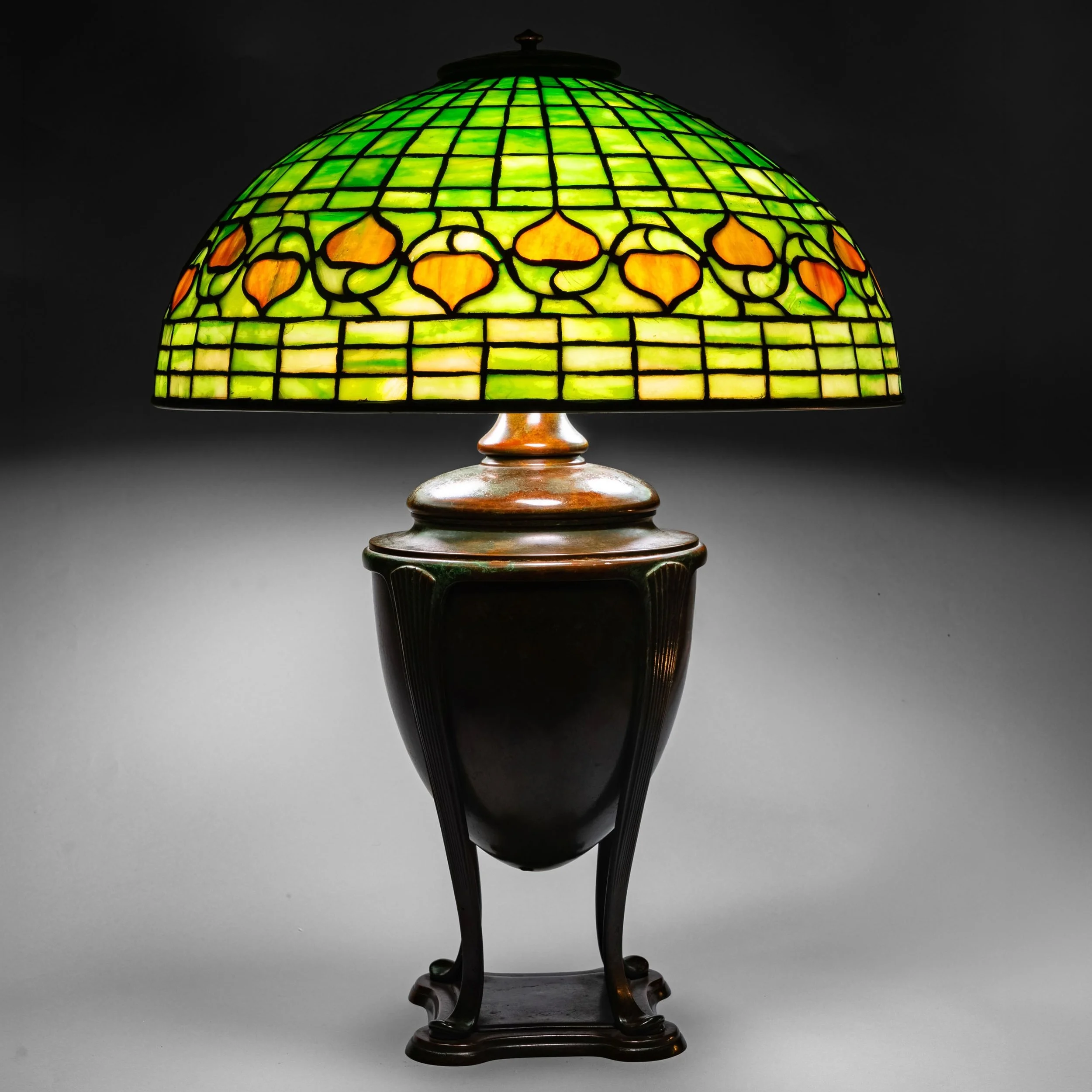
A leaded glass and patinated bronze Vine Border table lamp by Tiffany Studios, the domed 16-inch shade set with mottled green and yellow-green glass tiles in a geometric grid, with a continuous border of amber and orange leaves on sinuous vine stems encircling the lower register. The glass transitions from deep emerald at the crown to yellow-green at the apron, becoming luminous citrus and amber when lit. The patinated bronze Greek urn base on four cabriole legs with a shaped platform foot is an early transitional form from the period when Tiffany Studios was converting its lamp designs from kerosene to electricity. Urn base no. 185. Stamped to the shade rim: Tiffany Studios New York.
Height: 21½ in. / Shade diameter: 16 in.
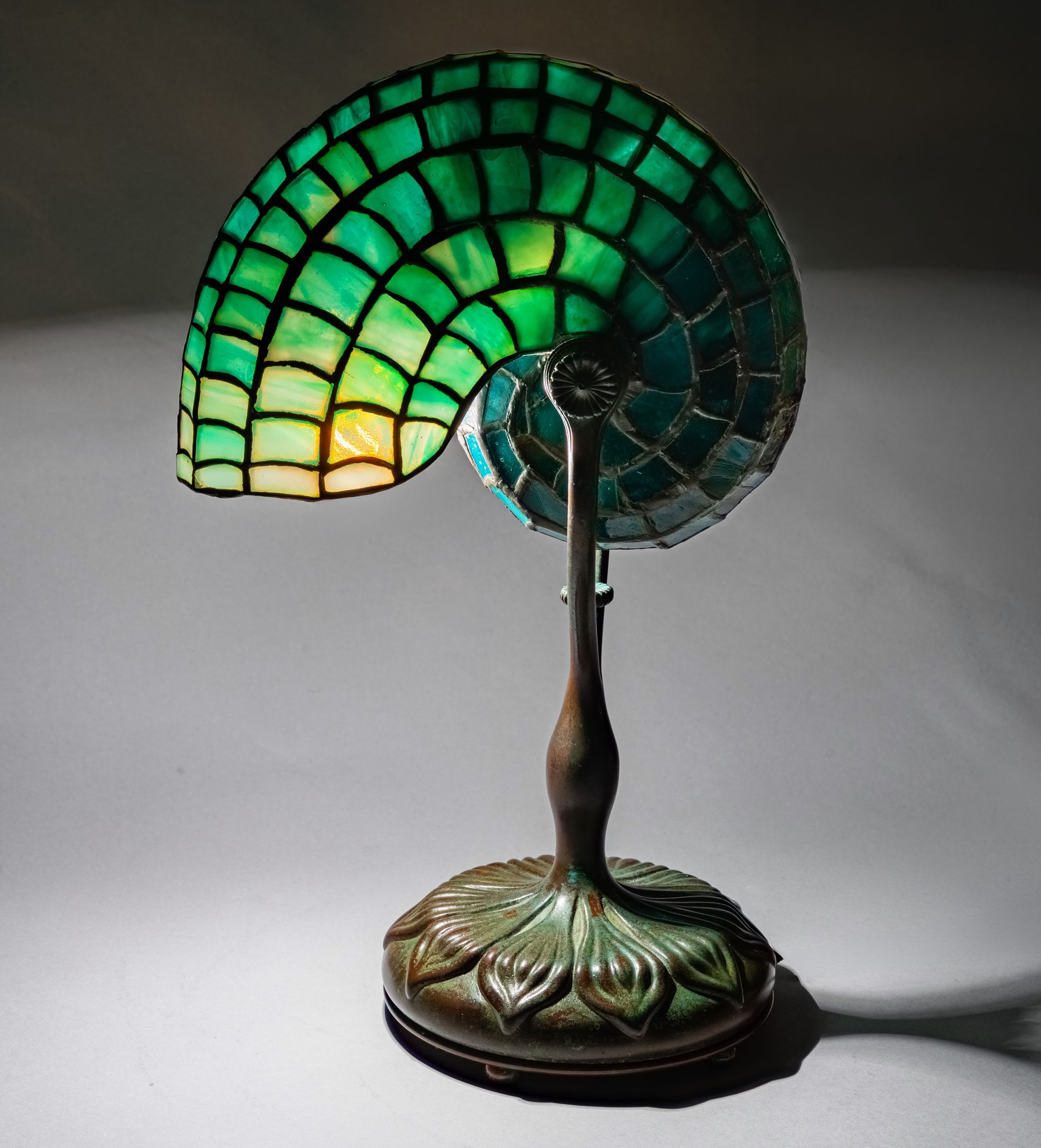
A leaded glass and patinated bronze Nautilus table lamp by Tiffany Studios, the shade constructed from glass tiles arranged in the precise logarithmic spiral of a nautilus shell, graduating from deep emerald and teal at the crown through luminous yellow-green at the center to soft cream-white at the open mouth — a color sequence that transforms entirely when lit. The patinated bronze base is cast in low relief, the slender stem curving upward to a raised floral boss at the shell's axis point. An early example of one of the most distinctive and sought-after of all Tiffany lamp designs, first patented on May 2, 1899, and exhibited that same year at Siegfried Bing's landmark Tiffany exhibition at the Grafton Galleries, London. Stamped to the underside: Tiffany Studios New York, no. 28537.
Height: 14 inches.
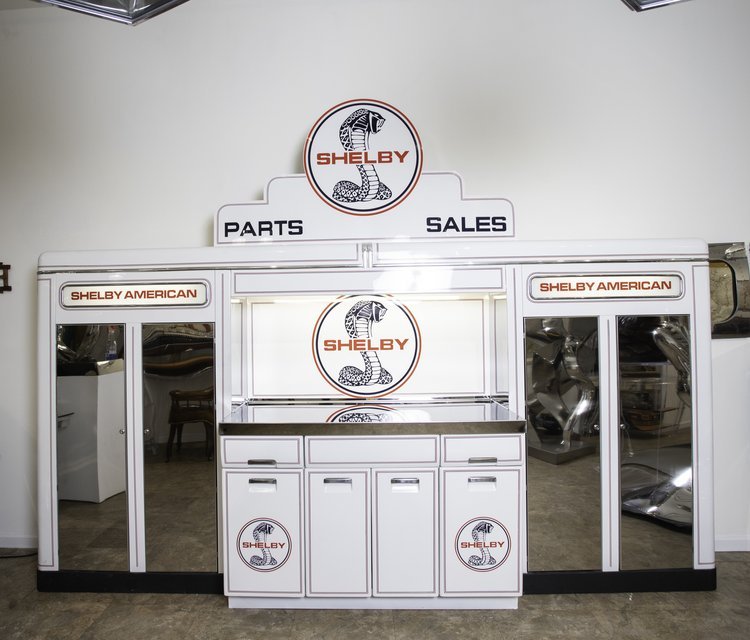
This original 1960s Shelby workstation has been fully restored to provide the perfect retro look.
Carroll Shelby had a real need for speed. Winning his first race in 1952 in a MG-TC got his road racing career on a fast track. Soon Shelby was driving Ferrari and Maserati sports racing cars. He won 12 races in two years. Impressed by his driving talents, Shelby was invited to join the Aston Martin factory team in 1954.


Pair of 1930’s Art Deco Floor Lamps
Illuminate your space with the elegance and sophistication of these exquisite 1930’s Art Deco Floor Lamps, a stunning pair that embodies the iconic design principles of the Art Deco era. Crafted during the golden age of design, these lamps exude timeless charm and showcase the distinctive aesthetic of the period.
Enhance your home with the timeless elegance of Art Deco design by adding these exquisite floor lamps to your interior decor. With their iconic style and enduring appeal, they serve as both functional lighting fixtures and exquisite works of art that celebrate the beauty of a bygone era.

Matched pair of harbor channel marker beacon lights — red to port, green to starboard — in brass and copper with original painted ironwork, retaining the international color convention that has governed safe navigation into harbors and channels for over a century. Manufactured circa 1890–1905, at the height of the great age of harbor engineering, these beacons formed a working installation, signaling left and right to vessels entering a harbor or channel. Their survival as a matched pair in original condition is exceptional.
Each beacon is constructed with a hand-raised copper conical chimney and ventilating collar above a heavy cast brass lamp housing, the cylindrical body glazed with Fresnel panels in original red and green, respectively, retained by diagonal brass straps and original red-painted iron banding. The lower body tapers in a barrel shape with heavy brass-stave construction and a cast base with an integral fuel fitting. The original kerosene burner assemblies are preserved intact. The beacons have been sympathetically electrified for display while retaining full original integrity.
The red and green channel marker convention — port to left, starboard to right — was codified in international maritime law in the nineteenth century and remains the global standard. Beacons of this pattern were produced for harbor authorities and port commissions across Europe and their colonial networks, and installed at quay heads, breakwater terminations, and channel entrances to guide commercial and naval shipping in all visibility conditions. A matched working pair in this state of preservation, retaining original paint, glazing, and burner mechanisms, is an exceptional survivor.
Electrified. Original kerosene burner mechanisms preserved. Original paint throughout.
Price on application.