

Expertise in Exclusive Antiques
About us
Daniels Antiques was founded in 1978 by Michael Daniels, whose lifelong passion for exceptional objects established the standard by which the business has operated ever since. Now in his eighties, Michael remains connected to the business he built — a testament to a devotion to the antiques world that has never wavered. What began as a single-minded pursuit of the finest rarities has grown, over nearly five decades, into one of America's most respected luxury antiques businesses, with galleries in Aspen, Colorado, and Fort Lauderdale, Florida.
The business is today run by Michael's two sons, each bringing a distinct and complementary expertise. Simon Daniels holds a Bachelor of Arts in Archaeology and Anthropology from Durham University and a Master of Philosophy in Archaeology from the University of Cambridge — a research degree whose foundations of rigorous inquiry, provenance, and material culture inform every acquisition the business makes. That expertise found published form in Swiss Carvings: The Art of the Black Forest (1820–1940), co-authored by Simon and Michael Daniels, which remains the authoritative reference on the subject. Jonathan Daniels brings over twenty-five years of hands-on experience in the antiques trade, with a trained eye and instinctive knowledge of the market that can only be earned through decades of practice.
Together, the Daniels family approaches every piece with the same question that has guided the business from the beginning: is this among the finest examples of its kind ever made? It is a deceptively simple standard — and an uncompromising one. The result is a collection that is deliberately eclectic, spanning Swiss Black Forest carvings, Louis Vuitton trunks, vintage gaming and gambling, luxury barware, Churchill memorabilia, weaponry and armor, and much more — united not by period or style, but by an insistence on quality, rarity, and the kind of enduring appeal that transcends passing taste.

Michael Daniels
Founder & Owner of Aspen Location
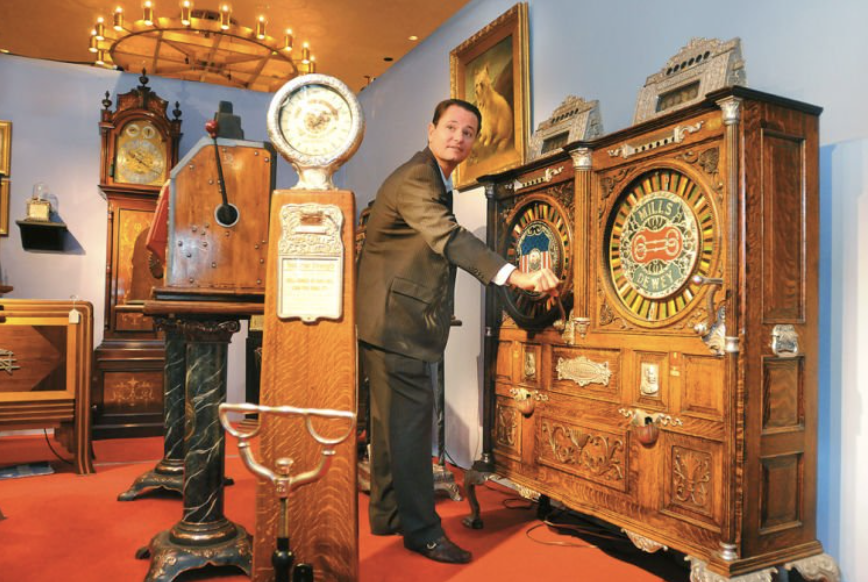
Jonathan Daniels
Owner of Las Olas Location

Simon Daniels
Owner of Aspen Location
Simon runs the Aspen gallery with a passion for collecting and for helping others build collections of their own. With over thirty years in the antiques world, he has developed a broad network to call on. Whether it is a piece already in the collection or something you are looking to source, Simon can usually find it.



✯ Daniels Selection ✯
Latest Antiques
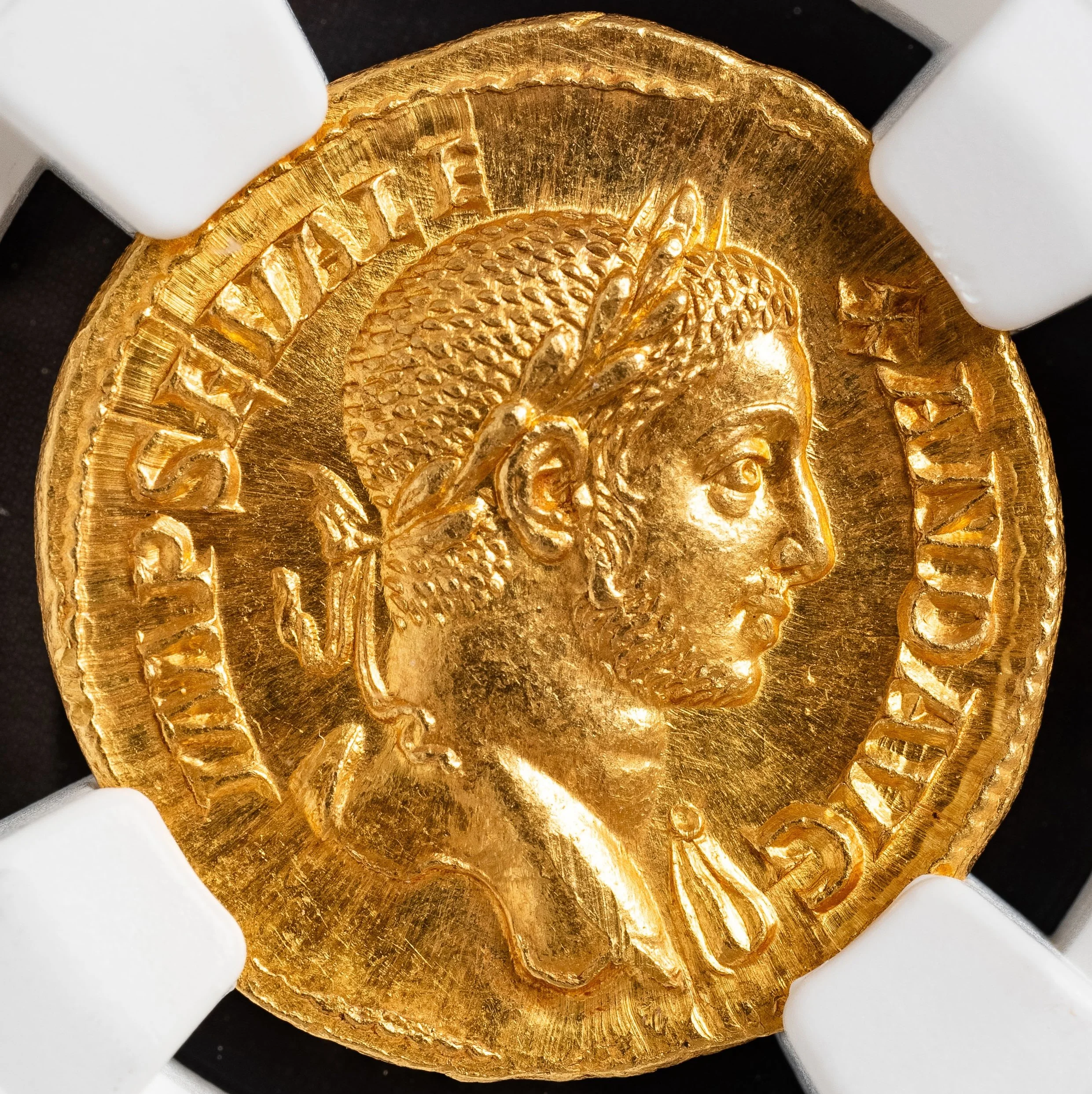
A gold aureus of the emperor Severus Alexander, struck at Rome in AD 230. The coin weighs 5.80 grams and is graded Choice Mint State by NGC, with a full strike of 5/5, surfaces of 4/5, and the Fine Style designation reserved for dies of superior artistry.
The obverse bears the laureate and draped bust of the young emperor facing right, seen from behind, with the drapery knotted at the left shoulder, within the legend IMP SEV ALEXAND AVG. The portrait shows the sensitive, almost boyish features that the mint of Rome gave the last of the Severan emperors, and the quality of the engraving is what earned the Fine Style designation.
The reverse shows the emperor in the guise of Romulus, the founder of Rome, radiate, in tunic and military cloak, advancing right with a transverse spear in his right hand and a trophy of captured arms over his left shoulder. The legend, P M TR P VIIII COS III P P, records his ninth tribunician power and third consulship and dates the coin precisely to AD 230. The date gives the image its edge. Severus Alexander had come to the throne at thirteen after the murder of his cousin Elagabalus and ruled under the guidance of his mother, Julia Mamaea. In 230, the armies of Ardashir I, founder of the new Sassanid Persian dynasty, broke into Roman Mesopotamia and laid siege to the frontier city of Nisibis, thereby facing its most serious eastern threat in a generation. A coin showing the gentle young emperor as Romulus, the city's founder and first warrior, was a statement of resolve from a regime under pressure. Alexander campaigned in the east in the years that followed, and his murder by his own troops in 235 ended the Severan dynasty and opened the fifty years of upheaval historians call the Crisis of the Third Century. This aureus belongs to the last confident moment before that storm.
Reference: RIC IV.2 103; Calicó 3121
Examples of the type are held by
The American Numismatic Society, New York
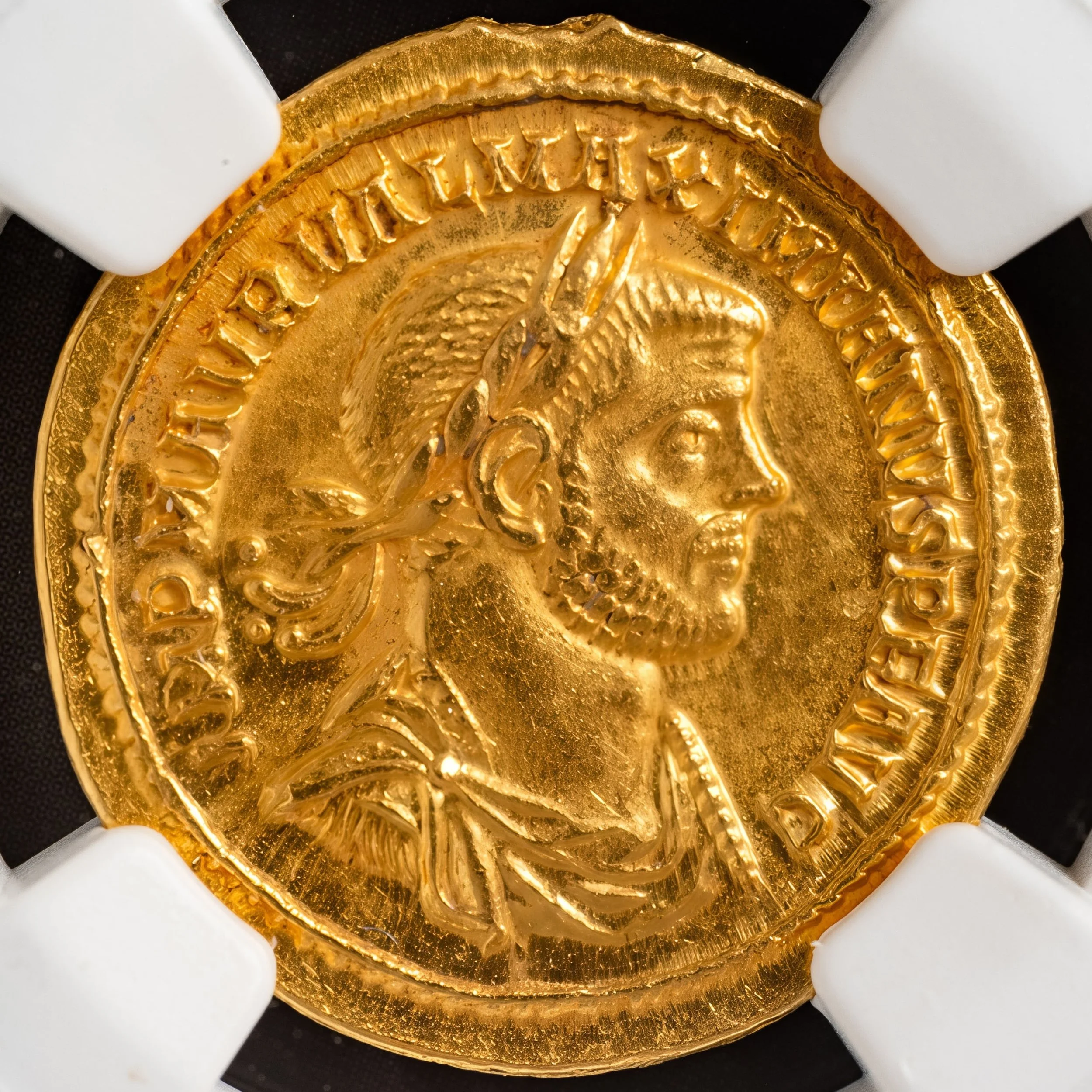
A gold aureus of the emperor Maximian, struck at the mint of Rome in the early years of his reign, circa AD 286–294. The coin weighs 5.50 grams and is graded Mint State by NGC, with a full strike of 5/5 and surfaces of 4/5.
The obverse carries the laureate, draped, and cuirassed bust of Maximian facing right, within his full titulature, IMP C M AVR VAL MAXIMIANVS P F AVG. The portrait is a fine example of the soldier-emperor style of the late third century, with the close-cropped beard and heavy features of a career officer from the Danube frontier.
The reverse shows Jupiter standing left, nude but for a chlamys over the shoulder, a thunderbolt in his outstretched right hand and a long scepter in his left, with the legend IOVI CONSERVAT AVGG, to Jupiter, preserver of the Augusti. The doubled G is the key to the coin. It marks the plural, two Augusti, and places the issue after 1 April 286, when Diocletian raised Maximian from Caesar to co-emperor and divided the burden of the empire between them. The partnership was sealed in religious terms. Diocletian took the title Iovius, placing himself under the protection of Jupiter, the ruler of the gods, while Maximian took Herculius, placing himself under Hercules, the god of strength who earned his divinity through labor. The choice fit the man. Maximian was the fighting half of the partnership, the commander who crushed the Bagaudae revolt in Gaul and campaigned across the Rhine while Diocletian governed, and the court orators praised him as a Hercules toiling on earth while Jupiter ruled above. A coin of the Herculian emperor honoring Jupiter is therefore the junior colleague paying public homage to the patron god of the senior, the theology of the two-man empire stated in a single reverse. The full weight of 5.50 grams reflects the strengthened standard of sixty aurei to the Roman pound, a weight increase introduced at the time of Maximian's elevation.
Reference: RIC V.2 492
Examples of the type are held by
The American Numismatic Society, New York
The Bibliothèque nationale de France, Paris
The American Numismatic Society specimen weighs 5.45 grams; the present coin, at 5.50 grams, is the heavier of the two.
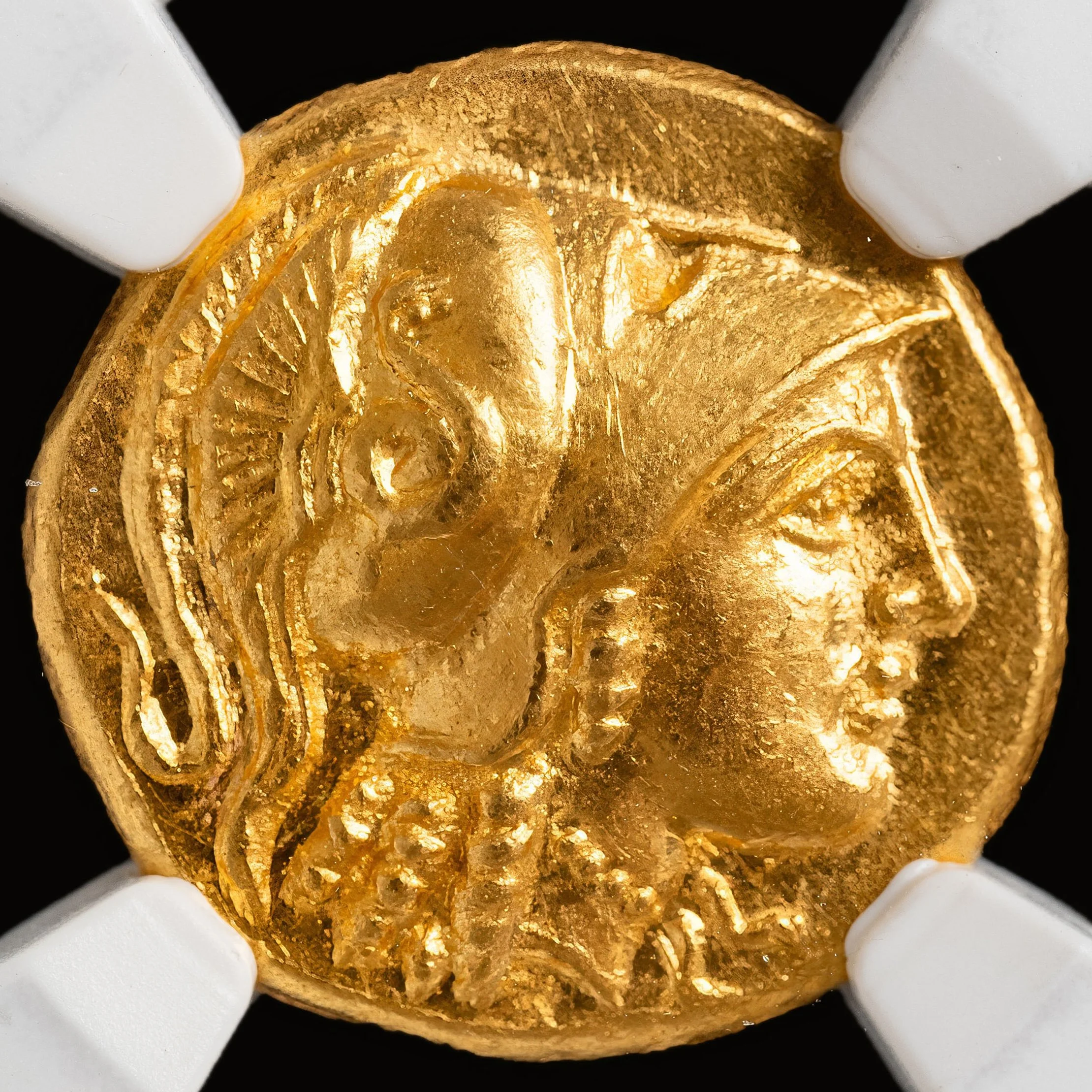
A gold stater of Alexander the Great, struck at an uncertain Greek or Macedonian mint in the decades following the king's death. The obverse carries the head of Athena in a triple-crested Corinthian helmet, the bowl decorated with a coiled serpent. The reverse shows Nike, the winged goddess of victory, standing with a wreath in her outstretched right hand and a stylis, the mast of a warship, in her left, beside the legend ΑΛΕΞΑΝΔΡΟΥ, "of Alexander." In the field are the two control marks of this issue, an ant to the left and an eight-rayed star below the goddess's wing.
The ant is among the rarest images on all Greek coinage, and its pairing with the star is thought to allude to some local legend whose meaning is now lost. The combination has intrigued scholars since the nineteenth century. Ludvig Müller, cataloging the Alexander coinage in 1855, read the two marks as civic badges and argued the coin was struck jointly by Apollonia and Acrothoon, two towns on Mount Athos, the ant standing for Apollonia and the star for the city at the holy mountain's summit. Modern scholarship no longer reads control marks as city emblems, and Martin Price returned the mint to "uncertain" in his 1991 corpus, but the puzzle Müller tried to solve remains open: a tiny insect, chosen deliberately by a mint official twenty-three centuries ago, for reasons no surviving source explains.
The type is scarce. Five examples are recorded in PELLA, the American Numismatic Society's corpus of the Alexander coinage in public collections, and market appearances are correspondingly few.
The coin weighs 8.59 grams and measures 18 millimeters. It is graded Choice Mint State (Ch MS) by NGC, Strike 5/5, Surface 4/5, certification 4877406-011.
Reference: Price 831.
Other examples of this type are held in the following collections:
The British Museum, London
The Ashmolean Museum, Oxford
The American Numismatic Society, New York
The Harvard Art Museums, Cambridge
The Münzkabinett, Vienna
At 8.59 grams, the present coin is identical in weight to the Ashmolean example, deposited at Oxford by New College in 1907.
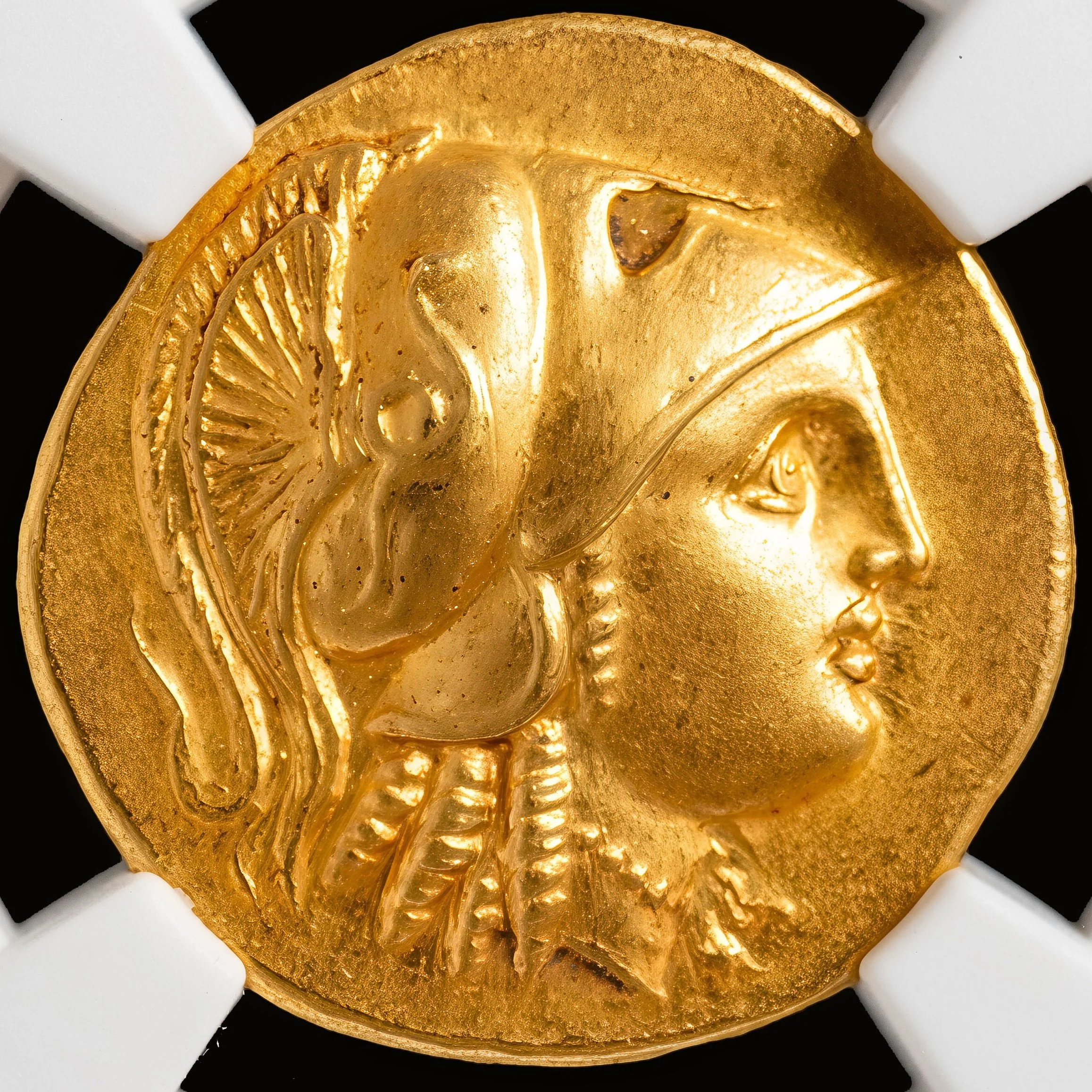
A gold stater of Alexander the Great, struck at the royal mint of Amphipolis in the late fourth century BC. The obverse carries the head of Athena in a triple-crested Corinthian helmet, the bowl decorated with a coiled serpent, her hair falling in corkscrew curls over her left shoulder. The reverse shows Nike, the winged goddess of victory, standing with a wreath in her outstretched right hand and a stylis, the mast of a warship, cradled in her left arm, beside the legend ΑΛΕΞΑΝΔΡΟΥ, "of Alexander." In the left field is the control mark of this issue, a trident head, the emblem of Poseidon.
Alexander introduced the Athena and Nike stater as the gold coinage of his empire, and the mints continued striking it in his name long after his death in 323 BC. Martin Price dated this issue to circa 330 to 320 BC, spanning the king's final years, while more recent scholarship places it under Cassander, circa 310 to 301 BC, the ruler who governed Macedon after Alexander's line was extinguished yet kept the conqueror's name on his gold. Either way, the coin belongs to the great Macedonian series struck at Amphipolis, the principal royal mint, within living memory of Alexander himself.
The coin weighs 8.59 grams and measures 19 millimeters. It is graded MS★ by NGC: Strike 5/5, Surface 4/5; the star denotes exceptional eye appeal. Certification 4885147-009.
Reference: Price 175.
Other examples of this type are held in the following collections:
The British Museum, London
The American Numismatic Society, New York
The Münzkabinett, Berlin
The Swiss National Museum, Zurich
At 8.59 grams, the present coin sits at the center of the recorded weight range for the type.
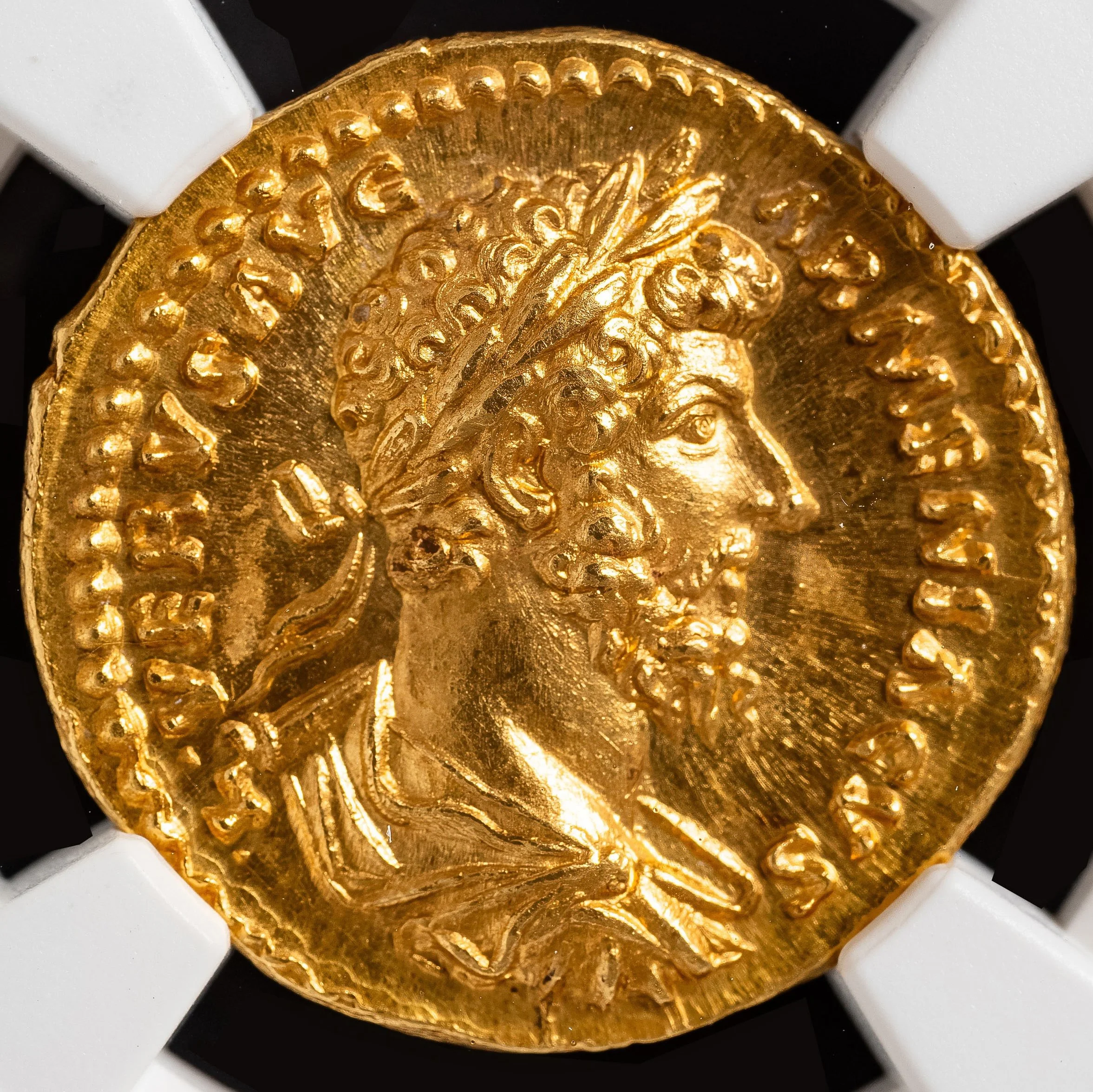
A Roman gold aureus of Lucius Verus, struck at Rome in AD 164 and certified by NGC as Gem Mint State, Strike 5/5, Surface 5/5, with the Fine Style designation, the highest combination of grades NGC Ancients awards short of a star. The coin weighs 7.28 grams, certification number 2100935-001.
The obverse bears the laureate, draped, and cuirassed bust of Verus facing right, the wreath ribbon trailing at the nape, with the legend L VERVS AVG ARMENIACVS. The reverse reads TR P IIII IMP II COS II and shows Victory, winged and half-draped, standing front with her head turned right, inscribing VIC AVG on a shield she steadies atop a palm tree.
The coin commemorates the campaign that earned Verus his title. When the Parthian king Vologases IV invaded Armenia in 161, expelling its Roman client king, Marcus Aurelius sent his co-emperor east. Roman forces under Statius Priscus retook Armenia and captured its capital, Artaxata, in 163, and Verus was hailed Armeniacus, a title he accepted with some reluctance, having directed the war from Antioch rather than the front. The shield Victory inscribes on this reverse is the official record of that victory, rendered in gold.
Portraits of Verus in this quality are seldom encountered. The engraving is unusually sensitive, the tight curls and full beard of the young emperor rendered with the depth of relief that earned the Fine Style designation, and the surfaces are essentially as struck. References: Calicó 2177; RIC III 525; BMC 296 note; Cohen 247 var.
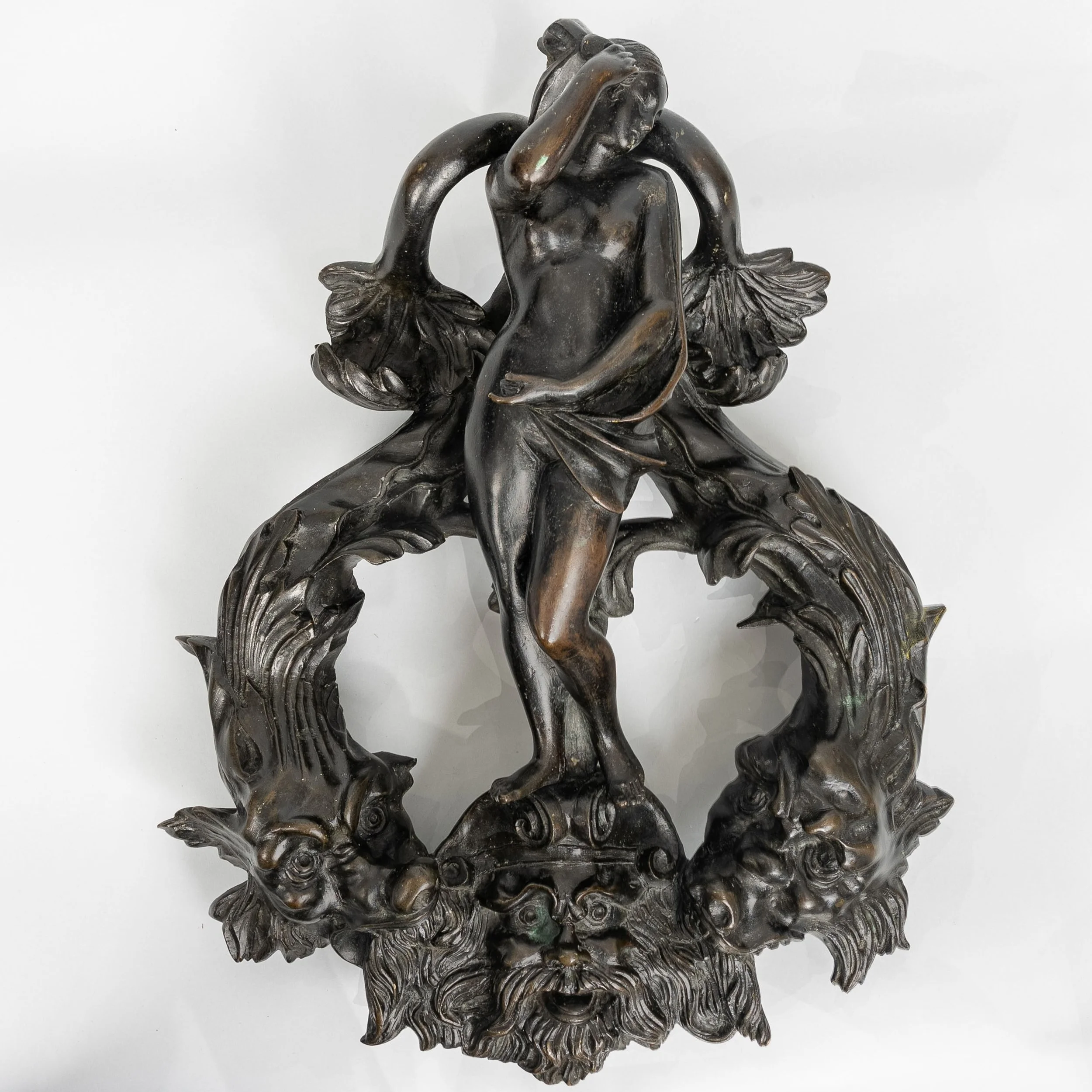
A large Italian bronze door knocker, or battente, of Venus Anadyomene, after a model of circa 1600, probably Venetian. The goddess is modeled fully in the round, one hand raised to her hair as she rises from the sea, drapery gathered at her hips, standing on a scrolled console above a bearded mask of Oceanus. Two dolphins rise at her sides, their arched bodies forming the loop of the knocker and their tails breaking into acanthus. Measuring 17 1/2 inches high by 14 inches wide and weighing approximately 38 pounds, it is a piece of sculpture that has spent its life on a door.
The construction is that of the earliest examples of the type. Figure and frame were cast together in a single, thick-walled pour by the lost-wax process, with the interior left open and irregular. The forged iron striker was set into the mould and the bronze poured around it, so the knocker was conceived as a working object from the wax stage, and the striker head, forged square, has been rounded by years of use against the strike boss on the reverse. The chasing is selective in the seventeenth-century manner: the hair worked in fine detail, the fingers and toes finished down to their nails, other passages left as cast. The cast is, on the evidence of its construction, of the seventeenth or early eighteenth century.
The surface tells the same story. The black patina is rubbed through to a warm bronze exactly where hands have gripped it for generations, along the goddess's leg and on the noses of the dolphins, while the reverse carries the green corrosion and iron staining of long service out of doors. Traces of old door paint survive in the crevices of the pivot lugs, left by painters working around a knocker that was never taken down, and the pivot bolt was replaced later, as fittings on a door in daily use are.
A cast of this model hung on the doors of the Hotel Porges in Paris, the mansion built in 1892 for Jules Porges, the diamond magnate whose Kimberley mining company was absorbed into De Beers in the great amalgamation of 1889. The house was built to hold his collection, its gallery hung with Rembrandt, Rubens, Van Dyck and Frans Hals, with Renaissance bronzes and enamels beneath them, and it was on the doors of that house that Eugène Atget photographed the model around 1901, paired with a pendant Neptune on the opposite leaf. The type belongs to the great tradition of figural knockers made for Venetian palace doors in the decades around 1600, when the finest were treated as sculpture and passed among collections accordingly.
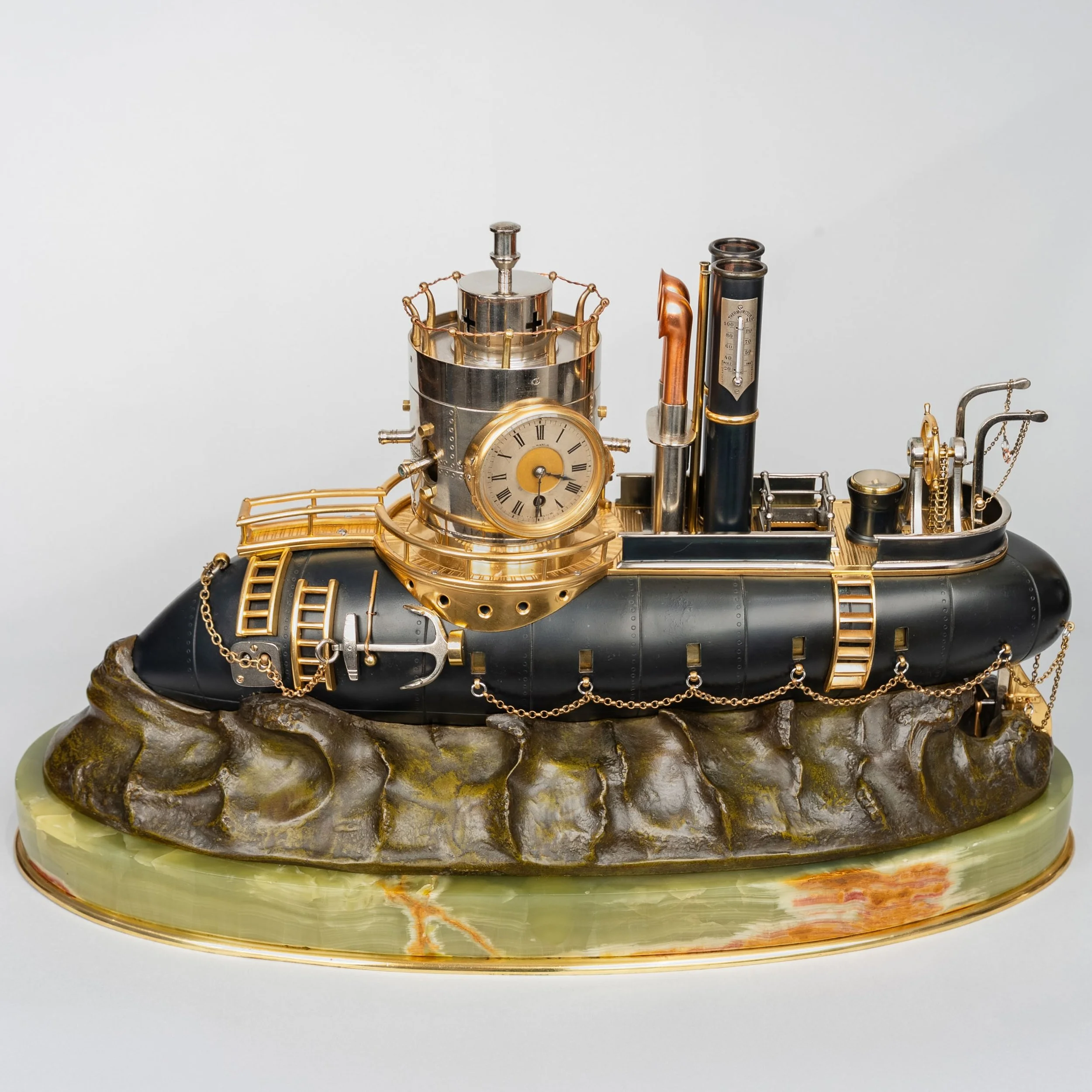
A French Industrial Series automaton clock in the form of a submarine, by André Guilmet, Paris, circa 1890. The black patinated hull, riveted throughout, rides atop a cast-bronze sea on an oval plinth of green onyx with a gilt rim. The silvered conning tower houses the movement behind a gilt-bezelled enamel dial, and the deck carries a full complement of fittings in gilt and silvered bronze: boarding ladders, railings, an anchor with chains, a copper vent cowl, a binnacle compass, and a stern davit crane with a winding wheel. A funnel-form thermometer stands amidships, its scale printed in English, indicating an example made for the export market. It measures 23 inches long, 15 inches high, and 10 inches deep, 58.5 by 38 by 25.5 cm.
The clock is a two-motion automaton. When wound, the conning tower rotates, and the stern propeller turns beneath the counter, both driven by the same train that powers the clock, so the vessel is animated whenever it is running.
The submarine is the rarest subject in Guilmet's nautical group, which also included a quarterdeck, a lighthouse, and a battleship. When this model was designed, no such vessel existed in service yet, and its true ancestor is literary. Jules Verne's Twenty Thousand Leagues Under the Sea of 1870 gave the public the Nautilus, an elongated cigar-shaped hull of riveted plates with a raised pilot house and a platform where Captain Nemo takes the air, and the illustrations by Alphonse de Neuville and Édouard Riou for the first illustrated Hetzel edition fixed that image in the popular imagination. The clock reads as the Nautilus made domestic, the same spindle hull, raised tower, and railed deck, translated to the drawing room. Reality only caught up afterward: France launched the Gymnote, her first working electric submarine, in 1888, and the larger Gustave Zédé followed in 1893. This is a mythical ship assembled from the fittings of real ones, machinery presented as spectacle.
The example survives in exceptional condition, the gilding bright, the patina unrubbed, and the chains and deck fittings complete. The series is discussed in Derek Roberts, Mystery, Novelty and Fantasy Clocks, 1999, pp. 253-270.
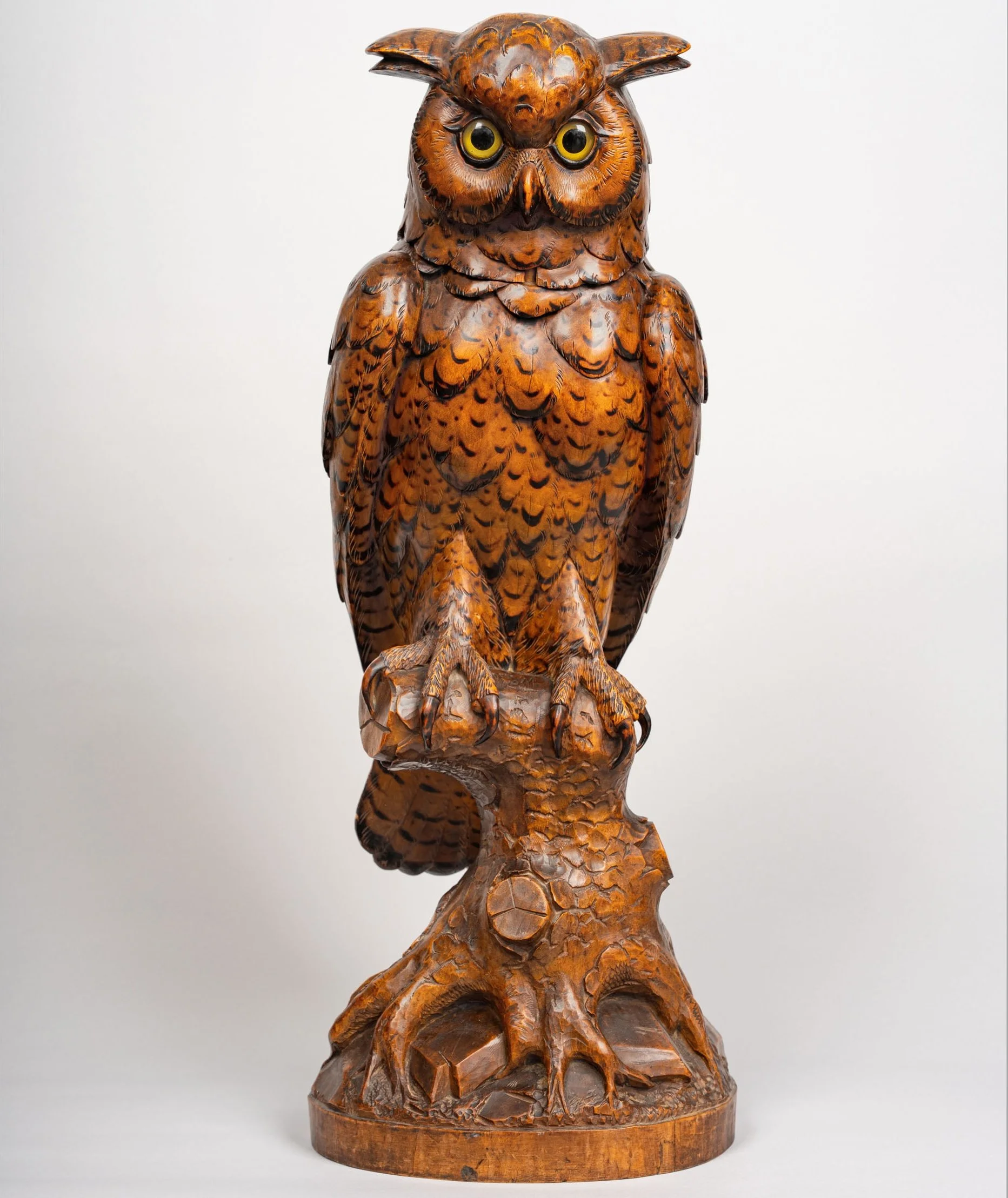
A life-sized carved eagle owl, attributed to the Ruef Brothers of Brienz, Switzerland, circa 1880, standing 28 inches high. The bird is carved in linden wood and perched upright on a cut branch rising from a rocky outcrop, the whole cut from a single block with a turned circular base. Ear tufts raised, wings folded, talons gripping the branch, it fixes the viewer with yellow glass eyes set into deeply carved facial discs.
What distinguishes this owl is the treatment of the plumage. Every feather is carved individually and then worked with a heated iron, the edges and barring scorched into the wood so that the graduated breast, the mottled crown, and the darker flight feathers read in tone as well as relief. This burning of the surface is the technique most closely associated with the Ruef workshop, whose birds of prey were a specialty of the Brienz trade, and the attribution rests on that handling together with the composition and the scale. The piece is unsigned.
The head is made separately and lifts off at the neck, a construction the carver has concealed within the ruff of feathers at the throat. It is not hinged, and the body is not hollowed out for use as a tobacco jar or humidor, which is consistent with the piece's size. The separate head allowed the carver to work the face and the body from blocks of different grain, and it is a feature worth knowing when a piece of this model is examined.
Carving of this ambition came out of Brienz in the Bernese Oberland, where the Ruef Brothers worked alongside Johann Huggler, Hans Huggler-Wyss, and Walter Mader in the decades when the international exhibitions at Vienna, Philadelphia, Paris, and Chicago carried Swiss carving to an American and English clientele. We discuss the Ruef workshop and the scorching technique in our article on the masters of the Black Forest, and in the reference we co-authored on the subject, Swiss Carvings: The Art of the Black Forest, 1820 to 1940.
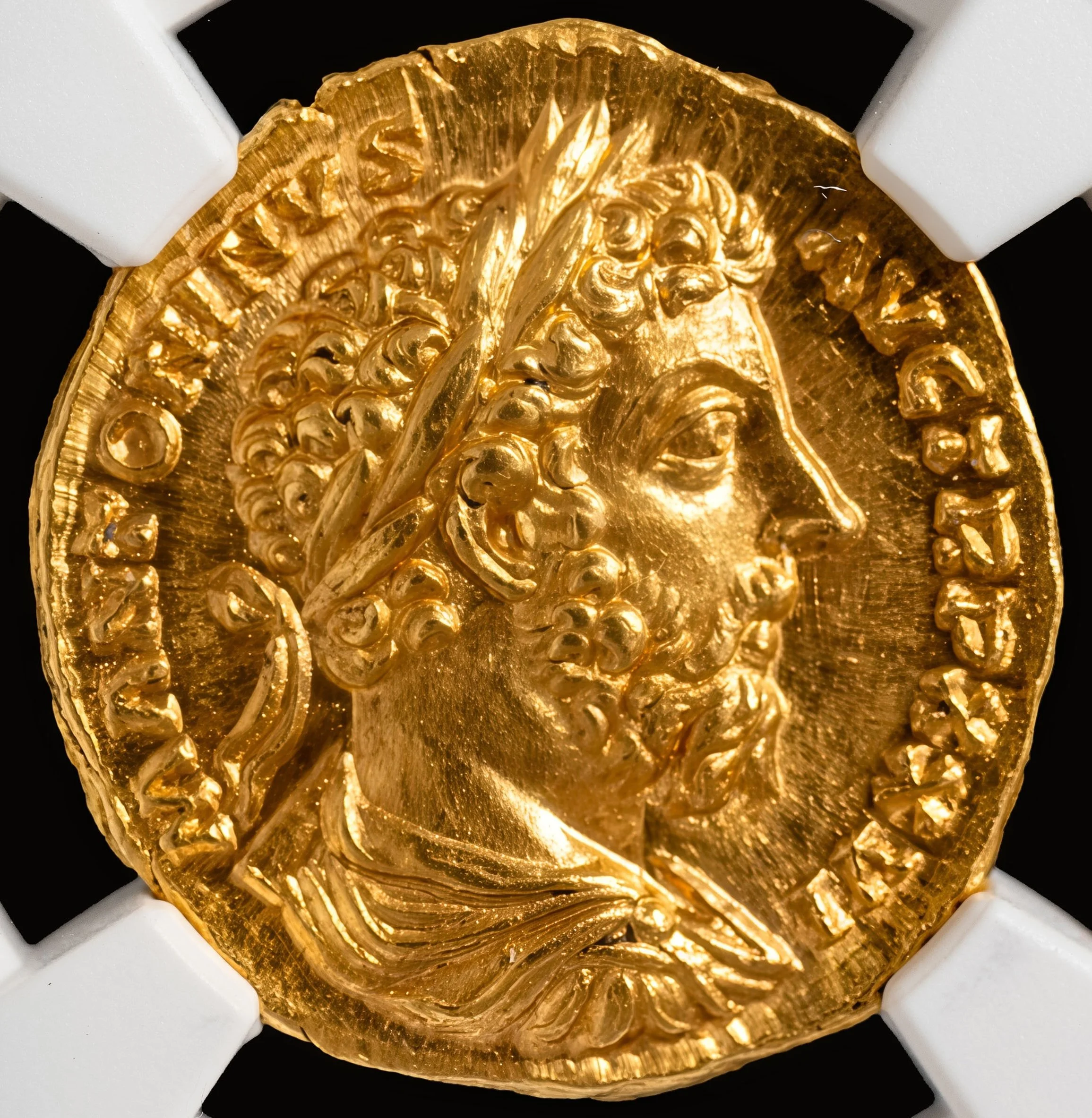
A gold aureus of the emperor Marcus Aurelius, struck at the mint of Rome in AD 172, at the height of the Marcomannic Wars on the Danube frontier. The obverse carries the laureate, draped portrait of the mature, bearded emperor with the legend M ANTONINVS AVG TR P XXVI. The reverse, reading IMP VI COS III, shows one of the boldest images in his coinage: the emperor standing in military dress, a reversed spear in his left hand and the thunderbolt of Jupiter gripped in his raised right, while Victory advances behind him with a palm frond to crown him with laurel.
The thunderbolt is the weapon of the supreme god, and an emperor shown wielding it is being assimilated to Jupiter himself, a step beyond the conventional imagery of divine favor. The type belongs to the years of the celebrated miracles of the northern wars, the lightning that destroyed an enemy siege engine and the rainstorm that saved a surrounded Roman army, both later carved on the Column of Marcus Aurelius in Rome. These are also the seasons in which the emperor, in winter quarters on the Danube, was writing the private notebook the world now knows as the Meditations.
The coin is graded Choice Mint State by NGC, Strike 4 of 5, Surface 5 of 5, with the Fine Style designation, certification 2100934-002, weight 7.19 grams. Scarcely circulated in eighteen centuries, it preserves the reverse composition with unusual clarity, the thunderbolt fully legible in the emperor's hand.
The type is cited as RIC III 265, with Calicó 1872, BMCRE 566 var., Biaggi 856 and Mazzini 308. Examples rest in the British Museum, the American Numismatic Society in New York, and the Kunsthistorisches Museum in Vienna, the last from the Bachofen collection, and the type is absent from the great published cabinets of Adda and Jameson. It is a coin found in the finest institutional collections and seldom in the market.
The aureus is exhibited in our Aspen gallery alongside a bronze reduction of the equestrian Marcus Aurelius of the Capitoline, cast in Rome in 1866, the emperor in gold and in bronze side by side.
The coin is considered at greater length, together with the equestrian bronze, in our article The Philosopher Emperor: Marcus Aurelius in Bronze, Gold, and Ink.
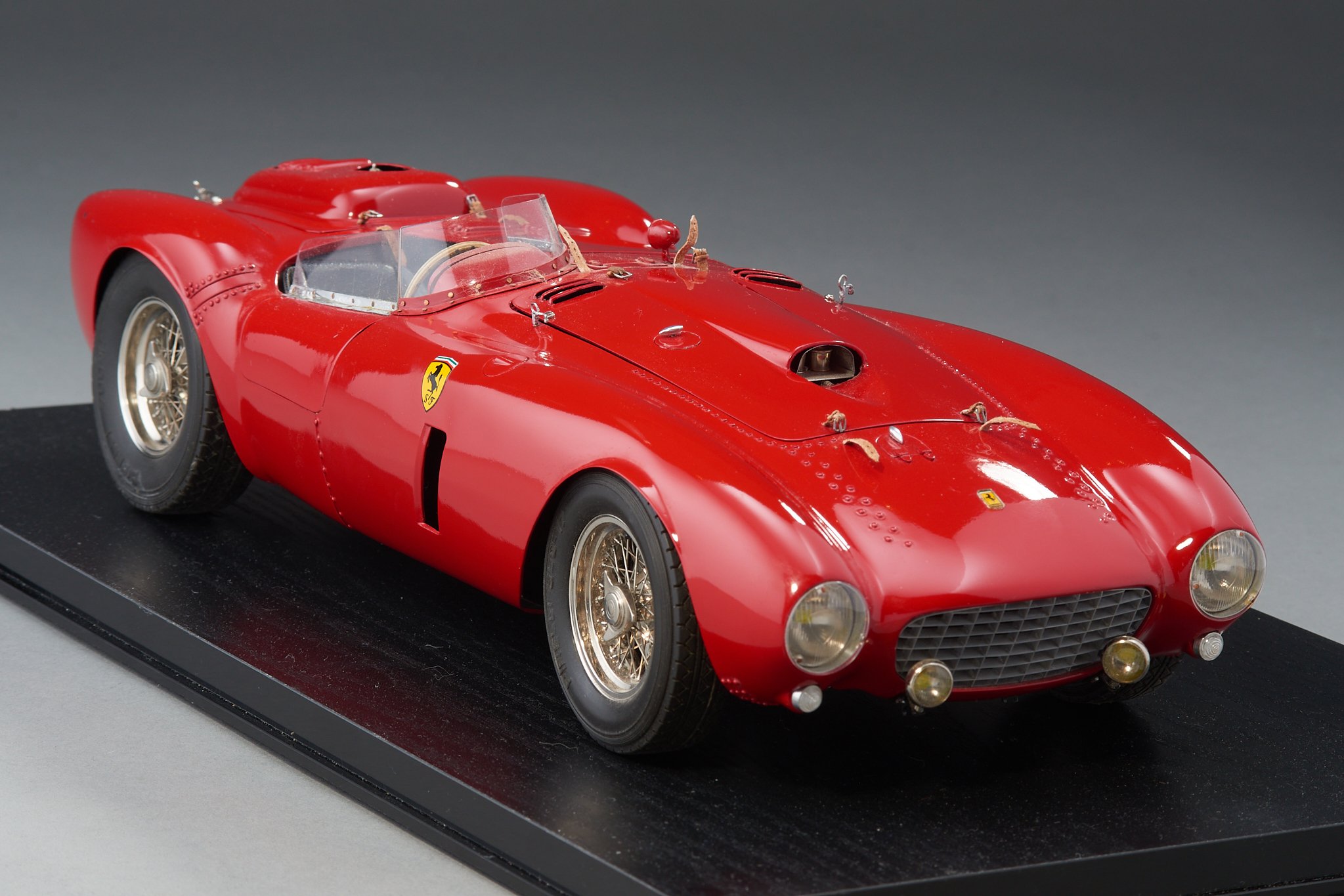
A hand-built 1:12 scale model of the Ferrari 375 Plus, executed by the French master craftsman J. Catti and distributed by Exoto, Inc., which placed this model on the cover of the Exoto Tifosi catalog, Second Edition, 1995.
The 375 Plus stands among the most formidable sports racing cars Maranello ever produced. Powered by the 4.9-liter Lampredi V12 and bodied by Pinin Farina, it carried José Froilán González and Maurice Trintignant to victory at Le Mans in 1954, with Umberto Maglioli adding the Carrera Panamericana later that year. Surviving examples rank among the most valuable Ferraris in existence.
Catti built his replica without compromise, and the Exoto catalog records some three hundred craftsman-hours in each limited-edition example. The sheet-metal body is formed entirely by hand, with its panels correctly riveted and its ventilation louvers genuinely open. The rolling chassis carries working suspension and steering; the engine and rear cover lids are secured with genuine leather straps, exactly as on the full-size car; and the metal tonneau cover is removable. The miniature Borrani wire wheels and Pirelli tires reproduce the original components, while the cockpit is finished with leather-covered seats, an aluminum-and-wood steering wheel, glass-covered instruments, a gated shift lever, and the correct center-throttle pedal arrangement. The model wears Modena prova plates, MO-36, identifying it in the works test car configuration.
At its 1995 release, the complete car was cataloged by Exoto at $18,900, catalog number JCA00375D.
The model is accompanied by an original copy of the Exoto Tifosi catalog, Second Edition, 1995, in which it appears on the cover, with a two-page feature illustrating the engine, cockpit, and rolling chassis.
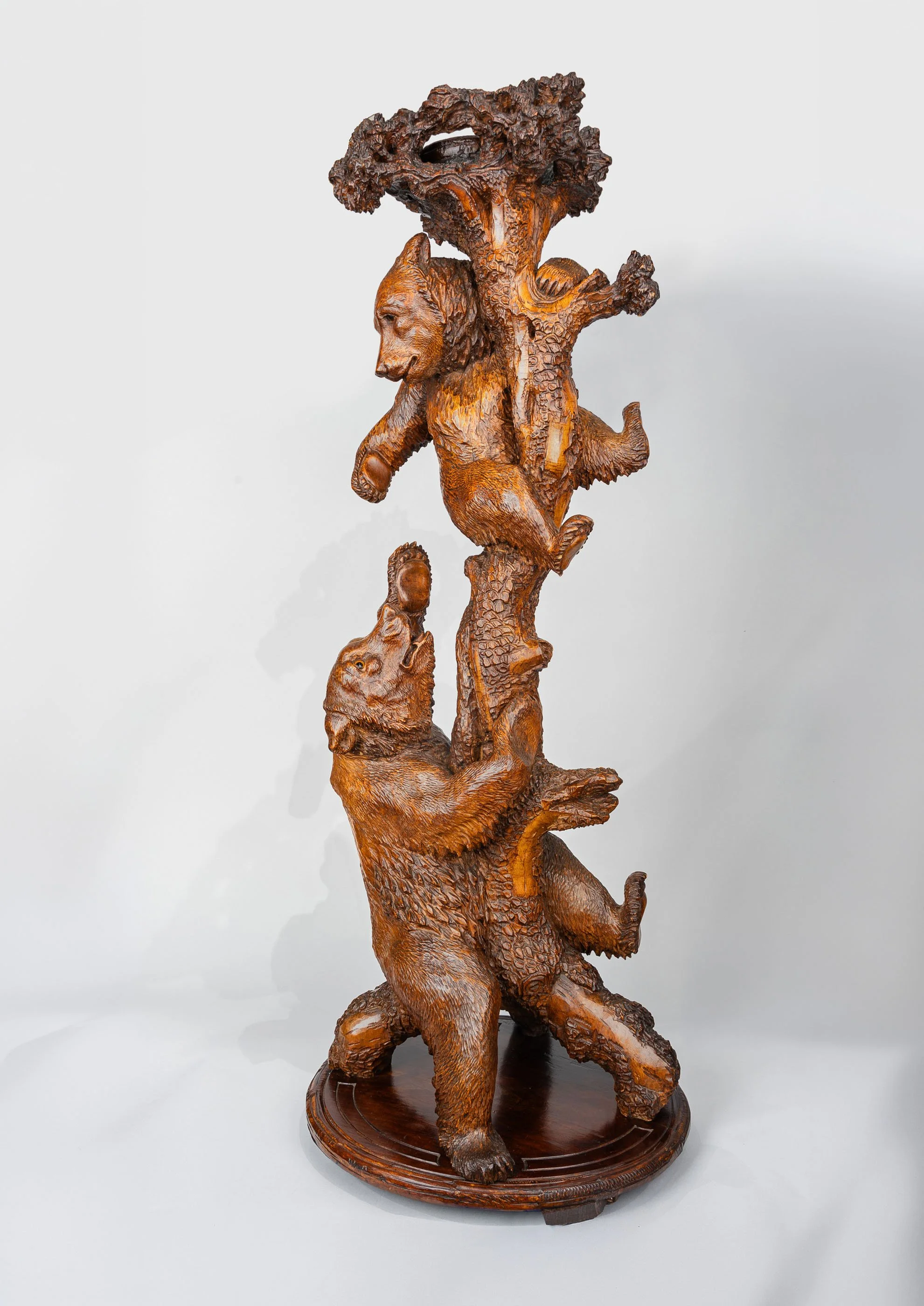
A large and theatrical Swiss Black Forest jardinière in carved linden wood, circa 1870, formed as two bears at a gnarled tree, the crown of which opens into a naturalistic basin for a plant or palm.
A young bear scrambles up the trunk, forelegs thrown over a branch, glancing back at the adult below, who rears upright against the tree, head thrown back and mouth open, one forepaw raised toward the escaping climber. Both bears carry inset glass eyes, and the carving moves confidently between textures, the dense fur of the animals, the scaled bark of the trunk, and the burled, leafy crown of the basin, the whole rising from a molded circular base.
The bear is the emblematic subject of Brienz carving, and jardinières of this scale belong to the upper end of its production, sculptural furniture made for the salons and winter gardens of the hotel age. A single-bear jardinière of similar style is illustrated on page 121 of Swiss Carvings; the present example, over three and a half feet tall and fully carved from every angle, holds a room as few functional objects of the period can.
Dimensions: 43"height
Literature
Jay Arenski, Simon Daniels, and Michael Daniels, Swiss Carvings: The Art of the Black Forest, 1820–1940 (2006), p. 121, where a single-bear jardinière of similar style is illustrated.
✯ Daniels Selection ✯
Curated Inventory
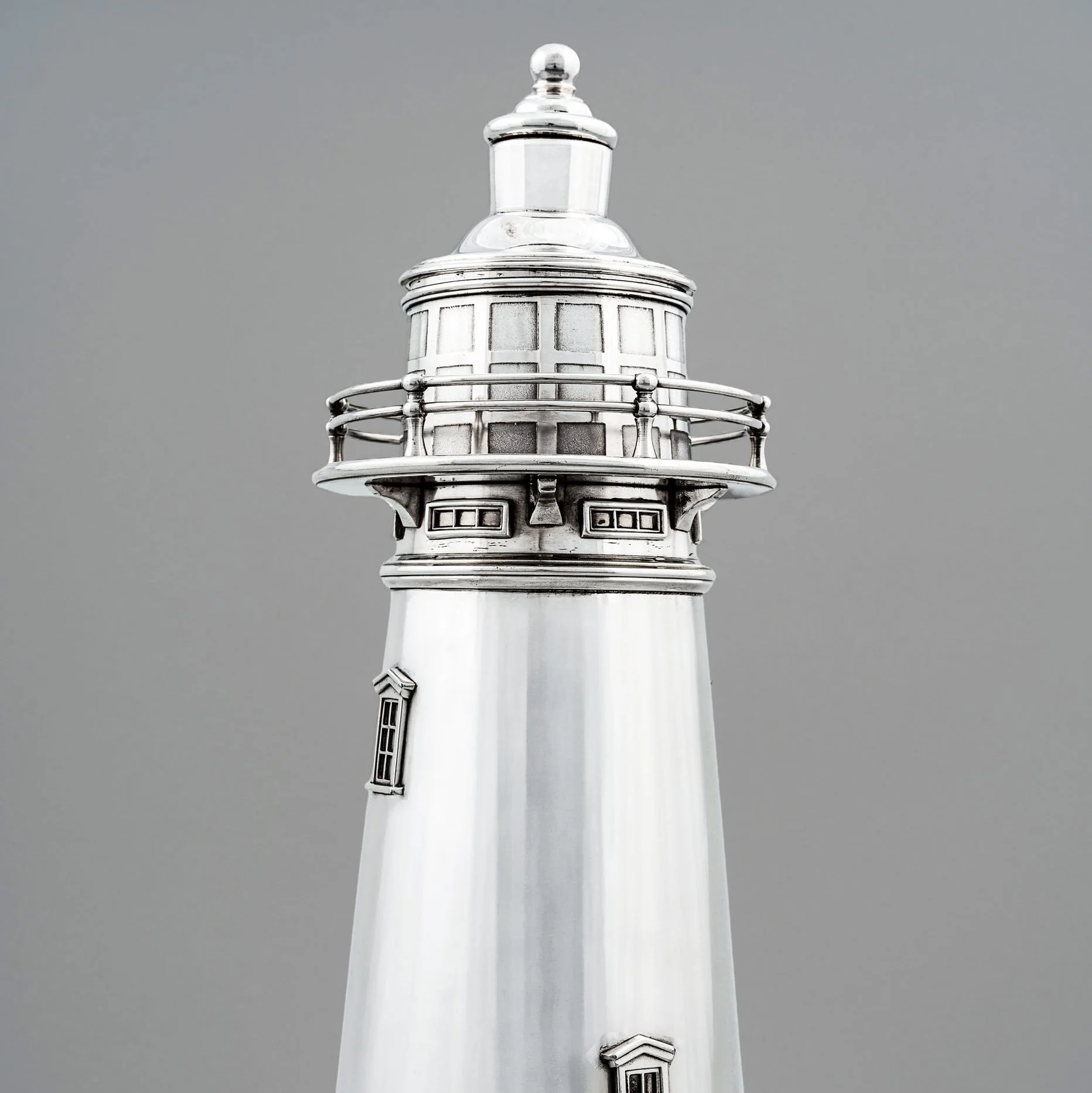
Among all the figural cocktail shakers of the great cocktail age, none is more celebrated than the lighthouse. Produced by the International Silver Company of Meriden, Connecticut, under its Meriden S.P. Co. mark and patented on January 11, 1927, the model takes its form from Boston Light, the first lighthouse established in America, and was made only briefly at the height of the era. An example is held in the Museum of Fine Arts, Boston.
The conceit is carried through with remarkable conviction. The tapering silver-plated tower rises past two pedimented dormer windows to the keeper's gallery, encircled by a freestanding double railing on turned stanchions above a run of portholes. The lantern room, with frosted panels simulating glazing, lifts off as the cap, and the domed roof with ball finial conceals the pourer. Filled and set on the bar, it is architecture; in hand, it is a working shaker of generous capacity. The shaker was made in two sizes, and this is the classic model 343; the monumental version towers over 20 inches and appears only rarely.
The model's fame has made it one of the most reproduced cocktail shakers, and later chrome and silver-plate copies circulate widely. The present example is an original of the period, bearing the correct Meriden S.P. Co. mark for International Silver, the model number, and the January 1927 patent date struck to the base.
This example has survived unusually well. The gallery railing, the first casualty on most surviving examples, is complete and true; the dormers and portholes are crisp, and the frosted lantern panels retain their original finish.
Condition: Excellent. Original frosted finish to the lantern panels. Gallery railing complete and straight. Plating bright with only minor surface wear consistent with age. Cap and pourer fitting correctly.
Height: 14 in.
Literature: Stephen Visakay, Vintage Bar Ware: Identification and Value Guide, Collector Books, 1997.
A gold aureus of the emperor Severus Alexander, struck at Rome in AD 230. The coin weighs 5.80 grams and is graded Choice Mint State by NGC, with a full strike of 5/5, surfaces of 4/5, and the Fine Style designation reserved for dies of superior artistry.
The obverse bears the laureate and draped bust of the young emperor facing right, seen from behind, with the drapery knotted at the left shoulder, within the legend IMP SEV ALEXAND AVG. The portrait shows the sensitive, almost boyish features that the mint of Rome gave the last of the Severan emperors, and the quality of the engraving is what earned the Fine Style designation.
The reverse shows the emperor in the guise of Romulus, the founder of Rome, radiate, in tunic and military cloak, advancing right with a transverse spear in his right hand and a trophy of captured arms over his left shoulder. The legend, P M TR P VIIII COS III P P, records his ninth tribunician power and third consulship and dates the coin precisely to AD 230. The date gives the image its edge. Severus Alexander had come to the throne at thirteen after the murder of his cousin Elagabalus and ruled under the guidance of his mother, Julia Mamaea. In 230, the armies of Ardashir I, founder of the new Sassanid Persian dynasty, broke into Roman Mesopotamia and laid siege to the frontier city of Nisibis, thereby facing its most serious eastern threat in a generation. A coin showing the gentle young emperor as Romulus, the city's founder and first warrior, was a statement of resolve from a regime under pressure. Alexander campaigned in the east in the years that followed, and his murder by his own troops in 235 ended the Severan dynasty and opened the fifty years of upheaval historians call the Crisis of the Third Century. This aureus belongs to the last confident moment before that storm.
Reference: RIC IV.2 103; Calicó 3121
Examples of the type are held by
The American Numismatic Society, New York
A gold aureus of the emperor Maximian, struck at the mint of Rome in the early years of his reign, circa AD 286–294. The coin weighs 5.50 grams and is graded Mint State by NGC, with a full strike of 5/5 and surfaces of 4/5.
The obverse carries the laureate, draped, and cuirassed bust of Maximian facing right, within his full titulature, IMP C M AVR VAL MAXIMIANVS P F AVG. The portrait is a fine example of the soldier-emperor style of the late third century, with the close-cropped beard and heavy features of a career officer from the Danube frontier.
The reverse shows Jupiter standing left, nude but for a chlamys over the shoulder, a thunderbolt in his outstretched right hand and a long scepter in his left, with the legend IOVI CONSERVAT AVGG, to Jupiter, preserver of the Augusti. The doubled G is the key to the coin. It marks the plural, two Augusti, and places the issue after 1 April 286, when Diocletian raised Maximian from Caesar to co-emperor and divided the burden of the empire between them. The partnership was sealed in religious terms. Diocletian took the title Iovius, placing himself under the protection of Jupiter, the ruler of the gods, while Maximian took Herculius, placing himself under Hercules, the god of strength who earned his divinity through labor. The choice fit the man. Maximian was the fighting half of the partnership, the commander who crushed the Bagaudae revolt in Gaul and campaigned across the Rhine while Diocletian governed, and the court orators praised him as a Hercules toiling on earth while Jupiter ruled above. A coin of the Herculian emperor honoring Jupiter is therefore the junior colleague paying public homage to the patron god of the senior, the theology of the two-man empire stated in a single reverse. The full weight of 5.50 grams reflects the strengthened standard of sixty aurei to the Roman pound, a weight increase introduced at the time of Maximian's elevation.
Reference: RIC V.2 492
Examples of the type are held by
The American Numismatic Society, New York
The Bibliothèque nationale de France, Paris
The American Numismatic Society specimen weighs 5.45 grams; the present coin, at 5.50 grams, is the heavier of the two.
A gold stater of Alexander the Great, struck at an uncertain Greek or Macedonian mint in the decades following the king's death. The obverse carries the head of Athena in a triple-crested Corinthian helmet, the bowl decorated with a coiled serpent. The reverse shows Nike, the winged goddess of victory, standing with a wreath in her outstretched right hand and a stylis, the mast of a warship, in her left, beside the legend ΑΛΕΞΑΝΔΡΟΥ, "of Alexander." In the field are the two control marks of this issue, an ant to the left and an eight-rayed star below the goddess's wing.
The ant is among the rarest images on all Greek coinage, and its pairing with the star is thought to allude to some local legend whose meaning is now lost. The combination has intrigued scholars since the nineteenth century. Ludvig Müller, cataloging the Alexander coinage in 1855, read the two marks as civic badges and argued the coin was struck jointly by Apollonia and Acrothoon, two towns on Mount Athos, the ant standing for Apollonia and the star for the city at the holy mountain's summit. Modern scholarship no longer reads control marks as city emblems, and Martin Price returned the mint to "uncertain" in his 1991 corpus, but the puzzle Müller tried to solve remains open: a tiny insect, chosen deliberately by a mint official twenty-three centuries ago, for reasons no surviving source explains.
The type is scarce. Five examples are recorded in PELLA, the American Numismatic Society's corpus of the Alexander coinage in public collections, and market appearances are correspondingly few.
The coin weighs 8.59 grams and measures 18 millimeters. It is graded Choice Mint State (Ch MS) by NGC, Strike 5/5, Surface 4/5, certification 4877406-011.
Reference: Price 831.
Other examples of this type are held in the following collections:
The British Museum, London
The Ashmolean Museum, Oxford
The American Numismatic Society, New York
The Harvard Art Museums, Cambridge
The Münzkabinett, Vienna
At 8.59 grams, the present coin is identical in weight to the Ashmolean example, deposited at Oxford by New College in 1907.
✯ Daniels Insights ✯
Latest from our Blog
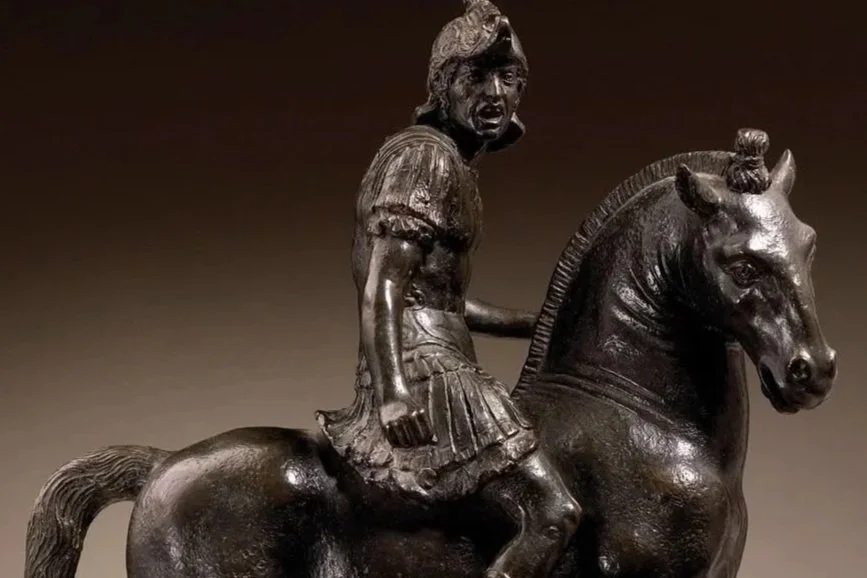
Is your inherited bronze real, old, and worth anything? A dealer's guide to judging bronze sculpture at home, from the magnet test to patina and foundry marks.
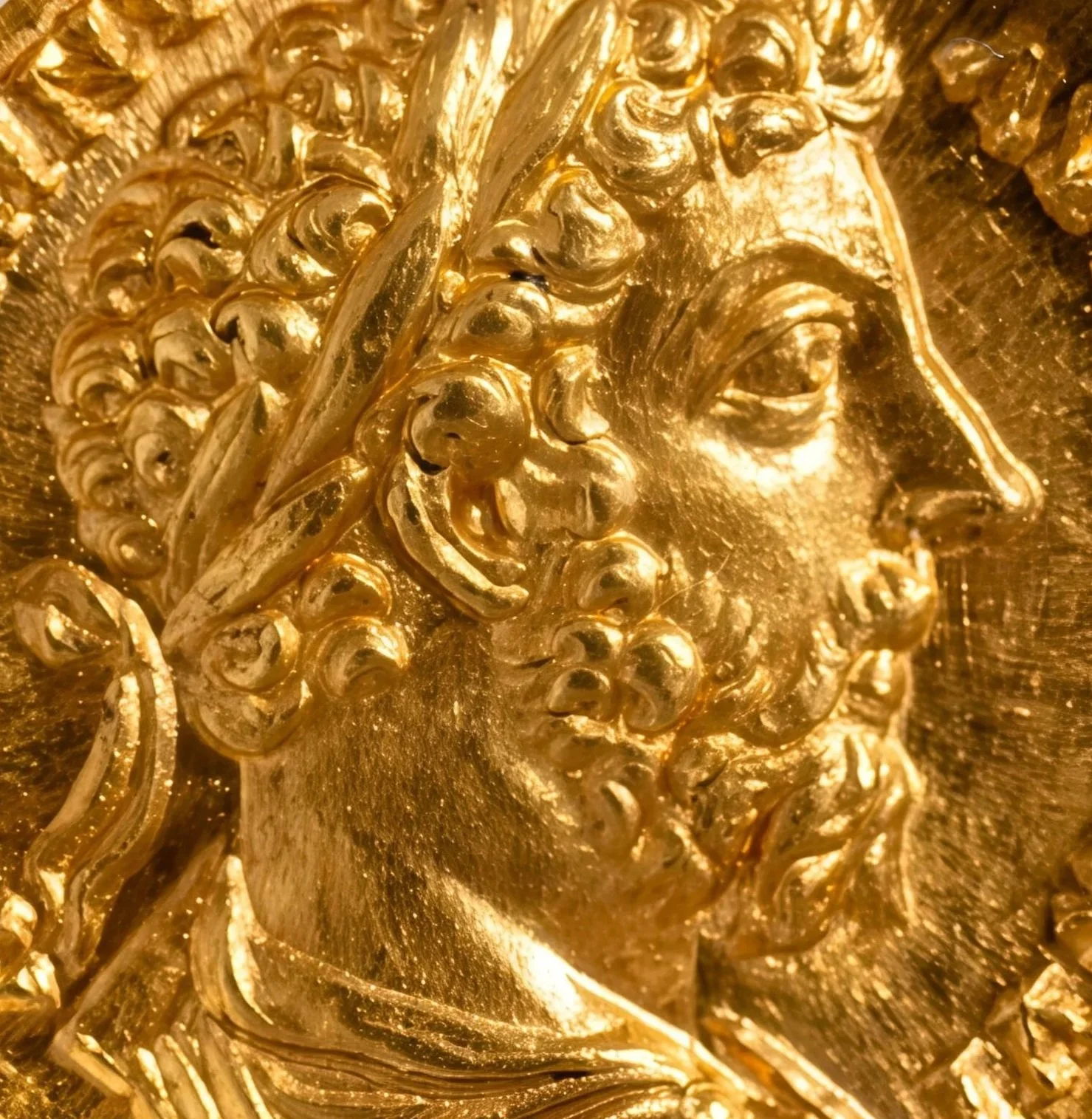
A gold aureus of AD 172, the equestrian bronze of the Capitoline and its nineteenth-century reductions, and the Meditations: the philosopher emperor, read through the three materials that survive him.
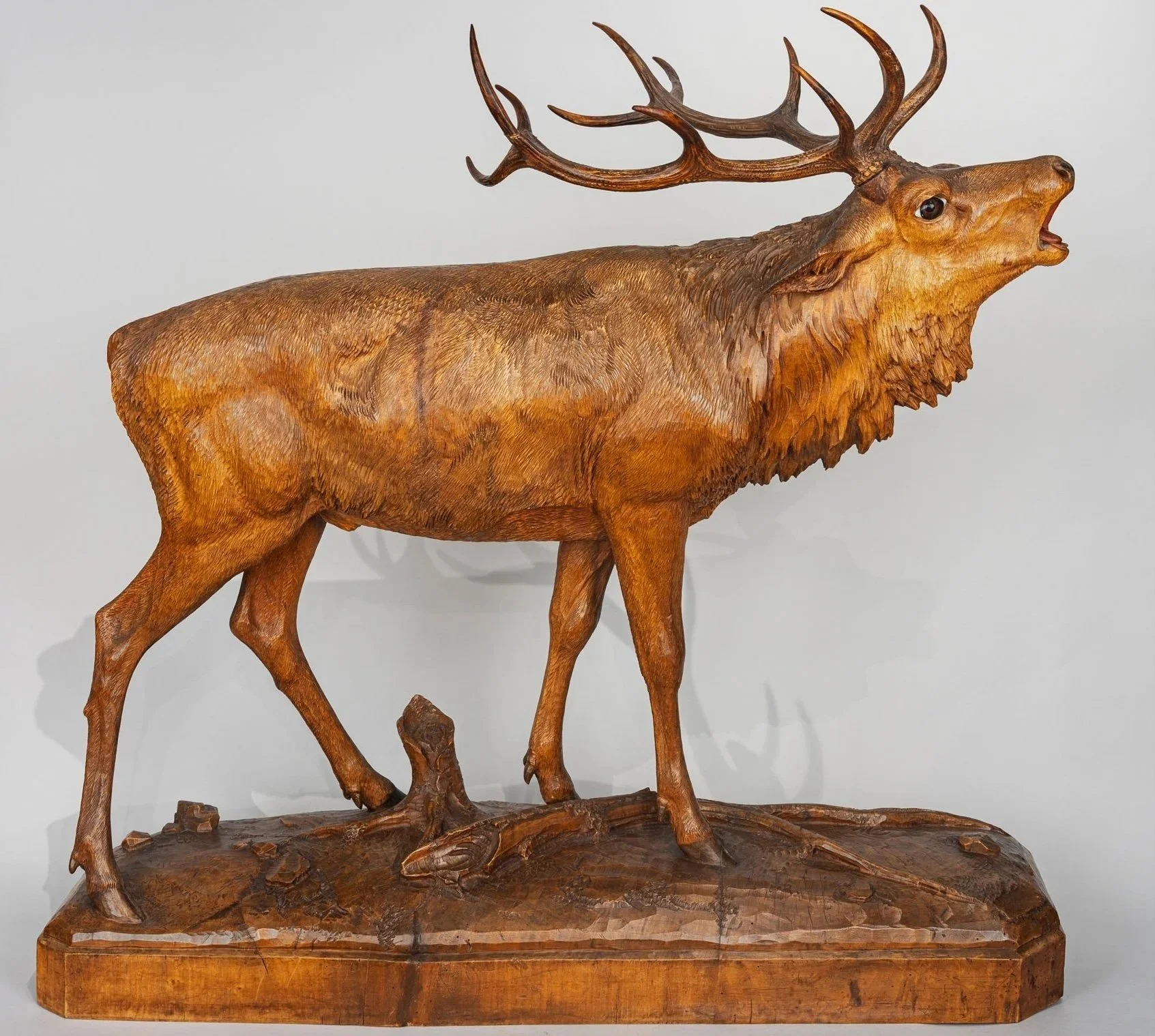
The story of Switzerland's great wood carvers, from the workshops of Brienz to gold medals at the world's fairs of Paris, Chicago, and beyond. A collector's guide to the finest Black Forest carvings, their masters, and what makes them remarkable.

Whether you are selling a single object, a collection, or an estate, understanding your options before approaching the market is the difference between a good outcome and a missed opportunity. A practical guide from Daniels Antiques.
Among all the figural cocktail shakers of the great cocktail age, none is more celebrated than the lighthouse. Produced by the International Silver Company of Meriden, Connecticut, under its Meriden S.P. Co. mark and patented on January 11, 1927, the model takes its form from Boston Light, the first lighthouse established in America, and was made only briefly at the height of the era. An example is held in the Museum of Fine Arts, Boston.
The conceit is carried through with remarkable conviction. The tapering silver-plated tower rises past two pedimented dormer windows to the keeper's gallery, encircled by a freestanding double railing on turned stanchions above a run of portholes. The lantern room, with frosted panels simulating glazing, lifts off as the cap, and the domed roof with ball finial conceals the pourer. Filled and set on the bar, it is architecture; in hand, it is a working shaker of generous capacity. The shaker was made in two sizes, and this is the classic model 343; the monumental version towers over 20 inches and appears only rarely.
The model's fame has made it one of the most reproduced cocktail shakers, and later chrome and silver-plate copies circulate widely. The present example is an original of the period, bearing the correct Meriden S.P. Co. mark for International Silver, the model number, and the January 1927 patent date struck to the base.
This example has survived unusually well. The gallery railing, the first casualty on most surviving examples, is complete and true; the dormers and portholes are crisp, and the frosted lantern panels retain their original finish.
Condition: Excellent. Original frosted finish to the lantern panels. Gallery railing complete and straight. Plating bright with only minor surface wear consistent with age. Cap and pourer fitting correctly.
Height: 14 in.
Literature: Stephen Visakay, Vintage Bar Ware: Identification and Value Guide, Collector Books, 1997.