
How to Authenticate a Louis Vuitton Trunk: An Expert Guide
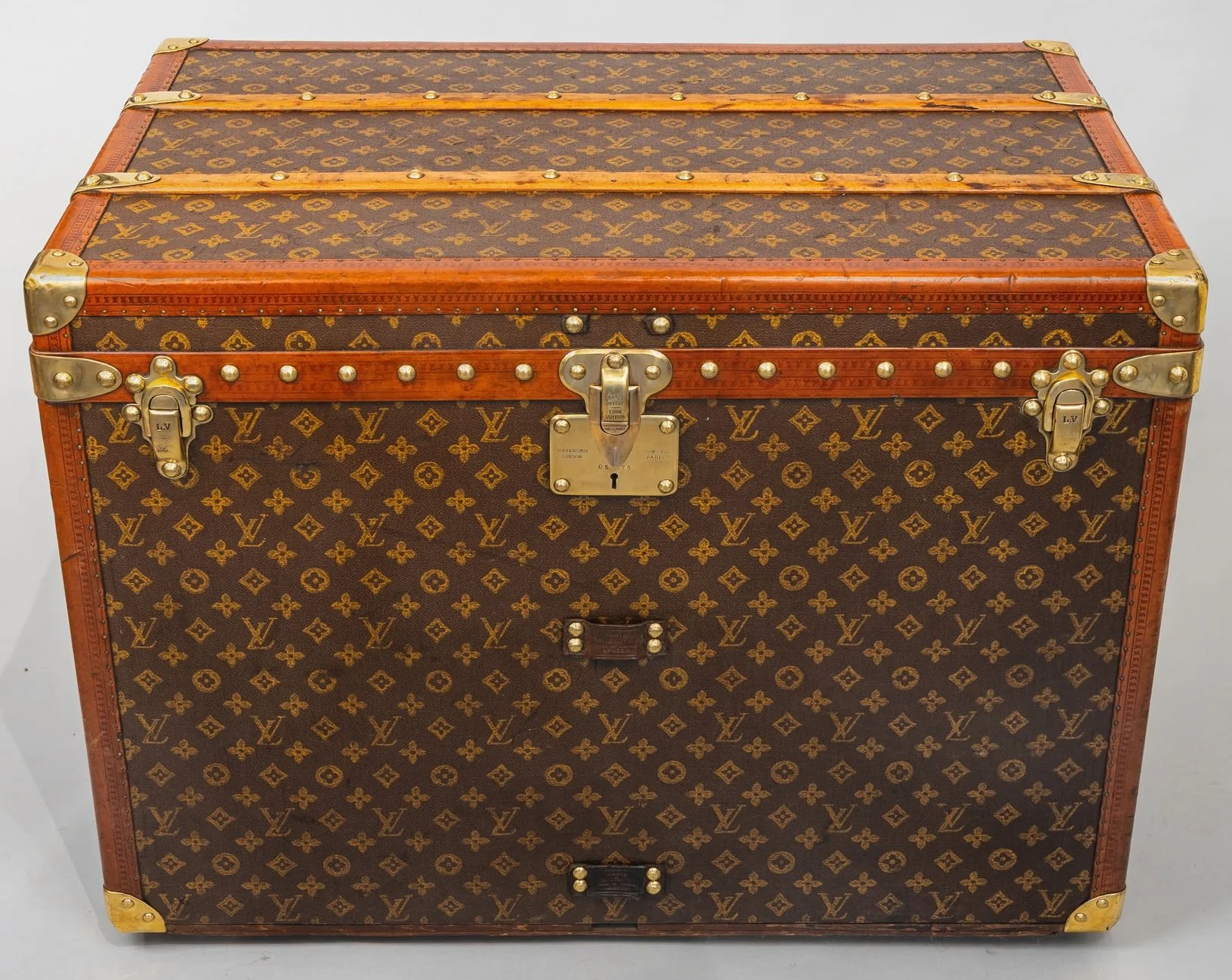
A collector-period Louis Vuitton Monogram steamer trunk, c.1920s. Rich tobacco canvas, hand-polished brass hardware, lozine trim intact.
A Louis Vuitton trunk is one of the most recognizable objects in the history of luxury travel — carried by royalty, artists, industrialists, and explorers across the great ocean liner routes of the early twentieth century.
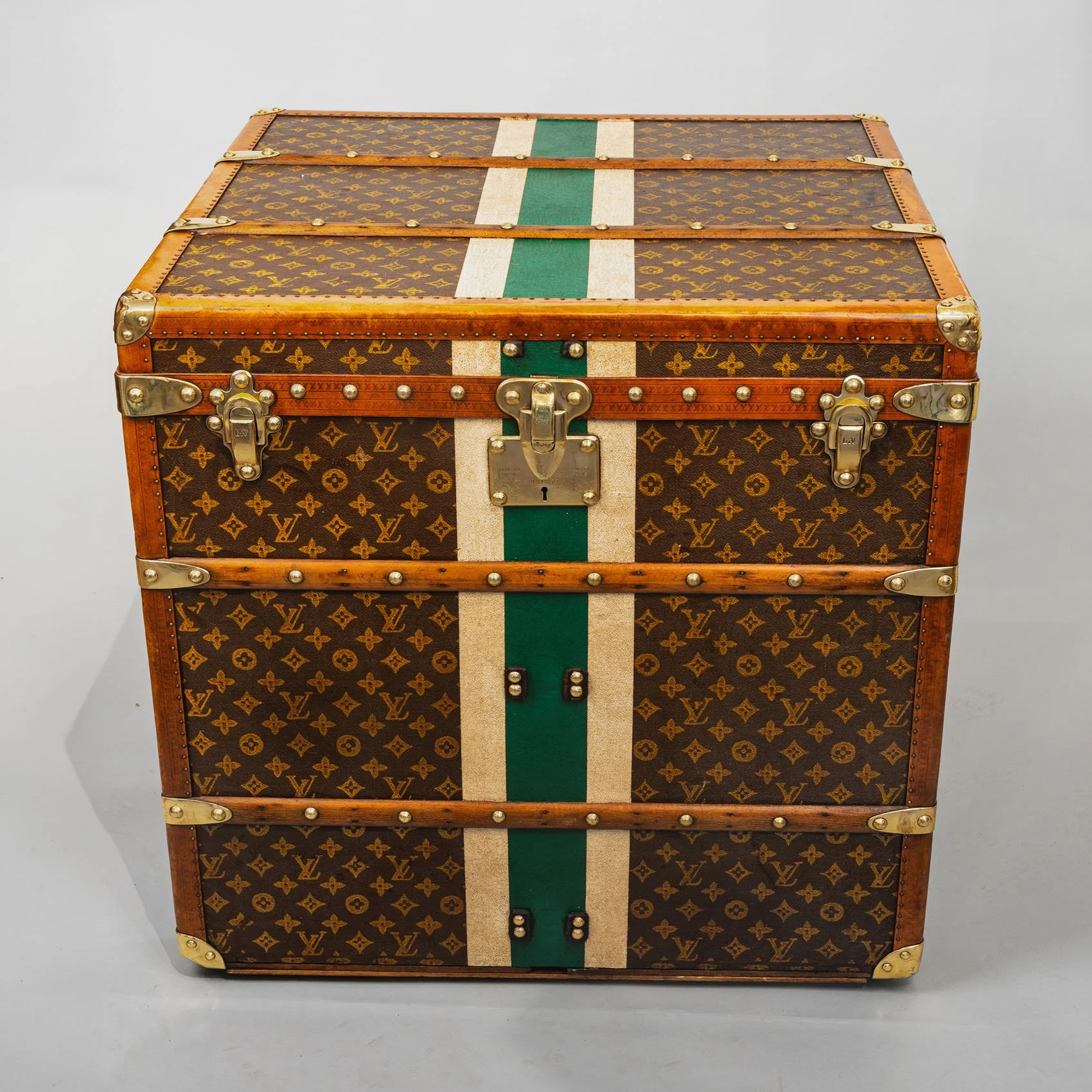
The Monogram canvas was introduced in 1896, and Louis Vuitton has produced trunks in it ever since. But the golden age of the steamer trunk coincides precisely with the golden age of ocean liner travel. Between 1896 and 1950, when air travel displaced the great liners, the trunk was the defining luggage form of the world's wealthy — handmade to exacting standards for a discerning clientele. Among the most practical and enduring forms was the cabin trunk, designed specifically for ocean liner travel and consistently built to 14 inches in height — precisely sized to slide beneath a stateroom bed. When air travel rendered the great liners obsolete after 1950, the cabin trunk went with them. No aircraft hold required a trunk that fit under a bed, and an entire luggage form simply ceased to be necessary. After 1950, production continued, but that concentrated fifty-year window accounts for the great bulk of the collector-period examples in circulation today.
Understanding authentication begins with understanding the object itself. The canvas, hardware, locks, and interior linings all evolved in distinct, datable ways throughout Louis Vuitton's history — a history we cover in depth in The Timeless Journey of Louis Vuitton Trunks.
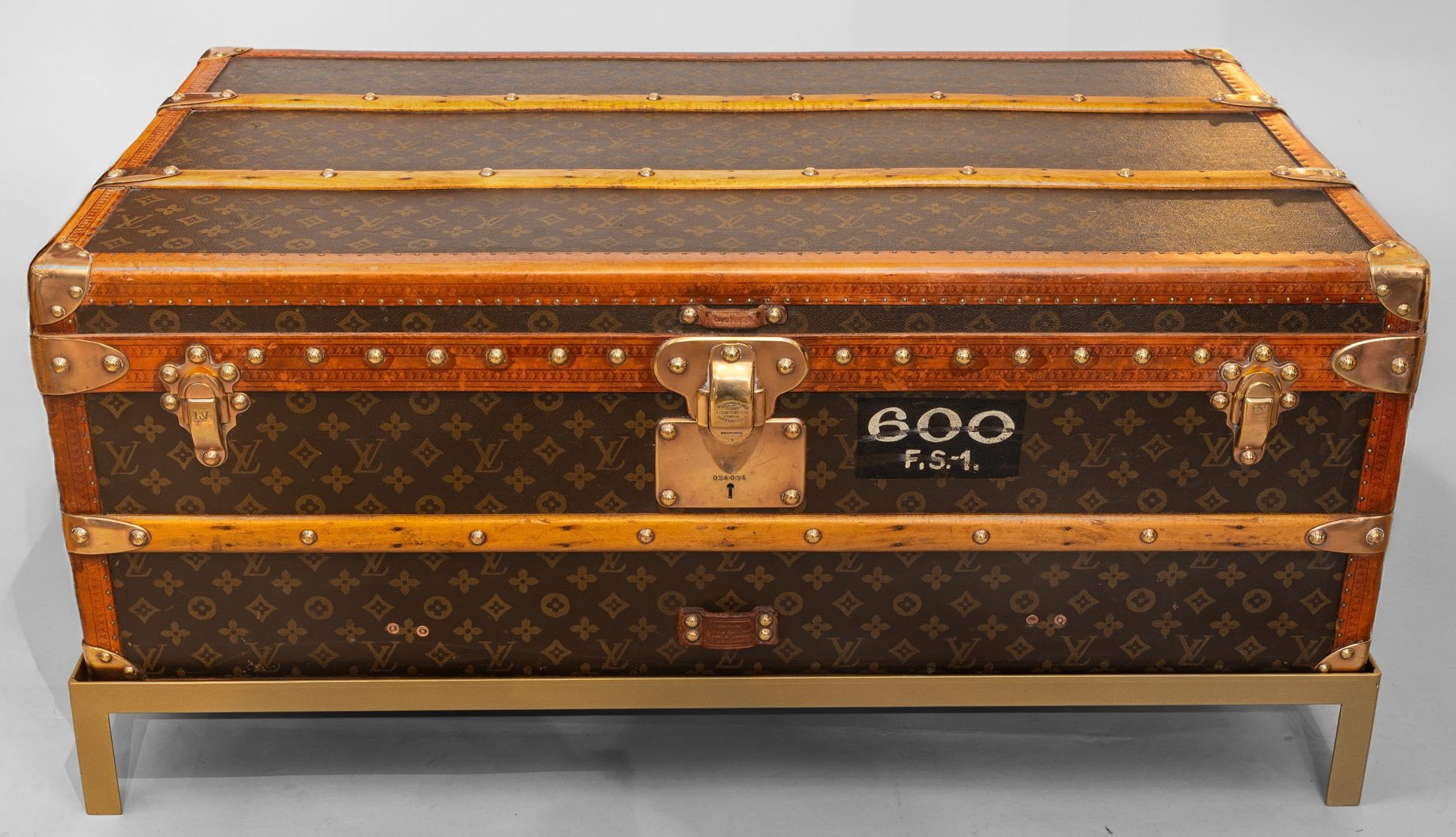
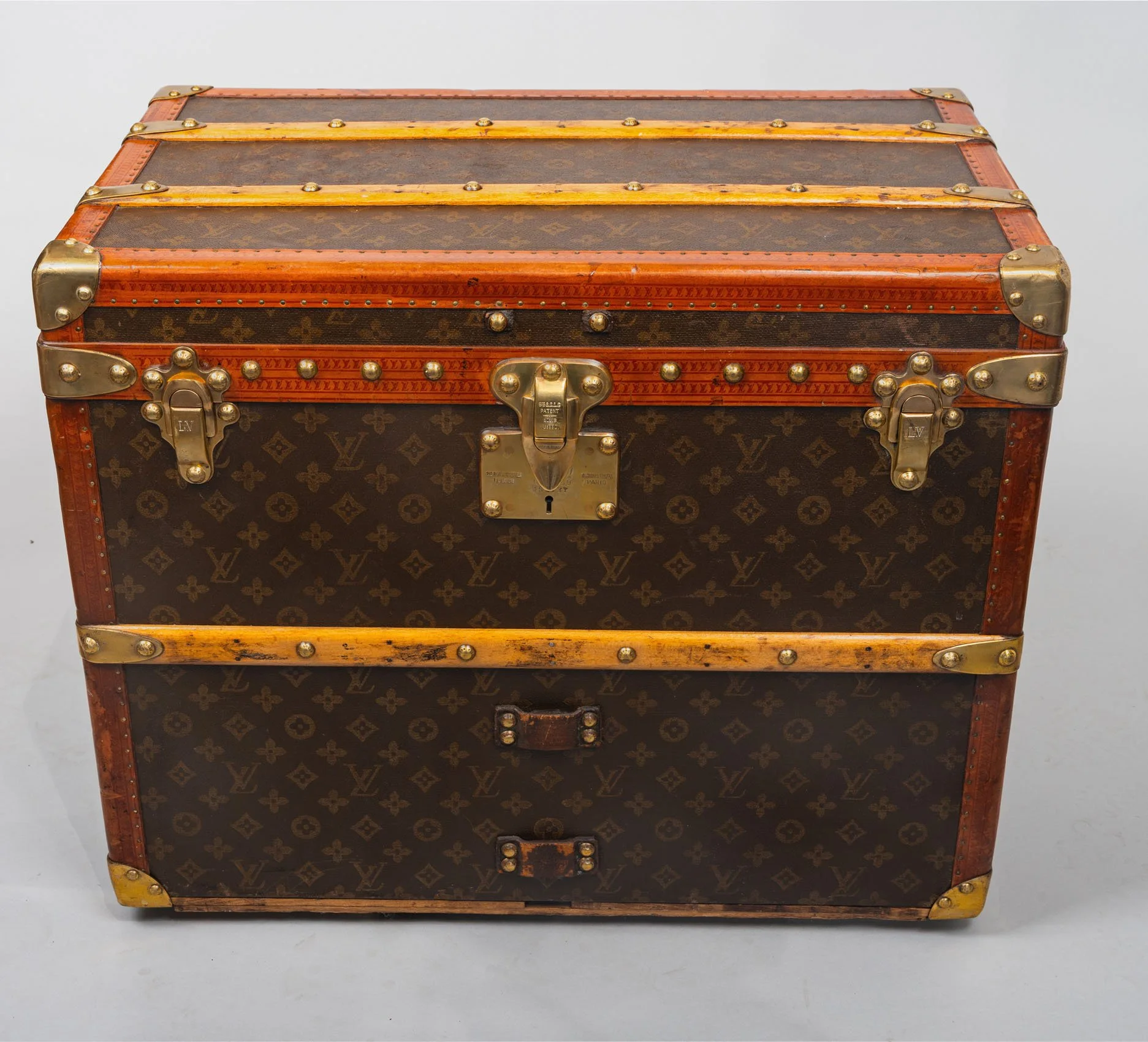
1920s Louis Vuitton Cabin Trunk.
Those trunks are now at least 70 years old. Supply is finite and slowly diminishing. Demand continues to grow. As prices rise, the incentive to fake, alter, and misrepresent increases. Counterfeit and misattributed trunks enter the market through credible channels — estate sales, auction houses, and private dealers who may themselves be unaware of what they are handling. A piece may carry a genuine Louis Vuitton lock married to a later carcass. Canvas may have been replaced. Hardware refinished or swapped. The trunk that presents beautifully in a photograph does not always survive close inspection.
The good news: Louis Vuitton trunks are remarkably difficult to fake convincingly. The house built its reputation on materials that age in specific, predictable ways no reproduction can fully replicate. Work through the criteria in this guide methodically, and the misrepresented trunk will almost always reveal itself.
The Canvas: Read the Surface First
The Monogram canvas — introduced in 1896 by Georges Vuitton as a tribute to his father, patented in 1905 — was designed from the outset to defeat counterfeiters. Its interlocking LV initials, quatrefoils, and four-petal flowers were so distinctively tied to the house's identity that no competitor could plausibly claim them. It is this canvas, produced through the mid-twentieth century, that defines the collector market today.
What to look for:
Depth of color. Authentic period canvas deepens from a warm tan toward rich tobacco brown with age. Replacement or reproduction canvas tends to sit too flat, too uniform, too pale.
Print registration. Motifs should be crisp and evenly registered — no blurring, no misalignment, no variation in ink density.
Wear patterns. Honest wear at corners and along the bottom edges is a signature of authenticity. A canvas in implausibly pristine condition on a century-old trunk should raise an immediate question.
Stickers and travel labels. Original port-of-call labels and hotel insignia are a pleasure — and very difficult to fake convincingly. But watch for labels placed strategically over suspicious areas. A cluster of labels concentrated on one face of the trunk, or a sticker whose edges haven't aged into the surrounding canvas, warrants a closer look. These can often hide issues underneath.
Turn the trunk over. This is one of my first moves when examining any piece — and something many first-time buyers never think to do. The underside canvas will typically be noticeably darker in tone than the sides and lid, as it is protected from sunlight for decades. This differential patina cannot be manufactured. The base will carry gouges, scuffs, and bruising — the accumulated evidence of a working life in cargo holds and on luggage carts. Look for the Louis Vuitton stamp pressed directly into the wood slats along the base. It is understated, unambiguous, and impossible to fake in context. However, the stamp is not consistently present.
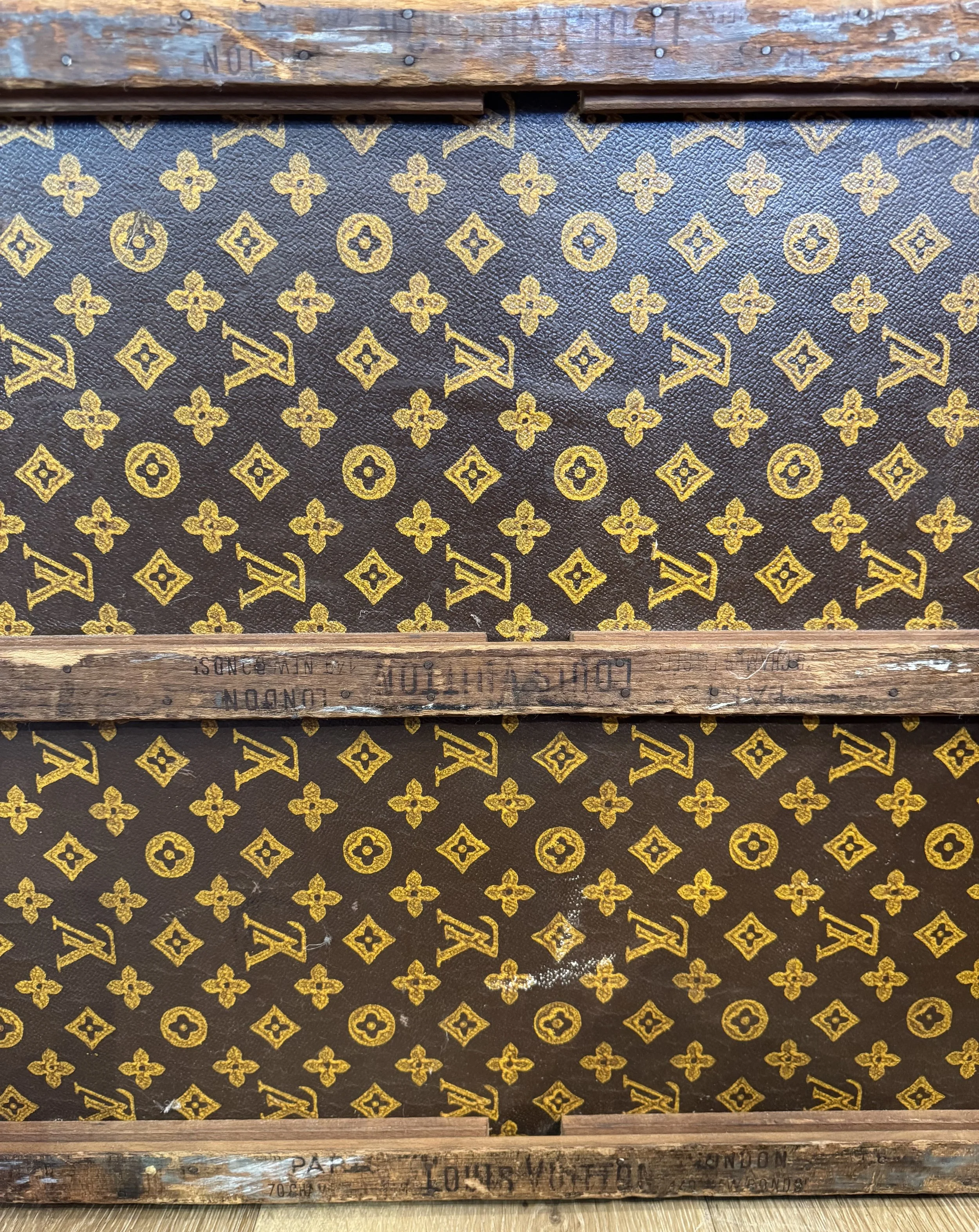
Underside of a 1920s Louis Vuitton Half Steamer Trunk.
The Hardware: Where Authenticity Becomes Most Apparent
I look at the brass hardware as a whole, and I look at it first. The gap between an authentic Louis Vuitton trunk and any misrepresented piece is most apparent here.
Lock evolution — a useful dating guide:
1860–1890: Flat clasps with a simple hasp
c.1885–1890: More elaborate clasps engraved with the house name and address introduced
c.1890, registered 1905: The "V" lock — the first Louis Vuitton tumbler lock, genuinely unpickable by the standards of the day, and the lock most commonly encountered on Monogram trunks from the collector period
What to examine on the lock:
The center lock is the first place to focus — and, in my experience, it is the component most commonly swapped on misrepresented trunks. The first trunk I purchased, more than twenty years ago, had a replacement center lock. The rest of the piece was genuine; the lock was not. It is a mistake I would not make today.
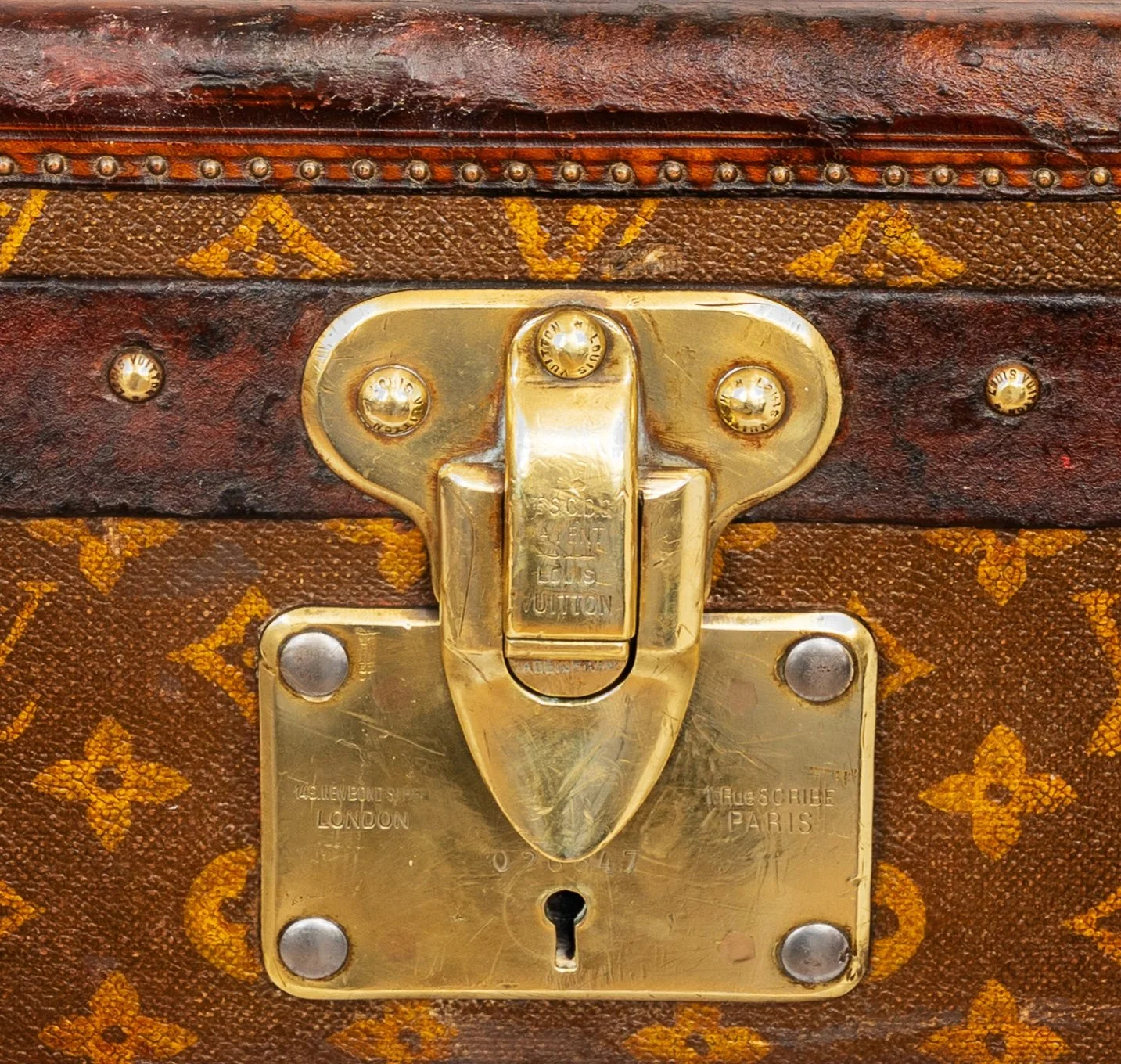
The lock body should be solid brass, substantial in weight, and stamped with the LV mark.
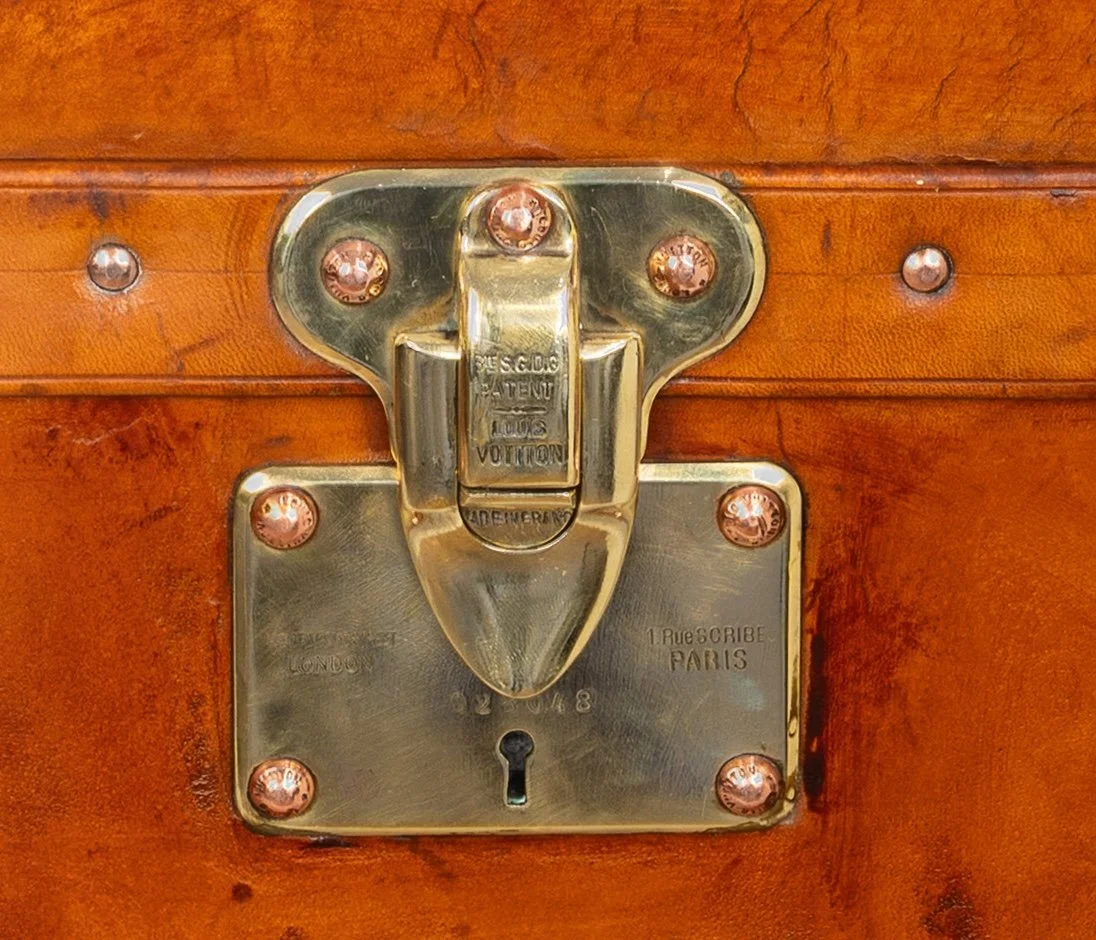
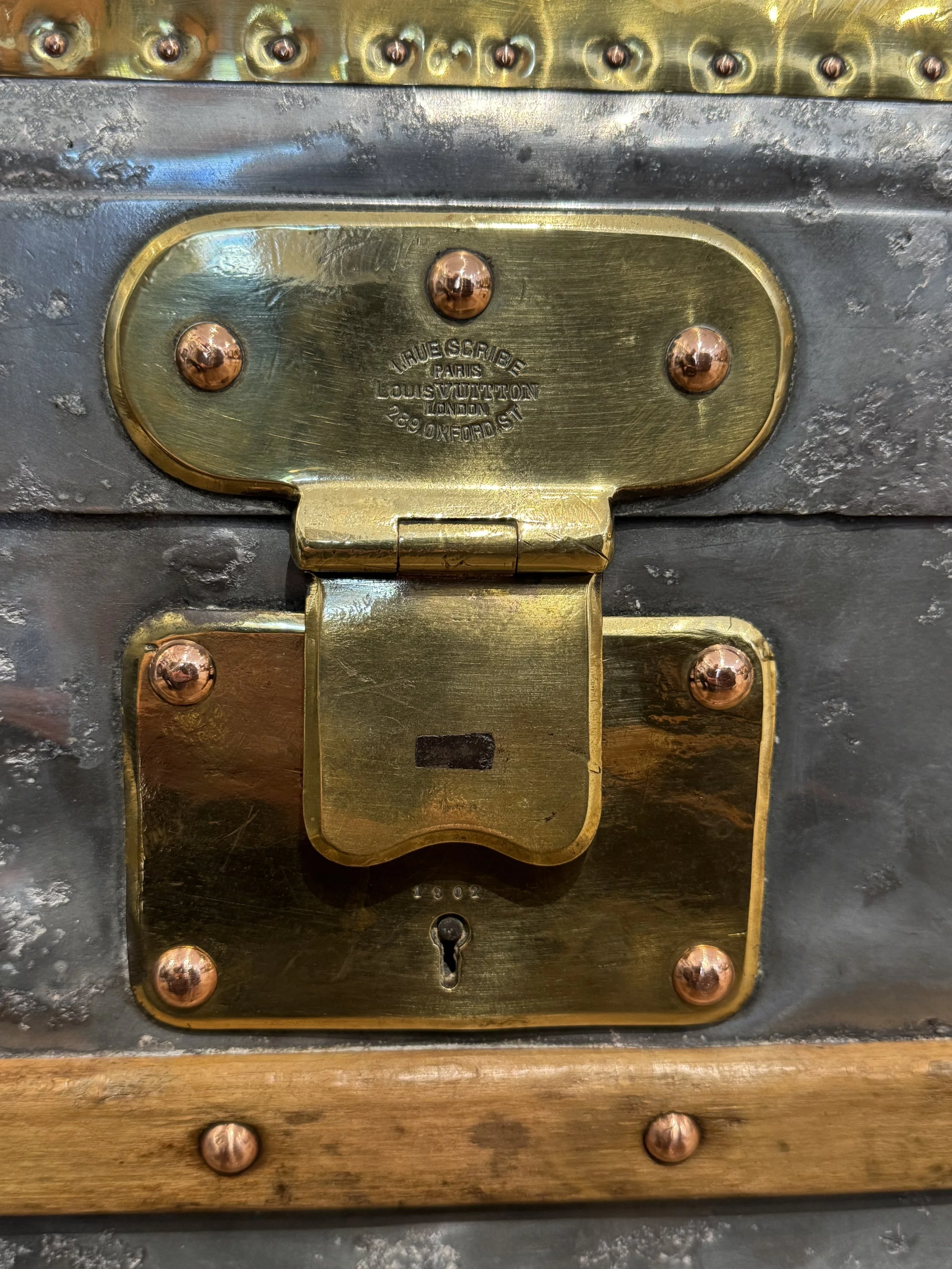
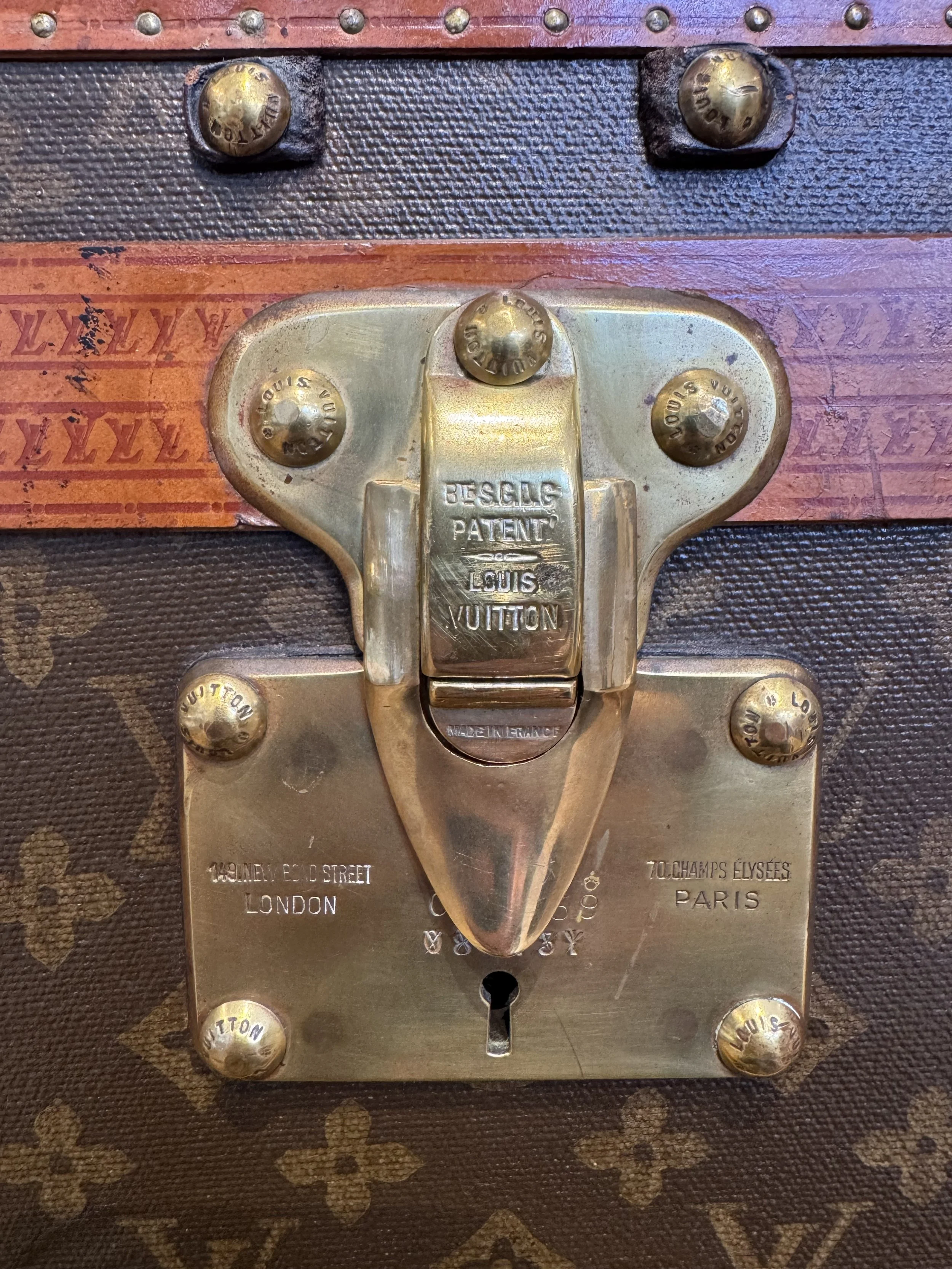
It will be stamped with the Louis Vuitton address — and that address is one of the most useful dating tools available. It should correspond to the age of the trunk and, where an interior label survives, to the address printed there.
A lock that feels light, moves loosely, or carries no stamping may be a replacement, a marriage from another piece, or a reproduction.
The four locks below, all from pieces in the Daniels Antiques collection, illustrate exactly how the address stamping changes across the production period — and how precisely a lock can date a trunk.
On polishing: I like the brass polished — it gives a beautiful contrast against the canvas, making a well-preserved trunk genuinely striking. But polishing must be done by hand, with each component carefully taped off to protect the surrounding canvas and lozine. I actively avoid trunks where the brass has been polished with a power tool. Engraved lettering, house names, and lock stampings worn smooth by a Dremel are gone forever.
The Interior: Half the Authentication Happens Inside
A buyer who examines only the exterior has examined half a trunk. Open the lid and look systematically.
The lining:
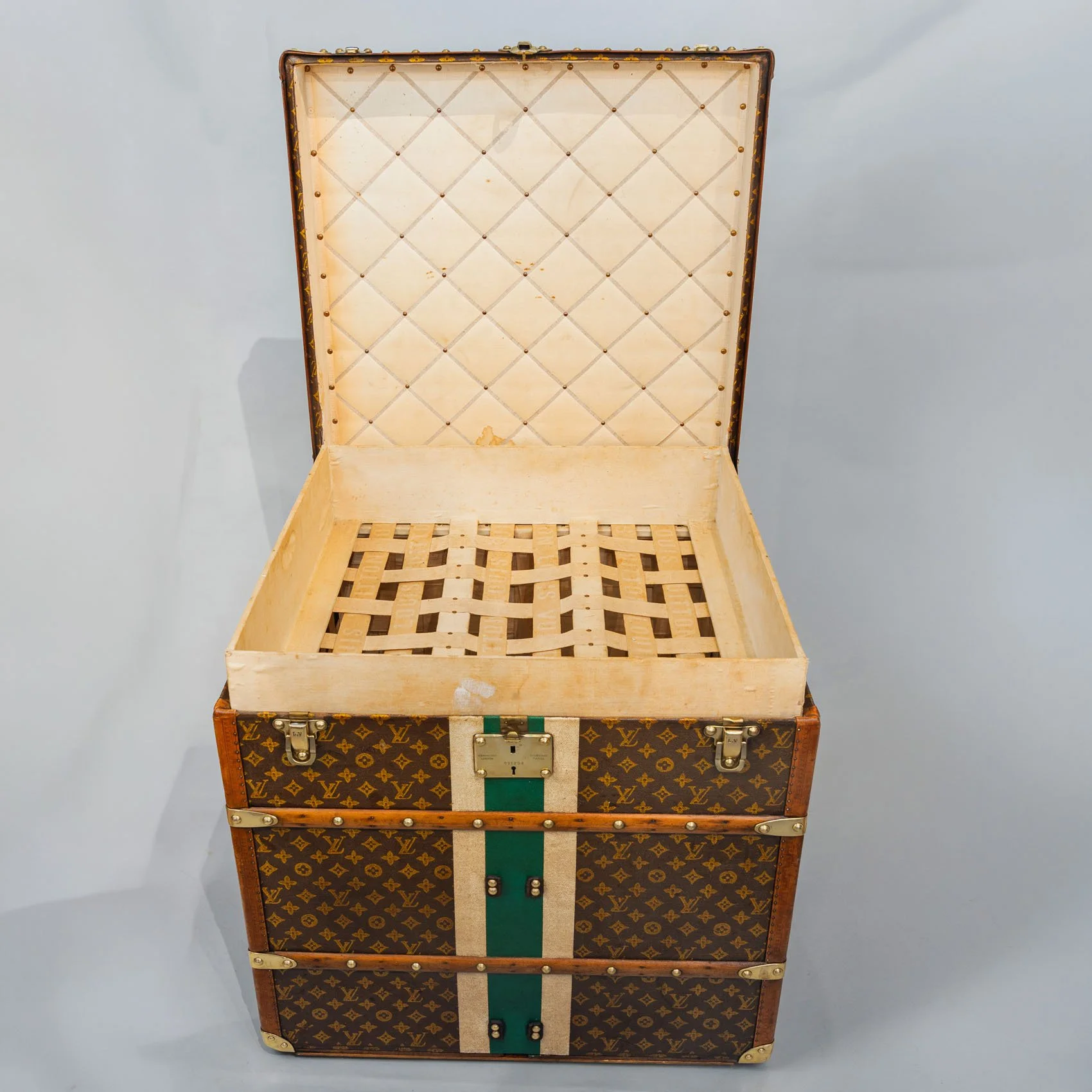
Authentic period trunks are lined in natural cotton canvas — typically a warm off-white or cream — that will have mellowed with age. But lining varies considerably across trunk types, periods, and original commissions. The four interiors below, all from the Daniels Antiques collection, illustrate the range of authentic pieces — and the consistent construction quality that unites them. The leather hat trunk has been tastefully relined whilst leaving the Louis Vuitton label in place.
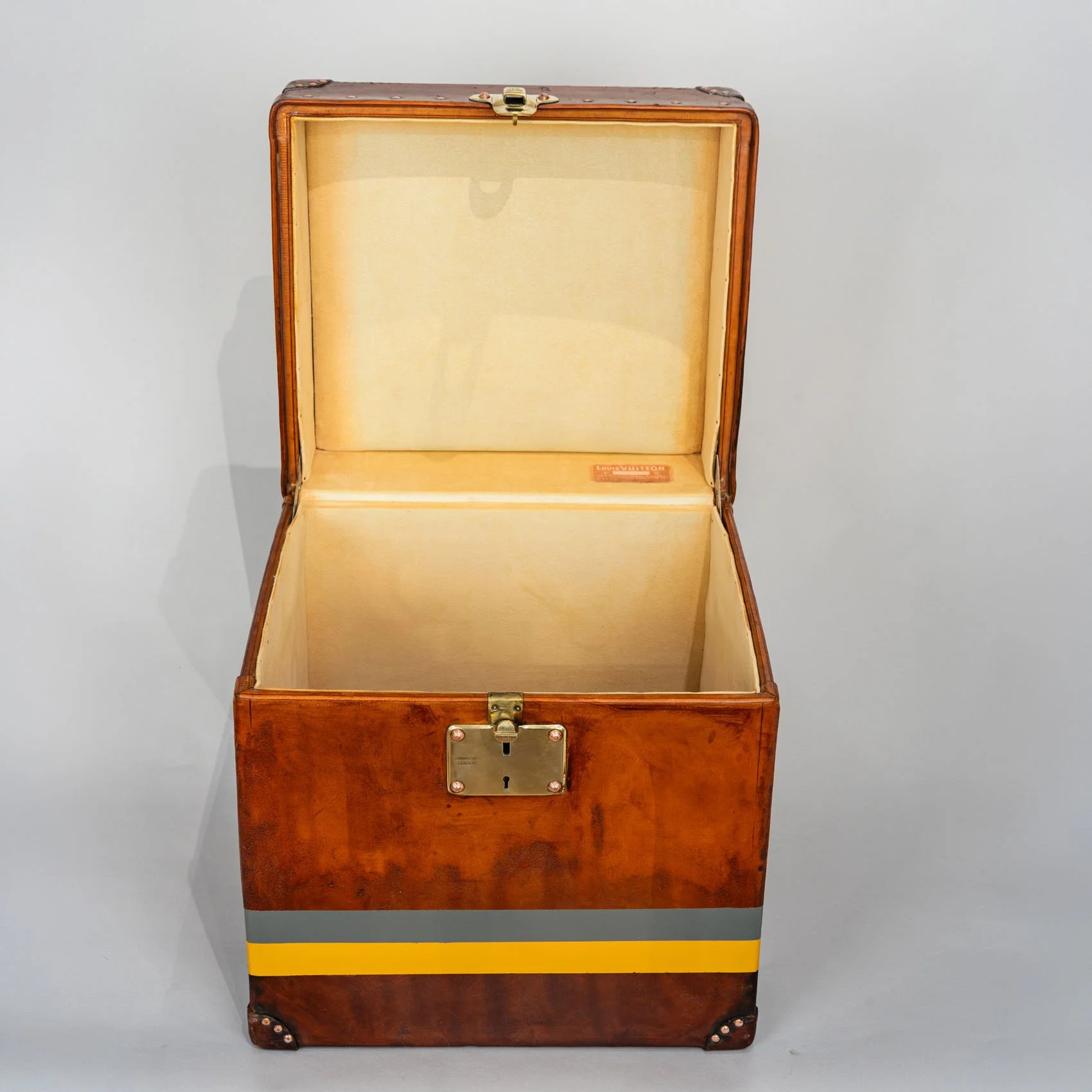
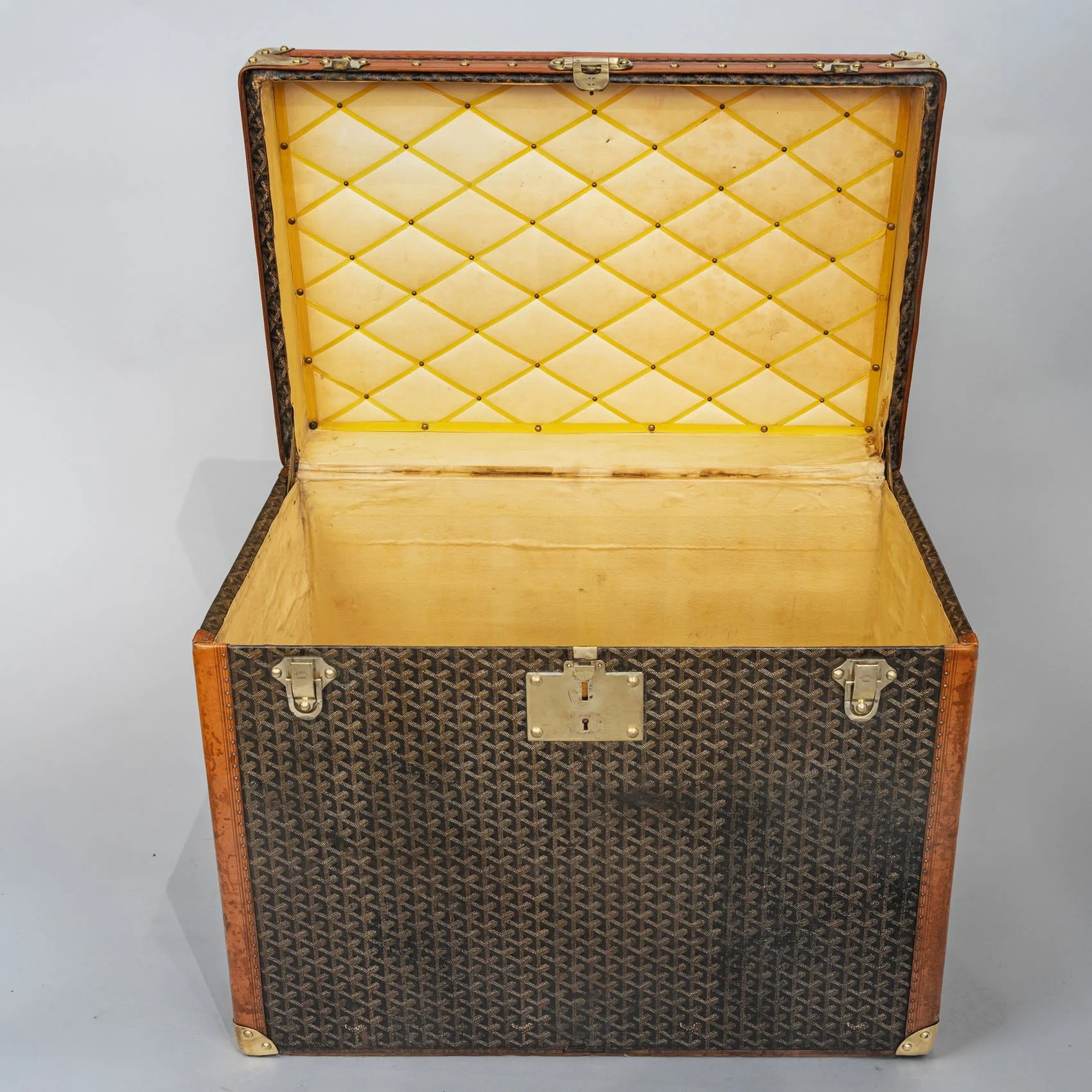
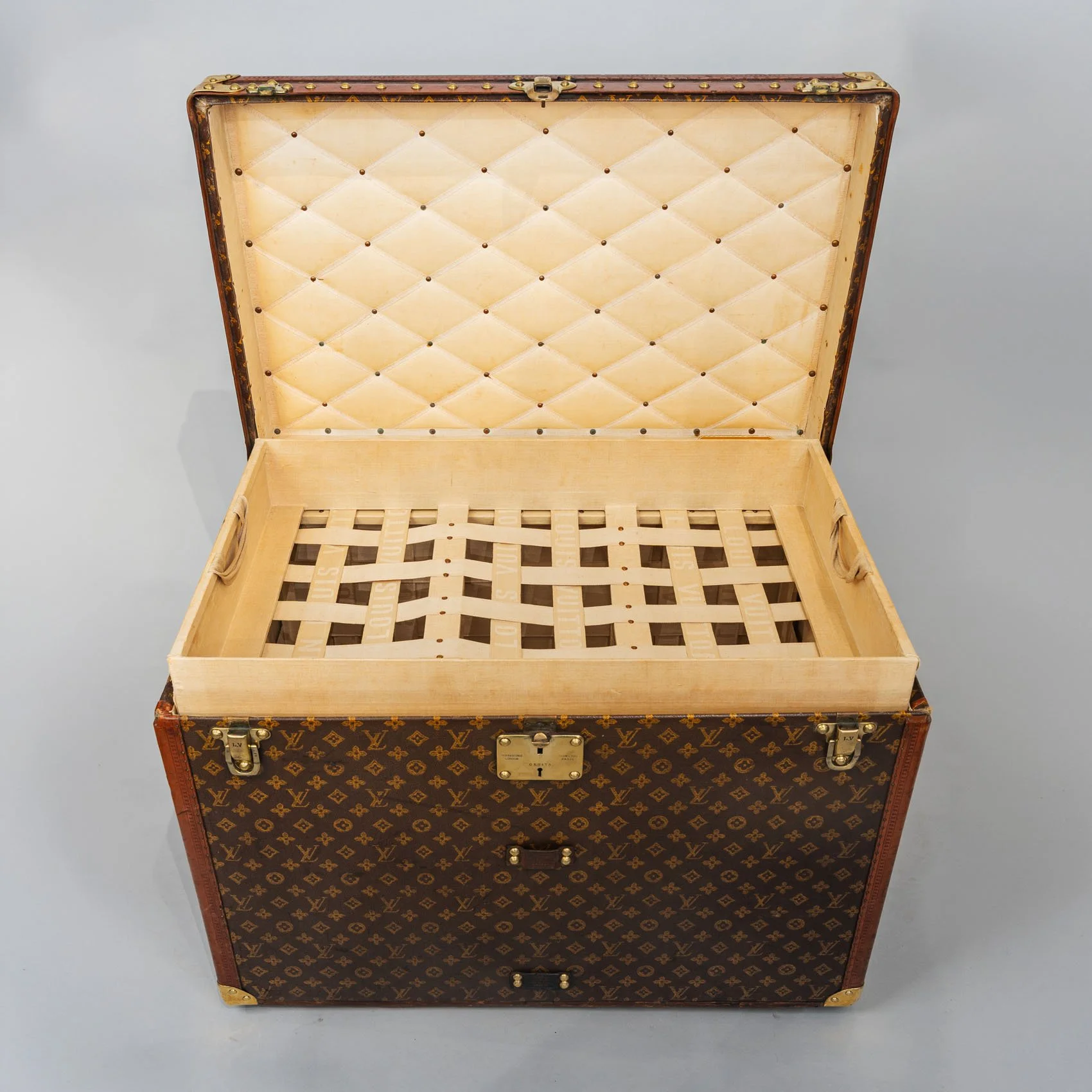
The label:
Where it survives, the label is invaluable. It lists the retail addresses of Louis Vuitton stores operating at the time of manufacture, and those addresses date the trunk with considerable precision.
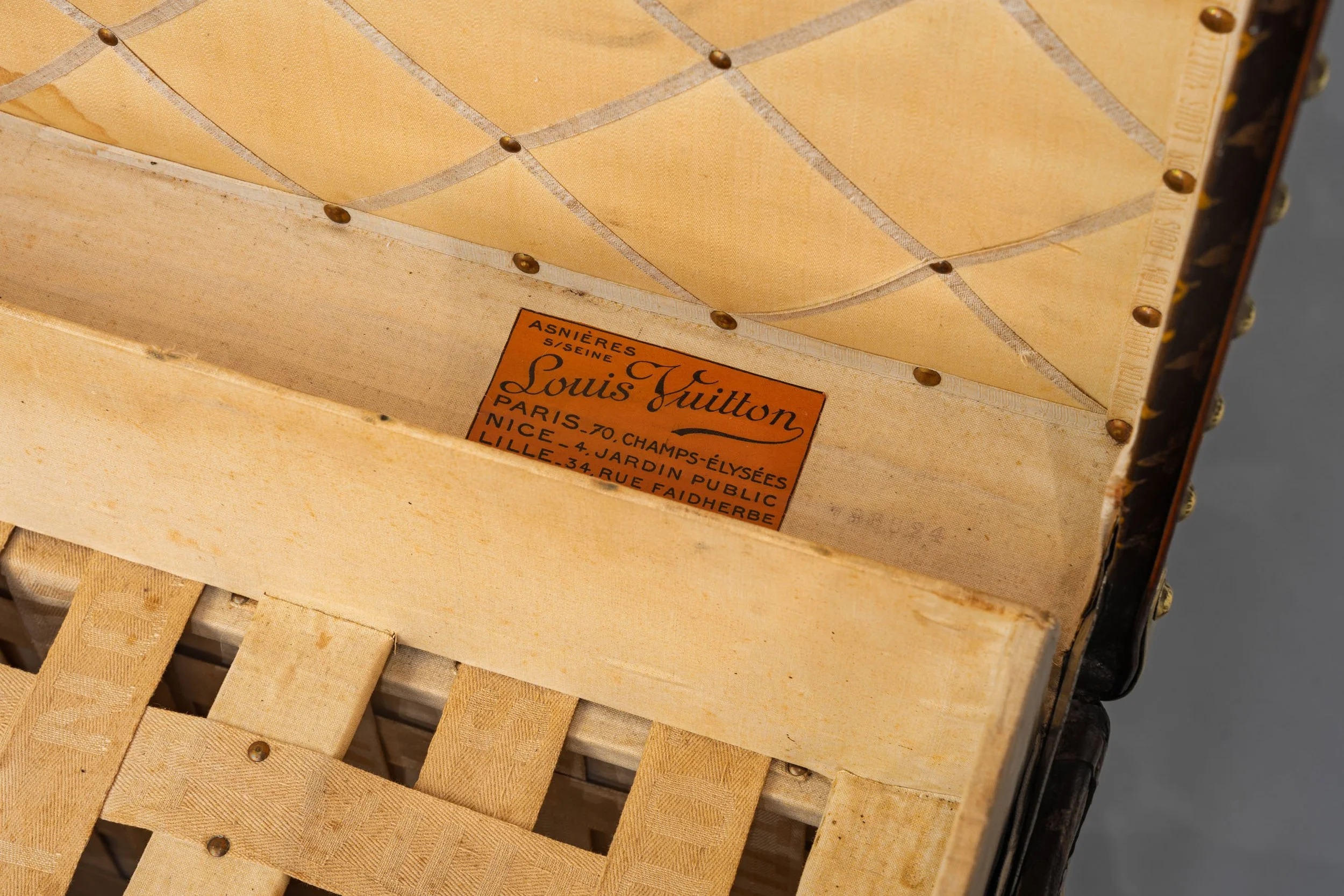
The interior label of a post-1914 Monogram trunk, showing the Asnières workshop, Paris–70 Champs-Élysées, Nice–4 Jardin Public, and Lille–34 Rue Faidherbe retail addresses. Cross-reference these against the center lock stamp and the serial number. All three should tell the same story.
Cross-reference the label address with the address stamped on the center lock. All three — label, lock stamp, and serial number — should tell the same story about the same trunk from the same period. Where they align, confidence increases. Where they conflict, the trunk is telling you something important.
The trays and fittings:
Removable trays should sit with precision — not rattling, not forced.
On finer examples, tray straps and ribbons carry the LV embroidered mark.
For specialist forms — shoe trunks, hat trunks, wardrobe trunks — the completeness of the original interior is central to value. Louis Vuitton produced bespoke trunk forms for some of the most celebrated clients of the era; the famous shoe trunk made for soprano Lily Pons, designed to carry thirty pairs of shoes, became a model that the house subsequently produced for other discerning clients.
The smell test:
For me, a bad-smelling trunk is close to a deal-breaker. Many of these pieces spent their working lives in steamship cargo holds, and water ingress was not uncommon. A trunk that sat in standing water can carry that smell for decades — it is extremely difficult to eliminate entirely. A heavy mothball smell signals prolonged sealed storage and warrants close inspection for the condition problems that typically accompany it.
Always inspect in person, or buy from a dealer who has opened the piece and will represent it honestly.
Serial Numbers: One Piece of a Larger Puzzle
Every Louis Vuitton trunk carries a serial number, stamped on the interior — typically on the back panel or lid — and in many cases repeated on the lock. The serial number confirms that a trunk left the Asnières workshop as a genuine Louis Vuitton piece, but it is one element within a broader assessment, not a standalone guarantee.
Cross-reference the serial number with the interior label address and the lock stamp. All three should tell a consistent story.
A number added later, transferred from another piece, or stamped with inconsistent typography is a red flag.
The absence of a serial number does not automatically disqualify a trunk — labels are lost, interiors are relined, and on the oldest examples, stamping may have faded. Absence is not evidence of fakery, but it places greater weight on every other authentication point.
Provenance: The Story Behind the Trunk
Strong provenance does two things simultaneously: it deepens a piece's historical interest and reinforces its authentication. A trunk with a documented ownership history is one whose story has been told and verified over time.
What counts as credible provenance:
Initials on a trunk are not provenance on their own. I have seen named attributions applied to a set of initials with nothing further to support them.
A credible attribution requires corroboration: initials on the trunk, travel labels consistent with the claimed owner's biography, period-correct paperwork, and — most compellingly — a photograph of the trunk in situ with its owner. That kind of evidence is very hard to manufacture.
Travel labels, port-of-call stickers, and shipping company tags are a form of provenance in their own right, and period-correct examples are very difficult to fake convincingly.
The absence of paperwork is not a disqualifier. Most authentic trunks in circulation today have lost their documentation over a century of ownership. What matters is that the physical evidence — canvas, hardware, serial number, label, and construction — tells a coherent and consistent story.
Red Flags: The Tells That Give a Trunk Away
Most misrepresented trunks fail not on one point but on several simultaneously. It is the accumulation of inconsistencies that confirms a problem.
Canvas that doesn't add up. Replacement canvas is the most frequent intervention. Too uniform, too pale, too pristine — or with wear patterns that don't correspond naturally to the trunk's form and age. Watch for travel labels placed strategically over suspicious areas.
Hardware inconsistencies. A light lock, missing LV stampings, an address that conflicts with the period suggested by the canvas and lozine, and brass polished with a power tool. A trunk assembled from components sourced from more than one piece.
Label and serial number conflicts. Where a label survives, it must correspond to the lock stamp and the period suggested by the rest of the evidence. A conveniently relined interior that has removed the label deserves closer scrutiny of every remaining authentication point.
An interior that doesn't belong. Loose-fitting trays, mismatched lining, and missing fittings on specialist forms. For wardrobe, hat, and shoe trunks, completeness of the original interior is inseparable from value.
The smell test failed. Heavy, damp, or mildew odor signals water damage that may be structural as well as cosmetic.
Over-restoration or poor restoration. Some trunks were beyond honest recovery before restoration began, and no amount of work changes that fundamental reality. The tells accumulate across the whole piece — a slightly off-canvas tone here, a replaced component there, a lozine that doesn't quite match. Poor restoration, or over-restoration that has erased the honest patina of age in favor of something that looks newer than it should, diminishes a trunk rather than enhancing it.
The Authentication Checklist
Run through these in order before committing to any piece:
Canvas tone, texture, and wear patterns consistent with claimed age
Underside canvas noticeably darker than sides and lid
LV stamp pressed into base wood slats
Center lock solid, heavy, stamped — address consistent with trunk's period
Lozine trim consistent with correct series (pre/post-1914)
Brass hardware hand-polished, not machine-polished
Interior label address matches lock stamp and serial number
Trays fit precisely; specialist interior fittings complete
Interior smell acceptable — no damp, mildew, or heavy mothball odor
Travel labels naturally aged into canvas, not strategically placed
Provenance, where claimed, corroborated beyond initials alone
In Summary
Authenticating a Louis Vuitton trunk is an exercise in reading consistency. Every authentic trunk tells a single coherent story — canvas, hardware, lozine, label, serial number, interior fittings, underside, and smell all pointing to the same piece, from the same period, with the same history. The moment elements begin to conflict, questions must be asked.
Honest condition — darkened canvas on the underside, gouged wood slats, seized wheels, a softened lining, handles deepened with age — is not a problem. It is evidence of a genuine working life. What concerns me is the condition that has been artificially manipulated, selectively improved, or inconsistently distributed across a piece.
Take your time. Turn the trunk over. Read the label. Cross-reference the address with the lock stamp. Smell the interior. Ask where the piece came from.
When in doubt, buy from a dealer with the knowledge and the reputation to stand behind what they sell.
Daniels Antiques is always interested in acquiring exceptional Louis Vuitton trunks and other fine travel pieces — contact us to discuss a potential sale.
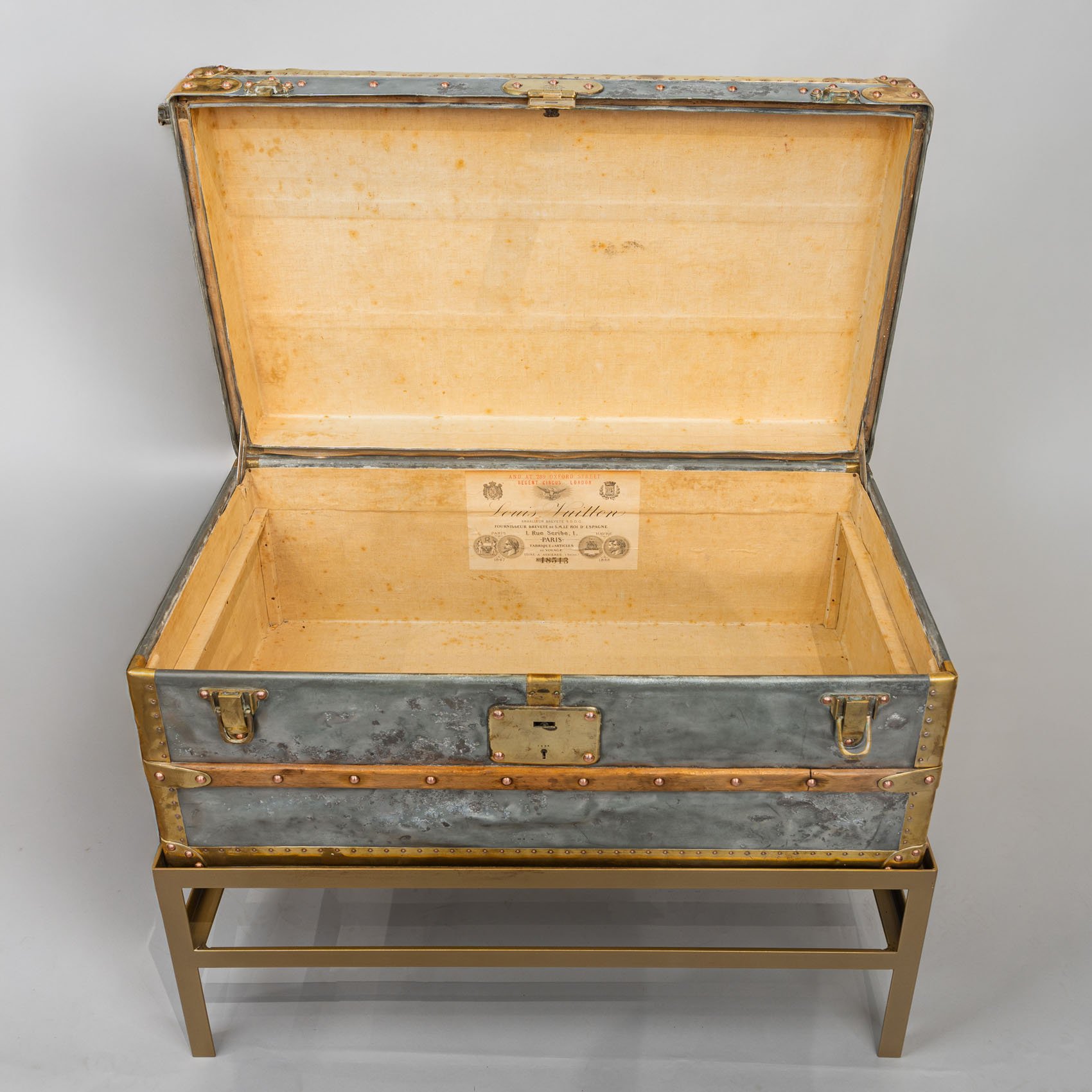
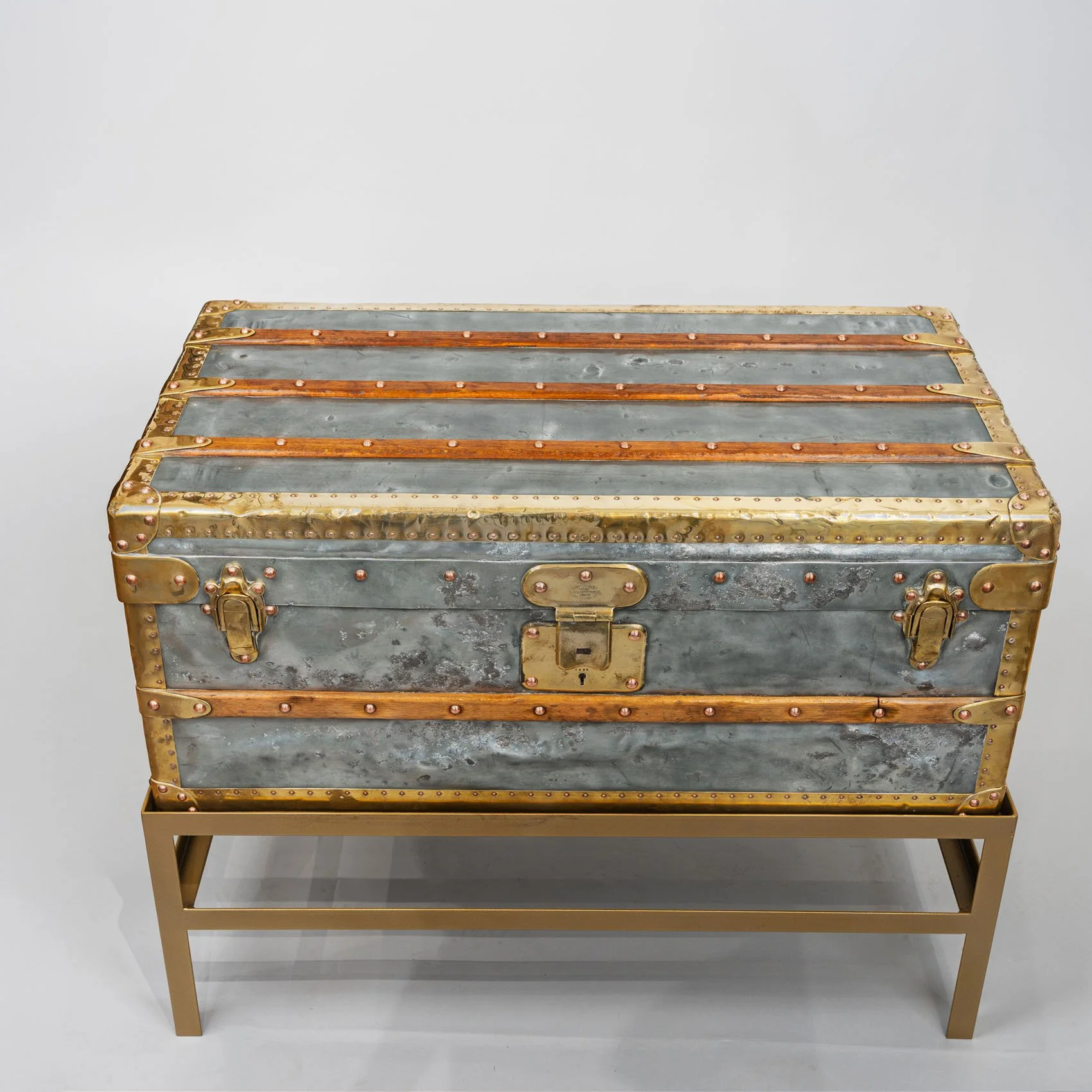
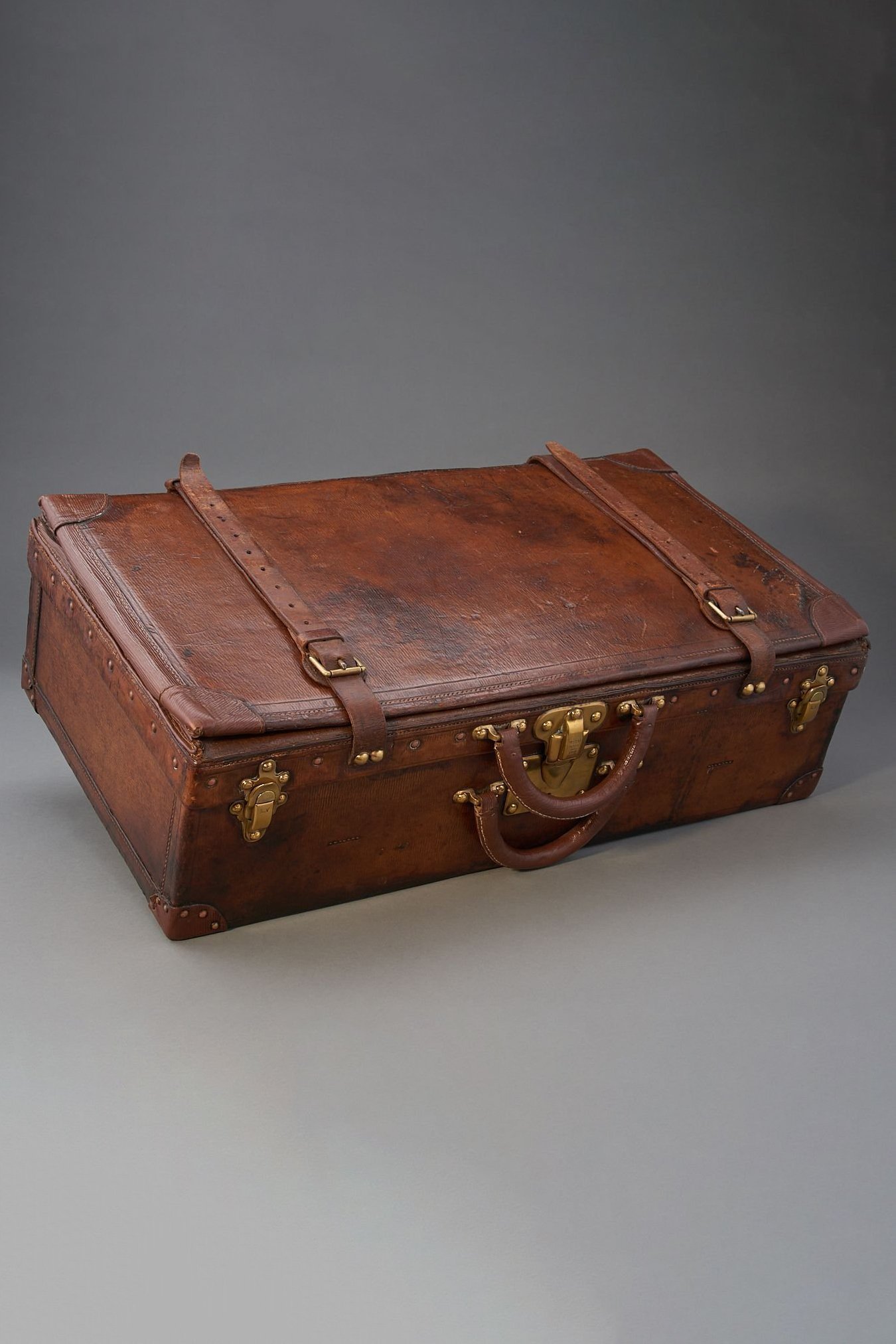
A Louis Vuitton zinc Explorer trunk, c.1880–1895, on custom brass stand — among the earliest surviving examples in the Daniels Antiques collection. The pre-Monogram period produced some of the most remarkable trunks the house ever made. Authentication principles remain consistent across every canvas and every era: the trunk that tells a coherent story is the trunk worth owning.
Further Reading
For those wishing to go deeper, the essential reference on the subject is Pierre Léonforte and Éric Pujalet-Plaà, 100 Legendary Trunks: Louis Vuitton (Louis Vuitton), with a preface by Patrick-Louis Vuitton — the most comprehensive illustrated survey of the house's trunk production, indispensable for any serious collector.
Browse the Daniels Antiques trunk collection →
Daniels Antiques, established in 1978. Gallery locations in Aspen, Colorado, and Fort Lauderdale, Florida. Inquiries by appointment.
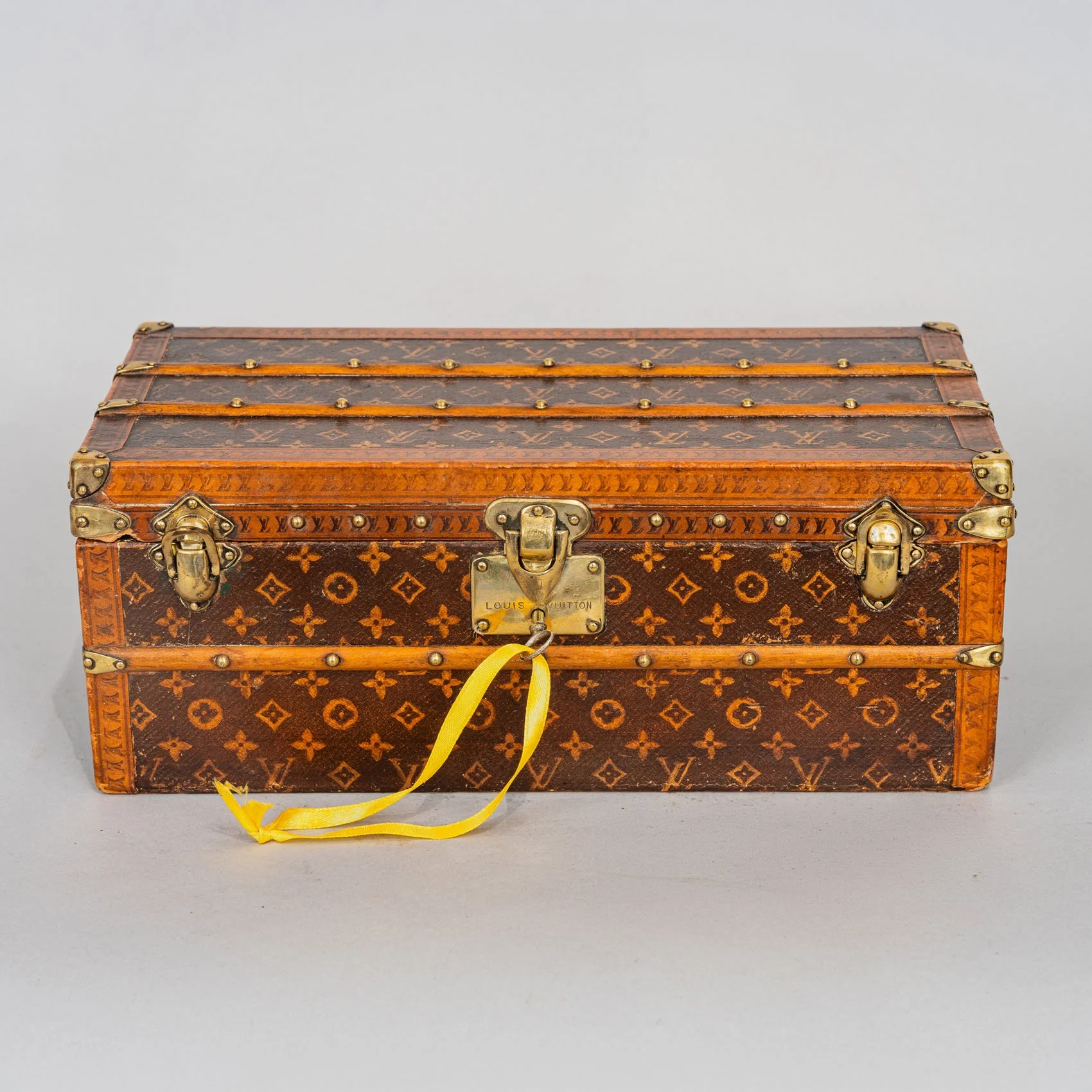
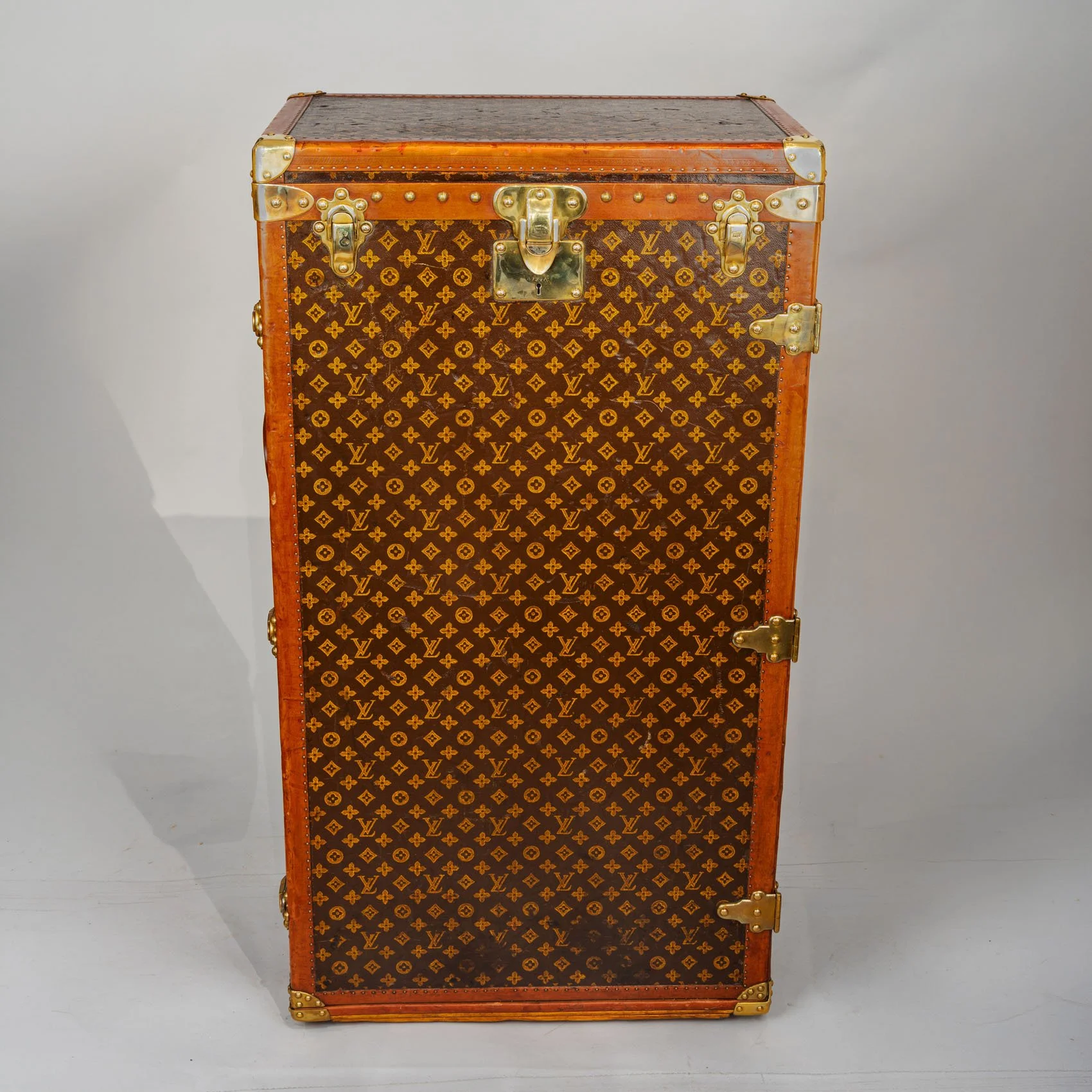
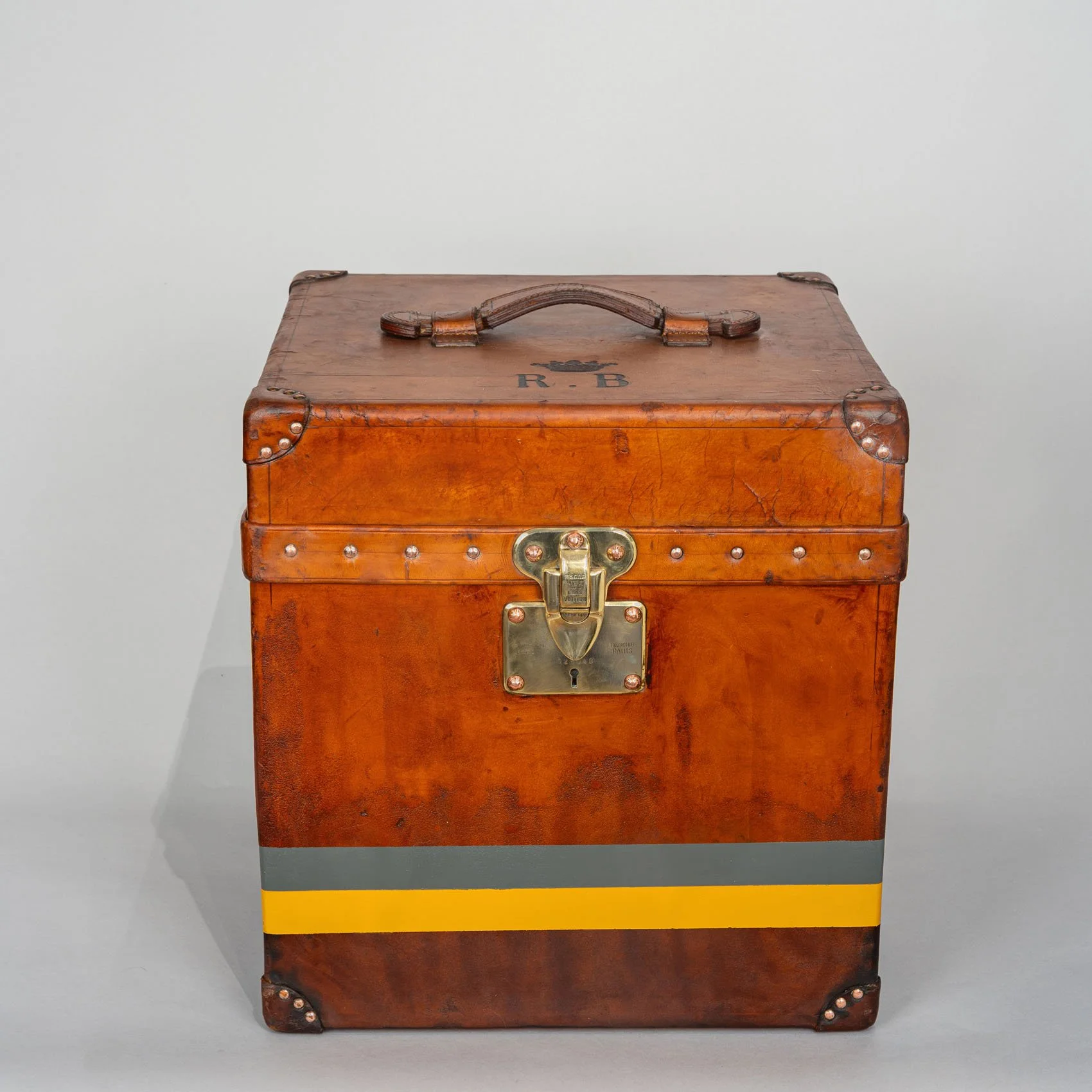
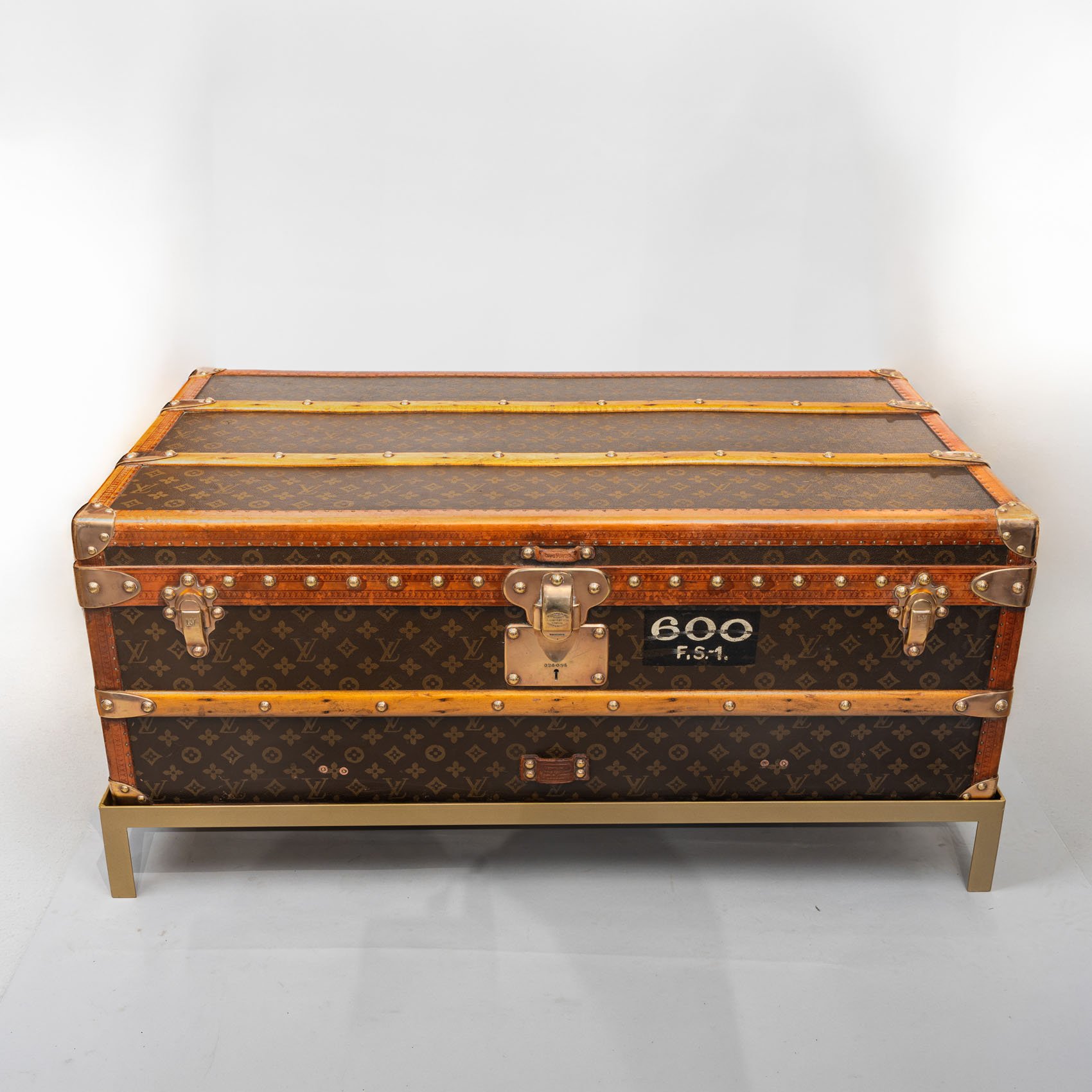
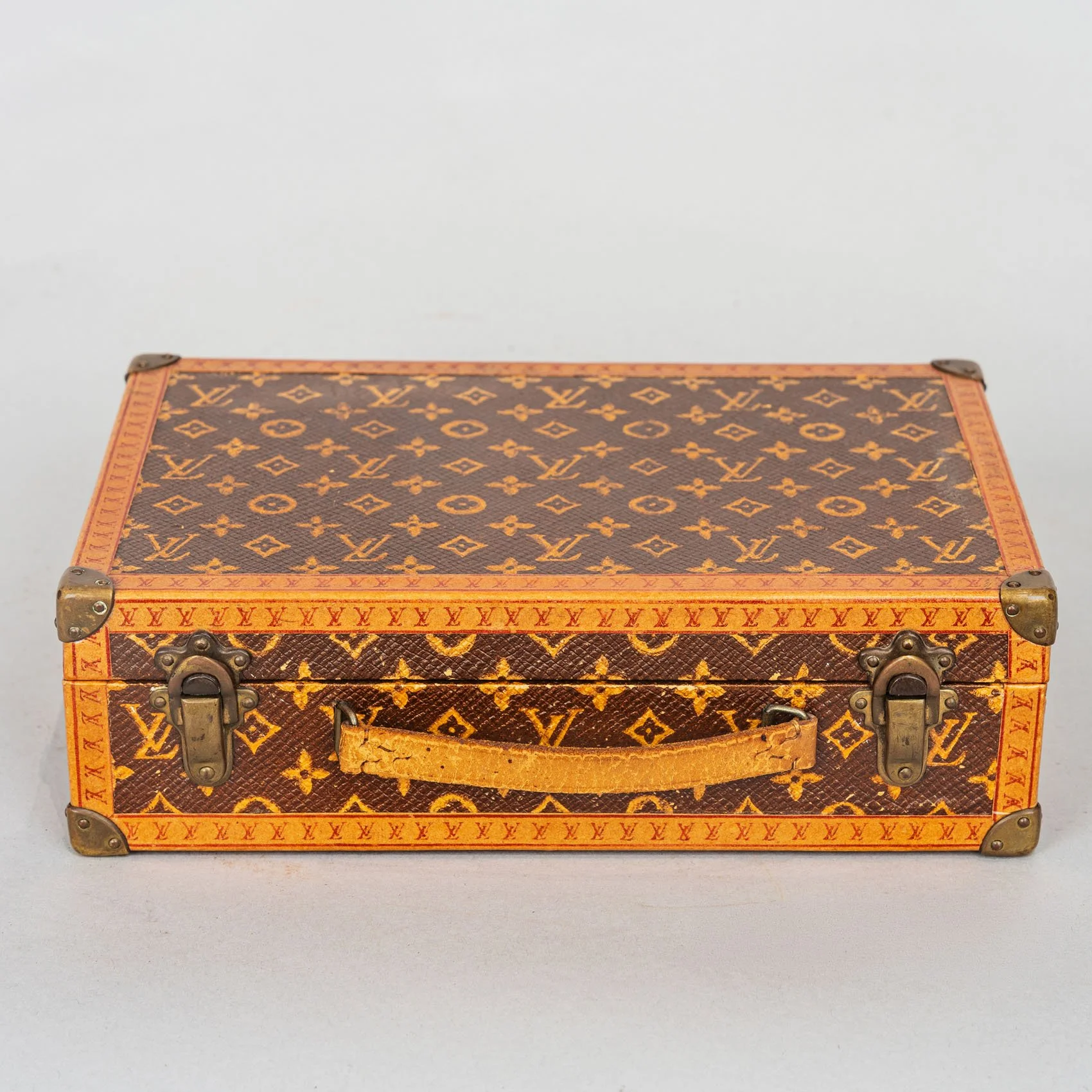
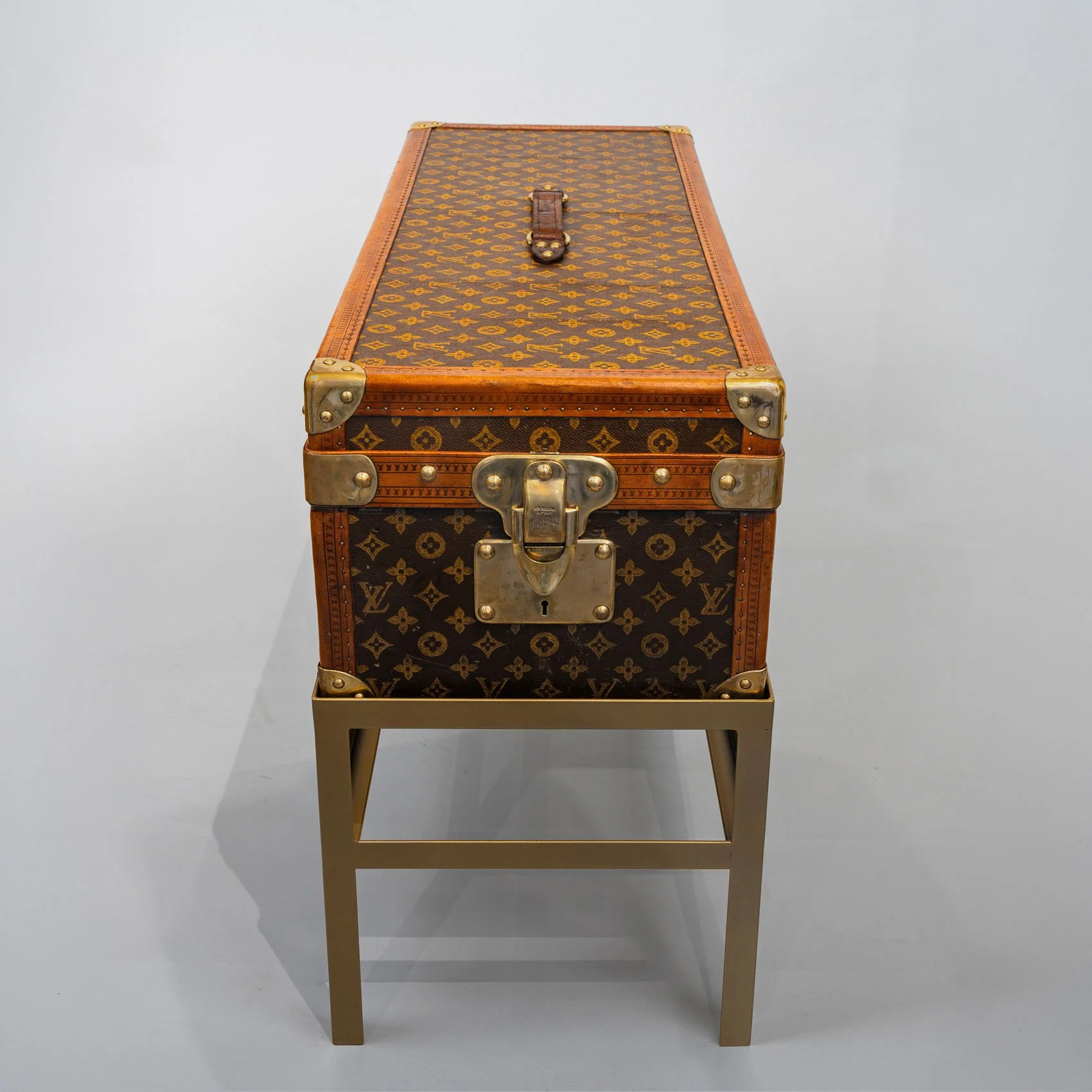

A small Louis Vuitton trunk in the classic LV monogram canvas, retaining its original brass hardware, leather trim, and painted initials throughout. The exterior is fitted with stamped brass hardware, a central lock, two swing-latch clasps, and brass corner protectors at all eight corners. The dark leather-trimmed borders are studded with domed brass nails, and a painted red lozenge stripe runs the full width of the lid. The dark leather carry handle is original.
The front bears the original owner's painted initials JMC in silver. The central lock is engraved with the maker's addresses, 149 New Bond Street, London and 1 Rue Scribe, Paris, the address Louis Vuitton occupied from 1871 until 1914, consistent with the dating of this piece.
The lid interior is lined in the original cream quilted linen, studded in a diamond lattice with brass tacks. The body is lined in the maker's natural linen canvas.
Dimensions: 20 inches long, 11 inches deep, 11 inches tall.
For a larger Louis Vuitton piece bearing the same 1 Rue Scribe, Paris address, see our 1905–1910 steamer trunk produced exclusively for John Wanamaker.