
Carl Zeiss Military Binoculars: A Cold War Relic.
The Carl Zeiss 8×60 torpedo fire-control optic and its Cold War origins.
On 9 February 1945, the United States Eighth Air Force struck the town of Jena in eastern Germany, with the Carl Zeiss optical works as its principal target. The firm whose name had defined precision optics for nearly a century emerged in ruins. A second raid followed on 19 March. Within months, the war was over; Jena lay behind what would soon be the Soviet zone, and Carl Zeiss stood on the brink of political dissolution.
What emerged from that collapse — and from the twenty years of reconstruction, division, and rearmament that followed — gave a certain class of object its particular historical weight: the vintage military binocular of West German naval issue. These instruments are physical artifacts of the Cold War. Twenty years on, Zeiss was making binoculars for the other side in a battle against Communism.
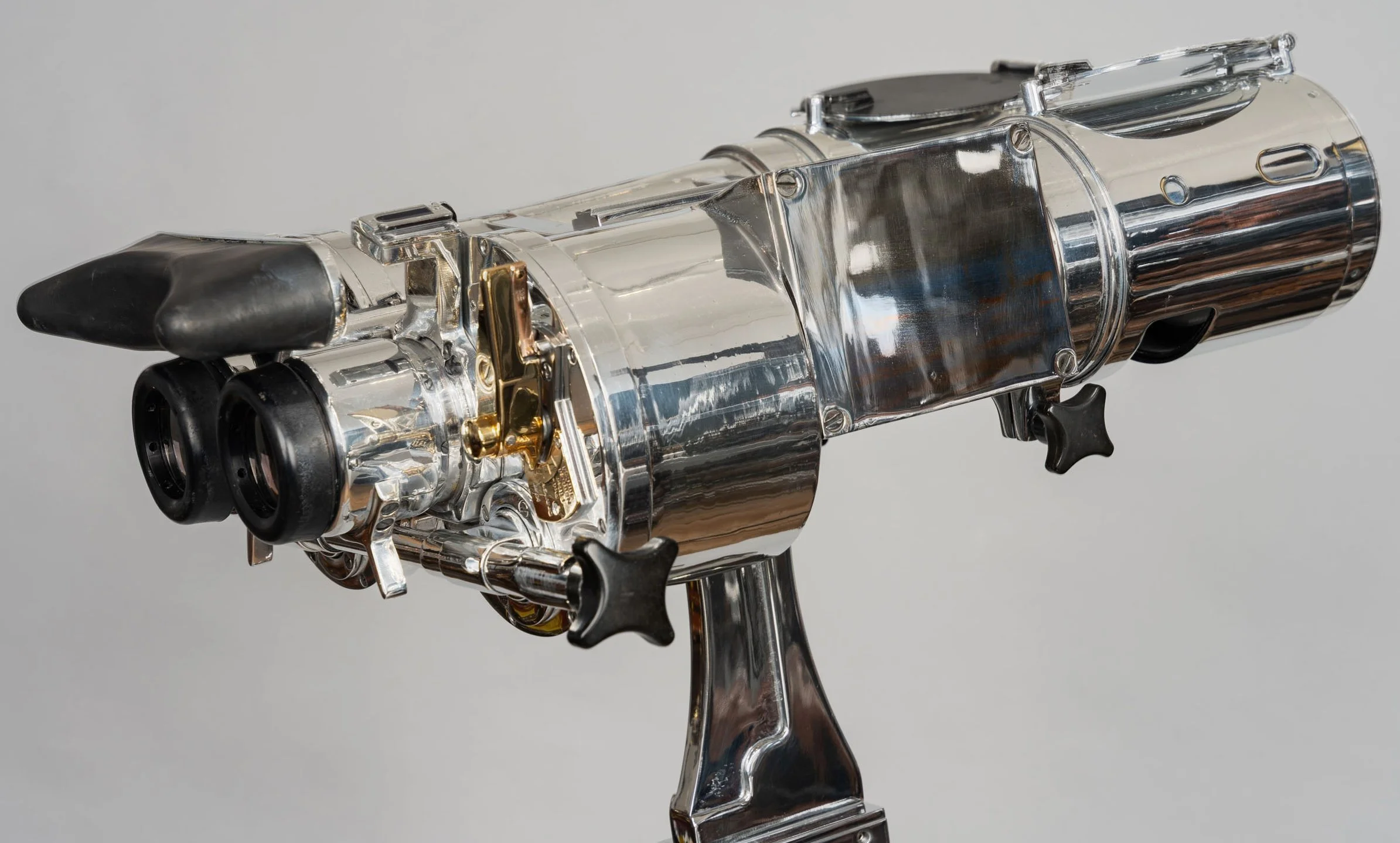
Carl Zeiss DF 8×60 Cold War naval binoculars.
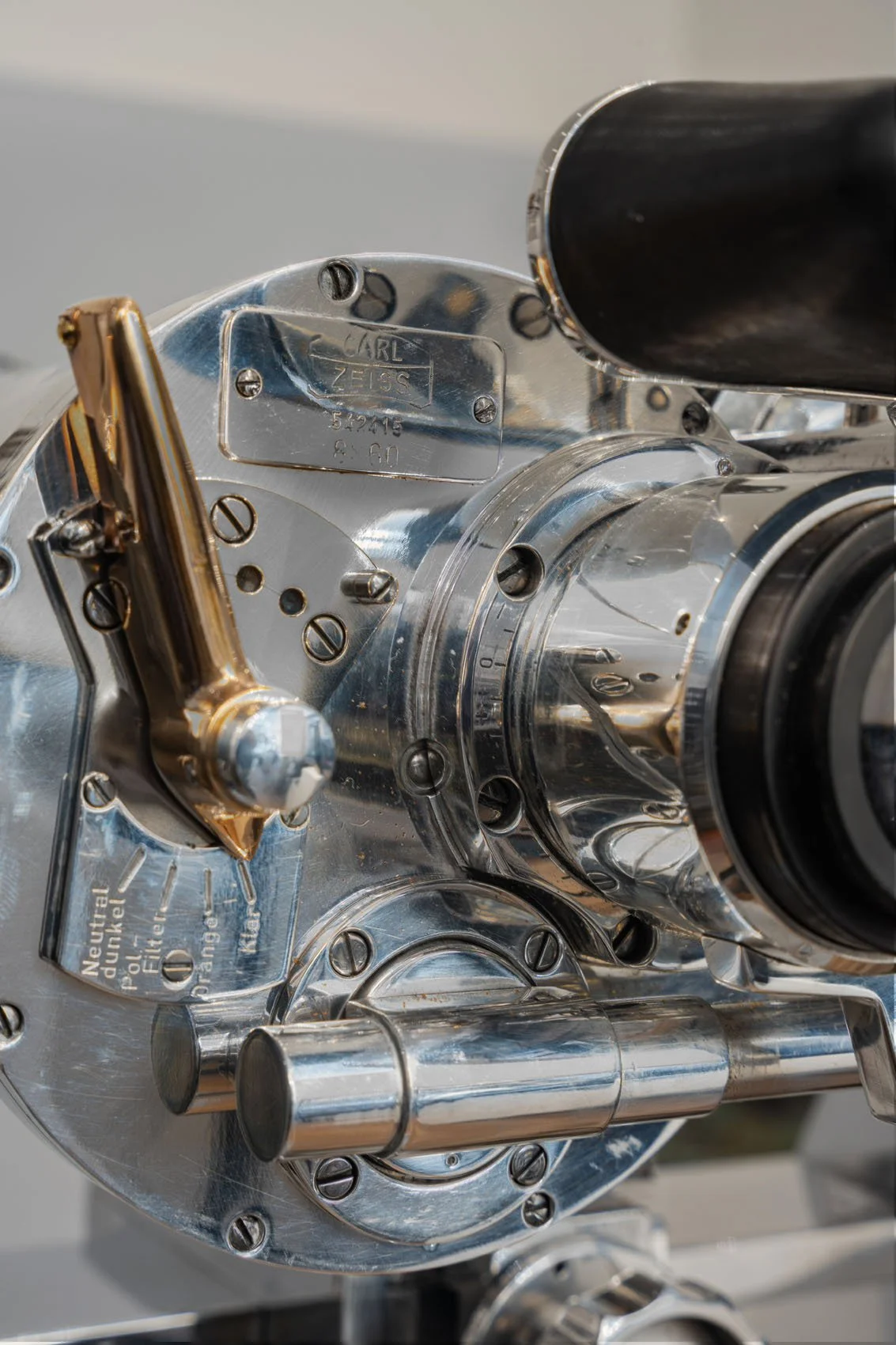
Carl Zeiss data plate.
NATO Binoculars.
The Cold War gave Oberkochen its enduring role. The Federal Republic's accession to NATO in 1955 and the creation of the Bundeswehr the following year — including the Bundesmarine, charged with defending the North Sea and Baltic created demand for precision optics of exactly the kind Zeiss had always produced, now on a western footing. Within a decade of its evacuation from a ruined factory, the transplanted firm was supplying a rearmed West German navy patrolling the same northern waters its predecessors had once contested.
A Relic of the Cold War
The DF 8×60 is among the clearest physical artifacts of that transformation. Hans Seeger dates the design to approximately 1962 and records its pairing with the Rohrzielgerät RZA 5b of 1961 — the torpedo aiming device onto which the DF 8×60 was mounted as the optical head of a naval fire-control system. It is intended as an aiming instrument for engaging enemy surface vessels at sea.
The platform was the Bundesmarine's new fleet of fast attack torpedo boats — the Jaguar-class and Zobel-class craft built by Lürssen at Bremen-Vegesack from the late 1950s into the early 1960s. Their theatre was the Baltic. Their opposite number was the Soviet Baltic Fleet — a numerically overwhelming force of destroyers, missile boats, and submarines operating from Kaliningrad, Rostock, and the Polish coast. German maritime strategy rested on the ability of small, fast boats to close at night, strike with torpedoes, and withdraw before they could be engaged in turn. Everything about that mission is written into the specifications Zeiss published for this instrument in its 1961 factory data sheet: 60mm objective lenses for exceptional performance at dusk and first light, a field of view of 154 metres at 1,000 metres (8.8°) for rapid acquisition and precise tracking, 22 mm of eye relief for use with naval headgear, and an illuminated reticle by which bearing could be read onto the target and passed to the fire-control system.
These naval binoculars exist only because of what two wars demanded. The Second World War drove German precision optics to their peak; the Cold War required the same standard for a new West German navy. The navy wanted the best, and no expense was spared. To handle one is to hold the instrument itself — not a commemorative piece, not a reproduction, but a working relic of that era.
Confirmed NATO Service
The example under discussion carries NATO stock number 1240-12-127-6687 — the identifier by which it was procured and issued. The prefix "1240" designates the supply class of optical sighting and observation instruments; the country code "12" identifies the Federal Republic of Germany as the procuring nation; the remaining digits fix this specific pattern within the Bundeswehr's inventory. NATO stock numbers are documentary evidence of formal military acceptance, tracing a clear chain of custody from manufacturer through procurement to active service.
The instrument is cataloged in Hans Seeger's Fernglaser und Fernrohre (p. 367, figure 249b), the standard scholarly reference on German binoculars. Seeger dates the pattern to approximately 1962 and illustrates it with the original 1961 Zeiss Oberkochen factory data sheet — an unusually complete factory provenance.
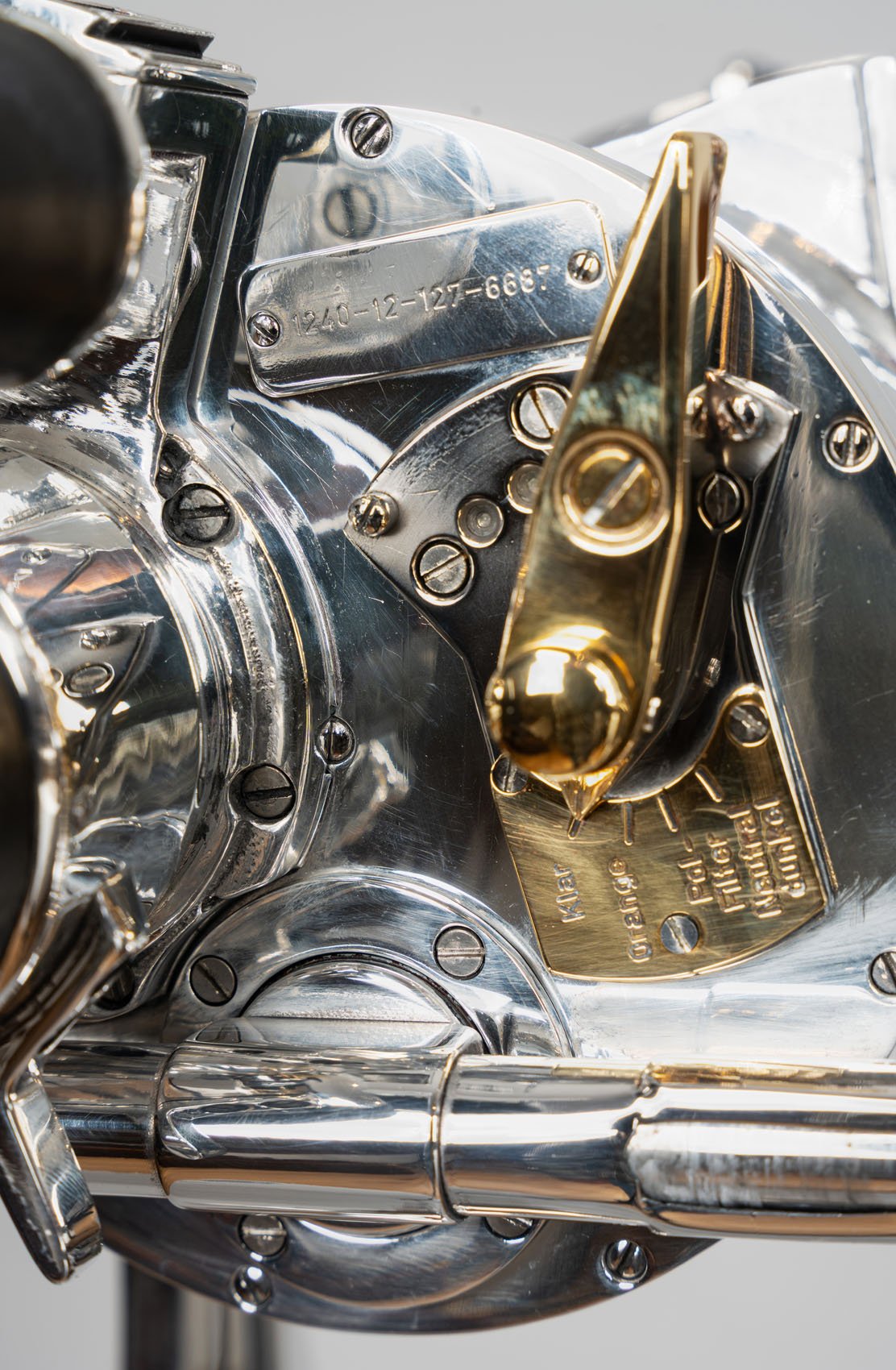
NATO data plate 1240-12-127-6687
A Rare Survivor
Surviving examples of large-format West German military optics from this period, in collector condition, are genuinely scarce. Instruments of this class were used hard; attrition was constant, and when vessels were retired, the optics were typically stripped out, refurbished, reissued, or disposed of through surplus channels without paperwork. Most comparable pieces come to market without a verifiable service history — their NATO stock numbers effaced by wear or polishing, their provenance reduced to the maker's mark alone.
To encounter an example that retains both the original NSN and a scholarly citation identifying the pattern — and to have the two corroborate one another — is rarer still. It is the difference between owning a fine pair of binoculars and owning a documented historical artifact: a piece of Cold War matériel that can be formally recorded as belonging to the navy that carried it and the industry that produced it.
The example is presented on a period 1940s military field tripod. In operational service, the DF 8×60 was mounted on the RZA 5b torpedo aiming device, but the full apparatus is too substantial for any private setting. The field tripod provides a stand of appropriate aperture and weight, and keeps the presentation in the correct historical register.
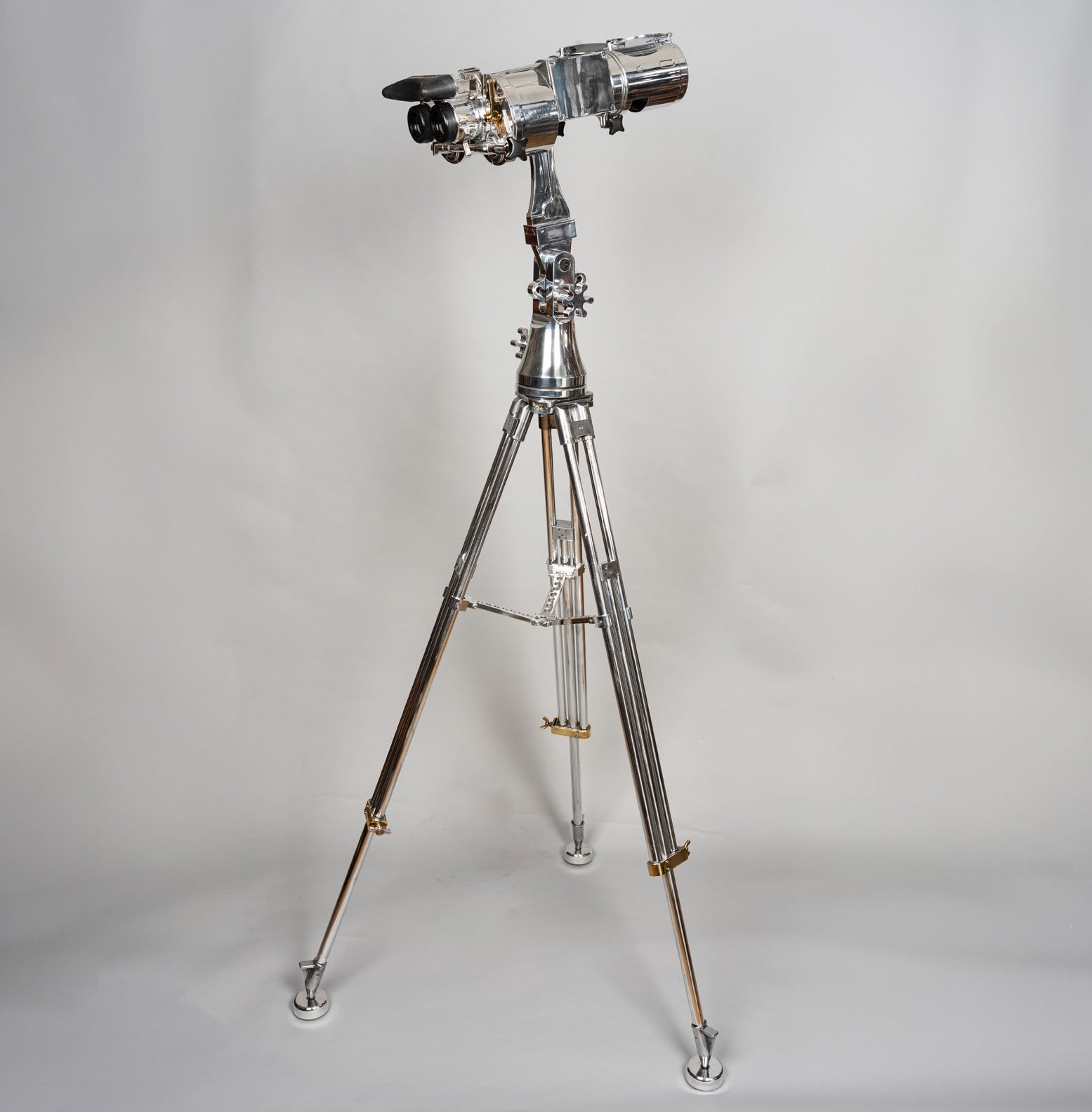
Carl Zeiss 8×60 mounted on a 1940s steel field tripod.
Collecting Vintage Military Binoculars
The market for vintage military binoculars has matured considerably over the past two decades, driven by the recognition that the finest examples are genuinely rare: precision instruments produced in limited runs for specific service requirements, used hard, and surviving in collector condition in very small numbers. The criteria for quality align with those of any serious antiques category: maker's reputation, period, provenance, and condition. Carl Zeiss instruments from the Oberkochen period occupy the upper tier by every measure.
The optics themselves are worth dwelling on. The DF 8×60 was built to tolerances the civilian market would not routinely approach for decades. The glass, the coatings, the mechanical centering of the prisms, the precision of the collimation — all were the work of a firm that understood optical performance as a matter of life or death for the watch-keeper straining to see a contact at the edge of first light. Look through one today, and the image is still astonishing: bright, sharp to the edge, mechanically tight, holding alignment after decades of service. These are not nostalgia pieces. They are instruments.
None of this work would have been commissioned without the wars. Zeiss would have gone on making microscopes and camera lenses in the quiet way it always had. The DF 8×60 exists because, in 1945, a city was bombed and a country was divided, and because, a decade later, the western half of that country was rearmed along one of the most heavily contested maritime frontiers of the twentieth century. Binoculars of this class are objects of extraordinary craft. They are also, and inseparably, objects of history.
At Daniels Antiques, we bring the same depth of knowledge and curation to vintage military binoculars that we bring to Louis Vuitton trunks, Swiss Black Forest carvings, antique clocks, and Churchill autograph letters. The Carl Zeiss DF 8×60 Bundesmarine discussed above is currently available; we invite you to view our full binocular collection or contact us directly for guidance on any piece you are considering.
Further Reading
Seeger, Hans. Fernglaser und Fernrohre. The standard scholarly reference on German binoculars, the DF 8×60 pattern is cataloged on p. 367, figure 249b, with its original 1961 Zeiss factory data sheet.
The Carl Zeiss Archive (Carl-Zeiss-Archiv) in Jena holds the primary documentary record of the firm's history in both its Jena and Oberkochen periods, and is the appropriate source for researchers pursuing further detail on production runs, serial number ranges, and variant identification.
• •
Daniels Antiques was founded in 1978 and maintains gallery locations in Aspen, Colorado, and Fort Lauderdale, Florida. The Aspen gallery operates by appointment.