
Black Forest Carvings: Comedy, Character and Naturalism from the Brienz Masters
There is a moment, familiar to collectors, when a piece ceases to be furniture or ornament and becomes something else entirely. It happens when the bear rears up from the ice floe with unmistakable menace, or when the fox raises his hunting horn with an air of absurd self-importance. The wood seems to breathe. An animal has become a character, and the carving has crossed into the realm of art.
This is the defining achievement of the Swiss carving tradition at its height — what separates the great Brienz masters from the competent craftsmen who surrounded them. When Johann Huggler exhibited at the World's Columbian Exposition in Chicago in 1893, his carvings demonstrated that Swiss animal sculpture could stand comparison with the finest decorative art being produced anywhere in the world.
No animal is more central to the Swiss Black Forest tradition than the bear. Two distinct traditions ran in parallel: the naturalistic, in which bears are observed and rendered with a precision that rivals the finest animal bronzes of the period; and the anthropomorphic, in which bears are cast in human roles and subjected to a form of comic scrutiny that is distinctly Swiss in its wry, deadpan quality.
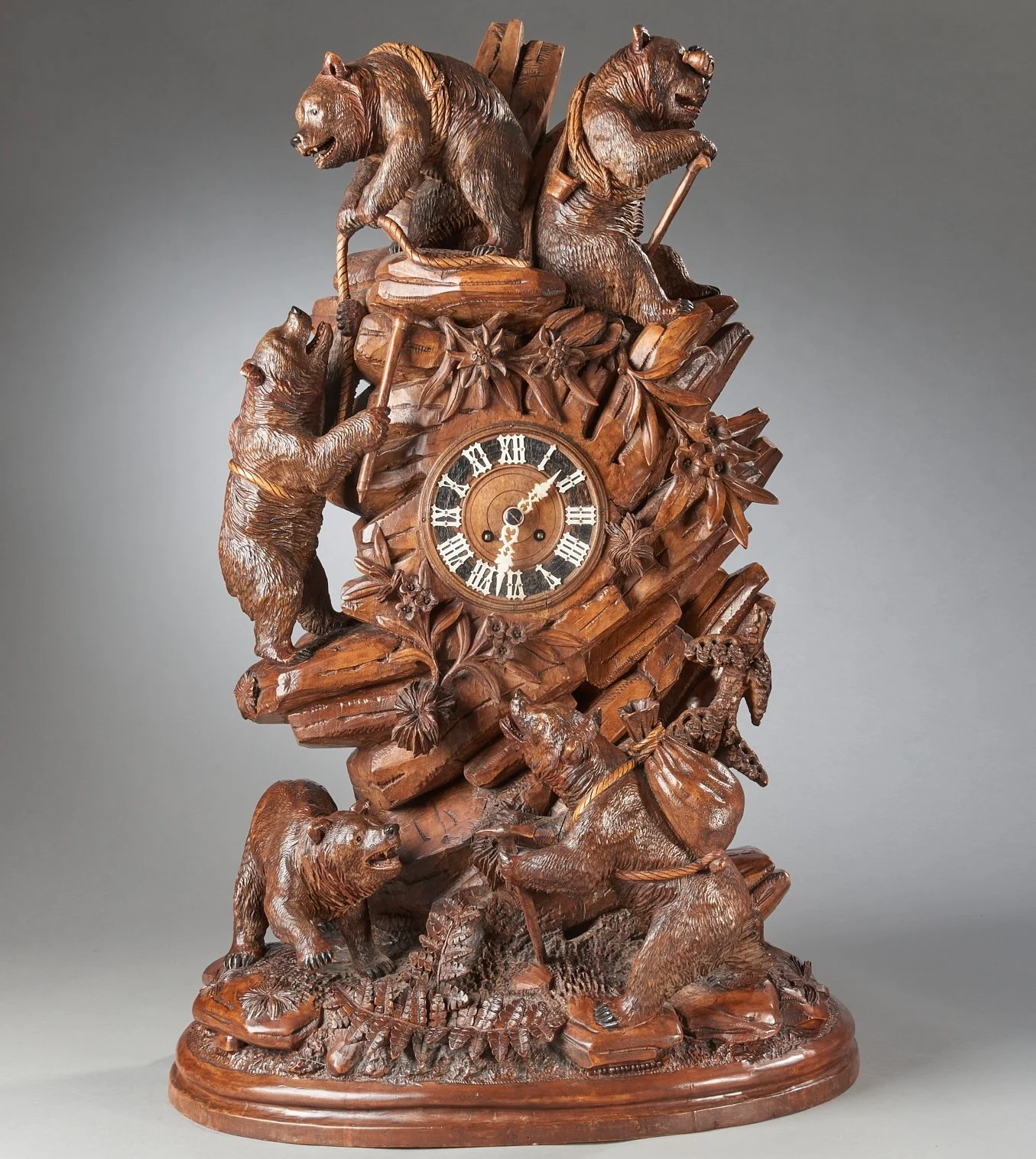
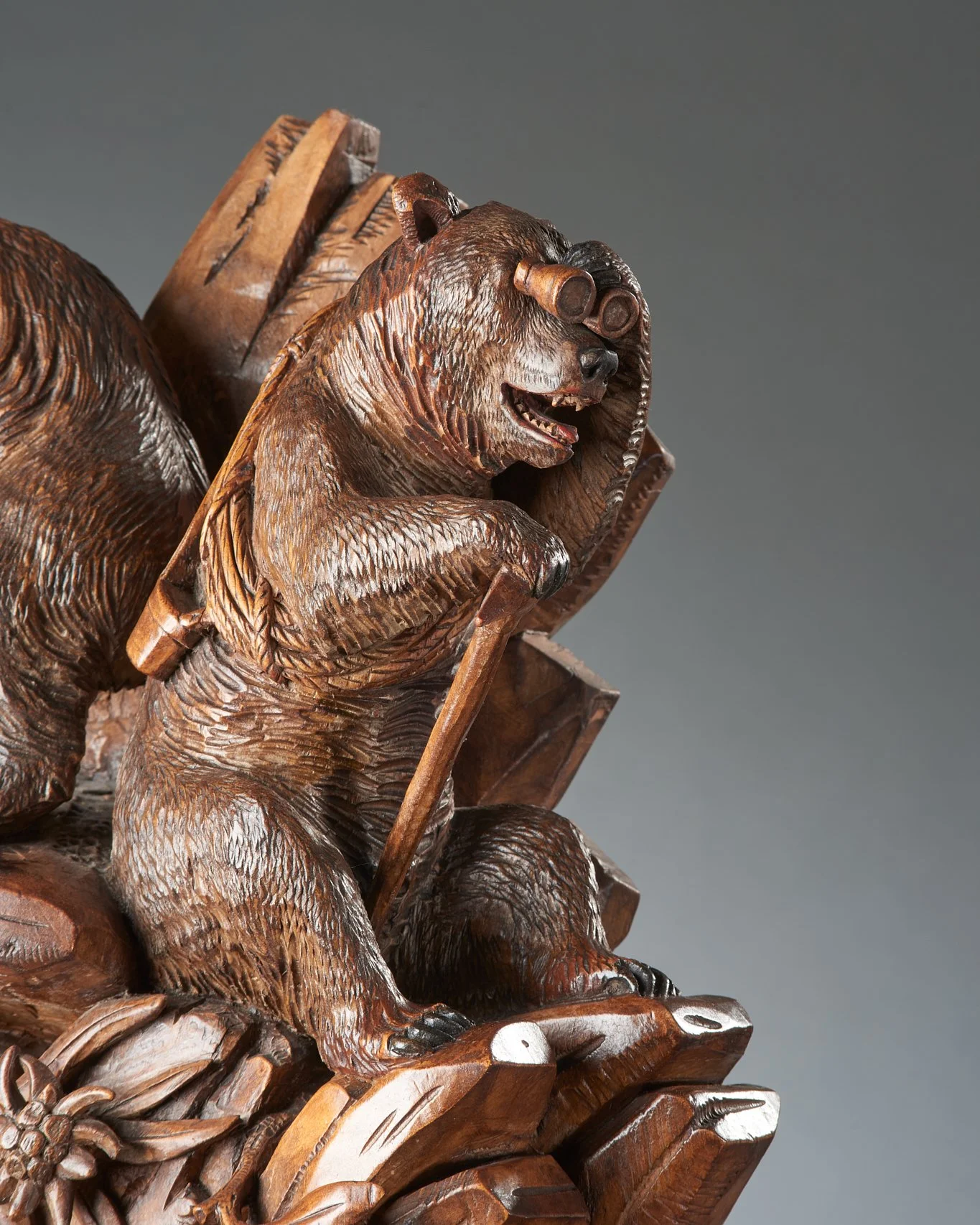
The climbing bear clock groups represent the anthropomorphic tradition at its most ambitious. The bears carry ropes and pickaxes, wear binoculars around their necks, haul, strain, and peer — maintaining throughout the expression of creatures entirely absorbed in their own importance. The carver has not merely dressed an animal in props; he has imagined what a bear would look like if it believed itself to be a mountaineer, and rendered that belief in wood.
Against this stands the fighting bear group. Where the clock composition is centrifugal — figures reaching outward, the eye invited to roam — the fighting group is centripetal. Two animals locked in combat on an ice floe, every element directed toward the central point of contact between them. There is nothing whimsical here. The bear that rears up with its mouth open and claws raised is not performing for the viewer; it is fighting for its life.
The technical demands are considerable — deep undercutting at the risk of splitting the piece, water-soaked fur carved with consistency across the entire surface. That the same tradition produced both the climbing clock bear and the fighting group is perhaps the most telling indicator of its range: the same deep engagement with a single subject, explored at opposite ends of the register with equal mastery.
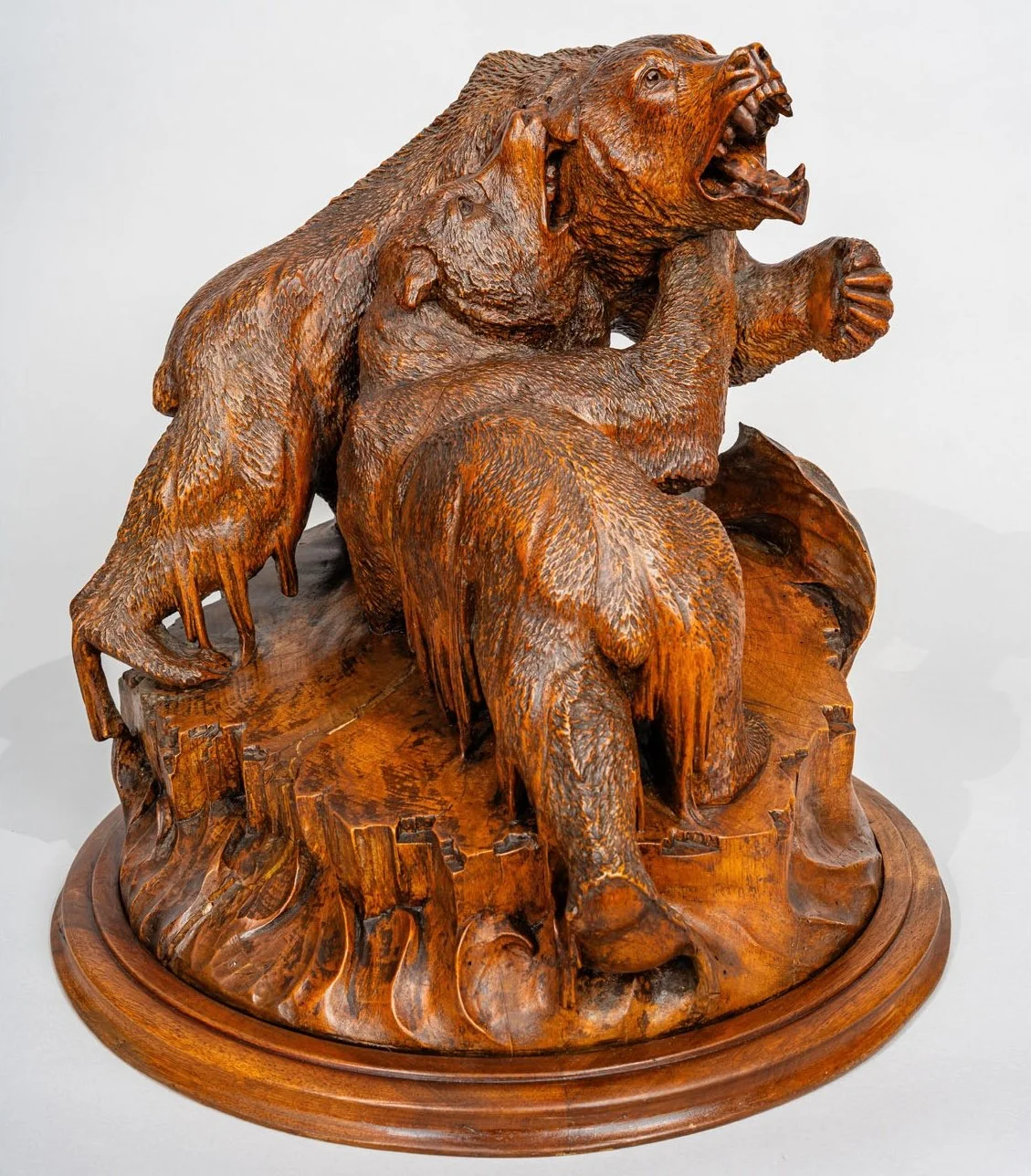
Swiss Black Forest Bears On An Ice Floe, circa 1860.
The wild boar is the tradition's study in a different kind of energy — more focused, more dangerous, more purely sculptural. The bear invites narrative; the boar demands formal attention.
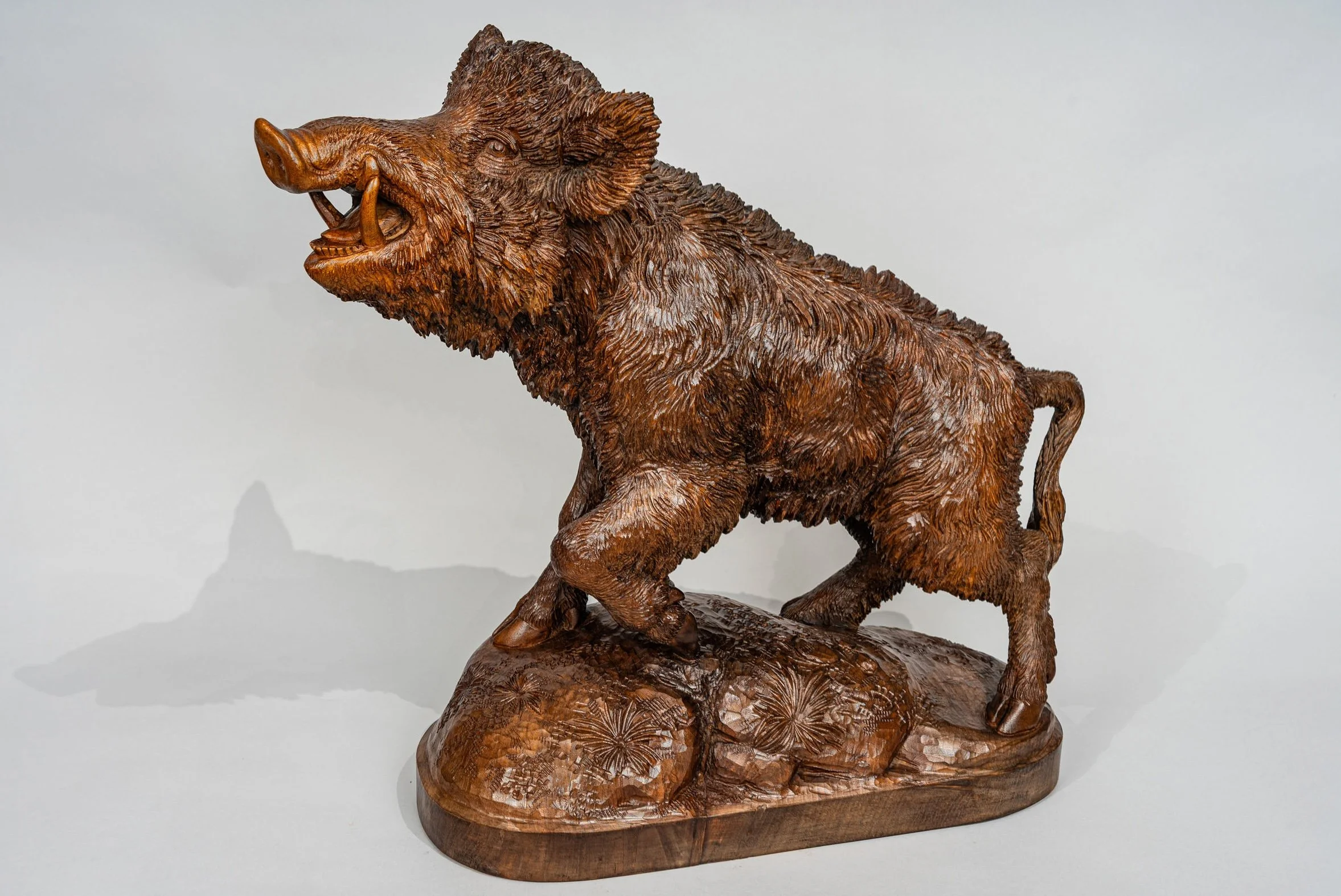
The single boar in mid-charge allows no hiding place. Everything depends on one animal: the dense, shaggy coat breaking into ragged points along the spine; the low, driving weight of the body; the head raised and turned, mouth open, tusks catching the light. The Peter Buri boar — signed by Johann Huggler and illustrated in Swiss Carvings: The Art of the Black Forest, 1820–1940 (Arenski, Daniels & Daniels, 2006) on page 57 — is a masterclass in this discipline. The drama is entirely internal: no context, no second figure, no prop. Huggler trusted the animal entirely.
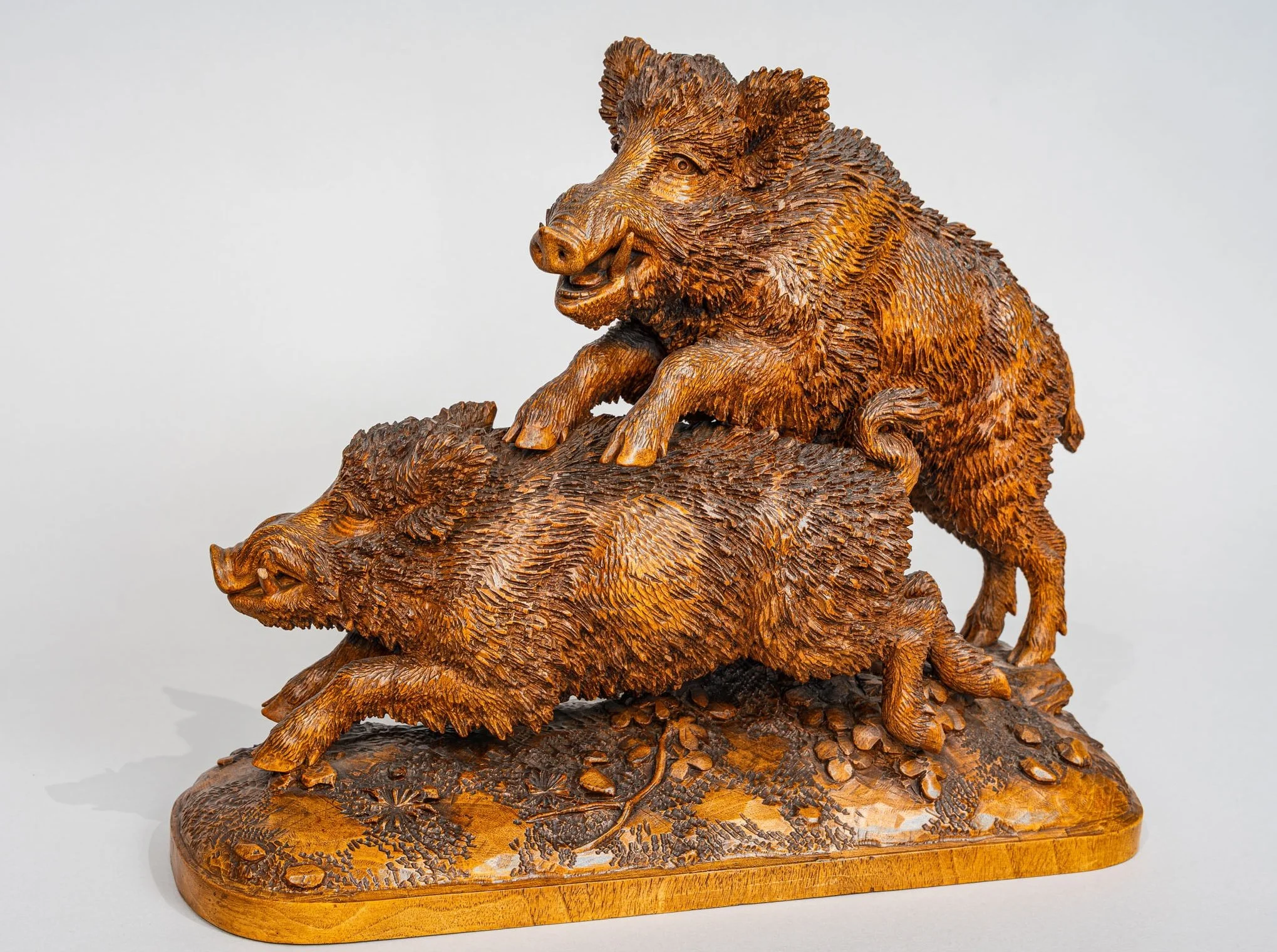
The boar group is an entirely different proposition — not concentrated aggression but pure comic chaos. Two young boars have been startled and are fleeing in opposite directions, one launching itself over the back of the other in its panic. The airborne boar caught at the apex of its leap, the lower animal's spine compressed under the impact — the two figures are locked in a relationship of collision so precisely observed that the viewer almost expects to hear the noise.
The single boar is confrontational — an animal that has decided to stop retreating. The group is ungoverned panic, comic in its chaos but observed with the same unsentimental eye
Where the bear and boar demand to be taken seriously, the anthropomorphic fox works by comic inversion. The animal stands upright, dresses in human clothes, and submits to human occupations with a solemnity that is itself the source of the joke.
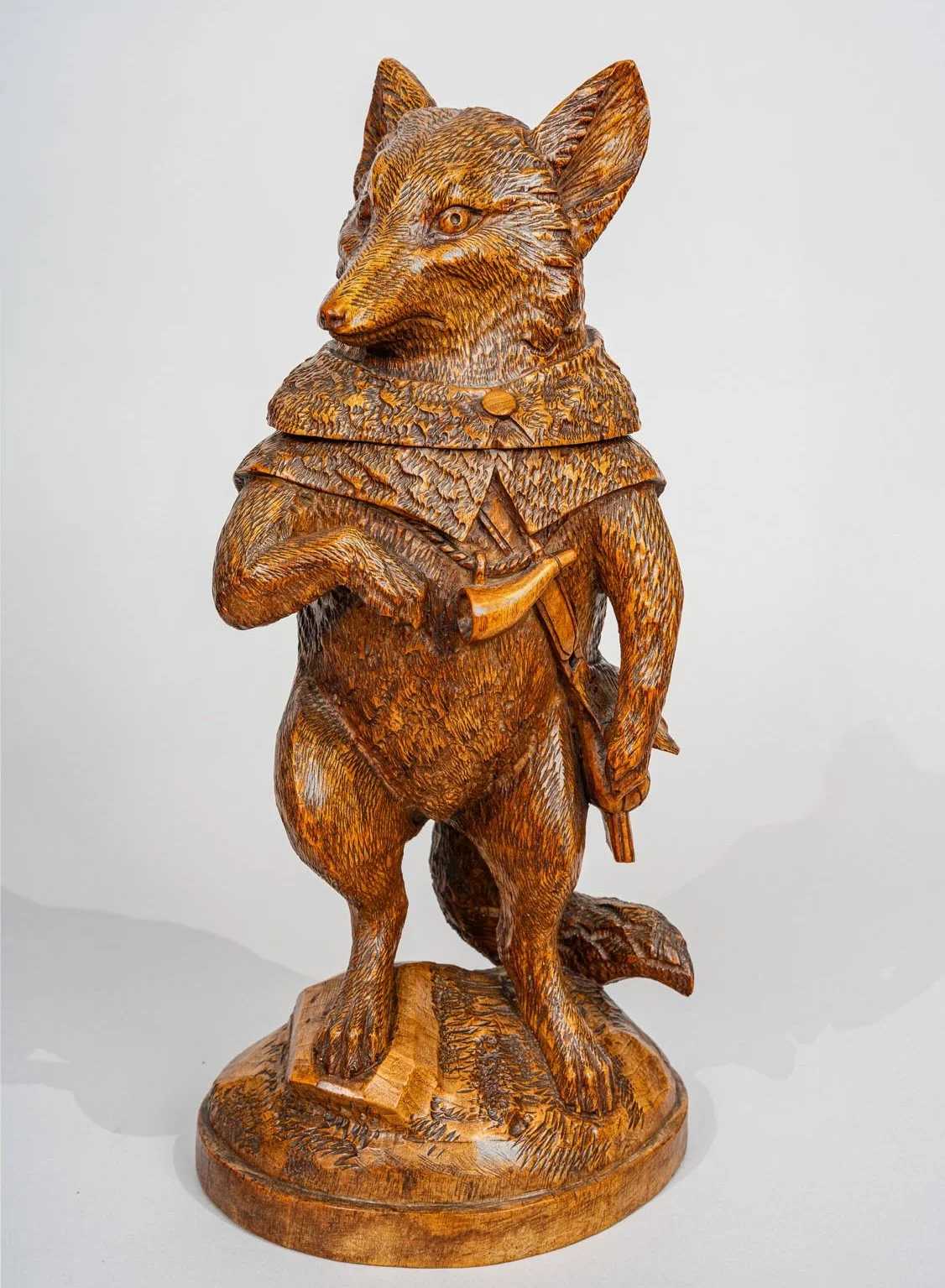
The fox huntsman tobacco jar catches this perfectly. Upright in a caped hunting coat, horn at his side, ears pricked, eyes forward — every detail conveys a creature entirely convinced of its own dignity. The carver has imagined the fox's inner life and found it occupied entirely with the performance of gentlemanly status. This fox has somewhere to be, and he intends to arrive there impressively.
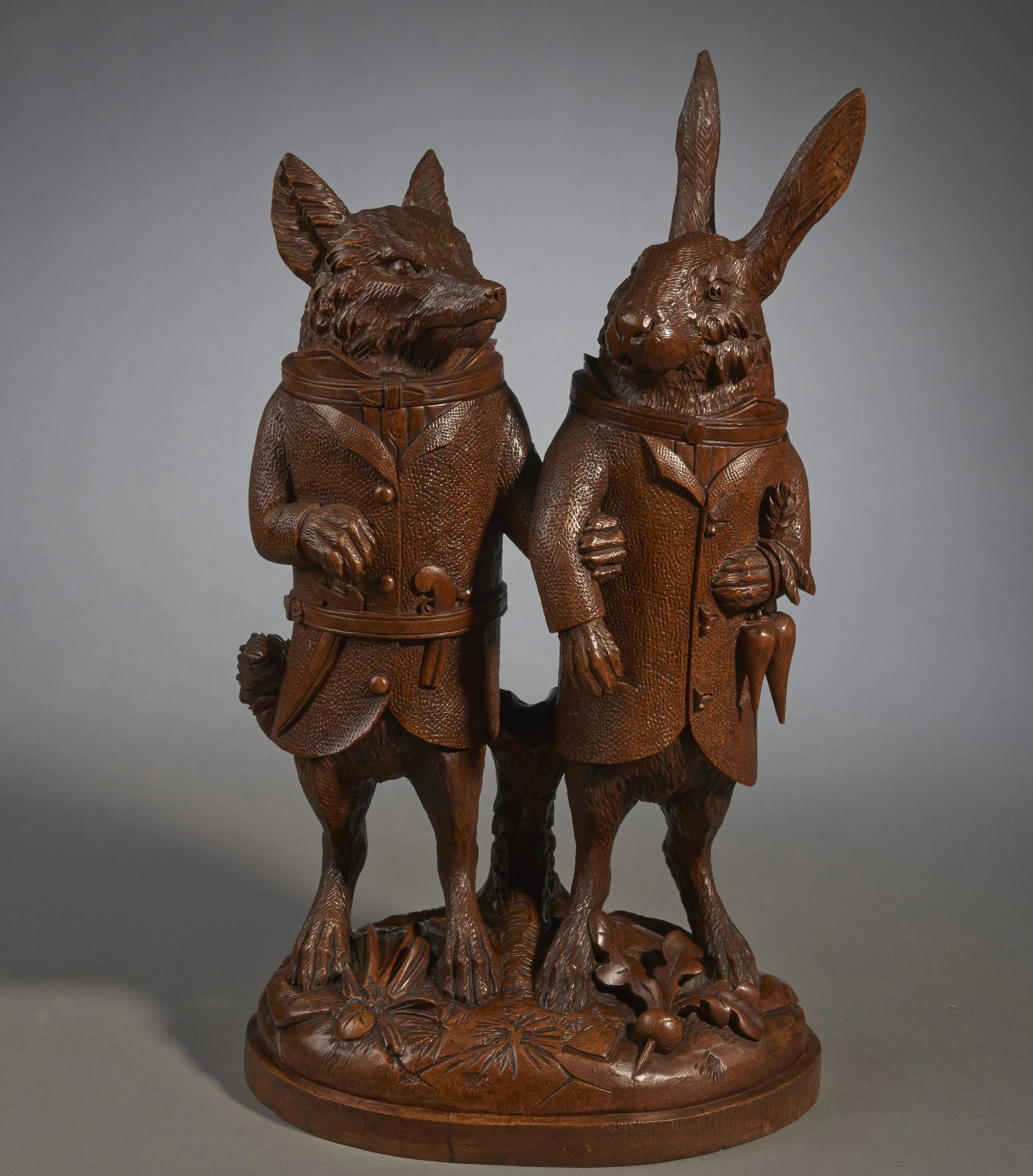
The companion group of fox and rabbit takes the comedy further. Reynard stands beside Mistress Rabbit as a social equal — both in matching coats, the fox with sword and flintlock pistol at his belt, the rabbit carrying her produce, sharing the same oval base with the same expression of mild self-importance.
Predator and prey have not merely swapped positions; they have been absorbed into the same social fiction. The fox does not look hungrily at the rabbit. The rabbit does not look nervously at the fox. Both gaze, with identical composure, at a world in which a fox and a rabbit may walk together without incident — provided both are wearing the right coat. It is a sophisticated observation, made with complete technical command: two entirely different kinds of fur rendered with equal precision, the miniature details of sword hilt, pistol grip, and vegetable carved with the same attention that Huggler brought to a boar's bristles.
The Achievement
What unites the bear, the boar, and the fox is the quality of attention the great Brienz carvers brought to animal life — observed not as symbolic forms but as specific creatures with characteristic weight, movement, and psychological presence. The international exhibitions of the second half of the nineteenth century — Vienna in 1873, Philadelphia in 1876, Paris in 1878 and 1889, Chicago in 1893 — confirmed what connoisseurs already knew: that the Swiss carving tradition had produced, in its greatest examples, animal sculpture of world-class.
The pieces that reach the market today are survivors, passed through the hands of collectors who encountered them at the great exhibitions or bought them through the Brienz dealers. They carry the evidence of their lives: the patina of limewood aged under consistent conditions, the occasional repair, the label or receipt that transforms a beautiful object into a documented one. They are still moving. The bear still strains against its adversary on the ice. The boar still carries its latent charge. And the fox, resplendent in his long coat, still raises his horn with the serene self-importance of a creature who has entirely missed the joke — and thereby becomes it.
If you own Swiss Black Forest carvings and are considering selling, we would be glad to hear from you. Get in touch with Daniels Antiques.
Daniels Antiques has handled Swiss Black Forest carvings of museum quality for more than forty years. For further reading, see Jay Arenski, Simon Daniels and Michael Daniels, Swiss Carvings: The Art of the Black Forest, 1820–1940 (2006), the definitive reference work on the subject.