

luxury barware

luxury barware collection
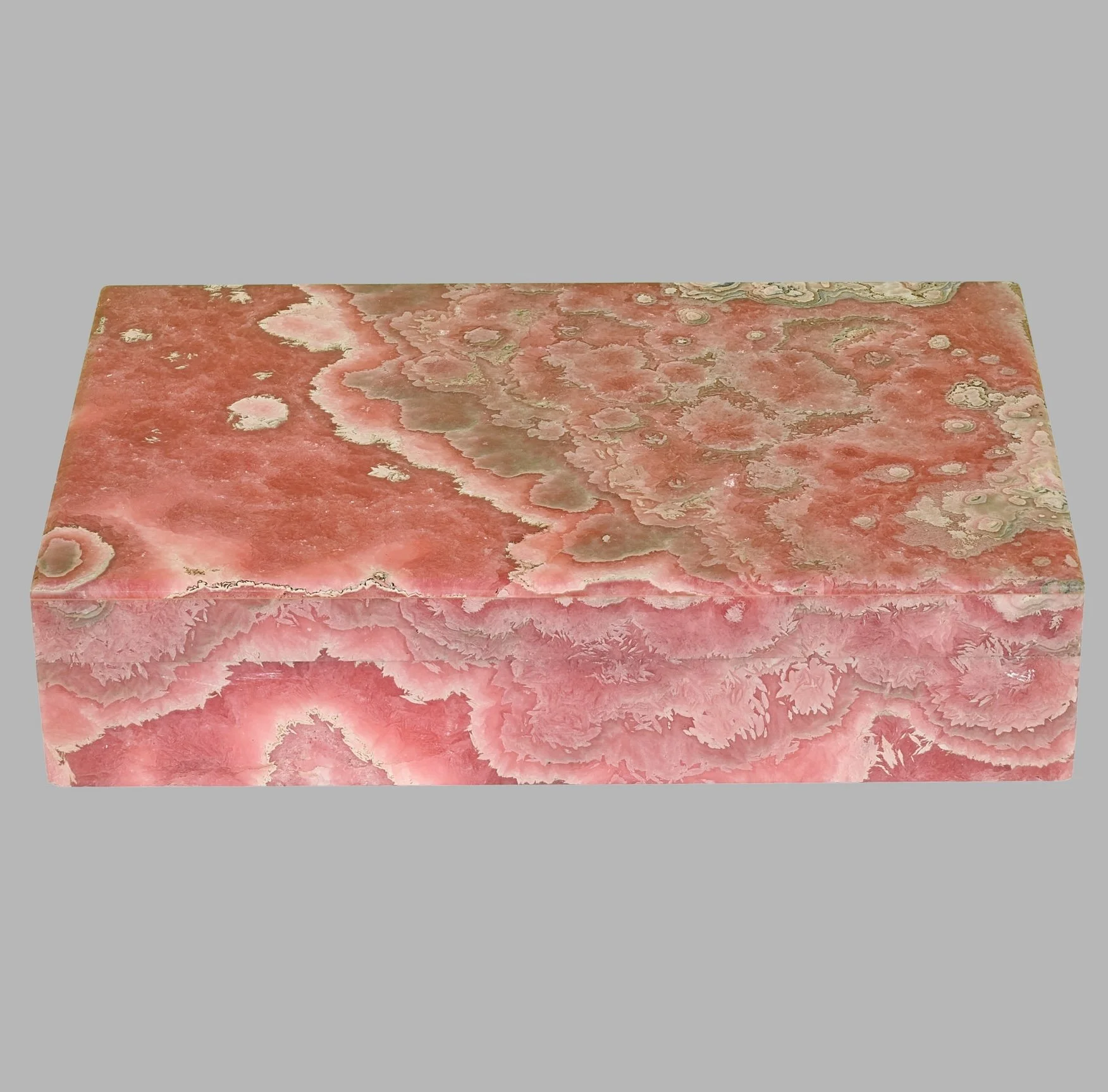
This box is cut from rhodochrosite, the banded pink stone known to collectors as Inca Rose, and mounted in gilt brass by Asprey of London. The lid presents a remarkable face of the material, a rose-pink ground broken by concentric rings and soft grey veining where the stone was sawn across its botryoidal growth, no two passages alike. The sides carry the same figure, drawn into the feathered, fan-like formations that mark the finest examples of the stone.
Rhodochrosite of this quality comes from the Capillitas mines of Catamarca in northern Argentina, where it forms in stalactitic columns within old silver workings. Cut across, those columns yield the concentric rose pattern that has been prized for generations, the stone taking its popular name, Rosa del Inca, from the Inca who are said to have worked the deposits. Its color derives from manganese, and its relative softness asks for an accomplished lapidary, which the even surfaces and crisp mounts here reflect.
Asprey, long established on Bond Street and a holder of royal warrants, has been associated with fine objects of this kind since the nineteenth century. The interior is stamped Asprey & Co, the form of the mark the house used into the early twentieth century. The box is hinged in gilt brass, the underside of the lid set with a panel of white quartz, and the well lined in velvet, the whole assembled to the standard for which the house is known.
A hardstone box of this scale and figure is an uncommon thing, as much a specimen of natural beauty as an object of luxury. It sits equally well on a desk, a dressing table, or among a collection of objects of vertu, and rewards handling as few decorative objects do.
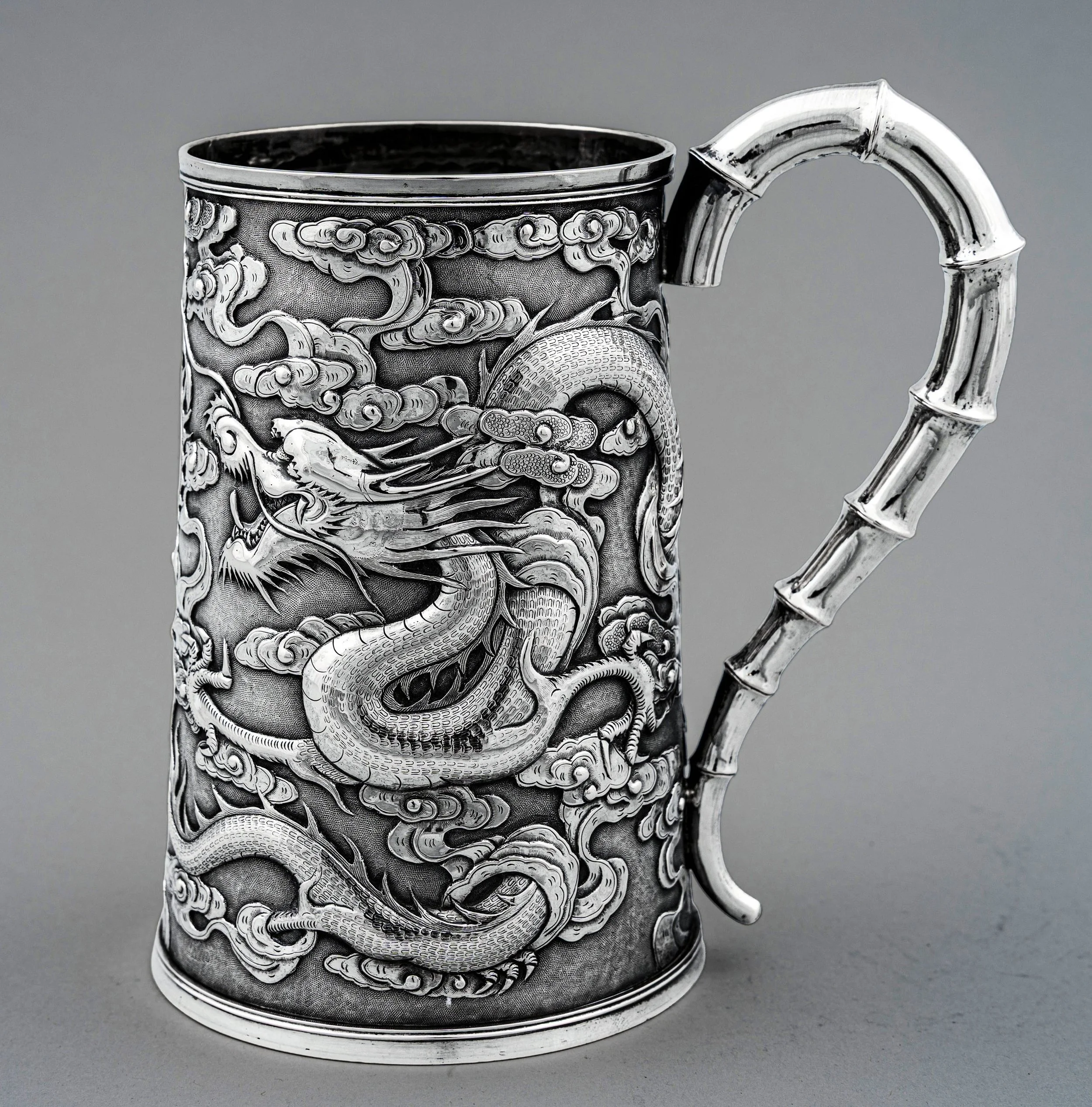
A cylindrical tankard worked in high-relief repoussé with two sky dragons — tianlong — surging through billowing clouds in pursuit of the flaming pearl of wisdom. Scaled bodies coil with extraordinary fluency against a finely matted ground, whiskered heads thrown back in dynamic tension. The handle is cast in the form of bamboo, its jointed culms rendered with botanical precision — a motif long associated in Chinese culture with resilience and scholarly virtue.
To the reverse, a polished cartouche bears the engraved monogram E.W.H., the recipient of a gift recorded in script on the base: E.H. to E.W.H. / March 1912 — the final year of the Qing dynasty, and the first of the Chinese Republic. Two marks are struck to the base, including the retail mark of Wang Hing, the celebrated Hong Kong silversmith whose pieces are among the most sought-after in the field of Chinese export silver today.
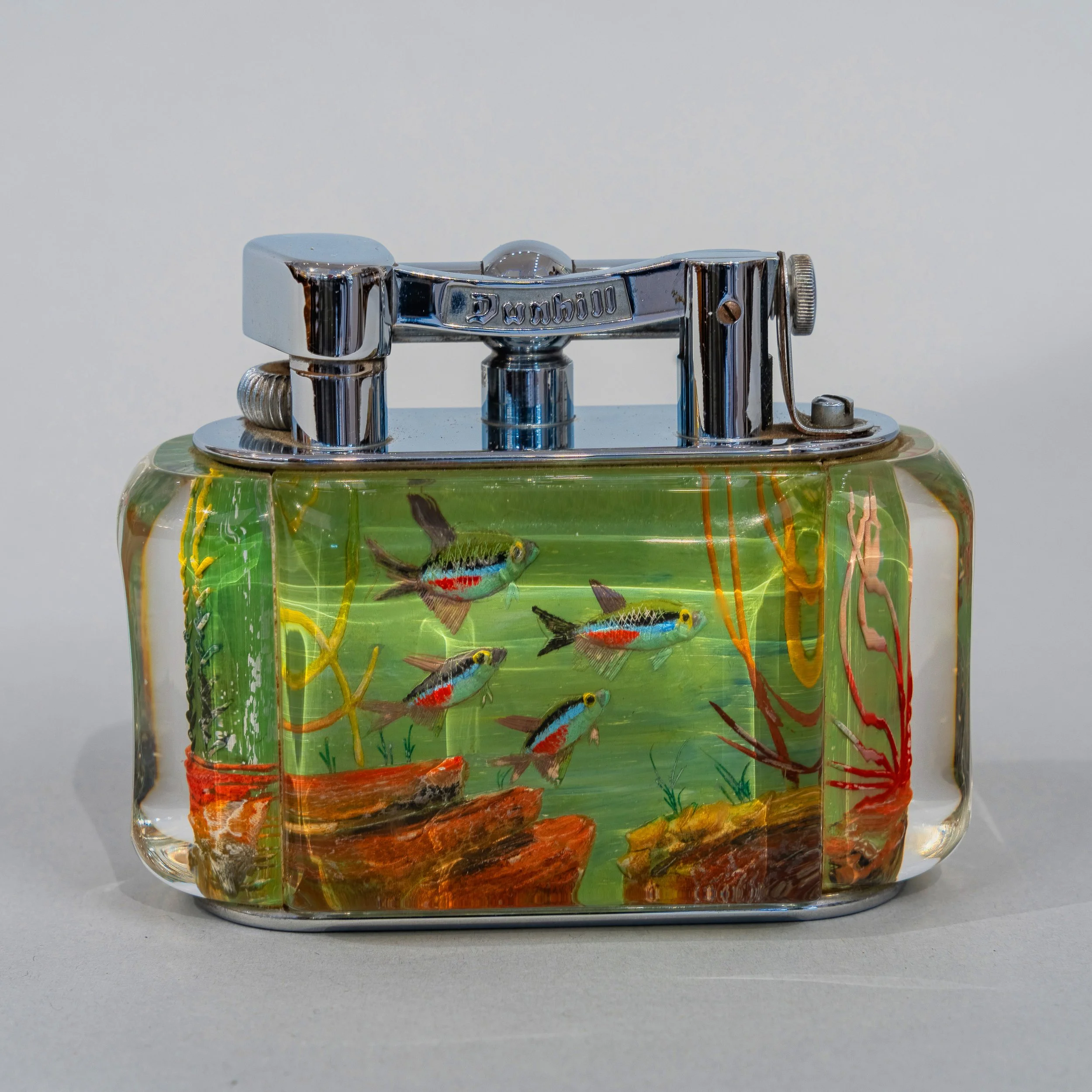
Among the most coveted luxury objects of the twentieth century, the Dunhill Aquarium lighter stands apart as a functional work of art — a miniature hand-painted seascape captured within a polished lucite body and mounted with precision chrome hardware bearing the signature Dunhill lift-arm nameplate.
Each panel is reverse-carved in intaglio, then back-painted, giving the scenes a luminous three-dimensional depth that no surface decoration could replicate. The principal face shows a shoal of neon tetra-style tropical fish — their red and blue markings rendered with exceptional precision — suspended mid-water above a seabed of ochre and rust-coloured rock formations, with aquatic grasses and tendrils of red coral framing the composition. The reverse presents two larger fish — a vivid orange-red specimen and a companion in gold — moving through the same green-tinted water column. The wraparound scene, continuous across all four panels, is the hallmark of the finest Aquarium examples.
Lucite, developed during the Second World War for aircraft windshields and submarine periscopes, found its way into artists' workshops in the postwar years — its capacity to be carved, painted, and polished to a sparkling finish making it an ideal medium for this kind of work. The Aquarium collection was launched in 1949 and ceased at the end of the 1950s following the retirement of its creator, Ben Shillingford, whose mastery could never be equaled. No two Aquarium lighters are alike.
The most celebrated owner of a Dunhill Aquarium lighter was Sir Winston Churchill, who kept one on his desk — a detail that has only deepened the series' desirability among collectors of both Dunhill and Churchill memorabilia.
Condition: Very good. The Lucite body is clear and bright throughout with no cracks, chips, clouding, or hairline scratches. The hand-painted scene is vivid and fully intact on both principal faces — fish, flora, and seabed detail all crisp and unfaded.
Chrome hardware is strong, with good reflectivity, no pitting, and a sharp, legible Dunhill nameplate engraving. Mechanism fully functional.
Made in England. Circa 1950–1959.
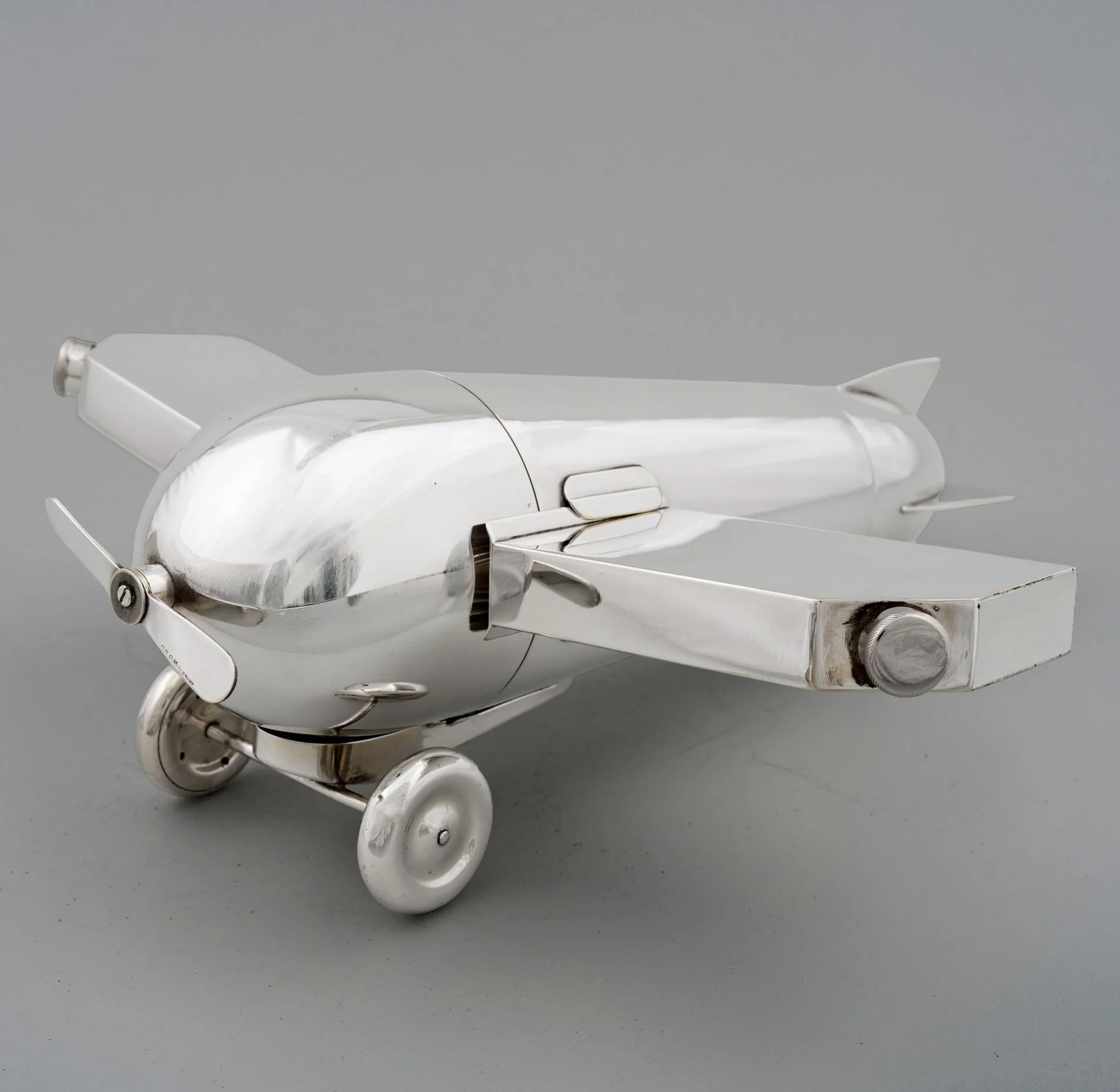
Silver-plated 18-piece airplane traveling bar by J.A. Henckels of Solingen, Germany, registered under the Deutsches Reichs-Gebrauchs-Muster (D.R.G.M.) mark and dating to circa 1928 — one of the most ingenious objects produced by the golden age of cocktail culture, combining the period's fascination with aviation and modernity into a fully functional traveling bar service of exceptional quality and completeness.
The fuselage opens to reveal a dedicated decanter for spirits; the detachable wings serve as hip flasks; the wheel well conceals four stirring spoons; the tail unscrews as a sugar or dried fruit cup; the nose houses a juicer with a strainer; four gilt-interior shot cups, a corkscrew, and a funnel complete the service. Every element of the aircraft's form has been pressed into function. Nothing is decorative that is not also useful.
The spherical cockpit, swept monoplane wings, spinning two-blade propeller, and fixed undercarriage with disc wheels produce a silhouette of unmistakable authority — the visual language of the inter-war aviation age rendered in miniature and mirror-polished to a finish that has lost nothing of its original brilliance.
J.A. Henckels, founded in Solingen in 1731, understood the cocktail hour not merely as a social ritual but as an occasion for design at its most ambitious. The set is complete, retaining all 18 original components in excellent condition. The present example is silver-plated, the more desirable finish, as distinct from the chrome-plated variant illustrated in Visakay.
Marks: D.R.G.M. Germany, stamped on the propeller blade and undercarriage.
Dimensions: Wingspan 12 in. (30.5 cm); length 12 in. (30.5 cm).
Literature: Stephen Visakay, Vintage Bar Ware, Collector Books, 1997, p. 50 (this model illustrated); Simon Khachadourian, The Cocktail Shaker, Philip Wilson Publishers, 2000 (this model illustrated).

The Manhattan cocktail ensemble, designed by Norman Bel Geddes for Revere Copper and Brass Incorporated of Rome, New York, and introduced in the company's 1935 gift catalog. Examples are held in the permanent collections of the Art Institute of Chicago and the Metropolitan Museum of Art, New York.
Bel Geddes (1893 to 1958) was the defining figure of American industrial design in the interwar years, among the first to open a dedicated industrial design studio in the United States in 1927, and best remembered for the Futurama installation at the 1939 New York World's Fair. The Manhattan set anchored the collaboration between Revere and Norman Bel Geddes and Company that began in late 1933, when Revere, seeking new markets during the Depression, engaged Bel Geddes to design its inaugural giftware line. The design pays open homage to the New York skyline, a tall cylindrical shaker rising above stemmed cups on a stepped, fluted tray, a plaza in miniature, and the 1935 catalog praised the tray's "distinguished simplicity." The shaker offered here is the second, larger party-size version, produced circa 1939 to 1941.
The set is complete with shaker, four stemmed cups, two candleholders, and stepped tray, and retains the original fitted boxes for the tray and candleholders, an exceptional survival. The tray is stamped "Revere, Rome, N.Y." on the underside, and the boxes are printed "Handicraft by Revere, Rome Manufacturing Company Division”. The tray measures 14 inches wide by 11 inches deep, and the shaker 13 inches high.
Literature: Art Institute of Chicago, accession no. 2005.50.1-8; Stephen Visakay, Vintage Bar Ware, 1997; Revere Copper and Brass gift catalog, 1935.

A black glass-and-chrome cocktail shaker by the Cambridge Glass Company of Cambridge, Ohio, circa 1930, the body in Cambridge's Ebony glass with a stepped chrome cap, an American Art Deco design of the Prohibition years.
The body is of square section, tapering upward from a broad base in four gently convex panels of black glass, the faces meeting at softly defined vertical ribs, rising to a narrow shoulder that receives the cap with a precise fit. The cap is a tiered construction of three progressively narrowing cylindrical sections, finished with a flat-topped knurled finial, the dark spreading base and bright ascending metal recalling the stepped profile of the Art Deco skyscraper. Cambridge, founded in 1901, was among the more technically accomplished American glass manufacturers of the period, and the Ebony line, introduced in the early 1920s, was one of its most successful colored glass productions.
Condition is excellent throughout: the glass body is free of chips or cracks, the cap is bright and even, and the strainer and pour mechanism are fully intact. It stands 12 inches high and 3 inches wide.

An English silver-mounted fox terrier decanter, circa 1900, the mold-blown clear glass body in the form of the seated dog, surmounted by a cast sterling silver head, in the Victorian and Edwardian tradition of figural novelty silver.
The glass body follows the seated terrier with real anatomical conviction, haunches, forelegs, and chest all rendered in the mould, work that required close collaboration between glassmaker and silversmith. The head is cast and chased, with the fur finely differentiated across the skull, muzzle, and ears, following the directional growth of the coat, the eyes set with black glass cabochons, and a hinged pouring lip discreetly incorporated at the rear of the head. The beaded collar band joins head to body and carries the English hallmarks, and the collar is fitted with a fully modeled silver buckle, prong, bar, and frame all present.
The fox terrier was among the most fashionable English breeds of the period, a favorite of the sporting and country-house set, and a decanter of this form would have been a luxury gift or a sporting presentation piece. It stands 9.5 inches high.
Condition is excellent throughout: the glass body is without chips or cracks, the silver is crisp with no repairs or restoration, the eyes are intact, and the hinged pourer is working.

A sterling silver cocktail shaker in the skyscraper manner, made by the Swedish firm Tesi to a design by Tage Gothlin, the base struck with a full suite of Swedish hallmarks, including maker's mark, assay marks, and the date letter for 1948.
The body is of tall octagonal section with strong vertical fluting, rising to a scalloped and cusped cornice, each point a sharp chevron of polished silver, above which a stepped square plinth carries the cylindrical cap. The cap is surmounted by a tight cluster of five spherical finials. The interplay of fluted shaft, jagged cornice, and geometric cap belongs to the skyscraper aesthetic that entered progressive silver design in the late 1920s, carried here into the postwar years with the restraint characteristic of Swedish silver of the period.
Condition is excellent, with the original polish substantially intact and the form crisp throughout.
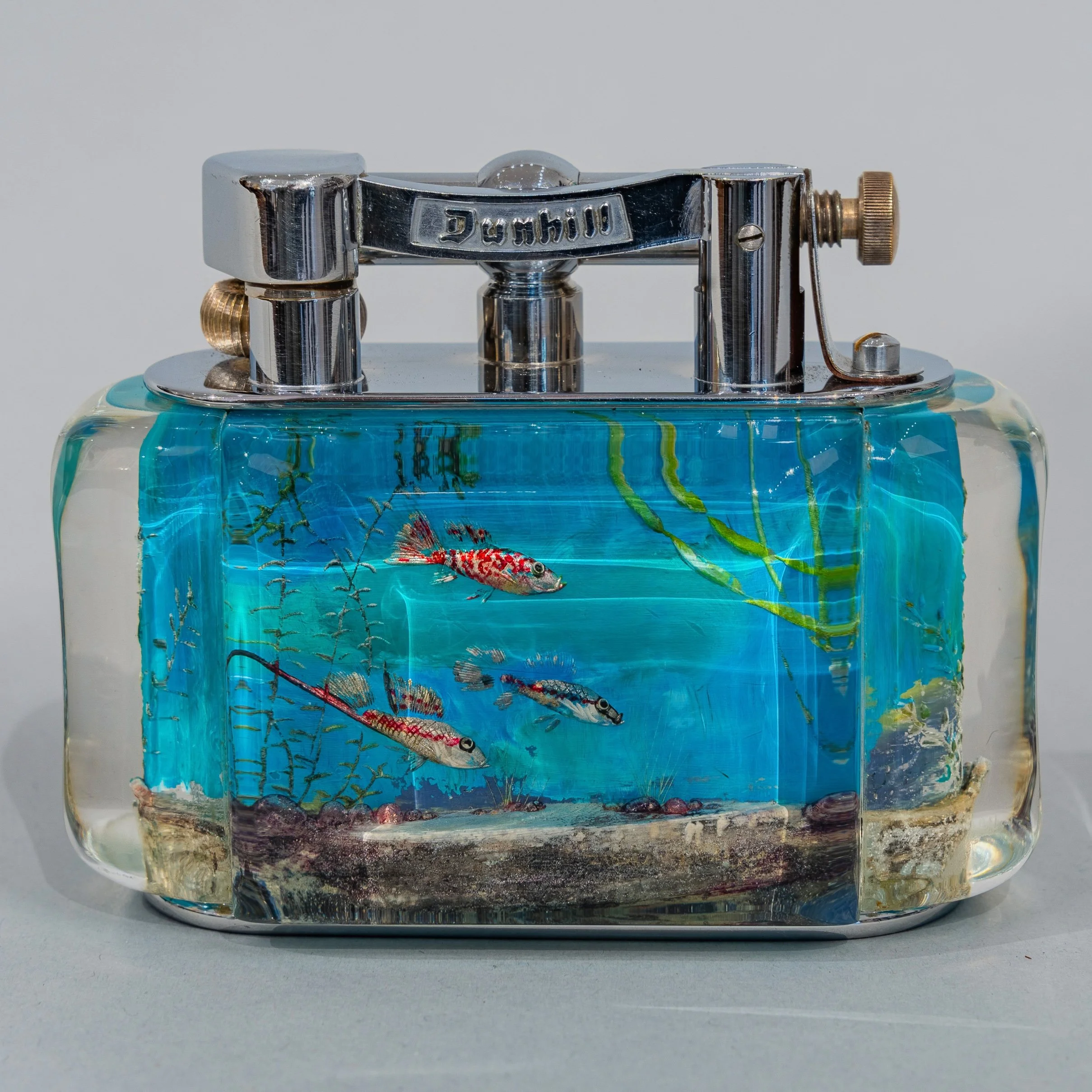
Among the most coveted luxury objects of the twentieth century, the Dunhill Aquarium lighter stands apart as a functional work of art — a miniature hand-painted seascape captured within a polished lucite body and mounted with precision chrome hardware bearing the signature Dunhill lift-arm nameplate.
This example is among the most visually striking of the series — the lucite body rendered in a vivid cerulean and turquoise blue of exceptional depth and clarity. The principal face presents a single large dragonet-style fish, its scales and fins worked in intricate detail in purple, red, and silver, suspended above a beautifully rendered rocky seabed of pebbles, coral, and fine aquatic plants. The reverse shows four smaller fish in red and silver moving across two levels of the water column, with bold green kelp fronds completing the composition. The wraparound scene is continuous across all four panels.
Each panel is reverse-carved in intaglio, then back-painted — giving the scenes a luminous, three-dimensional depth that no surface decoration could replicate. The Aquarium collection was launched in 1949 and ceased at the end of the 1950s following the retirement of its creator, Ben Shillingford, whose mastery could never be equaled. No two Aquarium lighters are alike. The most celebrated owner was Sir Winston Churchill, who kept one on his desk.
Condition: Very good. Lucite is clear and bright throughout, with no cracks, chips, clouding, or scratches. Hand-painted scene vivid and fully intact on both faces.
Chrome hardware is strong with good reflective quality, no pitting. Dunhill nameplate engraving is sharp and legible. Mechanism fully functional.
Made in England. Circa 1950–1959.
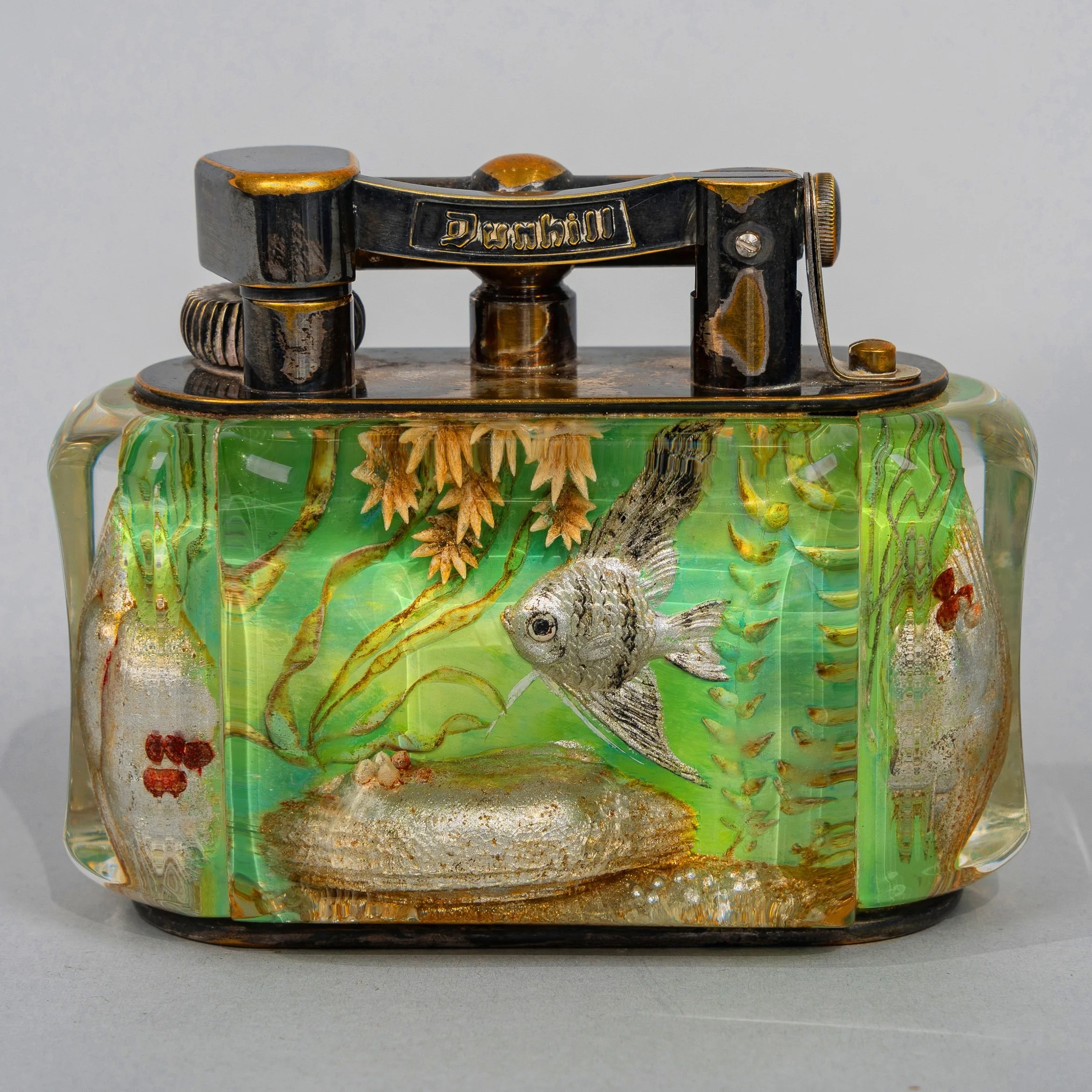
Among the most coveted luxury objects of the twentieth century, the Dunhill Aquarium lighter stands apart as a functional work of art — a miniature hand-painted seascape captured within a polished lucite body and mounted with gold-plated hardware bearing the signature Dunhill lift-arm nameplate.
This example presents a richly detailed underwater scene executed across all four lucite panels in the characteristic technique pioneered by Ben Shillingford: each panel reverse-carved in intaglio, then back-painted to create scenes of remarkable luminous depth. The lucite body is rendered in a vivid emerald and jade green, giving the piece exceptional warmth and presence. The principal face is dominated by a large, beautifully rendered angelfish, its scales and fins picked out with extraordinary precision against a background of golden aquatic plants, sweeping fronds, and clusters of red coral at the seabed. The reverse presents two smaller striped fish suspended mid-water above a silvered seabed, the surrounding flora rendered in fine detail throughout. The wraparound scene, continuous and dense across all four panels, places this among the more ambitious compositions from the workshop.
The Aquarium collection was launched in 1949 and ceased at the end of the 1950s following the retirement of its creator, Ben Shillingford, whose mastery could never be equaled. No two Aquarium lighters are alike. The most celebrated owner was Sir Winston Churchill, who kept one on his desk.
The gold-plated hardware has developed a rich patina consistent with honest age and use — the gilding worn in areas of natural contact, presenting authentically in original unrestored condition.
Condition: Very good. The Lucite body is clear and bright throughout with no cracks, chips, clouding, or hairline scratches. The hand-painted scene is vivid and fully intact on both principal faces — angelfish, striped fish, aquatic flora, and seabed detail all crisp and unfaded.
Gold-plated hardware worn to a rich patina consistent with age, presenting authentically in original unrestored condition. Dunhill nameplate engraving is sharp and legible. Mechanism fully functional.
Made in England. Circa 1950–1959.

One of René Lalique's most celebrated designs, the Bacchantes vase was first created in 1927 and remains an icon of Art Deco glassmaking. The sensuous bas-relief depicts the young priestesses of Bacchus—the Maenads of Greek mythology—in a graceful round dance celebrating the god of wine. Each piece requires approximately 30 hours of skilled craftsmanship to complete.
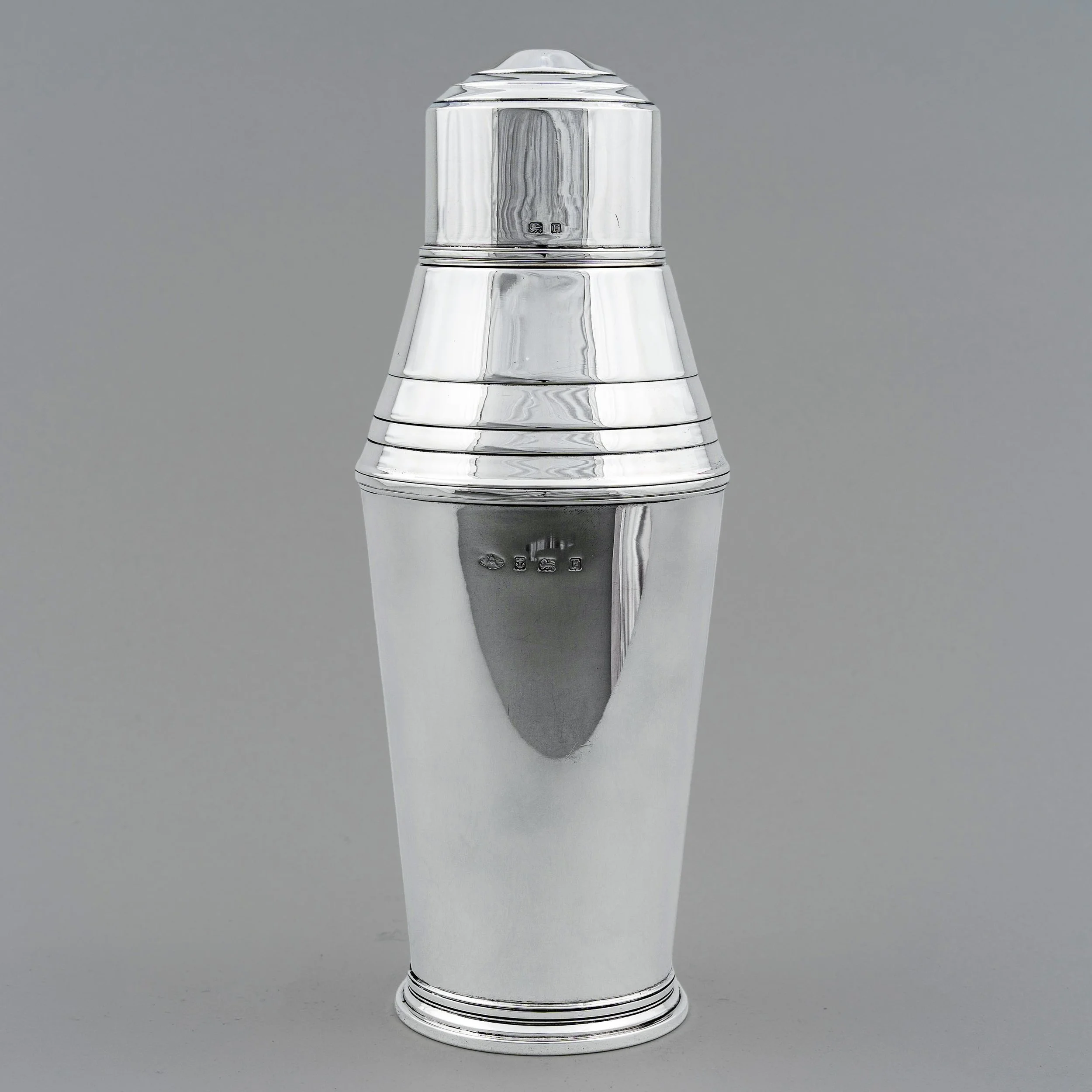
A fine Art Deco cocktail shaker in sterling silver, the tapering cylindrical body rising from a stepped circular foot, the conical strainer section articulated by crisp reeded bands at the shoulder, the domed cap with reeded collar. The plain surfaces rely entirely on proportion and the quality of the silver. Height 9 inches.
Hallmarked Birmingham 1931, maker's mark of Adie Brothers. In excellent condition with a fine, bright polish throughout.

A masterpiece of American silver plate barware from the golden age of country club culture, this Apollo Silver Co. cocktail shaker is distinguished by its all-over embossed decoration depicting a continuous golf course panorama — one of the most desirable and collectible decorative treatments in the category.
The shaker is of generous pitcher form, tapering from a broad circular foot to a fitted lid with faceted knop finial and beaded collar. A scrolled rococo-revival handle of considerable elegance is set opposite a short cylindrical pouring spout with strainer. The body is decorated in bold relief with a wraparound fairway scene: a golfer caught at the full follow-through of his drive, a caddie standing at attention beside a bag of clubs, mature oaks and conifers framing the composition, and naturalistic tufts of rough and bunker throughout. The scene reads as a complete landscape, animated and full of period character, the figures rendered with a charming directness entirely typical of American decorative metalwork of the 1920s.
The base retains its original cork pad centered by a small circular patent plaque stamped PAT'D. MAY 13, 1924, providing an exact date for the design. The body is further stamped with the maker's number 4949 and the Apollo Silver Co. mark. Apollo, a division of Bernard Rice's Sons of New York, was among the most prolific and quality-conscious silver plate manufacturers of the interwar period, supplying the American market with barware that married accessible luxury with genuine craft.
Golf-themed barware from the 1920s occupies a distinct collecting niche at the intersection of sporting memorabilia and decorative arts, and embossed rather than engraved examples — where the decoration is integral to the metal rather than applied — are significantly more desirable. This example, in very good condition with strong plate, is a superior representative of the form.
MAKER: Apollo Silver Co. (Bernard Rice's Sons), New York DATE: Patented May 13, 1924 MATERIALS: Silver plate; cork MARKS: "PAT'D. MAY 13, 1924" to base patent plaque; maker's number 4949 to body
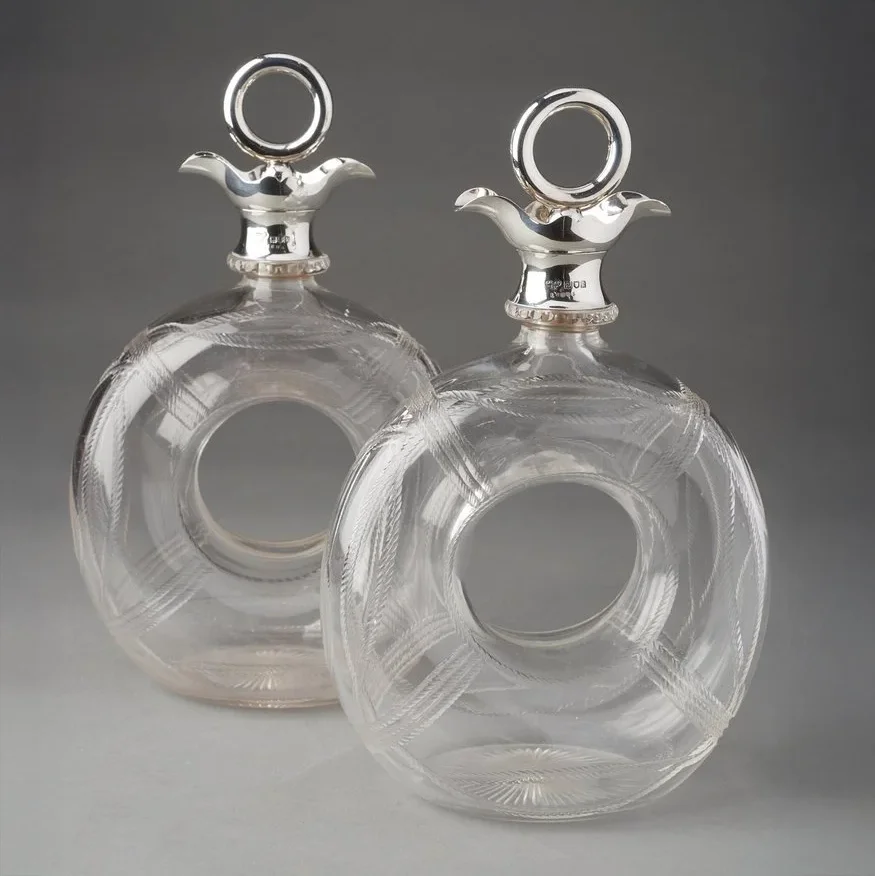
A Pair of Antique Silver & Glass Decanters in the form of “Life Rings” by Goldsmith’s & Silversmith’s Company, London 1905.

A Napier Tells-U-How menu cocktail shaker in silver plate with gilt fittings, made by the Napier Company of Meriden, Connecticut, circa 1929 to 1933, the recipe-dial form that stands among the most sought-after pieces of American interwar barware. The gilt-capped example is the shaker offered here, photographed alongside the silver-capped variant for comparison.
The shaker is constructed in three sections: a tapering cylindrical body, a bulbous upper section with four lobed quadrant panels, and a domed gilt cap lifting free to reveal the pouring spout. The rotating outer sleeve carries gilt-labeled recipe plaques arranged in a descending cascade around the body, a menu of the Jazz Age bar, the Orange Blossom, Palm Beach, Old Fashioned, Manhattan, and Gin Rickey among them, allowing the host to dial up a cocktail and follow its proportions from the object itself, a piece of wit entirely characteristic of American design in the years around Repeal. The base cap is stamped with the maker's mark and No. 398119. It stands 11 inches high.
Condition is very good; the silver plate is bright with minor wear consistent with age, the gilt fittings retain their strong original finish, and the rotating mechanism works freely.
Literature: Stephen Visakay, Vintage Bar Ware, 1997, p. 123.


Among the most evocative of Edwardian sporting objects, the crystal and boar's tusk lemonade pitcher represents the era's confident fusion of the field and the table — naturalism pressed into the service of civilized hospitality. This exceptional example, standing twelve inches in height, brings together every element that defines the form at its finest.
The body is of heavy cut crystal, worked in an all-over pattern of starburst and pinwheel motifs above a band of fine hobstar cutting at the base. The quality of the glass — its weight, its clarity, and the precision of its cutting — is immediately apparent and speaks to a commission of the first order. The silver-plate collar and hinged domed lid are of the highest "Best Electro Plate" designation, marked BEP/WF with model number 2291, and retain a strong, well-preserved finish. The lid opens on a robust hinge and is fitted with a ball thumb-piece. A short, elegantly proportioned pouring lip completes the mount.
The handle is a single natural boar's tusk of generous curve and warm honey tone, the sawn cross-section of its base visible where it is secured to the body by a silver-plate collar and screw fitting — an honest and direct connection between the raw material and the craftsman's intention. Both ends of the tusk are silver-mounted, and the natural surface texture and coloration of the ivory remain in fine, unrestored condition.
The outstanding practical feature of this pitcher is the removable glass ice cylinder — a cylindrical liner of plain glass with a silver-plate rim, designed to sit within the collar and keep the contents cold without diluting them. This device, sometimes called an ice jacket, was the mark of a truly well-considered piece; the mechanism is intact and fully functional.
Condition: The cut crystal is free of chips or cracks. The silver-plate mount retains very good finish with light use-wear consistent with age. The boar's tusk handle is sound and stable, with natural patination and no significant damage. The ice liner is present and intact.
Material: Cut crystal, silver plate (Best Electro Plate, BEP/WF, no. 2291), natural boar's tusk Height: 12 inches (30.5 cm) Origin: England Period: Edwardian, circa 1900–1910

A Serie Titanio V8 espresso machine by Super Veloce of Johannesburg, a half-scale sculpture in the form of a nineties Formula One engine that functions as a capsule espresso maker, with a grappa reservoir concealed in the oil filler for a caffè corretto.
The machine is precision-machined from aerospace-grade materials, with components in Anticorodal 6082 T6 and 7075 aluminum alloys, 316 and 304 stainless steel, and titanium; the billet engine block with polished velocity stacks; chrome exhaust stacks serving as the pour spouts; and red anodized cam covers with carbon fiber inlay. Each example is hand-built in limited numbers, and the series stands as the best-known expression of the engine-art genre, part functioning espresso maker, part tribute to the era of Senna and Schumacher.

A cocktail shaker of the highest design pedigree, this example was created by Keith Murray for Mappin & Webb — one of the defining collaborations of British Art Deco design. Murray, the New Zealand-born architect turned industrial designer, brought an architect's rigorous sense of form to everything he produced: clean geometry, precisely articulated stepped profiles, and a complete rejection of ornamental superfluity. All of those qualities are fully present here.
The shaker is of tapering cylindrical form, the body rising from a stepped and reeded base to a two-part top section with a domed, reeded cap — the horizontal banding at top and bottom providing the restrained architectural rhythm that is the hallmark of Murray's work for both Mappin & Webb and Wedgwood. In silver plate, the surface is brilliantly polished and unadorned save for the engraved decoration, which is itself a model of graphic clarity.
The body carries engraved decoration on two registers. A frieze of stylized cocktail bar imagery — palm trees, figures, and bar motifs rendered in a witty, spare line — encircles the upper shoulder. Below, six named cocktail recipes are set out with characteristic precision: No. 1 Bronx, No. 2 Clover Club, No. 3 Dry Martini, No. 4 Manhattan Dry, No. 5 Side Car, and No. 6 Charley Horse, each with its proportions engraved directly on the body — Dry Gin, Italian Vermouth, French Vermouth, juices and grenadine as required. The numbering system and engraved recipe format place this firmly in the tradition of the great British recipe shakers of the interwar period, of which the Murray/Mappin & Webb examples are the most architecturally distinguished.
Mappin & Webb, goldsmiths and silversmiths to the British Royal Family, produced Murray's designs to the highest standard of the silversmithing trade. Examples of this model appear in major collections of British decorative arts.
MAKER: Mappin & Webb, London; designed by Keith Murray DATE: c. 1930–1939 MATERIALS: Silver plate RECIPES ENGRAVED: No. 1 Bronx · No. 2 Clover Club · No. 3 Dry Martini · No. 4 Manhattan Dry · No. 5 Side Car · No. 6 Charley Horse

In the world of automobiliana, few objects capture the spirit of the 1960s British motoring golden age as precisely as a Ruddspeed radiator decanter. Produced by Ruddspeed Ltd. in the 1960s, these heavy chromium-plated decanters — each modelled on the radiator of a great marque — were sold by Harrods of London and other high-quality shops and garages across the UK. Ruddspeed They were not novelties. They were serious objects for serious enthusiasts, and they remain among the most sought-after pieces of mid-century automobiliana.
The firm behind them was founded by Ken Rudd, a competition driver sufficiently accomplished that in 1953 he was invited by Donald Healey to understudy for him at Le Mans. Mark Goodger Ruddspeed went on to convert Austin-Healeys, Volvos, Alfa Romeos, and Ford Mustangs, counting Ian Fleming and Bruce Reynolds among their customers. Mark Goodger The decanters were a sideline that became a legend.
This example is modeled on the iconic Rolls-Royce radiator, its vertical louvres rendered in heavy chromium plate with a fidelity that makes the identification instant and unmistakable. The enameled cartouche at the top of the grille carries the interlocked double-R monogram of Charles Rolls and Henry Royce — a badge that has represented the summit of British engineering since 1906. The radiator cap, in the flat screw form characteristic of the Rolls-Royce variant, serves as the stopper for the glass liner within. The backing plate, in black, carries a vertical slot through which the level of liquid in the glass liner can be read — a detail that distinguishes the genuine Ruddspeed from the many copies that followed. The rear is stamped RUDDSPEED LTD (ENGLAND), Registered Design No. 910435.
A piece that belongs equally on a bar trolley, a library shelf, or a collector's cabinet — and one that rewards the eye of anyone who has ever stood before a Silver Shadow or a Phantom and understood what the radiator means.
Condition: Chromium finish very good, with light age-consistent wear. Glass liner present and sound. Enamel badge intact. Backing plate original.
Material: Chromium-plated metal, glass liner, enamel Height: 8 inches (20.3 cm) Maker: Ruddspeed Ltd., Worthing, England Registration: Reg. Design No. 910435 Period: circa 1960

If the Rolls-Royce radiator represents the summit of English aristocratic engineering, the Bugatti horseshoe is something altogether more volatile — a shape that evokes Grand Prix starting grids, the hairpins of Monaco, and the long straight at Le Mans. Ruddspeed's decision to model a decanter on it was an act of perfect judgment.
Ettore Bugatti, born in Milan in 1881 and working from his atelier at Molsheim in the Alsace, produced automobiles that were simultaneously the most beautiful and the most successful racing machines of their era. The Type 35, introduced in 1924, would go on to win over two thousand races, and the horseshoe radiator that fronted every Bugatti of the period became one of the most recognizable silhouettes in the history of the automobile. It remains so today.
This decanter by Ruddspeed Ltd. of Worthing captures that silhouette with remarkable fidelity. The body is cast in heavy chromium-plated metal, its characteristic horseshoe arch rising to a knurled chrome screw cap that serves as the stopper for the glass liner within. The front face carries a black perforated mesh grille framed by a polished chrome surround, with the red oval enamel Bugatti badge — bearing the double-B monogram — positioned at the crown of the arch precisely as it appeared on the automobiles themselves. The reverse backing plate, in black, incorporates the characteristic vertical slot through which the level of liquid in the glass liner can be gauged, the feature that distinguishes every genuine Ruddspeed from the copies that followed. The piece is stamped RUDDSPEED LTD (ENGLAND), Registered Design No. 910435 on the reverse.
Ruddspeed was the creation of Ken Rudd, a competition driver who in 1953 was invited by Donald Healey to understudy for him at Le Mans. The firm went on to build a distinguished reputation as performance car specialists — converting Austin-Healeys, Volvos, and Ford Mustangs, and counting Ian Fleming among their clientele. The radiator decanters, sold through Harrods of London and select garages and sporting goods retailers across the United Kingdom, were a sideline that became, in the intervening six decades, considerably more collectible than many of the cars that inspired them.
Condition: Chromium finish very good with light age-consistent wear. Black enamel grille and chrome surround intact. Red enamel Bugatti badge present and sound. Glass liner present. Backing plate original with level window intact.
Material: Chromium-plated metal, black perforated enamel mesh, glass liner, enamel badge Maker: Ruddspeed Ltd., Worthing, England Registration: Reg. Design No. 910435 Period: circa 1960

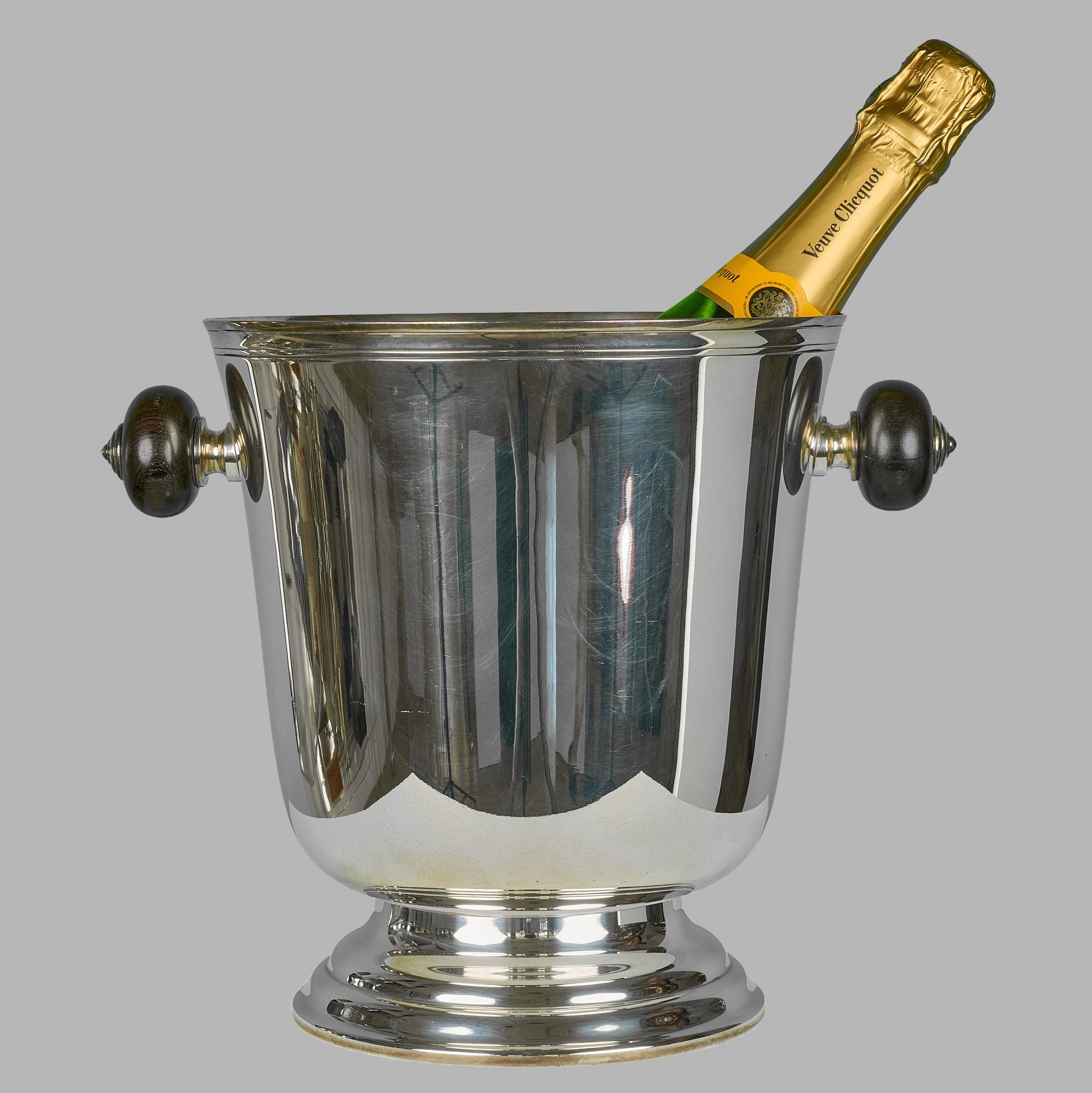
This champagne bucket by Christofle of Paris is raised in a silver plate to a clean tulip form, the polished body flaring from a stepped circular foot and finished at the rim with a restrained molded band. To either side, turned handles of ebonized wood are mounted on silvered collars, a dark and tactile counterpoint to the bright metal that is characteristic of the house at its best.
Christofle has stood at the forefront of French silver since Charles Christofle established the firm in Paris in 1830, supplying the tables of emperors and embassies and setting the standard for plated ware that the name still carries. Dating from the 1950s, the form here is at once classical and modern, owing its proportions to the wine coolers of the eighteenth century while wearing them with the economy of line that marks the best mid-century work. The wooden handles, beyond their elegance, keep the hand from the chilled metal, the mark of a piece made to be used as well as admired.
The body holds a single bottle in ice with room to spare, and the polished surface returns the light of a room as only a good silver plate can. The underside carries the Christofle mark.
A champagne bucket of this quality belongs on any table set for an occasion, and serves equally as a handsome still presence on a sideboard between them. Pieces by Christofle are always sought, and a well-kept example such as this rewards both the eye and the hand.
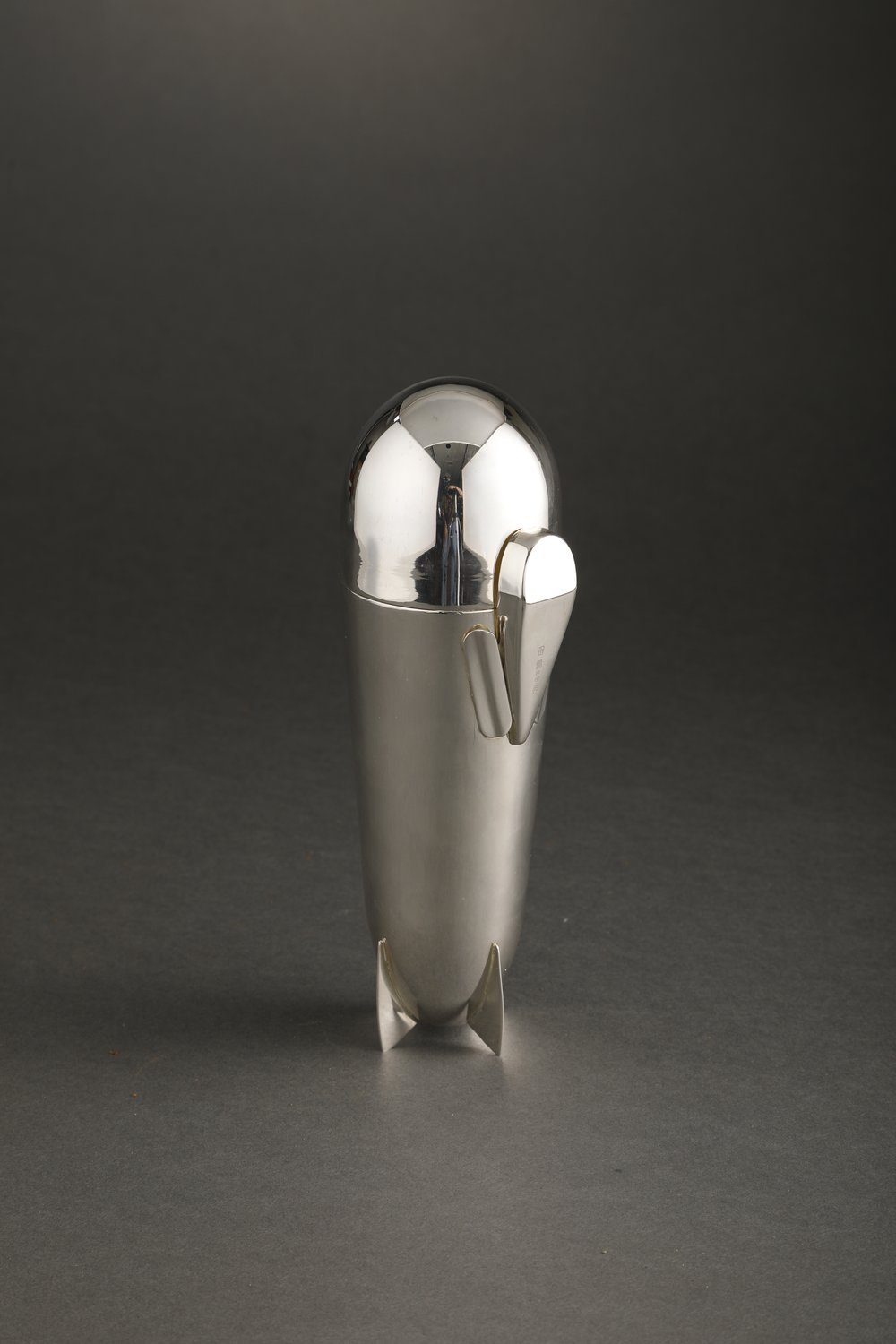
Few objects capture the romance of the interwar age more completely than the Zeppelin cocktail shaker — a tour de force of German industrial design in which the world's most thrilling aircraft was reimagined as a barware set for the well-appointed drawing room. This example, stamped by J.A. Henckels Twin Works, Solingen, Germany, is among the most sought-after variants of this celebrated form.
The shaker body is modeled in the unmistakable profile of the great dirigibles: a sleek, bullet-nosed fuselage rising from four swept tail fins that serve as the base, with a hinged side attachment functioning as the gondola. In silver plate throughout, the piece disassembles into its full complement of components: the body itself serves as cocktail shaker with integrated juicer and strainer; the nose cone lifts free; the tail section with cover doubles as a sugar container; the cup with cover is for dried fruit; a funnel accommodates refilling; and four graduating cups nest within the whole. A decanter with wings and wheels could be added to transform the shaker into an aeroplane — the convertible configuration that commands the highest collector premiums today. The complete set comprises 19 pieces.
The Zeppelin shaker was produced in Solingen — Germany's great center of metalwork — and retailed in America for $24.95 at original issue, a considerable sum for the era. The form celebrates the Graf Zeppelin's triumphant 1928 Atlantic crossing and the golden age of transatlantic airship travel that followed. Its commercial life was brief: the Hindenburg disaster of May 6, 1937 ended the Zeppelin era almost overnight, making surviving examples of all Zeppelin barware genuinely scarce.
The Henckels Twin Works stamp is one of the most desirable attributions in this category. Illustrated and described in the standard reference on the subject.
MAKER: J.A. Henckels Twin Works, Solingen, Germany DATE: c. 1928 MATERIALS: Silver plate DIMENSIONS: 12 in. (30.5 cm) height MARKS: Stamped "J.A. Henckels Twin Works, Solingen, Germany" to body COMPONENTS: 19 pieces: body/shaker, nose cone, gondola, four graduated cups, four spoons, one funnel, strainer with juicer, cap, decanter, tail with cover (sugar), cup with cover (dried fruit) CONDITION: [To be completed]
LITERATURE Stephen Visakay, Vintage Bar Ware (1997), pp. 49–50.


Among all the figural cocktail shakers of the great cocktail age, none is more celebrated than the lighthouse. Produced by the International Silver Company of Meriden, Connecticut, under its Meriden S.P. Co. mark and patented on January 11, 1927, the model takes its form from Boston Light, the first lighthouse established in America, and was made only briefly at the height of the era. An example is held in the Museum of Fine Arts, Boston.
The conceit is carried through with remarkable conviction. The tapering silver-plated tower rises past two pedimented dormer windows to the keeper's gallery, encircled by a freestanding double railing on turned stanchions above a run of portholes. The lantern room, with frosted panels simulating glazing, lifts off as the cap, and the domed roof with ball finial conceals the pourer. Filled and set on the bar, it is architecture; in hand, it is a working shaker of generous capacity. The shaker was made in two sizes, and this is the classic model 343; the monumental version towers over 20 inches and appears only rarely.
The model's fame has made it one of the most reproduced cocktail shakers, and later chrome and silver-plate copies circulate widely. The present example is an original of the period, bearing the correct Meriden S.P. Co. mark for International Silver, the model number, and the January 1927 patent date struck to the base.
This example has survived unusually well. The gallery railing, the first casualty on most surviving examples, is complete and true; the dormers and portholes are crisp, and the frosted lantern panels retain their original finish.
Condition: Excellent. Original frosted finish to the lantern panels. Gallery railing complete and straight. Plating bright with only minor surface wear consistent with age. Cap and pourer fitting correctly.
Height: 14 in.
Literature: Stephen Visakay, Vintage Bar Ware: Identification and Value Guide, Collector Books, 1997.