
Winston Churchill
Winston Churchill remains the most collected figure in twentieth-century political history: a statesman, orator, writer, and Nobel laureate whose correspondence, signed documents, and portraits command sustained collector interest worldwide.
“In letters as in speeches, Winston Churchill wielded words like weapons, helping unite Britain and America in defense of the free world.”

Winston Churchill — Letters, Signatures, Bronzes & Photographs
The market for Winston Churchill letters, photographs, and portraiture is broad, but value turns on content. Churchill dictated nearly all of his correspondence from the 1920s onward, so a letter entirely in his hand is scarce, yet a typed letter of real substance will outrun a holograph note about a dinner engagement. The strongest pieces combine both, as in our autograph letter of December 1926, thanking Max Beaverbrook, in Churchill's inimitable way, for the gift of a Frigidaire.
The Churchill collection at Daniels Antiques is built around correspondence from the wilderness years through the wartime premiership and into the postwar period, together with portraits by the two artists who knew him best. Oscar Nemon is represented by the bronze maquette for Married Love, the double portrait of Winston and Clementine whose full-scale version stands in the grounds of Chartwell, and by a solid gold miniature bust cast by Asprey of London around 1960. Yousuf Karsh's 1941 portrait The Roaring Lion is present in three examples, among them a print signed by both Karsh and Churchill himself in 1954.
Every piece is described with full physical detail, provenance, and published literature where applicable, and may be viewed by appointment in Aspen, Colorado, and Fort Lauderdale, Florida. We are always interested in acquiring fine Churchill material. Please contact us if you have a piece to sell.
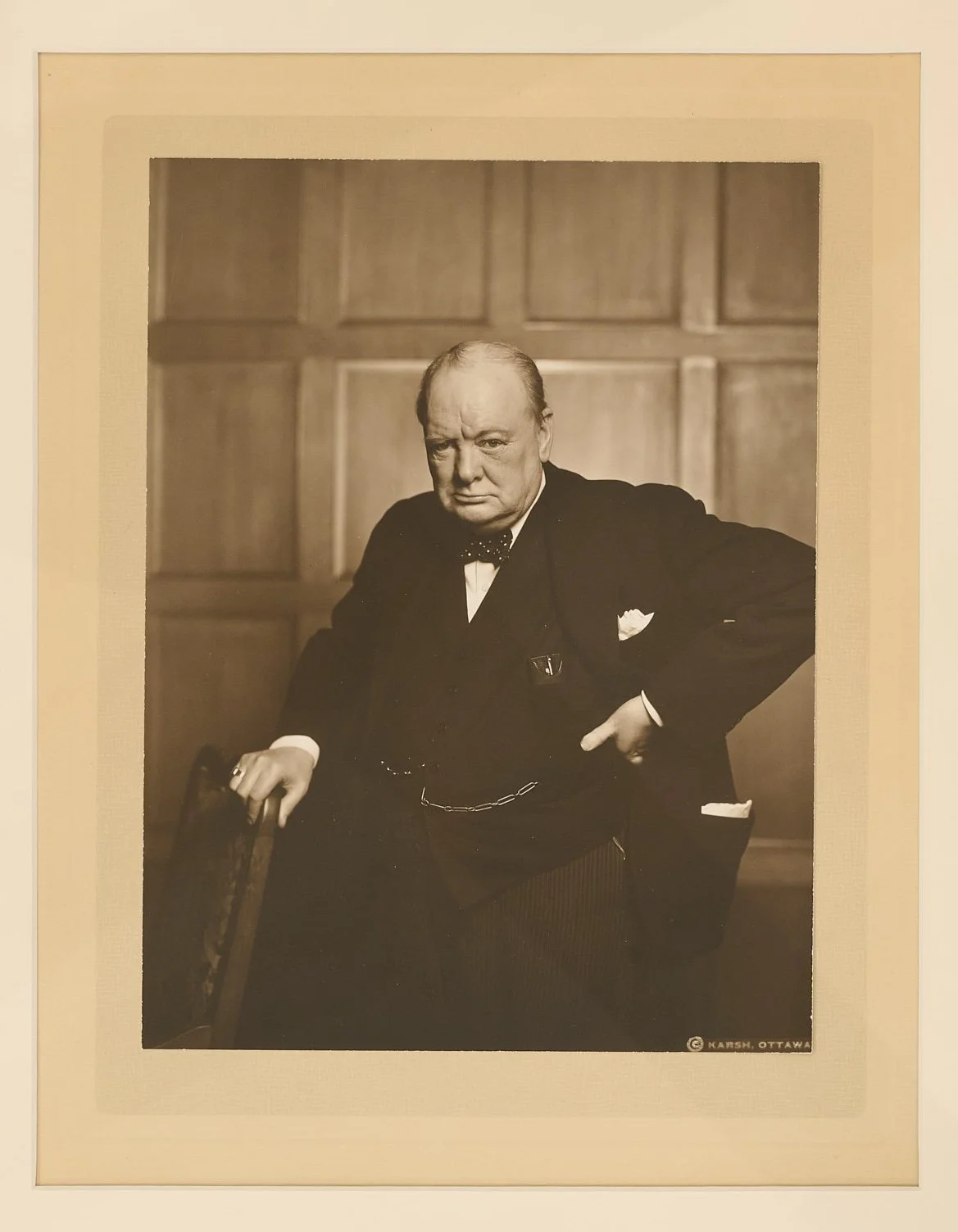
A vintage gelatin silver print of The Roaring Lion, Yousuf Karsh's portrait of Winston Churchill. This is an early printing, made circa 1944 within a few years of the 1941 negative.
Karsh made the portrait in the first weeks after Pearl Harbor, with the United States newly drawn into the war and its outcome far from certain. Churchill had crossed the Atlantic aboard HMS Duke of York to confer with Roosevelt, and traveled on from Washington to Ottawa, where on December 30, 1941, he addressed the Canadian Parliament in the speech remembered for his scorn of the prediction that Britain would have her neck wrung like a chicken. Karsh was waiting in the Speaker's Chamber. Allowed two minutes, and faced with a subject who would not set down his cigar, he stepped forward, said "Forgive me, sir," and drew it from Churchill's mouth. The expression that followed was caught in the instant the photographer returned to his camera, and it became the face of British resistance. Churchill, his composure recovered, told him he could even make a roaring lion stand still for a portrait.
Prints of this image reach the market at a rate of only a few each year, and the great majority of those are later printings. Having followed them for many years, and compared this example directly against another early print in this collection, I place it among the earliest to come from the negative. The composition retains the fuller field above the sitter's head, the area Karsh reduced in later years to concentrate the eye on Churchill, and his copyright credit appears in the early form, in white at the lower right within the image.
A manuscript note at the reverse records the print as given by Karsh in 1944 to the president of Canadian Kodak, and passed in 1972 to a retiring employee of the company. Provenance recording a gift from the photographer himself is of real importance for a print of this period.
The image has appeared on the Bank of England five-pound note since 2016, and is among the most widely reproduced portraits ever made. This example is in excellent original condition, clear and well contrasted, and distinguished by an unusually rich sepia tonality. It is not signed, and is presented in its period mount.
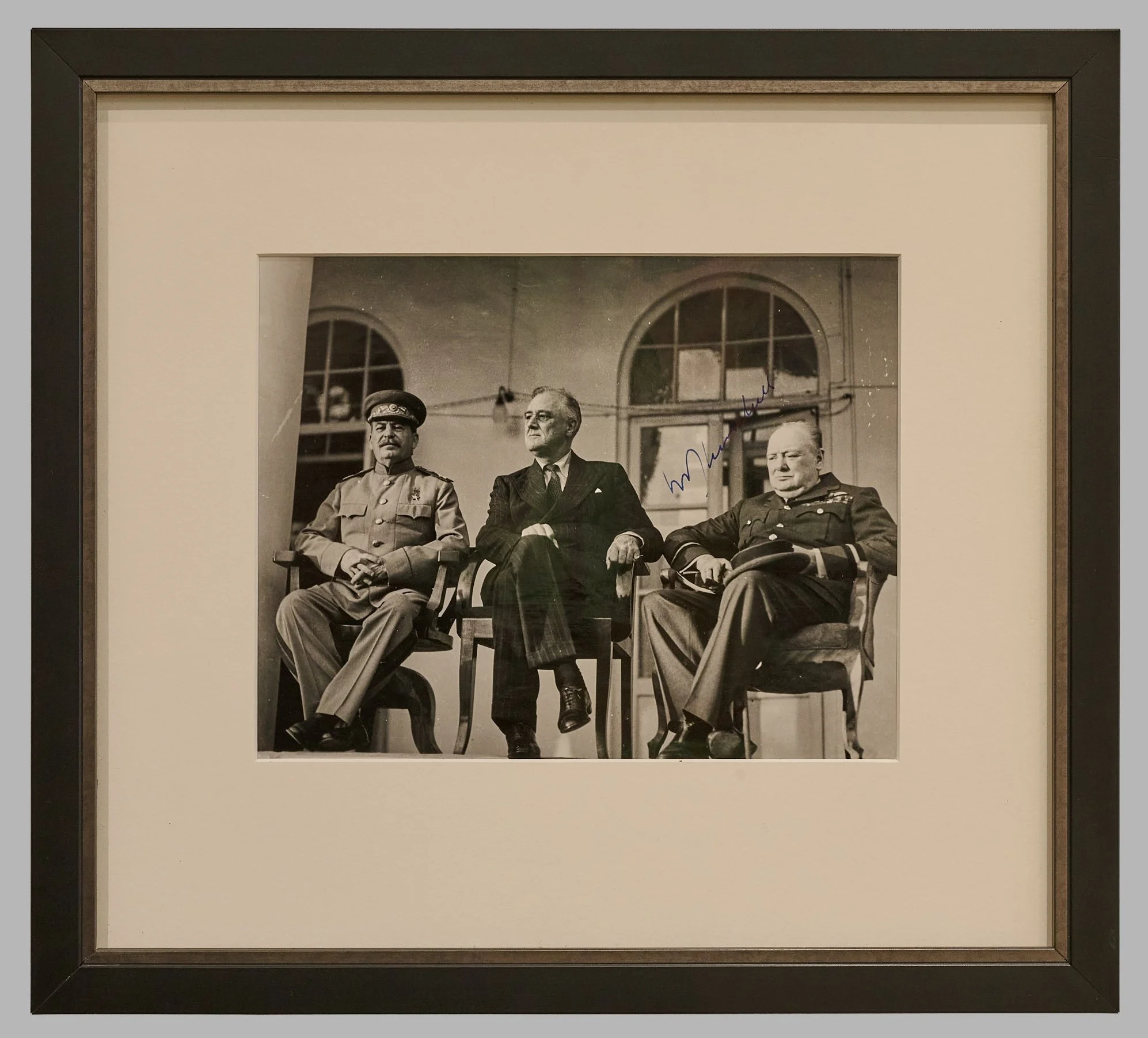
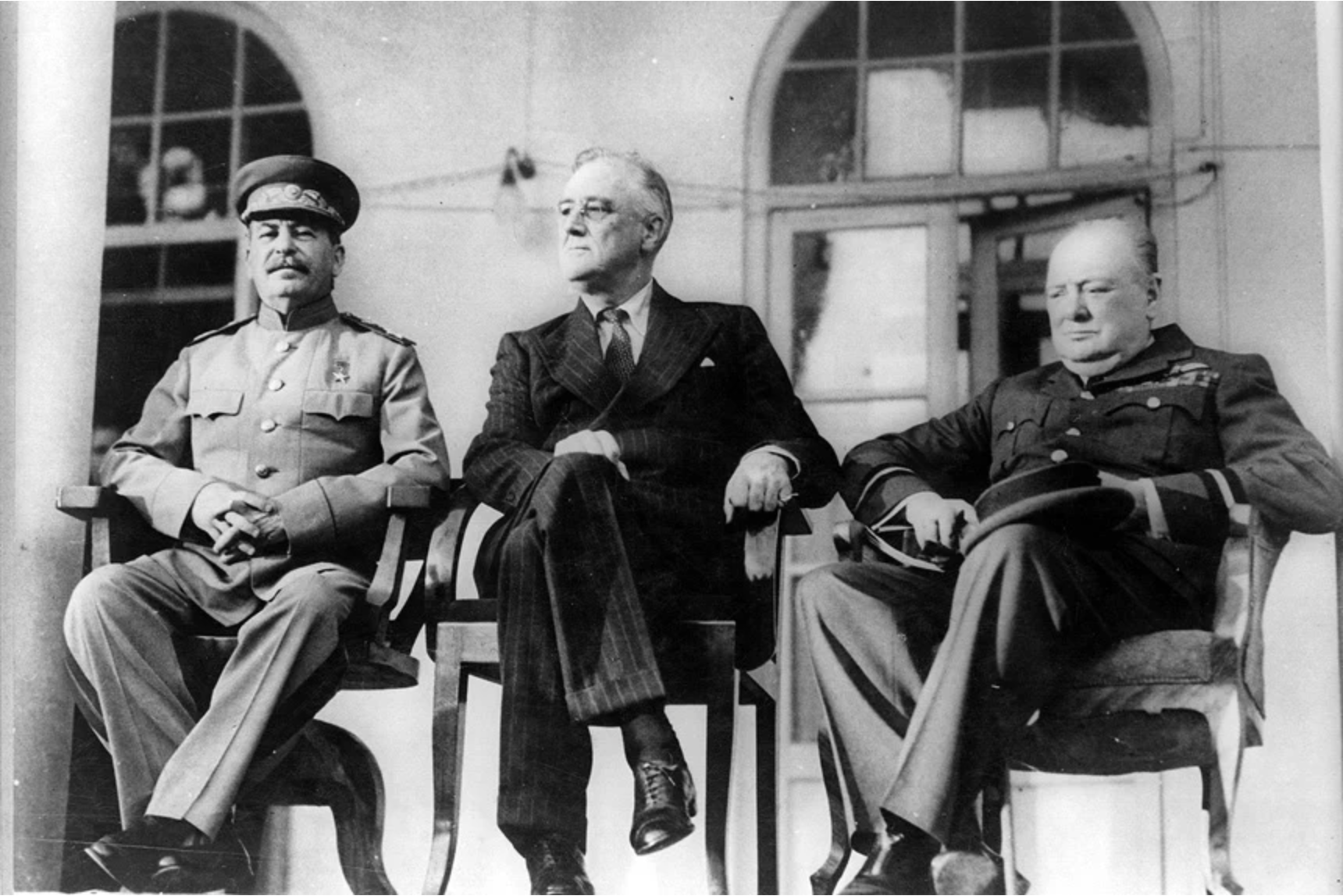
A wartime photograph of the three Allied leaders at the Tehran Conference, signed by Winston S. Churchill in blue ink to the upper right. The image records the first meeting of the Big Three, Churchill, Franklin D. Roosevelt, and Joseph Stalin, seated together on the portico of the Soviet Embassy in Tehran in late November 1943. Stalin sits at the left in the cap and service uniform of a Marshal of the Soviet Union, Roosevelt at the center, and Churchill at the right in Royal Air Force uniform with his hat resting on his lap. The signature falls in the background between Roosevelt and Churchill, clear of all three sitters.
The Tehran Conference, held between November 28 and December 1, 1943, under the codename Eureka, brought the three leaders together for the first time. Over four days, they agreed on the strategy that shaped the remainder of the war in Europe, committing to a second front in the west through Operation Overlord, the cross-Channel invasion launched the following June, alongside a coordinated Soviet offensive in the east. The portico photographs taken during the conference are among the defining images of the wartime alliance.
The photograph was offered at Swann Galleries, New York, on October 24, 1985, lot 71, where it was purchased by Steve Forbes, chairman and editor-in-chief of Forbes magazine and a candidate for the Republican presidential nomination in 1996 and 2000, and a well-known collector of Churchill material. It remained in his collection until recent years.
Gelatin silver print, warm in tone, measuring 205 by 260 mm, approximately 8 by 10 1/4 inches, mounted on card. The print is clear and well contrasted, the signature bold and unfaded. Presented in a black molding with a wide cream mount.
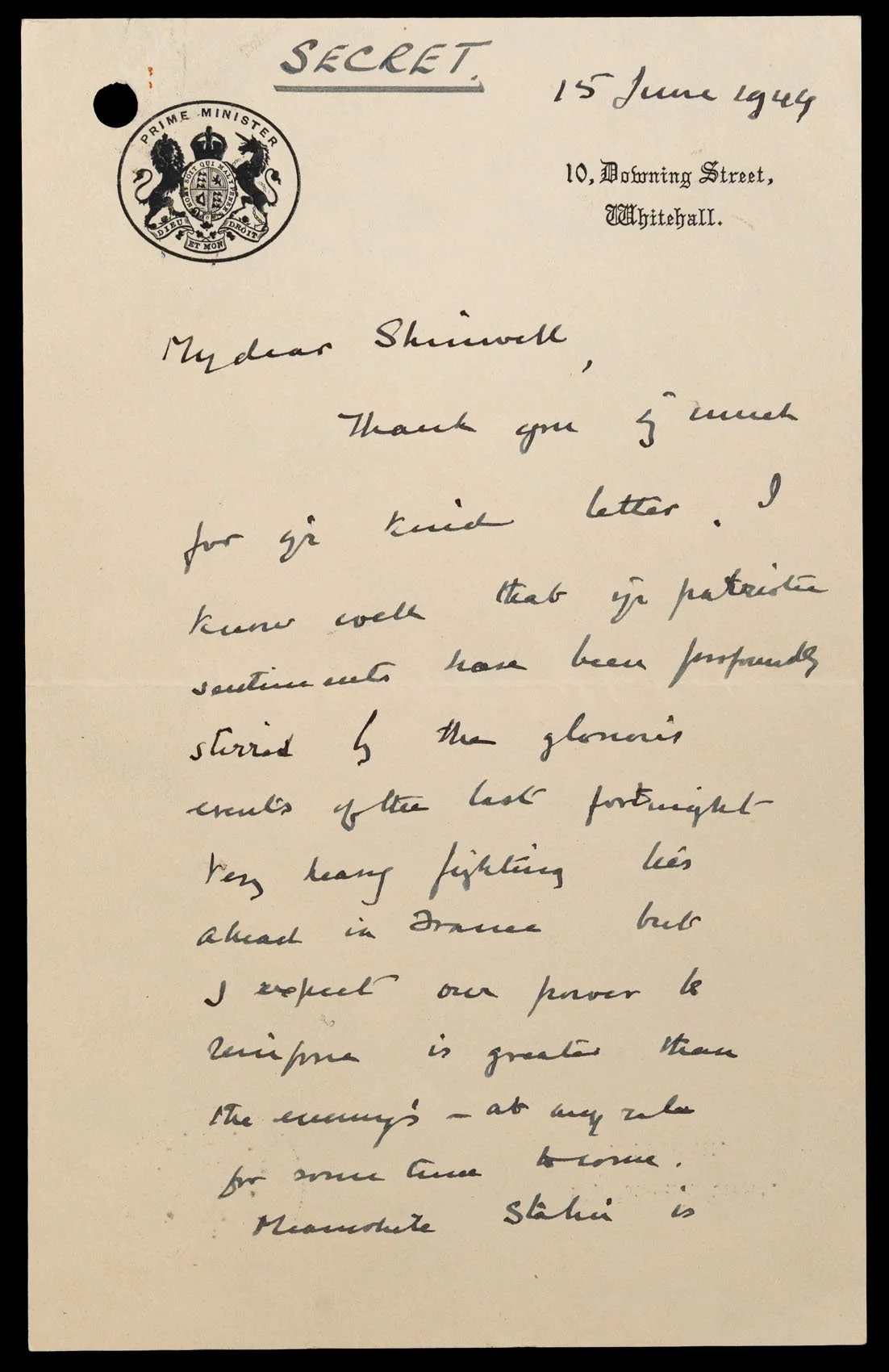
"The glorious events of the last fortnight"
Written nine days after D-Day, this autograph letter signed by Winston S. Churchill represents a document of exceptional historical importance — composed at the height of Allied operations in France, from the desk of the Prime Minister, and marked "SECRET" for reasons that speak directly to the grand strategic situation of June 1944.
The recipient, Emanuel Shinwell (1884–1986), was a Labour MP and persistent — though always patriotic — critic of Churchill's wartime coalition government. He had declined a post in that government, yet wrote to Churchill on 8 June in a spirit of national unity, praising the success of the landings. Churchill's Private Secretary advised that no reply was necessary. Churchill responded nonetheless.
In acknowledging Shinwell's letter, Churchill writes with characteristic clarity and measured confidence:
"Thank you so much for your kind letter. I know well that your patriotic sentiments have been profoundly stirred by the glorious events of the last fortnight. Very heavy fighting lies ahead in France, but I expect our power to reinforce is greater than the enemy's — at any rate for some time to come. Meanwhile, Stalin is sure to get on the move."
The final sentence — "Meanwhile, Stalin is sure to get on the move" — illuminates the SECRET designation. The Soviet summer offensive agreed at the Tehran Conference was imminent, its timing known only to the highest levels of Allied command. That Churchill committed this to paper, in a private letter to a political opponent, underscores both the trust implied and the strategic confidence with which he approached the campaign.
Letters of this period, written from Downing Street during active operations and touching on the broadest dimensions of Allied strategy, are of the greatest historical significance. That Churchill chose to write personally — overriding his Private Secretary's advice — lends the document an additional human and political dimension.
Provenance: The collection of Steve Forbes, chairman of Forbes Magazine and presidential candidate in the 1996 and 2000 US elections.
Reference: Martin Gilbert, Winston S. Churchill, Vol. VII, 1986, p. 800.
Physical description: Single sheet on official 10 Downing Street letterhead (191 × 121 mm), typed one side, signed "Winston S. Churchill." Hole punch, light toning, and handling soiling consistent with age. Overall condition is very good.
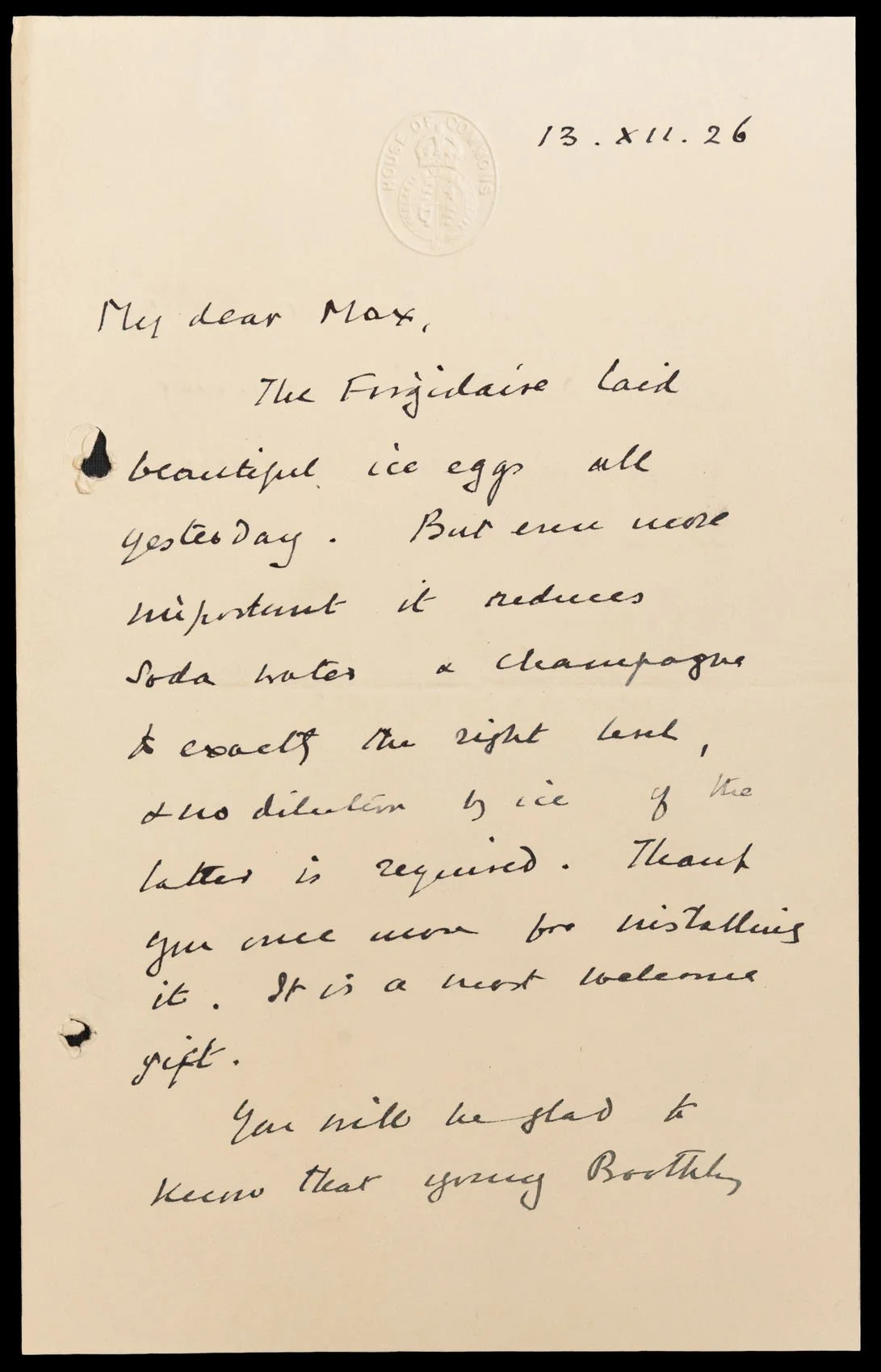
A manuscript letter signed by Winston S. Churchill, dated 13 December 1926, to Max Beaverbrook, thanking him for the gift of a Frigidaire refrigerator and reflecting on its use in domestic life.
CHURCHILL ON MODERN CONVENIENCE AND “BEAUTIFUL ICE EGGS”
A delighted and highly personal letter to Beaverbrook—one of Churchill’s closest friends and political allies—in which he expresses his enthusiasm for the newly installed refrigerator, then still a modern luxury in elite households. Writing with characteristic humor and vividness, Churchill observes:
“The Frigidaire laid beautiful ice eggs all yesterday. But even more important it reduces soda water & champagne to exactly the right level, & no dilution by ice of the latter is required. Thank you once more for installing it. It is a most welcome gift.”
The striking phrase “beautiful ice eggs” captures both the novelty of early refrigeration and Churchill’s distinctive gift for language, transforming a domestic appliance into a moment of charm and personality. His immediate focus on cooling champagne is equally characteristic, reflecting his well-known appreciation for food and drink.
Churchill continues with a brief note on political and personal matters, mentioning that the young Robert Boothby is to join him as parliamentary private secretary, adding a glimpse into his working life during this period. The letter closes on a convivial note, reflecting the warmth and familiarity that marked his long-standing relationship with Beaverbrook, signing simply “W,” as was his custom in correspondence with close friends.
Max Beaverbrook (1879–1964), the powerful press magnate and later Minister of Aircraft Production, was among Churchill’s most important allies, providing crucial media support throughout his career. Correspondence between the two is of particular interest for the insight it offers into both personal and political dimensions of Churchill’s life.
Written while Churchill was out of office yet actively engaged in political and social life, the letter offers a rare and intimate perspective distinct from his formal statesmanlike correspondence. It stands as a vivid example of Churchill’s private voice—witty, appreciative, and deeply human.
Single sheet on House of Commons blind-embossed letterhead (187 × 118 mm), handwritten on both sides in black ink. Signed “W.”
Two filing holes, light toning; overall in very good condition.
Provenance
Collection of Steve Forbes.
Sotheby’s, 5 July 1977, lot 163 (from a group of Churchill letters to Beaverbrook).
Literature
Published in Martin Gilbert, Winston S. Churchill, Vol. V, Companion Part 1 (1979), p. 894.
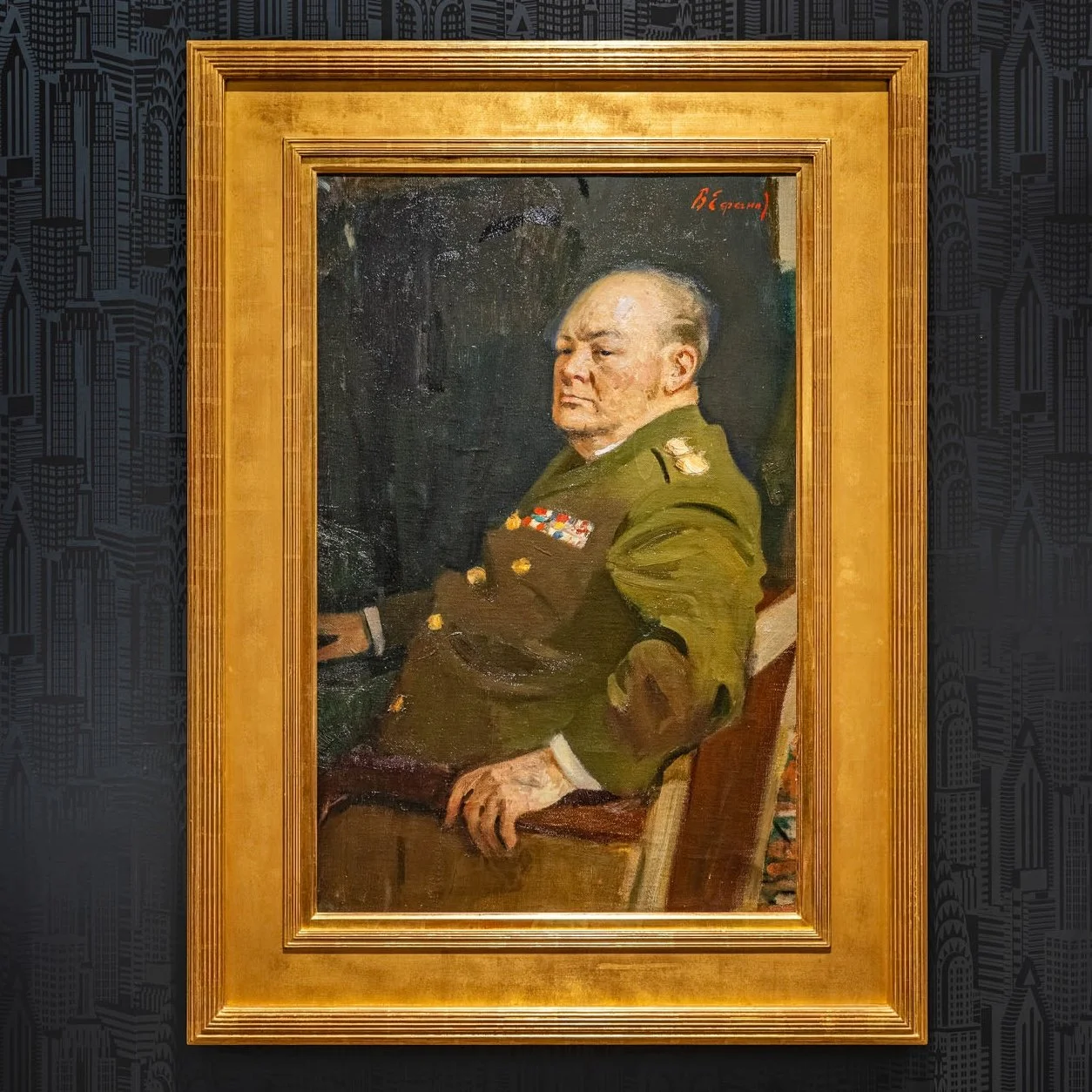
A portrait of Winston S. Churchill by Vasily Prokofyevich Yefanov, oil on canvas, signed and inscribed in Cyrillic on the reverse: V. Yefanov / W. Churchill / oil on canvas / 100 x 65 / 1944. It was painted in the autumn of the Fourth Moscow Conference of 9–19 October 1944, when Churchill sat across from Stalin to negotiate the political future of Eastern Europe and the so-called Percentages Agreement was informally drafted, an episode emblematic of the shifting balance of power at the close of the war.
Yefanov, a leading Soviet state artist and five-time Stalin Prize laureate, was renowned for authoritative depictions of official figures, and he presents Churchill with notable restraint: seated, in uniform, turned slightly from the viewer, absorbed in the gravity of decision rather than the rhetoric of the platform. The subdued palette and confident handling are characteristic of his mature style, here accommodating the distinct presence of a British sitter.
A Churchill of 1944 by a leading Soviet artist is a rare convergence of history, politics and art: painted from within the Soviet sphere at the very moment the post-war order was being negotiated, the work stands as both portrait and document.
Oil on canvas, 100 x 65 cm, presented in a gilt frame; typed label on the reverse identifying sitter and artist.
Provenance: Private collection; thence by descent.
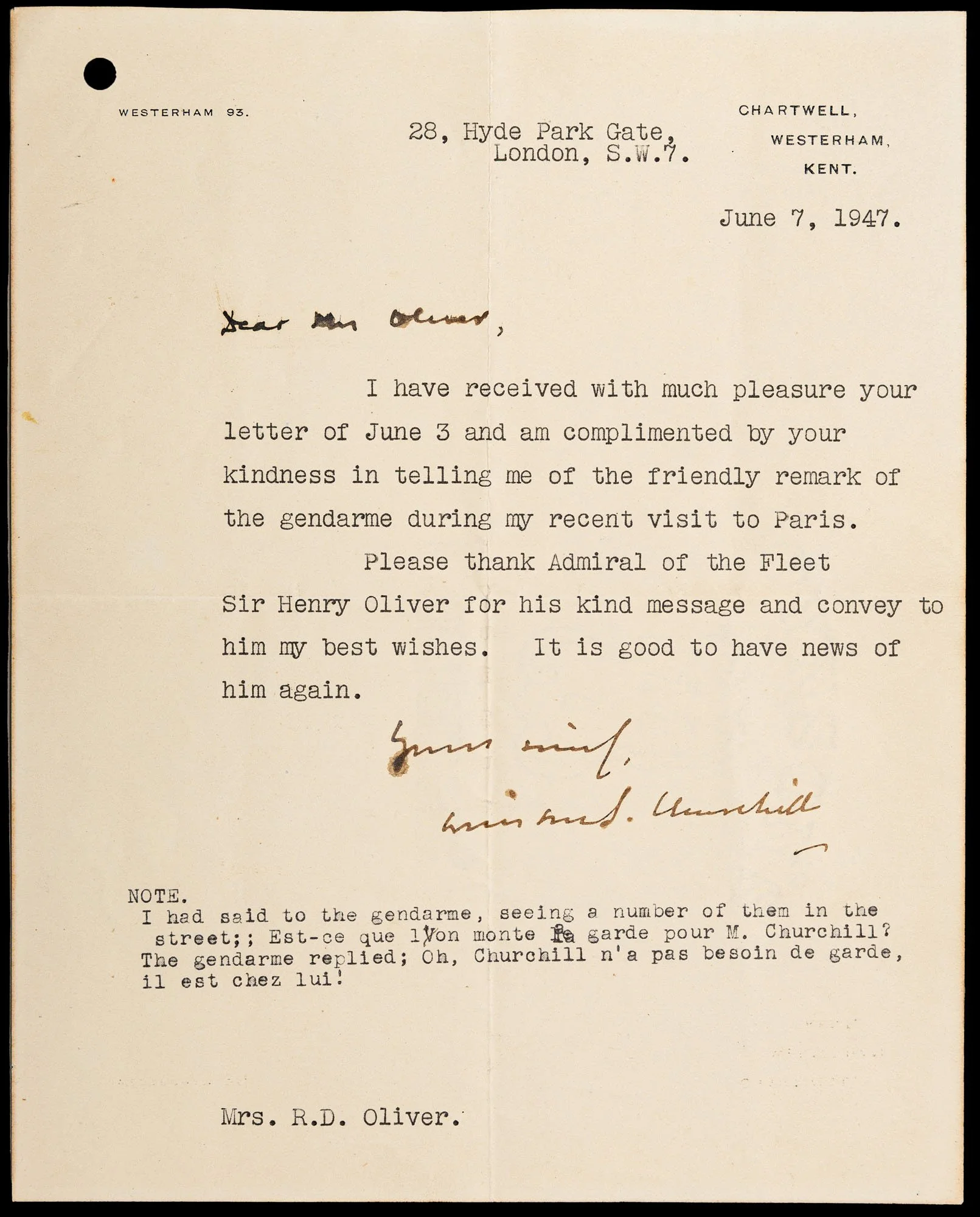
A typed letter signed by Winston S. Churchill, 7 June 1947, to Mrs. Torfrida Oliver, wife of Vice-Admiral Robert Don Oliver, recalling his reception in Paris that May, when Paul Ramadier presented him with the Médaille militaire, one of France's highest military distinctions, in recognition of his wartime leadership. Churchill thanks her for passing on a gendarme's remark from the visit, then records the exchange himself in a typed note:
"I had said to the gendarme, seeing a number of them in the street, Est-ce que l'on monte sa garde pour M. Churchill?
The gendarme replied; 'Oh, Churchill n'a pas besoin de garde, il est chez lui!'"
Churchill does not need a guard — he is at home. Few lines better capture the affection in which France held him in the immediate aftermath of the war. He closes by asking that his thanks be conveyed to Henry Oliver, a mark of his continuing ties to senior naval figures.
Single sheet on printed Chartwell letterhead overtyped with the London address 28 Hyde Park Gate, S.W.7, typed on one side and signed Winston S. Churchill, with the additional typed anecdotal note. Hole-punched upper left, light toning, signature slightly smudged; very good overall.
Provenance: Sotheby's, London, 8 November 1983, lot 369.
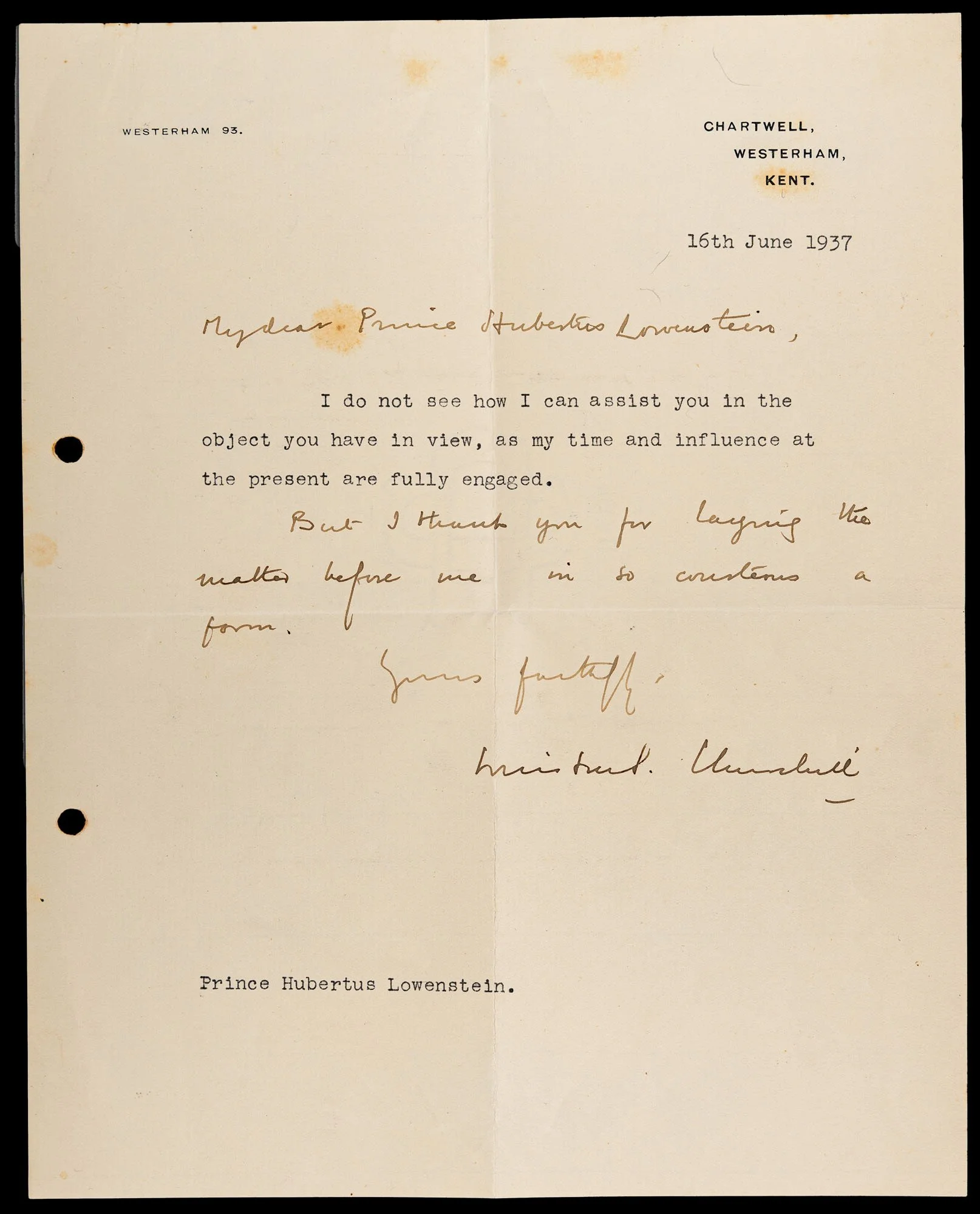
A typed letter signed by Winston S. Churchill on Chartwell letterhead, 16 June 1937, to Prince Hubertus zu Löwenstein-Wertheim-Freudenberg, one of the most prominent German opponents of Hitler. Löwenstein, an aristocrat who had fled Germany in 1933, had written on 11 June, warning that National Socialism would lead to "an international catastrophe" and appealing to Churchill for help in assembling British trustees and funds to take over the failing Paris émigré newspaper, Pariser Tageszeitung, as a center of resistance in exile.
Churchill declines: "I do not see how I can assist you in the object you have in view, as my time and influence at the present are fully engaged." Then, in an autograph continuation in his own hand, he adds: "But I thank you for laying the matter before me in so courteous a form."
The exchange shows Churchill's direct contact with the German opposition during the Wilderness Years, when, still out of office, he was emerging as the leading British voice against Nazi expansion — sympathetic to the cause, careful with his commitments. Löwenstein survived the war and returned to Germany, later serving in the Bundestag.
Single sheet, typed on one side and signed Winston S. Churchill, with autograph continuation. Two filing holes to the inner margin, folds from handling, light toning and scattered spotting; good overall.
Archive: Löwenstein's letter to Churchill of 11 June 1937 is preserved in the Churchill Archives Center (CHAR 2/296A–B).
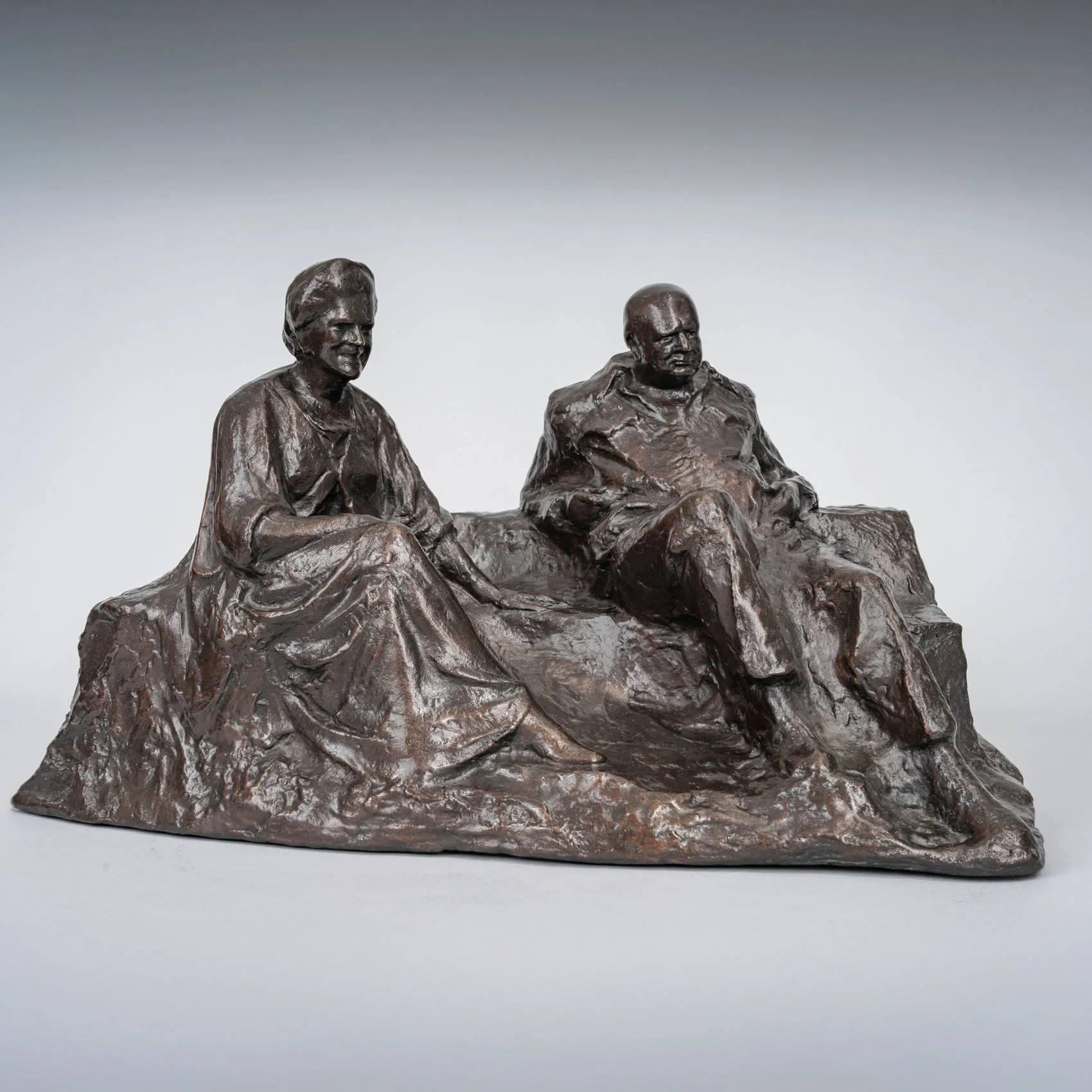
A bronze maquette by Oscar Nemon, Married Love, depicting Winston and Clementine Churchill, cast by the Morris Singer Foundry in a limited edition of 15 and numbered. This was the working model for the monumental sculpture at Chartwell, and so represents the most direct articulation of Nemon's original conception.
Among the most intimate sculptural interpretations of Churchill ever made, Married Love sets aside political authority in favor of companionship. Churchill sits beside Clementine in a composition of quiet balance, his grounded, introspective presence answered by her composed, stabilizing form; she is not secondary but integral, as she was in life. The bronze retains the immediacy of Nemon's modeling, the richly worked surface catching light across its planes, psychological depth taking precedence over formal idealization.
Nemon's association with Churchill began in Marrakesh in 1951, when he modeled the likeness from memory, and Clementine recognized it at once, opening the working relationship that produced the most authoritative sculptural records of Churchill's later life. A Croatian-born Jewish sculptor who lost twenty-two members of his family in the Holocaust, Nemon regarded his 1946 British naturalization as a debt of gratitude to Britain and its wartime leader, and that sincerity informs the work. His sculpture is held at the Guildhall, the House of Commons and Windsor Castle; within that body, Married Love is unique in presenting Churchill in a personal, relational context, and bronzes connected to the Chartwell monument are seldom encountered on the market.
Condition: Rich brown patina with expressive surface modeling; excellent overall. Mid-20th century.
Dimensions: 17” wide, 10” high, 10” deep
Literature: Oscar Nemon, unpublished memoirs and correspondence relating to Churchill's sittings; archival material relating to the Chartwell sculpture commission.
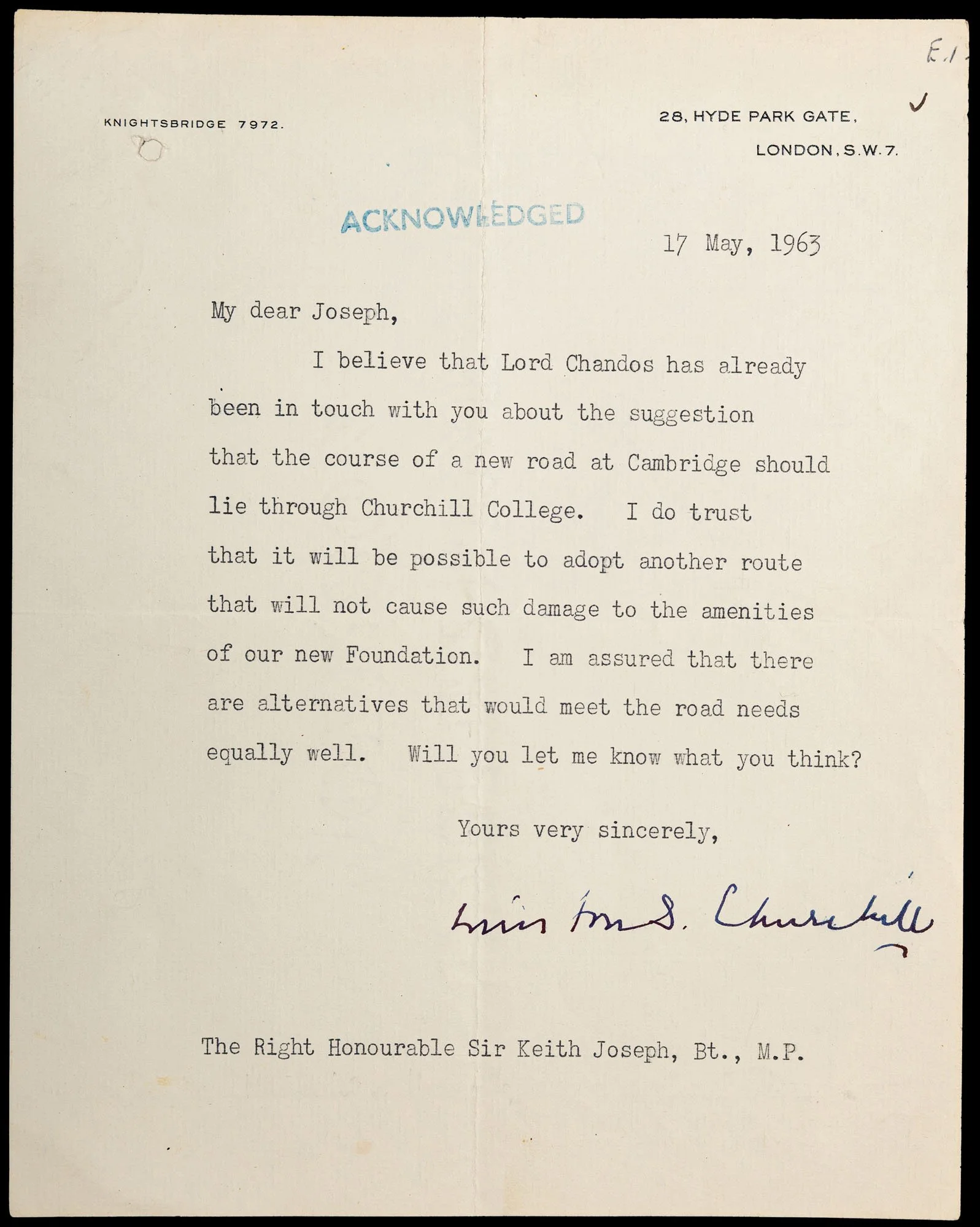
A typed letter signed by Winston S. Churchill, 17 May 1963, to Sir Keith Joseph, Minister of Housing, opposing a proposed road through the grounds of Churchill College, Cambridge, the institution founded in 1958 as his living memorial. Churchill writes:
"I do trust that it will be possible to adopt another route that will not cause such damage to the amenities of our new Foundation. I am assured that there are alternatives that would meet the road needs equally well."
Churchill had taken a close interest in the college's creation, envisioning a modern Cambridge foundation with particular emphasis on science and technology, and the proposed road threatened its setting in its formative years. Joseph replied on 19 June, acknowledging the concerns and undertaking to consider alternatives; no such road was built.
Written two years before his death, this is one of Churchill's last interventions in public affairs — the elder statesman engaged not in war or politics but in the preservation of the institution bearing his name.
Single sheet, 242 x 191 mm, typed on the printed letterhead of 28 Hyde Park Gate, London, signed Winston S. Churchill. Blue Acknowledged stamp at head, punched filing hole to inner margin, horizontal folds and light toning; very good overall.
Provenance: Paul C. Richards, Templeton, Massachusetts; his catalog, 1983, item 162.
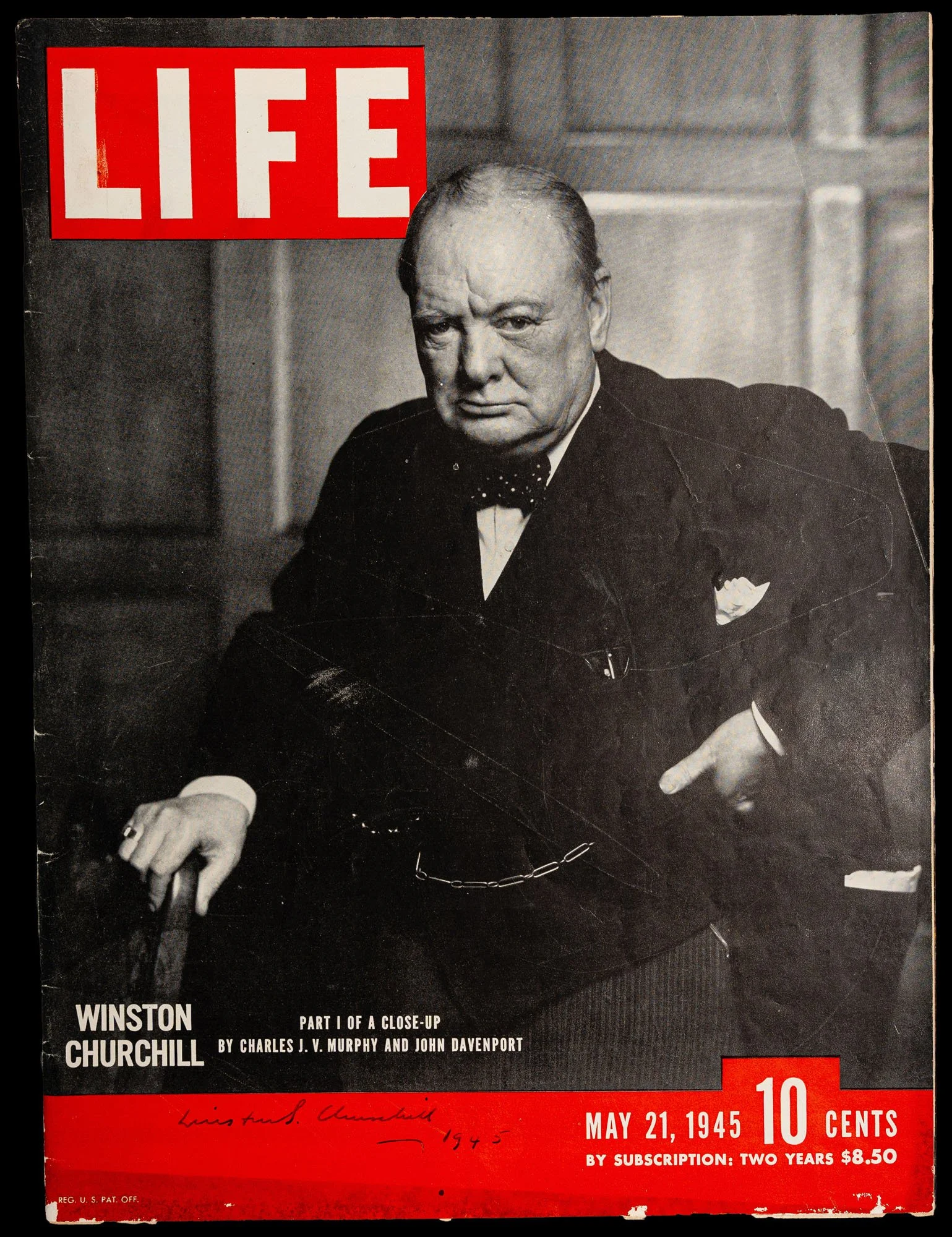
A copy of Life magazine for 21 May 1945, published in the week following victory in Europe, signed boldly in ink on the lower cover, Winston S Churchill 1945. The date in Churchill's hand anchors the autograph to the very moment the publication commemorates: Churchill at the height of his authority.
The cover carries Yousuf Karsh's celebrated 1941 portrait, later known as The Roaring Lion, taken moments after Churchill's address to the Canadian Parliament. By Karsh's own account, he plucked the cigar from Churchill's mouth just before releasing the shutter, provoking the defiant glare that became one of the enduring images of the Second World War.
Signed copies of this issue are rare, and examples dated contemporaneously in 1945 are particularly desirable. Image, authorship and moment meet in a single object of wartime memory.
Condition: Folio format with original printed wrappers; light wear to edges and surface consistent with age, minor creasing and handling marks, overall very good.
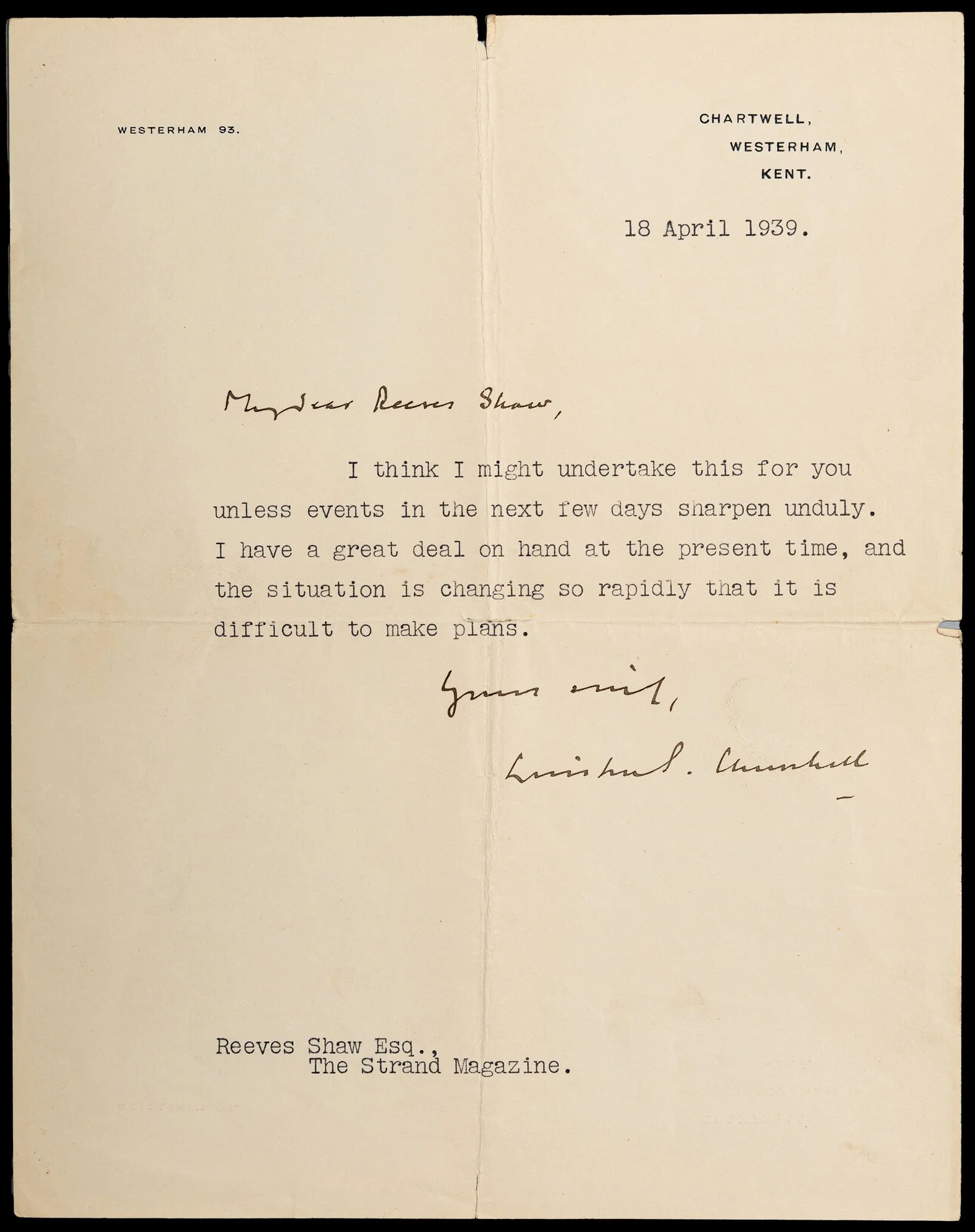
A typed letter signed by Winston S. Churchill on Chartwell letterhead, 18 April 1939, to Reeves Shaw, editor of The Strand Magazine, concerning a proposed article on Anthony Eden. Churchill writes: "I think I might undertake this for you unless events in the next few days sharpen unduly. I have a great deal on hand at the present time, and the situation is changing so rapidly that it is difficult to make plans."
The hesitation was warranted. Franco had declared victory in Spain on 1 April, Mussolini invaded Albania on the 7th, Britain introduced conscription within the month, and Hitler was about to repudiate the Anglo-German Naval Agreement. Shaw's invitation of 6 April had asked for "a frank character study of Mr. Anthony Eden," conceding the subject might present "embarrassments" (Churchill Archives Center, CHAR 8/624), and proposed £250 for some 3,000 words; Eden had resigned as Foreign Secretary in February 1938 in protest at appeasement, making any candid assessment by his closest political ally a delicate commission.
Churchill accepted, and the article appeared in the August 1939 Strand, weeks before the outbreak of war. In it he reported that Americans saw Eden as "the young Sir Galahad, who stood for the great causes of freedom and the maintenance of law against tyranny and aggression," and predicted, "it may well be that he will lead our country in days when leadership will ever more be needed." Eden served as Churchill's wartime Foreign Secretary and succeeded him as Prime Minister.
Single sheet, typed on one side with autograph salutation and signature. Central creases where folded, slight chips and short closed tears at fold ends, light toning; good overall.
Provenance: Sotheby's, 22 July 1982, lot 154.
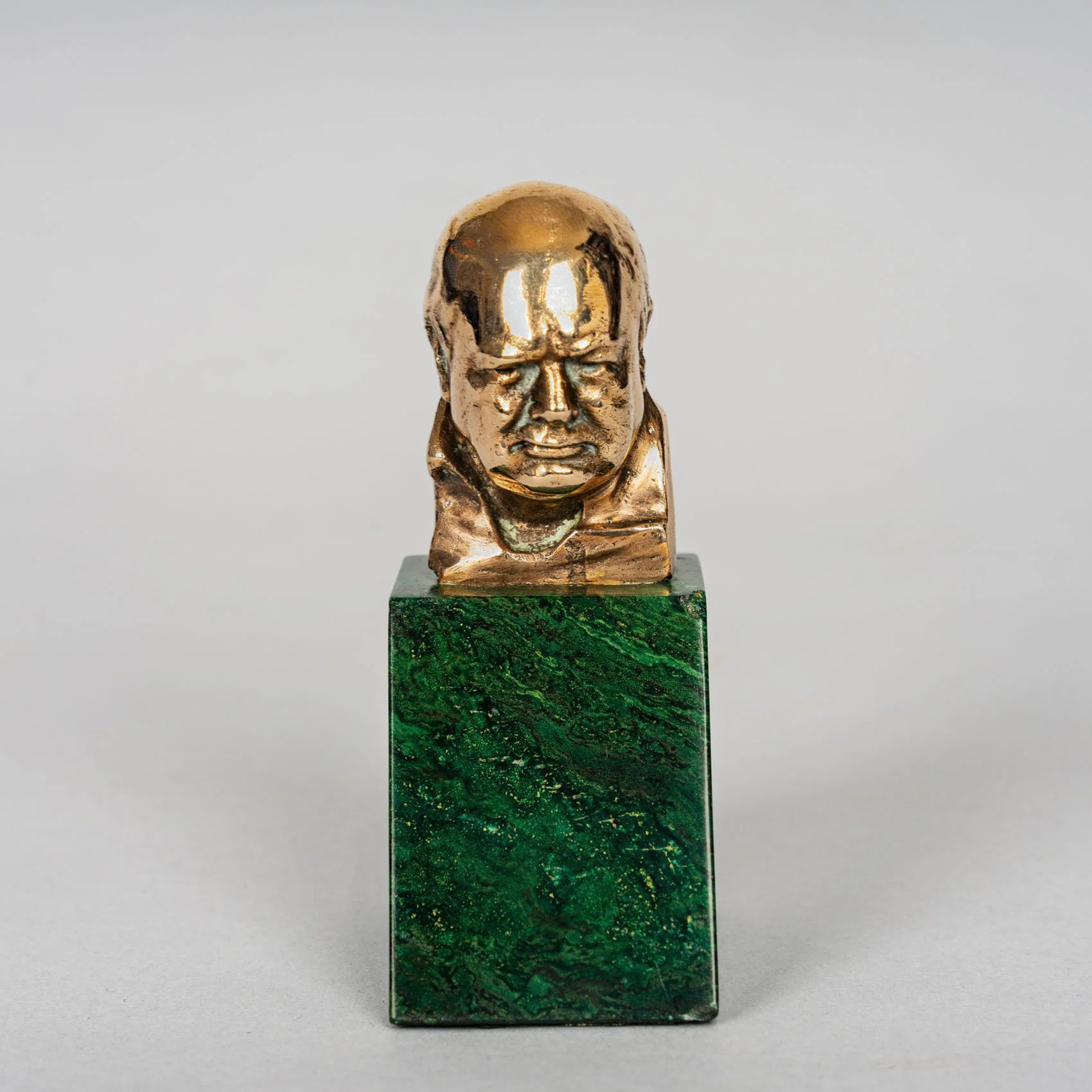
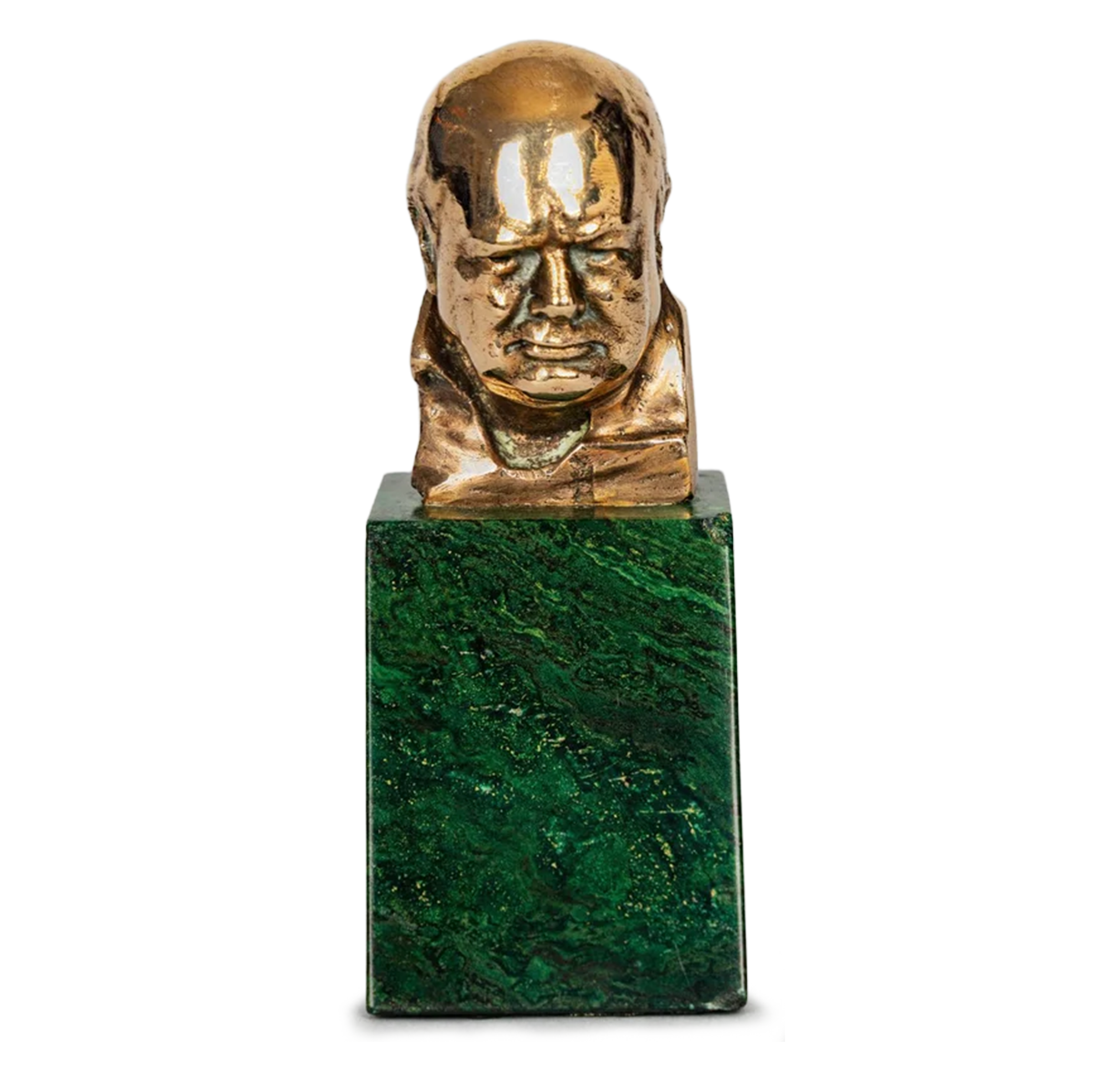
A rare solid gold miniature bust of Sir Winston Churchill by Oscar Nemon, signed NEMON, stamped for Asprey & Co. of Bond Street and mounted on a banded malachite plinth. Circa 1960.
Appointed Churchill's principal sculptor in 1951, Nemon was granted exceptional access to his sitter, and his work is widely considered the most psychologically accurate sculptural record of Churchill's later life. The present bust shows that mature understanding: modeled with bowed head, the heavy-lidded gaze, compressed mouth and weight of the brow convey not rhetoric but reflection. Where the monumental versions address the public figure, the reduced format emphasizes interiority — Churchill as a private presence.
The bust belongs to a small group of finely produced miniatures retailed by Asprey for a discerning clientele. Examples in silver are known; those in gold were made in extremely limited numbers, likely as presentation pieces, and are exceptionally rare. The warmth of the metal lends immediacy to the modeling, set against the richly veined malachite traditionally associated with diplomatic gifts. Objects uniting artist, sitter and retailer at this level are seldom encountered.
Height: 3.75 inches.
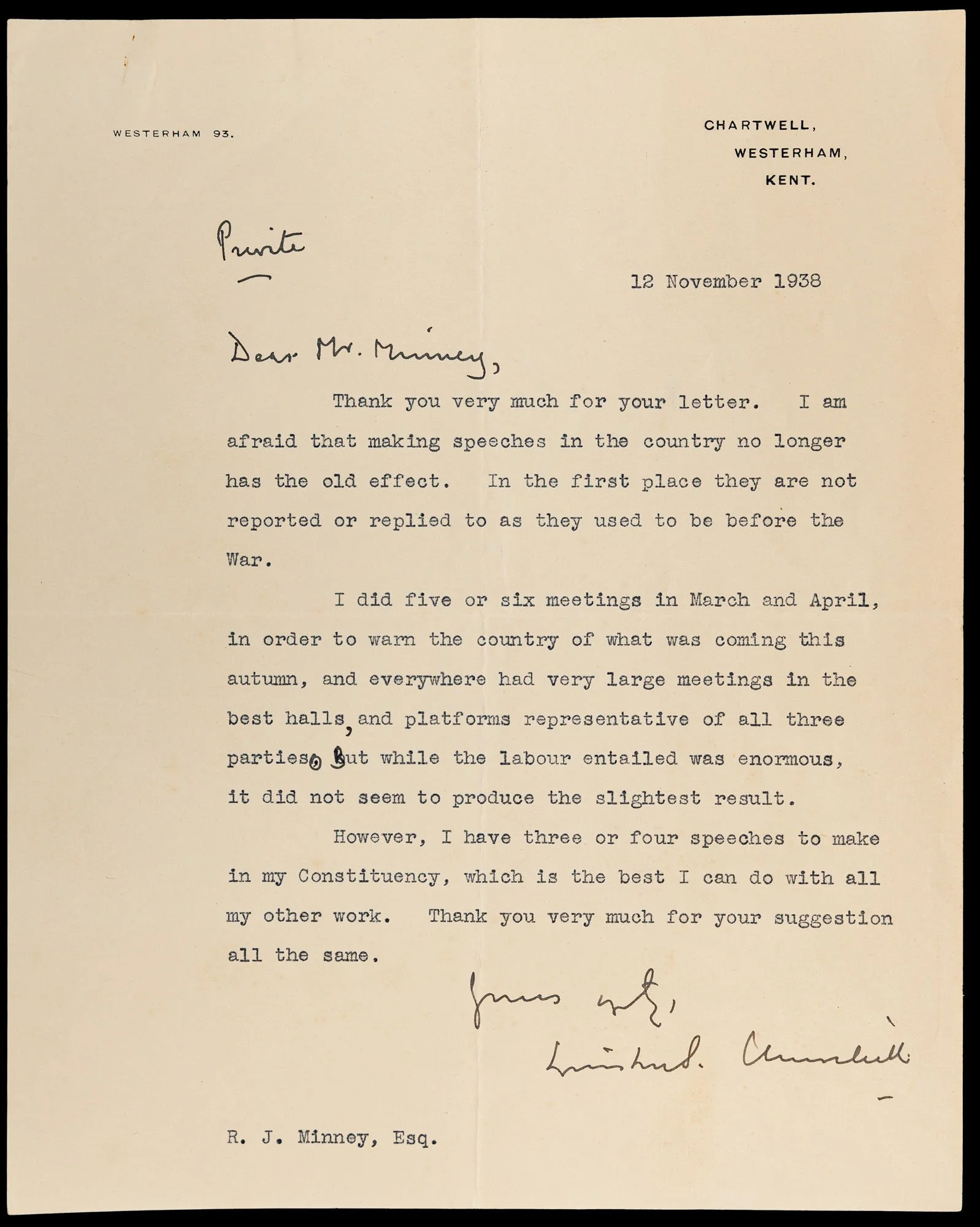
A typed letter signed by Winston S. Churchill on Chartwell letterhead, 12 November 1938, to the journalist R. J. Minney, with autograph salutation and signature, written six weeks after the Munich Agreement in the depth of the Wilderness Years. Minney had urged him to mount a speaking campaign in the manner of Gladstone to rouse the nation from its post-Munich complacency; Churchill replies with striking frankness: "I am afraid that making speeches in the country no longer has the old effect."
He explains that such speeches were no longer reported or debated as they had been before the First World War, and that earlier in the year he had already undertaken a series of meetings "to warn the country of what was coming," drawing large audiences and cross-party platforms, yet "while the labor entailed was enormous, it did not seem to produce the slightest result."
This is Churchill at the pivot of the pre-war years: out of office, accurate in his assessment of Hitler, unable to move Chamberlain's policy of appeasement, and confronting the failure of his own voice to carry. Minney's appeal of 11 November 1938 is included in a carbon copy.
Single sheet, typed on one side; central folds, light toning, faint paperclip impression at the head; the carbon with paperclip rust mark and minor edge wear; very good overall.
Provenance: Sotheby's, 22 July 1982, lot 153.
Literature: Quoted in Martin Gilbert, Winston Churchill, vol. V (1976), p. 1019.

A vintage silver gelatin print of Yousuf Karsh's portrait of Sir Winston Churchill, signed in pencil by Karsh at the lower left of the print margin, with the photographer's Karsh, Ottawa copyright stamp at the lower right of the image, and signed "Winston S. Churchill" and dated 1954 in ink by Churchill on the mount below.
The portrait was taken in the Speaker's Chamber of the Canadian Parliament in Ottawa on December 30, 1941, minutes after Churchill's "Some chicken! Some neck!" address to the House of Commons. Three weeks after Pearl Harbor, Churchill had crossed the Atlantic aboard the battleship HMS Duke of York to confer with President Roosevelt, spending Christmas at the White House before traveling north to address the Canadian Parliament. Karsh was granted two minutes with the Prime Minister, who arrived scowling, cigar in his teeth. Judging the cigar wrong for the occasion, Karsh plucked it from Churchill's mouth, and the glower that followed became the defining image of British defiance in the Second World War. Churchill, his mood turning as quickly as it had darkened, told the photographer he could make a roaring lion stand still to be photographed, and the portrait has carried the name ever since.
Churchill signed and dated this print in 1954, during his final visit to Canada as Prime Minister. Examples of The Roaring Lion bearing the signatures of both photographer and sitter are of the greatest rarity.
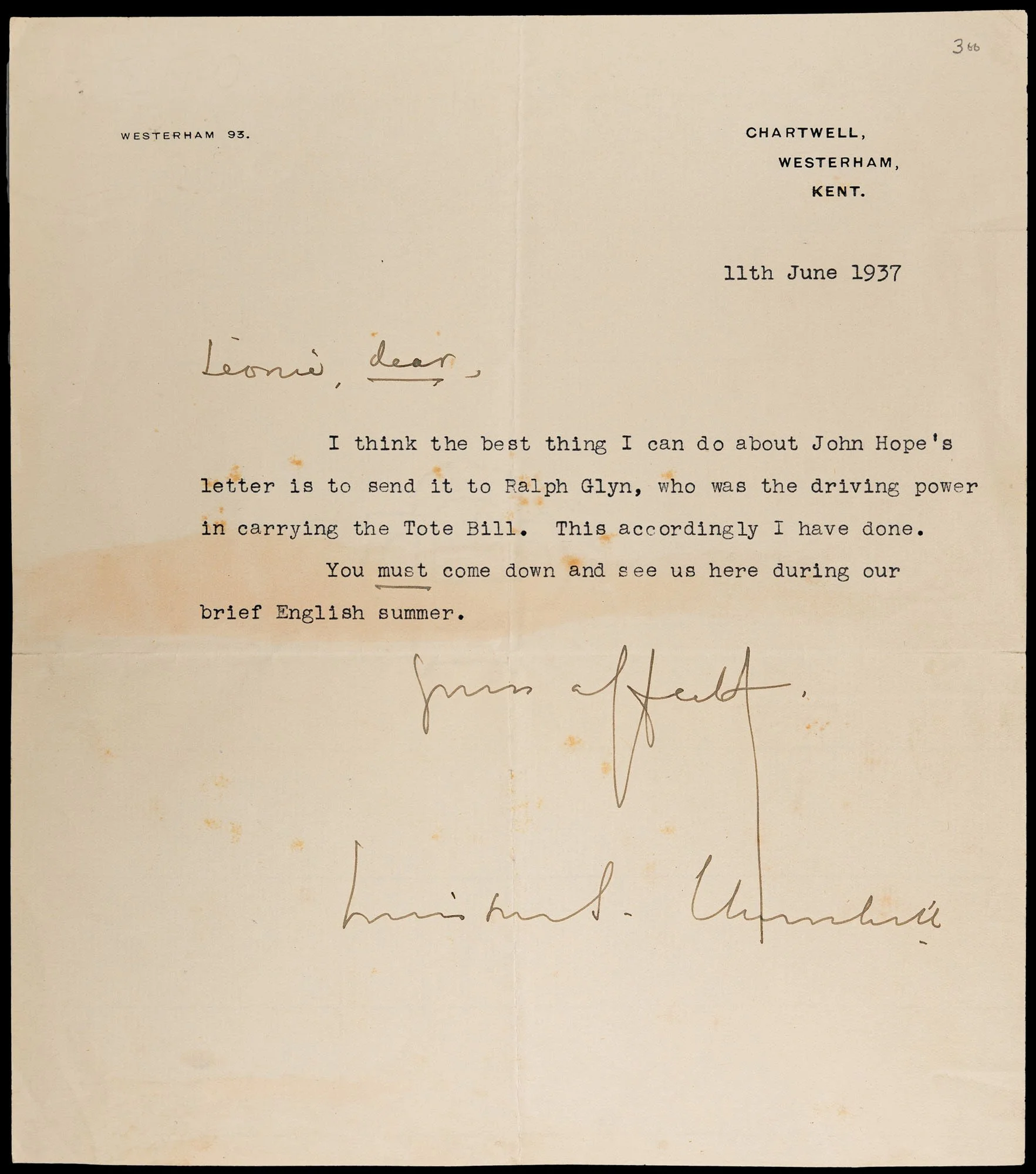
A typed letter signed by Winston S. Churchill to his aunt Leonie, Lady Leslie, on printed Chartwell letterhead, 11 June 1937, with autograph salutation and closing. Churchill writes:
"Leonie, dear, I think the best thing I can do about John Hope's letter is to send it to Ralph Glyn, who was the driving power in carrying the Tote Bill. Accordingly, I have done this. You must come down and see us here during our brief English summer."
He signs "Yours affectionately, Winston S. Churchill," the signature unusually large and expansive, and underlines "dear" and "must" by hand — the intimacy of tone rarely found in his formal correspondence. In contrast to his distant relationship with his parents, Churchill was close to his aunt all his life; she had played a near-maternal role in his youth and remained a trusted figure to the end.
The Tote was the legalized pari-mutuel betting system established under the Racecourse Betting Act 1928, and Ralph Glyn had been instrumental in carrying the legislation through Parliament; John Hope was the son of Victor Hope, 2nd Marquess of Linlithgow. On the same day, Churchill wrote separately to Glyn forwarding the complaint: "I know nothing of the merits of the enclosed, but when I recall the fact that but for you there would be no Tote, I feel it is a matter in which you might be interested" (Churchill Archives Center, CHAR 2/296A–B). Glyn replied that he would make inquiries.
One page, folded for mailing, a few light spots and minor handling marks.
Provenance: Private collection.
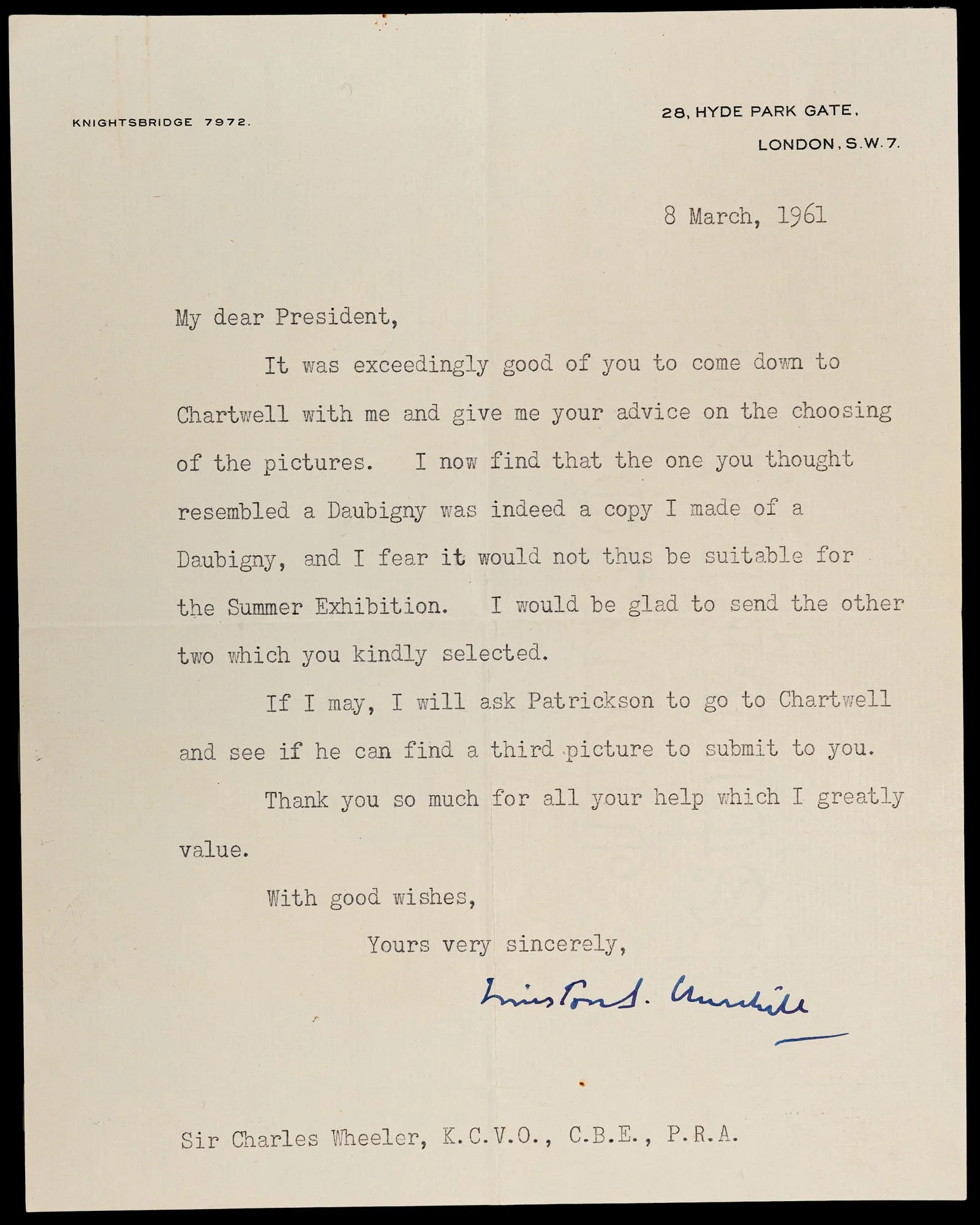
A typed letter signed by Winston S. Churchill, dated 8 March 1961, to the sculptor Sir Charles Wheeler, then President of the Royal Academy, following Wheeler's visit to Chartwell to advise on paintings for the Summer Exhibition. With characteristic candor, Churchill explains that one of the works Wheeler admired, thought to resemble a Daubigny, was in fact Churchill's own copy of one:
"I now find that the one you thought resembled a Daubigny was indeed a copy I made of a Daubigny, and I fear it would not thus be suitable for the Summer Exhibition."
He proposes submitting the two remaining paintings Wheeler selected, and suggests a third might be found at Chartwell with the help of his staff.
Churchill began painting in 1915 and remained devoted to it for the rest of his life. Elected Honorary Academician Extraordinary in 1948, he exhibited regularly thereafter, and by 1961 his paintings were recognized as integral to his private world. His refusal here to submit a copy shows the artistic conscience of the distinguished amateur, applied to his own work without ceremony.
Single sheet, 241 x 191 mm, typed on the printed letterhead of 28 Hyde Park Gate, London, signed in blue ink. Minor paperclip impression at the head and light handling creases; excellent overall.
Provenance: Paul C. Richards, Templeton, Massachusetts, 1984 (with original slip noting Item 109); possibly from the group of Churchill letters to Wheeler sold at Christie's, 28 March 1984, lot 32.

CHURCHILL, Sir Winston S. (1874–1965)
Typed Letter Signed, with Presentation Cigar
Chartwell, Westerham, Kent, 8 August 1951
A highly engaging and intimate letter from Sir Winston Churchill, offering a rare glimpse into his private life at Chartwell, accompanied by an exceptional associated relic.
Typed letter signed (“Winston S. Churchill”), two pages, 4to, on Chartwell headed paper, dated August 1951, the typed date amended in Churchill’s hand with a manuscript “8”. The letter is addressed to R. J. Whitwell, a tropical fish breeder, and thanks him for a recent delivery of exotic fish, while discussing, in charming and unexpectedly domestic detail, their behaviour and care:
“The Siamese Fighters, Golly and Cleopatra, both had three days together, but she remained coy… I have therefore returned them to their separate apartments and will have another try soon.”
Churchill continues with practical inquiries regarding water conditions and notes, with characteristic humour, the rapid breeding of his fish:
“The Black Mollies are breeding at so great a rate… we shall soon have to move out on to the lawn.”
The letter also reflects Churchill’s sense of propriety, urging Whitwell to invoice him for the fish supplied. The text features a small manuscript correction by Churchill, amending a typed error in “Siamese”.
Accompanied by an unsmoked cigar personally given by Churchill to Whitwell during a visit to Chartwell, retained by the latter as a memento. The cigar—one of Churchill’s favoured La Aroma de Cuba—remains intact in its original wrapping and is presented in a contemporary felt-lined, glass-fronted mahogany display case.
Churchill’s well-documented enthusiasm for animals extended to an especially keen interest in fishkeeping. At Chartwell, he maintained ponds stocked with goldfish and golden orfe, and later, upon returning to office in 1951, installed multiple aquariums at Chequers. This letter vividly illustrates the statesman's passion, revealing a lighter, more personal dimension at the height of his post-war leadership and enduring partnership with the United States.
R. J. Whitwell operated a successful tropical fish business in West Bergholt from 1945, supplying both private and commercial clients, and evidently advising Churchill directly.
Provenance:
By family descent from R. J. Whitwell, accompanied by a signed letter from his nephew recounting Whitwell’s visit to Chartwell, where he was hosted overnight by Churchill and presented with the cigar “to smoke on the way home,” which he instead preserved. The present letter followed shortly thereafter, relating to a subsequent order of fish.

Early silver gelatin print, signed in white ink on recto.
He marched in scowling, and regarded my camera as he might regard the German enemy. His expression suited me perfectly, if I could capture it, but the cigar thrust between his teeth seemed somehow incompatible with such a solemn and formal occasion. Instinctively I removed the cigar. At this the Churchillian scowl deepened, the head was thrust forward belligerently, and the hand placed on the hip in an attitude of anger. So he stands in my portrait in what has always seemed to me the image of England in those years, defiant and unconquerable.
With a swift change of mood, he came towards me when I was finished, extending his hand and saying. “Well, you can certainly make a roaring lion stand still to be photographed”
Yousuf Karsh.
This photograph was taken at the Canadian House of Commons directly after sir Winston Churchill's famous speech “Some chicken…some neck”. Churchill’s stern demeanor also reflects the time in history. Pearl Habor had been bombed three weeks earlier on December 7th, 1941. Churchill immediately boarded a British destroyer and set sail for Washington D.C. Churchill spent Christmas with President Roosevelt and took two days out for a secret trip to address the Canadian government.

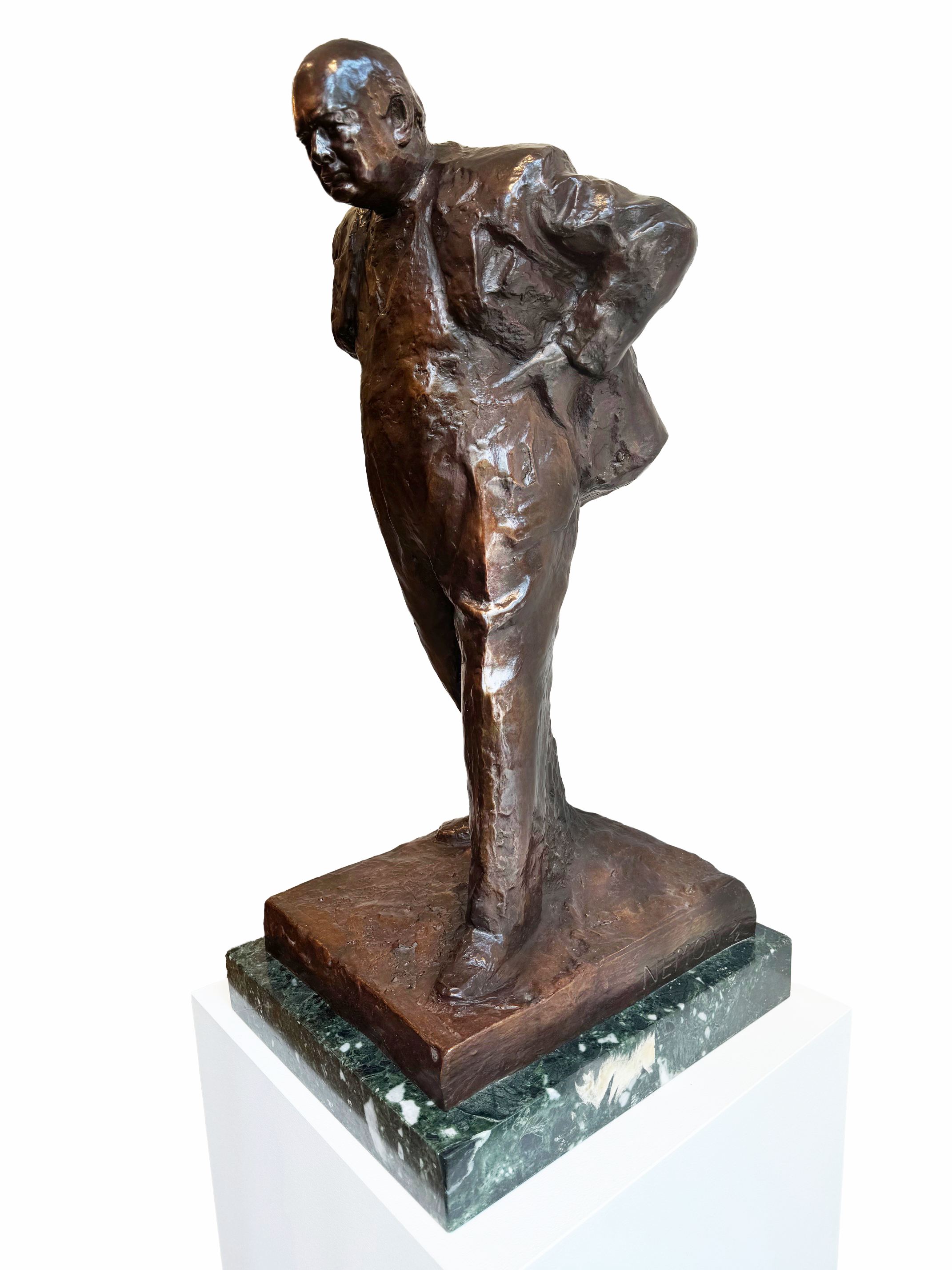
Sir Winston Churchill, A Bronze Maquette For The Statue In The Members Lobby in The Houses of Parliament. By Oscar Nemon 1906-1985.
Numbered 5/12.
By the Morris Singer Foundry.
The present work is a scale model of the monumental and imposing sculpture of Britain's greatest statesman, Sir Winston Churchill, which currently resides in the Member’s Lobby in the Houses of Parliament. The two main doors of the Lobby are winged by sculptures of four British prime ministers, Clement Atlee and Margaret Thatcher and outside what is now called the Churchill Arch, are the ministers who led Britain through each of the World Wars, Churchill and David Lloyd George. The arch was significantly damaged during the Second World War, and when it was rebuilt Churchill instructed that it retain some of the bomb damaged stones, as a testament to the conflict. It is perhaps no surprise then that when Oscar Nemon was chosen to produce a portrait of Churchill to stand alongside David Lloyd George, he chose to depict the great man with his hand on his hips, assessing the damage as he strode through London’s Blitz torn landscape.
Oscar Nemon had first met Churchill on a trip to Marrakesh, where he had travelled to visit a friend. In an unpublished memoir, Nemon recalls how he first encountered Churchill at the dining room of the hotel in which he was staying. Afraid
of approaching him, Nemon studied the hero of the Second World War from across the room, making mental notes so that he could work on a small bust in his room. When Clementine Churchill, Winston’s wife, was alerted to this, she had the artist send the bust over to their party; she found the result so impressive that she wrote to the artist asking to keep it. It should not, she requested, be altered as she had “seen so many portraits and busts spoilt by attempting to get an exact likeness. Your bust represents to me my husband as I see him and as I think of him, and I would like to have it just as it is”.
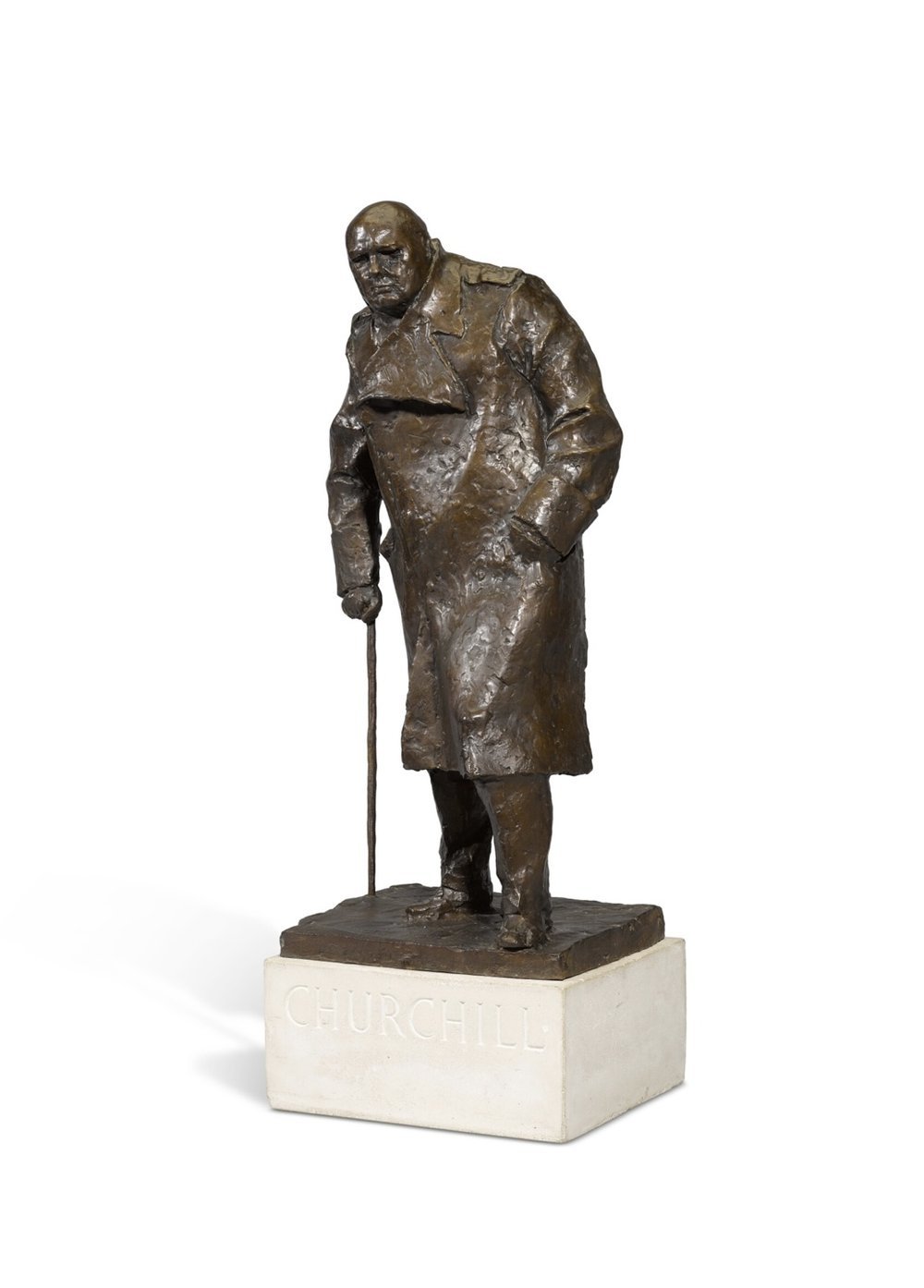
Sir Winston Churchill By Ivor Roberts-Jones RA.
Ivor Roberts-Jones, R.A.
1913-1996
Sir Winston Churchill, Maquette for the Monument in Parliament Square, Cast 1971.
Ivor Roberts-Jones’ most iconic work is the monumental sculpture of Winston Churchill which currently stands in Parliament Square. The work was commissioned in 1971, and this bronze was a maquette for this piece. Eight sculptors were asked to submit their designs for a committee to review. After a few suggested amendments to the initial design, the committee unanimously awarded the commission to Ivor Roberts-Jones.
A powerful bronze portrait of Sir Winston Churchill by Sir William Reid Dick, one of the foremost British sculptors of the twentieth century, taken from the life study he modeled in 1942, and signed and dated on the reverse of the neck. Height 11 inches, dark green patina, on an integral square bronze plinth.
The portrait was commissioned by the Royal Academy from Reid Dick in 1942, at the height of the Second World War. Churchill, consumed by the direction of the war, was reluctant to spare the hours a sitting required, and by tradition agreed to sit only after the personal intervention of King George VI. The result is a likeness drawn from life at the very moment of Churchill's wartime leadership, the heavy features and set mouth recorded with the directness that was Reid Dick's hallmark as a portraitist.
Reid Dick models the Prime Minister without flattery or rhetorical softening. The head is bare and frontal, the brow heavy, the jaw and jowls fully described, the expression fixed in an attitude of resolve. There is no ornament, no gesture toward the swagger of official portraiture, only the weight of the man and the office he carried. The surface is worked freely, catching light across the modeled planes, and finished in a dark green patina.
Reid Dick stood at the center of British public sculpture between the wars and after. A Royal Academician from 1928, President of the Royal Society of British Sculptors, knighted in 1935, and appointed King's Sculptor in Ordinary for Scotland in 1938, he was entrusted with many of the nation's most prominent commissions, among them the recumbent effigies of George V and Queen Mary at Windsor, the lion of the Menin Gate at Ypres, the eagle of the Royal Air Force Memorial on the Victoria Embankment, and the equestrian Lady Godiva at Coventry. His best-known work in the United States stands in London's Grosvenor Square, the memorial statue of Franklin D. Roosevelt, unveiled in 1948 by Eleanor Roosevelt in the presence of King George VI. His portrait of Churchill belongs to this company, a life study of the wartime leader by the sculptor of choice to the crown.
Provenance: Private collection.
Condition: Very good overall. The bronze presents a dark green patina with natural verdigris to the recesses. The signature and date, W Reid Dick 1942, are clear and legible on the reverse of the neck. Minor wear consistent with age and handling. No restoration noted.