A typed letter signed by Winston S. Churchill to his aunt Leonie, Lady Leslie, on printed Chartwell letterhead, 11 June 1937, with autograph salutation and closing. Churchill writes:
"Leonie, dear, I think the best thing I can do about John Hope's letter is to send it to Ralph Glyn, who was the driving power in carrying the Tote Bill. Accordingly, I have done this. You must come down and see us here during our brief English summer."
He signs "Yours affectionately, Winston S. Churchill," the signature unusually large and expansive, and underlines "dear" and "must" by hand — the intimacy of tone rarely found in his formal correspondence. In contrast to his distant relationship with his parents, Churchill was close to his aunt all his life; she had played a near-maternal role in his youth and remained a trusted figure to the end.
The Tote was the legalized pari-mutuel betting system established under the Racecourse Betting Act 1928, and Ralph Glyn had been instrumental in carrying the legislation through Parliament; John Hope was the son of Victor Hope, 2nd Marquess of Linlithgow. On the same day, Churchill wrote separately to Glyn forwarding the complaint: "I know nothing of the merits of the enclosed, but when I recall the fact that but for you there would be no Tote, I feel it is a matter in which you might be interested" (Churchill Archives Center, CHAR 2/296A–B). Glyn replied that he would make inquiries.
One page, folded for mailing, a few light spots and minor handling marks.
Provenance: Private collection.
A typed letter signed by Winston S. Churchill to his aunt Leonie, Lady Leslie, on printed Chartwell letterhead, 11 June 1937, with autograph salutation and closing. Churchill writes:
"Leonie, dear, I think the best thing I can do about John Hope's letter is to send it to Ralph Glyn, who was the driving power in carrying the Tote Bill. Accordingly, I have done this. You must come down and see us here during our brief English summer."
He signs "Yours affectionately, Winston S. Churchill," the signature unusually large and expansive, and underlines "dear" and "must" by hand — the intimacy of tone rarely found in his formal correspondence. In contrast to his distant relationship with his parents, Churchill was close to his aunt all his life; she had played a near-maternal role in his youth and remained a trusted figure to the end.
The Tote was the legalized pari-mutuel betting system established under the Racecourse Betting Act 1928, and Ralph Glyn had been instrumental in carrying the legislation through Parliament; John Hope was the son of Victor Hope, 2nd Marquess of Linlithgow. On the same day, Churchill wrote separately to Glyn forwarding the complaint: "I know nothing of the merits of the enclosed, but when I recall the fact that but for you there would be no Tote, I feel it is a matter in which you might be interested" (Churchill Archives Center, CHAR 2/296A–B). Glyn replied that he would make inquiries.
One page, folded for mailing, a few light spots and minor handling marks.
Provenance: Private collection.

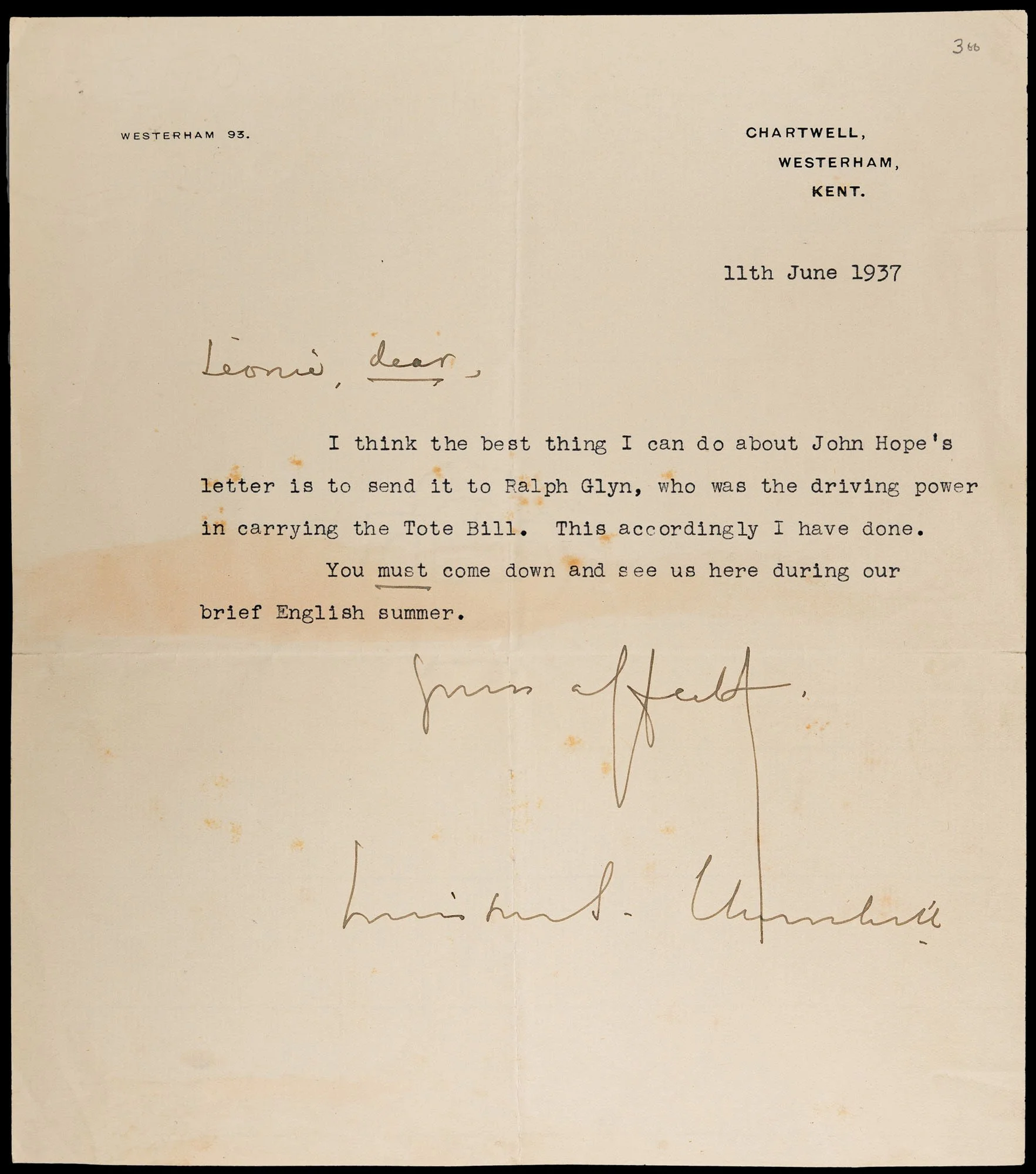 Image 1 of 1