

Sculptures & works of art
Sculpture & Works of Art
The sculpture collection at Daniels Antiques spans five centuries of European and American work. It begins in the Renaissance, with bronzes after Riccio and Tiziano Aspetti from the foundries of Padua and Venice, and a fire-gilt Mars made in Augsburg in the years of the Thirty Years' War.
From Rome comes the Grand Tour reduction trade at its most ambitious, a signed and dated Marcus Aurelius from the Hopfgarten foundry. The modern holdings center on Auguste Rodin, cast under the sculptor's own foundry contracts, with American historical bronzes by Gutzon Borglum and George Edwin Bissell, and portraits of Sir Winston Churchill in bronze, gold, and oil.
Every work is researched against the museum casts, foundry records, and published literature of its subject, and described with full provenance. Condition reports are available on request, and pieces may be viewed by appointment at our galleries in Aspen, Colorado, and Fort Lauderdale, Florida.
Daniels Antiques is always interested in acquiring fine sculpture, particularly Renaissance and Baroque bronzes, signed Grand Tour casts by Zoffoli, Righetti, and the Hopfgarten foundry, and documented casts of Rodin. Please contact us if you have a piece to sell.
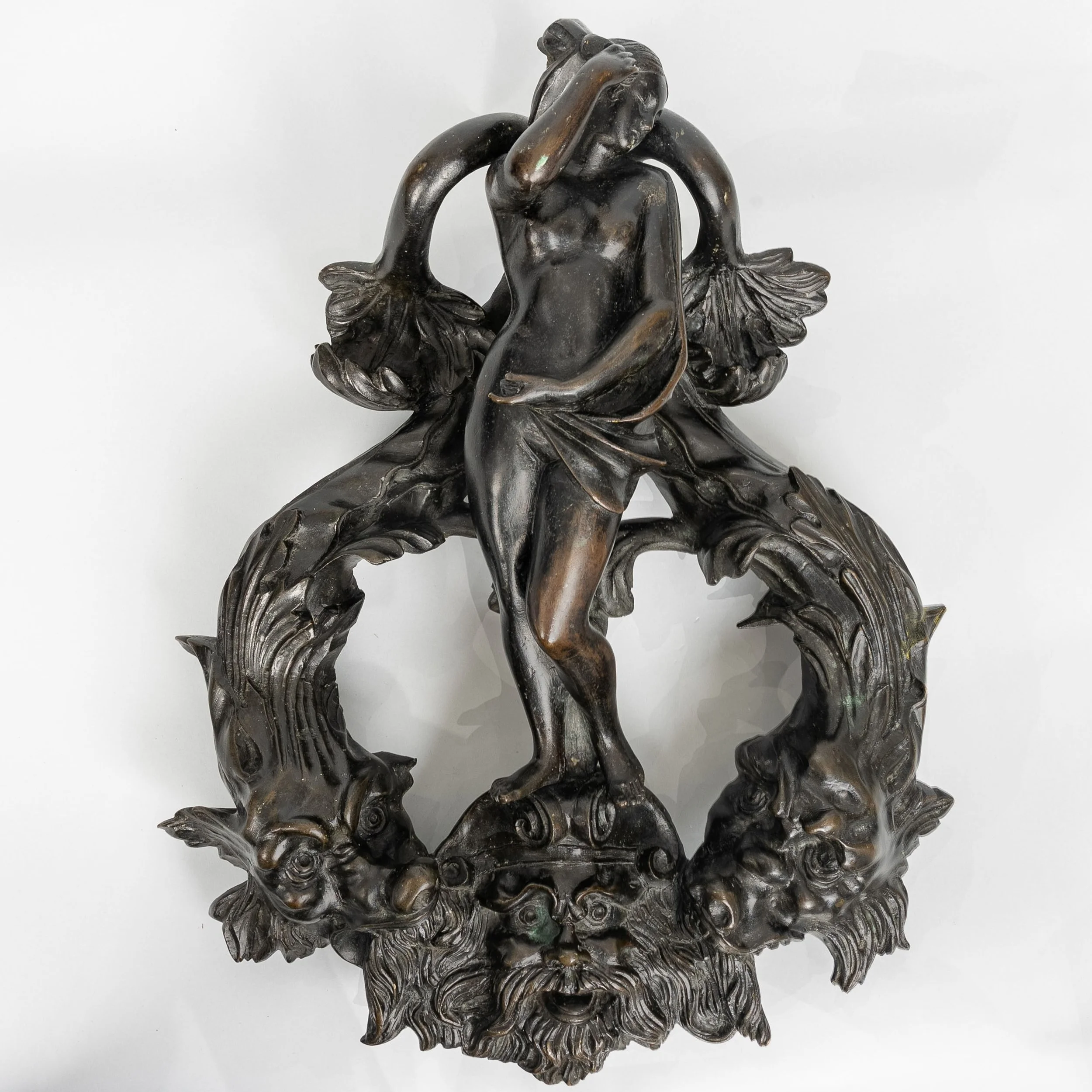
A large Italian bronze door knocker, or battente, of Venus Anadyomene, after a model of circa 1600, probably Venetian. The goddess is modeled fully in the round, one hand raised to her hair as she rises from the sea, drapery gathered at her hips, standing on a scrolled console above a bearded mask of Oceanus. Two dolphins rise at her sides, their arched bodies forming the loop of the knocker and their tails breaking into acanthus. Measuring 17 1/2 inches high by 14 inches wide and weighing approximately 38 pounds, it is a piece of sculpture that has spent its life on a door.
The construction is that of the earliest examples of the type. Figure and frame were cast together in a single, thick-walled pour by the lost-wax process, with the interior left open and irregular. The forged iron striker was set into the mould and the bronze poured around it, so the knocker was conceived as a working object from the wax stage, and the striker head, forged square, has been rounded by years of use against the strike boss on the reverse. The chasing is selective in the seventeenth-century manner: the hair worked in fine detail, the fingers and toes finished down to their nails, other passages left as cast. The cast is, on the evidence of its construction, of the seventeenth or early eighteenth century.
The surface tells the same story. The black patina is rubbed through to a warm bronze exactly where hands have gripped it for generations, along the goddess's leg and on the noses of the dolphins, while the reverse carries the green corrosion and iron staining of long service out of doors. Traces of old door paint survive in the crevices of the pivot lugs, left by painters working around a knocker that was never taken down, and the pivot bolt was replaced later, as fittings on a door in daily use are.
A cast of this model hung on the doors of the Hotel Porges in Paris, the mansion built in 1892 for Jules Porges, the diamond magnate whose Kimberley mining company was absorbed into De Beers in the great amalgamation of 1889. The house was built to hold his collection, its gallery hung with Rembrandt, Rubens, Van Dyck and Frans Hals, with Renaissance bronzes and enamels beneath them, and it was on the doors of that house that Eugène Atget photographed the model around 1901, paired with a pendant Neptune on the opposite leaf. The type belongs to the great tradition of figural knockers made for Venetian palace doors in the decades around 1600, when the finest were treated as sculpture and passed among collections accordingly.
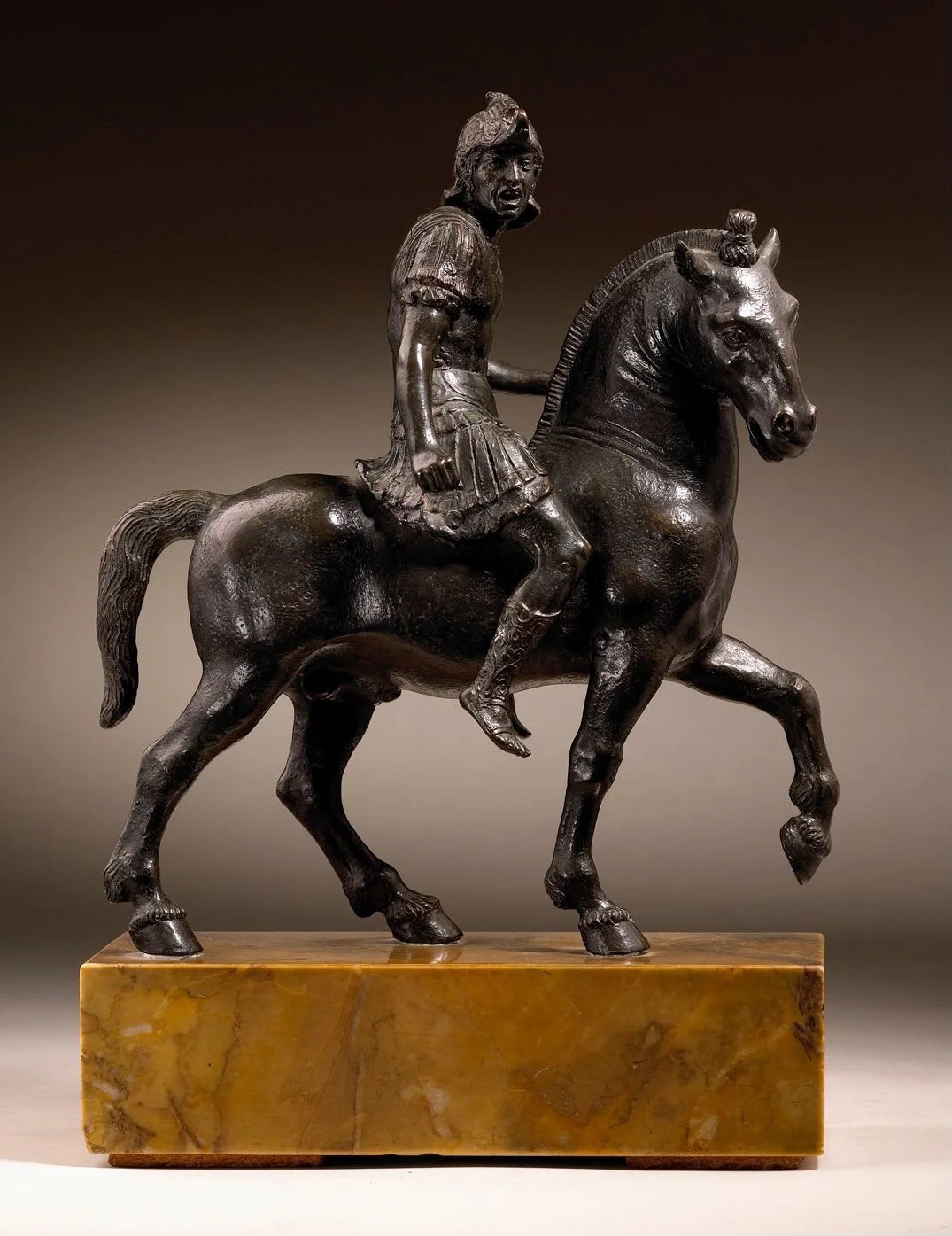
Among the small bronzes of the Italian Renaissance, few are as instantly recognizable as the Shouting Horseman. A warrior in classical armor sits a bare-backed, pacing horse, his head turned, his mouth open in a cry the sculptor never explains. He is caught in a single charged instant, and the interest is not power but life.
The original model is the work of Andrea Briosco, called Riccio, the Paduan master who did more than any other sculptor to make the bronze statuette a serious art form. Cast around 1510 for the private studies of Padua's humanist collectors, it was made by the direct lost-wax method, in which the wax original perishes in the casting, so only a single bronze from Riccio's own hand can exist. That cast passed through the collection of Frédéric Spitzer in Paris and, by the Salting bequest of 1910, into the Victoria and Albert Museum in London, where it remains. In the museum's view, it is the only cast from Riccio's hand, and the other known examples are casts of the rider taken from it, in all likelihood made while the bronze was in Spitzer's keeping in the later nineteenth century and set upon a variety of horses. It is through those casts that the shout has carried onto collectors' shelves across Europe. The present cast belonged to Sir Leon Bagrit, the industrialist and collector who delivered the 1964 Reith Lectures on automation.
The Present Cast
A bronze equestrian group of the Shouting Horseman after Riccio, the warrior in crested helmet and pleated tunic seated bareback and without reins upon a pacing horse, the off foreleg raised, the mane cropped to a standing crest with a bound topknot at the poll, his head turned and mouth open in a cry. The rider is a separate cast, secured to the horse at the skirt by three pins, as the rider casts made in Spitzer's keeping were set upon their horses. Cast in the nineteenth century, with a dark brown patina, raised on a veined Siena marble plinth, the underside with old labels including Trinity Fine Art no. 1412. The bronze 10¾ inches high, approximately 13 inches overall.
The final two photographs show, for reference, the original bronze as illustrated in the Spitzer sale catalog, Paris, 1893, lot 1454, before its entry into the Victoria and Albert Museum with the Salting Bequest in 1910, and the related cast formerly in the collection of Otto Beit, London, as published by Leo Planiscig, Andrea Riccio, Vienna, 1927, fig. 242.
Provenance
Sir Leon Bagrit (1902–1979), London, until 1979
Trinity Fine Art
Sotheby's, London, The Winter Collection, 10 December 2015, lot 1
Sources
Victoria and Albert Museum, London, the Shouting Horseman, Andrea Riccio, Padua, circa 1510, Salting Bequest, 1910.
Pomponius Gauricus, De Sculptura, Padua, 1504.
Daniels Antiques is always interested in acquiring Renaissance bronzes and later casts after the great models. Please contact us if you have a piece to sell.
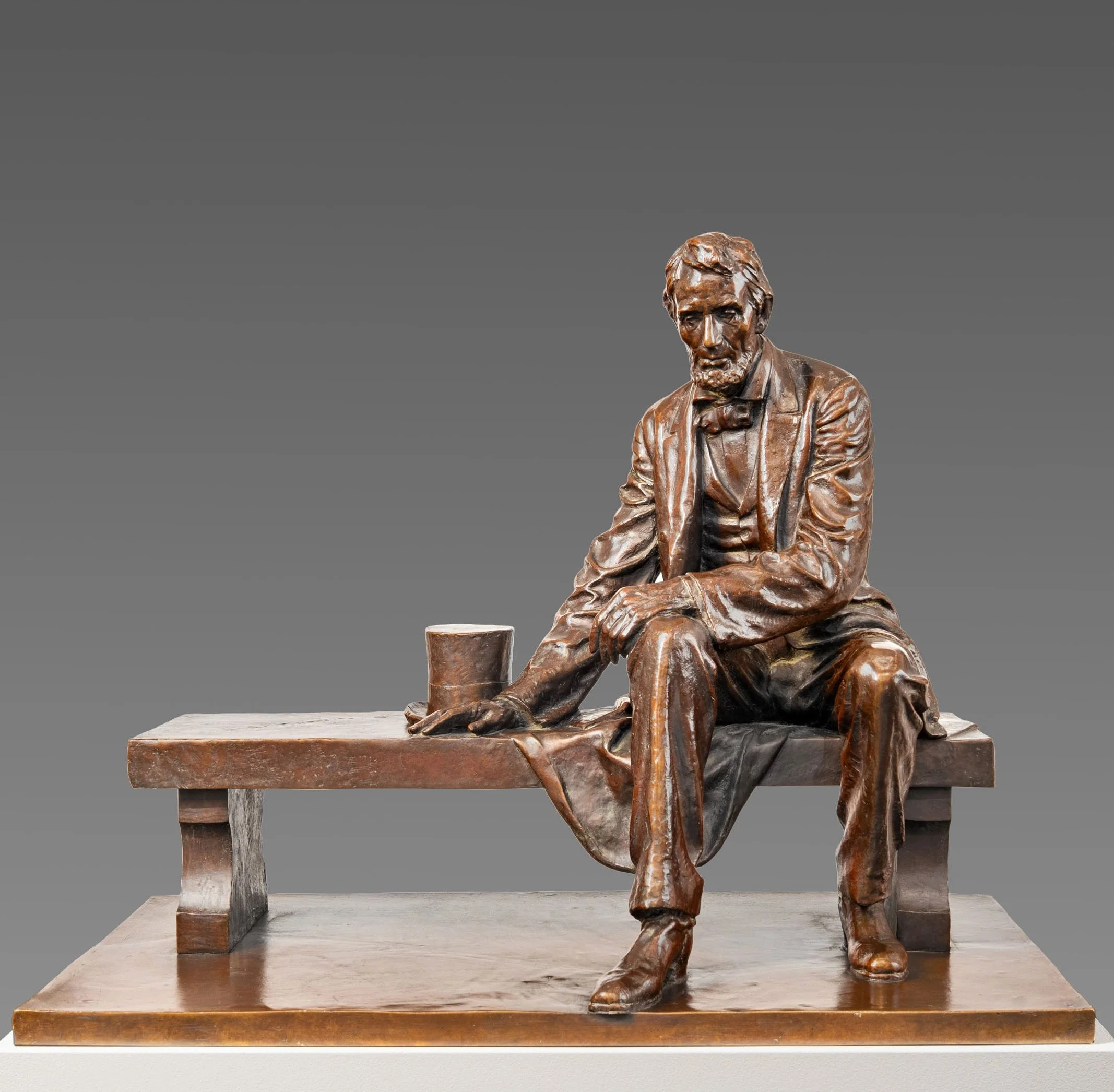
Abraham Lincoln, seated in thought, by Gutzon Borglum, the sculptor of Mount Rushmore. Cast by the Gorham Manufacturing Company, with the artist's incised signature on the bench top, the bronze stands 21 inches high, 29 inches wide, and 16 inches deep.
The composition reduces Borglum's Seated Lincoln of 1911, the life-size monument before the Essex County Courthouse in Newark, funded by a bequest of the merchant Amos Van Horn and unveiled by Theodore Roosevelt on Memorial Day of that year. Roosevelt's verdict, that it did not look like a monument at all, has been read as the highest praise ever since: Borglum had set the president on a bench at street level, and Newark has been sitting down beside him for over a century. Borglum authorized reductions of the composition, cast by Gorham for private collectors.
Unlike the heroic mode that defines Lincoln's public image, the work shows the president in private solitude. Borglum drew on accounts of Lincoln withdrawing to a garden bench through the darkest years of the Civil War, and the figure sits bareheaded, stovepipe hat set beside him, shoulders carrying a downward weight, head inclined over a lowered gaze, a man thinking, not performing. Borglum works here in the mode Rodin had made the sculptural language of the age, the seated figure turned entirely inward; where the Thinker is universal, Borglum's subject is particular and human. The debt was direct: trained in Paris at the Académie Julian, Borglum knew Rodin and kept the friendship until the older sculptor's death in 1917. The rich brown patina catches light across the coat folds and the planes of the face, lending warmth to a composition that depends on subtlety for its effect.
Borglum's engagement with Lincoln was lifelong. Of his marble head of 1908, carved from a three-foot block and now in the crypt of the United States Capitol, the president's son Robert Lincoln said, "I think it is the most extraordinarily good portrait of my father I have ever seen"; three decades later came the colossal Lincoln among the four presidents of Mount Rushmore. Seated Lincoln is the intimate counterpart to those undertakings, with Borglum as an interpreter of individual character rather than a carver of national symbols.
Provenance: Private collection, California.
Signed Gutzon Borglum, incised on the bench top; stamped GORHAM CO. FOUNDERS with casting number Q501 to the underside.
Condition: Very good; rich original brown patina throughout, minor wear consistent with age, no restorations noted.
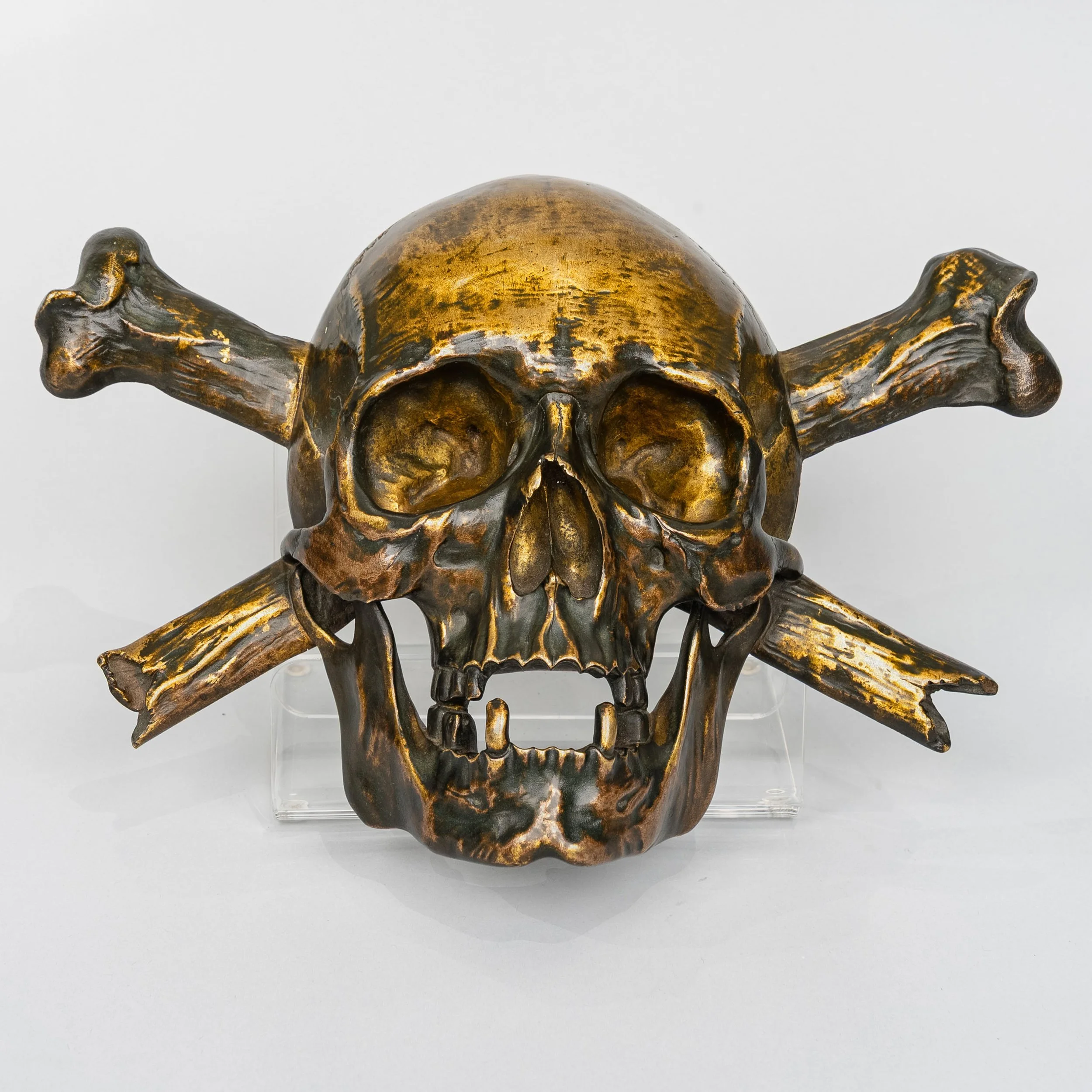
France, second half of the 19th century
Memento mori, remember that you must die, is among the oldest disciplines in Western art, and its purpose was never morbidity. Scholars kept a skull on the desk for the reason Jerome is painted with one, and fraternal orders seated initiates before this precise emblem in a chamber of reflection, where the point was not to frighten but to clarify. Marcus Aurelius, writing on campaign to no reader but himself, put the whole tradition into a line: soon thou wilt have forgotten all things, and soon all things will have forgotten thee.
Cast life-size, the skull is modeled with its jaw fallen open over two crossed long bones, their shafts deliberately broken and finished with splintered ends. The anatomy is observed rather than emblematic, the cranial sutures wandering across the dome as they do on a real specimen, and the gilding is concentrated on the raised surfaces, falling away into the hollows against the dark patina beneath. The bronze is sand cast, the reverse hollow and left as cast, with four integrally cast pads at the bone ends, dressed flat and tapped to take screws from behind; their irregular spacing shows the piece was fitted to one particular object rather than made to a repeatable pattern.
Condition: Sand-casting texture and minor surface irregularities consistent with period production. Gilding worn in the hollows and rubbed at the extremities. A later lead patch and wire have been applied to the reverse for wall hanging, an adaptation from a subsequent life; the four original fixing pads and their threads are intact and unaltered. No foundry mark.
Dimensions: Width 11½ in (29 cm), height 8 in (20 cm), depth 3 in (7.5 cm)
Provenance: French private collection
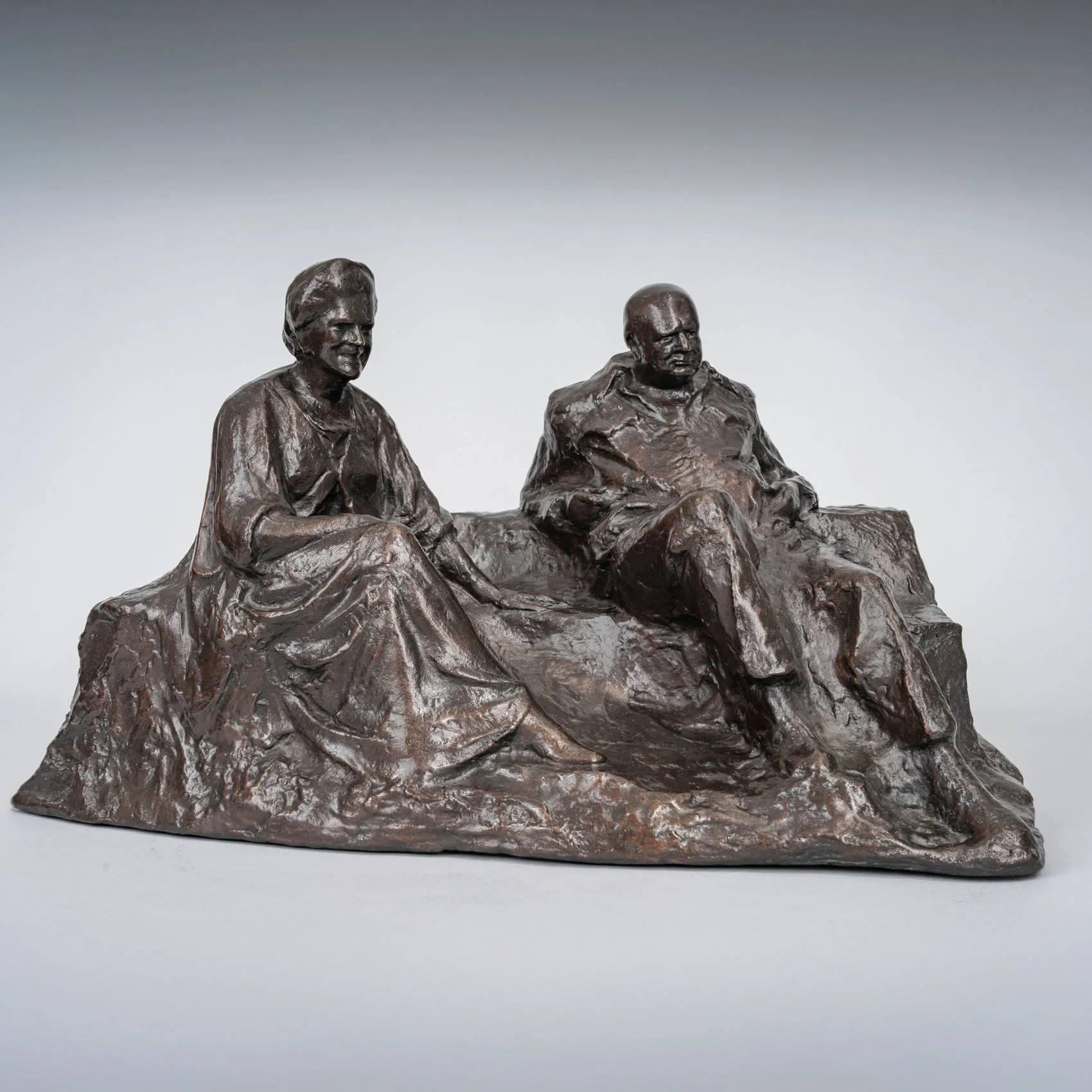
A bronze maquette by Oscar Nemon, Married Love, depicting Winston and Clementine Churchill, cast by the Morris Singer Foundry in a limited edition of 15 and numbered. This was the working model for the monumental sculpture at Chartwell, and so represents the most direct articulation of Nemon's original conception.
Among the most intimate sculptural interpretations of Churchill ever made, Married Love sets aside political authority in favor of companionship. Churchill sits beside Clementine in a composition of quiet balance, his grounded, introspective presence answered by her composed, stabilizing form; she is not secondary but integral, as she was in life. The bronze retains the immediacy of Nemon's modeling, the richly worked surface catching light across its planes, psychological depth taking precedence over formal idealization.
Nemon's association with Churchill began in Marrakesh in 1951, when he modeled the likeness from memory, and Clementine recognized it at once, opening the working relationship that produced the most authoritative sculptural records of Churchill's later life. A Croatian-born Jewish sculptor who lost twenty-two members of his family in the Holocaust, Nemon regarded his 1946 British naturalization as a debt of gratitude to Britain and its wartime leader, and that sincerity informs the work. His sculpture is held at the Guildhall, the House of Commons and Windsor Castle; within that body, Married Love is unique in presenting Churchill in a personal, relational context, and bronzes connected to the Chartwell monument are seldom encountered on the market.
Condition: Rich brown patina with expressive surface modeling; excellent overall. Mid-20th century.
Dimensions: 17” wide, 10” high, 10” deep
Literature: Oscar Nemon, unpublished memoirs and correspondence relating to Churchill's sittings; archival material relating to the Chartwell sculpture commission.
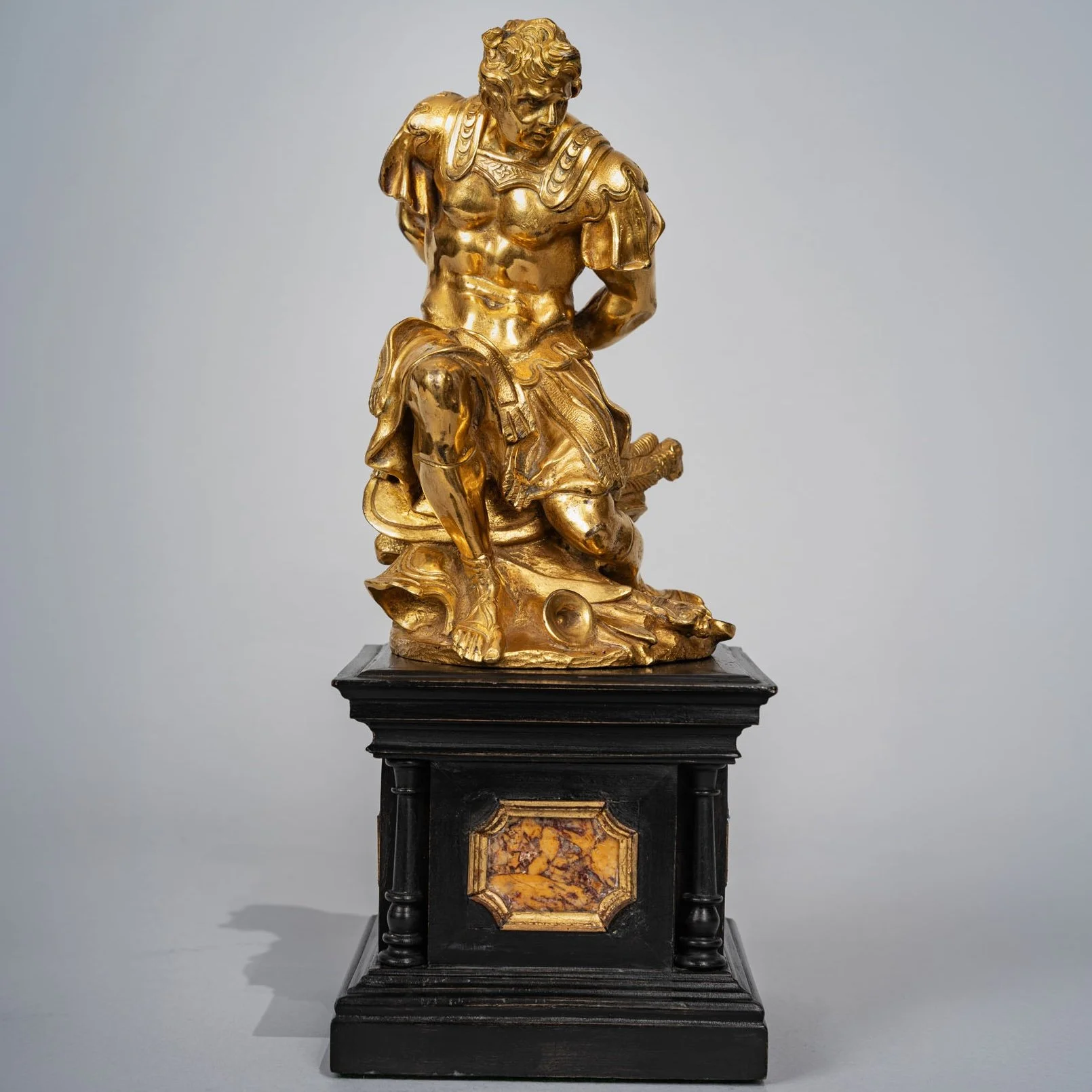
A fire-gilt bronze figure of Mars, the god of war, shown bound in chains and disarmed. The youthful, powerfully built god kneels on one knee upon his grounded arms, in a classical muscled cuirass with lappets at the shoulders and a pteruges skirt, his head turned down and to the side, his wrists fastened behind his back in finely wrought links. Around and beneath him lies the trophy of his weapons: a horn, a spear, a scabbard terminating in a scrolled chape, an oval shield with a lined border on which he partly rests, the doffed helmet, and the sword whose pommel is finished as a ram's head.
The subject is war restrained. The armor and attributes are the standard language of Mars in antiquity, as preserved in the life-size Roman stone statue of the god from Eboracum, now in the Yorkshire Museum, and the ram's-head pommel reinforces the identification, the ram being the animal of Aries, the god's own sign. What gives the group its meaning is that he is pressed down upon the very weapons he has surrendered, the helmet lifted from the head, the hands pinioned away from them. A Mars parted from his arms is an established emblem of peace.
That reading carries a particular weight here. The bronze was made in Augsburg in the first half of the 17th century, in the German lands that bore the worst of the Thirty Years' War. A god of war brought to his knees and bound upon his own arms, made in that place and at that moment, would have been understood not as a generic classical conceit but as peace longed for and war laid down. The heroic, idealized body argues for the god rather than a defeated mortal captive, though the pose plays knowingly on both readings.
The composition descends from the most famous seated Mars of antiquity, the Ludovisi Ares, the marble now in the Palazzo Altemps in Rome. Rediscovered in 1622 and restored by the young Bernini, it became the defining model of the war god in repose and was quickly copied in bronze reductions for collectors, so sculptors in the decades that followed would have known it well. The present figure belongs to that attribute-rich tradition rather than to the striding, stripped-down Mars of Giambologna, whose god carries nothing but his sword. Here the panoply is kept and set down, every piece rendered with care, and the god himself in chains upon it.
The bronze is a thin-walled lost-wax cast, worked directly in the wax, the gilding laid over a warm ground and now rubbed to a reddish underlayer on the high points through handling. It is raised on an ebonized wood socle with an inset giallo marble panel of the kind supplied for the cabinet of a serious collector. The definition of the hair, the chains, the chased scabbard, and the pommel is that of a fine metalworker, consistent with the goldsmiths' tradition of Augsburg, then the leading center of the craft in Europe.
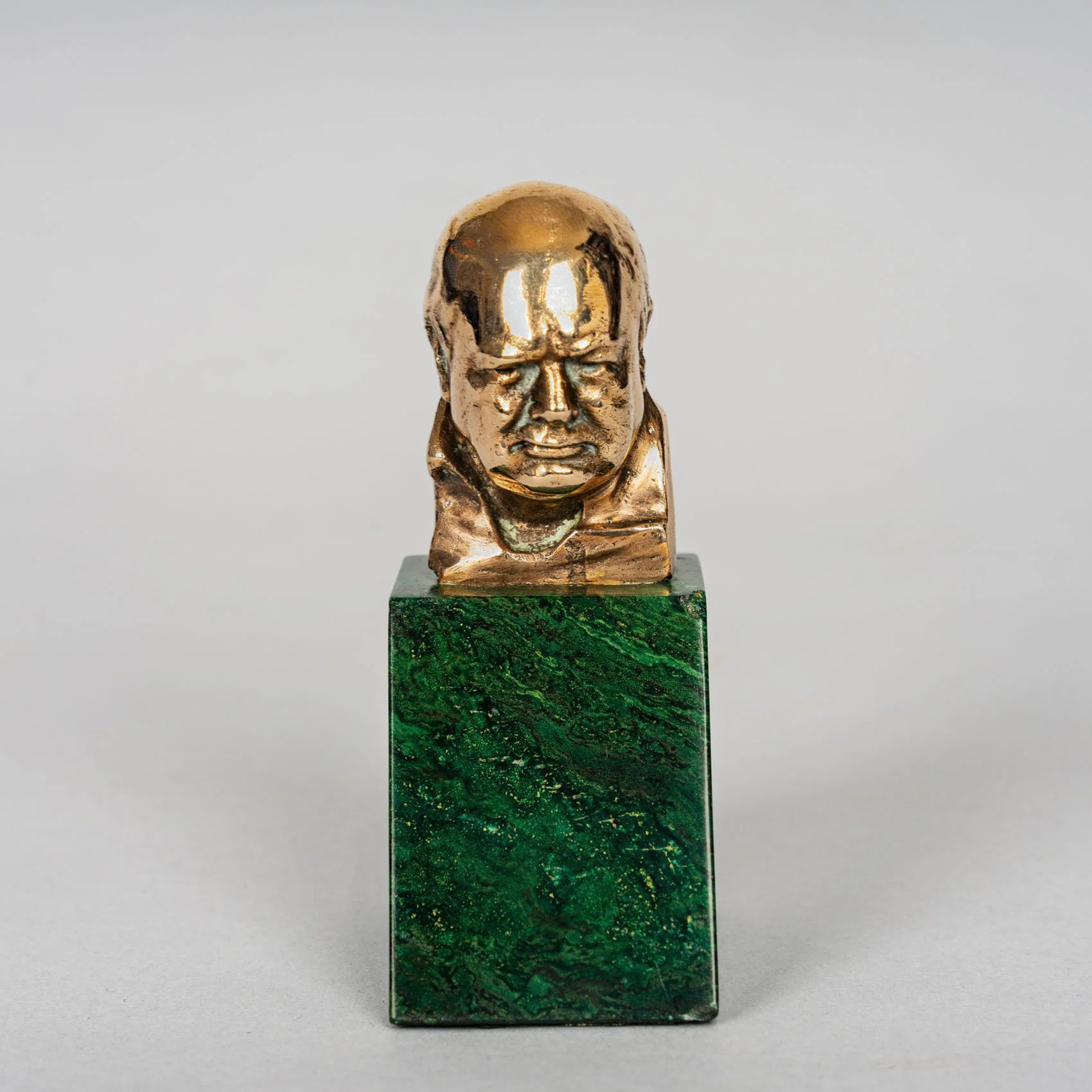
A rare solid gold miniature bust of Sir Winston Churchill by Oscar Nemon, signed NEMON, stamped for Asprey & Co. of Bond Street and mounted on a banded malachite plinth. Circa 1960.
Appointed Churchill's principal sculptor in 1951, Nemon was granted exceptional access to his sitter, and his work is widely considered the most psychologically accurate sculptural record of Churchill's later life. The present bust shows that mature understanding: modeled with bowed head, the heavy-lidded gaze, compressed mouth and weight of the brow convey not rhetoric but reflection. Where the monumental versions address the public figure, the reduced format emphasizes interiority — Churchill as a private presence.
The bust belongs to a small group of finely produced miniatures retailed by Asprey for a discerning clientele. Examples in silver are known; those in gold were made in extremely limited numbers, likely as presentation pieces, and are exceptionally rare. The warmth of the metal lends immediacy to the modeling, set against the richly veined malachite traditionally associated with diplomatic gifts. Objects uniting artist, sitter and retailer at this level are seldom encountered.
Height: 3.75 inches.
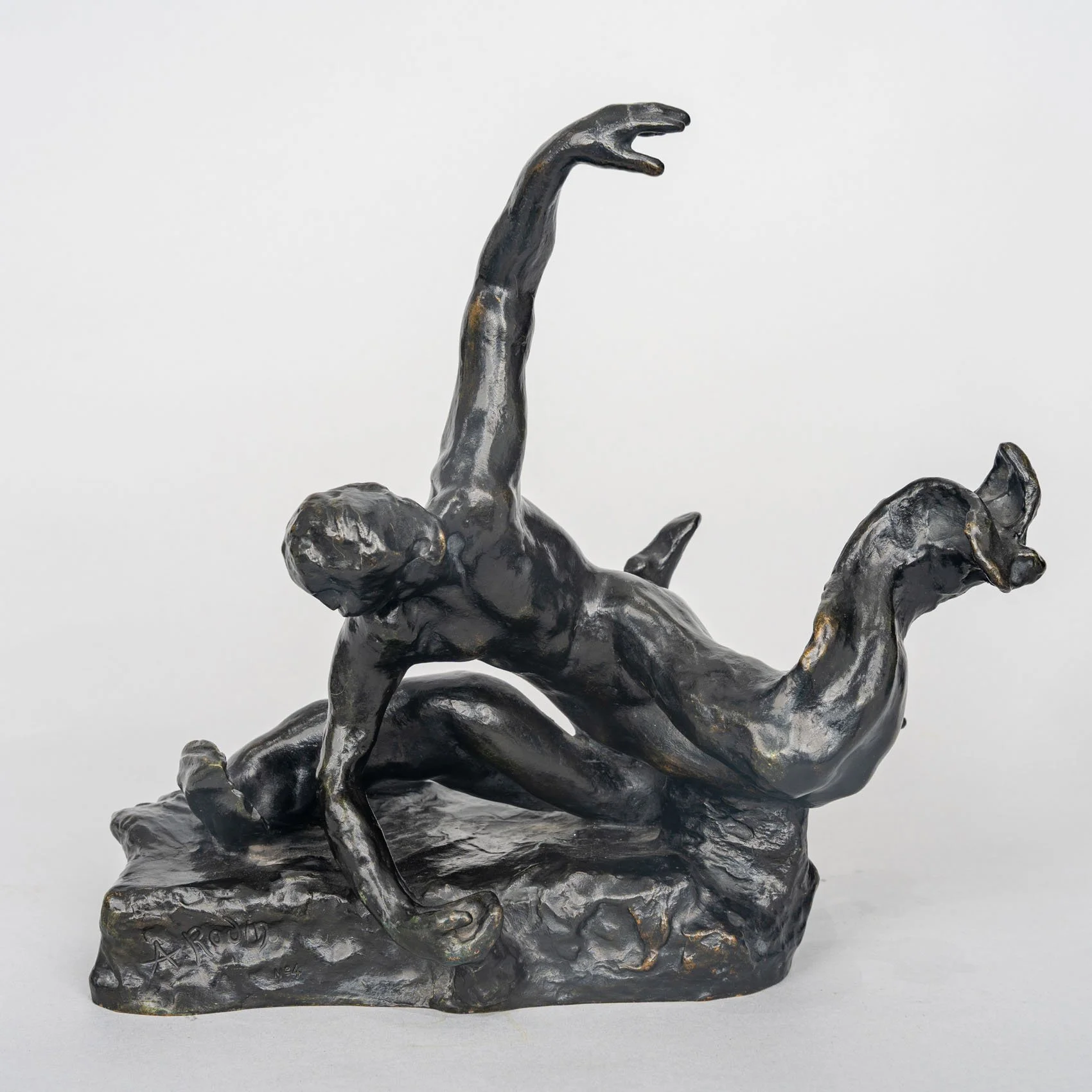
France, conceived circa 1902; cast 1969.
Auguste Rodin's Triton et Sirène presents a charged mythological encounter articulated through an intertwined and rhythmically complex composition. The figures are locked in a dynamic exchange, their bodies twisting and merging in a manner that dissolves narrative clarity in favor of sculptural tension and expressive force.
Conceived around 1902, the work belongs to a mature phase in Rodin's career when mythological subjects became vehicles for formal experimentation. Rather than adhering to classical idealization, Rodin renders Triton and the Siren with palpable physicality, emphasizing muscular strain, shifting contours, and tactile surface modeling. The composition reflects his ongoing investigation into fragmentation, movement, and the expressive autonomy of the human form.
In this sculpture, meaning emerges not through anecdotal storytelling but through the interaction of bodies in space. The figures appear simultaneously united and in conflict, embodying transformation, desire, and resistance, central themes in Rodin's late oeuvre.
The present bronze was cast in 1969 by Georges Rudier and is numbered 4. Casts by Georges Rudier are regarded for their fidelity to Rodin's original plasters and occupy a significant place within the artist's sculptural legacy.
Examples of Triton et Sirène are held in major institutional collections, including the Musée Rodin and the Cantor Arts Center, underscoring the importance of this composition within Rodin's body of work.
Height: 9¼ in (23.5 cm)
Literature
Antoinette Le Normand-Romain, The Bronzes of Rodin: Catalog of Works in the Musée Rodin, 2 vols., Paris, 2007.
Albert E. Elsen, Rodin's Art: The Rodin Collection of the Iris & B. Gerald Cantor Center for Visual Arts at Stanford University, New York, 2003.
Catherine Chevillot et al., Rodin: The Laboratory of Creation, Paris, 2014.
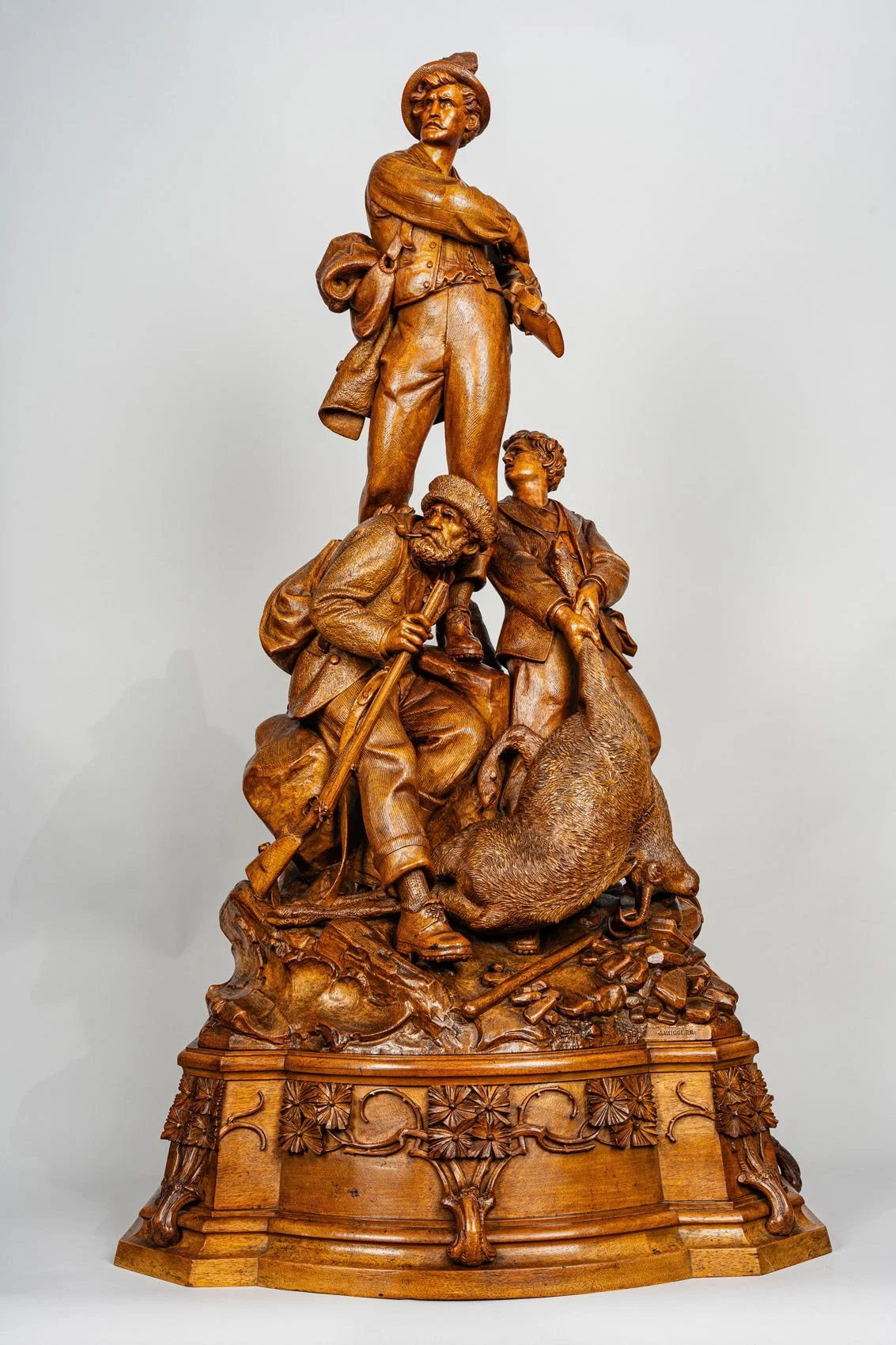
A monumental walnut group by Johann Huggler (1834–1912), the pre-eminent master of the Brienz carving tradition, conceived as a meditation on the three ages of man within an Alpine chamois hunt. It carries two forms of the master's signature: the stamped J. HUGGLER on the plinth edge, and his cursive autograph scratched into the underside of the base — a personal mark, distinct from the workshop stamp, that speaks to what this work meant to its maker.
The composition rises 48 inches as a vertical narrative. At the summit, a young hunter stands triumphant, arms crossed, feathered hat, game bag full of birds; below to the left an older bearded figure crouches with pipe and rifle, watching upward with a lifetime's experience; a second younger figure completes the generational triangle; and at the base the chamois lies fallen among rocks, scattered equipment and a carved woodcock. Each surface takes its own tool treatment — the knitted stocking of the elder's leg, the chamois fur, the feathers, the rock grain — and the carved rosette-and-scrollwork plinth signals exhibition-level ambition. The subject was personal: Huggler was known in Brienz not only as the master carver but as an unapologetic poacher, and he is believed to have cast himself and his companions in the group, the figures glancing outward with the alertness of hunters who remain aware of authority even in triumph.
The carving was purchased directly from the family firm, Huggler Huggler of Interlaken, on 14 March 1925 by Herr Walter Ords of Remscheid, and the original receipt survives with the work: catalog number H.H. 468, Jägergruppe 3 Jäger, 1,000 Swiss Francs, the Canton Bern revenue stamp intact. It then passed by descent through three generations of the same family — among the most complete provenances recorded for any Swiss Black Forest carving.
Huggler exhibited at the great international exhibitions, the Exposition Universelle in Paris and the World's Columbian Exposition of 1893, where Brienz work was judged not as craft but as sculpture. Large figural groups of this ambition, doubly signed and documented to the day of sale, stand at the summit of the tradition.
Condition: Very good for the scale and age; warm original patina, all figures complete and crisp, both signatures legible, minor wear consistent with age, no significant losses or restorations noted.
Provenance: Purchased from Huggler Huggler, Interlaken, by Walter Ords, Remscheid, 14 March 1925 (original receipt, H.H. 468); thence by direct descent through three generations.
Literature: Jay Arenski, Simon Daniels, and Michael Daniels, Swiss Carvings: The Art of the Black Forest, 1820–1940 (2006).
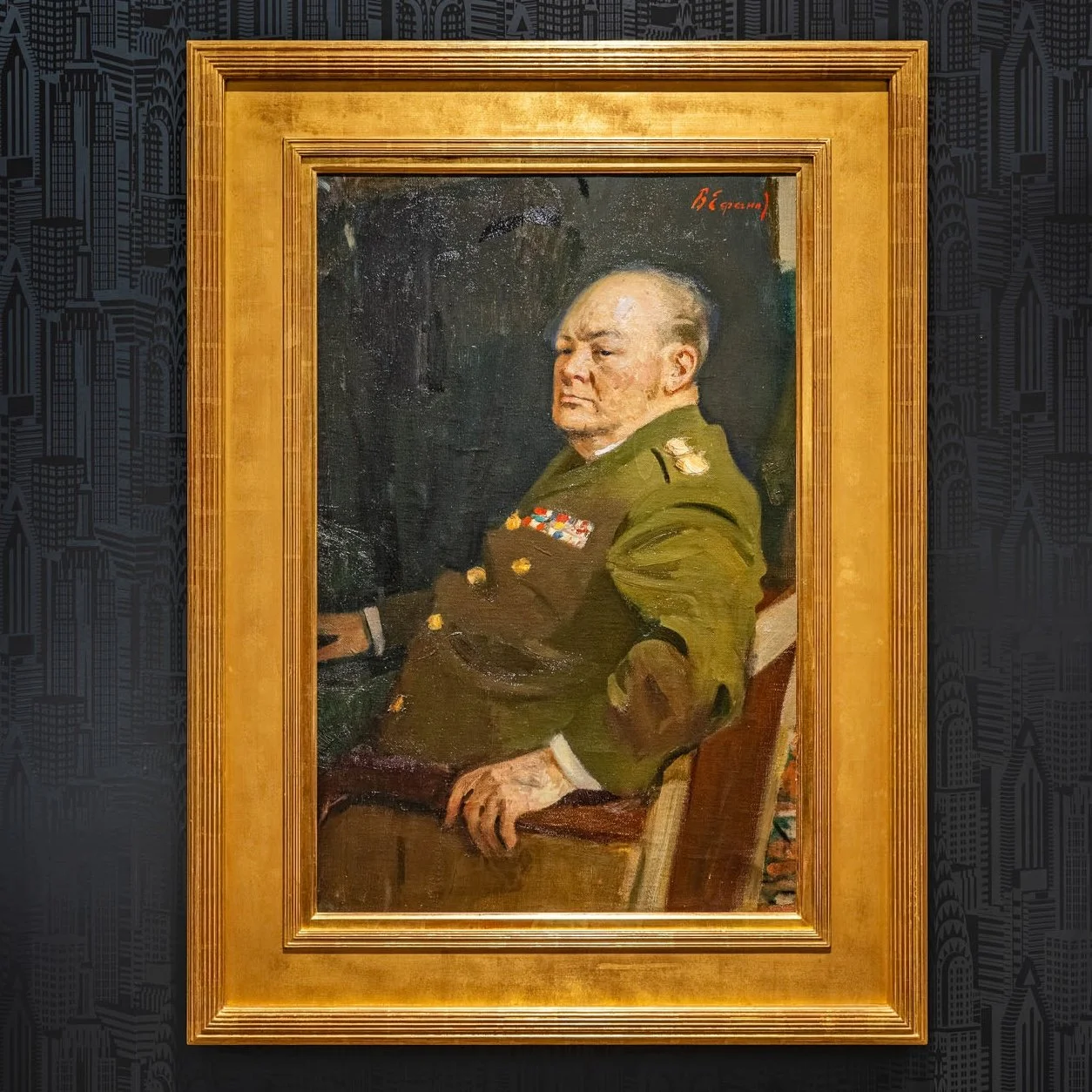
A portrait of Winston S. Churchill by Vasily Prokofyevich Yefanov, oil on canvas, signed and inscribed in Cyrillic on the reverse: V. Yefanov / W. Churchill / oil on canvas / 100 x 65 / 1944. It was painted in the autumn of the Fourth Moscow Conference of 9–19 October 1944, when Churchill sat across from Stalin to negotiate the political future of Eastern Europe and the so-called Percentages Agreement was informally drafted, an episode emblematic of the shifting balance of power at the close of the war.
Yefanov, a leading Soviet state artist and five-time Stalin Prize laureate, was renowned for authoritative depictions of official figures, and he presents Churchill with notable restraint: seated, in uniform, turned slightly from the viewer, absorbed in the gravity of decision rather than the rhetoric of the platform. The subdued palette and confident handling are characteristic of his mature style, here accommodating the distinct presence of a British sitter.
A Churchill of 1944 by a leading Soviet artist is a rare convergence of history, politics and art: painted from within the Soviet sphere at the very moment the post-war order was being negotiated, the work stands as both portrait and document.
Oil on canvas, 100 x 65 cm, presented in a gilt frame; typed label on the reverse identifying sitter and artist.
Provenance: Private collection; thence by descent.
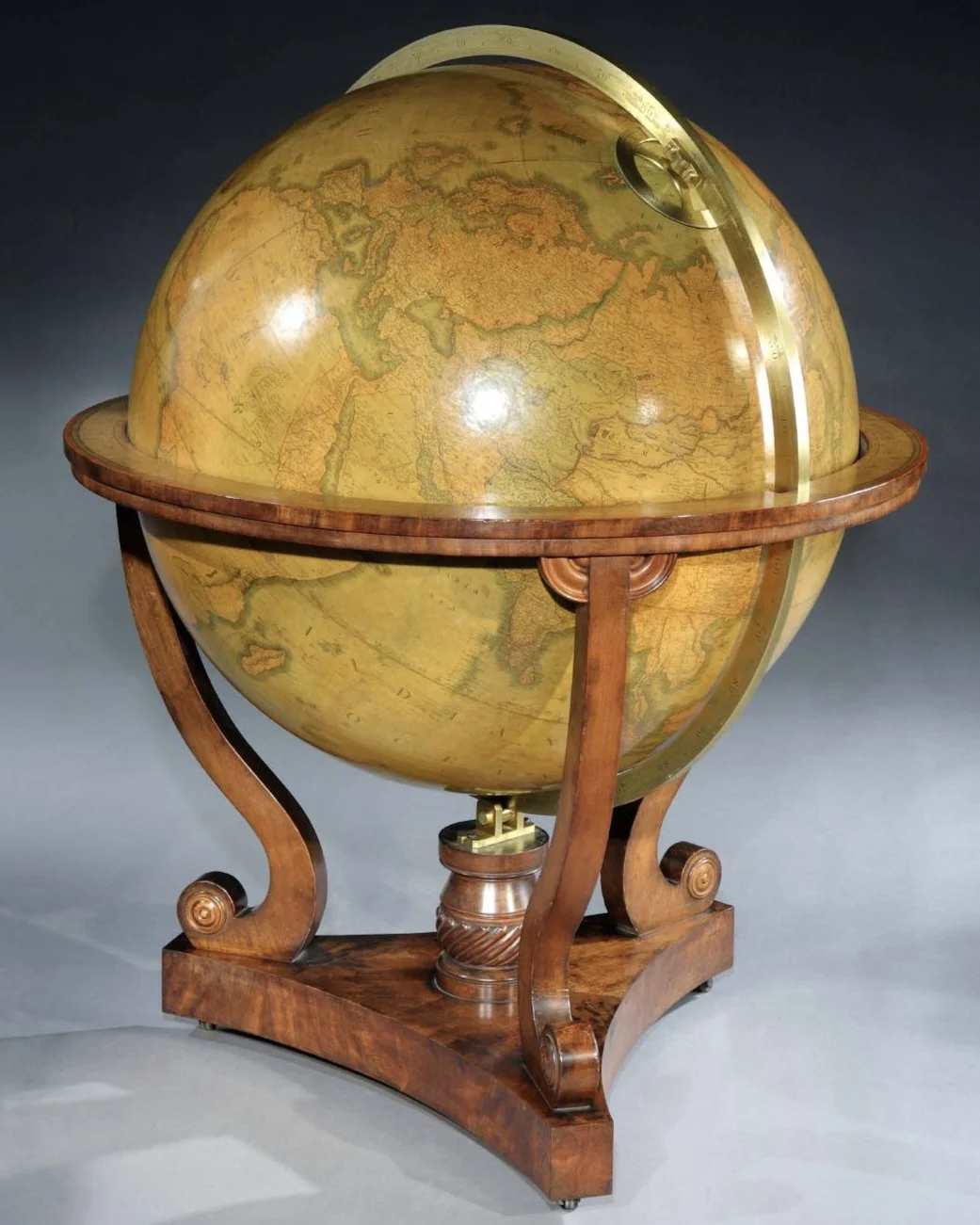
The Terraqueous Globe, exhibiting the present state of the known World, published under the immediate patronage of and dedicated by permission to His Most Gracious Majesty George IV, by John Addison, London. Manufactured and sold by G. and J. Cary, 86 St. James's Street, London.
A 36-inch terrestrial library globe, the hollow plaster-coated sphere covered in twenty-four hand-colored engraved gores, within a graduated brass meridian ring with hour dial, the engraved horizon paper laid with the thirty-two points of the compass, raised on a San Domingo mahogany stand with curved scroll supports and a concave-sided trefoil platform. Height 54 inches, horizon ring diameter 42 inches.
The globe is sold with the original bill of sale and receipt from the makers, itemizing the globe at £39 15s and a buff leather cover at £3 10s, the receipt signed for the firm on July 21st 1840 beneath an embossed duty stamp, acknowledging forty-one pounds two shillings received from the Reverend Thomas Davies. Davies, Senior Bursar of Jesus College, Oxford and the college's celebrated judge of wine, bought the globe for his college, where it remained for the next 169 years. Few globes of any period survive with their original documentation, and fewer still with the day, the purchaser, and the sum recorded in the maker's own hand. Sotheby's research in 2009 recorded no other example of this globe made by Cary.
The voyages of the great navigators are engraved across the oceans. The tracks of Cook, Gore, La Perouse, Vancouver, and Weddell can each be followed around the sphere, and three of them converge on Hawaii, then the Sandwich Islands, where a legend at Karakakooa Bay records that Captain Cook was killed by the natives on 14 February 1779. In the far south, a legend marks where Weddell reached his farthest point in 1823, with open water engraved beyond it, the Antarctic continent still unfound.
America appears in the moment before it became itself. Florida is still divided as East Florida, Cohahuila runs across ground that would be an independent Texas within a decade, and an American state within two, and on the Pacific coast the Columbia is marked Clatsop or Fort George, with no boundary drawn across the West at all.
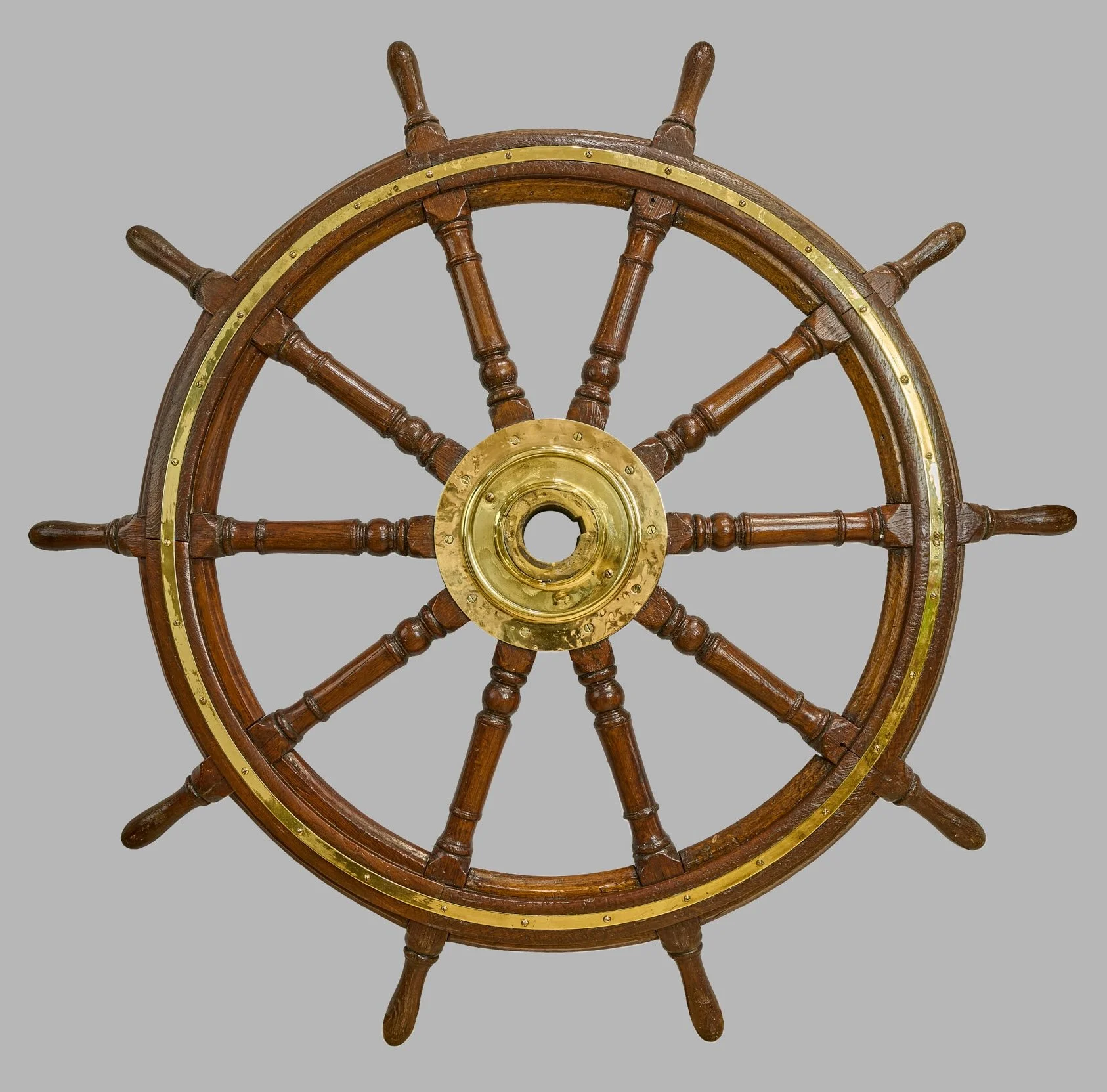
Ship's wheel of impressive proportions in solid oak with brass mounts, English or American, circa 1900. The wheel with ten baluster-turned spokes terminating in shaped handgrips, the heavy sectioned rim faced with a continuous brass band secured by pins, centered by a substantial polished brass hub plate with a keyed boss for the steering shaft.
Wheels of this pattern were fitted to sailing vessels and early motor yachts at the turn of the twentieth century, when steering gear was still built to last generations. The ten-spoke form, the depth of the rim, and the quality of the turning all point to a vessel of real size, and by repute, this example served aboard a schooner before spending its later life ashore.
The wheel comes from a private collection in the Florida Keys, where it remained for more than seventy years. The Keys have a long tradition of ship salvage and maritime recovery, stretching back to the wrecking era of the nineteenth century, and old wheels such as this were prized fixtures in the islands' resorts and waterfront establishments. Few survive in such complete and original condition.
The oak retains a deep, mellow color and an old surface, while the brass band and hub have a soft, polished patina. Condition is very good throughout, with honest wear to the handgrips consistent with working use and minor age splits to the rim sections, all stable. The wheel is ready for display, whether wall-mounted as a sculpture or fitted to a binnacle or pedestal.
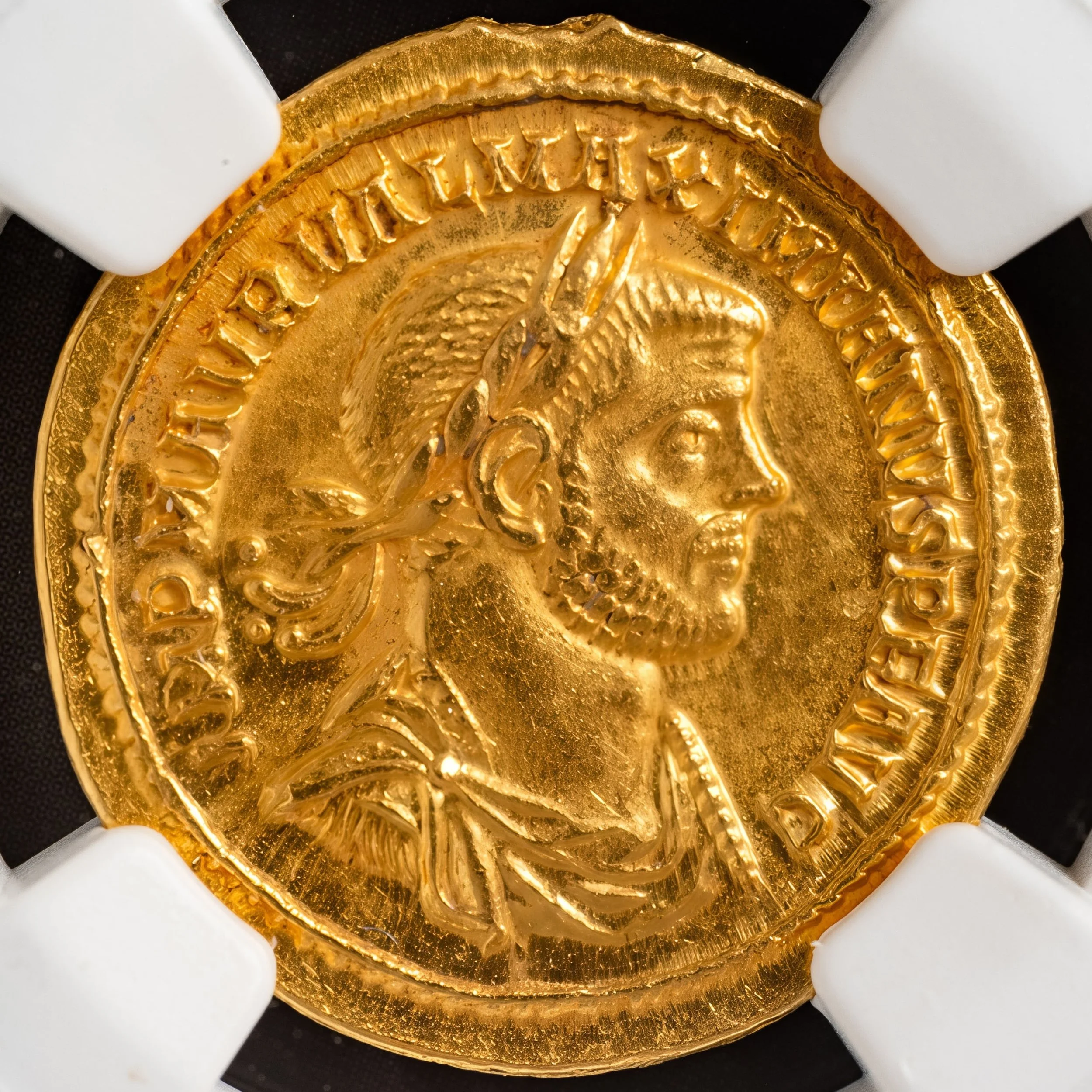
A gold aureus of the emperor Maximian, struck at the mint of Rome in the early years of his reign, circa AD 286–294. The coin weighs 5.50 grams and is graded Mint State by NGC, with a full strike of 5/5 and surfaces of 4/5.
The obverse carries the laureate, draped, and cuirassed bust of Maximian facing right, within his full titulature, IMP C M AVR VAL MAXIMIANVS P F AVG. The portrait is a fine example of the soldier-emperor style of the late third century, with the close-cropped beard and heavy features of a career officer from the Danube frontier.
The reverse shows Jupiter standing left, nude but for a chlamys over the shoulder, a thunderbolt in his outstretched right hand and a long scepter in his left, with the legend IOVI CONSERVAT AVGG, to Jupiter, preserver of the Augusti. The doubled G is the key to the coin. It marks the plural, two Augusti, and places the issue after 1 April 286, when Diocletian raised Maximian from Caesar to co-emperor and divided the burden of the empire between them. The partnership was sealed in religious terms. Diocletian took the title Iovius, placing himself under the protection of Jupiter, the ruler of the gods, while Maximian took Herculius, placing himself under Hercules, the god of strength who earned his divinity through labor. The choice fit the man. Maximian was the fighting half of the partnership, the commander who crushed the Bagaudae revolt in Gaul and campaigned across the Rhine while Diocletian governed, and the court orators praised him as a Hercules toiling on earth while Jupiter ruled above. A coin of the Herculian emperor honoring Jupiter is therefore the junior colleague paying public homage to the patron god of the senior, the theology of the two-man empire stated in a single reverse. The full weight of 5.50 grams reflects the strengthened standard of sixty aurei to the Roman pound, a weight increase introduced at the time of Maximian's elevation.
Reference: RIC V.2 492
Examples of the type are held by
The American Numismatic Society, New York
The Bibliothèque nationale de France, Paris
The American Numismatic Society specimen weighs 5.45 grams; the present coin, at 5.50 grams, is the heavier of the two.
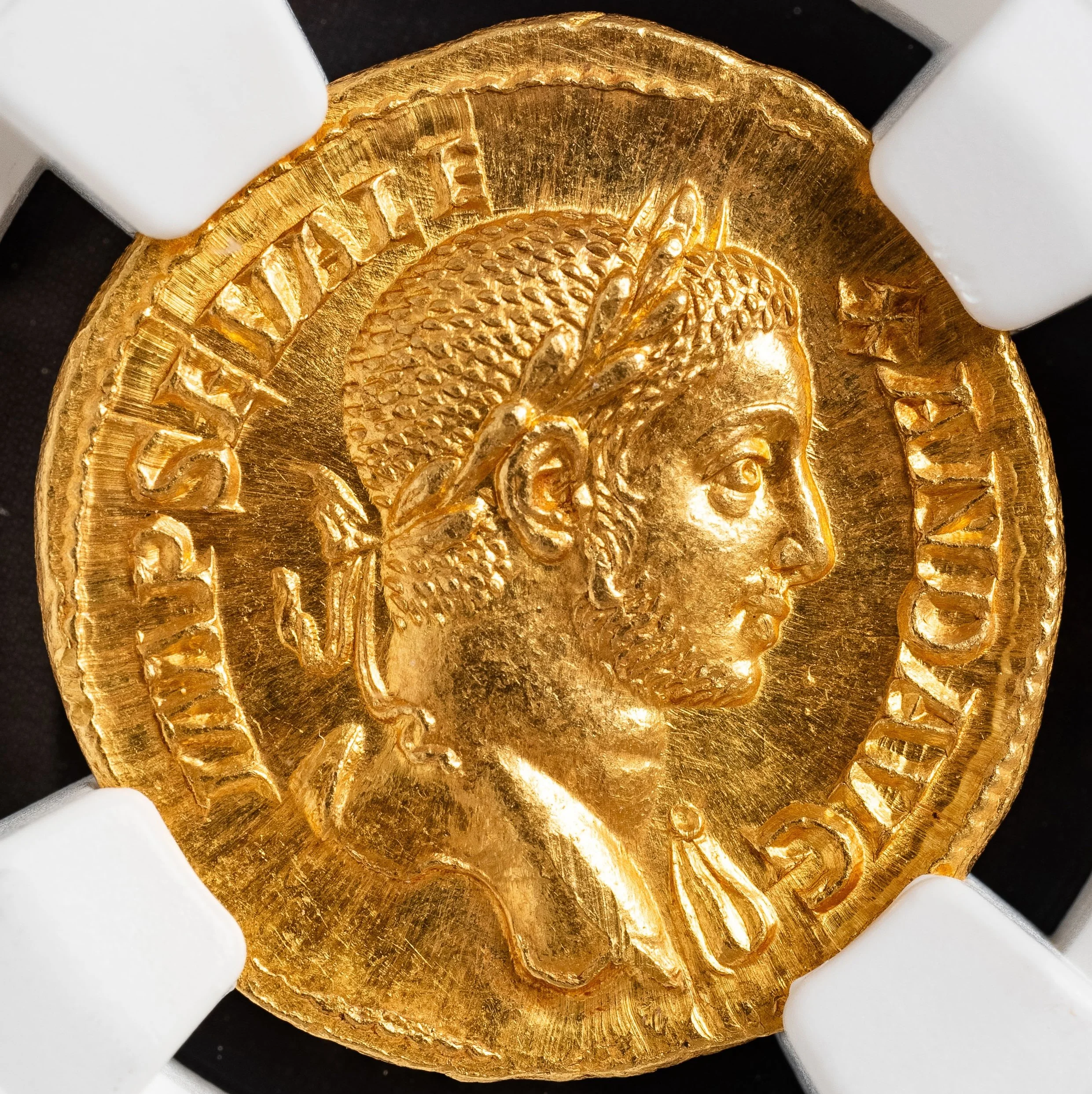
A gold aureus of the emperor Severus Alexander, struck at Rome in AD 230. The coin weighs 5.80 grams and is graded Choice Mint State by NGC, with a full strike of 5/5, surfaces of 4/5, and the Fine Style designation reserved for dies of superior artistry.
The obverse bears the laureate and draped bust of the young emperor facing right, seen from behind, with the drapery knotted at the left shoulder, within the legend IMP SEV ALEXAND AVG. The portrait shows the sensitive, almost boyish features that the mint of Rome gave the last of the Severan emperors, and the quality of the engraving is what earned the Fine Style designation.
The reverse shows the emperor in the guise of Romulus, the founder of Rome, radiate, in tunic and military cloak, advancing right with a transverse spear in his right hand and a trophy of captured arms over his left shoulder. The legend, P M TR P VIIII COS III P P, records his ninth tribunician power and third consulship and dates the coin precisely to AD 230. The date gives the image its edge. Severus Alexander had come to the throne at thirteen after the murder of his cousin Elagabalus and ruled under the guidance of his mother, Julia Mamaea. In 230, the armies of Ardashir I, founder of the new Sassanid Persian dynasty, broke into Roman Mesopotamia and laid siege to the frontier city of Nisibis, thereby facing its most serious eastern threat in a generation. A coin showing the gentle young emperor as Romulus, the city's founder and first warrior, was a statement of resolve from a regime under pressure. Alexander campaigned in the east in the years that followed, and his murder by his own troops in 235 ended the Severan dynasty and opened the fifty years of upheaval historians call the Crisis of the Third Century. This aureus belongs to the last confident moment before that storm.
Reference: RIC IV.2 103; Calicó 3121
Examples of the type are held by
The American Numismatic Society, New York
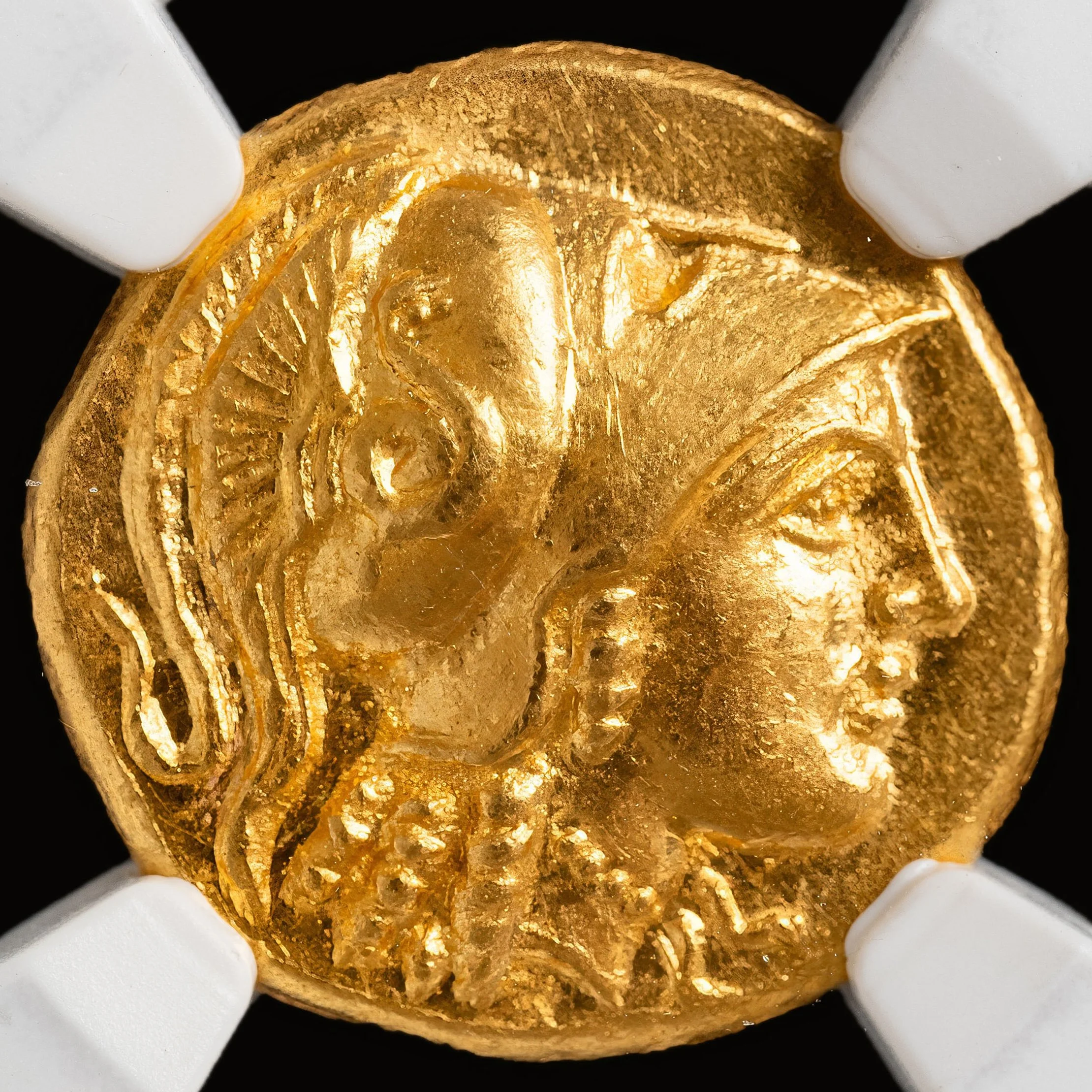
A gold stater of Alexander the Great, struck at an uncertain Greek or Macedonian mint in the decades following the king's death. The obverse carries the head of Athena in a triple-crested Corinthian helmet, the bowl decorated with a coiled serpent. The reverse shows Nike, the winged goddess of victory, standing with a wreath in her outstretched right hand and a stylis, the mast of a warship, in her left, beside the legend ΑΛΕΞΑΝΔΡΟΥ, "of Alexander." In the field are the two control marks of this issue, an ant to the left and an eight-rayed star below the goddess's wing.
The ant is among the rarest images on all Greek coinage, and its pairing with the star is thought to allude to some local legend whose meaning is now lost. The combination has intrigued scholars since the nineteenth century. Ludvig Müller, cataloging the Alexander coinage in 1855, read the two marks as civic badges and argued the coin was struck jointly by Apollonia and Acrothoon, two towns on Mount Athos, the ant standing for Apollonia and the star for the city at the holy mountain's summit. Modern scholarship no longer reads control marks as city emblems, and Martin Price returned the mint to "uncertain" in his 1991 corpus, but the puzzle Müller tried to solve remains open: a tiny insect, chosen deliberately by a mint official twenty-three centuries ago, for reasons no surviving source explains.
The type is scarce. Five examples are recorded in PELLA, the American Numismatic Society's corpus of the Alexander coinage in public collections, and market appearances are correspondingly few.
The coin weighs 8.59 grams and measures 18 millimeters. It is graded Choice Mint State (Ch MS) by NGC, Strike 5/5, Surface 4/5, certification 4877406-011.
Reference: Price 831.
Other examples of this type are held in the following collections:
The British Museum, London
The Ashmolean Museum, Oxford
The American Numismatic Society, New York
The Harvard Art Museums, Cambridge
The Münzkabinett, Vienna
At 8.59 grams, the present coin is identical in weight to the Ashmolean example, deposited at Oxford by New College in 1907.
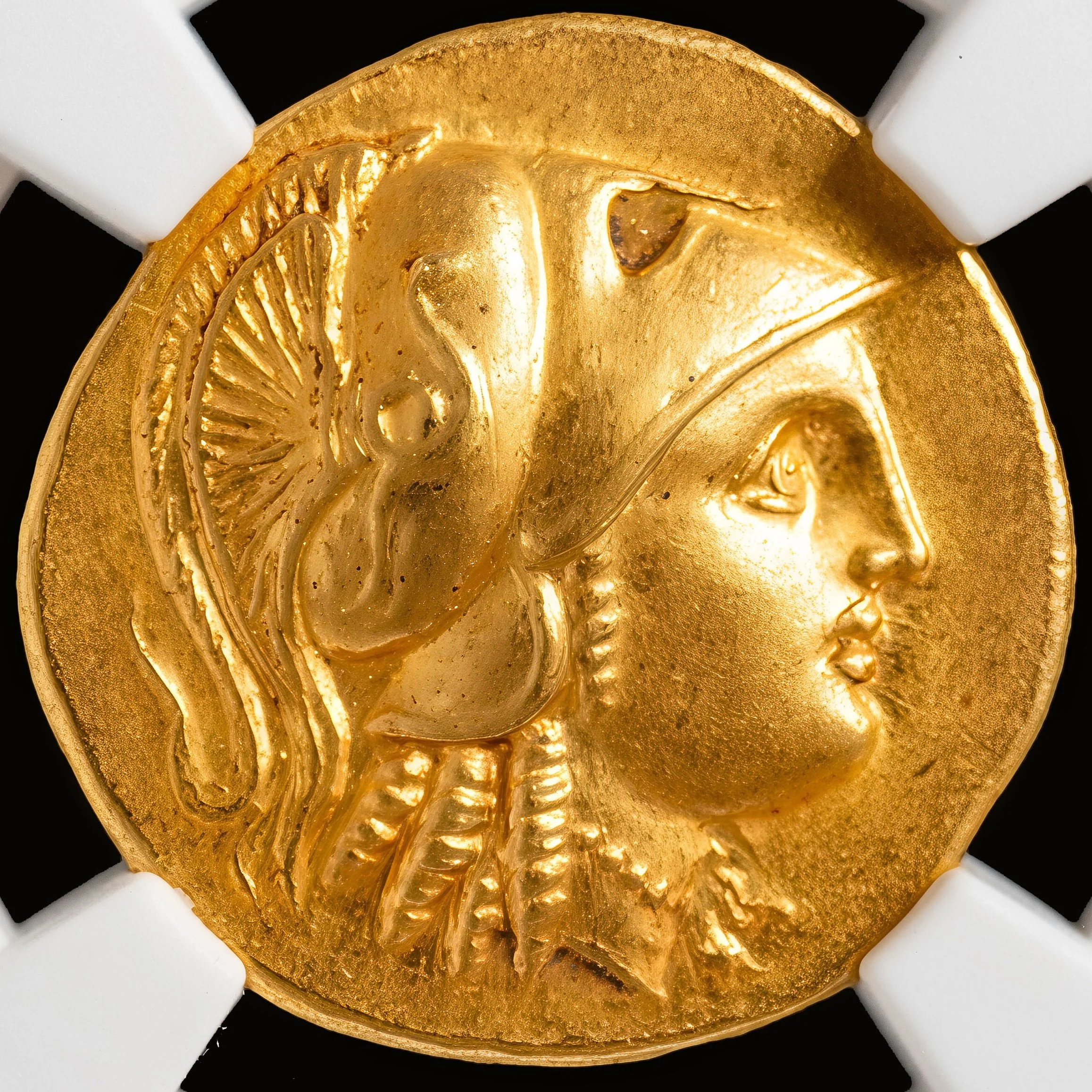
A gold stater of Alexander the Great, struck at the royal mint of Amphipolis in the late fourth century BC. The obverse carries the head of Athena in a triple-crested Corinthian helmet, the bowl decorated with a coiled serpent, her hair falling in corkscrew curls over her left shoulder. The reverse shows Nike, the winged goddess of victory, standing with a wreath in her outstretched right hand and a stylis, the mast of a warship, cradled in her left arm, beside the legend ΑΛΕΞΑΝΔΡΟΥ, "of Alexander." In the left field is the control mark of this issue, a trident head, the emblem of Poseidon.
Alexander introduced the Athena and Nike stater as the gold coinage of his empire, and the mints continued striking it in his name long after his death in 323 BC. Martin Price dated this issue to circa 330 to 320 BC, spanning the king's final years, while more recent scholarship places it under Cassander, circa 310 to 301 BC, the ruler who governed Macedon after Alexander's line was extinguished yet kept the conqueror's name on his gold. Either way, the coin belongs to the great Macedonian series struck at Amphipolis, the principal royal mint, within living memory of Alexander himself.
The coin weighs 8.59 grams and measures 19 millimeters. It is graded MS★ by NGC: Strike 5/5, Surface 4/5; the star denotes exceptional eye appeal. Certification 4885147-009.
Reference: Price 175.
Other examples of this type are held in the following collections:
The British Museum, London
The American Numismatic Society, New York
The Münzkabinett, Berlin
The Swiss National Museum, Zurich
At 8.59 grams, the present coin sits at the center of the recorded weight range for the type.
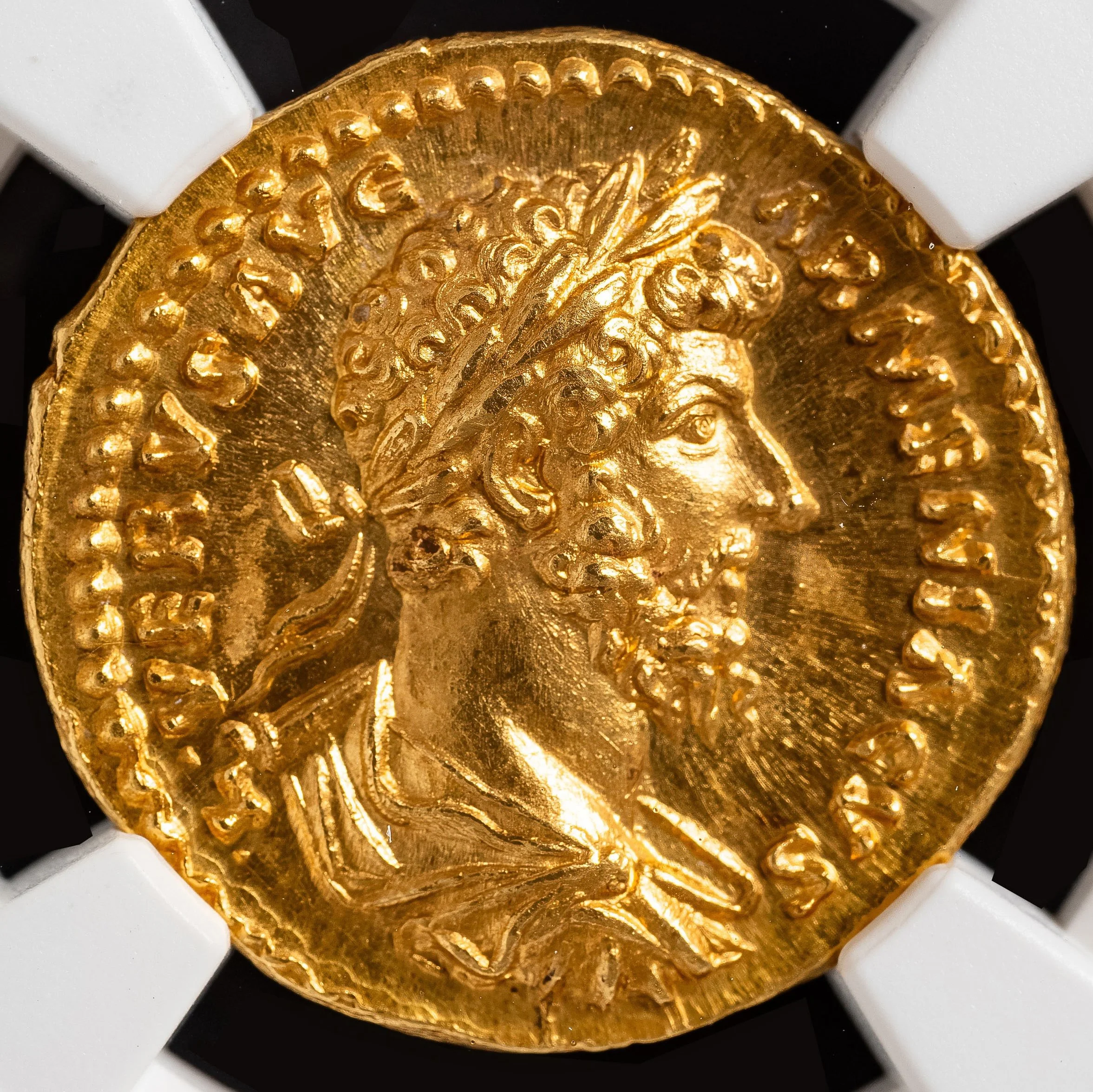
A Roman gold aureus of Lucius Verus, struck at Rome in AD 164 and certified by NGC as Gem Mint State, Strike 5/5, Surface 5/5, with the Fine Style designation, the highest combination of grades NGC Ancients awards short of a star. The coin weighs 7.28 grams, certification number 2100935-001.
The obverse bears the laureate, draped, and cuirassed bust of Verus facing right, the wreath ribbon trailing at the nape, with the legend L VERVS AVG ARMENIACVS. The reverse reads TR P IIII IMP II COS II and shows Victory, winged and half-draped, standing front with her head turned right, inscribing VIC AVG on a shield she steadies atop a palm tree.
The coin commemorates the campaign that earned Verus his title. When the Parthian king Vologases IV invaded Armenia in 161, expelling its Roman client king, Marcus Aurelius sent his co-emperor east. Roman forces under Statius Priscus retook Armenia and captured its capital, Artaxata, in 163, and Verus was hailed Armeniacus, a title he accepted with some reluctance, having directed the war from Antioch rather than the front. The shield Victory inscribes on this reverse is the official record of that victory, rendered in gold.
Portraits of Verus in this quality are seldom encountered. The engraving is unusually sensitive, the tight curls and full beard of the young emperor rendered with the depth of relief that earned the Fine Style designation, and the surfaces are essentially as struck. References: Calicó 2177; RIC III 525; BMC 296 note; Cohen 247 var.
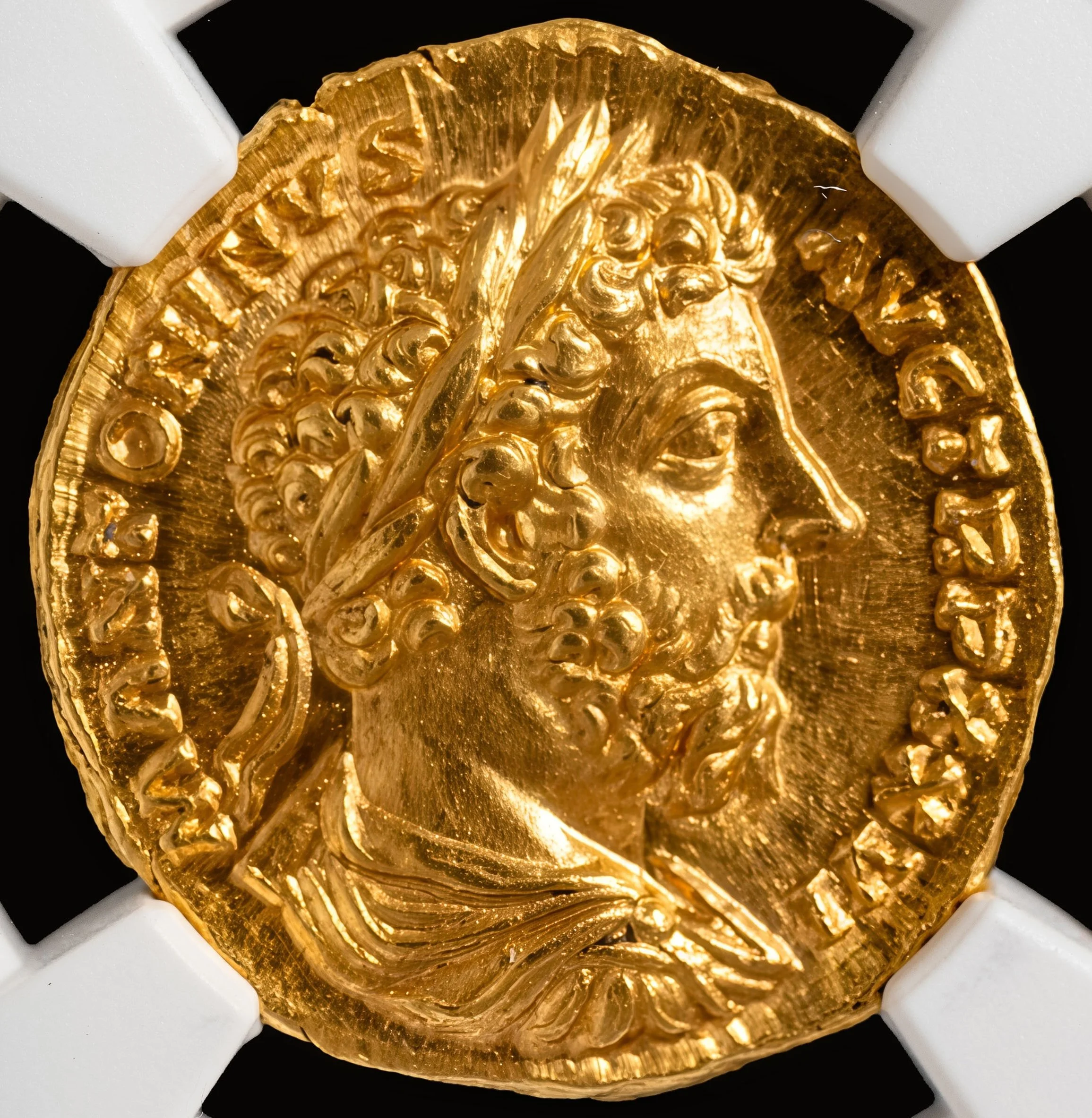
A gold aureus of the emperor Marcus Aurelius, struck at the mint of Rome in AD 172, at the height of the Marcomannic Wars on the Danube frontier. The obverse carries the laureate, draped portrait of the mature, bearded emperor with the legend M ANTONINVS AVG TR P XXVI. The reverse, reading IMP VI COS III, shows one of the boldest images in his coinage: the emperor standing in military dress, a reversed spear in his left hand and the thunderbolt of Jupiter gripped in his raised right, while Victory advances behind him with a palm frond to crown him with laurel.
The thunderbolt is the weapon of the supreme god, and an emperor shown wielding it is being assimilated to Jupiter himself, a step beyond the conventional imagery of divine favor. The type belongs to the years of the celebrated miracles of the northern wars, the lightning that destroyed an enemy siege engine and the rainstorm that saved a surrounded Roman army, both later carved on the Column of Marcus Aurelius in Rome. These are also the seasons in which the emperor, in winter quarters on the Danube, was writing the private notebook the world now knows as the Meditations.
The coin is graded Choice Mint State by NGC, Strike 4 of 5, Surface 5 of 5, with the Fine Style designation, certification 2100934-002, weight 7.19 grams. Scarcely circulated in eighteen centuries, it preserves the reverse composition with unusual clarity, the thunderbolt fully legible in the emperor's hand.
The type is cited as RIC III 265, with Calicó 1872, BMCRE 566 var., Biaggi 856 and Mazzini 308. Examples rest in the British Museum, the American Numismatic Society in New York, and the Kunsthistorisches Museum in Vienna, the last from the Bachofen collection, and the type is absent from the great published cabinets of Adda and Jameson. It is a coin found in the finest institutional collections and seldom in the market.
The aureus is exhibited in our Aspen gallery alongside a bronze reduction of the equestrian Marcus Aurelius of the Capitoline, cast in Rome in 1866, the emperor in gold and in bronze side by side.
The coin is considered at greater length, together with the equestrian bronze, in our article The Philosopher Emperor: Marcus Aurelius in Bronze, Gold, and Ink.

This sculptural bust represents the Roman emperor Marcus Salvius Otho (AD 32–69), portrayed with his head turned to the left. The finely carved Carrara marble head is set upon a polychrome bust veneered in an array of decorative stones, including Spanish Brocatello, Languedoc Rouge, Grey Lez Breccia, Noir de Sablé, Brèche d'Aste, and Giallo Antico. These veneers are applied to a grey volcanic stone composite core and supported by a socle of Grey Lez Breccia. The work reflects the late Baroque fascination with color, texture, and the revival of antique Roman marble revetment.
Born into a distinguished Etruscan family, Otho belonged to Rome's highest aristocratic circles and was closely associated in his youth with the future emperor Nero. Their friendship ended when Nero appropriated Otho's wife, Poppaea Sabina, after which Otho was removed from court and appointed governor of the province of Lusitania (modern Portugal). There he ruled with notable competence and restraint for approximately ten years (AD 58–68), establishing a reputation for effective provincial administration.
Following Nero's suicide in AD 68, Otho initially supported Galba's claim against rival contenders for power. When Galba failed to reward him with the expected succession, Otho turned against him, securing the allegiance of the Praetorian Guard. Galba was assassinated in January AD 69, and Otho was proclaimed emperor, inaugurating one of the most turbulent episodes in Roman imperial history, the so-called "Year of the Four Emperors."
Otho's reign lasted little more than three months and was dominated by civil war. Opposing him was Vitellius, commander of the legions in Germany, whose forces advanced into northern Italy. Despite efforts to negotiate and to consolidate support, Otho suffered defeat at the First Battle of Bedriacum. Rather than prolong the conflict and subject the empire to further bloodshed, Otho chose to take his own life, declaring that it was better for one man to die than for many to perish in continued civil war. His suicide was widely regarded by ancient authors as an act of moral courage and political responsibility.
In subsequent Roman literature, Otho's decision earned him admiration. Writers such as Tacitus emphasized the dignity of his death, while Martial praised his self-sacrifice, contrasting it favorably with the ambitions of other civil war protagonists. This posthumous reassessment transformed Otho from a figure initially associated with courtly excess into an emblem of honorable restraint.
As one of the Twelve Caesars of Suetonius, Otho was most often carved for a series of imperial busts assembled for learned display, and the present head belongs to that tradition. By combining an imperial likeness with a richly polychrome body, this bust reflects early modern interest in Roman history and exemplifies the Baroque reinterpretation of ancient portraiture, evoking both the authority of the Roman emperors and the cultivated taste for antiquity characteristic of elite collectors in late 17th- and early 18th-century Italy.
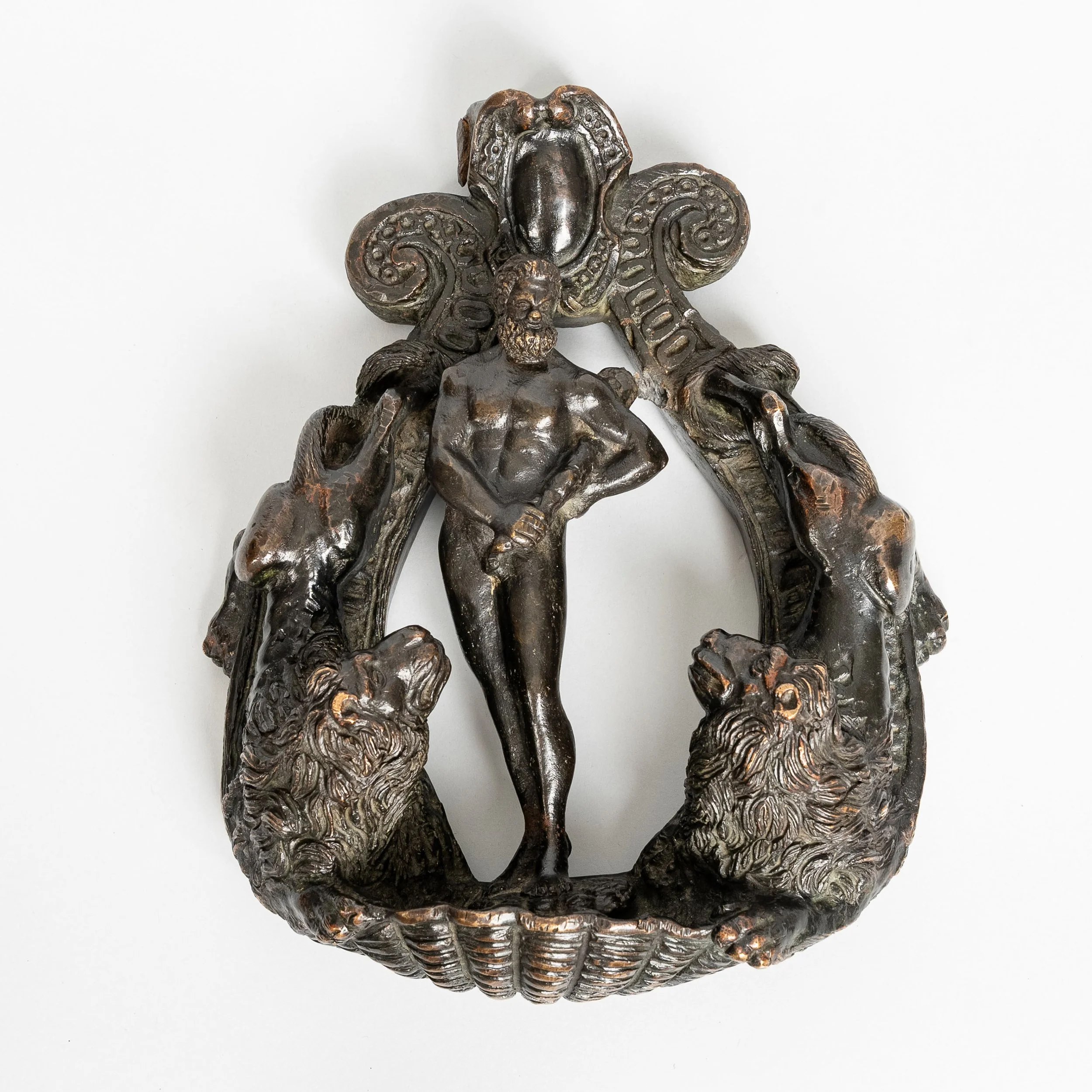
Cast in the form of a lyre, the door knocker centers on a standing figure of Hercules, nude and bearded, his club lowered at his side, set within a fluted shell and flanked by two lions modeled fully in the round, their forepaws on the shell and their hindquarters rising along the curved arms of the knocker, which terminate above in scrolled horns framing a strapwork cartouche. The bronze retains a dark brown patina, the high points rubbed to a warm copper red from centuries of handling, and preserves its original hinged suspension and hammered striker boss, the working evidence of a knocker that hung and sounded on a Venetian door.
The knocker is a solid lost-wax cast. The reverse is open and irregular, the figure and lions finished in the round both front and back, and the surface preserves passages of the original wax texture alongside areas of crisp, selective hand-chasing, the working method of an accomplished sixteenth-century foundry rather than the thin, uniform walls of later reproductions.
The model is associated with Tiziano Aspetti (1559–1606), the Paduan sculptor who worked in Venice in the circle of Girolamo Campagna and whose name has long been attached by collectors to the finest Venetian bronzes of this type, andirons, statuettes, and door knockers alike. The composition belongs to a small family of casts sharing the same lyre-form frame with an interchangeable central figure. The closest comparison, and the only other recorded example with Hercules, is the cast in the Rijksmuseum, Amsterdam (inv. BK-NM-3309), attributed to Aspetti and dated to Venice, circa 1590–1600, acquired by the museum in 1894 and continuously published since 1904. The present example corresponds closely to the Rijksmuseum bronze in model and dimensions, differing in the treatment of the shell, and retains notably crisp definition in the head, beard, and club. A version of the frame with a female allegorical figure is in the Bayerisches Nationalmuseum, Munich; a further female example, formerly in the Pierpont Morgan collection and inscribed on a tablet for the founder Giovanni Antonio Tavagni, was published by Bode in 1912; and two additional examples, with variants, were recorded in the Spitzer collection in the nineteenth century.
Door knockers of this kind, battenti, were among the signature productions of the Venetian bronze workshops of the late Cinquecento, cast from models supplied by the leading sculptors of the city and mounted on the doors of Venetian palazzi as emblems of strength and welcome. Hercules flanked by lions carried an unmistakable message of fortitude, while the shell spoke to the city's marine identity.
Condition: Minor casting flaws consistent with period lost-wax production, an old break between the end of the club and the tail of one lion, and honest wear to the high points. Retains its hinged suspension with an iron pin and its striker boss. Mounted on a later display stand.
Dimensions: Height 9¾ in (24.5 cm), width 8 in (20.5 cm)
Provenance: European private collection
Literature (comparative): Catalogus van de beeldhouwwerken in het Nederlandsch Museum voor geschiedenis en kunst te Amsterdam, Amsterdam, 1904, no. 165, and 2nd ed., 1915, no. 78 (the Rijksmuseum cast); W. Bode, The Italian Bronze Statuettes of the Renaissance, London, 1907–12, pl. CCLXIV (the Tavagni example, ex-Pierpont Morgan); J. Leeuwenberg, Beeldhouwkunst in het Rijksmuseum, Amsterdam, 1973, cat. 657 (the Rijksmuseum cast); M. Schapelhouman, "Talking of Door Knockers," The Rijksmuseum Bulletin 64 (2016), no. 2, pp. 151–55, fig. 3 (the Rijksmuseum cast)
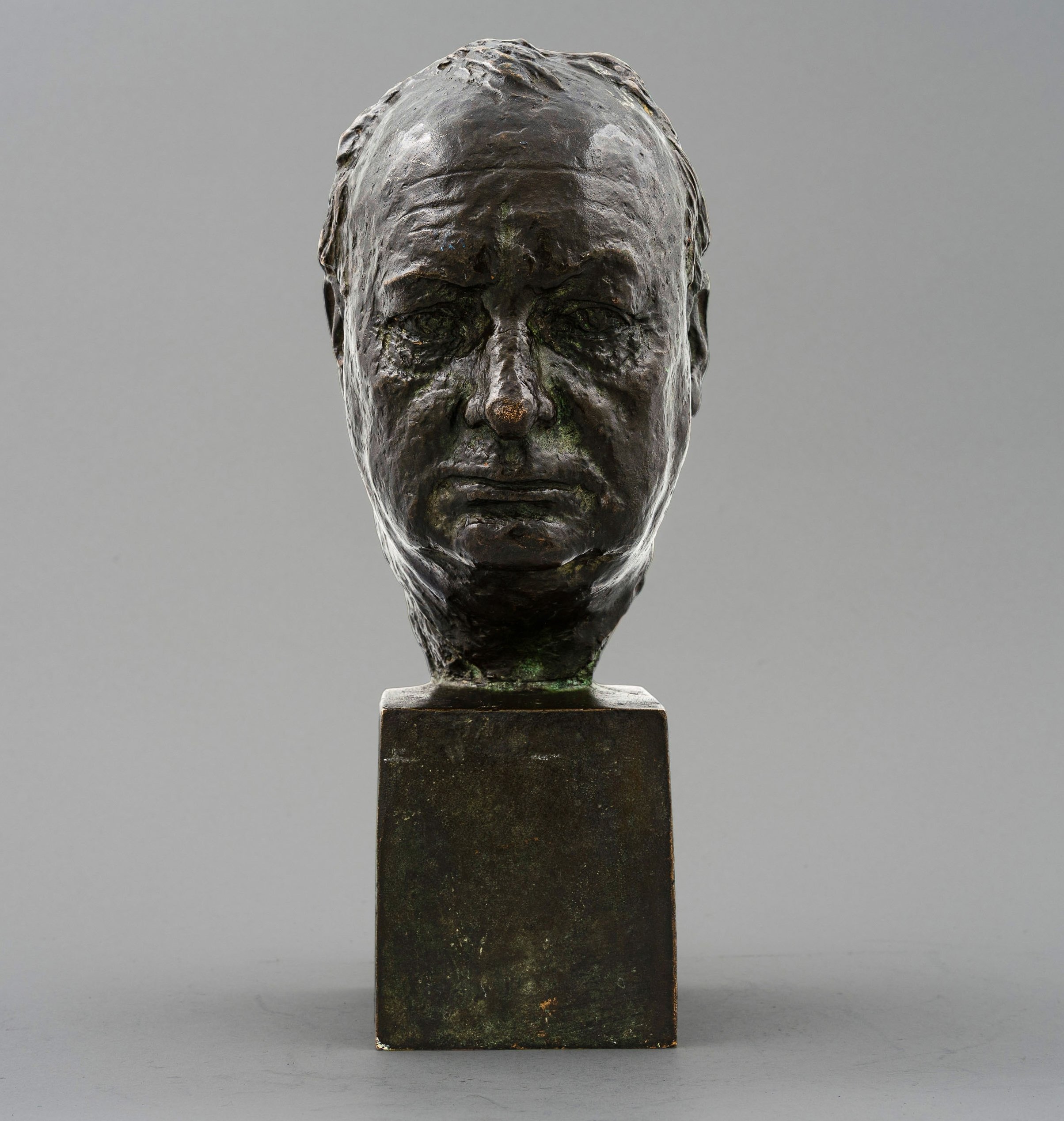
A powerful bronze portrait of Sir Winston Churchill by Sir William Reid Dick, one of the foremost British sculptors of the twentieth century, taken from the life study he modeled in 1942, and signed and dated on the reverse of the neck. Height 11 inches, dark green patina, on an integral square bronze plinth.
The portrait was commissioned by the Royal Academy from Reid Dick in 1942, at the height of the Second World War. Churchill, consumed by the direction of the war, was reluctant to spare the hours a sitting required, and by tradition agreed to sit only after the personal intervention of King George VI. The result is a likeness drawn from life at the very moment of Churchill's wartime leadership, the heavy features and set mouth recorded with the directness that was Reid Dick's hallmark as a portraitist.
Reid Dick models the Prime Minister without flattery or rhetorical softening. The head is bare and frontal, the brow heavy, the jaw and jowls fully described, the expression fixed in an attitude of resolve. There is no ornament, no gesture toward the swagger of official portraiture, only the weight of the man and the office he carried. The surface is worked freely, catching light across the modeled planes, and finished in a dark green patina.
Reid Dick stood at the center of British public sculpture between the wars and after. A Royal Academician from 1928, President of the Royal Society of British Sculptors, knighted in 1935, and appointed King's Sculptor in Ordinary for Scotland in 1938, he was entrusted with many of the nation's most prominent commissions, among them the recumbent effigies of George V and Queen Mary at Windsor, the lion of the Menin Gate at Ypres, the eagle of the Royal Air Force Memorial on the Victoria Embankment, and the equestrian Lady Godiva at Coventry. His best-known work in the United States stands in London's Grosvenor Square, the memorial statue of Franklin D. Roosevelt, unveiled in 1948 by Eleanor Roosevelt in the presence of King George VI. His portrait of Churchill belongs to this company, a life study of the wartime leader by the sculptor of choice to the crown.
Provenance: Private collection.
Condition: Very good overall. The bronze presents a dark green patina with natural verdigris to the recesses. The signature and date, W Reid Dick 1942, are clear and legible on the reverse of the neck. Minor wear consistent with age and handling. No restoration noted.
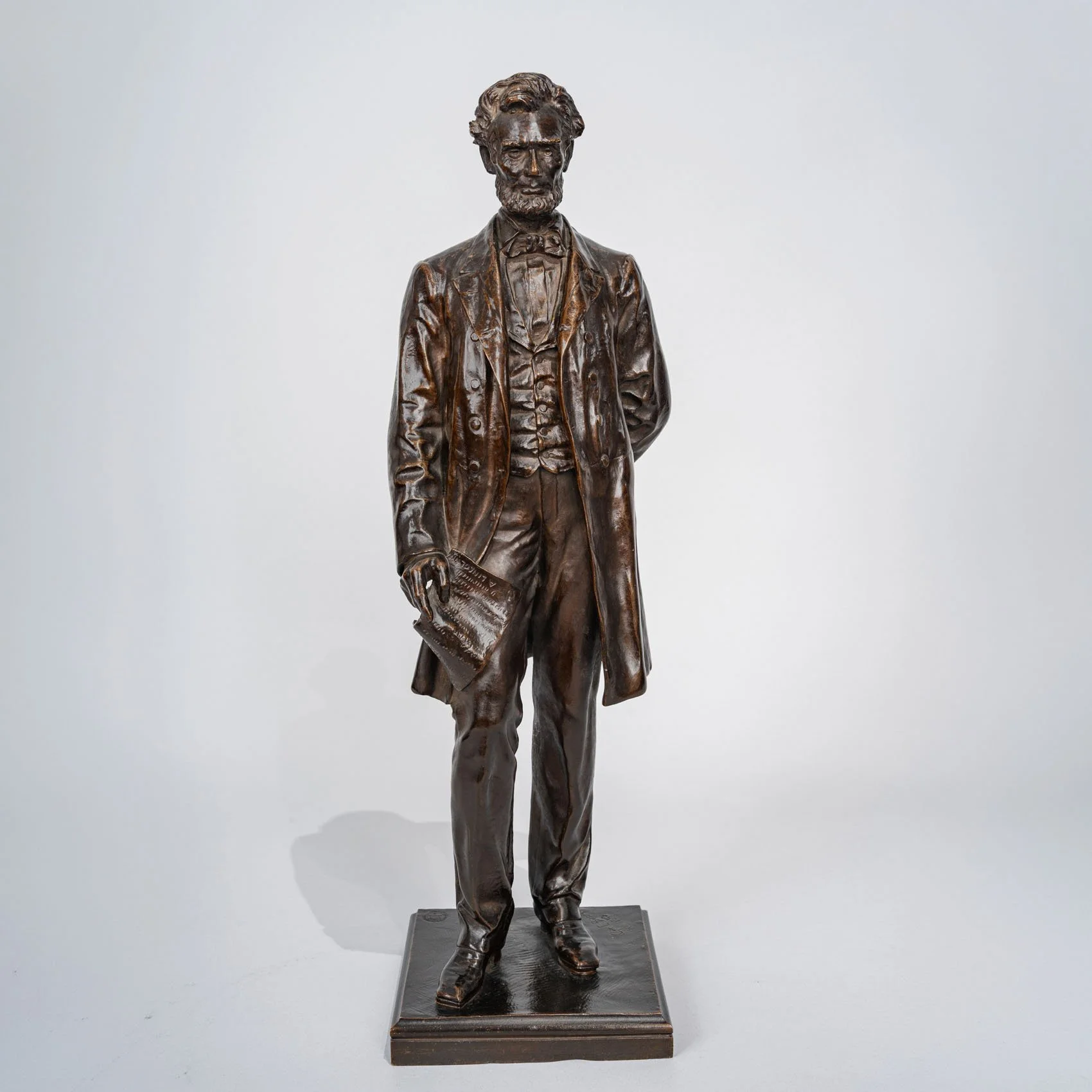
A patinated bronze figure of Abraham Lincoln, standing bare-headed in a frock coat and holding the Emancipation Proclamation in his lowered right hand, the scroll incised with its title and with the signature A. Lincoln, raised on a stepped square base. Signed to the base Geo. E. Bissell and dated 1893, and stamped with the cachet of the Paris foundry E. Gruet Jeune, Fondeur, 44 bis Avenue de Châtillon, Paris. Height 17 inches (43 cm).
The model derives from Bissell's monumental standing Lincoln for the Scottish-American Soldiers Monument in the Old Calton Burial Ground, Edinburgh, unveiled on 21 August 1893. It was the first statue of Lincoln raised outside the United States, and it remains the only monument to the American Civil War outside America. A second monumental version was erected in 1902 at Clermont, Iowa. In the reduction, as on the monument, Lincoln holds the Emancipation Proclamation, the document that gives the figure its title.
The present bronze is the Paris cast, by the foundry of Edmond Gruet, known as E. Gruet Jeune, active from 1891 until 1904 at 44 bis Avenue de Châtillon, among the few Parisian founders of the period to practice the lost-wax method, and the founder of some of the best-known bronzes of Frederick MacMonnies. Bissell lived and worked in Paris through much of the 1880s and 1890s, and the Gruet casting belongs to those years, contemporary with the monument itself. The subject was afterward issued commercially by the Gorham Company of New York, and it is the Gorham casts that account for most of the models on the market; the Paris examples are encountered far less often, and this one retains the crisp definition of the face, hair, and incised proclamation associated with the Gruet casting.
The bronze retains a warm, dark brown patina of good tone, with wear consistent with age and handling. Signed, dated, and foundry-stamped as described. A formal condition report is available on request.
The equestrian statue of Marcus Aurelius on the Capitoline is the only surviving bronze equestrian monument of a Roman emperor from antiquity. Cast in gilded bronze around AD 175 and standing more than thirteen feet tall, it survived the melting pots that consumed every other imperial horseman because the medieval city took the rider for Constantine. It stood for centuries outside the Lateran until 1538, when Paul III moved it to the Capitoline, and Michelangelo designed the piazza around it. It remains there today: the original is now indoors in the Capitoline Museums, with traces of its ancient gilding intact; a replica stands on the pedestal outside; and it is still an official emblem of the city of Rome.
The man on the horse wears no armor and carries no weapon. His right arm is extended in the gesture of clemency, and the sculptor gave him the face of someone who has thought about what he is doing. He had. Marcus Aurelius is the one Roman emperor whose book is still read. The Meditations were written in Greek, in camp on the Danube frontier, a private notebook of a man reminding himself how to behave while holding absolute power. Take care, he writes, that thou art not made into a Caesar, that thou art not dyed with this dye. The statue and the book describe the same person.
A bronze equestrian group of Marcus Aurelius after that monument, the emperor bearded and bareheaded in tunic and paludamentum, his right arm extended, seated without stirrups or reins upon a walking horse with the right foreleg raised. Cast in two patinations, the figure in a deep brown and the pedestal in a warm golden bronze, the pedestal with panels bearing both inscriptions, the ancient dedication and the text of Paul III, dated 1538. Signed on the plinth: A. DRESSLER HOPFGARTEN ROMA 1866. Height 24 inches.
The model belongs to the Roman reduction trade that supplied the Grand Tour from the 1750s, led by Giacomo and Giovanni Zoffoli and by Francesco Righetti, whose small bronzes after the antique rarely exceeded fifteen inches and were prized above all by the English. Into this trade came two Prussians, Wilhelm Hopfgarten and Benjamin Ludwig Jollage, who opened their studio at 94 via Due Macelli by about 1808 and within a generation were the leading bronze founders in Rome. They cast for Canova and Thorvaldsen, and supplied papal gifts to Bavaria and to Charles X. Where their predecessors had worked small, they took the same subjects and made them large, and the Marcus Aurelius was the greatest of these: ordered by the Crown Prince of Prussia in 1828, singled out by Nagler, worked from the monument by pantograph with a fidelity that extends to the veining of the horse's chest, and displayed in the workshop's street window beside the Capitoline Wolf as the two emblems of Rome. The 1837 inventory gives the window cast's height as sixty-two centimeters. The present cast stands twenty-four inches. It is the size of the piece the founders put in the window.
At Hopfgarten's death in 1860, the concern passed by will to A. Dressler, his employee and sole heir, who took the molds and plaster models with the business, kept the Hopfgarten name as a guarantee of quality, and ran the shop through the following decade. Where the Hopfgarten and Jollage production of half a century had gone out largely unsigned and is known today mostly by attribution, Dressler stamped and dated his casts. A signed and dated Hopfgarten bronze is accordingly rare, and one carrying the workshop's most ambitious model is rarer still. The present group is dated 1866, and no other dated cast of the Marcus Aurelius has been traced in the public record. It is a documented cast, from the original matrices, of the model this foundry was founded on, in the size the founders themselves chose to display.
It is exhibited in our Aspen gallery beside a gold aureus of Marcus Aurelius, struck at the Rome mint in AD 172, on which Victory crowns the emperor as he holds the thunderbolt of Jupiter.
The bronze is considered at greater length, together with the gold aureus, in our article The Philosopher Emperor: Marcus Aurelius in Bronze, Gold, and Ink.
Sources
Chiara Teolato, Hopfgarten and Jollage Rediscovered: Two Berlin Bronzists in Napoleonic and Restoration Rome, Rome, Edizioni del Borghetto, 2016, including the Jollage (1837) and Hopfgarten (1860) inventories, Archivio di Stato di Roma.
G. K. Nagler, Neues allgemeines Künstler-Lexicon, Munich, 1838.
Marcus Aurelius, Meditations, translated by George Long, 1862.
Musei Capitolini, Rome.
Daniels Antiques is always interested in acquiring Grand Tour bronzes, particularly signed examples by Zoffoli, Righetti, and the Hopfgarten foundry. Please contact us if you have a piece to sell.