Cast in the form of a lyre, the door knocker centers on a standing figure of Hercules, nude and bearded, his club lowered at his side, set within a fluted shell and flanked by two lions modeled fully in the round, their forepaws on the shell and their hindquarters rising along the curved arms of the knocker, which terminate above in scrolled horns framing a strapwork cartouche. The bronze retains a dark brown patina, the high points rubbed to a warm copper red from centuries of handling, and preserves its original hinged suspension and hammered striker boss, the working evidence of a knocker that hung and sounded on a Venetian door.
The knocker is a solid lost-wax cast. The reverse is open and irregular, the figure and lions finished in the round both front and back, and the surface preserves passages of the original wax texture alongside areas of crisp, selective hand-chasing, the working method of an accomplished sixteenth-century foundry rather than the thin, uniform walls of later reproductions.
The model is associated with Tiziano Aspetti (1559–1606), the Paduan sculptor who worked in Venice in the circle of Girolamo Campagna and whose name has long been attached by collectors to the finest Venetian bronzes of this type, andirons, statuettes, and door knockers alike. The composition belongs to a small family of casts sharing the same lyre-form frame with an interchangeable central figure. The closest comparison, and the only other recorded example with Hercules, is the cast in the Rijksmuseum, Amsterdam (inv. BK-NM-3309), attributed to Aspetti and dated to Venice, circa 1590–1600, acquired by the museum in 1894 and continuously published since 1904. The present example corresponds closely to the Rijksmuseum bronze in model and dimensions, differing in the treatment of the shell, and retains notably crisp definition in the head, beard, and club. A version of the frame with a female allegorical figure is in the Bayerisches Nationalmuseum, Munich; a further female example, formerly in the Pierpont Morgan collection and inscribed on a tablet for the founder Giovanni Antonio Tavagni, was published by Bode in 1912; and two additional examples, with variants, were recorded in the Spitzer collection in the nineteenth century.
Door knockers of this kind, battenti, were among the signature productions of the Venetian bronze workshops of the late Cinquecento, cast from models supplied by the leading sculptors of the city and mounted on the doors of Venetian palazzi as emblems of strength and welcome. Hercules flanked by lions carried an unmistakable message of fortitude, while the shell spoke to the city's marine identity.
Condition: Minor casting flaws consistent with period lost-wax production, an old break between the end of the club and the tail of one lion, and honest wear to the high points. Retains its hinged suspension with an iron pin and its striker boss. Mounted on a later display stand.
Dimensions: Height 9¾ in (24.5 cm), width 8 in (20.5 cm)
Provenance: European private collection
Literature (comparative): Catalogus van de beeldhouwwerken in het Nederlandsch Museum voor geschiedenis en kunst te Amsterdam, Amsterdam, 1904, no. 165, and 2nd ed., 1915, no. 78 (the Rijksmuseum cast); W. Bode, The Italian Bronze Statuettes of the Renaissance, London, 1907–12, pl. CCLXIV (the Tavagni example, ex-Pierpont Morgan); J. Leeuwenberg, Beeldhouwkunst in het Rijksmuseum, Amsterdam, 1973, cat. 657 (the Rijksmuseum cast); M. Schapelhouman, "Talking of Door Knockers," The Rijksmuseum Bulletin 64 (2016), no. 2, pp. 151–55, fig. 3 (the Rijksmuseum cast)
Cast in the form of a lyre, the door knocker centers on a standing figure of Hercules, nude and bearded, his club lowered at his side, set within a fluted shell and flanked by two lions modeled fully in the round, their forepaws on the shell and their hindquarters rising along the curved arms of the knocker, which terminate above in scrolled horns framing a strapwork cartouche. The bronze retains a dark brown patina, the high points rubbed to a warm copper red from centuries of handling, and preserves its original hinged suspension and hammered striker boss, the working evidence of a knocker that hung and sounded on a Venetian door.
The knocker is a solid lost-wax cast. The reverse is open and irregular, the figure and lions finished in the round both front and back, and the surface preserves passages of the original wax texture alongside areas of crisp, selective hand-chasing, the working method of an accomplished sixteenth-century foundry rather than the thin, uniform walls of later reproductions.
The model is associated with Tiziano Aspetti (1559–1606), the Paduan sculptor who worked in Venice in the circle of Girolamo Campagna and whose name has long been attached by collectors to the finest Venetian bronzes of this type, andirons, statuettes, and door knockers alike. The composition belongs to a small family of casts sharing the same lyre-form frame with an interchangeable central figure. The closest comparison, and the only other recorded example with Hercules, is the cast in the Rijksmuseum, Amsterdam (inv. BK-NM-3309), attributed to Aspetti and dated to Venice, circa 1590–1600, acquired by the museum in 1894 and continuously published since 1904. The present example corresponds closely to the Rijksmuseum bronze in model and dimensions, differing in the treatment of the shell, and retains notably crisp definition in the head, beard, and club. A version of the frame with a female allegorical figure is in the Bayerisches Nationalmuseum, Munich; a further female example, formerly in the Pierpont Morgan collection and inscribed on a tablet for the founder Giovanni Antonio Tavagni, was published by Bode in 1912; and two additional examples, with variants, were recorded in the Spitzer collection in the nineteenth century.
Door knockers of this kind, battenti, were among the signature productions of the Venetian bronze workshops of the late Cinquecento, cast from models supplied by the leading sculptors of the city and mounted on the doors of Venetian palazzi as emblems of strength and welcome. Hercules flanked by lions carried an unmistakable message of fortitude, while the shell spoke to the city's marine identity.
Condition: Minor casting flaws consistent with period lost-wax production, an old break between the end of the club and the tail of one lion, and honest wear to the high points. Retains its hinged suspension with an iron pin and its striker boss. Mounted on a later display stand.
Dimensions: Height 9¾ in (24.5 cm), width 8 in (20.5 cm)
Provenance: European private collection
Literature (comparative): Catalogus van de beeldhouwwerken in het Nederlandsch Museum voor geschiedenis en kunst te Amsterdam, Amsterdam, 1904, no. 165, and 2nd ed., 1915, no. 78 (the Rijksmuseum cast); W. Bode, The Italian Bronze Statuettes of the Renaissance, London, 1907–12, pl. CCLXIV (the Tavagni example, ex-Pierpont Morgan); J. Leeuwenberg, Beeldhouwkunst in het Rijksmuseum, Amsterdam, 1973, cat. 657 (the Rijksmuseum cast); M. Schapelhouman, "Talking of Door Knockers," The Rijksmuseum Bulletin 64 (2016), no. 2, pp. 151–55, fig. 3 (the Rijksmuseum cast)

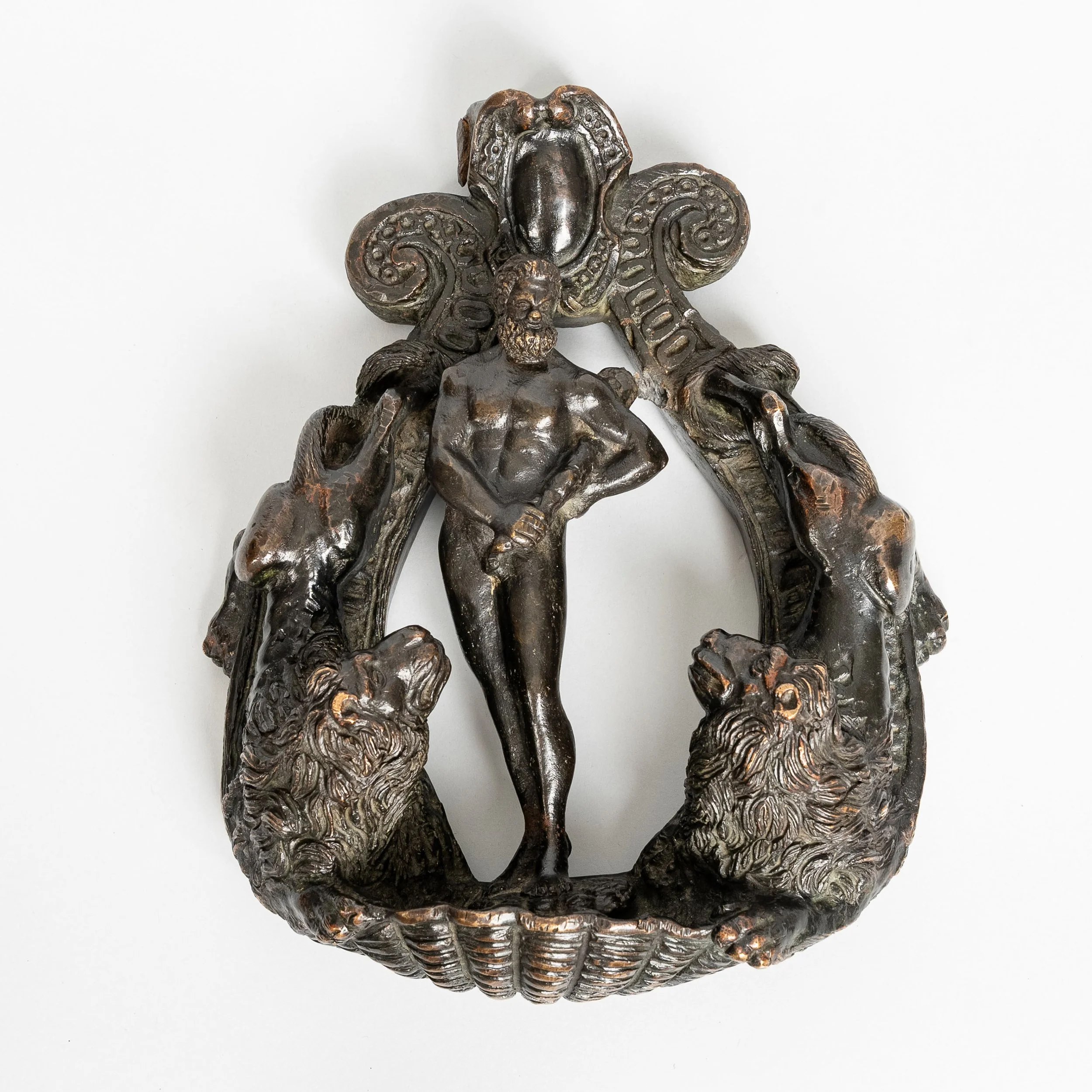 Image 1 of 2
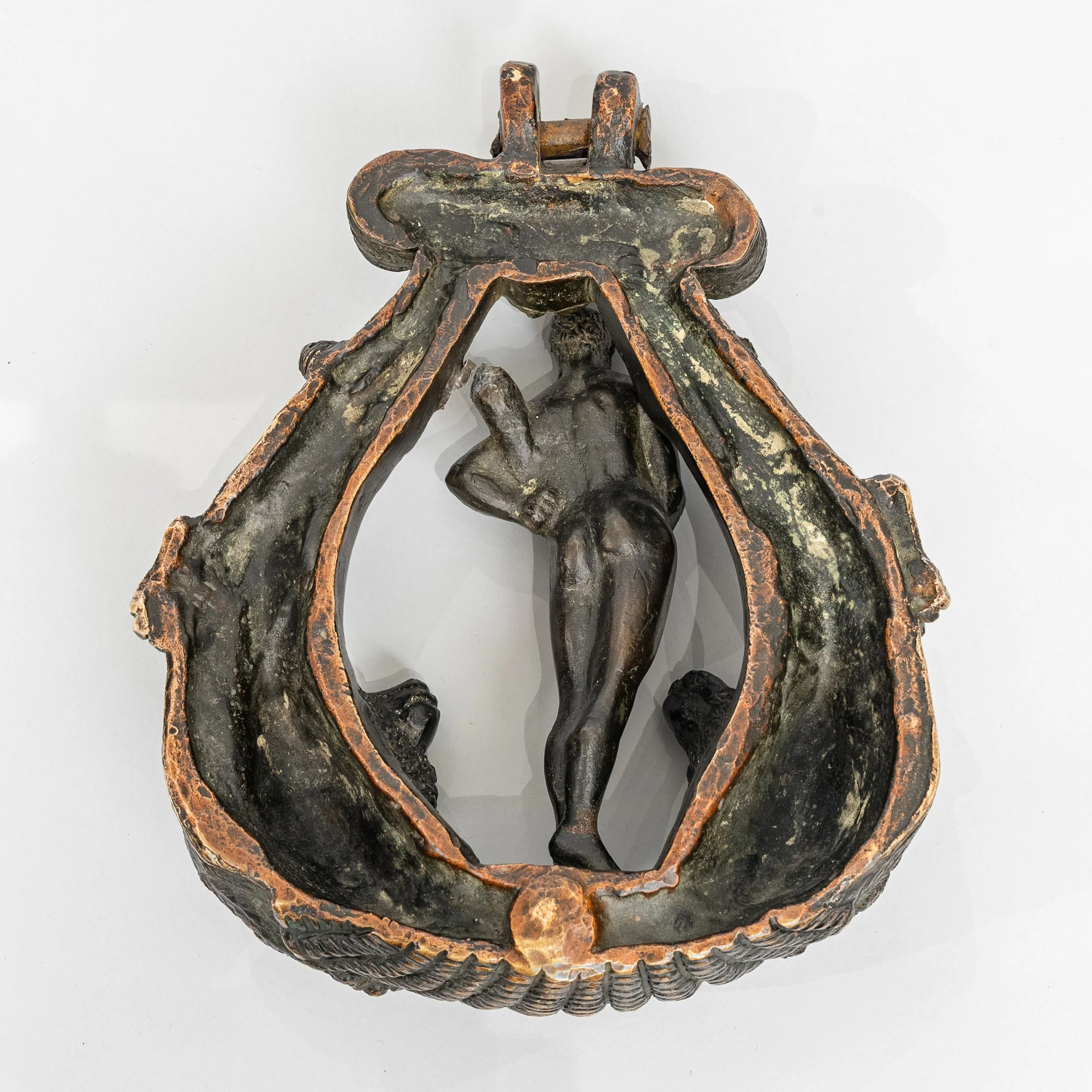 Image 2 of 2