
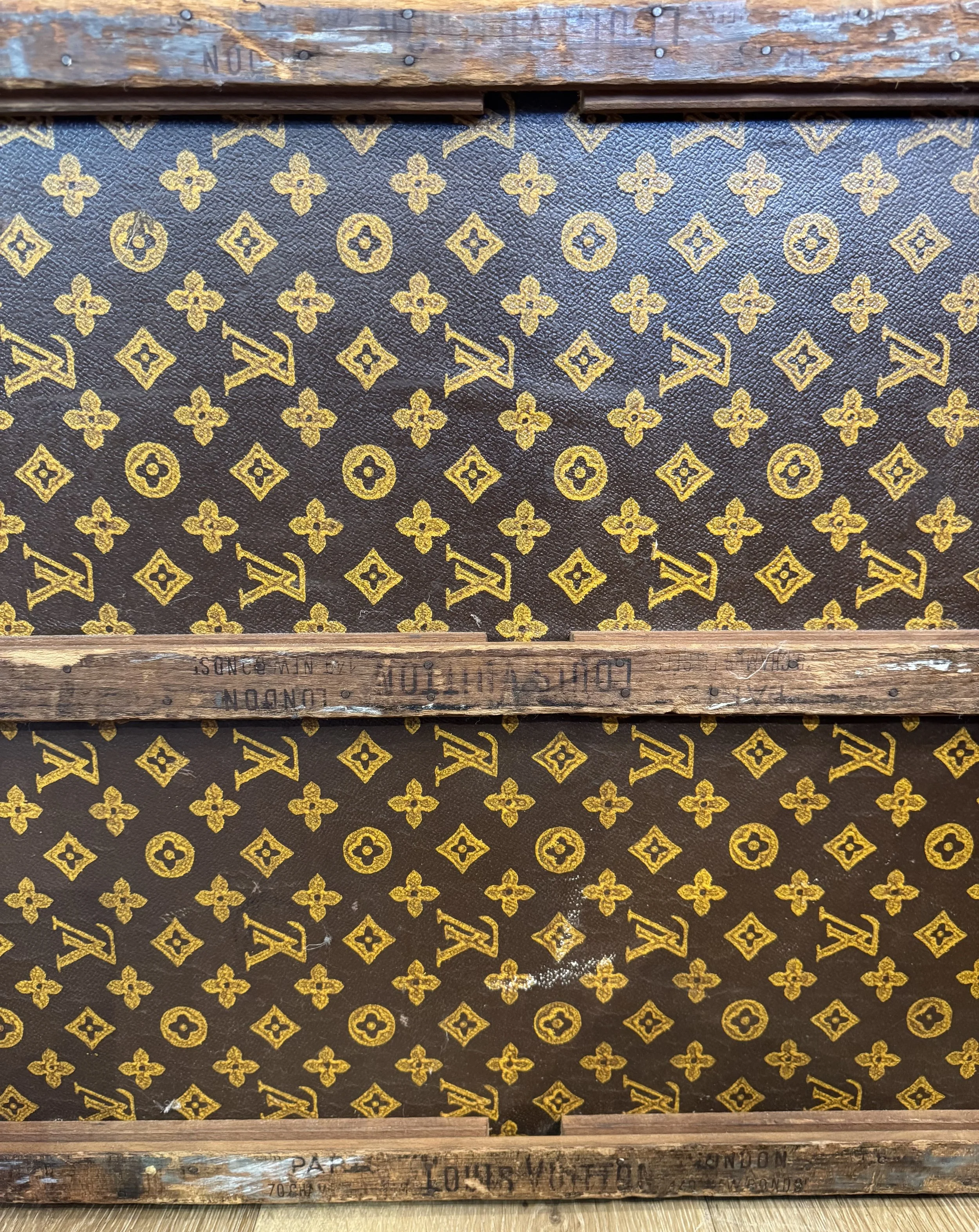
Antique Trunks & Luggage
Louis Vuitton
One of the largest and most carefully documented collections of antique Louis Vuitton trunks in the United States, spanning the golden age of the house from the 1880s to the 1940s. Steamer, cabin, wardrobe, shoe, and hat trunks, alongside rarer bespoke commissions, are offered in monogram canvas, natural leather, and hermetic zinc, each selected for condition, originality of hardware, and the integrity of its dating evidence.

Antique Louis Vuitton Trunks & Luggage
Louis Vuitton established his Paris atelier in 1854, and within a generation had built the most celebrated name in luxury travel, its monogram canvas, flat-topped trunk construction, and signature brass hardware becoming the defining language of elite travel for the century that followed. The golden age of the Vuitton trunk spans roughly 1880 to 1940, encompassing the great ocean liner crossings, the Orient Express, and the colonial and expeditionary travel of the late nineteenth and early twentieth centuries. During this period the house produced an extraordinary range of forms: the flat-topped steamer trunk engineered for the hold of a transatlantic liner; the low-profile cabin trunk designed to slide beneath the berth of a first-class stateroom; the wardrobe trunk fitted with hangers and drawers for extended travel; the shoe trunk with its individual fitted compartments; the hat trunk; the jewelry case; and the bespoke commission, including library trunks, bar trunks, and expedition trunks in hermetically sealed zinc, produced for individual clients to requirements that no other maker could match. Address stampings on the hardware and serial numbers on the lock plates allow precise dating, with the sequence of Paris addresses, from 1 Rue Scribe through 70 Champs-Élysées, providing a reliable chronological framework for attribution.
Daniels Antiques has been dealing in antique Louis Vuitton trunks and luggage for over twenty years, with one of the most varied and carefully documented collections available in the United States. The inventory spans monogram canvas, natural leather, Roma canvas, flower canvas, and zinc construction, from the 1880s through the 1940s, including a shoe trunk made for opera star Lily Pons and a library trunk specially made for the Encyclopedia Britannica. Each piece is selected for its condition, the originality of its hardware and interior, and the integrity of its dating evidence. Pieces may be viewed by appointment at our galleries in Aspen, Colorado, and Fort Lauderdale, Florida. We are always interested in acquiring fine Louis Vuitton trunks.
———————————————————————————————————————
See our guides to antique Louis Vuitton trunks and how to authenticate a Louis Vuitton trunk.
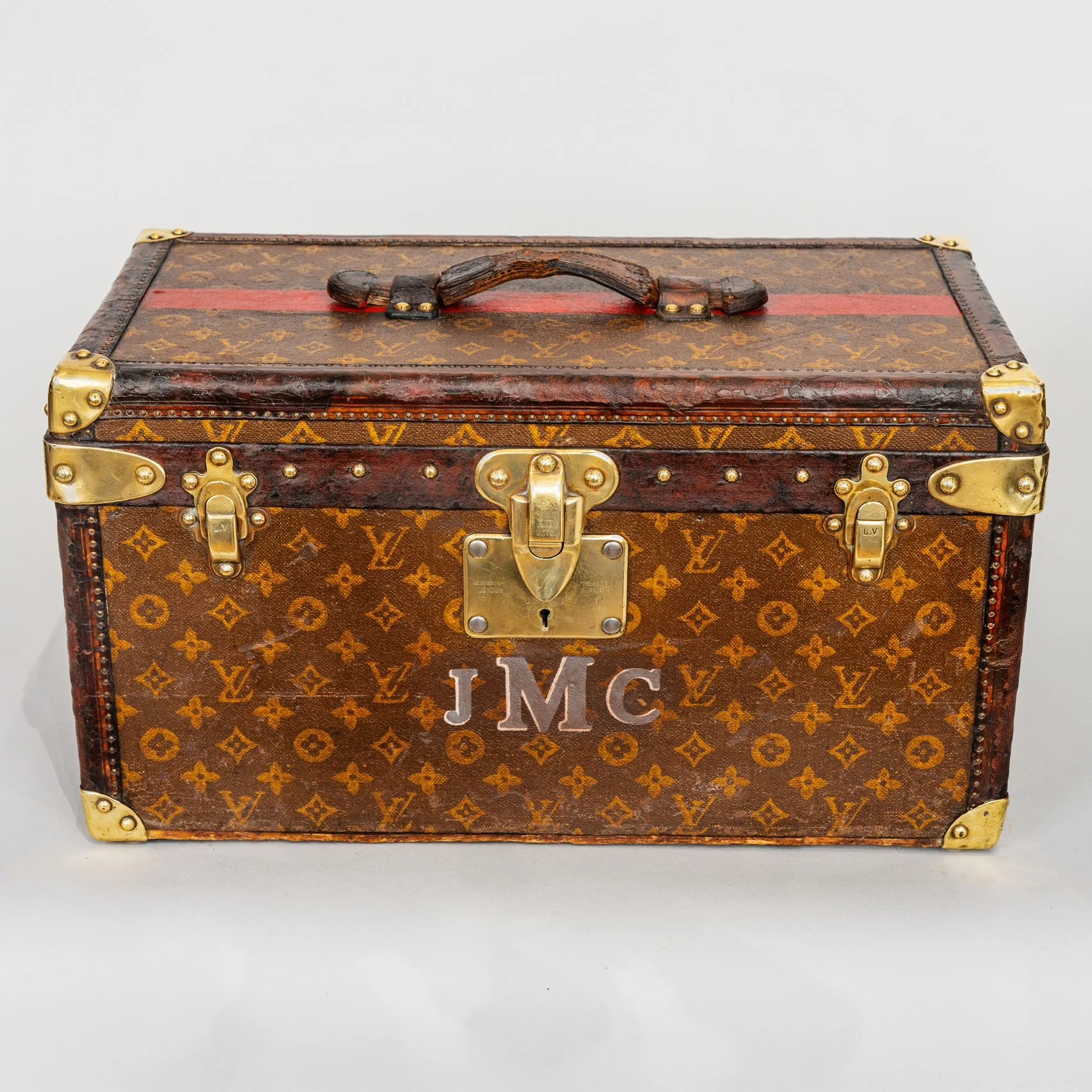
A small Louis Vuitton trunk in the classic LV monogram canvas, retaining its original brass hardware, leather trim, and painted initials throughout. The exterior is fitted with stamped brass hardware, a central lock, two swing-latch clasps, and brass corner protectors at all eight corners. The dark leather-trimmed borders are studded with domed brass nails, and a painted red lozenge stripe runs the full width of the lid. The dark leather carry handle is original.
The front bears the original owner's painted initials JMC in silver. The central lock is engraved with the maker's addresses, 149 New Bond Street, London and 1 Rue Scribe, Paris, the address Louis Vuitton occupied from 1871 until 1914, consistent with the dating of this piece.
The lid interior is lined in the original cream quilted linen, studded in a diamond lattice with brass tacks. The body is lined in the maker's natural linen canvas.
Dimensions: 20 inches long, 11 inches deep, 11 inches tall.
For a larger Louis Vuitton piece bearing the same 1 Rue Scribe, Paris address, see our 1905–1910 steamer trunk produced exclusively for John Wanamaker.
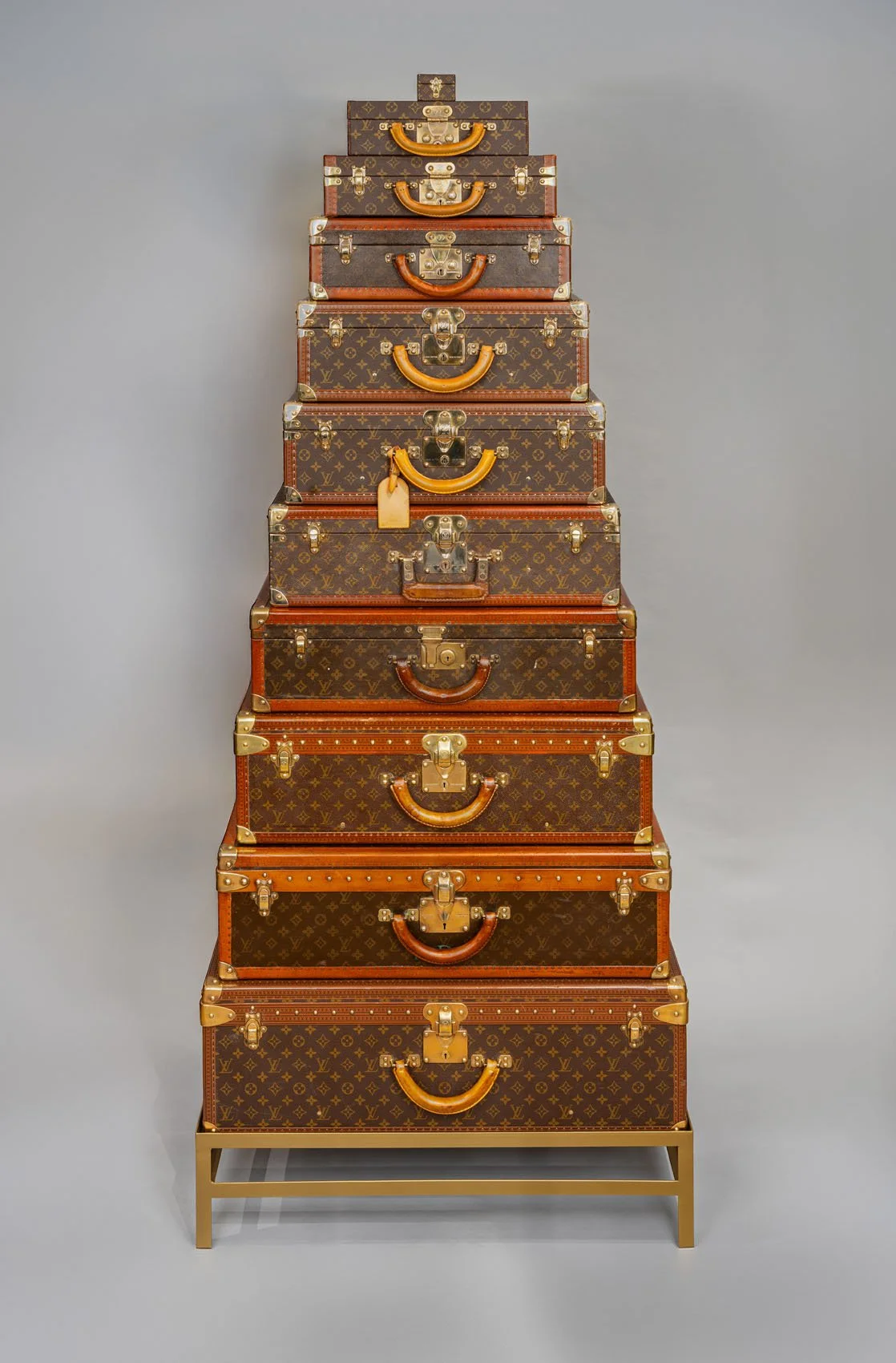
Assembled over two years, this graduated stack brings together eleven vintage Louis Vuitton monogram canvas trunks, arranged largest to smallest and rising as a single sculptural tower on a custom stand made expressly for the purpose. The trunks span the 1920s through the 1970s, each in monogram canvas with lozine edging, natural leather trim, and brass fittings, and together they trace half a century of the house's most enduring design. Every trunk in the stack is an exceptional example in its own right, selected for condition as much as for proportion, with the brass hardware hand-polished to a warm, even shine. To compose a stack of this kind is the work of patience rather than purchase, since the trunks must descend in even steps of size while holding to a consistent character, and pieces of the right quality and proportion appear only rarely. The custom stand raises the ensemble clear of the floor, so that it reads less as luggage than as sculpture, a true work of art for the home, commanding as the focal point of an entrance hall, a stair, a gallery, or a grand dressing room. Offered as a single lot, it is a rare opportunity to acquire, in a single moment, what is otherwise the patient work of years.
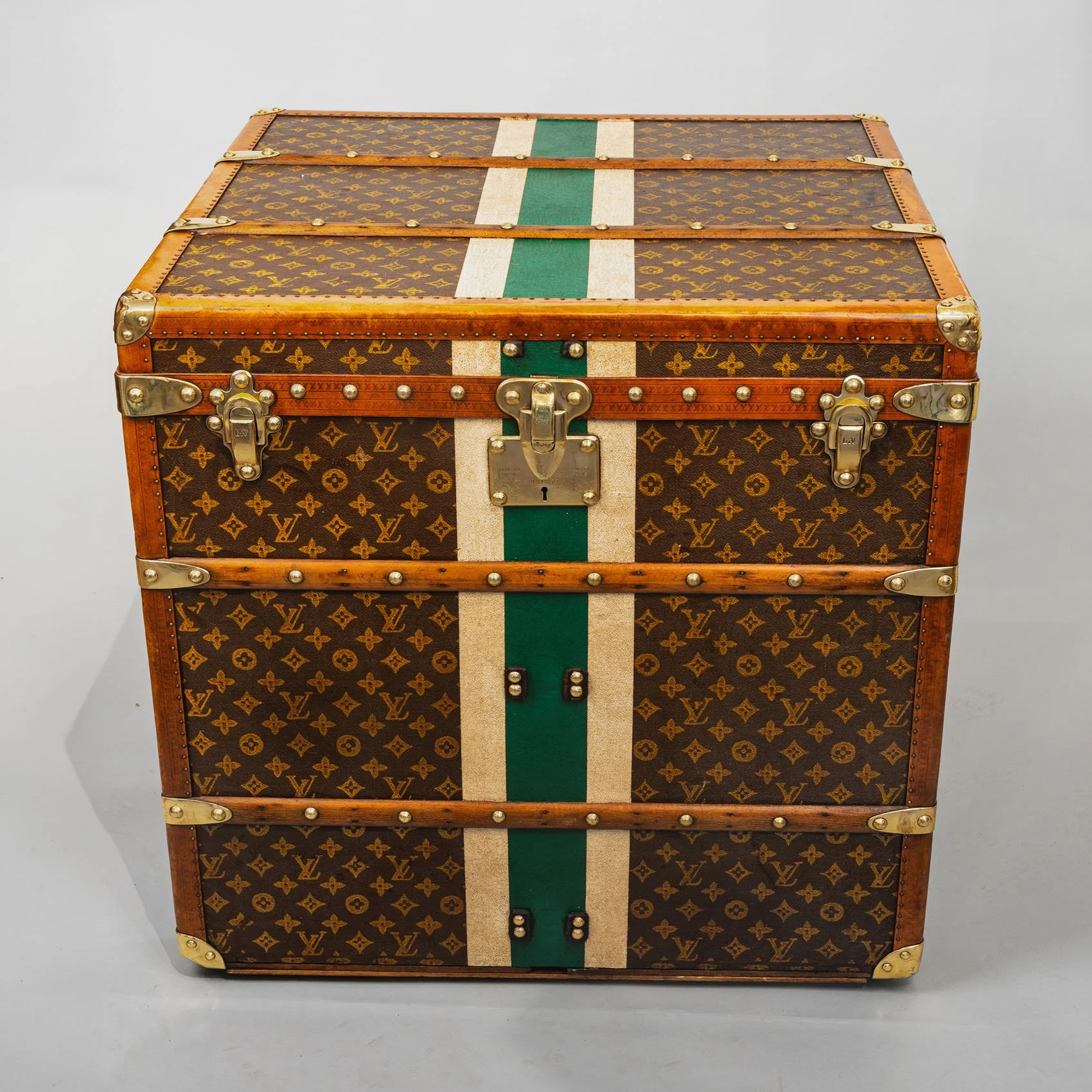
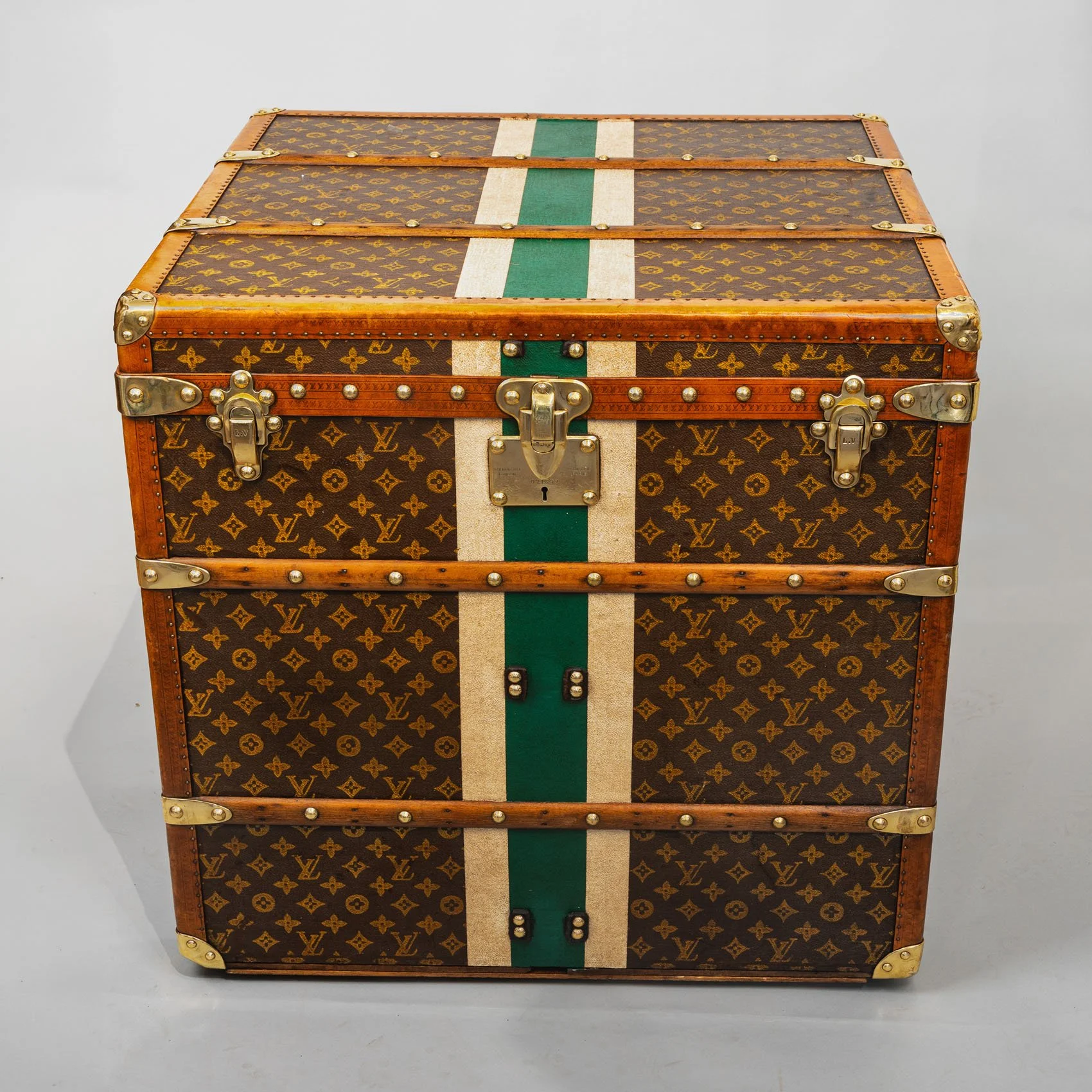
This rare Louis Vuitton monogram canvas double hat trunk, dating to the 1920s, is distinguished by its bold green and cream painted stripe and represents one of the most striking and scarce forms of early 20th-century luxury travel luggage.
Covered in the house’s iconic monogram canvas, the trunk is bound with lozine leather trim, brass edges, and reinforced corner mounts. The domed lid is secured by leather slats, while the front retains its central brass lock stamped ‘Louis Vuitton’ and flanked by spring latches. Leather side handles complete the form, combining durability with refined construction.
The interior is lined in quilted canvas and retains its original fitted double “cage” with webbed supports, designed to secure multiple hats in transit. This specialized system prevented crushing while allowing air circulation—an essential innovation at a time when hats formed a central element of both men’s and women’s dress.
Double hat trunks of this scale were produced in very limited numbers and typically executed as special commissions. Their larger proportions, combined with bold painted livery such as the present example, ensured immediate recognition during travel and give the piece a commanding sculptural presence today.
Produced during the golden age of travel, Louis Vuitton revolutionized luggage design with purpose-built forms tailored to the needs of an international clientele. The malle à chapeaux stands among the most sophisticated of these creations, reflecting both technical ingenuity and refined taste.
Today, double hat trunks remain among the rarest and most desirable Vuitton models, prized for their scale, bespoke nature, and strong decorative appeal. Examples retaining original interiors and distinctive painted decoration are increasingly scarce.
Explore additional Louis Vuitton trunks, including explorer trunks, library trunks, and other rare bespoke examples from the golden age of travel.
Condition
Very good overall condition, with a richly developed patina to the monogram canvas and leather trim consistent with age and use. The painted stripe remains vibrant and well-preserved. Brass hardware with light surface wear and oxidation. Interior clean and complete, retaining the original fitted double hat “cage” with expected signs of use.
Dimensions:
26”width x 25.5”height x 24.5”depth
Literature
Comparable examples of Louis Vuitton hat trunks and specialized travel cases are illustrated in:
Pierre Léonforte and Eric Pujalet-Plaà, Louis Vuitton: 100 Legendary Trunks, Abrams, New York, 2010.
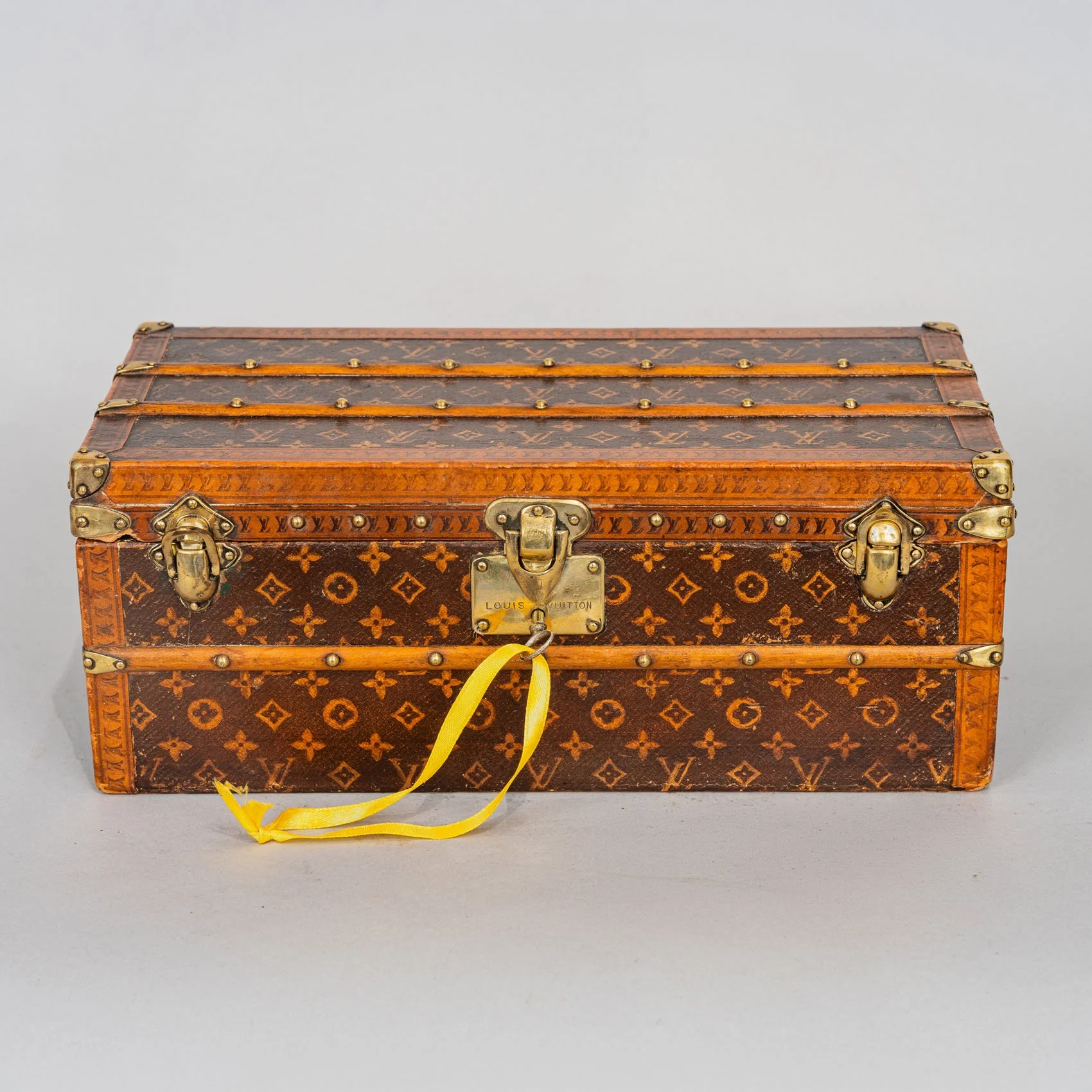
The Malle Fleurs was never sold. It appeared in no window and no catalog: it was given, personally, by Georges and Gaston-Louis Vuitton to the clients they valued most. To receive one was to be acknowledged as belonging to the innermost circle of the house, a distinction no money could buy.
The custom began in 1910. Forbidden by house rule from offering discounts to even their most loyal clients, the Vuittons devised another gesture of gratitude: instead of a bouquet, flowers planted in a miniature trunk in the house monogram. By the 1920s and 1930s it had become one of the most coveted status symbols in Paris. The soprano Marthe Chenal received hers in 1922, in the very years of the present example, and Georges Vuitton himself was photographed examining a flower trunk around 1930. The custom continued until the early 1980s.
This example, circa 1920, is built in papier-mâché, covered in the monogram paper finish, the more refined specification reserved for these gift objects rather than the canvas used in commercial trunk production. It is trimmed with the LV pattern edging and fitted with brass corner guards, side clasps, a stamped lock plate, and leather handles, and, as a survival of the greatest rarity, the original key, still on its yellow ribbon. The interior is lined in French marbled paper, swirling greens, golds, purples, and creams, a theatrical reveal that shows the piece was conceived from the outset as a jewelry or decorative box rather than a planter.
Flower trunks of this period, with the key present, are among the most collectible of all Vuitton objects and appear on the market only rarely.
Condition: Very good, consistent with age. Honest patina to the monogram paper, brass hardware complete, handles sound, marbled lining rich throughout. Original key on yellow ribbon.
Dimensions: 11 in. width x 5 1/2 in. depth x 4 1/4 in. height
Literature: Pierre Léonforte and Éric Pujalet-Plaà, Louis Vuitton: 100 Legendary Trunks, New York, 2010, p. 334, "Trunk for Flowers, Georges and Gaston-Louis Vuitton, Paris, 1910," including the photograph of Georges Vuitton examining a flower trunk, c.1930.
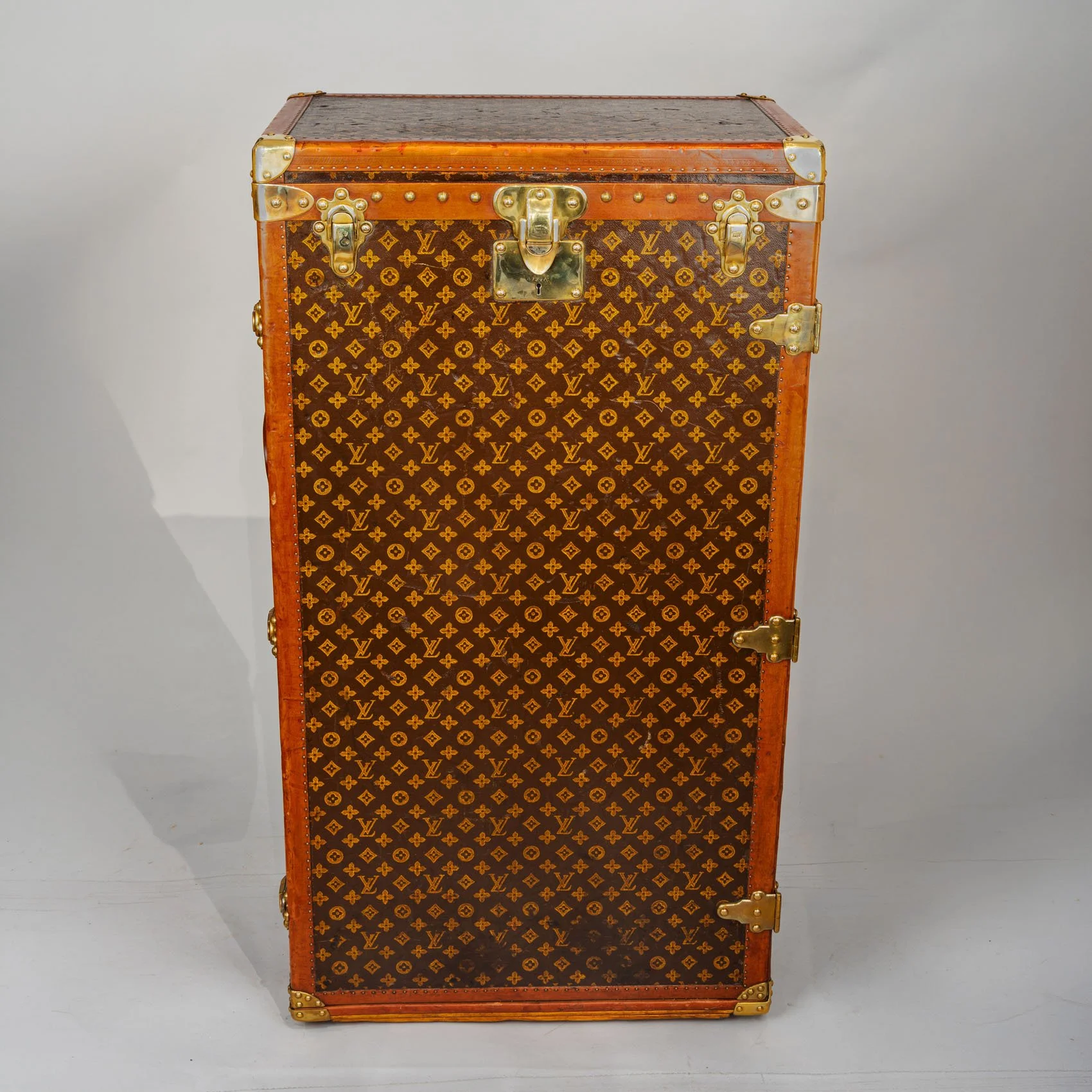
This rare Louis Vuitton monogram canvas shoe trunk, dating to the 1920s, represents one of the most sophisticated and highly specialized forms of early twentieth-century luxury travel luggage.
Constructed in the house's iconic monogram canvas with lozine leather trim, the trunk is reinforced with brass-bound edges and corner mounts, and fitted with a central brass lock and multiple latches. The side door opens to reveal an exceptionally well-preserved interior, fully fitted with a series of individual drawers, each with leather pulls and label frames, above a larger compartment below.
Designed as a portable wardrobe for footwear, the trunk reflects Louis Vuitton's remarkable innovation during the golden age of travel. Each drawer functions as an individual shoebox, allowing pairs to be stored securely while remaining immediately accessible, an elegant solution to the demands of an increasingly mobile and style-conscious clientele.
As recorded in period accounts, Vuitton developed such compartmentalized interiors to protect delicate personal effects while maintaining order in transit. The form was first created for the soprano Lily Pons, whose celebrated commission was designed to carry some thirty pairs of shoes, and the house subsequently produced trunks of this type for other discerning clients. The present example belongs to that lineage: closely related to the Pons original in form and function, though a distinct trunk in its own right.
Examples of shoe trunks with complete fitted drawer systems were produced in limited numbers and often executed as bespoke commissions. With its intact interior and exceptional state of preservation, the present example stands as a rare and highly functional expression of Vuitton's craftsmanship and the culture of refined travel in the early twentieth century. Today, such trunks are among the most desirable Vuitton forms, combining architectural presence with a direct connection to the lifestyle of an international elite.
Condition: Very good overall, with a well-developed patina to the monogram canvas and leather trim consistent with age and use. Brass hardware shows light surface wear and oxidation. The interior is exceptionally well-preserved and complete, retaining the full set of fitted drawers with minor, as expected, wear.
Dimensions: 45 in. high × 24 in. wide × 16 in. deep
Literature: Pierre Léonforte and Éric Pujalet-Plaà, 100 Legendary Trunks: Louis Vuitton, Abrams, New York, 2010 (see the discussion of specialized shoe trunks and compartmentalized interiors, pp. 252–253).
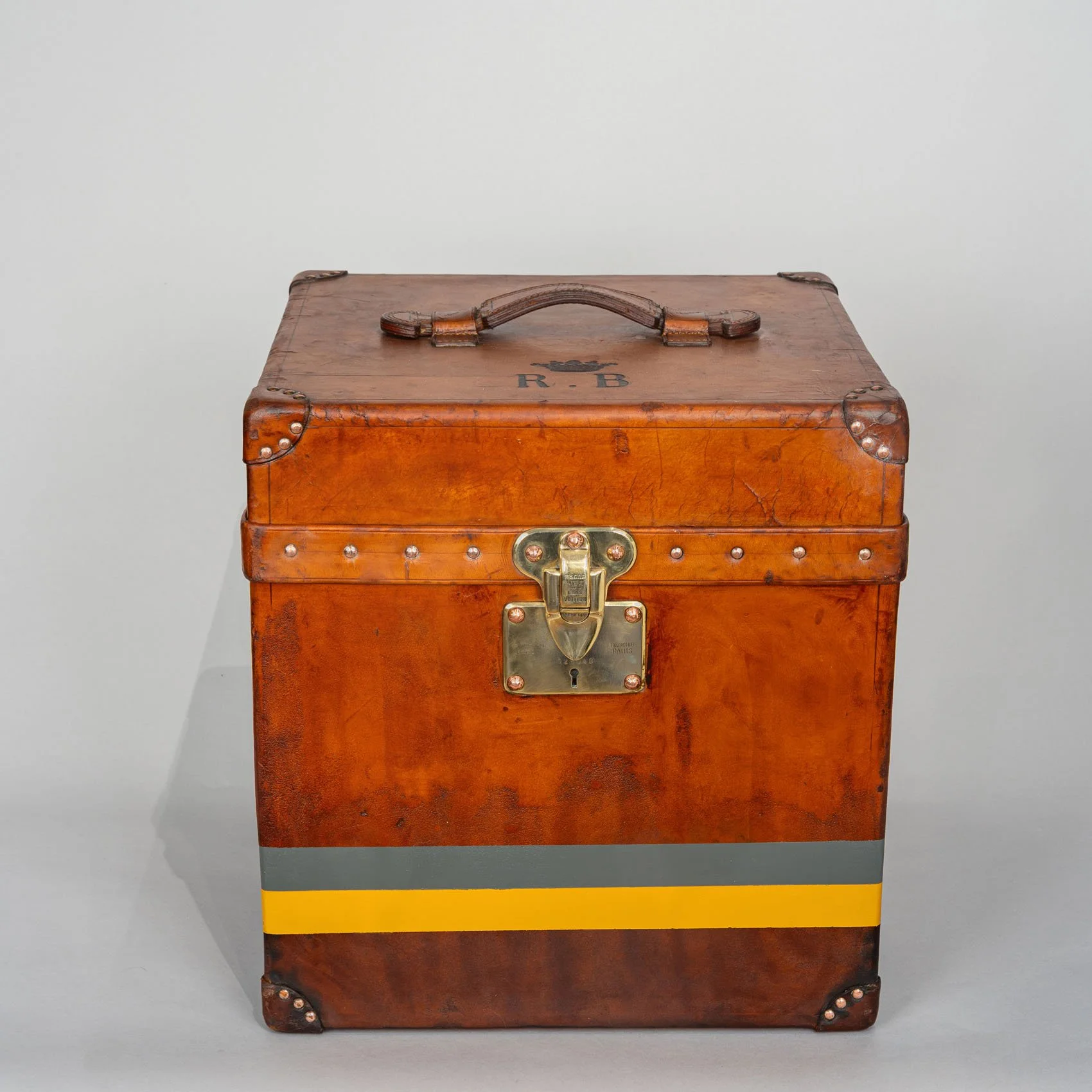
A Louis Vuitton hat trunk, the malle à chapeau, in untreated cuir naturel, early twentieth century. Of square form, bound with riveted leather bands and fitted with a brass lockplate and protective corner mounts, the lid centered with a leather handle and stenciled R.B. beneath a coronet, the body encircled by grey and yellow painted identification stripes for immediate recognition in transit. The leather has matured to the deep, varied patina these pieces were designed to acquire, each one uniquely with use, and the interior is lined in cream canvas retaining the Louis Vuitton label.
By the turn of the twentieth century, Vuitton was particularly attentive to the safe transport of hats, essential elements of formal dress, and the malle à chapeau was developed precisely for this purpose, its structured interior preserving delicate forms through rail and steamship journeys. Bespoke examples were made for distinguished patrons, among them the hatboxes commissioned for William Twombley in Paris in 1895, and the coronet stenciled above the initials here points to a titled original owner. Cuir naturel examples with original personalization are among the most sought-after forms of early Vuitton luggage.
Condition: Very good. Beautifully developed patina with wear consistent with age and use; brass hardware with an attractive aged surface; lining present and clean with light age toning; structurally sound.
Dimensions: 15 in. width x 16.5 in. height x 13.75 in. depth
Literature: Florence Müller, Louis Vuitton: 100 Legendary Trunks, New York, 2010; Pierre Léonforte, Louis Vuitton: The Birth of Modern Luxury, Paris, 2004
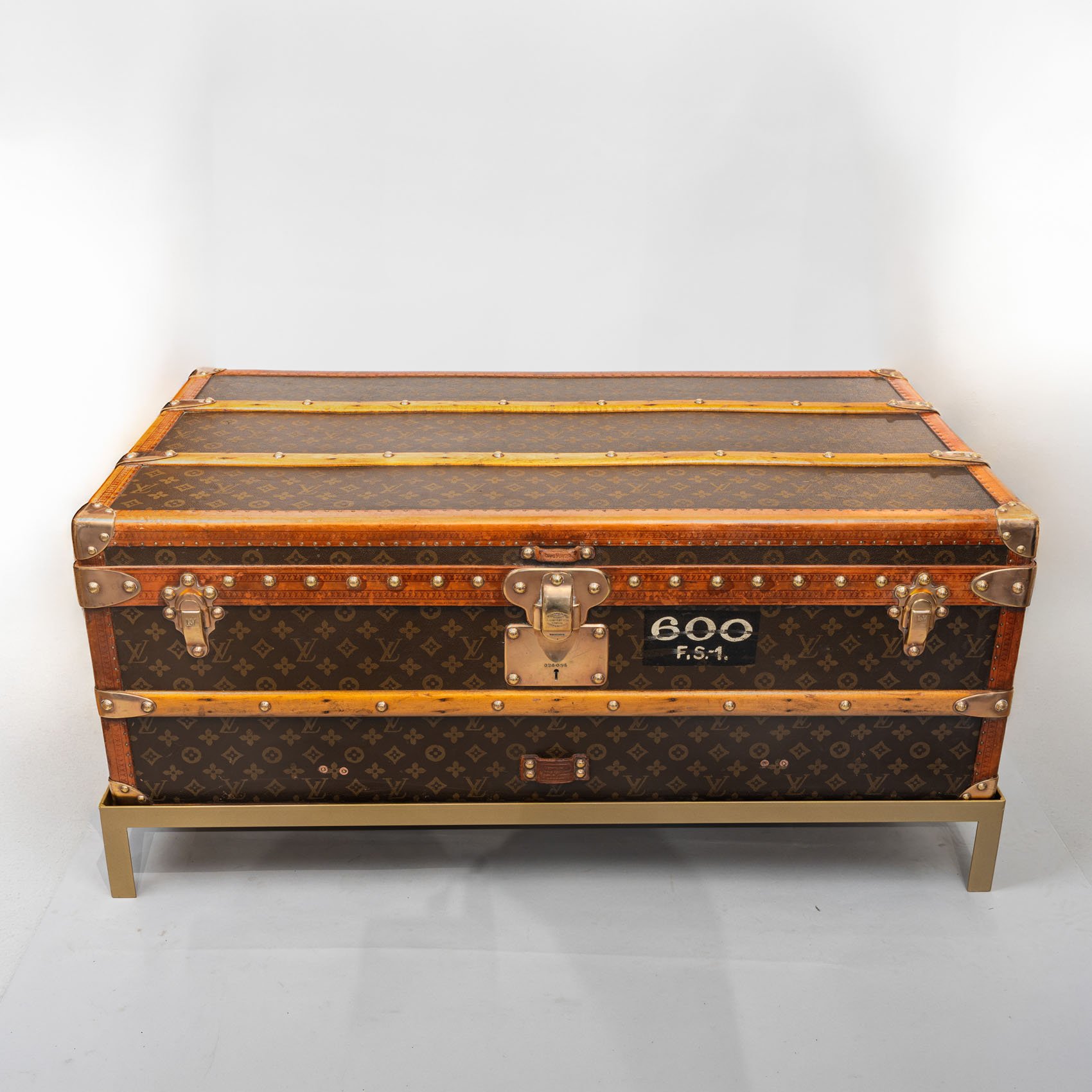
The cabin trunk is the form that defined transatlantic travel in its golden age — engineered to a reduced height that allowed it to slide beneath the berth of a first-class stateroom aboard the great ocean liners of the early twentieth century, keeping a traveler's essentials within reach for the duration of a crossing that might last five days or more. This handsome example, dating to the 1920s and produced in Louis Vuitton's Paris atelier, retains on its front face the original stencilled designation "600 F.S.-1" — almost certainly a stateroom or cabin assignment from its days aboard a passenger vessel, a marking applied by the ship's baggage handlers to ensure correct routing and delivery. It is a detail that transforms a fine trunk into a specific historical object: one that crossed oceans, was handled by porters, and was delivered to a first-class cabin by people who knew exactly what it was and who it belonged to.
The exterior is executed in monogram canvas with the natural wood slat banding characteristic of 1920s production, lozine leather trim with the embossed LV border running the full perimeter, and the full complement of original brass hardware — central lock plate, flanking clasps, corner guards, and studded borders. The lock plate is stamped with the serial number 075075. The canvas presents with the characteristic warm, rich patina of a piece that has lived a full life in honest use, while retaining the structural integrity of Vuitton's exceptional construction throughout.
The interior is lined and fitted, preserving the original configuration in which the trunk traveled. The piece is presented on a custom brass stand — the same clean rectangular profile as Vuitton's own display mounts — which elevates it to coffee table height while allowing the lid to open freely, providing storage of considerable capacity.
Cabin trunks with clear, legible period stencilling documenting their original shipboard use are a specific and sought-after category within the Vuitton collecting market. The combination of the "600 F.S.-1" designation, the serial number, and the original hardware and interior in this condition represents a piece of genuine travel history.
Stencilling: 600 F.S.-1 (original shipboard cabin designation) Serial No.: 075075 Dimensions: 13 × 36 × 20 in Stand: Custom brass, purpose-made
Condition: Very good overall, consistent with age and honest use. Monogram canvas strong throughout with rich, even patina. Natural wood slat banding and lozine trim structurally sound. Brass hardware complete — lock plate, clasps, corner guards, and studs all present. Serial number 075075 on lock plate. Stencilling "600 F.S.-1" bold and fully legible. Interior lining and fittings present and intact. Custom brass stand present and structurally sound.
Literature:
Paul-Gérard Pasols, Louis Vuitton: Malletier à Paris, Paris, 1987
Florence Müller, Louis Vuitton: 100 Legendary Trunks, New York, 2010
Pierre Léonforte, Louis Vuitton: The Birth of Modern Luxury, Paris, 2004
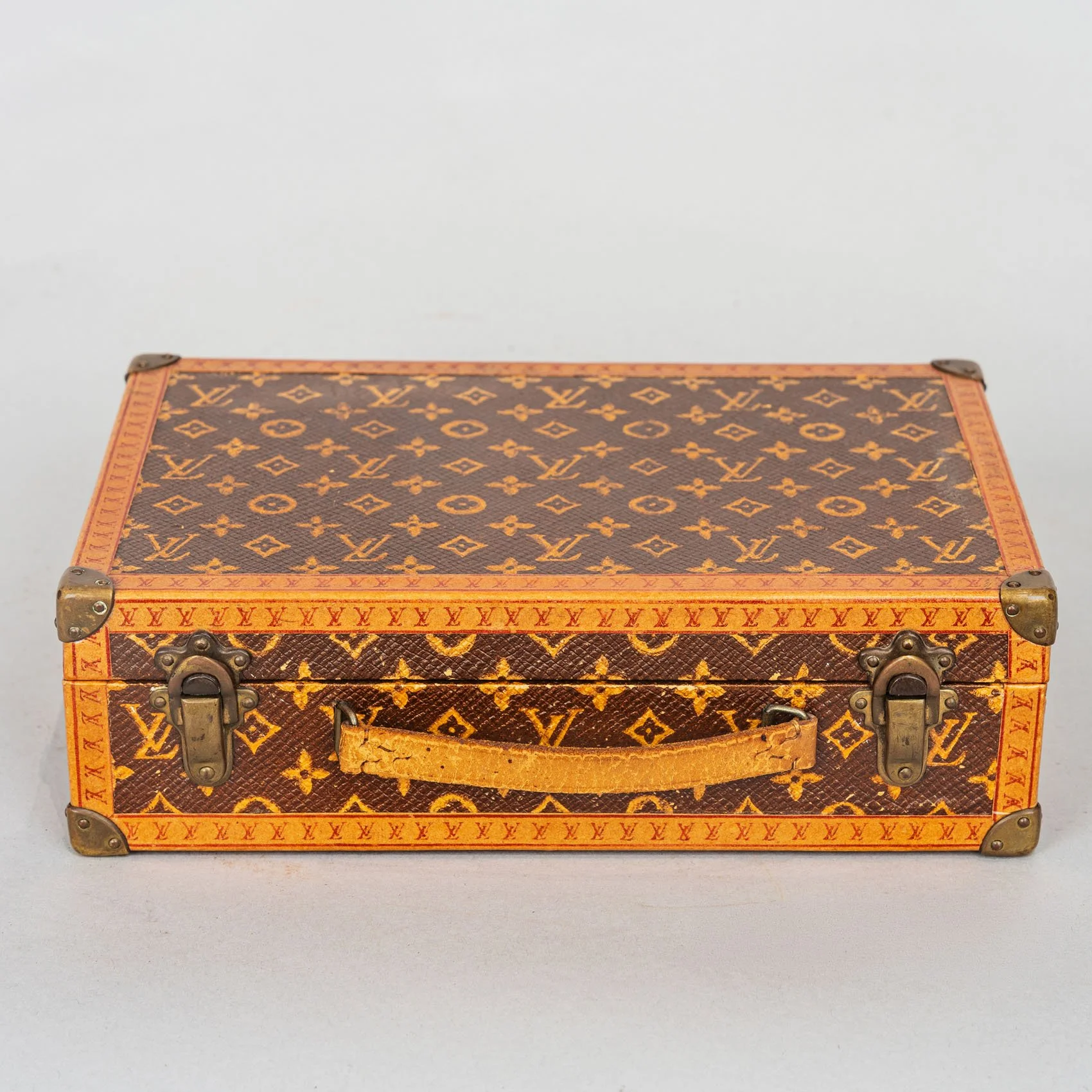
This small jewelry case shares its construction directly with the celebrated flower trunks produced from around 1910 — the same printed monogram paper laminated over a lightweight board core, the same grained natural leather interior, the same L.Vuitton maker's stamp. It belongs to the same rarefied tier of Vuitton production as those objects reserved for the maison's most valued clients, conceived for the dressing table rather than the hold, and built with a delicacy that reflects its purpose entirely.
The exterior features the classic LV monogram in the warm ochre-and-brown palette of early twentieth-century production, with the characteristic LV-initialed border stripe in red and gold running along all edges. Brass lozenge-form lock clasps secure the lid at either side, matched by brass corner protectors at all eight corners. The vachetta leather handle has developed a deep honey patina consistent with careful use over many decades.
The interior is lined throughout in grained natural leather, a single central divider creating two shallow compartments ideally proportioned for jewelry, watches, or small valuables. The inner corner bears the stamped maker's mark L.Vuitton, associated with early pieces predating the fuller address stamps of later production.
At 9 inches wide, 5 inches deep, and 3½ inches tall, this is a personal object of the first order.
Dimensions: 9 in. wide × 5 in. deep × 3½ in. tall (22.9 × 12.7 × 8.9 cm)
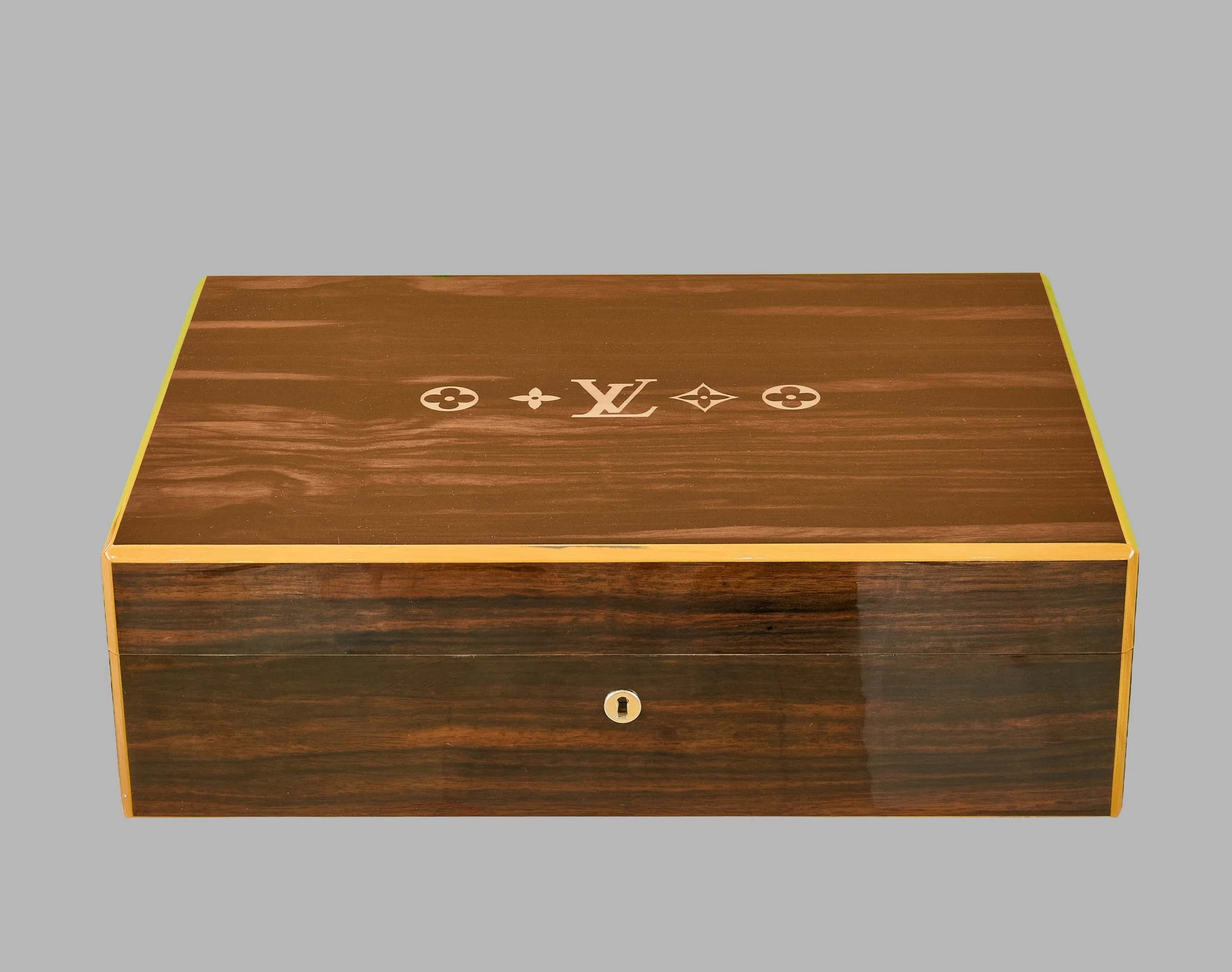
Louis Vuitton cigar humidor, the case in mahogany with a Macassar ebony veneer and pear wood accents, the high-gloss lid centered with the Louis Vuitton monogram, its flowers, quatrefoils, and initials worked in pear wood inlay, with a brass escutcheon to the front.
The interior is lined throughout in cedar and fitted with a removable divided tray, a gilt Louis Vuitton Paris hygrometer set into the lid, and a Credo Precision 70 humidification system; here, a pair of units is retained in their original wrapping. A brass plaque is engraved with "Louis Vuitton,” and the humidor retains its Louis Vuitton Cadeau booklet. Made in France.
Condition: excellent, unused.
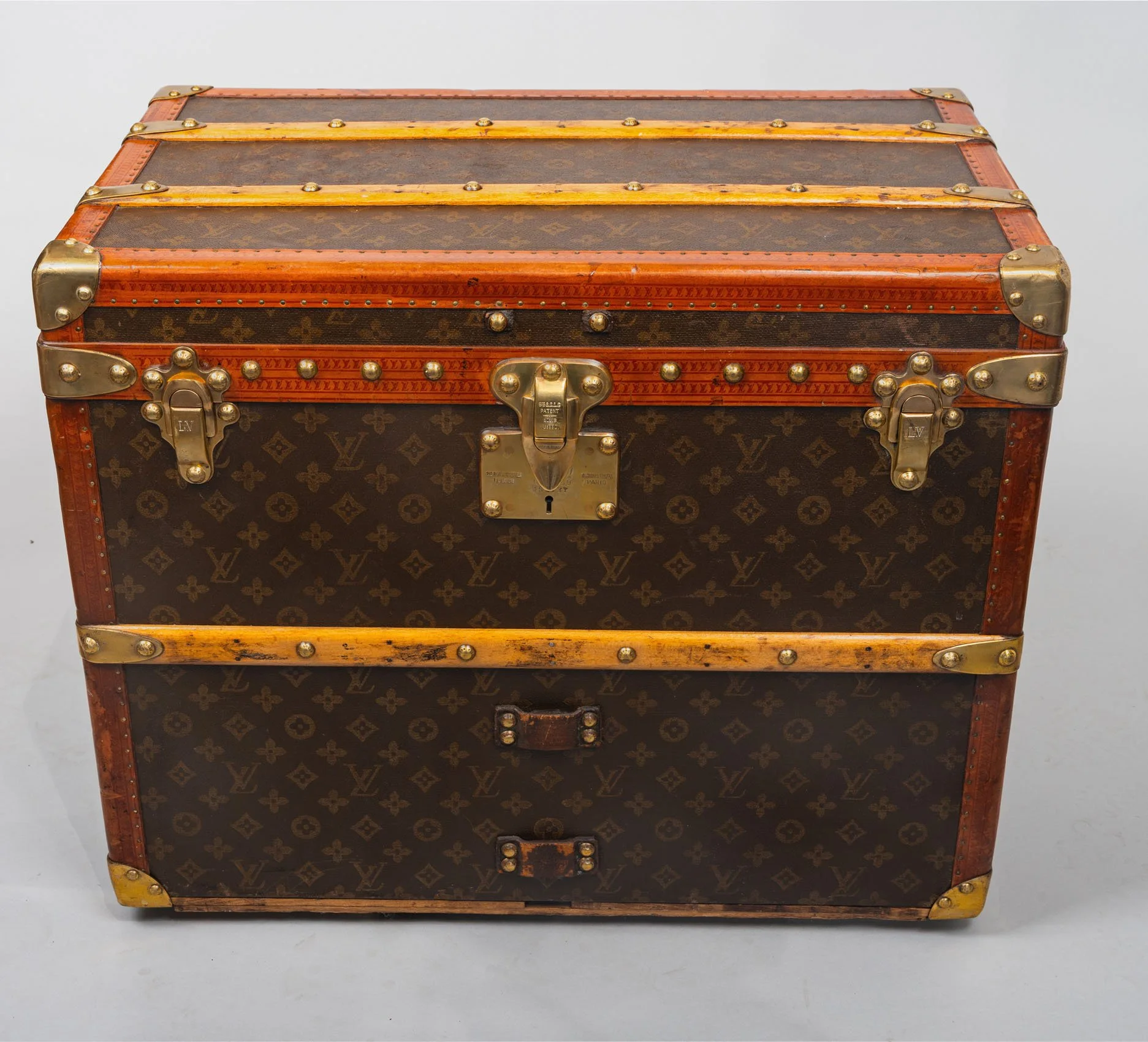
A Louis Vuitton shoe trunk in monogram canvas, made in Paris in the 1920s, with original brass hardware, leather trim, and exposed wooden slats. Leather side handles. The interior retains its original lining and is fitted with three removable trays and compartments for organized footwear storage.
Designed specifically for the transport of shoes, trunks of this form allowed multiple pairs to travel securely and accessibly on extended journeys, in an era when wardrobes traveled in full. They were Vuitton's answer to an increasingly mobile and sophisticated clientele in the early twentieth century, and function less as luggage than as portable dressing systems.
Examples retaining their original interior fittings and hardware, as here, are increasingly scarce, and the survival of these elements adds considerably to the historical integrity and desirability of the piece.
Condition: Wear consistent with age and use; overall very good with strong presentation.
Dimensions: 24 in. wide x 19.5 in. high x 15 in. deep
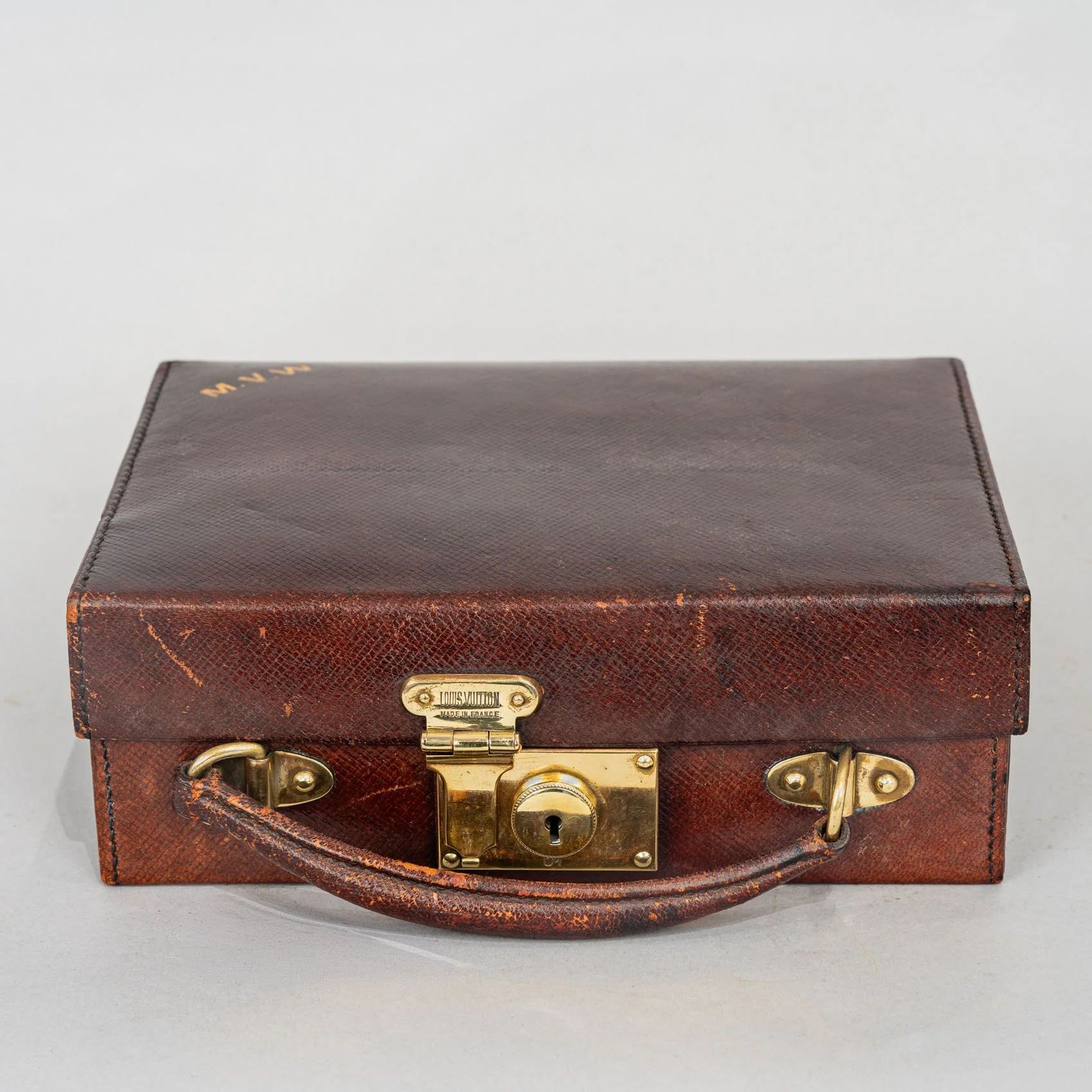
Among the most intimate objects the Louis Vuitton atelier produced, the fitted jewelry case shows the house at its most refined, made not for the rigors of travel but for the private world of its owner. This example, in natural-grain leather with a royal blue velvet interior, is one of the finest of its type we have encountered.
The brass lock plate, stamped Louis Vuitton Made in France, is functional, with the side clasps and leather carry handle present and sound. In the upper-left corner of the lid, the owner's monogram, M.V.W, is stamped in gold. Natural leather pieces of this type were made to order for individual clients rather than kept in stock, and the monogram marks this as a bespoke commission.
The interior is in perfect original condition, remarkable for a piece of this age. The fitted compartments are lined in royal blue velvet of deeply saturated, unfaded color, a central open section flanked by two padded compartments with rolls for rings or bracelets, and the blue silk lid lining is clean and intact. The contrast between the warm chestnut exterior and the vivid blue interior is entirely as made. Serial number 800580 is stamped on the interior leather; the hardware style and serial number place the case in the 1930s.
For the serious Vuitton collector, a natural-leather jewelry case from this period in this state of preservation is an exceptional find.
Condition: Excellent; honest unrestored condition with rich, even patina and no structural losses. No key.
Dimensions: 8 in. width x 6 in. depth x 3 in. height
Literature: Paul-Gérard Pasols, Louis Vuitton: Malletier à Paris, Paris, 1987; Florence Müller, Louis Vuitton: 100 Legendary Trunks, New York, 2010; Pierre Léonforte, Louis Vuitton: The Birth of Modern Luxury, Paris, 2004
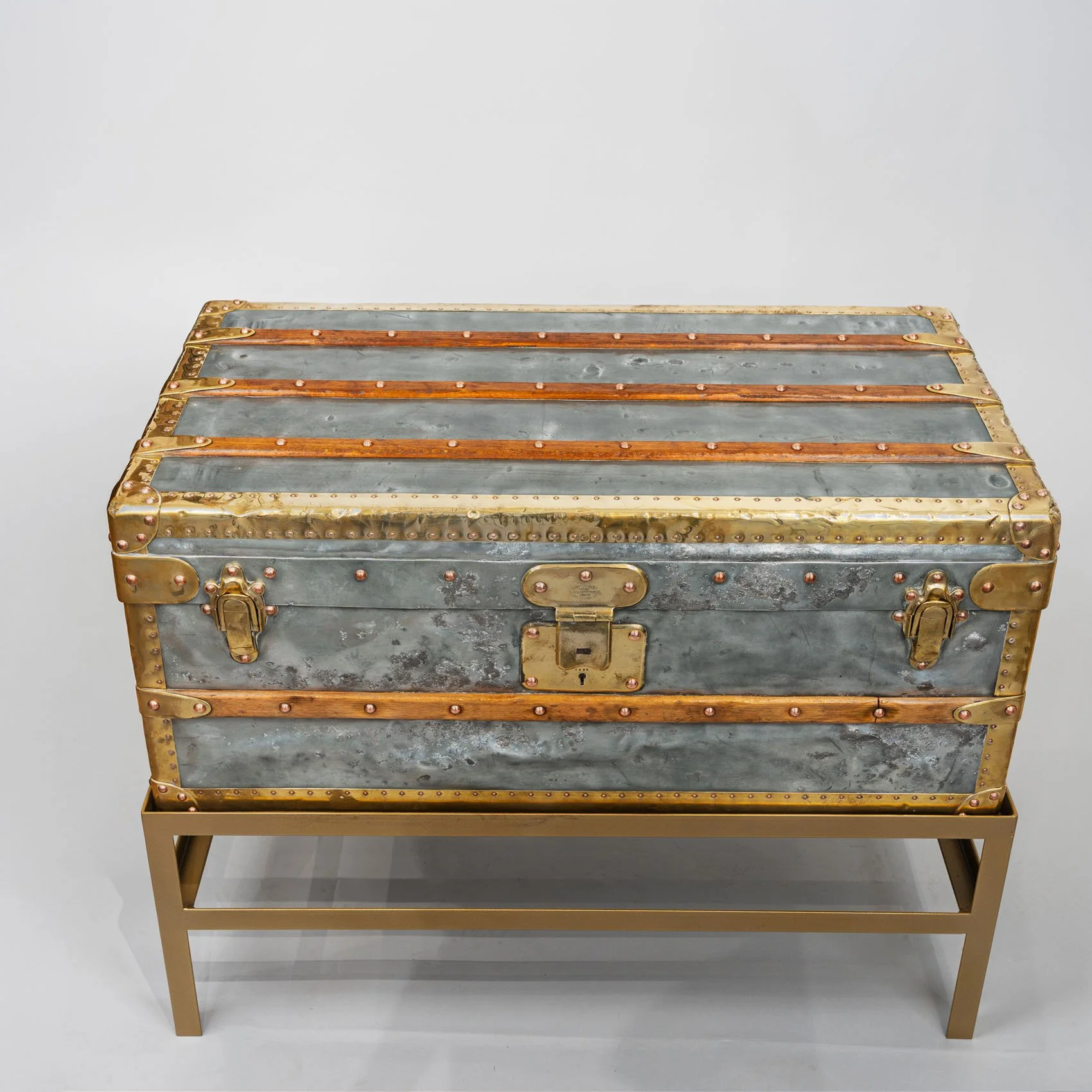
By the 1880s, Louis Vuitton had already transformed the luggage of Europe's most discerning travelers. His striped and Damier checkerboard canvas trunks had become the standard of the transatlantic crossing, the grand hotel, and the continental express. But for a different class of traveler, canvas was not enough: the diplomat, the explorer, the colonial administrator, the naturalist bound for equatorial Africa or the South China Sea. The enemy was not the baggage handler or the rain-wet quayside. It was heat, humidity, tropical insects, and the months-long sea voyage that preceded any destination worthy of the name expedition. For these clients, Vuitton developed one of the most technically ambitious objects in the history of luggage: the zinc-clad hermetic trunk.
This exceptional example, dating to circa 1880–1895, is constructed on a wooden carcass fully sheathed in zinc, a material chosen with precision for its impermeability, its resistance to the corrosive effects of tropical humidity, and its ability to form a near-hermetic seal that kept its contents dry and secure through months at sea. The zinc panels are reinforced with hardwood slats, the characteristic structural element of the Vuitton trunk, translated here into an exceptional material context. Brass mounts, rivets, and the original lock hardware complete the exterior, fittings chosen to resist the very conditions the zinc itself was designed to defeat.
The flat-top form reflects Vuitton's revolutionary approach to travel luggage, a configuration that allowed for efficient stacking in the hold of a steamship or the luggage van of a colonial railway, and that had already distinguished the house from the domed-top makers of an earlier generation. In the zinc trunk, this practical logic is taken to its extreme: a case built not for convenience but for survival, intended to arrive at its destination intact, regardless of what the journey demanded.
More than a century after it was made, the zinc exterior presents a surface of extraordinary character, soft oxidation across the panels creating a nuanced, almost mineral patina that contrasts with the warm tones of the aged hardwood slats and the deep, even burnish of the brass hardware. This is not deterioration; it is the record of a life fully lived, and it is entirely beyond the reach of any reproduction. The interior retains its original Louis Vuitton, Paris label, the authenticating detail that confirms both maker and period, and one that survives in a form decades of expeditionary use might easily have destroyed.
Zinc "Explorer" trunks were produced in limited numbers for a highly specialized clientele and were never part of Vuitton's mainstream production. As documented in Pierre Léonforte and Éric Pujalet-Plaà's 100 Legendary Trunks: Louis Vuitton, they were designed specifically for travel to the tropics and the colonies, offering protection unavailable from any other form of luggage then in existence. Their survival rate is low. Examples retaining original structure, hardware, and interior label in this condition are, by any measure, scarce.
Interior Label: Louis Vuitton, Paris (original, present, and legible)
Provenance: Private collection
Dimensions: 13 in. high × 30 in. wide × 17 in. deep
Condition: Very good overall, structurally solid and stable throughout, with sound hardwood slats and all brass mounts, rivets, and lock hardware present. The zinc exterior carries a rich, even, fully stable oxidation patina with no structural losses, and the original Louis Vuitton, Paris interior label remains present and legible over honest age toning to the lining.
Literature:
Florence Müller, Louis Vuitton: 100 Legendary Trunks, New York, 2010
Pierre Léonforte, Louis Vuitton: The Birth of Modern Luxury, Paris, 2004
Paul-Gérard Pasols, Louis Vuitton: Malletier à Paris, Paris, 1987
When Louis Vuitton opened his London shop circa 1885, he encountered for the first time the luggage traditions of the English gentleman — a culture of travel defined by practicality, restraint, and the finest materials. His response was characteristically creative: he studied the English forms, improved upon them, and designed a model specifically for his British clientele. He named it, with elegant simplicity, the "London" — a roomy, expandable suitcase conceived for the era of railway travel, lighter in construction than the great steamer trunks, and engineered for the particular demands of a clientele accustomed to moving between country house, city club, and continental hotel with equal efficiency.
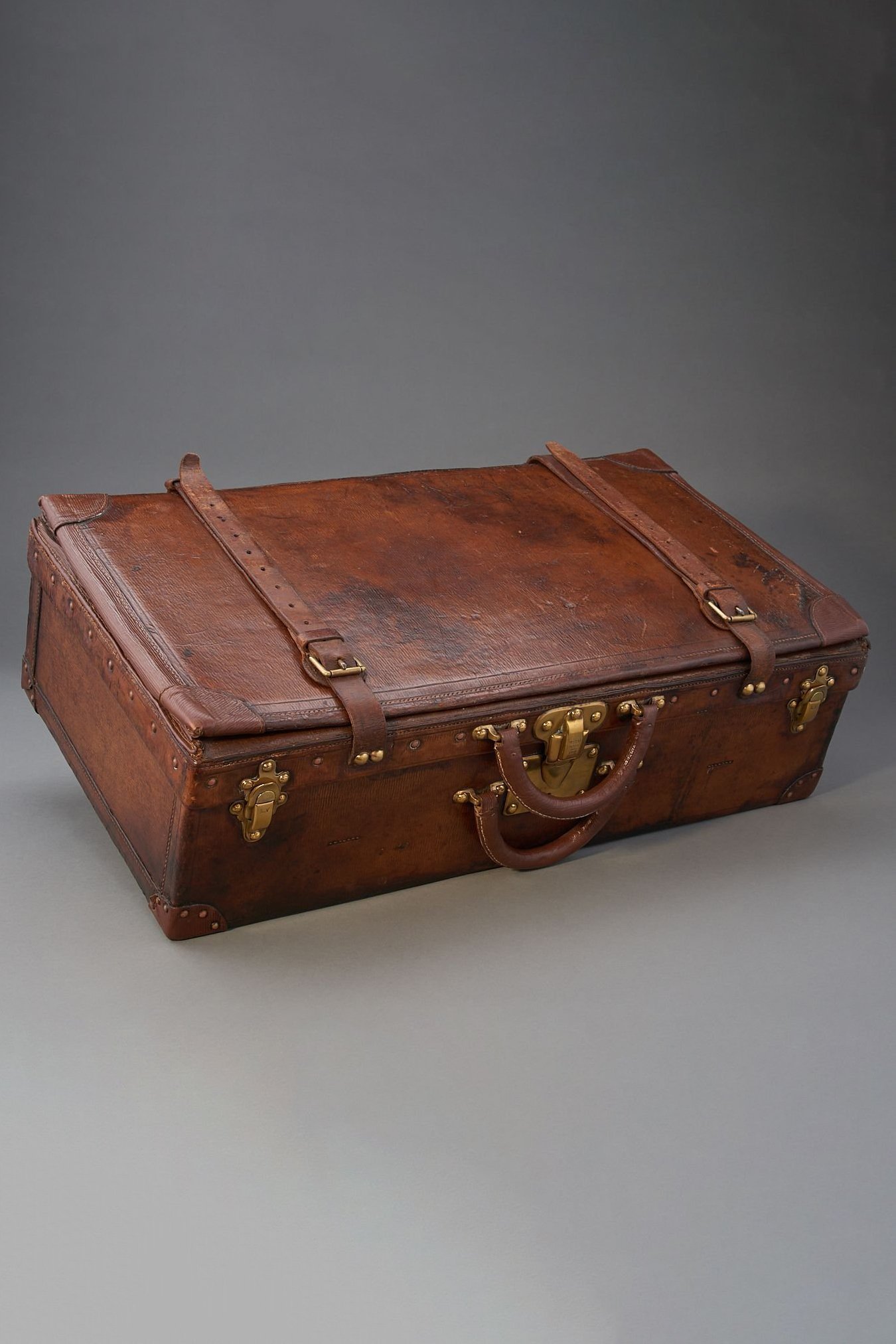
This rare example of the Malle Vache — the full cowhide trunk — is precisely that model. Executed entirely in cowhide rather than the monogram canvas that defined the majority of Vuitton's production, it represents the more exclusive and less commonly encountered strand of the house's output: a material choice that speaks to a client for whom the discreet richness of untreated leather was preferable to the house's more immediately recognisable canvas. The surface has acquired over more than a century the deep, burnished patina that only full cowhide develops — warm, complex, and entirely irreproducible by any means other than time.
The lock plate, centrally positioned on the front face, is stamped with the full dual-address legend: 1 Rue Scribe, Paris — the celebrated maison across from the Grand Hôtel, occupied until 1914 — and 149 New Bond Street, London, the house's English address from the late nineteenth century. The presence of both addresses confirms a production date of circa 1900–1910, within the most refined period of the house's pre-war craftsmanship. The exterior is further fitted with brass corner guards, studded borders, and the original leather carry handle. Two leather straps with brass buckles traverse the exterior top, providing additional security in transit — a configuration specific to the suitcase forms of this period.
The interior is the finest feature of this already exceptional piece. The cream linen lining is present and intact throughout — and, remarkably, the original fitted leather document and accessory pouch survives, strapped to the lid interior by its original leather buckle straps, fully functional and structurally sound. This interior pouch — designed to hold papers, tickets, and personal documents within immediate reach — is among the most frequently lost fittings in Vuitton suitcases of this period. Its survival here, in original condition with all straps intact, transforms this from a fine object into a document of the highest completeness.
The piece is catalogued in Florence Müller's Louis Vuitton: 100 Legendary Trunks at pages 106–107, confirming its status as one of the documented forms in the Vuitton canon.
Lock Plate Addresses: 1 Rue Scribe, Paris & 149 New Bond Street, London (pre-1914) Material: Full cowhide Dimensions: 26.5 × 18 × 8 in
Condition: Very good overall, consistent with age. Full cowhide exterior retains its original surface with deep, rich patina throughout — warm, even, and fully intact with no cracks or structural losses. Brass hardware complete — corner guards, lock plate, studs, and buckles all present. Lock plate stamping reading "1 Rue Scribe, Paris / 149 New Bond Street, London" clear and legible. Exterior leather straps present and functional. Carry handle present with good structure. Interior cream linen lining intact. Original fitted leather document pouch present in the lid, with all leather buckle straps intact and functional — an exceptional survival. A complete and unrestored example of the highest order.
Literature:
Florence Müller, Louis Vuitton: 100 Legendary Trunks, New York, 2010, pp. 106–107
Paul-Gérard Pasols, Louis Vuitton: Malletier à Paris, Paris, 1987
Pierre Léonforte, Louis Vuitton: The Birth of Modern Luxury, Paris, 2004
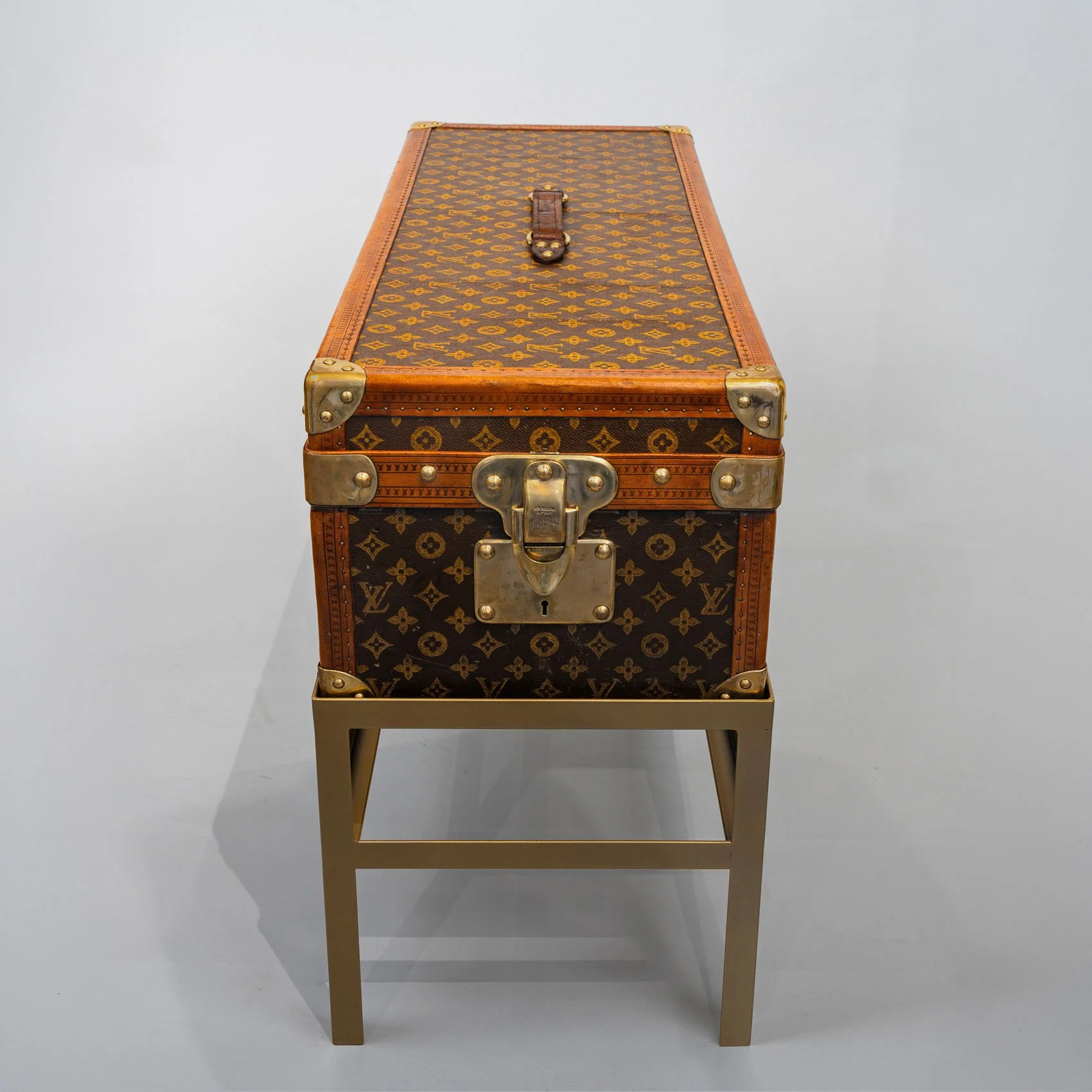
In 1911, Cambridge University Press completed publication of the Eleventh Edition of the Encyclopaedia Britannica, twenty-nine volumes drawing on more than 1,500 contributors, and still regarded as the finest single edition of the work ever published. In the same year, Louis Vuitton produced a trunk designed to carry it, and stamped the interior lid with the words that define the present example: "Specially made for the Encyclopaedia Britannica by Louis Vuitton."
That inscription transforms the trunk from a rare specialized object into a primary document, a manufacturer's statement of purpose applied at the moment of production and surviving intact after more than a century. It confirms not merely that the model was designed to house the Encyclopaedia Britannica, but that it was produced under a specific commission between the two houses.
The trunk is constructed in Louis Vuitton's monogram canvas, here in the smaller-scale, higher-density pattern of the period, with embossed lozine border trim, reinforced brass corner guards, and a large central brass lock plate. The top-mounted leather handle retains its original structure. The form is long, low, and proportioned to hold the volumes in a single fitted layer, a configuration so specific to its purpose that no other use would have suggested it. The trunk is presented on a purpose-made brass stand that raises it to console height, the volumes visible along the full length of the open case.
The interior is lined in the house's period fabric and fitted for the volumes it was designed to hold. Twenty-eight volumes of the Eleventh Edition, published by Cambridge University Press, are present in the original fitted configuration.
Library trunks of this model were produced in very small numbers. Examples in any condition are rare; examples retaining their original volumes are rarer still. An example bearing the original commission inscription in the interior lid is, to the best of our knowledge, without precedent in the current market.
Interior lid inscription: "Specially made for the Encyclopaedia Britannica by Louis Vuitton"
Contents: Eleventh Edition, Encyclopaedia Britannica, Cambridge University Press, twenty-eight volumes in the original fitted interior
Provenance: Private collection, United States
Stand: Purpose-made brass
Height: 10½ in (26.5 cm)
Width: 35 in (89 cm)
Depth: 13 in (33 cm)
Condition: Very good overall. The monogram canvas shows honest wear consistent with age and travel; structure and hardware are well preserved throughout. Lozine trim intact. Brass hardware complete, with corner guards, lock plate, and handle all present. The interior lid inscription is present and legible, the fitted interior intact, and twenty-eight volumes present.
Literature
Pierre Léonforte and Éric Pujalet-Plaà, Louis Vuitton: 100 Legendary Trunks, New York, 2010, p. 253.
Paul-Gérard Pasols, Louis Vuitton: The Birth of Modern Luxury, New York, 2005.

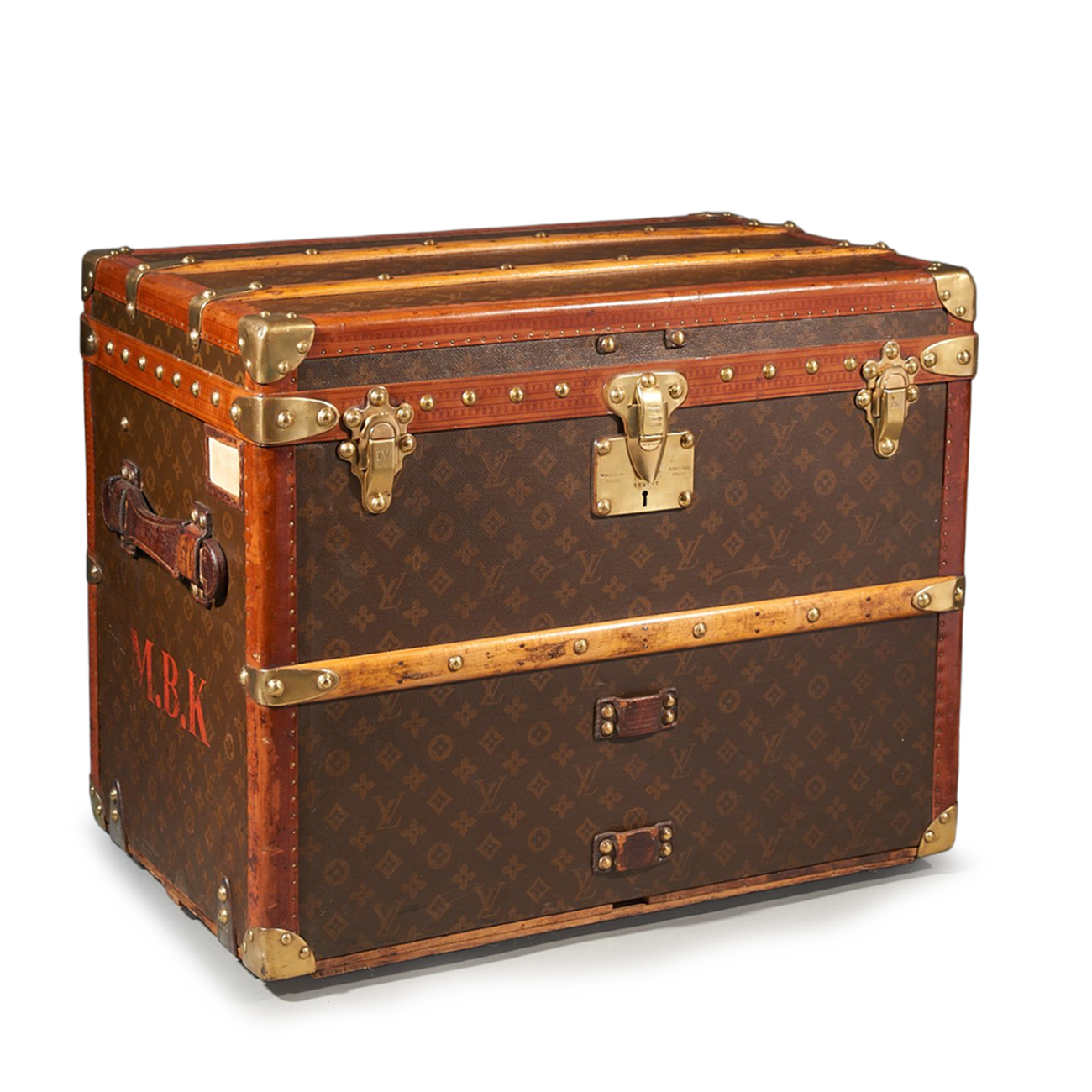
By the 1940s, Louis Vuitton's monogram canvas had been in continuous production for half a century — refined, standardised, and recognised across the baggage halls of the world's great hotels, ocean liners, and railway termini as the unambiguous mark of a certain kind of traveler. The shoe trunk of this period represents the house's luggage craft at its most purposeful: a form dedicated entirely to the organised transport of footwear, engineered with the same precision that Vuitton brought to every specialised case in his range.
This handsome example, dating to the 1940s, carries on its front face the owner's initials M.B.K. in bold red paint — a personalisation that was as much a practical necessity as a statement of ownership, ensuring immediate identification among the considerable quantities of luggage that accompanied a well-appointed traveler of the period. The canvas, characteristically darker and more compressed than the warmer tones of the 1920s production, presents with the deep, rich patina of a piece that has been honestly used and honestly aged.
The exterior is structured with natural wood slat banding in the warm honey tone characteristic of the post-war years, leather trim, and the full complement of original brass hardware — corner guards, central lock plate and clasp, flanking clasps, and studded borders. The leather side handle is present and retains good structure. On the lower section, two original leather pull-tab straps — the characteristic fittings of the Vuitton shoe trunk form — provide access to the lower trays.
The interior is the defining feature of this piece. Three individual layers of purpose-built shoe trays, each lined in the original felt, provide organised storage for a substantial collection of footwear — a configuration that reflects both the practical demands of extended travel and the social requirements of a wardrobe that might encompass day shoes, evening shoes, and sporting footwear simultaneously. The suede and orange canvas lining of the interior body is present and intact, the combination of textures characteristic of Vuitton's premium shoe trunk production of this period.
Shoe trunks with original three-layer felt tray interiors intact, named owner initials, and complete hardware in this condition represent a consistently desirable category in the Vuitton collecting market — the interior configuration, so frequently disturbed or lost over decades of use, survives here in remarkable completeness.
Owner's Initials: M.B.K. (red paint, front face) Dimensions: 24 × 15.5 × 20 in
Condition: Very good. Monogram canvas strong and intact with deep, even patina characteristic of 1940s production. Natural wood slat banding present and structurally sound. Leather trim intact throughout. Brass hardware complete and bright — corner guards, lock plate, clasps, and studs all present. Owner's initials "M.B.K." in red paint bold and fully legible. Interior exceptional: three original felt-lined shoe trays present and intact. Suede and orange canvas interior lining present and clean. Lower leather pull-tab straps present and functional. A well-preserved example retaining its complete original interior.
Literature:
Paul-Gérard Pasols, Louis Vuitton: Malletier à Paris, Paris, 1987
Florence Müller, Louis Vuitton: 100 Legendary Trunks, New York, 2010
Pierre Léonforte, Louis Vuitton: The Birth of Modern Luxury, Paris, 2004

Louis Vuitton Bespoke Matched Pair of Natural Leather Fitted Suitcases, circa 1920s–1930s
Among the most visually striking and least commonly encountered of all Louis Vuitton variants, natural leather suitcases represent a departure from the standard Vuitton repertoire, available only to those who sought something entirely their own. Produced as bespoke commissions rather than stock items, they were the most expensive option in the Vuitton catalog — and the most vulnerable to the ravages of time, which makes surviving examples in fine original condition correspondingly rare.
This exceptional matched pair — two suitcases in graduated sizes, presented together as they were originally commissioned — is executed throughout in natural leather, its warm tone having deepened over the decades into the complex, burnished surface that characterizes the finest aged leather goods. That both cases survive together in matched condition with complementary hardware is itself a rarity: the attrition of time and successive ownership separates matched luggage sets with near-certainty, and pairs of this completeness are correspondingly uncommon on the market.
The construction of each case follows Vuitton's characteristic flat-top suitcase configuration: brass corner guards, studded borders, central lock plate with flanking clasps, and the original leather carry handles. The brass hardware on both cases is well-matched in tone, consistent with original production.
The interior of the larger case retains its original lining, clean and fully intact, with the fitted dividers still in place. The original Louis Vuitton, Paris interior label is present and legible — a detail of both authenticating and historical significance. The smaller case retains its own interior lining.
A matched pair of Louis Vuitton natural leather suitcases in this condition, with original interiors and labels, is an opportunity that rarely presents itself. For the serious Vuitton collector or the interior designer seeking a statement piece of the highest quality, this pair has no equal.
Canvas: Natural leather
Condition: Very good overall, consistent with age, offered as a matched pair. Natural leather in both cases retains its distinctive warm tone with deep, even patina and no structural losses. Brass hardware present and complete on both cases — corner guards, lock plates, clasps, and studs all in place. Original leather carry handles are present on both cases. Larger case: interior lining clean and intact, original fitted dividers present, Louis Vuitton Paris interior label present and legible. Smaller case: interior lining present.
Literature: Paul-Gérard Pasols, Louis Vuitton: Malletier à Paris, Paris, 1987; Florence Müller, Louis Vuitton: 100 Legendary Trunks, New York, 2010; Pierre Léonforte, Louis Vuitton: The Birth of Modern Luxury, Paris, 2004

A Louis Vuitton cabin trunk in the house's orange Roma canvas, dating to the 1930s, mounted on a purpose-made brass stand for use as a coffee table.
The Roma canvas was produced in far smaller quantities than the monogram, and this example carries it in a deep, warm orange-red, mellowed over decades into a complex, almost lacquered surface that only time and use can produce. Against the canvas, the brass hardware reads with particular authority, the central lock plate, flanking clasps, corner guards, and studded borders all present and bright. The trunk is structured with natural wood slat banding and leather trim, with the period-embossed borders, the leather side handle retaining good structure, and the lower face carrying the original leather pull-tab fitting. The interior is lined in Vuitton's quilted cream fabric with diamond-pattern stitching and brass stud detailing, the premium interior of the house's cabin trunk production, structurally intact with honest age marking throughout.
The brushed brass stand has been made to complement the hardware, and in this configuration the trunk serves as a coffee table while keeping its full integrity as a historical object, the lid opening freely onto storage of considerable capacity. The trunk measures 27 inches wide, 10 inches high, and 18.5 inches deep. A rare cabin-format example of the Roma canvas in original unrestored condition.
Literature: Pierre Léonforte and Éric Pujalet-Plaà, Louis Vuitton: 100 Legendary Trunks, New York, 2010; Paul-Gérard Pasols, Louis Vuitton: The Birth of Modern Luxury, Paris, 2004.

This distinguished early Louis Vuitton trunk belongs to a period before the now-ubiquitous LV interlocking monogram had achieved its definitive form — a moment in the house's history when the canvas carried the geometric flower and diamond stencil pattern that characterises Vuitton's production at the turn of the twentieth century. It is, in every sense, an earlier and rarer canvas than the one most collectors encounter, and its survival in this condition speaks to the exceptional durability that made Vuitton trunks the standard of the age.
The exterior is executed in the stencilled flower monogram canvas, structured with natural wood slat framing, leather trim with the characteristic embossed LV border running the full perimeter, brass corner guards, and the house's signature studded construction. At the centre of the front face, the original brass Louis Vuitton lock plate — engraved with the house name — remains present and secure. Across the top and sides of the trunk runs a bold white cross travel stripe, applied by the original owner as a personal identification mark — a common practice among the well-travelled clientele who relied on Vuitton luggage for ocean liner and rail crossings, where the ability to spot one's trunk among hundreds was a practical necessity.
On the end panel, the owner's identity is recorded in confident white-painted stencil lettering: J.B.B / N.Y. — a New York owner of the turn-of-the-century period whose initials, combined with the white cross stripe, would have made this trunk unmistakeable on the docks of any transatlantic port.
The interior is lined in the house's red canvas — a lining associated with Vuitton's earlier production and one that, in its warm depth of colour, lends the piece a particular period character. The lining shows honest wear consistent with a century of use, with the characteristic darkening and surface patina that speaks to authentic age rather than restoration.
Flat-top steamer trunks of this period in the earlier flower monogram canvas, retaining original hardware, owner markings, and personal travel stripe, are increasingly scarce. This is a trunk that documents a specific individual and a specific era — New York, the turn of the century, the age of the ocean liner.
Owner's Markings: J.B.B / N.Y. (white paint, end panel) Travel Stripe: White cross, top and sides Lock Plate: Engraved "Louis Vuitton"
Condition: Good, consistent with age. Flower monogram canvas present throughout with honest surface wear and patina appropriate to a trunk of this period. Leather and embossed LV border trim retains structure with wear. Wood slat framing intact. Brass hardware present — corner guards, clasps, and Louis Vuitton engraved lock plate all in place. White cross travel stripe and "J.B.B / N.Y." owner markings legible. Interior red canvas lining present with significant wear and darkening consistent with age — structurally intact. An unrestored example in honest original condition.
Literature:
Paul-Gérard Pasols, Louis Vuitton: Malletier à Paris, Paris, 1987
Florence Müller, Louis Vuitton: 100 Legendary Trunks, New York, 2010
Pierre Léonforte, Louis Vuitton: The Birth of Modern Luxury, Paris, 2004

There are Louis Vuitton trunks, and then there are trunks that document history. This exceptional steamer trunk, dating to circa 1910, belongs firmly in the latter category — a piece in which every surviving detail, from its interior labels to its stamped brass handles, places it at the precise intersection of Vuitton's most celebrated address and one of America's greatest retail dynasties.
The trunk retains its original interior label bearing the address 1 Rue Scribe, Paris — the maison Louis Vuitton occupied from the late nineteenth century until 1914, situated directly across from the Grand Hôtel, that monument of Second Empire grandeur which cost over twenty-one million gold francs to construct and which drew the wealthiest and most cosmopolitan clientele in Europe. The proximity was no coincidence: world travelers arriving in Paris by ocean liner tender, private automobile, or the great express trains of the Wagon-Lits company passed through the Grand Hôtel, and the shop across the street served them accordingly. A trunk bearing the Rue Scribe address is therefore dateable with precision — it was made and sold before 1914, placing it in the final and arguably most refined years of Vuitton's pre-war production.
A second interior label elevates this piece further still. It identifies the trunk as a special model exclusively produced for John Wanamaker, New York and Philadelphia by Louis Vuitton, Paris — a distinction that connects it to one of the defining figures in the history of American retail. John Wanamaker's department stores in New York and Philadelphia were not merely commercial enterprises; they were institutions of American civic life, celebrated for the quality and exclusivity of their merchandise. The Wanamaker-Vuitton relationship was one of mutual prestige, and trunks produced under this exclusive arrangement — sold through Wanamaker's to the American market — represent a specific and documented chapter in the transatlantic luxury trade of the Gilded Age and early twentieth century.
The exterior is executed in Louis Vuitton's monogram canvas with the characteristic triple wood-slat banding, leather trim, and brass hardware throughout. The original brass side handles are stamped with the full Vuitton address legend: 1 Rue Scribe, Paris / Louis Vuitton / London, 149 New Bond Street — a detail of exceptional rarity that transforms functional fittings into primary historical documents. The interior is lined in Vuitton's quilted cream fabric, clean and fully intact, with the characteristic diamond-pattern stitching and brass stud detailing of the house's premium production. A dark travel stripe runs vertically on the front face, the personal identifier of the original owner.
Trunks of this layered provenance — Rue Scribe label, Wanamaker exclusivity label, and stamped address handles, all present and legible — are extraordinarily rare. This is a piece for the serious Vuitton collector or institution, and one that will not easily be replicated.
Interior Labels: 1 Rue Scribe, Paris (pre-1914); John Wanamaker, New York & Philadelphia — Exclusive Model by Louis Vuitton, Paris Handle Stamps: 1 Rue Scribe, Paris / Louis Vuitton / London, 149 New Bond Street
Condition: Very good overall, consistent with age. Monogram canvas strong and intact with rich, even patina. Leather trim and wood slat banding structurally sound. Brass hardware complete — corner guards, clasps, lock plate, and side handles all present. Both interior labels present and legible. Handle stamps reading "1 Rue Scribe, Paris / Louis Vuitton / London, 149 New Bond Street" clear and sharp. Interior quilted cream lining clean and fully intact with original brass studs throughout. A well-preserved and historically significant example.
Literature:
Paul-Gérard Pasols, Louis Vuitton: Malletier à Paris, Paris, 1987
Florence Müller, Louis Vuitton: 100 Legendary Trunks, New York, 2010
Pierre Léonforte, Louis Vuitton: The Birth of Modern Luxury, Paris, 2004

Among the rarest and most distinctive objects in the Louis Vuitton repertoire, the Malle Vache — the cowhide trunk — stands apart from the house's more familiar canvas production as an expression of an altogether different order of luxury. Where the monogram canvas trunks were engineered for durability and identification across the baggage halls of ocean liners and grand hotels, the Malle Vache was conceived for a clientele for whom the material itself was the statement: full, untreated cowhide, structured with brass hardware and studded borders, presenting a surface of deep, burnished richness that only deepens with age.
This exceptional example is a hat box — one of the most specialized and purposeful forms in the Vuitton range, born of a practical problem that confronted every well-dressed traveler of the Belle Époque and Edwardian era. The hat, whether a silk top hat, a Homburg, or a formal touring cap, was among the most delicate and socially consequential items a gentleman could carry. Louis Vuitton's response was characteristically precise: a purpose-built case, constructed to exactly the dimensions required, fitted with a circular cradle to cradle the crown and protect the brim, and finished to the same standard as the finest luggage in his range.
The exterior is covered in full cowhide with characteristic warm mahogany depth of tone, structured with brass corner hardware, studded borders, and the original brass lock plate stamped with the Vuitton name and dual London-Paris addresses. The top-mounted leather carry handle retains good structure. The construction is compact and cubic — a form that conveys absolute purposefulness.
The interior is fitted with its original cream linen configuration: a circular cut-out cradle sized to receive a gentleman's hat crown, flanked by linen-panelled document and accessory pockets fitted to the inside of the lid. An original linen hanging tab is present. The interior label bears the address 1 Rue Scribe, Paris — the celebrated maison across from the Grand Hôtel that Vuitton occupied until 1914 — placing this piece in the final, most accomplished years of the house's pre-war production, when the Rue Scribe address was synonymous with the summit of Parisian luxury trade.
Full cowhide Vuitton pieces survive in far smaller numbers than their canvas counterparts — the material, while extraordinarily robust, was produced in more limited quantities and for a more restricted clientele. A Malle Vache hat box in this form, with original fitted interior and Rue Scribe label intact, represents one of the most desirable and collectable configurations in which this form appears.
Interior Label: 1 Rue Scribe, Paris (pre-1914) Lock Plate: Stamped Louis Vuitton, London / Paris Material: Full cowhide
Condition: Very good overall, consistent with age. Full cowhide exterior retains its original surface with deep, even patina and honest wear throughout — no cracks or structural losses. Brass hardware present and complete — corner guards, studs, lock plate, and carry handle all in place. Lock plate stamping legible. Interior in notably good condition: circular hat cradle present and intact, original cream linen lid pockets present, linen hanging tab present. Interior label reading "1 Rue Scribe, Paris" present and legible. An unrestored example of exceptional rarity.
Literature:
Paul-Gérard Pasols, Louis Vuitton: Malletier à Paris, Paris, 1987
Florence Müller, Louis Vuitton: 100 Legendary Trunks, New York, 2010
Pierre Léonforte, Louis Vuitton: The Birth of Modern Luxury, Paris, 2004

The year 1915 occupies a precise and historically charged moment in the story of Louis Vuitton. Europe was at war, the great age of transatlantic leisure travel had been interrupted, and the house was producing luggage under conditions that would soon be reflected in the materials available to its craftsmen. Trunks from this specific year carry the marks of that transitional moment — the tighter, darker monogram canvas of the mid-1910s, the black-painted wood trim that replaced the natural slat framing of the pre-war years, and the dark lozine edging that characterises the house's wartime and immediate post-war production. They are, in their own way, documents of a world in the process of changing.
This handsome steamer trunk, dated 1915, presents in precisely that form. The exterior is executed in the monogram canvas of the period, structured with black-painted wood slat banding, dark lozine trim, brass corner guards, and the full complement of original hardware — central brass lock plate, flanking clasps, and a leather centre strap with brass buckles running from top to base, the characteristic configuration of the Vuitton steamer of this era. Side handles are present on both faces. The proportions are those of a substantial general-purpose steamer — wide, low, and capacious — designed for the hold of an ocean liner or the luggage van of a continental express train.
The interior is lined in Vuitton's cream canvas, clean and unfitted — a configuration intended to receive the full wardrobe of a traveler on an extended journey, augmented as needed by the individual fitted trays and organisers that Vuitton also produced and which were inserted at the owner's specification. The lid interior is clean and retains its original lining in good condition.
Steamer trunks from the mid-1910s, with original hardware intact and clear period dating, represent an increasingly scarce category within the Vuitton collecting market. The black trim and darker canvas of the wartime years give pieces from this period a visual character distinct from both the earlier natural-leather examples and the more standardised post-war production — serious collectors recognise and seek the distinction.
Condition: Very good, consistent with age. Monogram canvas strong and intact with rich patina characteristic of this period's production. Black-painted wood slat banding present and structurally sound. Dark lozine trim intact throughout. Brass hardware complete — corner guards, lock plate, clasps, and buckles all present. Central leather strap present with good structure. Interior cream canvas lining clean and intact. Lid lining present and in good condition. An honest, unrestored example in fine original state.
Literature:
Paul-Gérard Pasols, Louis Vuitton: Malletier à Paris, Paris, 1987
Florence Müller, Louis Vuitton: 100 Legendary Trunks, New York, 2010
Pierre Léonforte, Louis Vuitton: The Birth of Modern Luxury, Paris, 2004
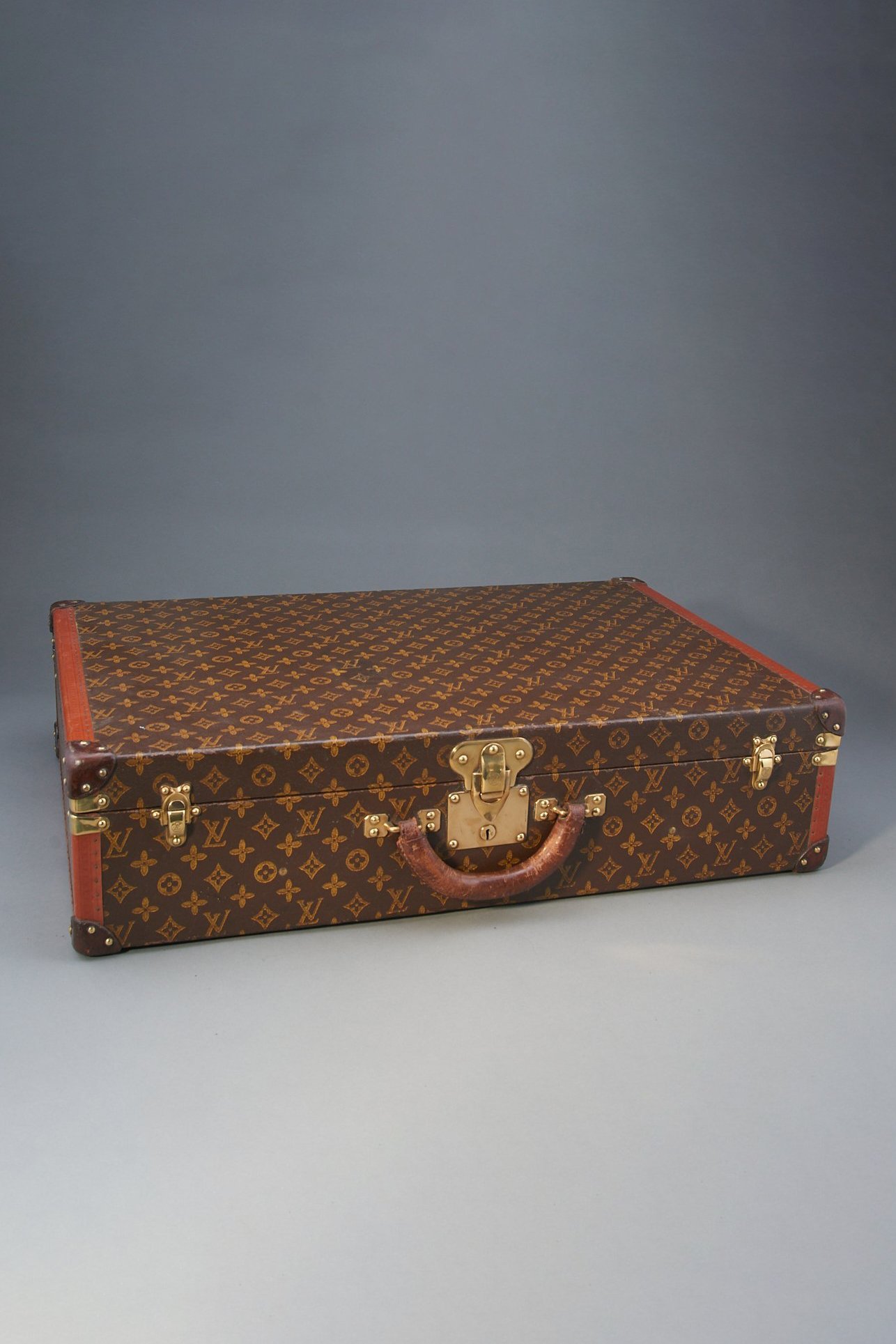
By the mid-twentieth century, Louis Vuitton had distilled a century of luggage-making into its most refined and enduring form: the Alzer hard-sided suitcase, a piece so precisely resolved in its proportions and construction that it has required no fundamental revision in the decades since. Flat, structured, and immediately recognizable, the Alzer became the defining Vuitton travel object of the post-war era — carried through the airports and grand hotels of a world learning to travel in a new way, and collected today as one of the most desirable and versatile objects the house has ever produced.
This excellent example, dating to the 1950s–1960s, presents in the standard monogram canvas of the period with the red trim that is the characteristic dating feature of Vuitton's mid-century suitcase production — distinct from the natural leather of earlier decades and the darker red of the wartime years, and immediately identifiable to the collector's eye. The canvas is vibrant and strong throughout, the pattern crisp and well-registered. The exterior is fitted with the full complement of brass hardware: a central lock plate with integrated handle mount, flanking clasps, corner guards, and the characteristic Vuitton stud borders. The leather carry handle retains good structure with honest patina.
The interior is lined in Vuitton's warm cream canvas, clean and fully intact, with the original linen packing straps present — the paired fabric loops that held clothing and accessories securely in place during transit, and which are among the most frequently lost of all interior fittings in suitcases of this period. Their survival here, in original condition, is a mark of a piece that has been well kept. A small label is visible on the interior lid — consistent with Vuitton's mid-century production labelling.
The Alzer in this period and condition is equally at home in a collector's display, as a bedside or side table, or in active daily use — the construction is sufficiently robust that a well-preserved example of this age remains entirely functional. It is, in every respect, the suitcase that defined mid-century luxury travel.
Condition: Very good. Monogram canvas strong and vibrant throughout with even patina. Red lozine trim intact and structurally sound. Brass hardware complete and bright — corner guards, lock plate, clasps, and studs all present. Leather carry handle present with honest patina and good structure. Interior cream canvas lining clean and fully intact. Original linen packing straps present and functional.
Literature:
Paul-Gérard Pasols, Louis Vuitton: Malletier à Paris, Paris, 1987
Florence Müller, Louis Vuitton: 100 Legendary Trunks, New York, 2010
Pierre Léonforte, Louis Vuitton: The Birth of Modern Luxury, Paris, 2004

The hat trunk occupies a singular place in the Louis Vuitton hierarchy — a form conceived for one of the most delicate and socially consequential items in the Edwardian and interwar wardrobe, demanding both structural precision and absolute reliability in transit. This handsome example, dating to the 1920s, is a double hat trunk in the house's iconic monogram canvas, retaining its original interior and bearing the hand-painted owner's initials "B.C." in bold red on the exterior face — a personalisation practice common among Vuitton's most loyal clientele and one that today transforms a fine trunk into a documented personal object.
The exterior presents in monogram canvas with leather trim, brass corner guards, studded borders, and the characteristic flat-top profile that distinguished Vuitton trunks from the domed constructions of rival makers. The hardware — clasps, lock plate, and corner mounts — is present and complete. The leather side handle retains good structure. The initials "B.C.", applied directly to the canvas in red paint, are bold and legible, anchoring this piece to a specific individual and a specific moment in the golden age of travel.
The interior is lined in Vuitton's quilted cream fabric with characteristic studded detailing throughout the lid — a premium finish associated with the house's higher-specification production of this period. The body of the trunk is lined in the house's signature cream canvas. Together, the interior presents in notably fresh condition for its age.
Hat trunks of this period are today among the most versatile and decoratively desirable of all Vuitton forms — equally at home as a side table, a coffee table, or a statement piece in a library or dressing room — while retaining their full historical integrity as objects of early twentieth-century travel luxury. Named examples with original initials command consistent premiums in the collector market.
Initials: B.C. (painted in red, exterior face)
Condition: Very good. Monogram canvas strong throughout with rich, even patina consistent with age. Leather trim retains good structure with honest wear. Brass hardware complete — corner guards, clasps, lock plate, and studs all present. Owner's initials "B.C." in red paint bold and fully legible. Interior exceptional: quilted cream lid lining clean and intact with original brass studs throughout. Canvas body lining present and clean.
Literature:
Paul-Gérard Pasols, Louis Vuitton: Malletier à Paris, Paris, 1987
Florence Müller, Louis Vuitton: 100 Legendary Trunks, New York, 2010
Pierre Léonforte, Louis Vuitton: The Birth of Modern Luxury, Paris, 2004

The shoe trunk is among the most purposeful and collectible specialized forms in the Louis Vuitton range — a case designed not for general luggage but for the precise and considered transport of footwear, at a time when the wardrobe of a well-dressed gentleman or lady traveling between continents might encompass a dozen or more pairs for different occasions and environments. This handsome example, dating to the 1920s, carries on its front face the owner's name stenciled in bold letters: CATTERSON — a named provenance that connects the trunk directly to a specific individual and elevates it from fine object to personal document.
The exterior is executed in Louis Vuitton's monogram canvas in the warm, amber-toned register characteristic of the house's early 1920s production — richer and more saturated in tone than the darker canvas of the wartime years, and immediately distinguishable to the trained eye. The trunk is structured with natural wood slat banding — the return to natural materials after the black-painted wartime trim — leather edging, and the full complement of brass hardware: corner guards, studded borders, central lock plate and clasp, flanking clasps, and side handles. A secondary lock plate is present on the lower section. The construction is the characteristic flat-top configuration that Vuitton had made the industry standard since the late nineteenth century.
The interior is lined in Vuitton's signature orange canvas, vivid and clean, with a fitted divider tray providing organized storage for footwear. The lid interior is lined in the house's warm brown suede-effect fabric — a premium interior finish associated with this period's production — clean and fully intact.
Shoe trunks with named owner stencilling from the 1920s represent a category of increasing collector interest — the combination of a specialized form, period provenance, and intact interior configuration in this condition is genuinely uncommon on the current market.
Condition: Very good. Monogram canvas strong and vibrant with the characteristic warm amber tone of 1920s production. Leather edging and natural wood slat banding structurally intact. Brass hardware complete and bright — corner guards, clasps, lock plates, studs, and side handles all present. Owner's stenciling "CATTERSON" bold and fully legible. Interior orange canvas lining vivid and clean. Fitted divider tray present and intact. Lid suede-effect brown lining clean and fully intact. An excellent unrestored example.
Literature:
Paul-Gérard Pasols, Louis Vuitton: Malletier à Paris, Paris, 1987
Florence Müller, Louis Vuitton: 100 Legendary Trunks, New York, 2010
Pierre Léonforte, Louis Vuitton: The Birth of Modern Luxury, Paris, 2004

Few names in the history of collecting carry the resonance of Lily Pons — the French-born soprano who became one of the most celebrated opera stars of the interwar period, the reigning prima donna of the Metropolitan Opera for two decades, and a figure whose glamour bridged the worlds of Carnegie Hall and Hollywood. This extraordinary trunk was made for her personal use circa 1925, purpose-built to transport thirty-six pairs of shoes between Paris and the great stages and film sets of America.
The exterior is executed in Louis Vuitton's iconic monogram canvas, trimmed in leather with the house's characteristic brass hardware — corner guards, clasps, and studded borders all present and intact. Across the face of the trunk runs a bold navy blue travel stripe, Pons's personal identification mark, applied so that her luggage could be instantly distinguished among the mountains of baggage that accompanied a touring opera company. It is a detail at once practical and theatrical — entirely in keeping with the woman herself.
The interior reveals the full ingenuity of Vuitton's bespoke atelier. Three rows of individual shoe compartments, each fitted with an original leather pull-tab and label window, are configured to accommodate thirty-six pairs with precision. Below, three substantial drawers with original leather handles provide additional storage. The entire interior is lined in Vuitton's signature orange canvas, in remarkably preserved condition. This is a trunk conceived not merely for storage but for the management of a professional wardrobe at the highest level — the traveling infrastructure of a life lived entirely on the world stage.
Lily Pons was born in Draguignan, France in 1898 and made her operatic debut in Paris in 1920. Her American debut at the Metropolitan Opera in 1931 was an immediate sensation, and she remained one of the Met's most beloved performers throughout the 1930s and 1940s. She became an American citizen in 1940, performed for Allied troops during the Second World War, and appeared in three Hollywood films. Her personal effects, costumes, and travel accessories are among the most sought-after in the world of opera memorabilia and celebrity collecting.
Provenance of this directness — a trunk made for a named individual, with original interior configuration intact and the owner's personal travel stripe present — is exceptionally rare in the Louis Vuitton market.
Dimensions: 22.8 × 15 × 45.7 in (58 × 38 × 116 cm) Circa: 1925 Provenance: Lily Pons (1898–1976), Paris-Hollywood Condition: See below.
Condition: Very good. Monogram canvas strong and vibrant throughout with honest patina consistent with age. Leather trim retains good structure. Brass hardware complete — corner guards, clasps, and studs all present. Navy blue travel stripe intact on both faces. Interior exceptional: all thirty-six shoe compartments present with original leather pull-tabs and label windows. Three lower drawers present and functioning with original leather handles. Orange canvas lining clean and intact throughout.
Literature:
Paul-Gérard Pasols, Louis Vuitton: Malletier à Paris, Paris, 1987
Florence Müller, Louis Vuitton: 100 Legendary Trunks, New York, 2010
Pierre Léonforte, Louis Vuitton: The Birth of Modern Luxury, Paris, 2004
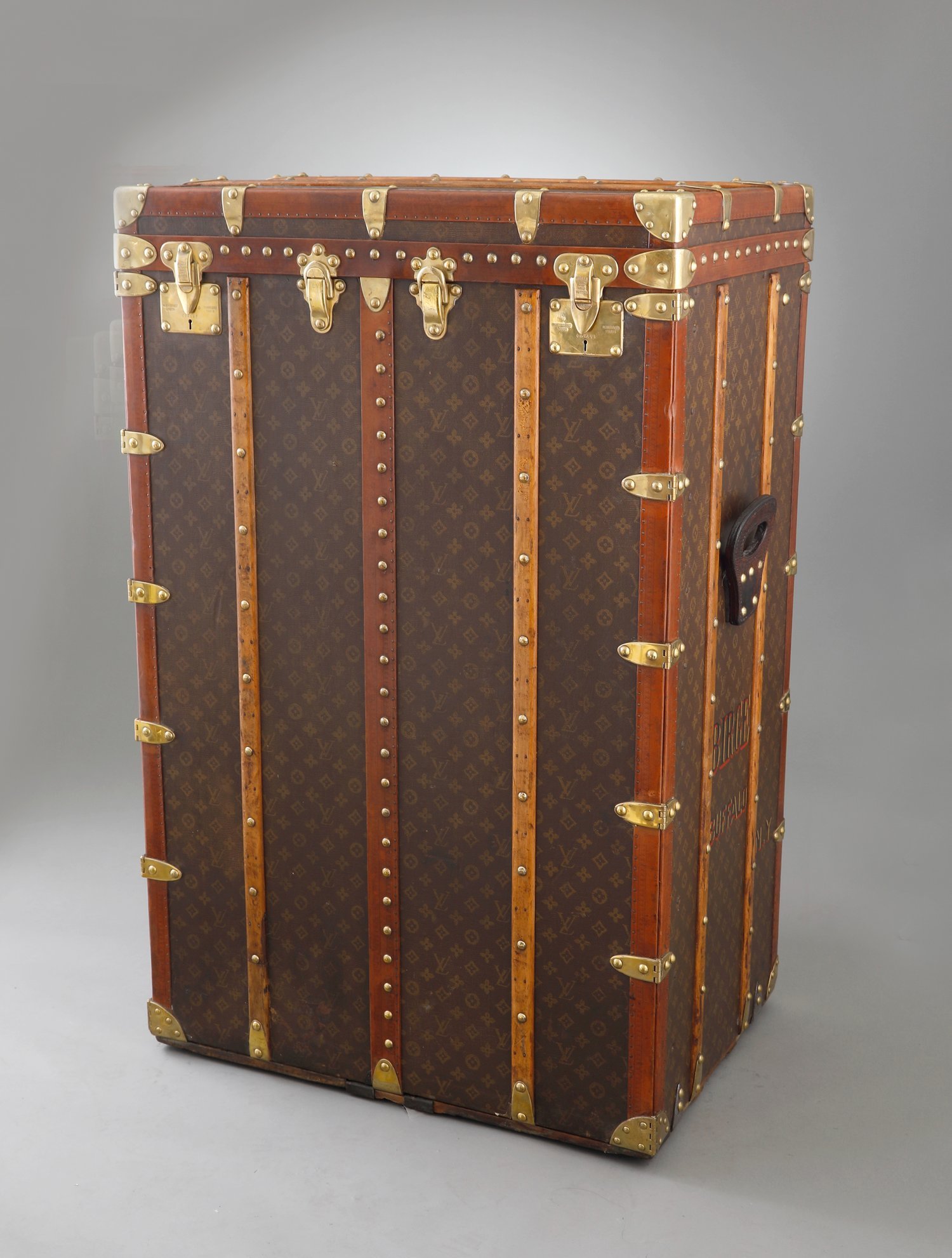
Among the most accomplished forms in the Louis Vuitton canon, the fitted wardrobe trunk represents the apex of the house's ambition during the golden age of transatlantic travel — a self-contained traveling cabinet engineered to the same standard as the finest furniture, and tailored to the exacting requirements of its original owner.
This exceptional example, bearing serial number 062145 and retailing through Vuitton's London address at 149 New Bond Street and the Paris maison at 70 Champs-Élysées, was made for the Birge family of Buffalo, New York — placing it within the tradition of bespoke commission that defined Vuitton's relationship with America's most prominent families during the 1920s. Buffalo's Birge family were among the city's leading industrial dynasties, and their patronage of Vuitton is entirely consistent with the social world they inhabited — one of ocean liner crossings, European seasons, and the grand hotels of London and Paris.
The exterior is executed in the house's iconic monogram canvas, structured with natural leather trim, brass hardware throughout, and the characteristic studded lozine borders. The flat-top profile — Vuitton's signature innovation over the domed trunks of rival makers — permitted efficient stacking in the hold of a Cunard or White Star liner, while the robustness of the construction ensured the contents arrived in precisely the condition they departed.
The interior is of the first order. A full bank of ten drawers, each fitted with original leather pull-tabs stamped with the Vuitton name, provides comprehensive storage for clothing and personal effects. Above, a removable tray with original linen-lined compartments and period brass fittings accommodates more delicate items. The lid interior is lined in quilted cream fabric with studded detailing — a hallmark of Vuitton's premium wardrobe production during this period. The door interior retains its original orange canvas lining with fitted horizontal rails.
Wardrobe trunks of this quality and completeness — retaining original interior fittings, original hardware, and documented provenance — are increasingly rare on the market. The combination of named family provenance, dual-address lock plate, and intact interior configuration places this example among the most desirable pieces of its kind.
Serial No.: 062145 Retailed through: 149 New Bond Street, London & 70 Champs-Élysées, Paris Provenance: Birge Family, Buffalo, New York
Condition: Very good overall. Monogram canvas strong and intact with honest patina consistent with age and use. Leather trim retains good structure throughout. Brass hardware present and complete — lock plate, clasps, corner guards, and studs all in place. Serial number 062145 clearly legible on lock plate. Interior exceptional: all ten drawers present and functioning, original leather Vuitton-stamped pulls intact on each. Removable upper tray present with original linen dividers. Quilted cream lid lining clean and intact. Orange canvas door lining present. A rare example retaining its complete original interior.
Literature:
Paul-Gérard Pasols, Louis Vuitton: Malletier à Paris, Paris, 1987
Florence Müller, Louis Vuitton: 100 Legendary Trunks, New York, 2010
Pierre Léonforte, Louis Vuitton: The Birth of Modern Luxury, Paris, 2004
A full-size Louis Vuitton explorer’s trunk clad in zinc and bound in brass, made in Paris circa 1895, the rarest and most collectible of the Louis Vuitton steamer trunks. In the 1880s, the house began building zinc-and-copper trunks to order for its wealthiest clients: titled officers, colonial administrators, engineers, and explorers heading for Africa, Indochina, and the tropics, where canvas rotted and leather mildewed within a season. The metal skin sealed the contents against humidity and insects, and the trunk is bound entirely in brass, with no leather trim anywhere, because nothing else would stand up to the climate. Louis Vuitton supplied Pierre Savorgnan de Brazza’s Congo expeditions with zinc trunks like this, and the explorer’s trunk has been part of the house’s legend ever since.
Most surviving zinc trunks are small cabin and expedition models. A full steamer trunk of this size, with three wooden slats across the front and three across the lid, was heavy, costly, and made only to order, and very few exist.
The zinc panels are framed in brass bands with brass corners, and the slats are secured with brass nails whose domed heads carry the name LOUIS VUITTON in raised letters. The main lock with its stamped clasp sits between two hasp latches, each stamped LV. The brass handle plates at either end are stamped 1 Rue Scribe Paris, Louis Vuitton, London 454 Strand, and Made in France, the last a marking that appears on French export goods after 1890.
Inside, the lid carries the original paper label numbered 37946 in red. It is printed for both shops, London and Paris, under the British royal arms, the American eagle, and the Spanish royal arms, with the Prince of Wales feathers between them and the exhibition medals for Paris 1867, Havre 1868, and London 1885 below. The London address reads 289 Oxford Street, struck through with a printed bar, and 454 Strand set beneath it. Louis Vuitton opened its first London shop on Oxford Street in 1885 and moved to the Strand a few years later. Rather than discard its stock of labels, the house corrected them, and a trunk carrying a corrected label can be placed in the years immediately after the move, before fresh labels were printed. The interior keeps its original canvas lining and the runners for the tray.
The trunk has been cleaned and the brass polished. A later owner removed the painted initials. The zinc retains the dents and burnish of its traveling life, the stamped lettering on the hardware and nails is sharp throughout, and the trunk stands on casters.