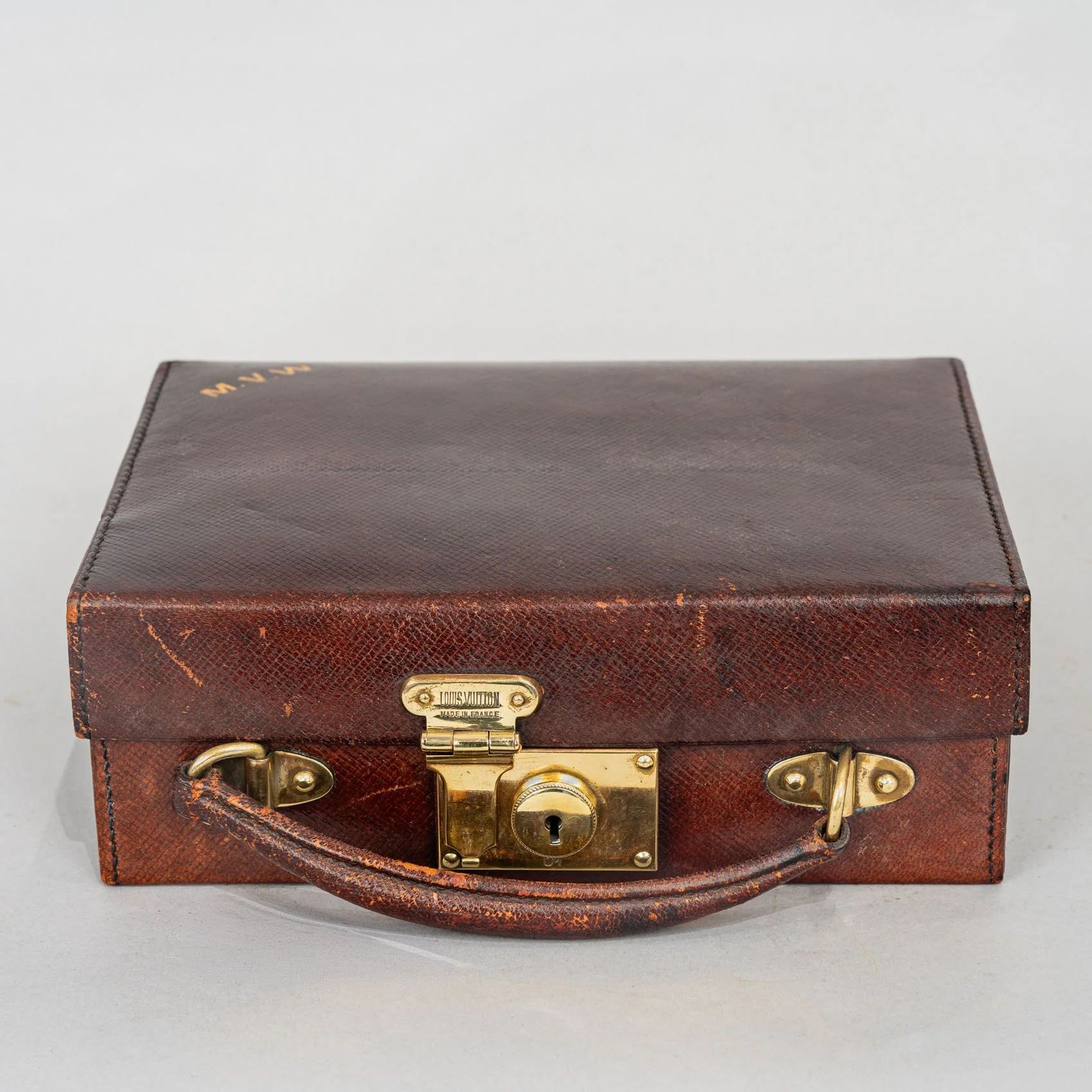
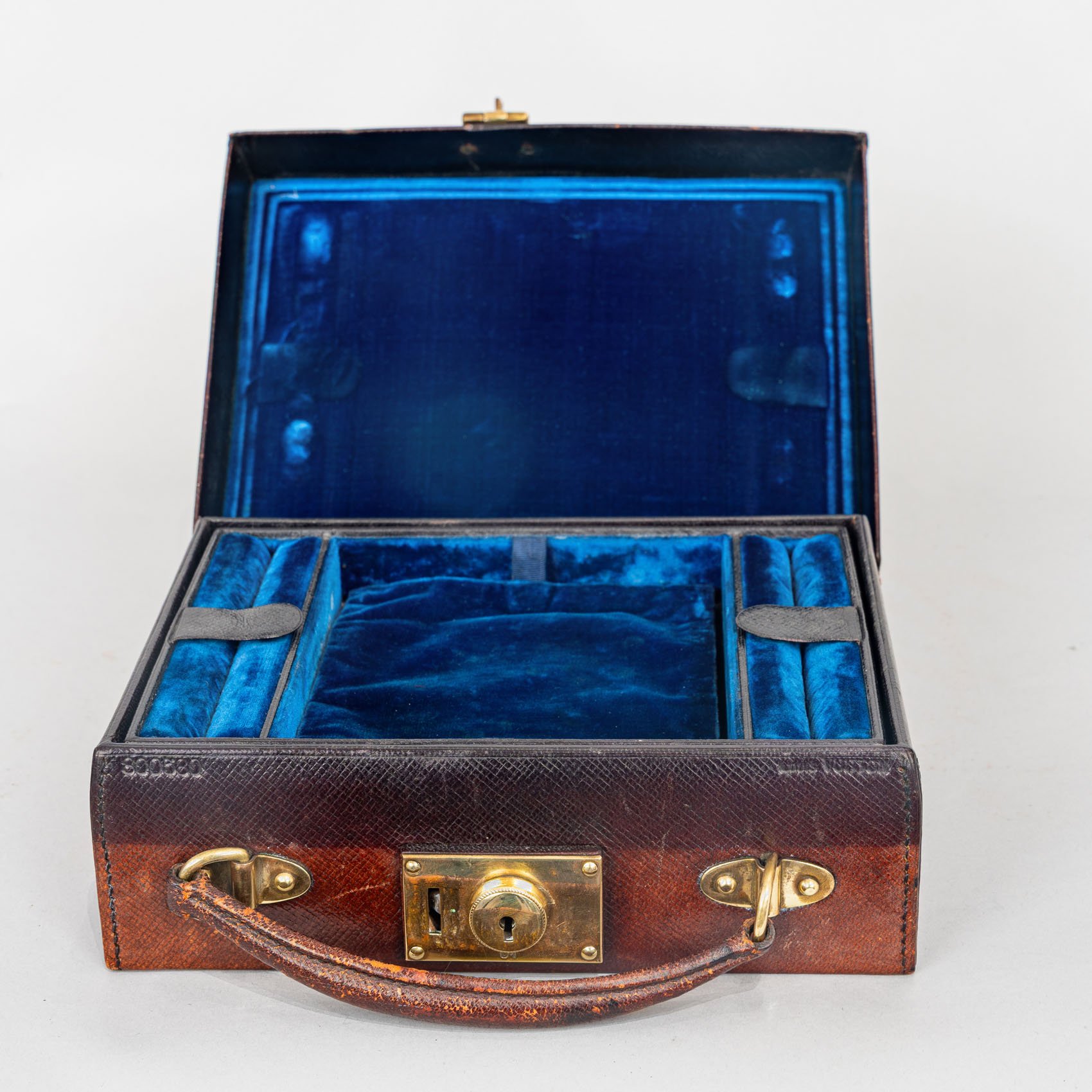
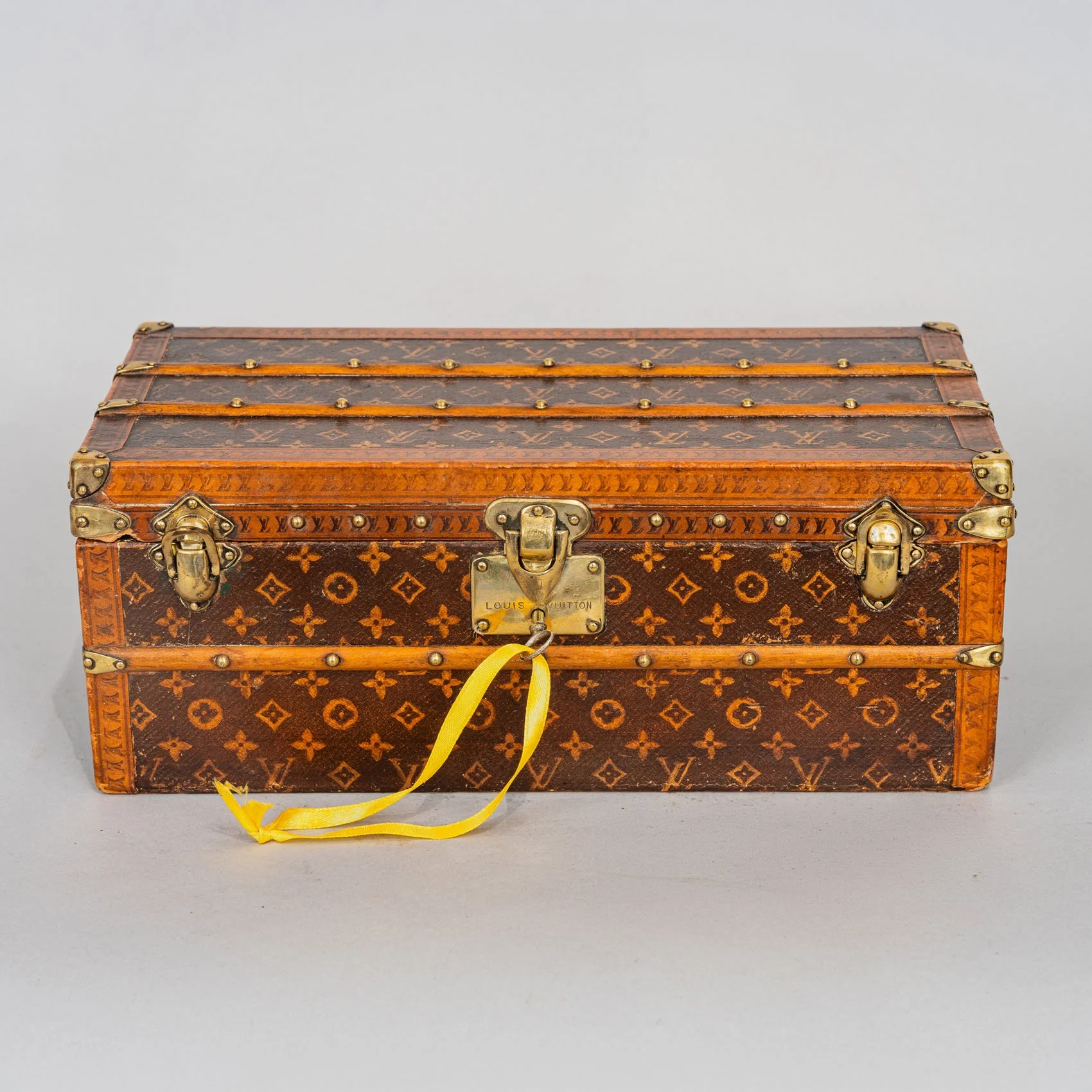
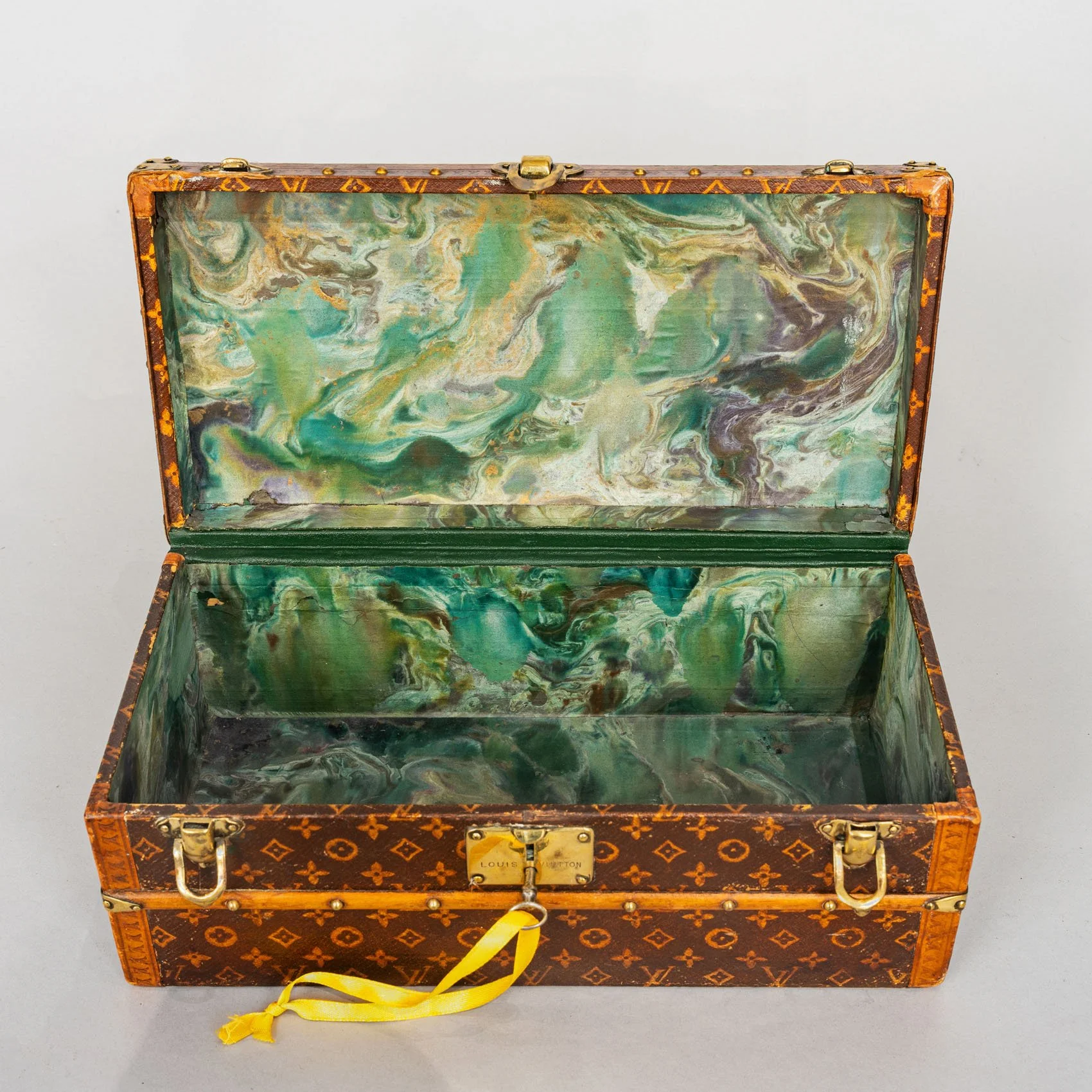
When Louis Vuitton opened his London shop circa 1885, he encountered for the first time the luggage traditions of the English gentleman — a culture of travel defined by practicality, restraint, and the finest materials. His response was characteristically creative: he studied the English forms, improved upon them, and designed a model specifically for his British clientele. He named it, with elegant simplicity, the "London" — a roomy, expandable suitcase conceived for the era of railway travel, lighter in construction than the great steamer trunks, and engineered for the particular demands of a clientele accustomed to moving between country house, city club, and continental hotel with equal efficiency.
This rare example of the Malle Vache — the full cowhide trunk — is precisely that model. Executed entirely in cowhide rather than the monogram canvas that defined the majority of Vuitton's production, it represents the more exclusive and less commonly encountered strand of the house's output: a material choice that speaks to a client for whom the discreet richness of untreated leather was preferable to the house's more immediately recognisable canvas. The surface has acquired over more than a century the deep, burnished patina that only full cowhide develops — warm, complex, and entirely irreproducible by any means other than time.
The lock plate, centrally positioned on the front face, is stamped with the full dual-address legend: 1 Rue Scribe, Paris — the celebrated maison across from the Grand Hôtel, occupied until 1914 — and 149 New Bond Street, London, the house's English address from the late nineteenth century. The presence of both addresses confirms a production date of circa 1900–1910, within the most refined period of the house's pre-war craftsmanship. The exterior is further fitted with brass corner guards, studded borders, and the original leather carry handle. Two leather straps with brass buckles traverse the exterior top, providing additional security in transit — a configuration specific to the suitcase forms of this period.
The interior is the finest feature of this already exceptional piece. The cream linen lining is present and intact throughout — and, remarkably, the original fitted leather document and accessory pouch survives, strapped to the lid interior by its original leather buckle straps, fully functional and structurally sound. This interior pouch — designed to hold papers, tickets, and personal documents within immediate reach — is among the most frequently lost fittings in Vuitton suitcases of this period. Its survival here, in original condition with all straps intact, transforms this from a fine object into a document of the highest completeness.
The piece is catalogued in Florence Müller's Louis Vuitton: 100 Legendary Trunks at pages 106–107, confirming its status as one of the documented forms in the Vuitton canon.
Lock Plate Addresses: 1 Rue Scribe, Paris & 149 New Bond Street, London (pre-1914) Material: Full cowhide Dimensions: 26.5 × 18 × 8 in
Condition: Very good overall, consistent with age. Full cowhide exterior retains its original surface with deep, rich patina throughout — warm, even, and fully intact with no cracks or structural losses. Brass hardware complete — corner guards, lock plate, studs, and buckles all present. Lock plate stamping reading "1 Rue Scribe, Paris / 149 New Bond Street, London" clear and legible. Exterior leather straps present and functional. Carry handle present with good structure. Interior cream linen lining intact. Original fitted leather document pouch present in the lid, with all leather buckle straps intact and functional — an exceptional survival. A complete and unrestored example of the highest order.
Literature:
Florence Müller, Louis Vuitton: 100 Legendary Trunks, New York, 2010, pp. 106–107
Paul-Gérard Pasols, Louis Vuitton: Malletier à Paris, Paris, 1987
Pierre Léonforte, Louis Vuitton: The Birth of Modern Luxury, Paris, 2004
When Louis Vuitton opened his London shop circa 1885, he encountered for the first time the luggage traditions of the English gentleman — a culture of travel defined by practicality, restraint, and the finest materials. His response was characteristically creative: he studied the English forms, improved upon them, and designed a model specifically for his British clientele. He named it, with elegant simplicity, the "London" — a roomy, expandable suitcase conceived for the era of railway travel, lighter in construction than the great steamer trunks, and engineered for the particular demands of a clientele accustomed to moving between country house, city club, and continental hotel with equal efficiency.
This rare example of the Malle Vache — the full cowhide trunk — is precisely that model. Executed entirely in cowhide rather than the monogram canvas that defined the majority of Vuitton's production, it represents the more exclusive and less commonly encountered strand of the house's output: a material choice that speaks to a client for whom the discreet richness of untreated leather was preferable to the house's more immediately recognisable canvas. The surface has acquired over more than a century the deep, burnished patina that only full cowhide develops — warm, complex, and entirely irreproducible by any means other than time.
The lock plate, centrally positioned on the front face, is stamped with the full dual-address legend: 1 Rue Scribe, Paris — the celebrated maison across from the Grand Hôtel, occupied until 1914 — and 149 New Bond Street, London, the house's English address from the late nineteenth century. The presence of both addresses confirms a production date of circa 1900–1910, within the most refined period of the house's pre-war craftsmanship. The exterior is further fitted with brass corner guards, studded borders, and the original leather carry handle. Two leather straps with brass buckles traverse the exterior top, providing additional security in transit — a configuration specific to the suitcase forms of this period.
The interior is the finest feature of this already exceptional piece. The cream linen lining is present and intact throughout — and, remarkably, the original fitted leather document and accessory pouch survives, strapped to the lid interior by its original leather buckle straps, fully functional and structurally sound. This interior pouch — designed to hold papers, tickets, and personal documents within immediate reach — is among the most frequently lost fittings in Vuitton suitcases of this period. Its survival here, in original condition with all straps intact, transforms this from a fine object into a document of the highest completeness.
The piece is catalogued in Florence Müller's Louis Vuitton: 100 Legendary Trunks at pages 106–107, confirming its status as one of the documented forms in the Vuitton canon.
Lock Plate Addresses: 1 Rue Scribe, Paris & 149 New Bond Street, London (pre-1914) Material: Full cowhide Dimensions: 26.5 × 18 × 8 in
Condition: Very good overall, consistent with age. Full cowhide exterior retains its original surface with deep, rich patina throughout — warm, even, and fully intact with no cracks or structural losses. Brass hardware complete — corner guards, lock plate, studs, and buckles all present. Lock plate stamping reading "1 Rue Scribe, Paris / 149 New Bond Street, London" clear and legible. Exterior leather straps present and functional. Carry handle present with good structure. Interior cream linen lining intact. Original fitted leather document pouch present in the lid, with all leather buckle straps intact and functional — an exceptional survival. A complete and unrestored example of the highest order.
Literature:
Florence Müller, Louis Vuitton: 100 Legendary Trunks, New York, 2010, pp. 106–107
Paul-Gérard Pasols, Louis Vuitton: Malletier à Paris, Paris, 1987
Pierre Léonforte, Louis Vuitton: The Birth of Modern Luxury, Paris, 2004

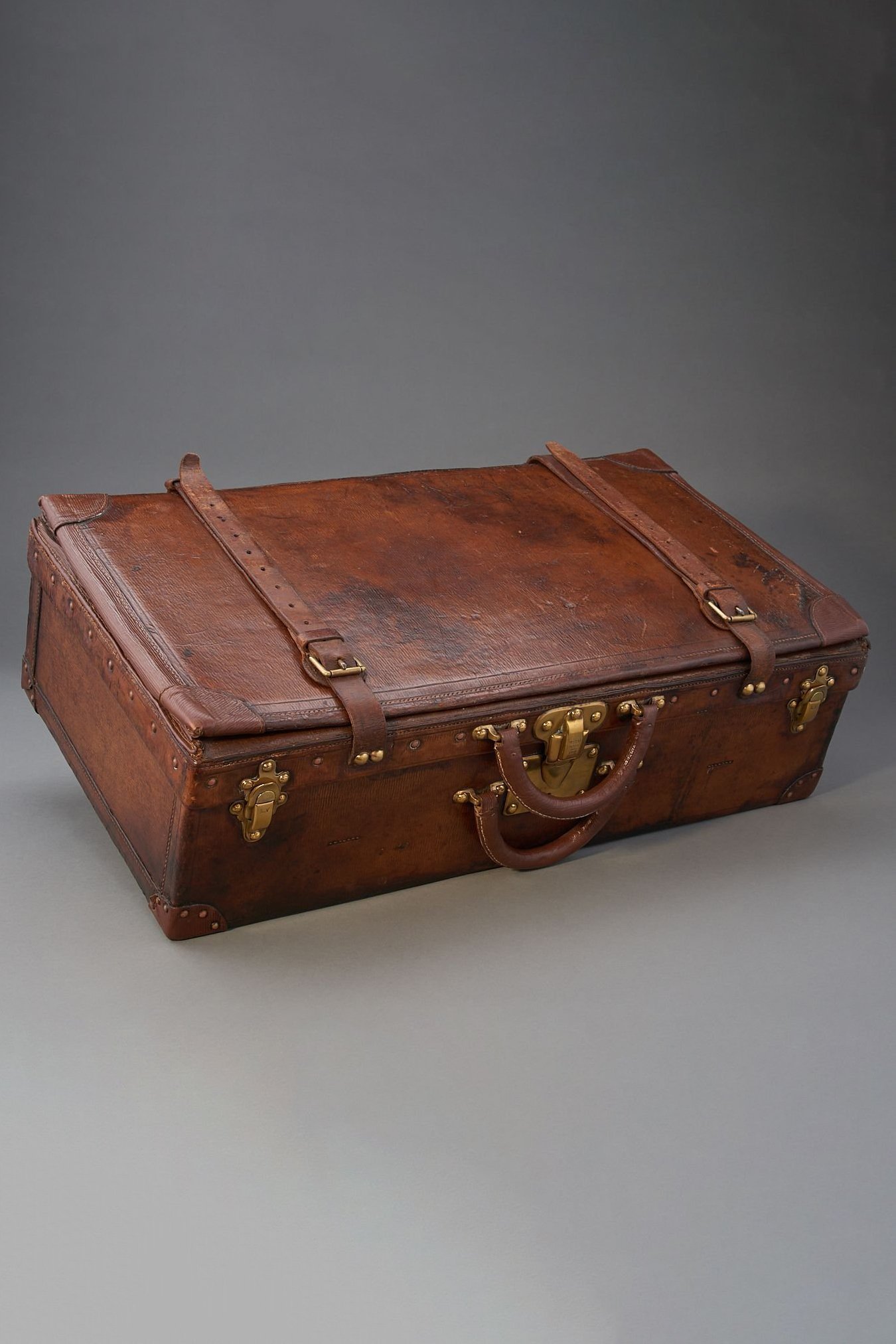 Image 1 of 3
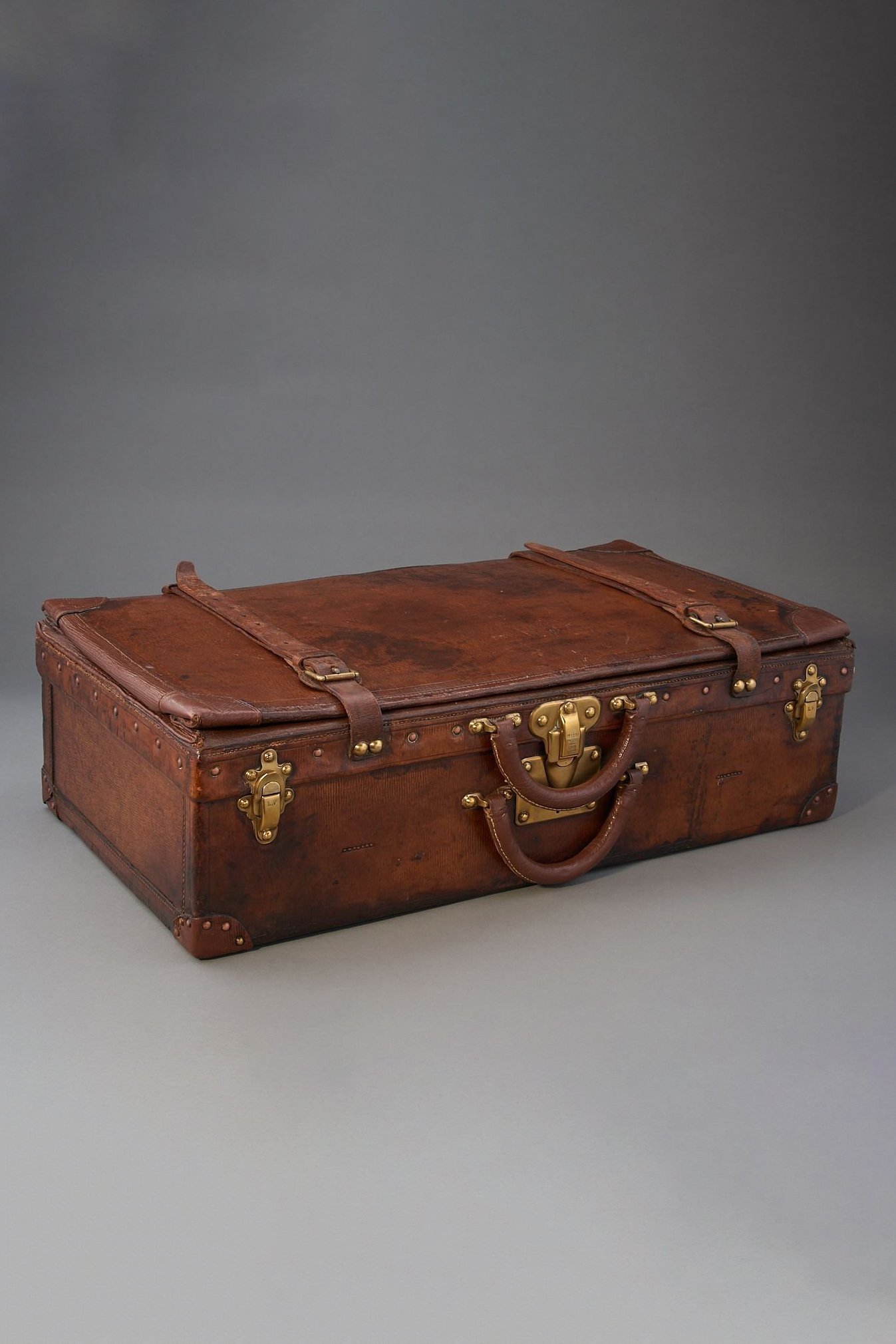 Image 2 of 3
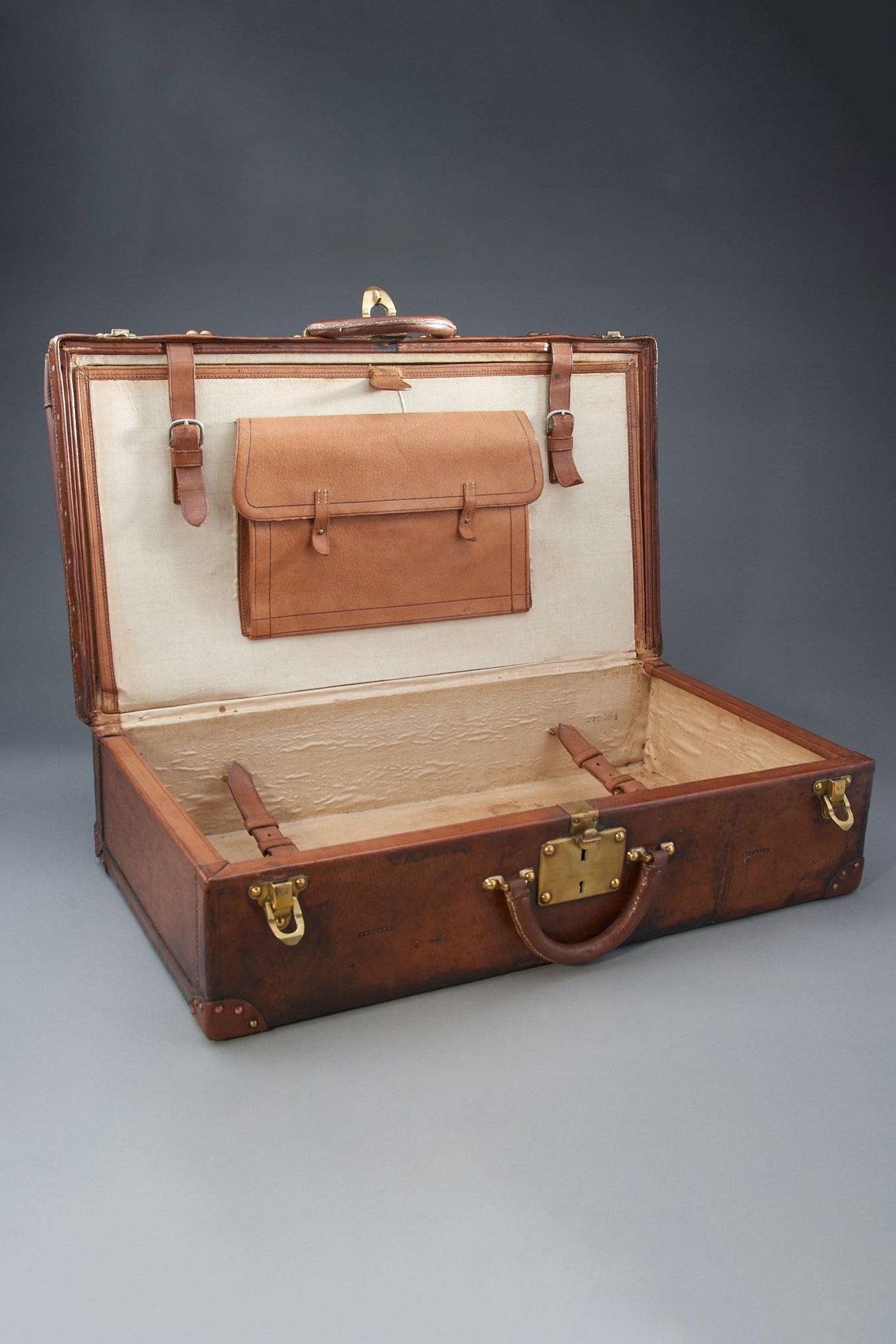 Image 3 of 3