

silver

Chinese export silver forms the heart of this collection, drawn from the great Canton, Hong Kong, and Shanghai workshops of the late nineteenth and early twentieth centuries. Pieces by Wang Hing, Hung Chong, and Leeching are represented here, their dragons, bamboo, and prunus rendered in the high relief that distinguishes the finest export work from the European silver it was made to rival. Each example is chosen for the quality of its chasing, the clarity of its marks, and a provenance that can be stated with confidence.
Imperial Russian silver follows, led by the cigar boxes made for a cosmopolitan clientele in the closing decades of the Imperial period. These combine engine-turned grounds, often with applied gold mounts, and the assay marks of Moscow and St. Petersburg, and they remain among the most collectible objects of their kind.
English silver completes the selection, from Birmingham cocktail shakers of the Art Deco years to presentation trophies bearing full hallmarks and, frequently, a documented commission.
Every piece of antique silver offered here is chosen with the discipline that has guided Daniels Antiques since 1978: rarity, condition, and a history that an appraiser can defend. Inquiries about individual works, including pricing and additional images, are welcome by appointment or by email.
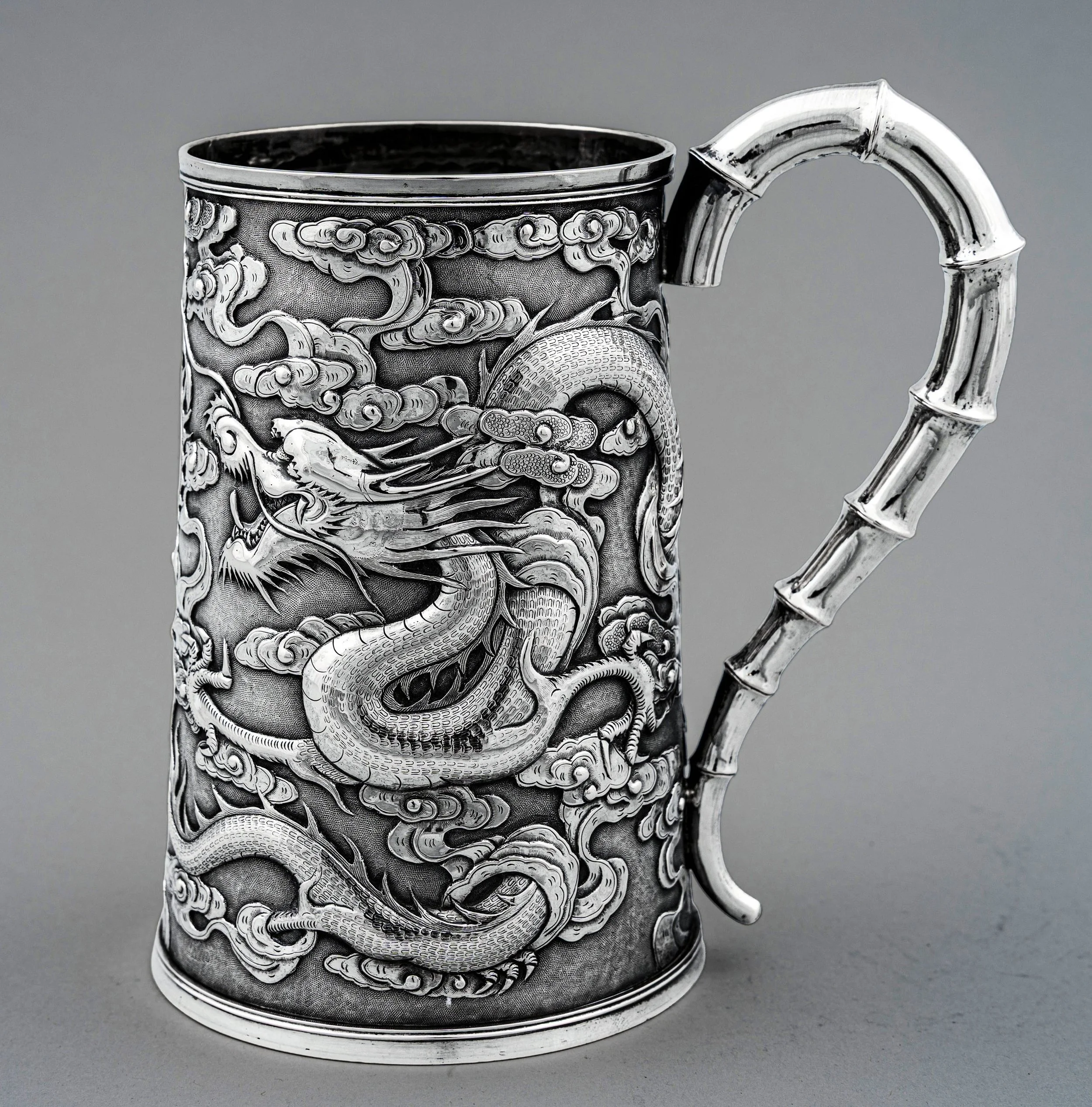
A cylindrical tankard worked in high-relief repoussé with two sky dragons — tianlong — surging through billowing clouds in pursuit of the flaming pearl of wisdom. Scaled bodies coil with extraordinary fluency against a finely matted ground, whiskered heads thrown back in dynamic tension. The handle is cast in the form of bamboo, its jointed culms rendered with botanical precision — a motif long associated in Chinese culture with resilience and scholarly virtue.
To the reverse, a polished cartouche bears the engraved monogram E.W.H., the recipient of a gift recorded in script on the base: E.H. to E.W.H. / March 1912 — the final year of the Qing dynasty, and the first of the Chinese Republic. Two marks are struck to the base, including the retail mark of Wang Hing, the celebrated Hong Kong silversmith whose pieces are among the most sought-after in the field of Chinese export silver today.
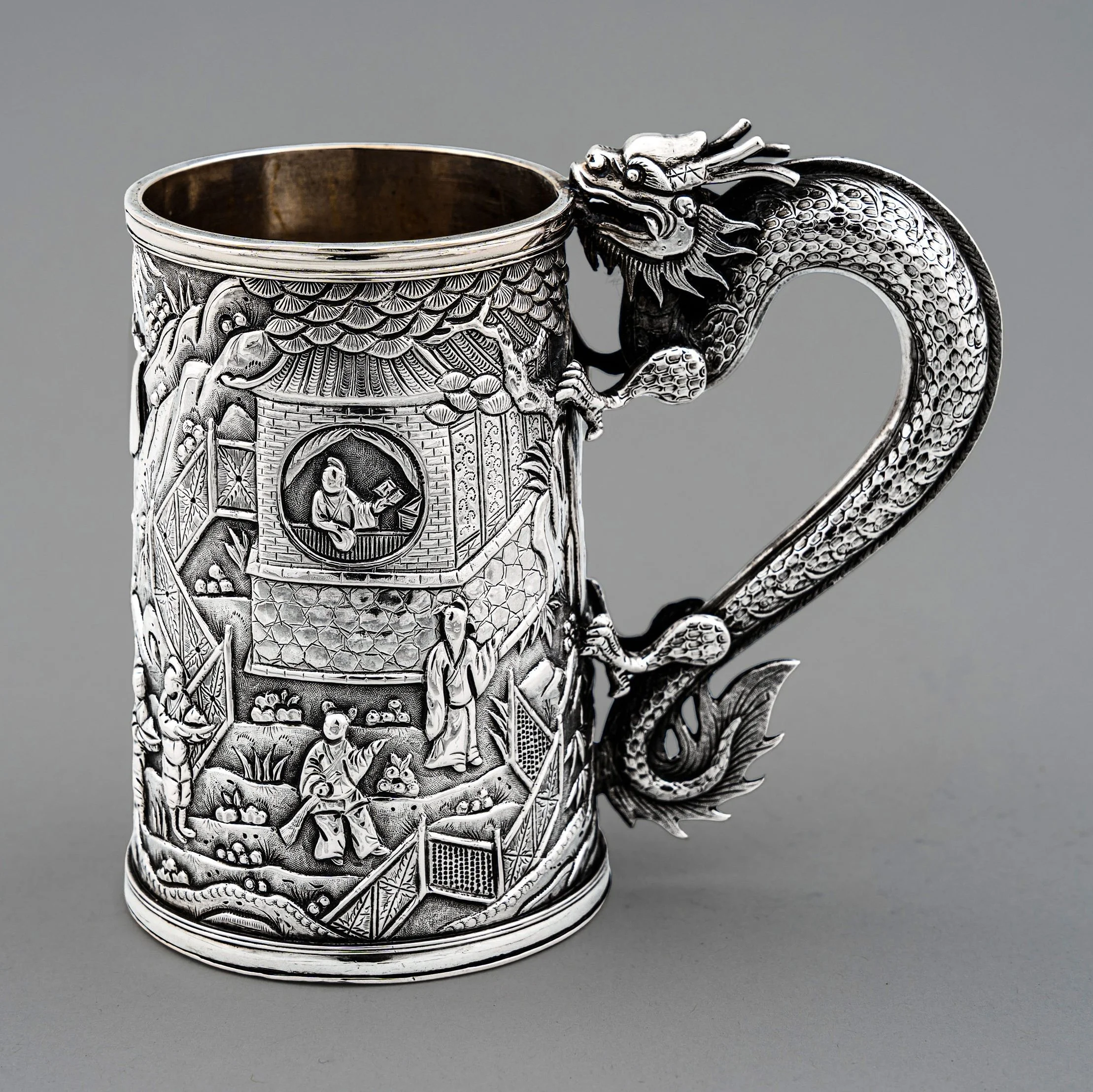
A fine Chinese Export Silver double-walled mug by Leeching of Canton, circa 1895.
The cylindrical body is decorated in continuous high repoussé with narrative figural scenes: courtly figures, attendants, pavilions, and mountainous landscapes rendered with great precision across the entire surface. A plain shield-form cartouche is reserved to one side, unengraved. The handle is formed as a fully modeled sky dragon, its head hooking over the rim, its scaled body forming the grip, its tail curling to meet the base.
Struck to the base with the Leeching maker's mark.
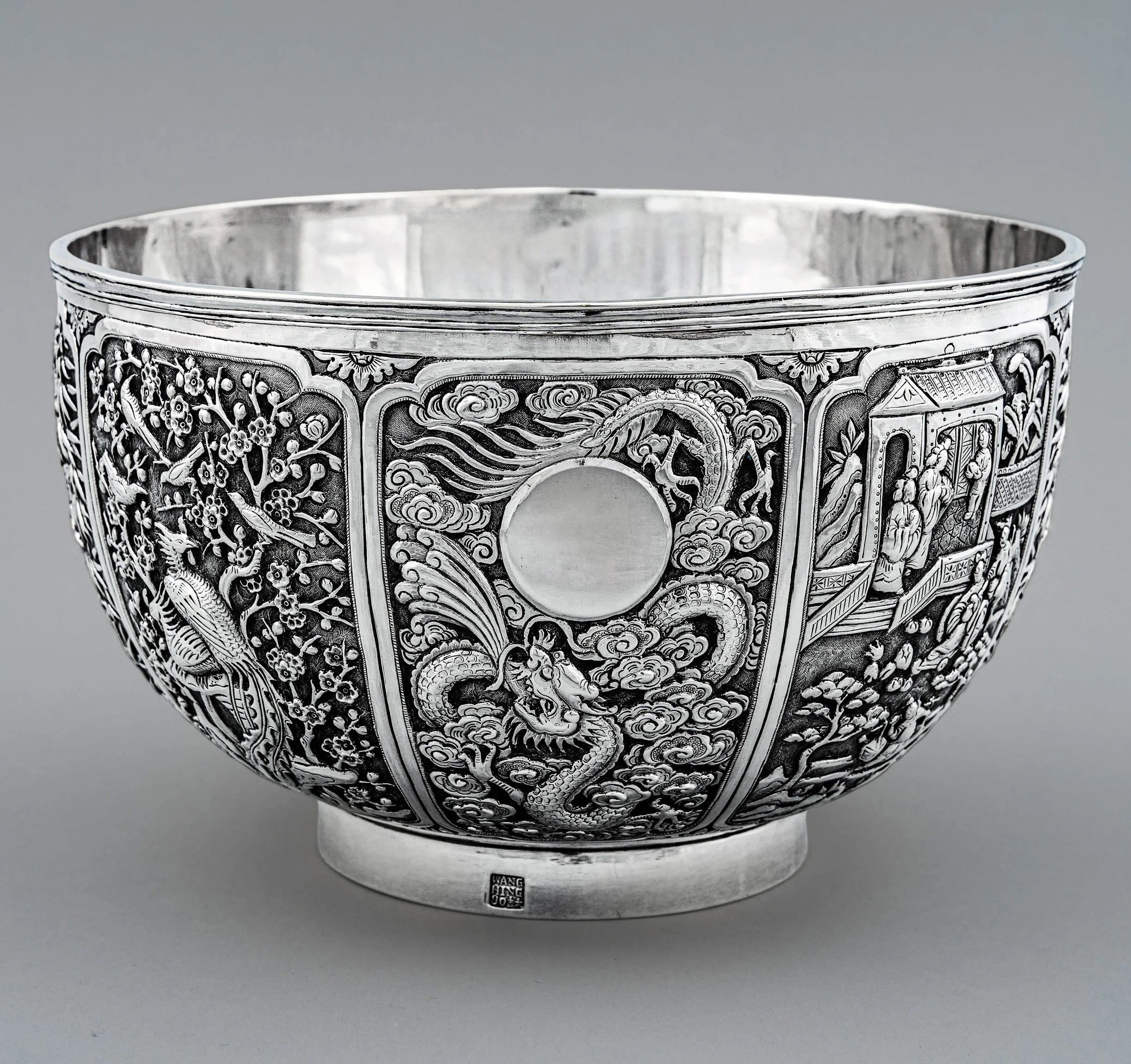
A fine Chinese Export Silver double-walled bowl of eight-panel form, dated 1860, retailed by Wang Hing of Hong Kong, the work of the artisan Da Ji (大吉).
The hemispherical body is of double-walled construction — an exceptional technical achievement in hand-worked silver, requiring the raising and fitting of two perfectly matched shells — and raised on a plain circular foot, the exterior divided into eight lobed panels in high repoussé: two figural scenes, two dragon panels, each with a plain round cartouche, two bamboo and bird panels, and two prunus and phoenix panels. The ground of each panel is darkened to throw the decoration into sharp relief. The interior is polished bright.
Diameter 8¼ inches, height 5 inches. Weight 32oz.
Struck to the base with the Wang Hing retailer's mark.
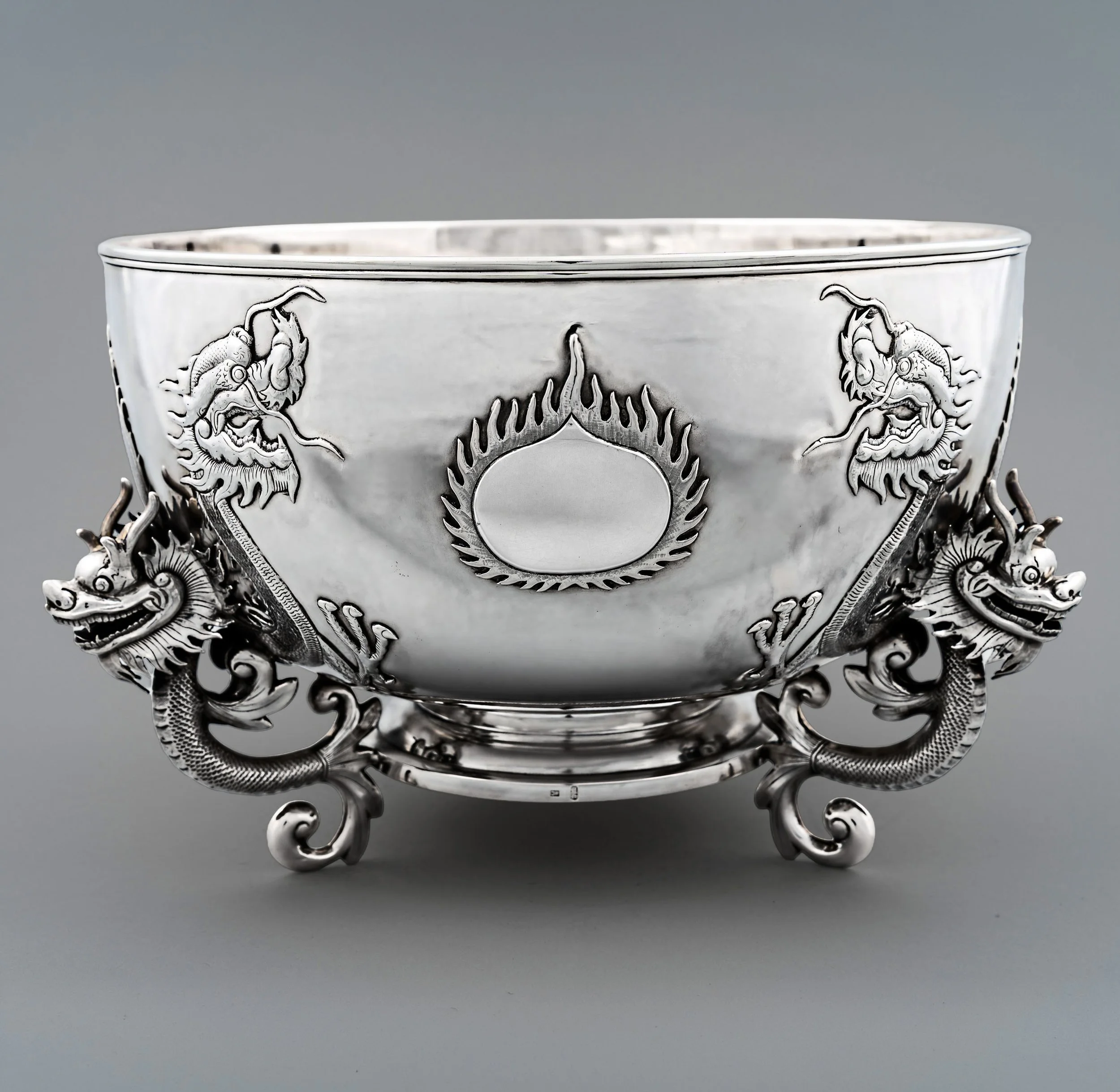
A magnificent Chinese Export Silver punchbowl by Hung Chong of Shanghai, one of the most accomplished silversmithing workshops of the late Qing period. Circa 1900.
The deep hemispherical bowl is raised on a circular foot and supported by three fully modeled sky dragons, their sinuous bodies forming the legs, their heads rearing outward at the quarters. The exterior of the bowl is decorated in repoussé with two further dragons in vigorous pursuit of the flaming pearl of wisdom, the scales, whiskers, and claws rendered with exceptional precision. The interior is polished bright. Diameter 14 inches.
Struck with the maker's mark HC and Chinese character punch for Hung Chong, 11B Nanking Road, Shanghai.
In excellent condition throughout, the detail crisp and the surface with a fine bright polish.
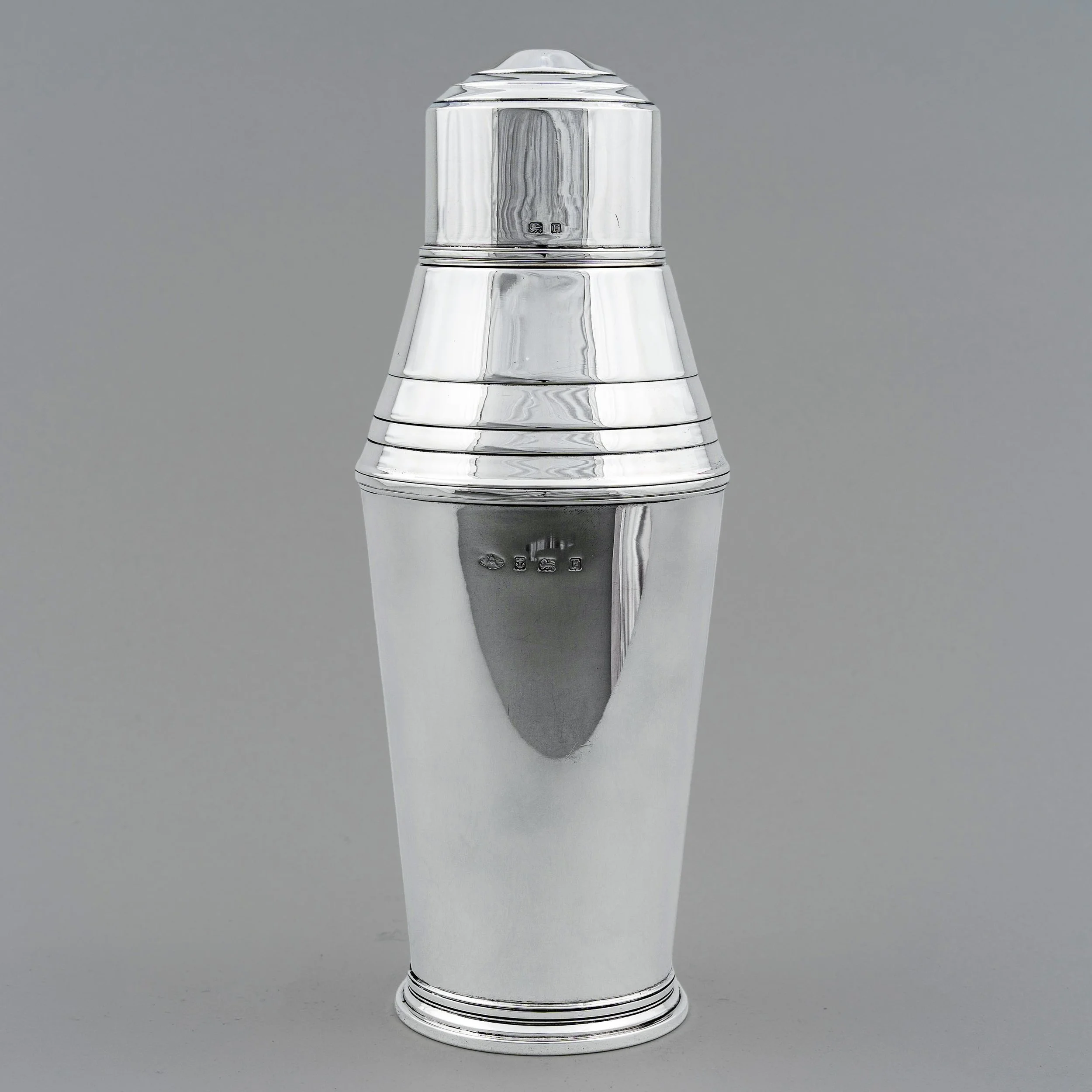
A fine Art Deco cocktail shaker in sterling silver, the tapering cylindrical body rising from a stepped circular foot, the conical strainer section articulated by crisp reeded bands at the shoulder, the domed cap with reeded collar. The plain surfaces rely entirely on proportion and the quality of the silver. Height 9 inches.
Hallmarked Birmingham 1931, maker's mark of Adie Brothers. In excellent condition with a fine, bright polish throughout.
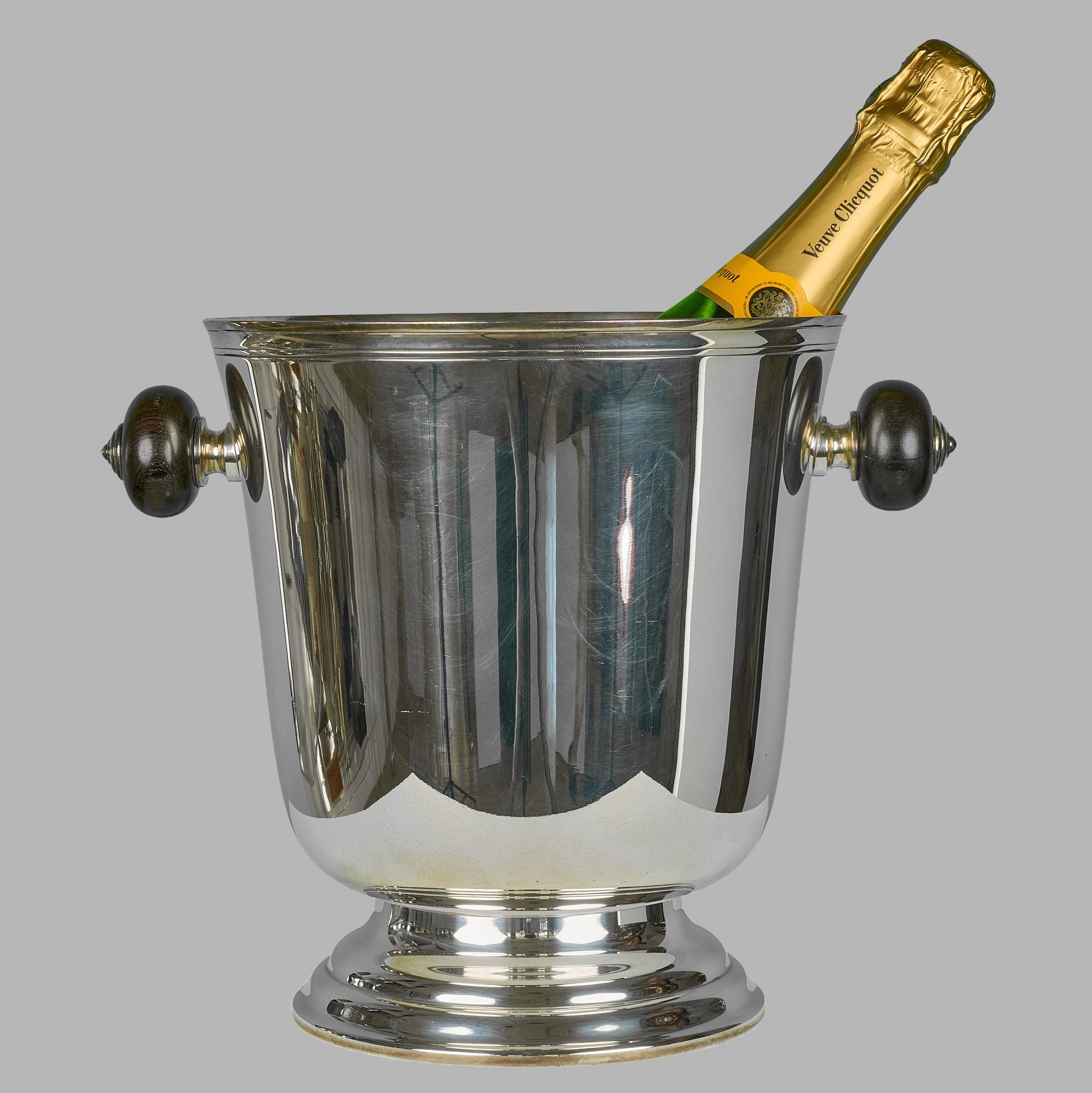
This champagne bucket by Christofle of Paris is raised in a silver plate to a clean tulip form, the polished body flaring from a stepped circular foot and finished at the rim with a restrained molded band. To either side, turned handles of ebonized wood are mounted on silvered collars, a dark and tactile counterpoint to the bright metal that is characteristic of the house at its best.
Christofle has stood at the forefront of French silver since Charles Christofle established the firm in Paris in 1830, supplying the tables of emperors and embassies and setting the standard for plated ware that the name still carries. Dating from the 1950s, the form here is at once classical and modern, owing its proportions to the wine coolers of the eighteenth century while wearing them with the economy of line that marks the best mid-century work. The wooden handles, beyond their elegance, keep the hand from the chilled metal, the mark of a piece made to be used as well as admired.
The body holds a single bottle in ice with room to spare, and the polished surface returns the light of a room as only a good silver plate can. The underside carries the Christofle mark.
A champagne bucket of this quality belongs on any table set for an occasion, and serves equally as a handsome still presence on a sideboard between them. Pieces by Christofle are always sought, and a well-kept example such as this rewards both the eye and the hand.
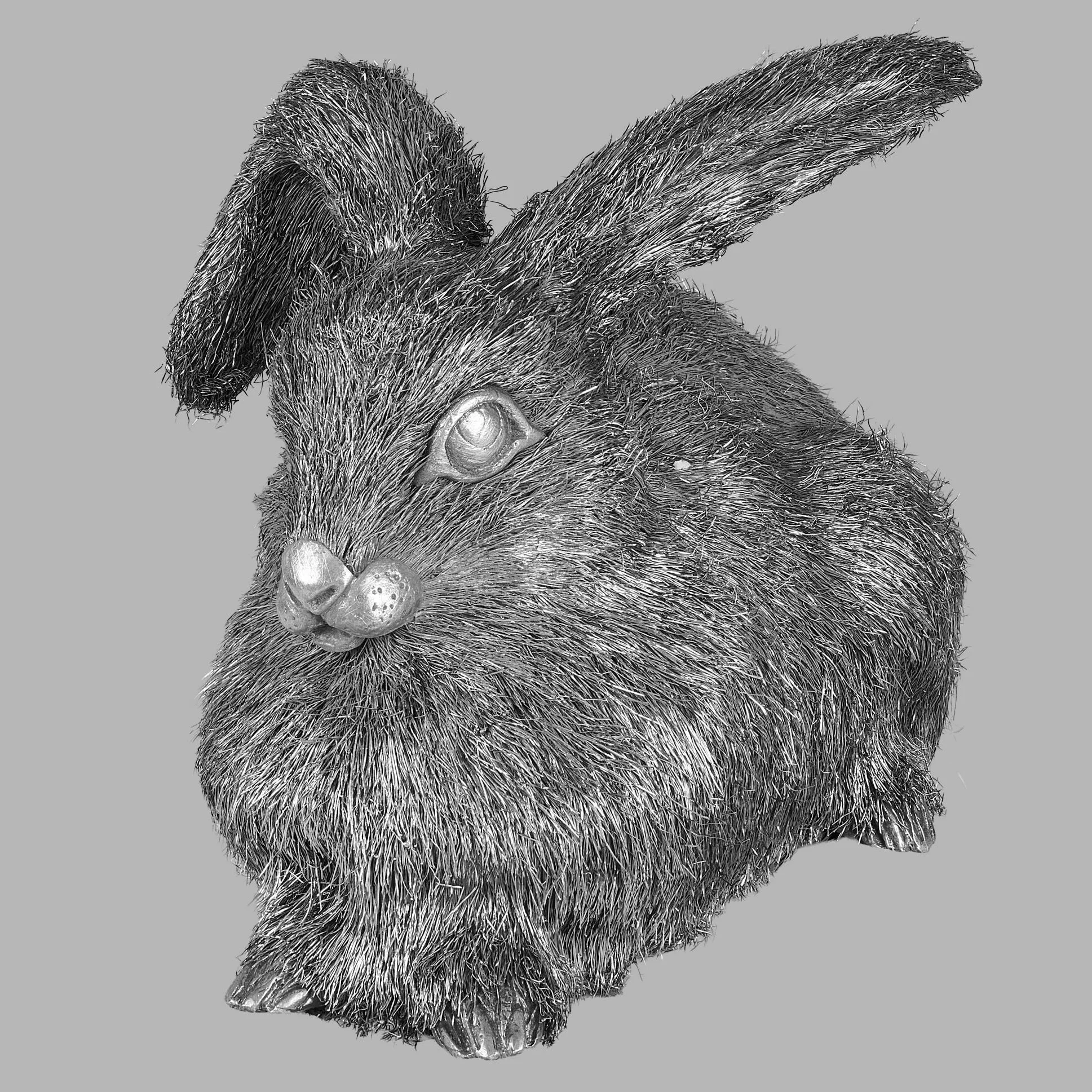
This sterling silver rabbit is the work of Mario Buccellati of Milan, modeled crouching with its ears laid back and rendered lifelike in the textured, hand-engraved fur that is the unmistakable signature of the house. Every surface is worked, the coat drawn out in countless fine strokes that catch and scatter the light, while the eyes, nose, and paws are finished smooth, a contrast that gives the creature its startling presence. Few silversmiths have ever captured an animal with such tactility.
Mario Buccellati founded his house in Milan in 1919 and brought to silver an artistry drawn from Renaissance goldsmiths, reviving engraving techniques that had fallen out of use and making them his own. His naturalistic animals, worked in this manner, are among the most admired objects in twentieth-century Italian silver. The present rabbit shows the hand of the workshop at its finest, the modeling assured, and the texture carried over the whole without a passage left flat.
The underside is marked M. Buccellati and stamped 925 for sterling silver, the mark used by Mario Buccellati's own workshop. The rabbit dates from the 1950s.
An object such as this sits beyond the ordinary run of silver, a piece to be handled and set where it can be seen closely. Buccellati animals are sought by collectors the world over, and a rabbit of this character, modeled with such life, is a rare thing to come by.




A lobed eight-panel comport, the bowl worked in high-relief repoussé with an alternating program of auspicious subjects: a sky dragon surging through clouds, a scholar contemplating a winter garden, birds on prunus blossom, birds among bamboo, and a peony in full bloom. Each panel is framed by polished borders against a finely matted ground, the imagery drawn from the classical vocabulary of Chinese decorative art — symbols of longevity, scholarly virtue, and the natural world in perpetual renewal.
The stem is formed as a sea dragon — jiaolong — rising in full relief from cresting waves, its scaled body rendered with remarkable sculptural precision, jaws open, every fin and whisker crisply delineated. The silver base is engraved with further wave decoration and mounted on a turned hardwood plinth. Two marks are struck to the base: the retail mark of Wang Hing and the artisan mark of Xie Chang.