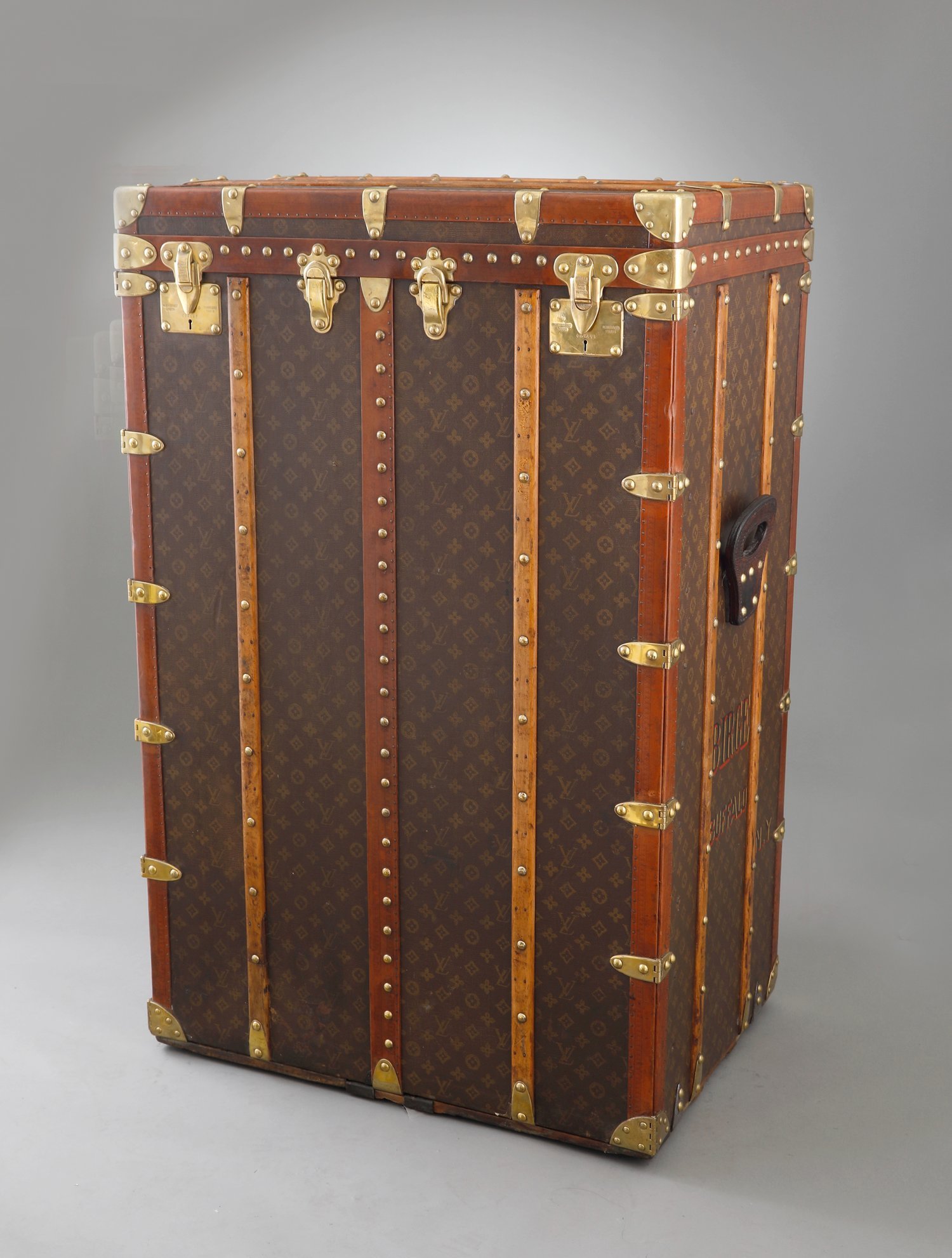
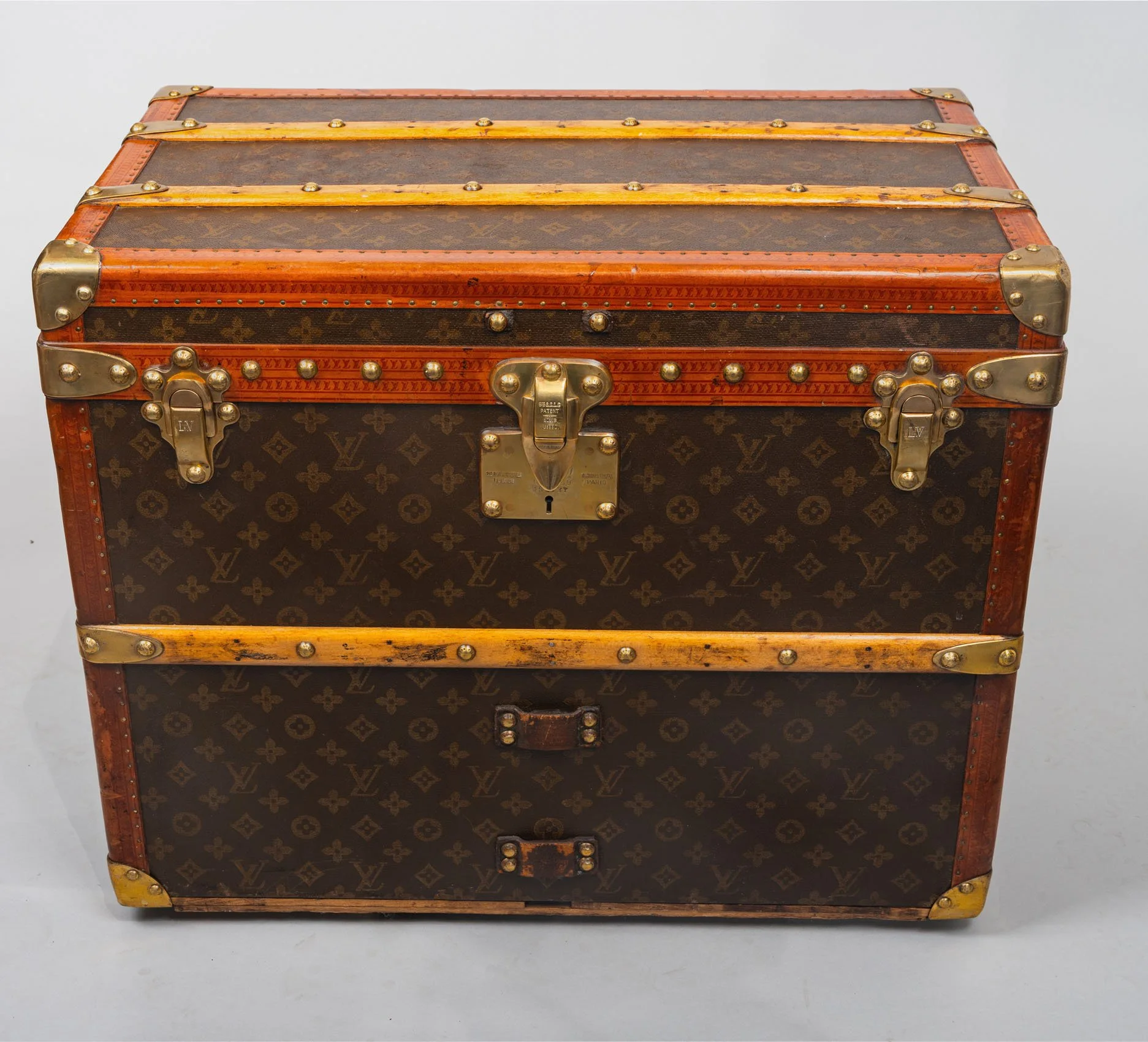
There are Louis Vuitton trunks, and then there are trunks that document history. This exceptional steamer trunk, dating to circa 1910, belongs firmly in the latter category — a piece in which every surviving detail, from its interior labels to its stamped brass handles, places it at the precise intersection of Vuitton's most celebrated address and one of America's greatest retail dynasties.
The trunk retains its original interior label bearing the address 1 Rue Scribe, Paris — the maison Louis Vuitton occupied from the late nineteenth century until 1914, situated directly across from the Grand Hôtel, that monument of Second Empire grandeur which cost over twenty-one million gold francs to construct and which drew the wealthiest and most cosmopolitan clientele in Europe. The proximity was no coincidence: world travelers arriving in Paris by ocean liner tender, private automobile, or the great express trains of the Wagon-Lits company passed through the Grand Hôtel, and the shop across the street served them accordingly. A trunk bearing the Rue Scribe address is therefore dateable with precision — it was made and sold before 1914, placing it in the final and arguably most refined years of Vuitton's pre-war production.
A second interior label elevates this piece further still. It identifies the trunk as a special model exclusively produced for John Wanamaker, New York and Philadelphia by Louis Vuitton, Paris — a distinction that connects it to one of the defining figures in the history of American retail. John Wanamaker's department stores in New York and Philadelphia were not merely commercial enterprises; they were institutions of American civic life, celebrated for the quality and exclusivity of their merchandise. The Wanamaker-Vuitton relationship was one of mutual prestige, and trunks produced under this exclusive arrangement — sold through Wanamaker's to the American market — represent a specific and documented chapter in the transatlantic luxury trade of the Gilded Age and early twentieth century.
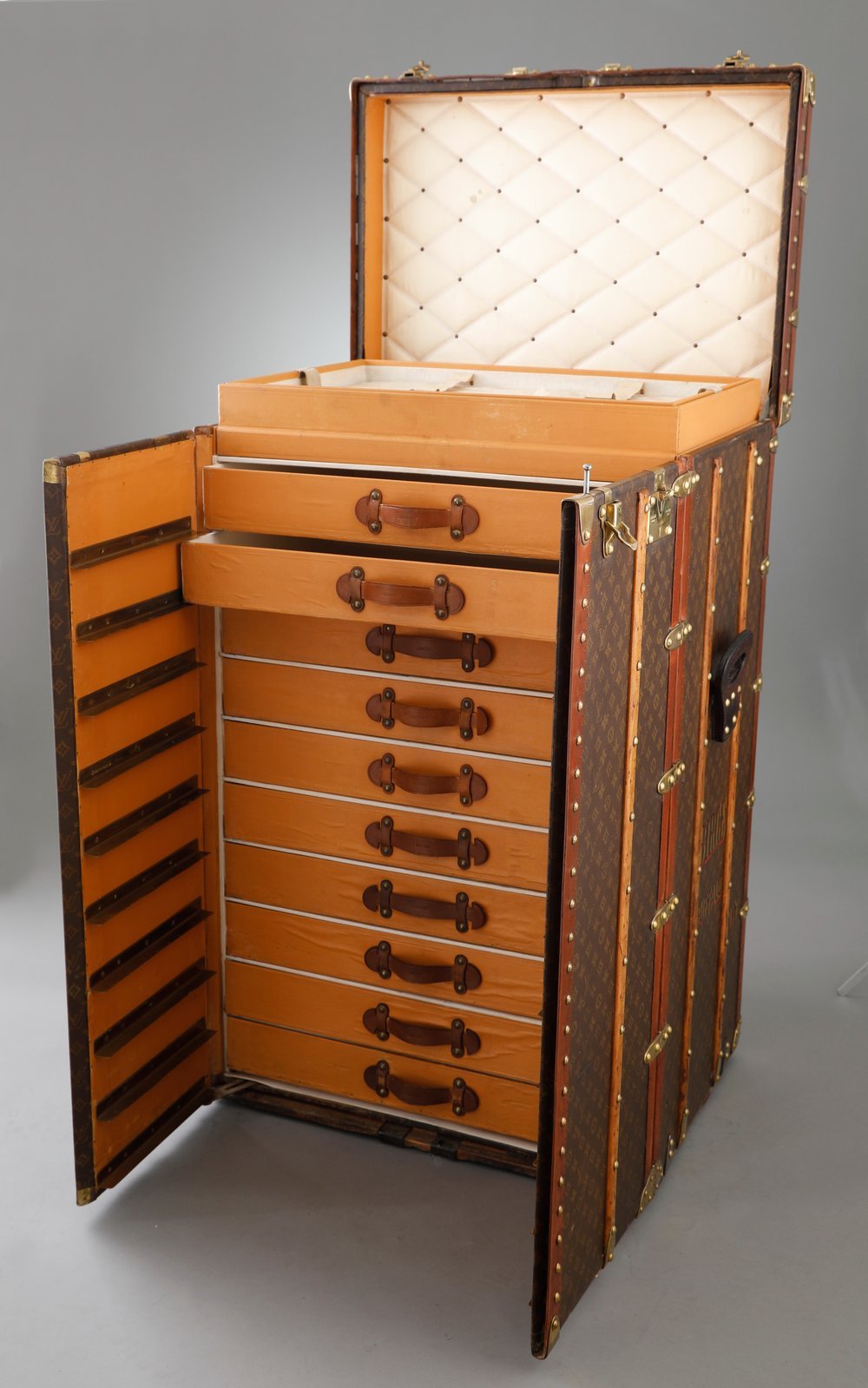
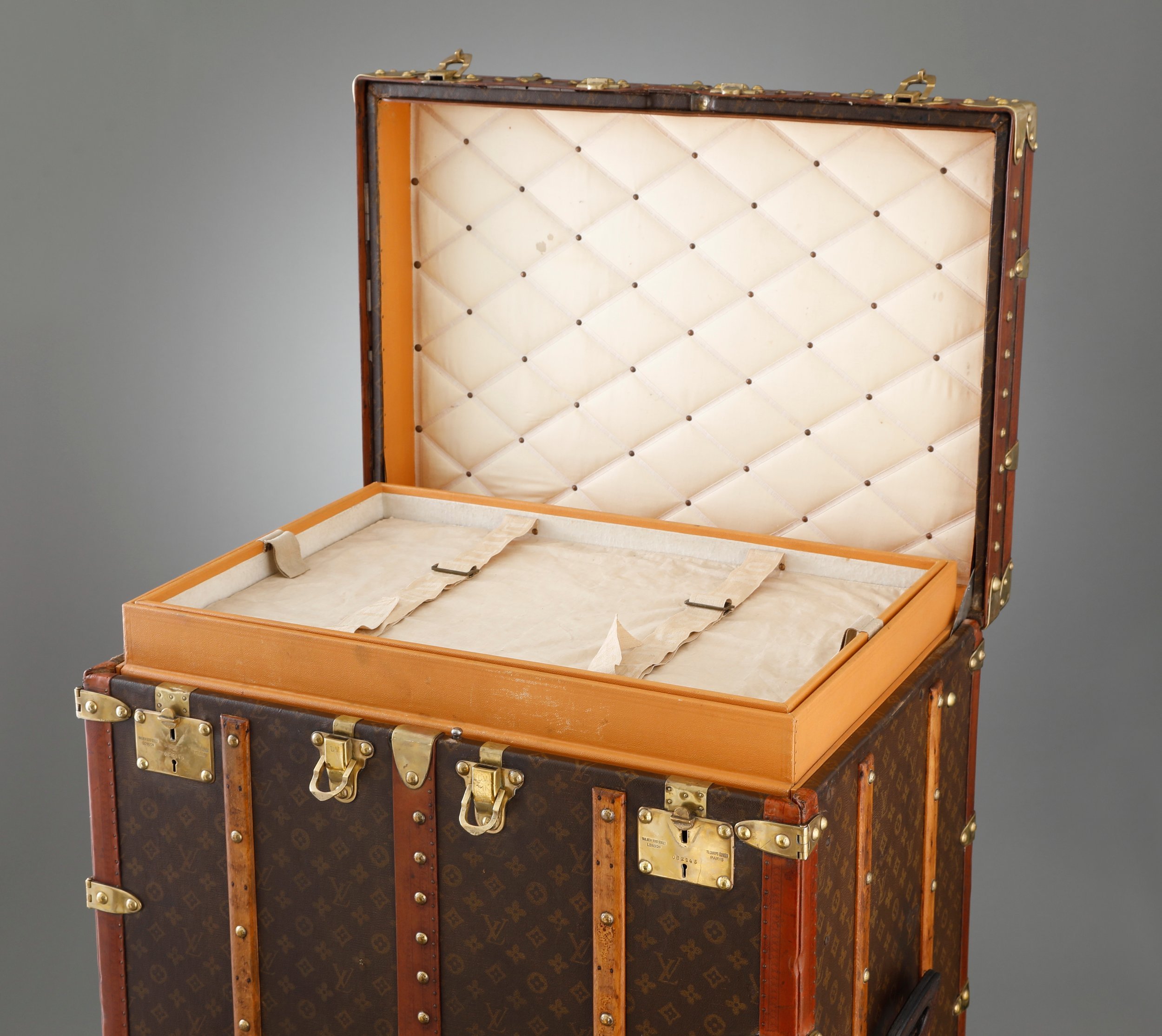
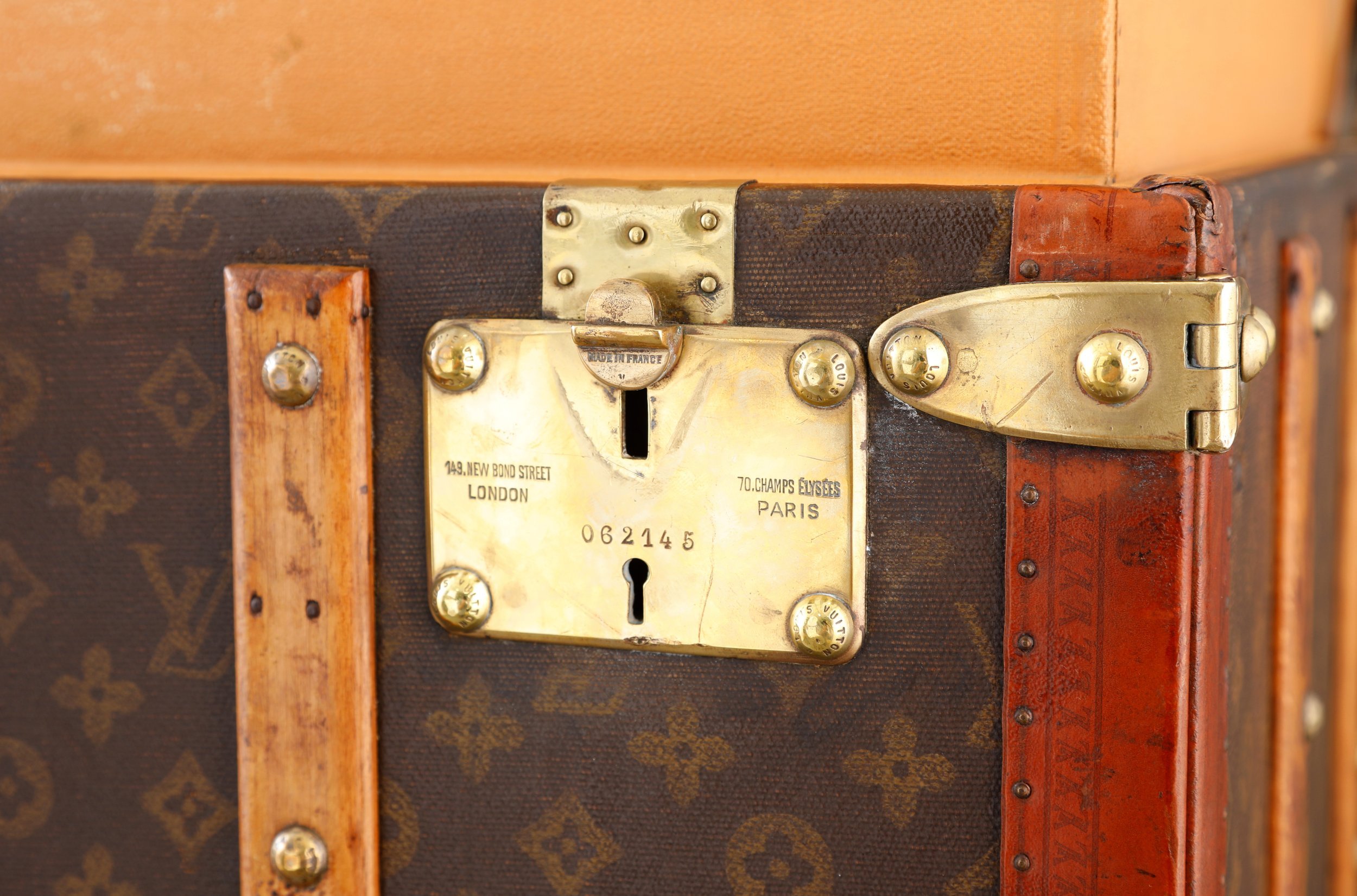
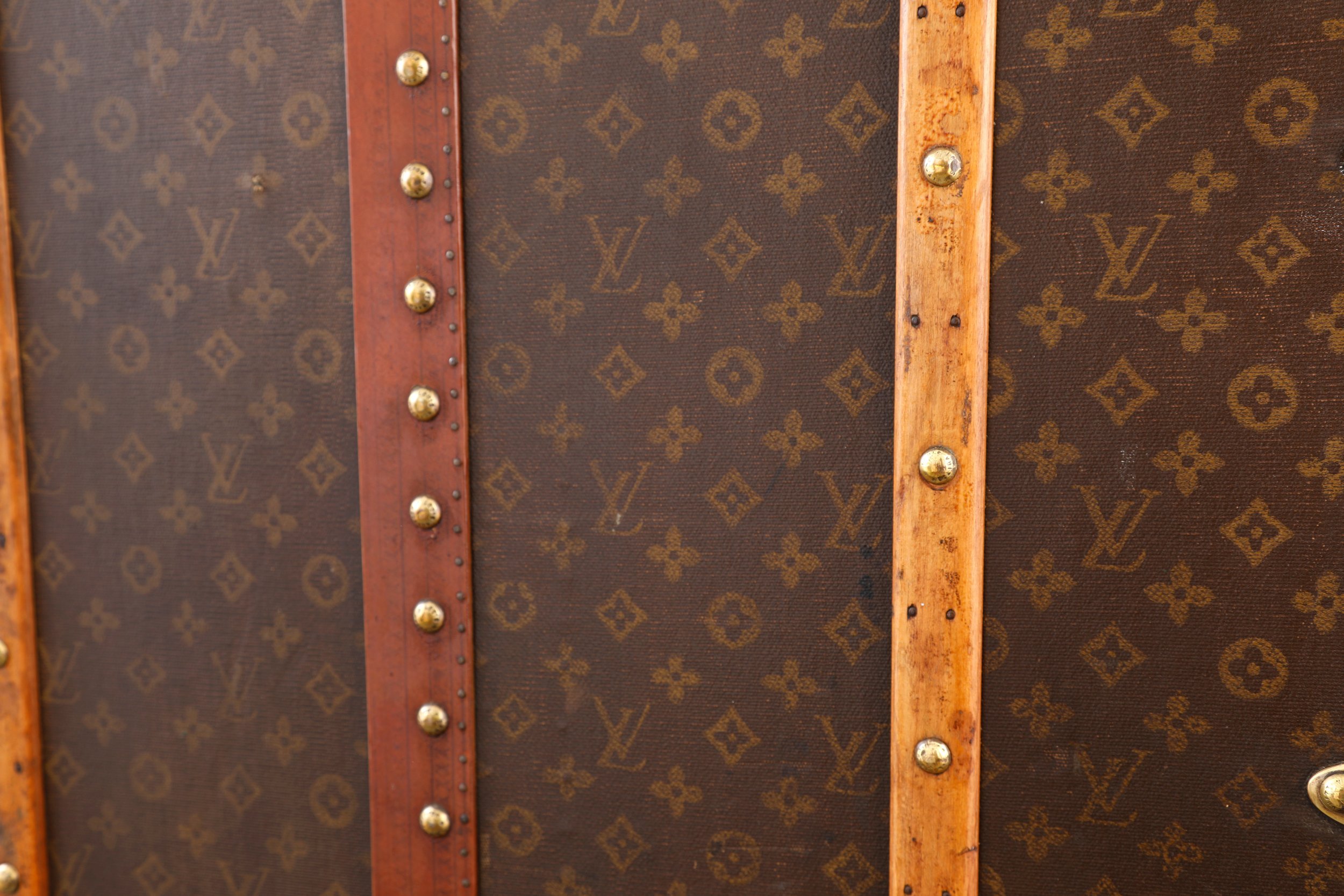
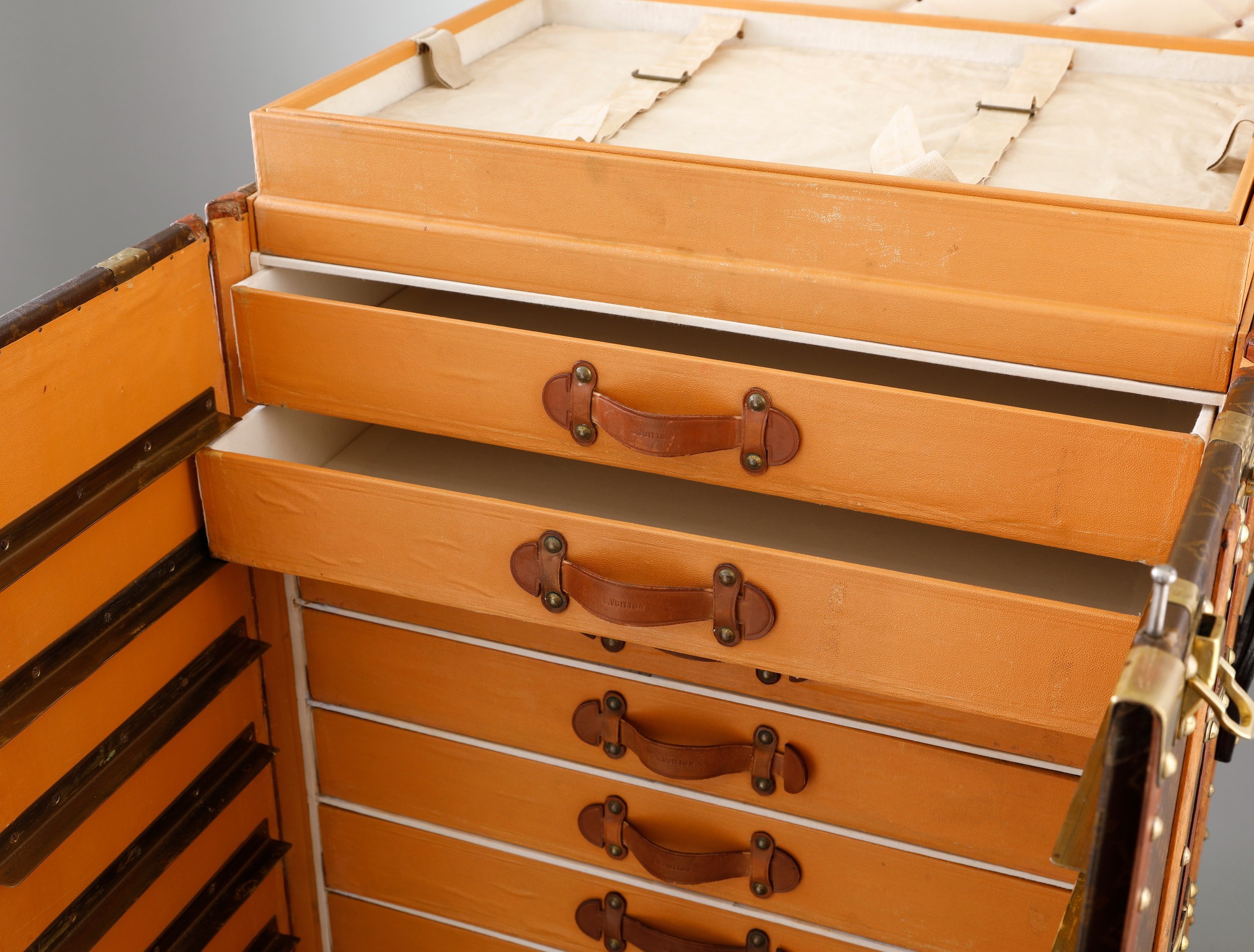
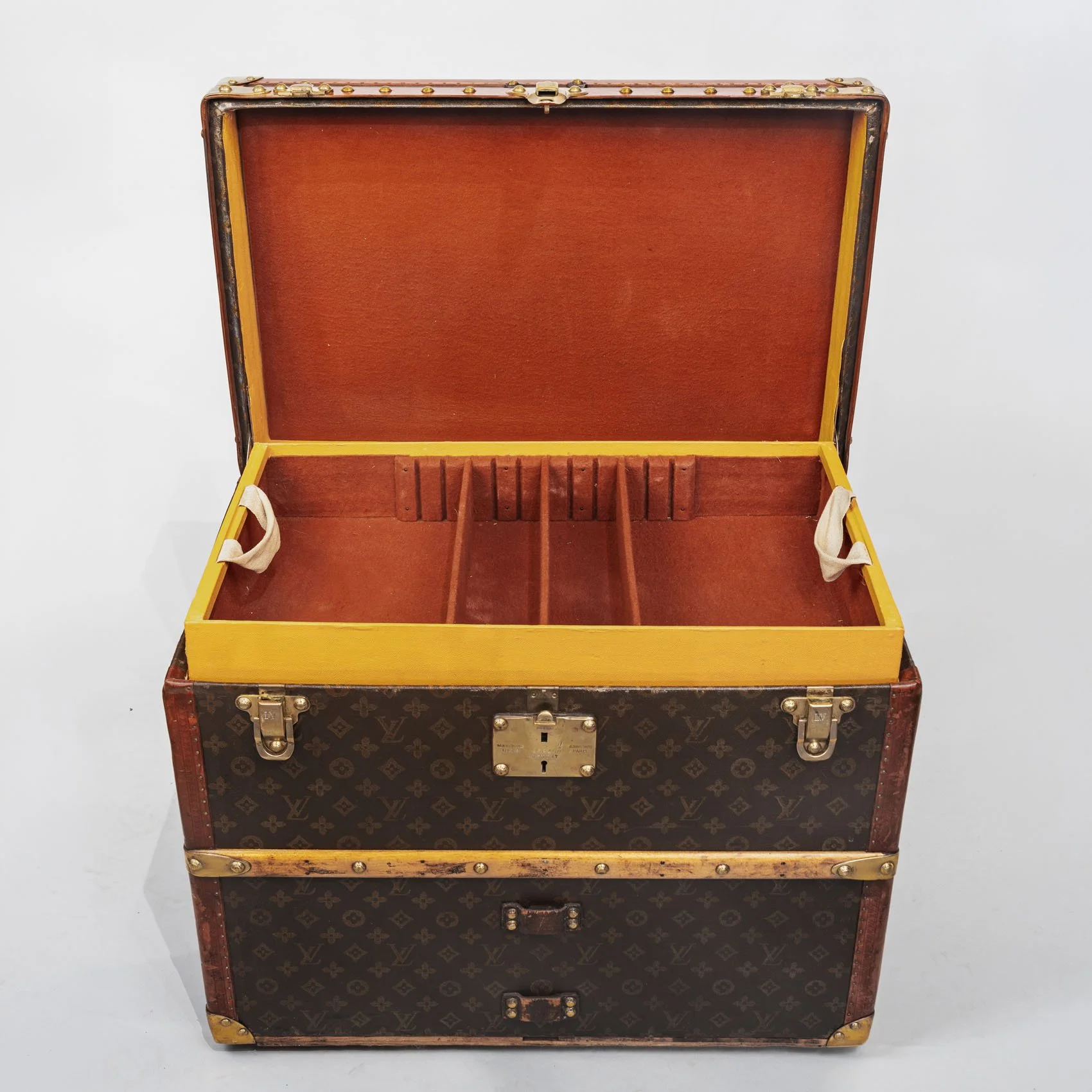
The exterior is executed in Louis Vuitton's monogram canvas with the characteristic triple wood-slat banding, leather trim, and brass hardware throughout. The original brass side handles are stamped with the full Vuitton address legend: 1 Rue Scribe, Paris / Louis Vuitton / London, 149 New Bond Street — a detail of exceptional rarity that transforms functional fittings into primary historical documents. The interior is lined in Vuitton's quilted cream fabric, clean and fully intact, with the characteristic diamond-pattern stitching and brass stud detailing of the house's premium production. A dark travel stripe runs vertically on the front face, the personal identifier of the original owner.
Trunks of this layered provenance — Rue Scribe label, Wanamaker exclusivity label, and stamped address handles, all present and legible — are extraordinarily rare. This is a piece for the serious Vuitton collector or institution, and one that will not easily be replicated.
Interior Labels: 1 Rue Scribe, Paris (pre-1914); John Wanamaker, New York & Philadelphia — Exclusive Model by Louis Vuitton, Paris Handle Stamps: 1 Rue Scribe, Paris / Louis Vuitton / London, 149 New Bond Street
Condition: Very good overall, consistent with age. Monogram canvas strong and intact with rich, even patina. Leather trim and wood slat banding structurally sound. Brass hardware complete — corner guards, clasps, lock plate, and side handles all present. Both interior labels present and legible. Handle stamps reading "1 Rue Scribe, Paris / Louis Vuitton / London, 149 New Bond Street" clear and sharp. Interior quilted cream lining clean and fully intact with original brass studs throughout. A well-preserved and historically significant example.
Literature:
Paul-Gérard Pasols, Louis Vuitton: Malletier à Paris, Paris, 1987
Florence Müller, Louis Vuitton: 100 Legendary Trunks, New York, 2010
Pierre Léonforte, Louis Vuitton: The Birth of Modern Luxury, Paris, 2004
There are Louis Vuitton trunks, and then there are trunks that document history. This exceptional steamer trunk, dating to circa 1910, belongs firmly in the latter category — a piece in which every surviving detail, from its interior labels to its stamped brass handles, places it at the precise intersection of Vuitton's most celebrated address and one of America's greatest retail dynasties.
The trunk retains its original interior label bearing the address 1 Rue Scribe, Paris — the maison Louis Vuitton occupied from the late nineteenth century until 1914, situated directly across from the Grand Hôtel, that monument of Second Empire grandeur which cost over twenty-one million gold francs to construct and which drew the wealthiest and most cosmopolitan clientele in Europe. The proximity was no coincidence: world travelers arriving in Paris by ocean liner tender, private automobile, or the great express trains of the Wagon-Lits company passed through the Grand Hôtel, and the shop across the street served them accordingly. A trunk bearing the Rue Scribe address is therefore dateable with precision — it was made and sold before 1914, placing it in the final and arguably most refined years of Vuitton's pre-war production.
A second interior label elevates this piece further still. It identifies the trunk as a special model exclusively produced for John Wanamaker, New York and Philadelphia by Louis Vuitton, Paris — a distinction that connects it to one of the defining figures in the history of American retail. John Wanamaker's department stores in New York and Philadelphia were not merely commercial enterprises; they were institutions of American civic life, celebrated for the quality and exclusivity of their merchandise. The Wanamaker-Vuitton relationship was one of mutual prestige, and trunks produced under this exclusive arrangement — sold through Wanamaker's to the American market — represent a specific and documented chapter in the transatlantic luxury trade of the Gilded Age and early twentieth century.
The exterior is executed in Louis Vuitton's monogram canvas with the characteristic triple wood-slat banding, leather trim, and brass hardware throughout. The original brass side handles are stamped with the full Vuitton address legend: 1 Rue Scribe, Paris / Louis Vuitton / London, 149 New Bond Street — a detail of exceptional rarity that transforms functional fittings into primary historical documents. The interior is lined in Vuitton's quilted cream fabric, clean and fully intact, with the characteristic diamond-pattern stitching and brass stud detailing of the house's premium production. A dark travel stripe runs vertically on the front face, the personal identifier of the original owner.
Trunks of this layered provenance — Rue Scribe label, Wanamaker exclusivity label, and stamped address handles, all present and legible — are extraordinarily rare. This is a piece for the serious Vuitton collector or institution, and one that will not easily be replicated.
Interior Labels: 1 Rue Scribe, Paris (pre-1914); John Wanamaker, New York & Philadelphia — Exclusive Model by Louis Vuitton, Paris Handle Stamps: 1 Rue Scribe, Paris / Louis Vuitton / London, 149 New Bond Street
Condition: Very good overall, consistent with age. Monogram canvas strong and intact with rich, even patina. Leather trim and wood slat banding structurally sound. Brass hardware complete — corner guards, clasps, lock plate, and side handles all present. Both interior labels present and legible. Handle stamps reading "1 Rue Scribe, Paris / Louis Vuitton / London, 149 New Bond Street" clear and sharp. Interior quilted cream lining clean and fully intact with original brass studs throughout. A well-preserved and historically significant example.
Literature:
Paul-Gérard Pasols, Louis Vuitton: Malletier à Paris, Paris, 1987
Florence Müller, Louis Vuitton: 100 Legendary Trunks, New York, 2010
Pierre Léonforte, Louis Vuitton: The Birth of Modern Luxury, Paris, 2004

 Image 1 of 2
 Image 2 of 2