
How to Tell if a Bronze Sculpture Is Real, Old, and Worth Anything
Every week, someone emails the gallery about a bronze they have inherited, and the questions are almost always the same three. Is it really bronze, is it old, and is it worth anything? They are different questions, and the order matters. The first can usually be settled in your own hands in a few minutes. The second is where connoisseurship begins. And the third depends entirely on the first two, because value in bronze sits in the cast, not the metal, as we will see. This article will take you as far as photographs and common sense can go before a trained eye needs to take over.
I come to bronzes as an archaeologist by training, and an archaeologist is really a detective looking into the past. Nothing is taken at face value; everything is evidence, and evidence is collected in order. The work starts before the piece is even handled, with its history. Where did it come from, who bought it, when and why, and how has it lived since, on display and dusted weekly or packed in a box in the attic? With an inherited bronze, you have an advantage no dealer does: you may actually know, so write down what the family remembers, because that history travels with the piece and counts toward its value. Then comes the object itself: is it really bronze, how was it cast and finished, what condition is it in, and does its wear agree with the story it arrived with? Only when everything adds up does the piece go into context. What follows is that checklist, in the order I use it.
Is It Bronze at All?
Begin with a magnet. Bronze is a copper alloy, and a magnet will not grip it. If the magnet sticks, you are holding cast iron or plated steel, and the question of age becomes a different conversation entirely.
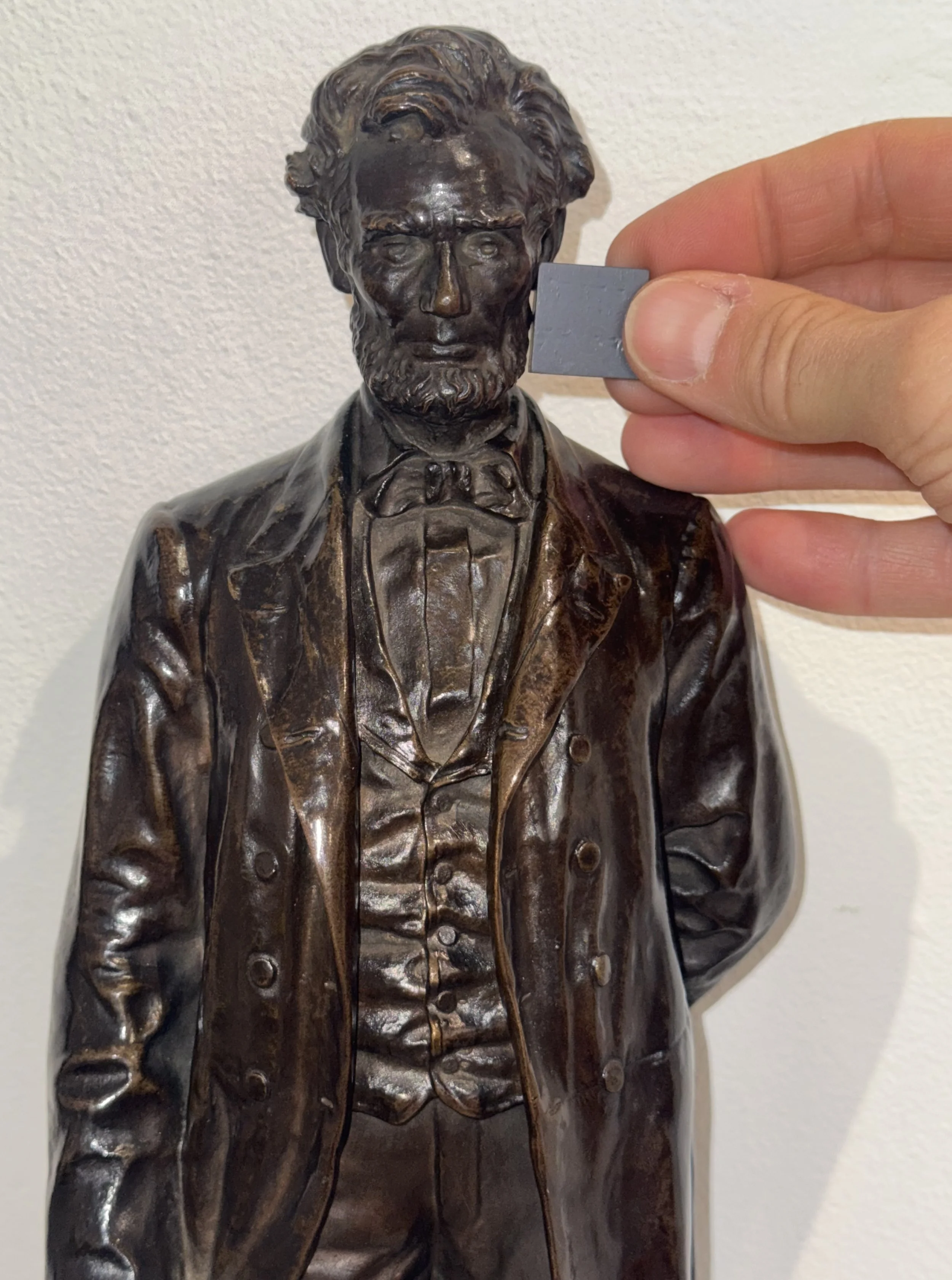
A magnet will not stick to bronze. If it grips the surface, the piece is made of iron or steel beneath the finish. Use a magnet with a rubber coating so it cannot mark the patina.
One refinement is worth knowing before you conclude anything. If the magnet generally refuses the surface but grips at one or two small spots, you have probably found an iron-core pin, called a chaplet, one of the small rods that held the internal core in position while the molten metal was poured around it. Hollow casts made by traditional methods often keep their iron pins, sometimes plugged flush and invisible beneath the patina, so a magnet that catches locally on an otherwise non-magnetic figure is not a failed test but a discovery about how the bronze was made. Mark those spots and photograph them, because they are precisely the kind of evidence a specialist wants to see.
Next, weight. Bronze is dense, denser in fact than solid steel, and a volume of it the size of a soda can weighs about seven pounds. Nobody can tell you what a bronze figure of a given height should weigh, because most bronzes are cast hollow, and wall thickness varies from cast to cast, but the density comes through regardless. A bronze figure a foot tall has real heft, noticeably more than feels reasonable for its size. The common imitations fail this test in both directions. Spelter, a zinc alloy used for cheap decorative casting from the mid-nineteenth century onward, is roughly a quarter lighter than bronze and feels it. Cold-cast resin, a modern material made from bronze powder in polyester, is only about a third as dense as bronze and, unlike metal, feels warm to the touch. Genuine bronze at room temperature is cold in the hand and warms slowly.
Then look for honest wear. Where a bronze has been rubbed or knocked over the years, the exposed metal glows a warm yellow or coppery tone. Spelter betrays itself the same way, but the metal beneath its bronzed paint shows silvery white. Keep note of where those worn spots are, because they do double duty. Here they answer what the metal is, and when we come to the patina, they will help answer how old it is.
The Scratch and Sound Tests, and Why to Skip Them
Most guides at this point recommend the scratch test, taking a knife or a pin to a hidden spot to see the color of the metal underneath, and the sound test, tapping the piece to hear whether it rings. I would skip both. Please do not scratch a bronze. Every scratch is permanent; it cuts through a surface that took a century or more to form and that carries a real share of the object's value, and it tells you nothing that the piece's existing honest wear does not already show for free. Look for the spot where life has done the scratching for you, the worn nose, the rubbed base edge, the bright line where a fitting has moved, and read the metal color there. If a figure genuinely has no honest wear anywhere, that fact is itself worth noting, and the question of what lies beneath the surface is one a specialist can settle without harm, including with instruments that read the alloy without touching it at all. As for the ring, a hollow bronze, a thick-walled bronze, and a spelter figure on a marble base can all ring or thud in ways that mislead, so weight, magnetism, and the color of worn metal remain more reliable and require no judgment about tone.
You will notice that this section includes no demonstration photographs. I am not scratching my bronzes to make one.
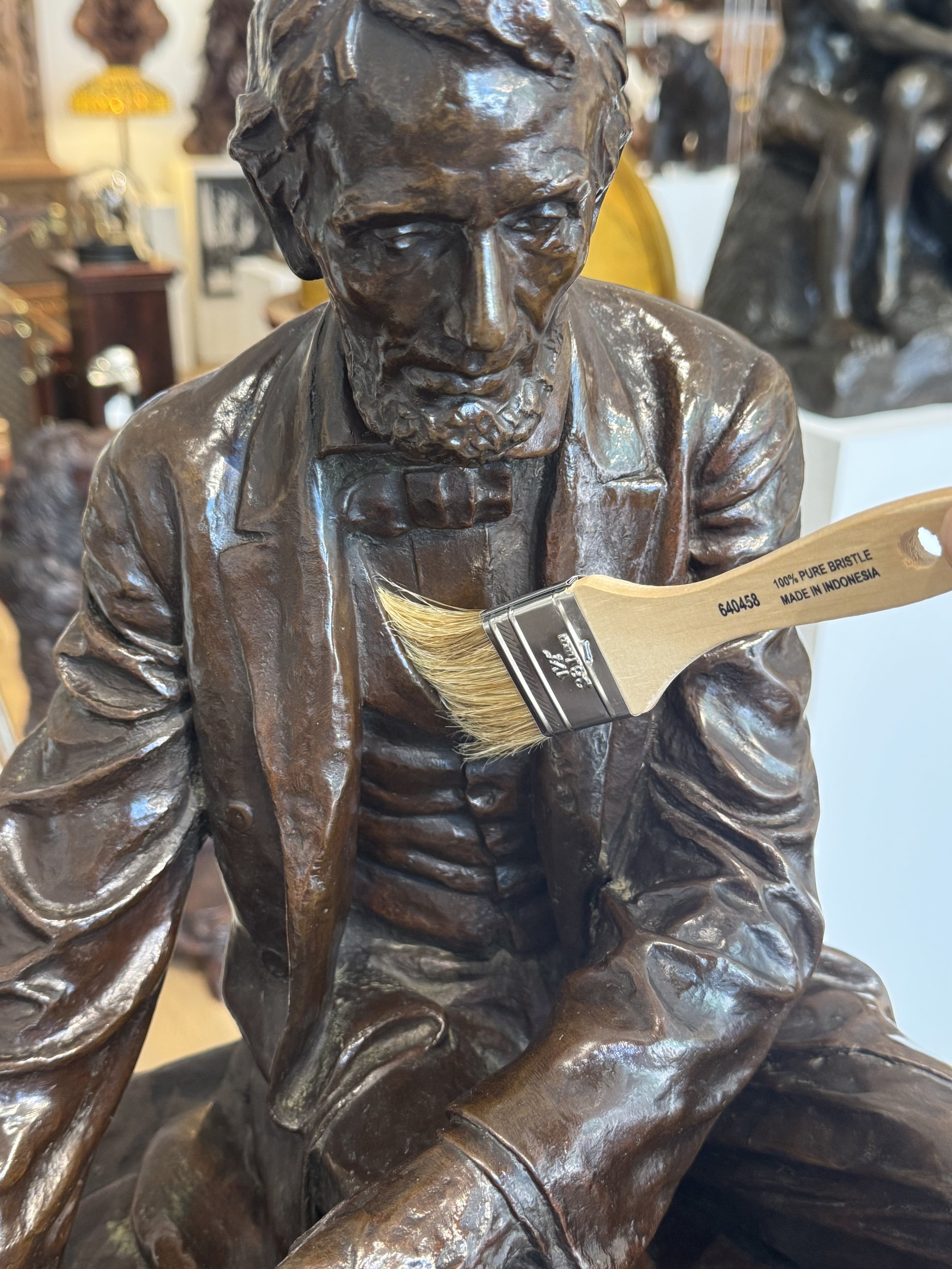
All the cleaning an old bronze needs. A soft, dry-bristle brush lifts the dust and touches nothing else.
How Should You Clean a Bronze?
Barely at all, and that is the point. No metal polish, no ammonia, no abrasive pads, no wire brush. The patina is not tarnish to be removed; it is the surface itself and a large part of the value, and one enthusiastic polishing session turns an antique bronze into a shiny modern one and strips away the very evidence the rest of this article will teach you to read. All an old bronze needs is dusting with a soft, dry brush or cloth. An ordinary natural bristle brush from the hardware store does the job perfectly well; there is no need to spend extra on specialist conservation brushes. If the surface is powdery, flaking, or actively corroding, do nothing and ask for advice first.
Bronze or Brass?
This question often comes up, and the honest answer is that for sculpture it matters less than people fear. Bronze is a copper alloy principally with tin; brass is copper alloyed with zinc; and historical foundries used a range of mixtures that shade from one to the other. Pure copper, for its part, is rarely used for cast sculpture at all, being too soft and reading distinctly redder than any bronze, so a cast figure is almost never solid copper. Renaissance and later founders chose their alloys for how the metal poured and chased, not to satisfy a modern definition. The practical point is this. If the piece passes the tests above, it is a copper-alloy casting, and its age and quality are decided by the evidence discussed below, not by an assay.
Reading the Patina
Patina is the colored surface a bronze acquires, partly applied by the foundry with heat and chemicals, partly earned through decades of air, handling, and wax. On the finest bronzes the applied layer is itself an artwork. Richard Stone, the Metropolitan Museum's longtime conservator of Renaissance bronzes, demonstrated that most Renaissance patinas are organic, translucent varnishes of oils and resins applied over the worked metal, allowing the bronze to glow through from beneath. He was writing about the finest small bronzes in the world, but the principle he described is the one to hold in mind at every level of the market, because it is why a good patina reads as depth rather than as paint, the metal living under the surface rather than hidden by it. It is the first thing your eye should interrogate, because age leaves a pattern that is difficult to counterfeit convincingly.
On an old bronze, the patina lives. It is worn thin and paler on the high points, the nose, the knuckles, the mane, wherever hands and dust cloths have reached, and it sits darker in the recesses where they have not. This is the same honest wear that told you the metal's color, now read for its pattern rather than its tone. The color varies subtly across the surface, and the whole reads as a skin rather than a coating. A bronze whose color is perfectly even from crown to base, with a granular or sprayed look under a loupe, is telling you its surface was applied recently and quickly. That does not, by itself, condemn the cast, since old bronzes are sometimes stripped and repatinated, but it removes the surface as evidence of age and shifts the burden of proof elsewhere.
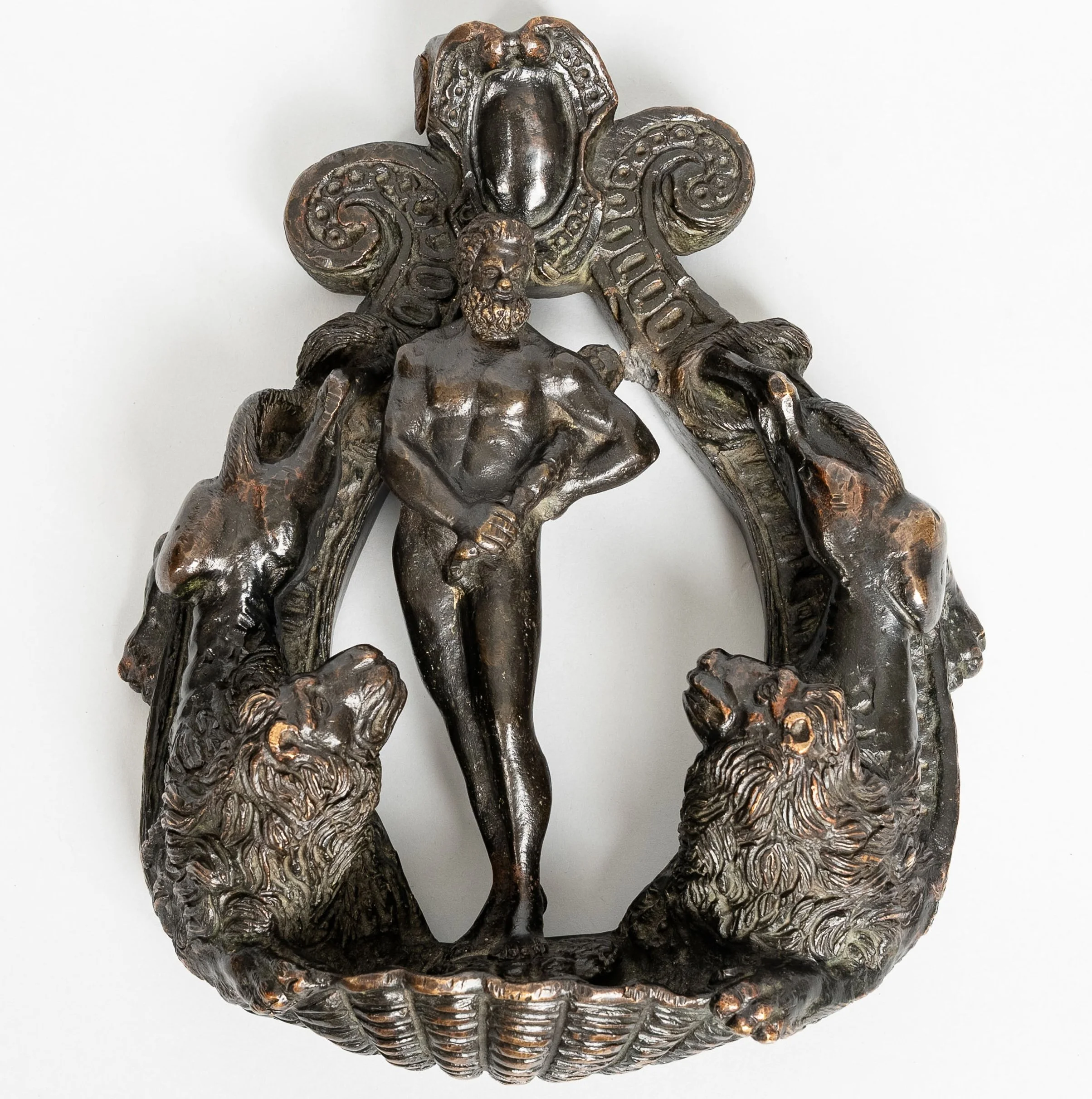
A Venetian bronze door knocker. Centuries of handling have worn the dark surface down to bright bronze on the high points, wear that no artificial finish reproduces convincingly. Note the wear on the right lion's body, the bottom of the shell, two places a hand would naturally grab, and the high points of both lions' ears.
Be equally wary of theatrical antiquity. Bright green corrosion crusted into every crevice of an otherwise crisp figure is a stage effect, applied to suggest excavation. Genuine burial patina is a subject of its own, and on the kind of decorative and cabinet bronzes most people inherit, it is almost never the real explanation.
Turn It Over
If I could see only one photograph of a bronze, I would ask for the underside. The top of a sculpture is where a maker, honest or otherwise, spent all his effort. The bottom is where the history of manufacture survives unedited.
An old sand-cast or lost-wax bronze shows an interior and base worked by hand. Expect irregularity, file marks, traces of the casting process, plugs and old repairs, and fastenings that were peened or threaded by hand. Feet that have stood on marble or wood for a century show genuine flattening and dirt in a pattern that matches how the piece actually sits. A modern reproduction shows a different character altogether: machine-regular surfaces, crisp identical screws of hardware-store type, or a base sealed with felt hiding everything, which is itself a reason to look further. None of these observations alone dates a bronze, but together the underside usually speaks more plainly than the front.
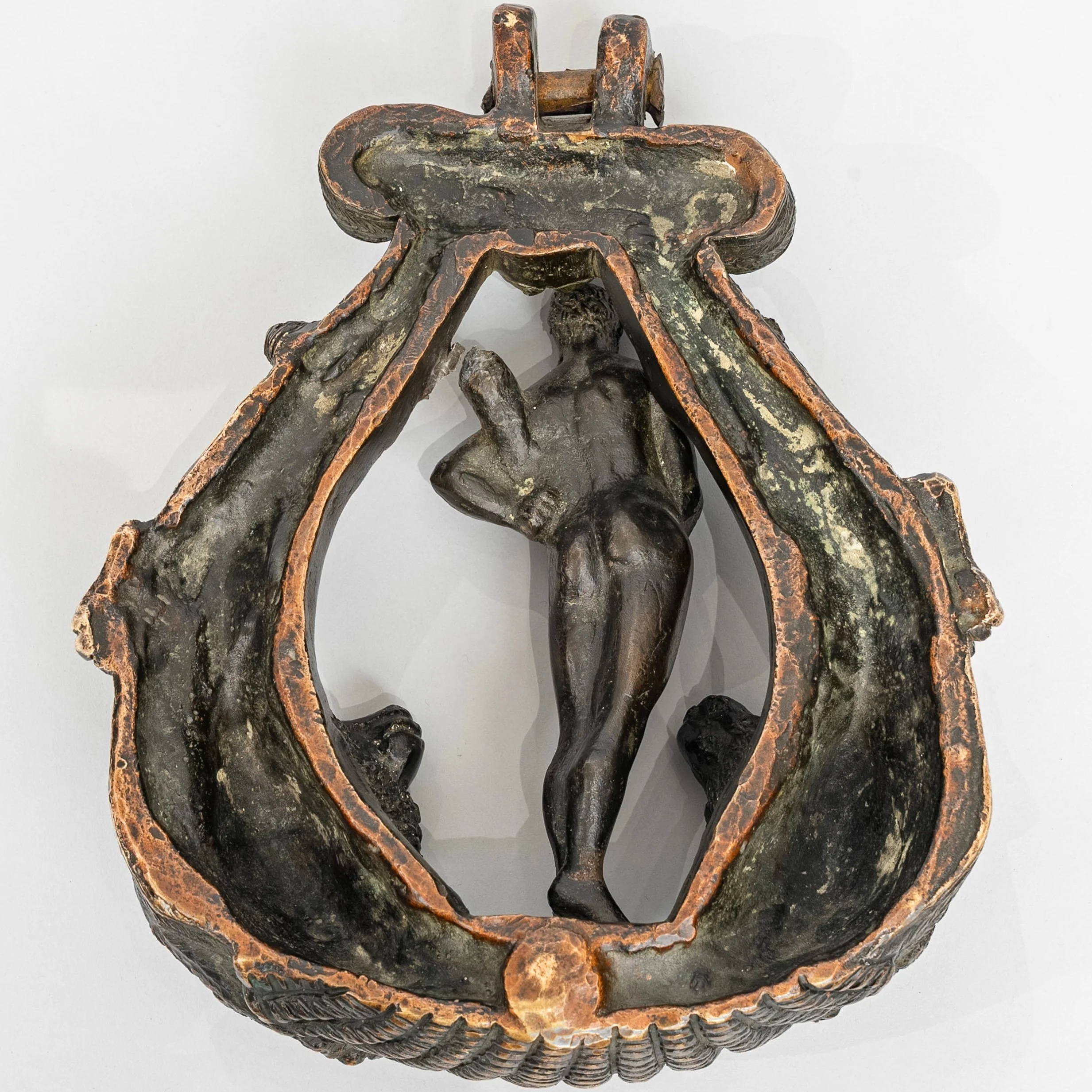
The back of the same knocker. The hollow, slightly irregular interior is typical of the lost-wax process used for fine bronzes. Note how the hollows follow the forms of the front, and the pale traces of casting material are still lodged in the recesses.
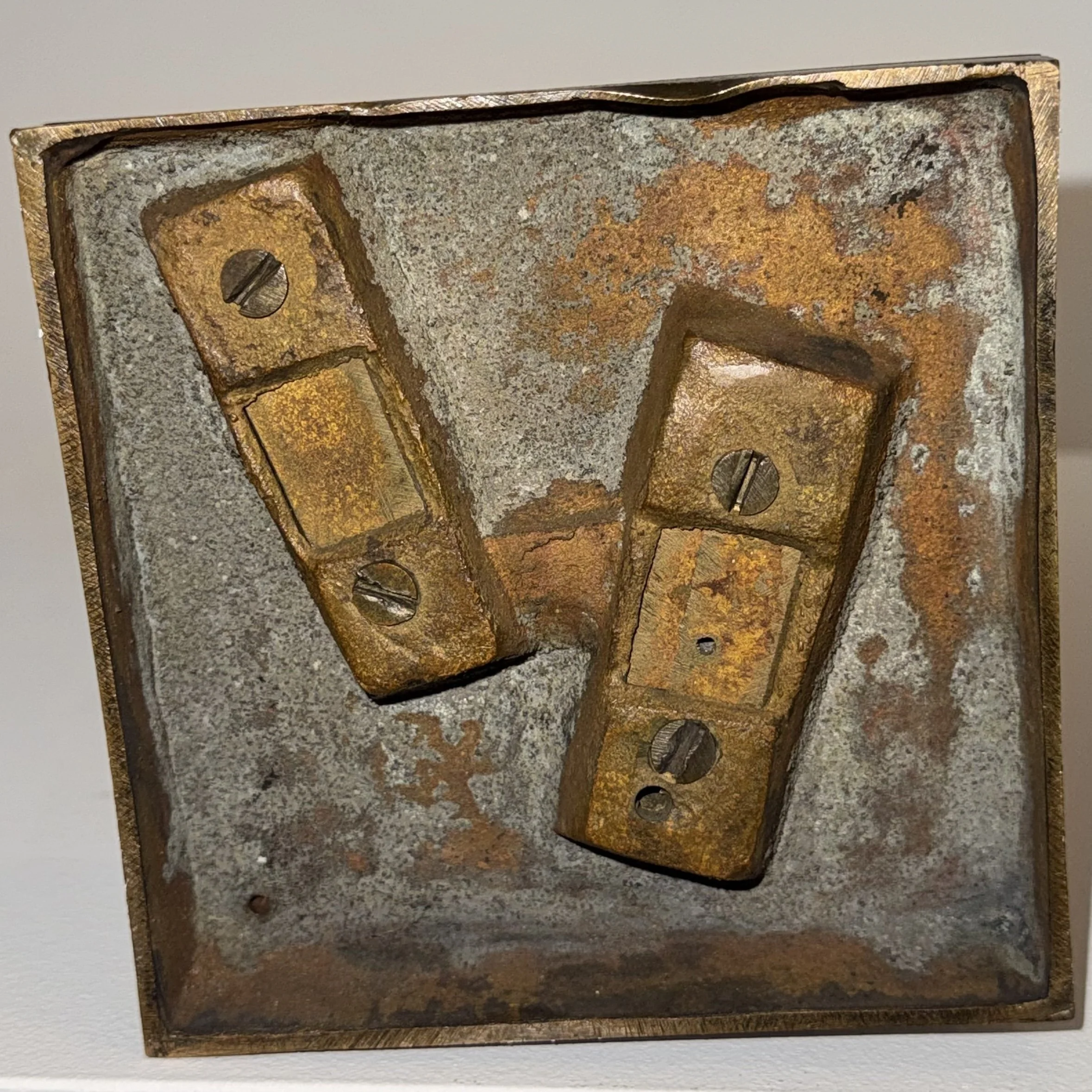
The underside of a nineteenth-century sand-cast bronze, the granular interior quite different from the smooth hollow of a lost-wax cast. The figure's feet pass through the base and are held by hand-fitted slotted screws, with file marks still visible along the rim.
How Bronzes Are Actually Dated
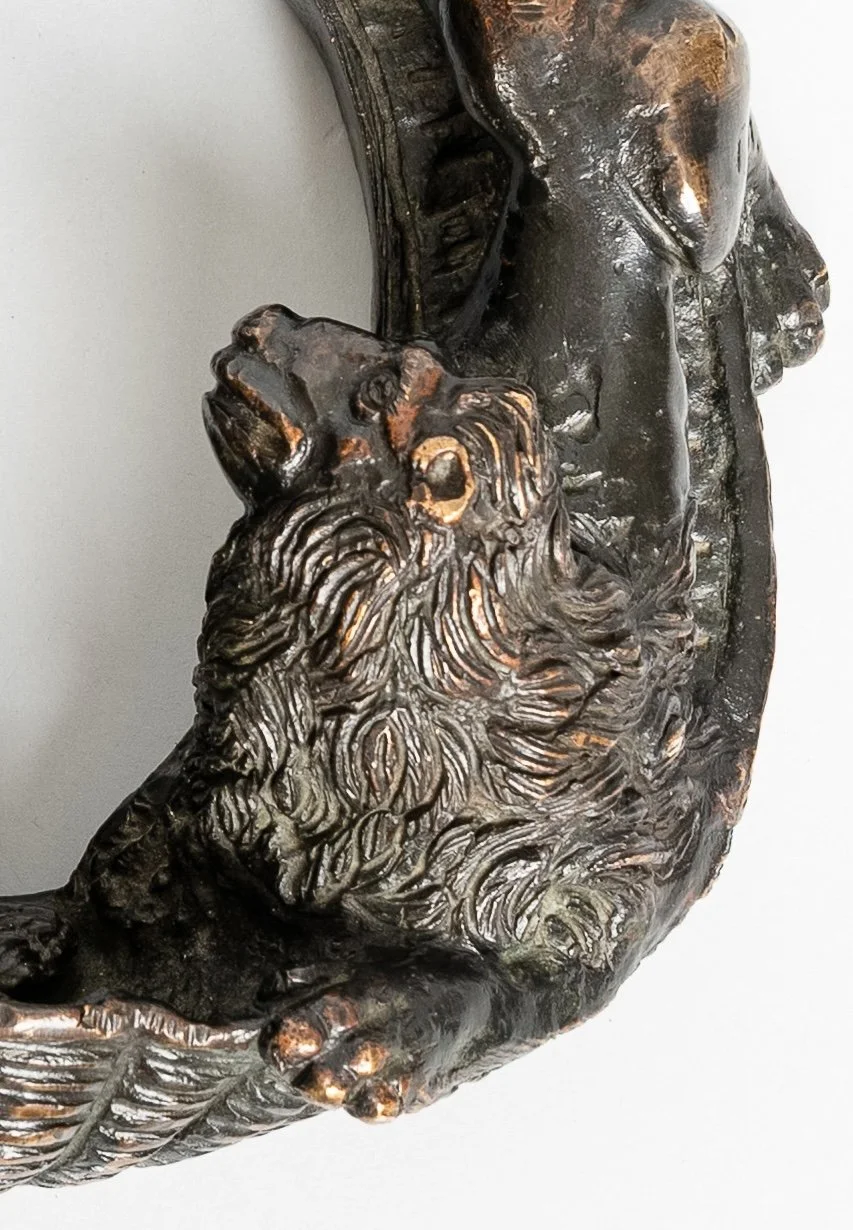
Every strand of the mane was chased by hand with steel tools after casting, the crispness that fades with every generation of copying.
The honest general view is that a bronze does not carry its birthday inside it. There is no laboratory test that dates the metal itself, the way tree rings date timber or radiocarbon dates anything that once lived, because the copper in a nineteenth-century cast can be chemically much the same as the copper in a Renaissance one. Science helps at the edges. An alloy analysis, usually by X-ray fluorescence, or XRF, reads the metal's recipe without touching the piece and can rule certain periods in or out, but foundries within any one period used such a wide range of mixtures that the numbers rarely settle a date on their own. Where the original clay casting core survives inside a hollow figure it can sometimes be dated directly, but no instrument will simply announce a year. Even where laboratory dating can be applied, the answer arrives with a plus or minus, and the range is often generous. A radiocarbon or thermoluminescence result can span a century or more, sometimes wide enough that the very question being asked, Renaissance or nineteenth century, sits inside it.
Dating a bronze is instead an argument from converging evidence. How the figure was cast and fastened, how its surface has aged and worn, how its finest details compare with documented examples, and what history travels with it all have to point the same way. One piece of that evidence is worth understanding on its own, because bronzes have been copied for as long as they have been made, usually by pressing a mold against an existing bronze and casting again. Think of a photocopy of a photocopy. Each generation loses a little sharpness, so on an early cast every strand of hair is a distinct cut line, chased sharp by hand after casting, while on a copy of a copy the same passages go soft and blurry, as though seen through frosted glass. Reading that sharpness against documented casts is much of what a specialist is doing when asked how old a bronze is. No single observation dates a bronze; the agreement of many does.
Foundry Marks and Signatures
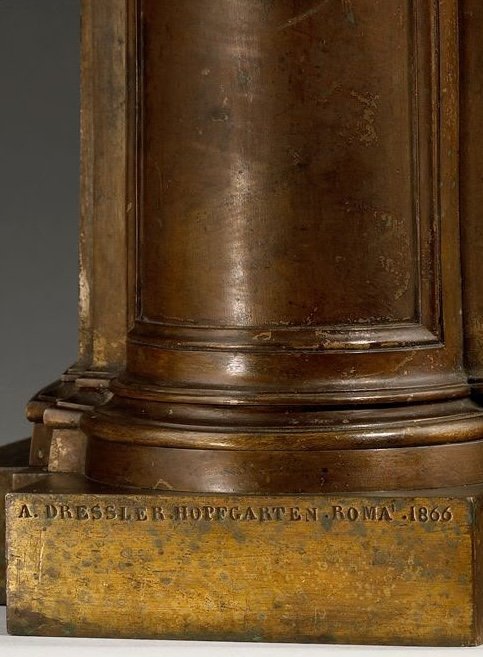
The signed base of a bronze reduction of the Marcus Aurelius monument in Rome, marked A. Dressler, Hopfgarten, Roma, 1866. A genuine signature sits naturally in the metal and names a real founder, place, and date.
A mark helps, but it is a clue and not a verdict. The great nineteenth-century foundries marked much of their production: Barbedienne and Susse in Paris, the Naples workshops of Chiurazzi and Sommer for casts after the antique, and a stamped foundry mark, a cast-in signature, or an inscribed edition number is always worth photographing squarely and researching. One caution. Because a famous name adds value, names and marks have been added to casts that never earned them, so a signature is a claim the rest of the object must support. The mark begins the investigation; the casting quality and surface finish decide it.
American Western bronzes deserve a word of their own here, because they are among the most actively collected bronzes in this country and their market runs on the artist's name. Western sculptors signed by hand in the wax before casting, so the signature comes out in the metal itself, and some added a personal device besides. Charles Marion Russell signed CM Russell with a small buffalo skull drawn beside the name, and Harry Jackson, the celebrated Western sculptor, went so far as to press his own thumbprint beside his signature, a mark that auction houses catalog to this day. The lesson carries beyond the West. The more a market runs on names, the more those names are reproduced, so on a bronze with a famous signature, the checks in this article matter more, not less.
Are Old Bronzes Worth Money?
Sometimes considerably, and the range surprises people. Clear away one misconception first. Bronze as scrap metal trades for a few dollars a pound, so the weight of metal in a sculpture has almost nothing to do with its worth, and anyone offering to price your bronze by the pound is valuing the copper rather than the art. The value sits in the cast. The same popular model was often cast for two or three centuries at every level of the market, from the original workshop through fine Grand Tour foundries to tourist souvenirs and modern decorator reproductions. Two bronzes of identical subject and similar size can honestly differ in value by a factor of fifty, and the difference sits precisely in the evidence described above: the sharpness of the cast, the character of the surface, the story told by the underside, and the documentation that travels with the piece. This is why a confident answer about value from a photograph of the front alone is rarely worth having, and why the pieces worth pursuing reward a careful look.
When to Ask for a Professional Opinion
The tests in this article will tell you whether a bronze deserves investigation. They cannot tell you what it is. That final step is comparative, setting your cast against documented examples, foundry records, and the published literature, and it is the part of the work that cannot be done from general principles. It is what we do every day at the gallery.
If you own a bronze you would like an opinion on, photograph it in good natural light and send us the set, and tell us anything you know of its history, who bought it, where, and when. Take the whole figure from several sides, then close-up details of the finest passages, the face, the hands, the hair. Photograph any signature, mark, or number squarely and in focus. Then turn the piece over and photograph the underside and interior, in raking light from a window or lamp if you can manage it, because that is the photograph that tells us the most. We review what arrives with genuine interest, whether the answer is a decorator's cast or something that warrants a longer conversation, and we are always interested in hearing from owners considering a sale. If your question is not what your bronze is but where to sell it, that is a conversation we welcome, since the gallery buys bronzes outright and advises on them. Our galleries are in Aspen, Colorado, and Fort Lauderdale, Florida, and we review photographs from anywhere.
Sources:
Richard E. Stone, Organic Patinas on Small Bronzes of the Italian Renaissance, Metropolitan Museum Journal 45 (2010), pp. 107-24.