
The Philosopher Emperor: Marcus Aurelius in Bronze, Gold, and Ink
"Near is thy forgetfulness of all things; and near the forgetfulness of thee by all."
— Marcus Aurelius, Meditations VII.21, translated by George Long, 1862
Marcus Aurelius wrote that sentence to himself on campaign, in a notebook he intended no one to read, and he has been wrong for eighteen centuries and counting. No ruler of the ancient world is less forgotten. He survives in more ways than any one essay can follow: in the philosophy classroom, in the word stoic itself, in every generation that rediscovers his book. This article follows three of the ways, because they are the three that took physical form, and the three a collector can still hold: ink, bronze, and gold. The ink is the Meditations, probably the most widely read work ever written by a head of state. The bronze is the horseman of the Capitoline, the only bronze equestrian statue of a Roman emperor to survive from antiquity. And the gold is the coinage struck in his name at the mint of Rome, which passed through Roman hands while he lived and passes through collectors' hands still.
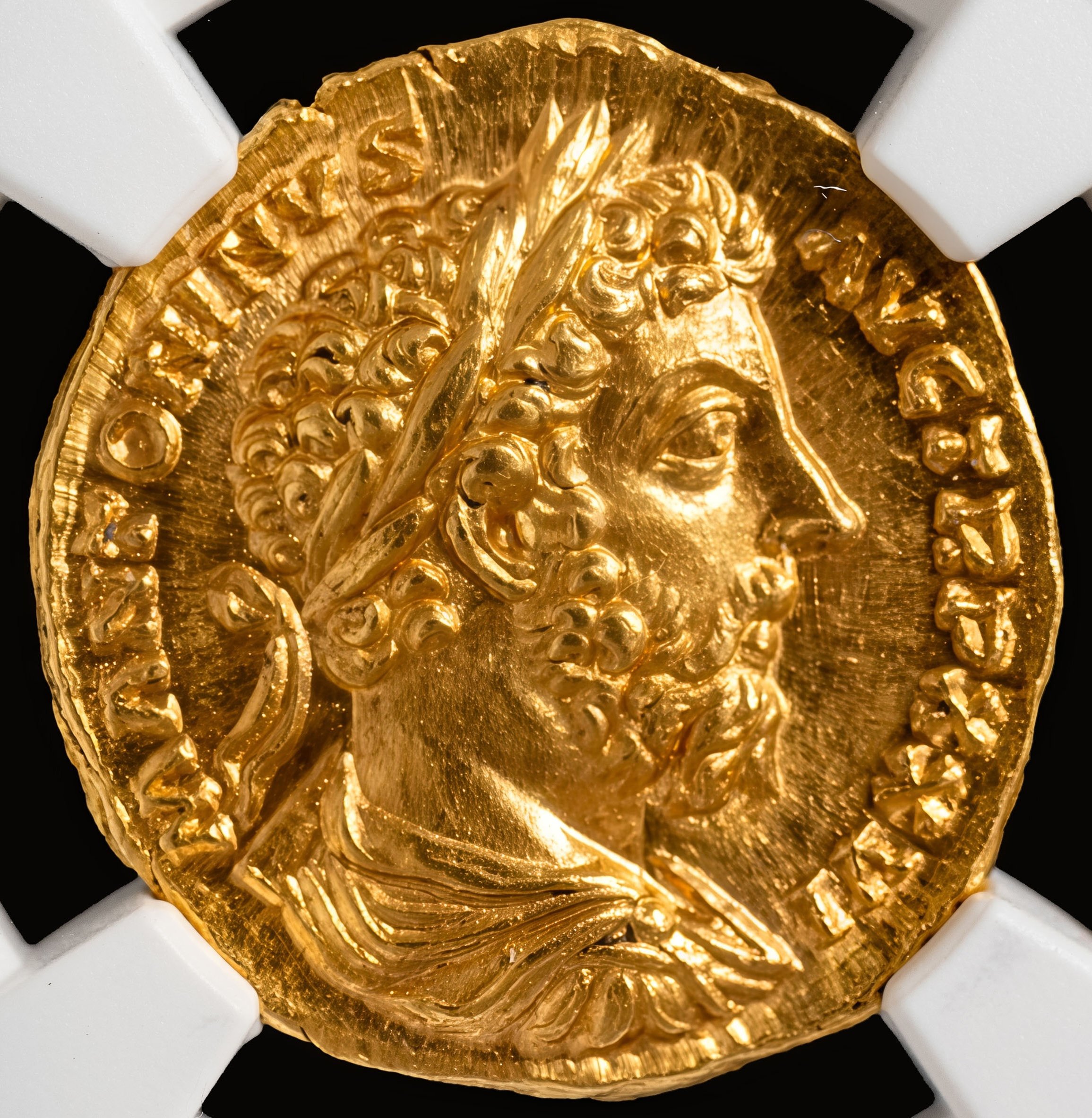
Gold aureus of Marcus Aurelius, Rome mint, AD 172. Daniels Antiques.
What makes these survivals remarkable is not simply that they exist. It is that each one carries two meanings at once, and the meanings pull against each other. The statue shows a benevolent ruler with his hand extended, and it also showed, when it was made, a conqueror riding over a bound captive. The coinage shows an emperor defending Rome with heaven's own weapon, and it also shows a mortal being raised to the company of the gods. The book, meanwhile, quietly dismisses everything the bronze and the gold proclaim. The Romans saw no contradiction in any of this. Only we do, and the distance between their eyes and ours is the true measure of eighteen hundred years.
The Notebook in the War Camp
Marcus Aurelius ruled from AD 161 to 180, the last of the men Gibbon called the good emperors, and he spent most of his reign at war. He shared the throne at first with his adoptive brother Lucius Verus, the first time Rome had two emperors of equal rank, and after Verus died in 169 he carried the load alone. From about 170 onward that meant the Danube frontier, where the Marcomanni, the Quadi, and the Sarmatians pressed against the river line in the longest war of the imperial period.
It was there, in winter quarters, that he wrote. The manuscript tradition preserves the evidence in the headings themselves: one book is noted as written among the Quadi on the river Granua, another at Carnuntum, the legionary fortress on the Danube in what is now Austria. The Meditations are not the product of a study in Rome. They are camp writing, composed by lamplight in the middle of a grinding frontier war, by a man reminding himself that fame is smoke and that the applause of the crowd means nothing.
He wrote for no audience, and the text very nearly found none. No autograph survives, and no ancient copy. The Meditations came down to the modern world by a thread, through a threadbare chain of manuscripts, and the book was not printed until 1559. Of our three materials, the most famous is the most fragile. The words survived by luck. The metal survived because metal does.
Gold for the War
In our own cabinet is a gold aureus of Marcus Aurelius struck at Rome in AD 172, in the thick of the Danube campaigns, and its reverse is one of the strangest images in his coinage. The emperor stands in military dress, and Victory crowns him with laurel, which is conventional enough. But in his raised right hand he grips a thunderbolt.
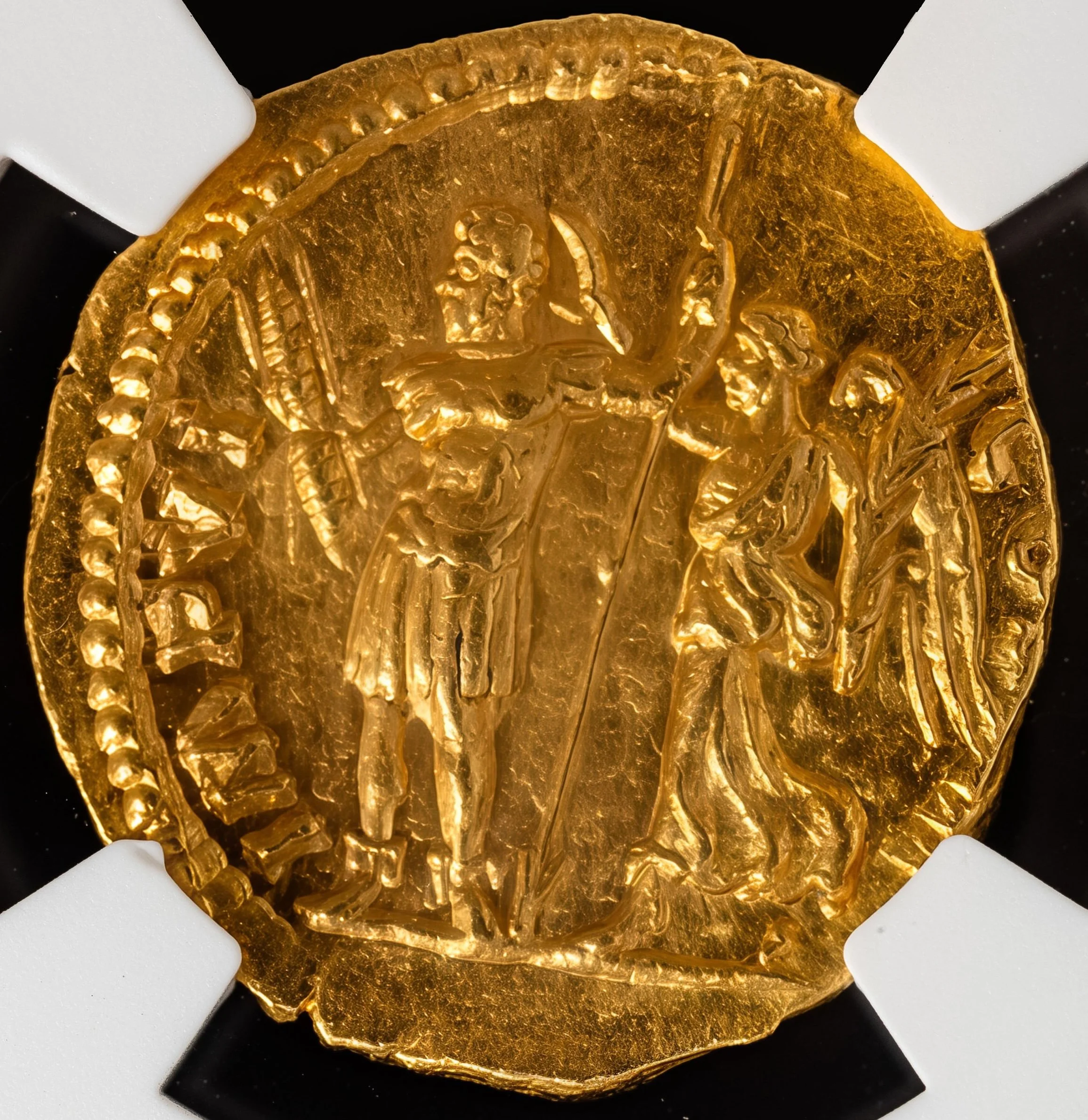
The reverse: the emperor in military dress holding the thunderbolt of Jupiter, crowned by Victory. The coin survives in nearly mint state, scarcely circulated in eighteen centuries, and the thunderbolt is as legible in the emperor's hand as the day the die struck it. Daniels Antiques.
The thunderbolt is the weapon of Jupiter, and no mortal holds it casually. Roman viewers read the image exactly as it was intended: the emperor, who was also pontifex maximus, the chief priest of the Roman state, stands so close to the supreme god that he wields the god's own instrument. Numismatic writers have called the type unusual and historically remarkable, and it is both. On most Roman coins the gods protect the emperor. On this one the emperor has, for a moment, become the protection.
The date gives the image its edge. These are the years of the celebrated miracles of the northern wars. The Historia Augusta records that the emperor "summoned a thunderbolt from heaven against a siege-engine of the enemy," and Cassius Dio tells of the rain miracle, the sudden storm that saved a surrounded Roman force dying of thirst and drowned the enemy around it. Both scenes were carved onto the Column of Marcus Aurelius, where the rain god can still be seen pouring himself down over the grateful legionaries, and the bolt itself, cut in the same form the mint engravers gave it, still hangs in the flames of the enemy siege engine. The chronology of coin and miracle is debated by specialists, and the honest reading is that the mint put Jupiter's weapon in the emperor's hand first, and within a year or two the sky obliged. Propaganda first, miracle after. Rome, carving both onto the Column, drew no distinction.
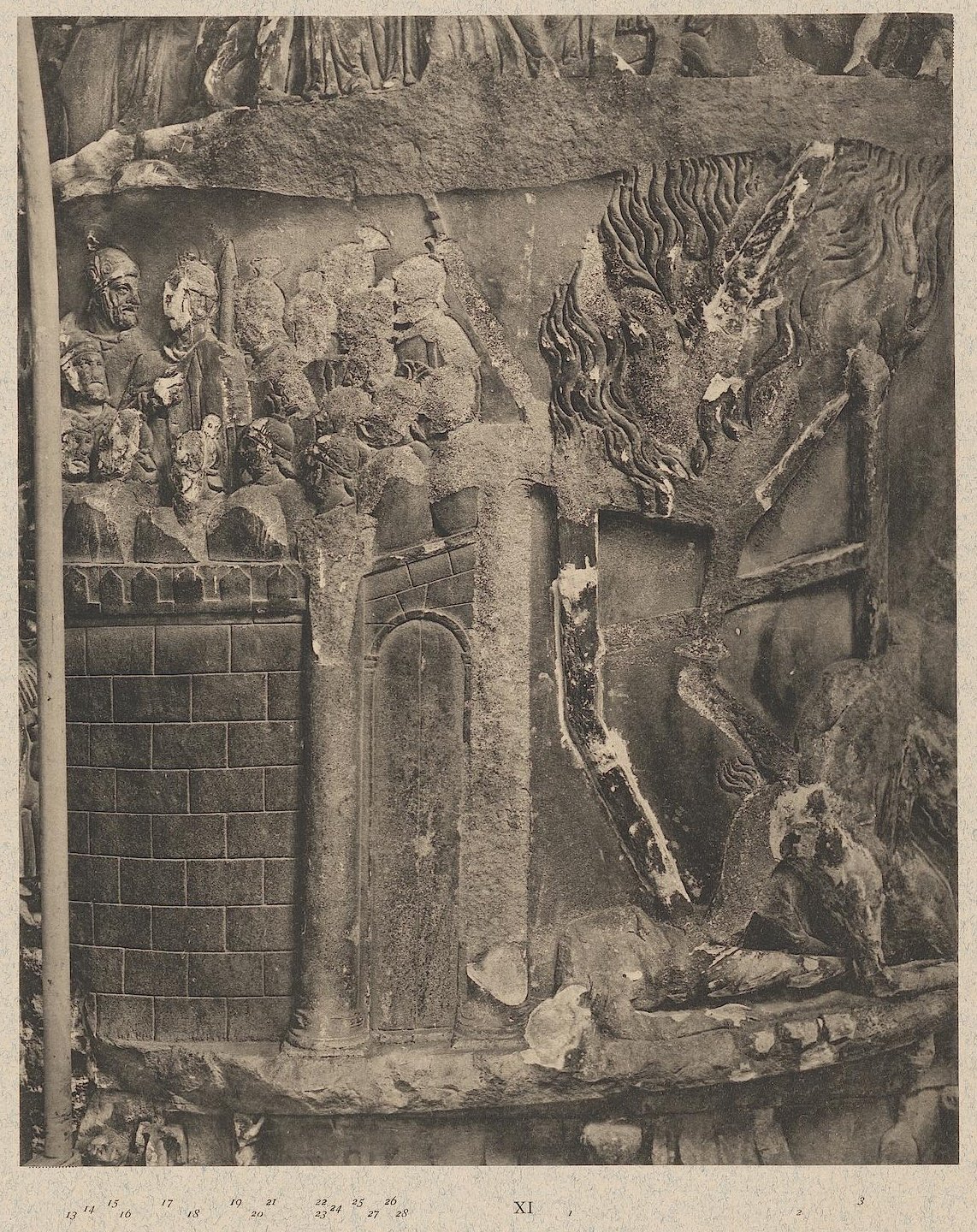
The lightning miracle, scene XI of the Column of Marcus Aurelius: the thunderbolt descends on the enemy siege engine. Petersen, 1896, plate 17, detail.
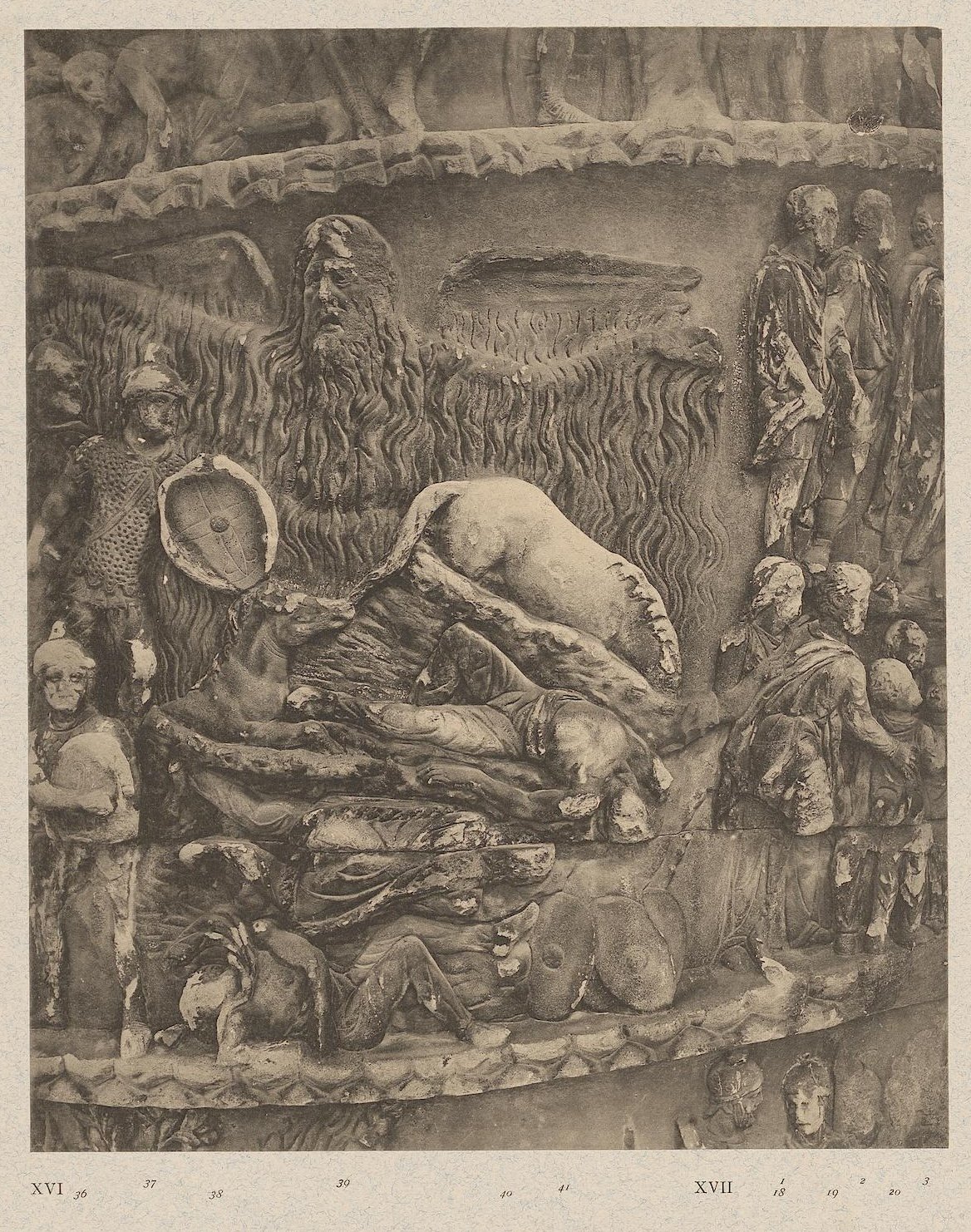
The rain miracle, scene XVI of the Column of Marcus Aurelius: the rain god pours himself over the battlefield, the drowned enemy beneath him. Petersen, 1896, plate 23, detail.
Examples of this striking rest today in the British Museum, the American Numismatic Society in New York, and the Kunsthistorisches Museum in Vienna, and the type is absent from several of the great published private cabinets. It is a coin that exists in the finest collections and rarely appears anywhere else.
And here is the detail worth pausing over. The coin and the notebook come from the same months. While the mint in Rome was striking his image with the thunderbolt of Jupiter in its hand, Marcus himself was in a tent on the frozen frontier, filling his notebook with reminders that none of it mattered. One of them, borrowed from the philosopher Epictetus, was that a man is only a little soul carrying a corpse: a brief flicker of mind inside a mortal body, with no claim on heaven at all. In the same season, then, the empire declared him nearly a god, and he told himself he was barely a body. The state needed the image. The man believed the notebook.
The Rider on the Capitoline
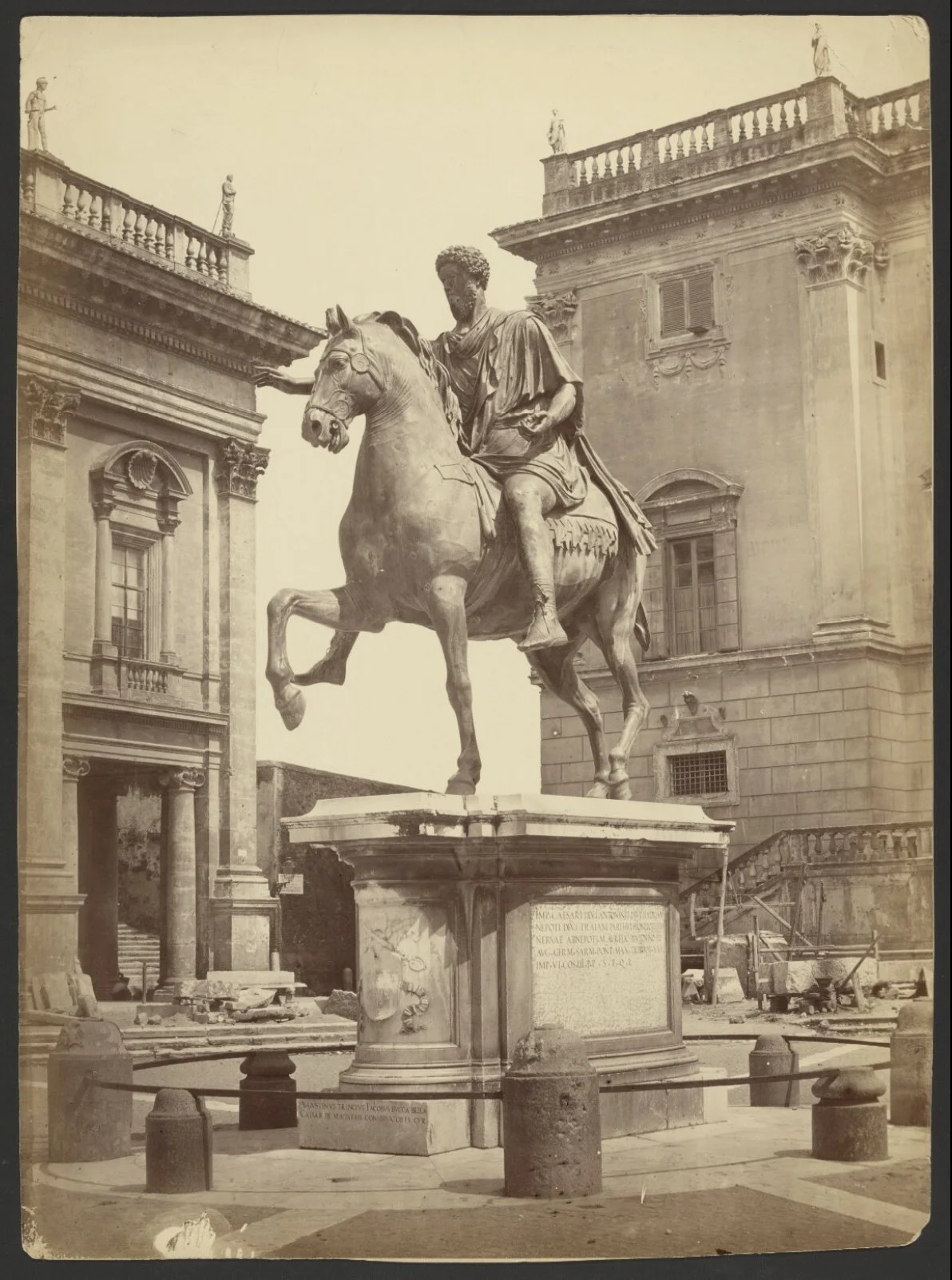
The equestrian monument on the Piazza del Campidoglio. Albumen print, Rome, about 1860 to 1870. The J. Paul Getty Museum.
The monument came a few years later. The Capitoline Museums, which house it, date the great gilded bronze horseman to the aftermath of the Germanic campaigns, most likely erected for the triumph of AD 176. It stood over four meters tall, emperor and horse cast in sections by the lost-wax process and joined, the whole surface once bright with gold.
Every visitor notices the gesture. Marcus rides without armor, without weapons, in the civic dress of a magistrate, and his right hand reaches out over the world with the palm turned down. For centuries the gesture has been read as clemency, and the reading is not guesswork. Medieval descriptions of Rome, among them the Mirabilia Urbis Romae, record a small figure of a bound barbarian chieftain crouching beneath the horse's raised foreleg. The figure was lost somewhere in the Middle Ages, but a surviving relief panel from a lost triumphal arch of Marcus, now in the Capitoline Museums, preserves the full composition: the emperor on horseback above kneeling barbarians. The hand was never addressing the Roman people. It was sparing the men beneath the horse. Mercy, in the Roman grammar of power, is not the opposite of conquest. It is conquest's final privilege, and the statue originally said both things at once, until time edited out the captive and left us the gentler monument we know.
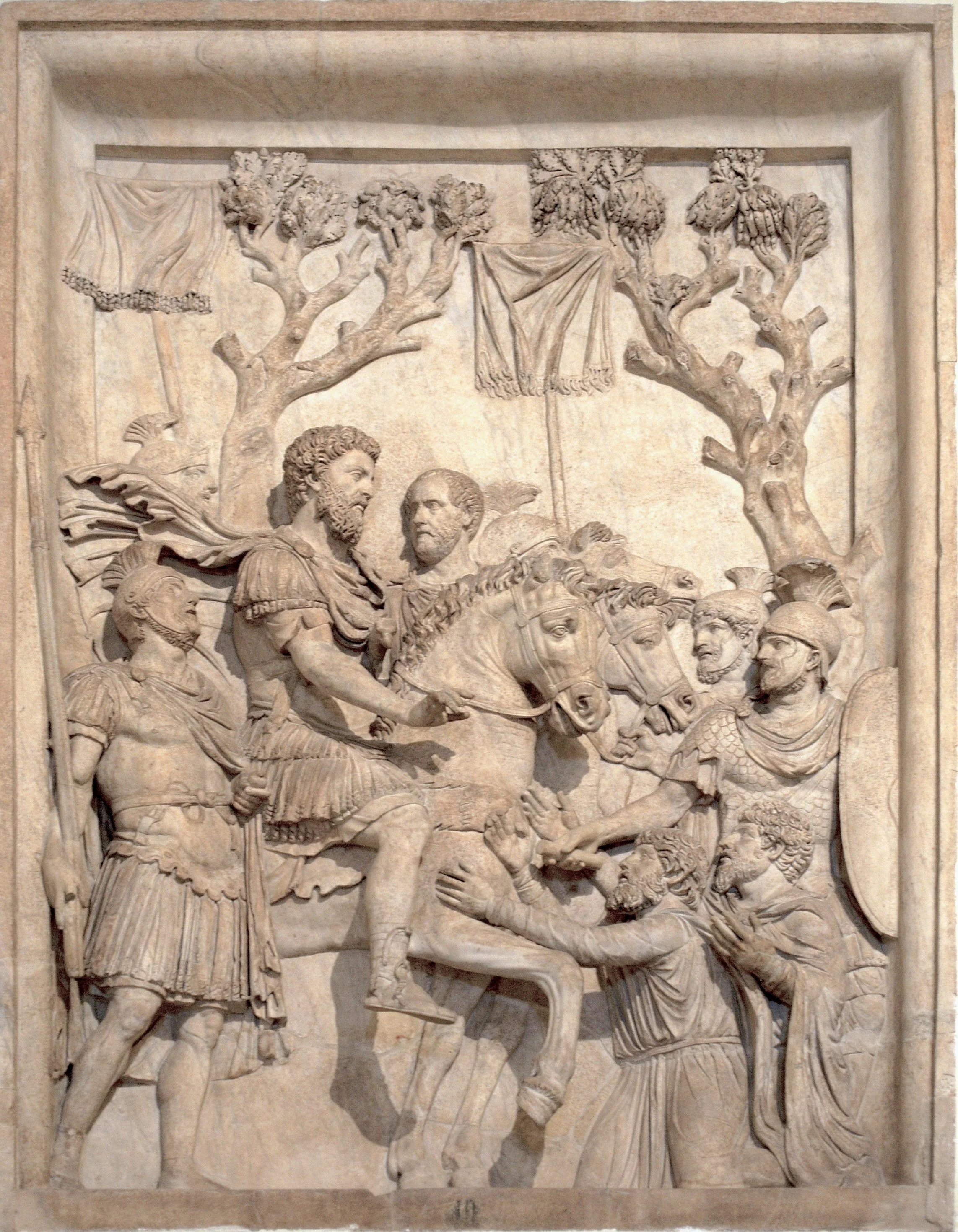
The clemency of Marcus Aurelius: the emperor extends his hand over kneeling barbarians. Marble relief panel from a lost triumphal arch of Marcus Aurelius, AD 176 to 180, Capitoline Museums, Rome. Photo: Matthias Kabel, Wikimedia Commons, CC BY-SA 3.0.
The panel bears witness to the bronze's authority in a second way. When its damaged portions were restored in 1595, the restorers reworked the emperor's hand to copy the statue's gesture, which had stood on the Campidoglio since 1538. Everything on the Capitoline came, in the end, to agree with the horseman.
The statue's survival is itself a story of mistaken identity. Rome once held dozens of imperial horsemen in bronze, and nearly all of them went to the melting pots, recycled for coin, cannon, and church doors. This one stood for a thousand years outside the Lateran Palace because medieval Rome believed the rider was Constantine, the first Christian emperor, and no one melts the first Christian emperor. In 1538 Pope Paul III had it moved to the Capitoline Hill, where Michelangelo designed the piazza around it, the inscribed pedestal recording the transfer in the pope's own Latin.
The bronze that survived the melting pots nearly did not survive its own weight. A structural survey in 1979 found the horse's legs, which had carried the entire mass for eighteen centuries, threaded with fissures, and the statue came down in 1981 for a restoration that ran to the end of the decade. The original now stands indoors in the Capitoline Museums, and the horseman in the open piazza is the replica installed in its place. Anyone who has examined a bronze horse of any size knows the lesson: the whole story of the object is written at the load points. The physics that nearly brought down the original four-meter monument is the same physics a connoisseur checks, on a much smaller scale, in the fetlocks of every cast that descends from it.
The Nineteenth-Century Afterlife
Descend from it they did. From the eighteenth century onward, the Marcus Aurelius was among the most desired models of the Grand Tour, reduced in bronze by the great Roman foundries for travelers who wanted to carry the Capitoline home. The Zoffoli workshop offered reductions of the famous antiquities to English milordi in the eighteenth century, and in the nineteenth the Prussian founders Hopfgarten and Jollage, established in Rome from 1805, made the equestrian Marcus Aurelius their most ambitious model, ordered by the Prussian crown and displayed in the firm's windows as one of the symbols of Rome itself. The Zoffoli workshop's printed price list, of which a copy survives from about 1795, offers the Marco Aurelio a cavallo at forty zecchini, the most expensive single figure in the catalog, more than twice the price of the Farnese Hercules. The horseman was the summit of the trade.
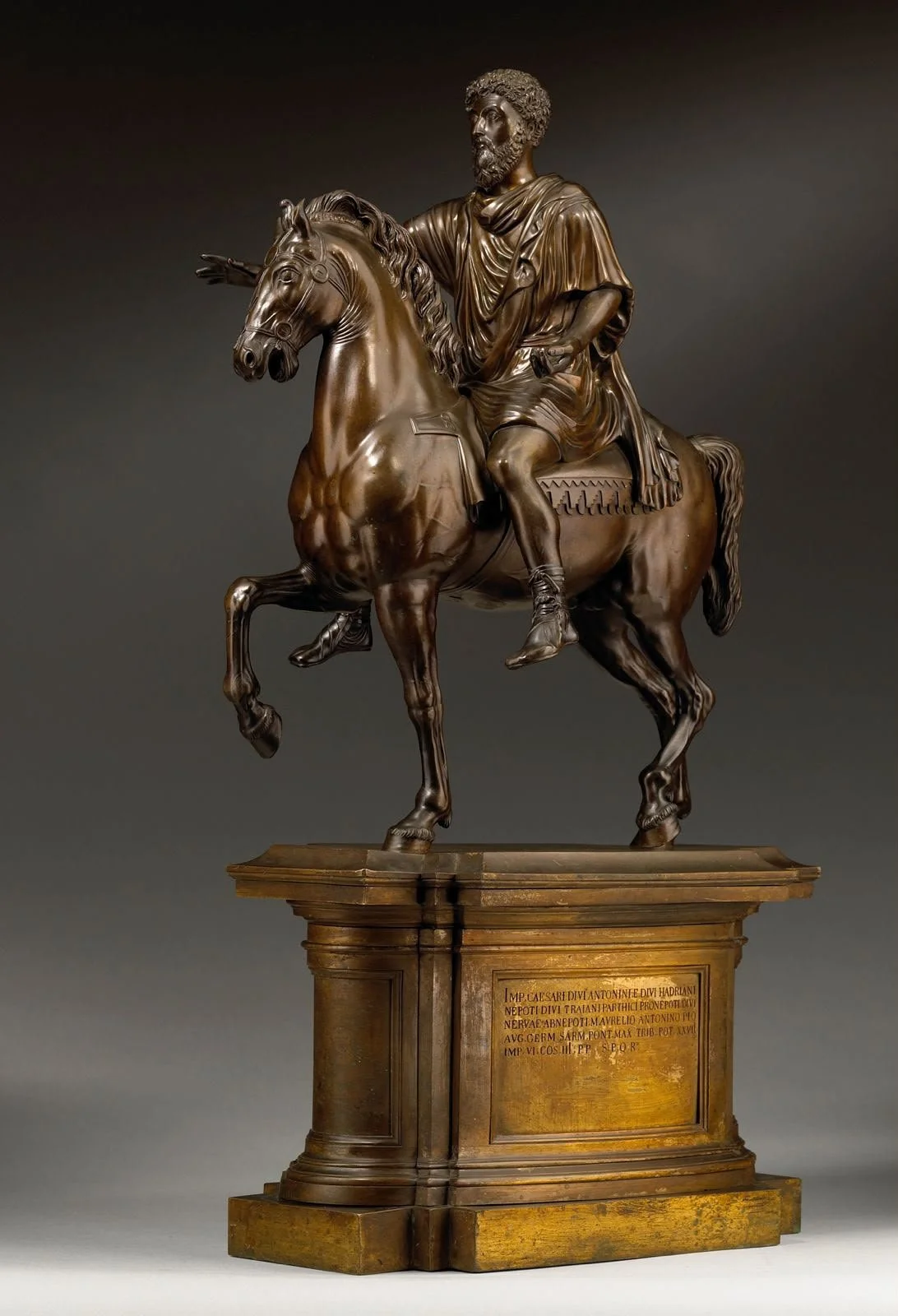
Bronze equestrian statue of Marcus Aurelius, signed A. Dressler, Hopfgarten, Rome, 1866. Daniels Antiques. Height 24”
The gallery's own cast belongs to this tradition. It is signed and dated A. DRESSLER HOPFGARTEN ROMA 1866, made by Dressler, Wilhelm Hopfgarten's heir, who inherited the workshop's models and kept the old name on the bronze. Its pedestal reproduces, in miniature, the inscriptions of the Campidoglio itself, the ancient titulature of Marcus, and Pope Paul's record of the 1538 transfer. It was cast in the same decade that the first photographers were setting up their tripods in the piazza, and we display it alongside an albumen print of the monument taken in Rome in the 1860s, the statue exactly as the founders of that generation saw it, a century before restoration moved the original indoors.
A coin struck under the emperor's authority in 172, a monument raised to him in 176, and a bronze reduction of 1866 that carried his image across the world: the thread that connects them is the image program of a single reign, still legible after eighteen hundred years.
The Verdict of the Objects
Marcus would have disapproved of all of it. Forgetfulness was near, he told himself in camp on the Danube, his own and everyone else's, and he believed it when he wrote it. The sentence has now been wrong for eighteen centuries. The notebook that dismissed fame became immortal. The statue that survived under another man's name became the model for every equestrian monument in Europe. The gold that proclaimed him Jupiter's companion outlasted the empire that struck it.
The objects, in the end, won the argument with their author. That is worth remembering in a gallery: words are the record of what people believed, but objects are the record of what they made, and the things, patient and unarguing, outlast us all.
We are always interested in acquiring Grand Tour bronzes and Roman gold coins. If you own a Zoffoli or Hopfgarten cast, or a work of this kind, we would be glad to hear from you.
Sources
Marcus Aurelius, Meditations, translated by George Long, London, 1862. The epigraph is book VII, section 21; the phrase "a little soul carrying a corpse" is book IV, section 41, where Marcus quotes Epictetus.
Historia Augusta, Life of Marcus Aurelius, 24.2, for the lightning miracle.
Cassius Dio, Roman History, epitome of book 72, for the rain miracle.
The Mirabilia Urbis Romae and other medieval descriptions of Rome, for the bound barbarian recorded beneath the horse's raised foreleg.
Eugen Petersen, Alfred von Domaszewski and Guglielmo Calderini, Die Marcus-Säule auf Piazza Colonna in Rom, Munich, 1896. The photographs of the Column reproduced here are from the plates of this publication, digitized by Heidelberg University Library.
Péter Kovács, Marcus Aurelius' Rain Miracle and the Marcomannic Wars, Leiden and Boston, 2009.
Harold Mattingly and Edward Sydenham, The Roman Imperial Coinage, volume III, London, 1930, for the coinage of the reign.
Studio di Scultura di Bronzi di Giovanni Zoffoli Romano, the Zoffoli workshop's printed list of bronze reductions after the antique, Rome, about 1795, reproduced in Francis Haskell and Nicholas Penny, Taste and the Antique, New Haven and London, 1981, page 342; with Hugh Honour, "Bronze Statuettes by Giacomo and Giovanni Zoffoli," The Connoisseur, November 1961, pages 198 to 205, for the workshop and its models.
Collection records of the British Museum, London, the American Numismatic Society, New York, and the Kunsthistorisches Museum, Vienna, for the museum examples of the aureus type.
The Capitoline Museums, Rome, for the dating and the conservation history of the equestrian monument.
James Grout, "The Equestrian Statue of Marcus Aurelius," Encyclopaedia Romana, for the 1595 restoration of the clemency relief.