
Black Forest Carvings: A Collector's Guide to the Swiss Art of Brienz
The carvings the trade calls Black Forest were not made in the Black Forest, and they are not German. They are the work of Swiss hands, produced in and around the village of Brienz on the northern shore of Lake Brienz, in the Bernese Oberland, from roughly 1820 until the Second World War. The name is one of the more durable misnomers in the decorative arts, and it has fixed itself so firmly that even seasoned collectors use it without a second thought. The confusion is understandable. The dark, richly stained walnut favored by the Brienz workshops resembles the timber of the German forest from which that region takes its name, and Victorian shopkeepers were content to let a vague Alpine association do the selling. The carvings themselves belong wholly to Switzerland, and the distinction matters because the finest of them stand among the great achievements of nineteenth-century wood sculpture.
The account that follows draws on the research behind Swiss Carvings: The Art of the Black Forest, 1820–1940 (Antique Collectors' Club, 2006), which I wrote with Jay Arenski and my father, Michael Daniels, and which remains the standard reference on the subject.
The trade's longevity is reflected in the houses that served it. The catalog reproduced here belongs to Th. Zryd, whose "Diana" galleries on the main thoroughfare of Interlaken were established in 1837 and remained in business a full century later, when this centenary edition was printed for the export market.
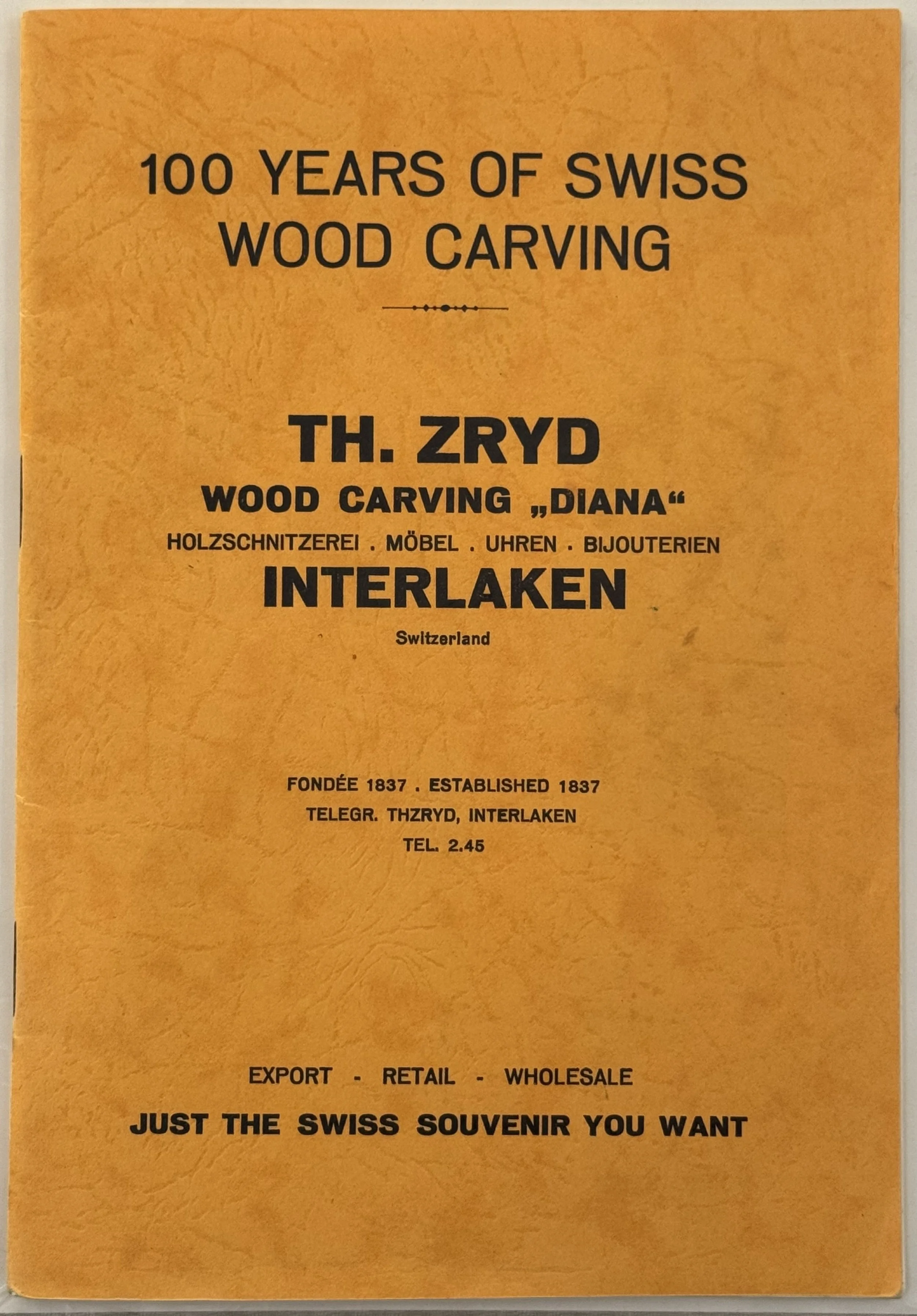
Trade catalogue of Th. Zryd, Wood Carving "Diana," Interlaken, issued circa 1937 to mark the firm's centenary.

The Th. Zryd "Diana" galleries on the main street of Interlaken, beneath the Jungfrau, dealing in Swiss carved and inlaid furniture, clocks, and ivory goods for the export market.
The Origins in Brienz
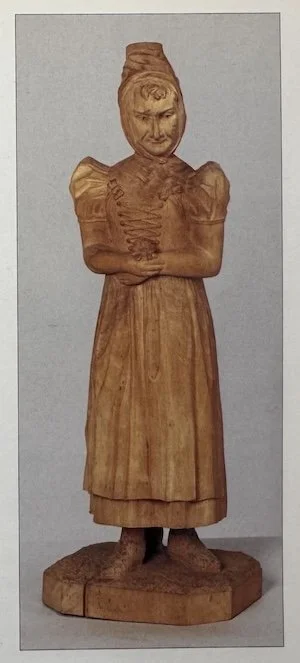
A carved figure of a Bernese countrywoman by Christian Fischer, circa 1820, is among the earliest documented works of the Brienz trade. Illustrated in Swiss Carvings: The Art of the Black Forest, 1820–1940.
The trade was born of hardship. The eruption of Mount Tambora in 1815 brought the year without a summer to Europe, and the failed harvests that followed fell heavily on the Bernese Oberland, a region of thin soil and few industries. A wood turner named Christian Fischer, working in Brienz in those lean years, began producing carved objects for the travelers passing along the lake, and the local authorities, looking for any means to keep families fed and at home, encouraged the craft. What began as a cottage occupation became, within a generation, an organized industry.
Geography did the rest. Brienz lay on the Grand Tour route, and as wealthy travelers resumed their continental journeys after the Napoleonic Wars, Lake Brienz became a fashionable stop. Visitors wanted souvenirs, and the carvers supplied them, at first with modest figures and boxes, later with work of real ambition. By the middle of the century, the town was synonymous with fine wood carving, and in 1884, a dedicated School of Woodcarving was founded in Brienz, the only institution of its kind in Switzerland and one that trains carvers to this day.
The carvers worked chiefly in the linden and walnut of the surrounding forests, the one prized for its fine, even grain and the other for the depth of its color, and the finest among them, men such as Johann Huggler and Walter Mader, brought to animal and figure subjects a naturalism that lifted the work far above the souvenir trade from which it had grown. By the early years of the twentieth century, the locality supported some thirteen hundred carvers, and Brienz had become the recognized center of the Swiss carving trade.
The Great Exhibitions
Nothing did more for the standing of the Brienz carvers than the international exhibitions, and no part of their history is more useful to a collector trying to understand quality. The workshops first drew wide notice at the Great Exhibition in London in 1851, where their work was awarded medals and seen by an audience that had never encountered carving of this kind.
Among the pieces that survive from this period is one that carries its exhibition history in its own base. The subject is the most beloved of all Brienz inventions, a child carried to safety by a St. Bernard of the Alpine hospice, the dog bearing at its collar the small barrel of the rescue tradition. The hospice at the Great St. Bernard Pass had kept such dogs for centuries to find travelers lost in the snow, and the most famous of them, Barry, was credited with saving dozens of lives in the early years of the nineteenth century. The legend was known across Europe, and it made the subject irresistible to the Victorian travelers who came to Brienz. This example, retailed by Ed. Binder of Interlaken and dated 1848, was shown at the Great Exhibition in London in 1851, and set into the underside of its base is the white-metal medal struck for that exhibition, a view of the Crystal Palace on its face. Few carvings of the period carry so direct a link to the event that first brought the work of Brienz before the world.
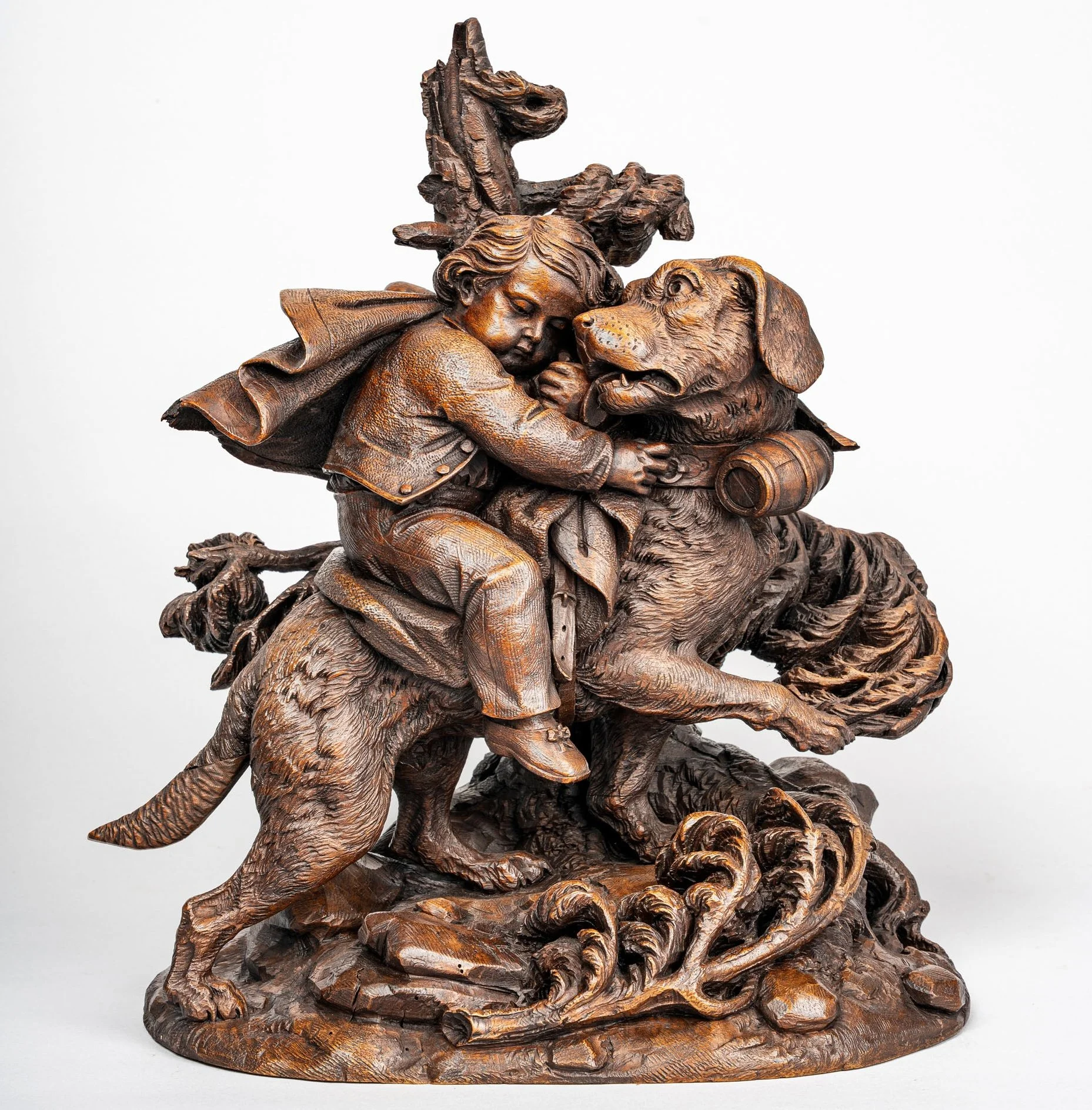
A carved walnut group of a child and a St. Bernard, Brienz, dated 1848, retailed by Ed. Binder of Interlaken. Exhibited at the Great Exhibition, London, 1851.
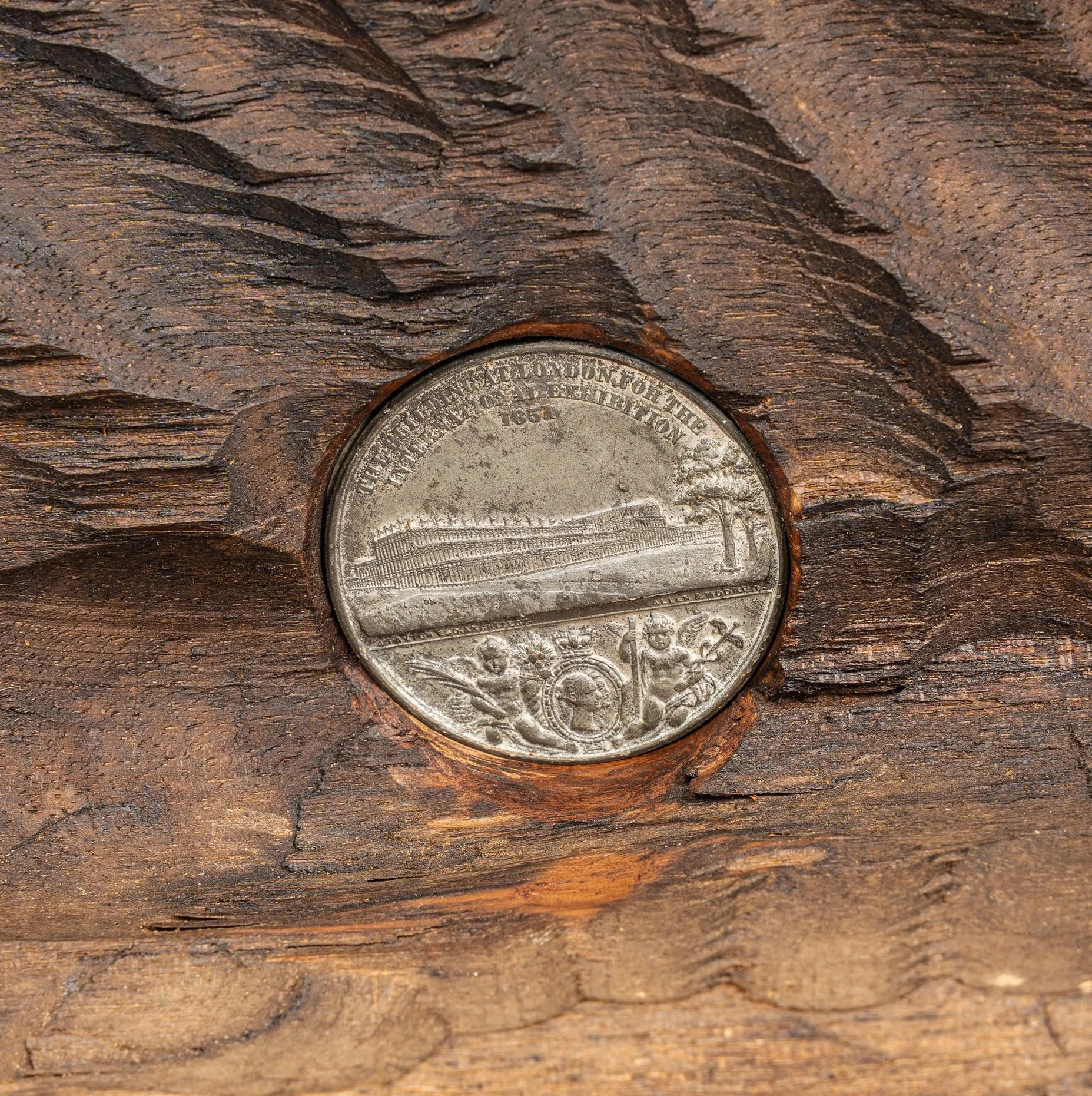
The white-metal medal struck for the Great Exhibition of 1851, set into the underside of the base, a view of the Crystal Palace on its face.
Vienna in 1873, Philadelphia in 1876, and Paris in 1878 and 1889 carried the reputation further, and at the World's Columbian Exposition in Chicago in 1893, the Huggler workshop exhibited to an American public that would become, and remains, the most important market for these pieces.
The high point came at the Paris Exposition of 1900, where the Swiss embellished their pavilion with carved interiors of such accomplishment that they took a gold medal. The reliefs, carved at the Brienz Woodcarving School under Albert Huggler and Hans Kienholz, survive to this day, installed in the Federal Palace in Bern in a room known as the Brienz Room. A documented exhibition history is one of the surest marks of a serious piece, and it is the first thing worth establishing when an important carving comes to light.
The Foremost Carvers and Retailers
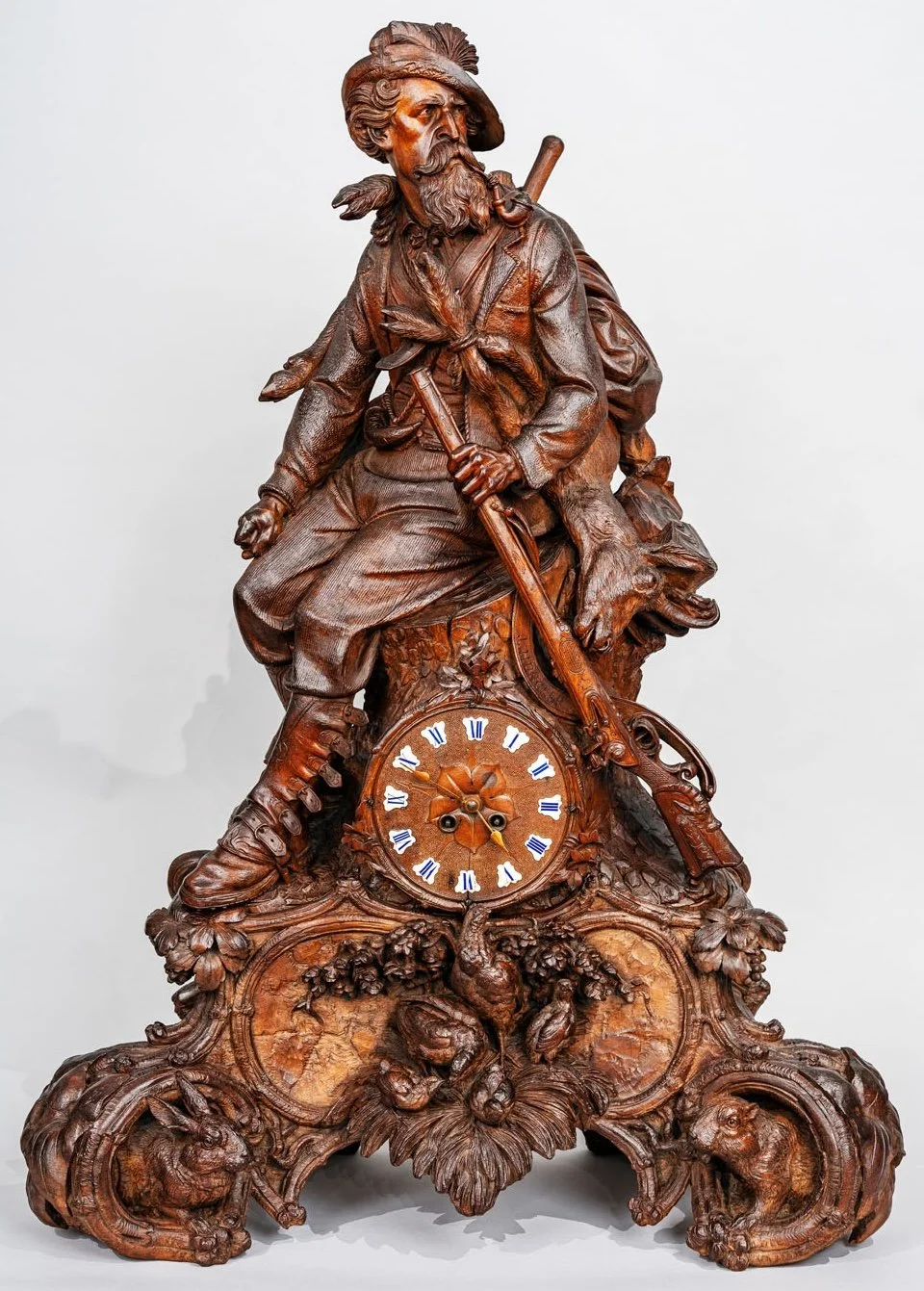
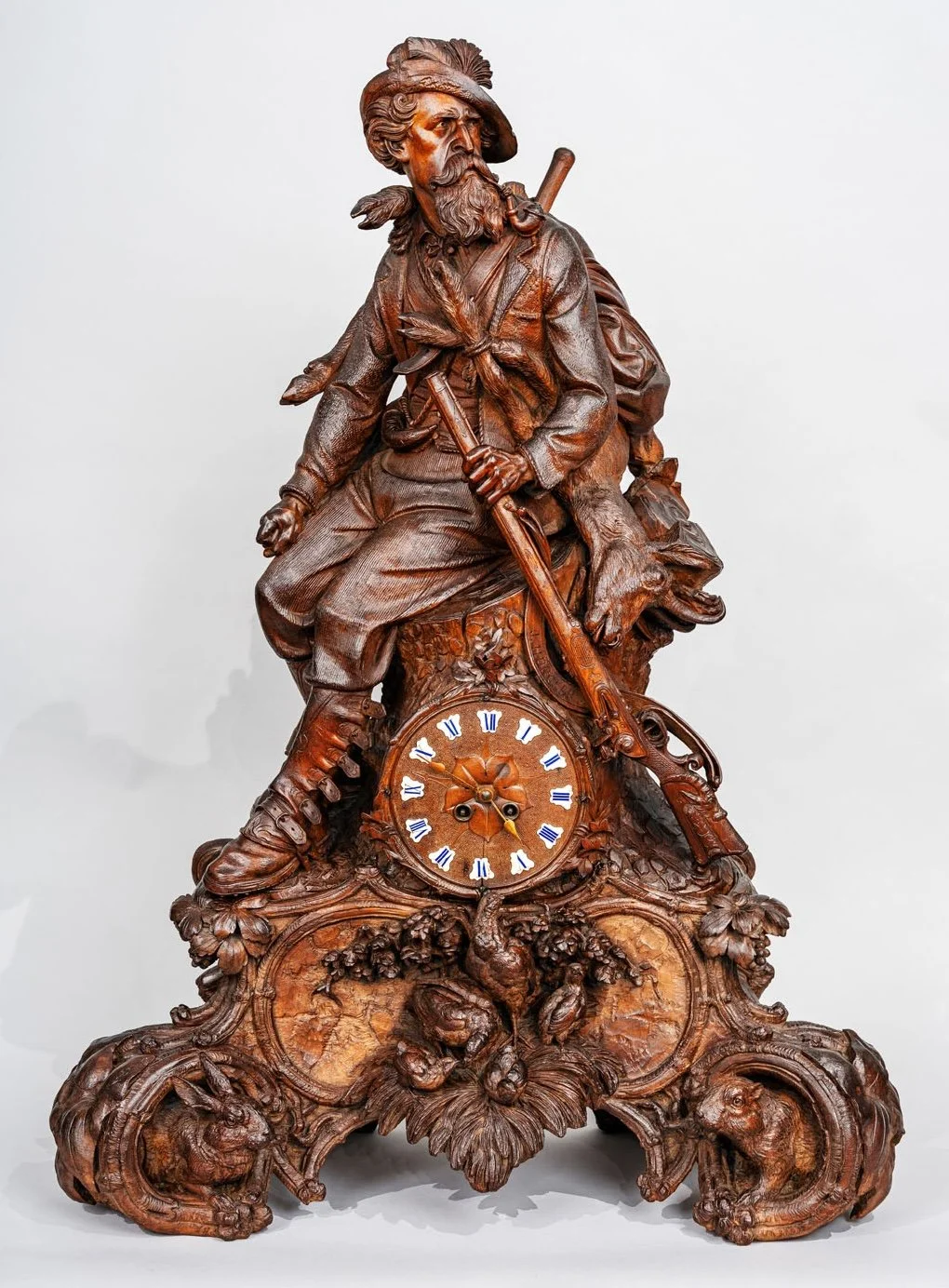
A carved walnut figural mantel clock, an Alpine hunter above the dial, signed J. Huggler on the strap of the rifle, Brienz, circa 1870. The individualized face reflects the tradition that Huggler carved his hunters in his own likeness.
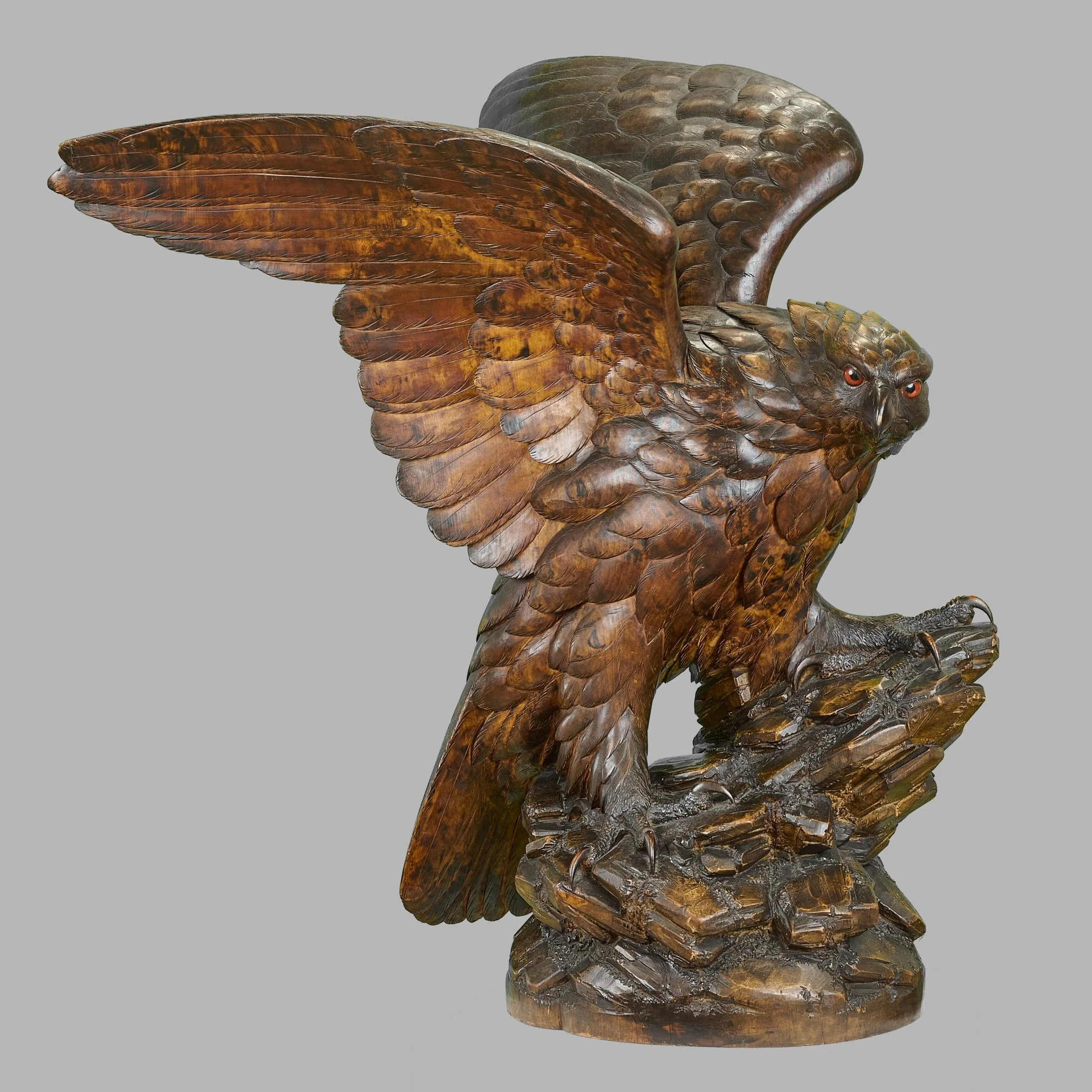
The names to know are few, and they reward learning. Christian Fischer is credited as the founder of the tradition. Johann Huggler and Albert Huggler led the most celebrated of the carving families, and a signed Huggler animal or figural group sits at the top of the market. Walter Mader is the other great name, remembered above all for his dogs, while the Ruef Brothers are known for their birds of prey, eagles and owls, often with the feathers darkened by burning. Their work was widely copied in its own day and has been copied since, which is precisely why attribution carries such weight. These workshop histories are documented at length in Swiss Carvings.
Such a piece is illustrated here. A bearded hunter sits above the dial, his rifle laid across his knee and a pipe at his lips, the face strongly individualized in a manner that recalls the tradition that Huggler carved his hunters in his own likeness. The layered garments, the game birds clustered below the dial in high relief, the hare and the marmot worked into the base, are rendered with the close and patient observation that separates Huggler's finest work from the broader production of the trade. It is signed on the rifle's strap, the maker's name carved where a buyer would see it, which is itself worth remarking on.
Most of the carvings of the period bear no maker's name at all. Beneath the carvers sat a network of retail houses that commissioned, finished, and sold the work, and their names appear far more often than the carvers' own. Binder and Company, Bergen of Interlaken, and Peter Trauffer were among the most prominent. Carvings bearing the Bergen mark tend to be walnut and of notably high quality, the sign of a house that commissioned and selected with care, while Trauffer's work runs to the whimsical, in one instance a cabinet carved with bears dancing and drinking wine. The retailers assembled garnitures, fitted clocks and glass, and shipped them to dealers across Europe and America. These houses generally forbade the workshops from openly signing the carvings, preferring that the shop's name, not the maker's, reach the buyer. In examining these pieces, I have repeatedly found the carvers' answer to the prohibition: minute initials stamped in concealed places, on the underside, inside a base, along a back edge where a retailer would not look. A carving that appears anonymous is therefore not always unattributable, and a careful examination will sometimes recover a name that doubles a piece's interest and its value.
Understanding this structure explains much of what a collector encounters: a piece marked with a retailer rather than a maker, a clock case from Brienz fitted with a French movement, a matched suite assembled from separately carved elements. None of these tells against authenticity. They are simply how the trade worked.
The Collector's Guide: Subjects, Care, and Value
Subjects and Forms
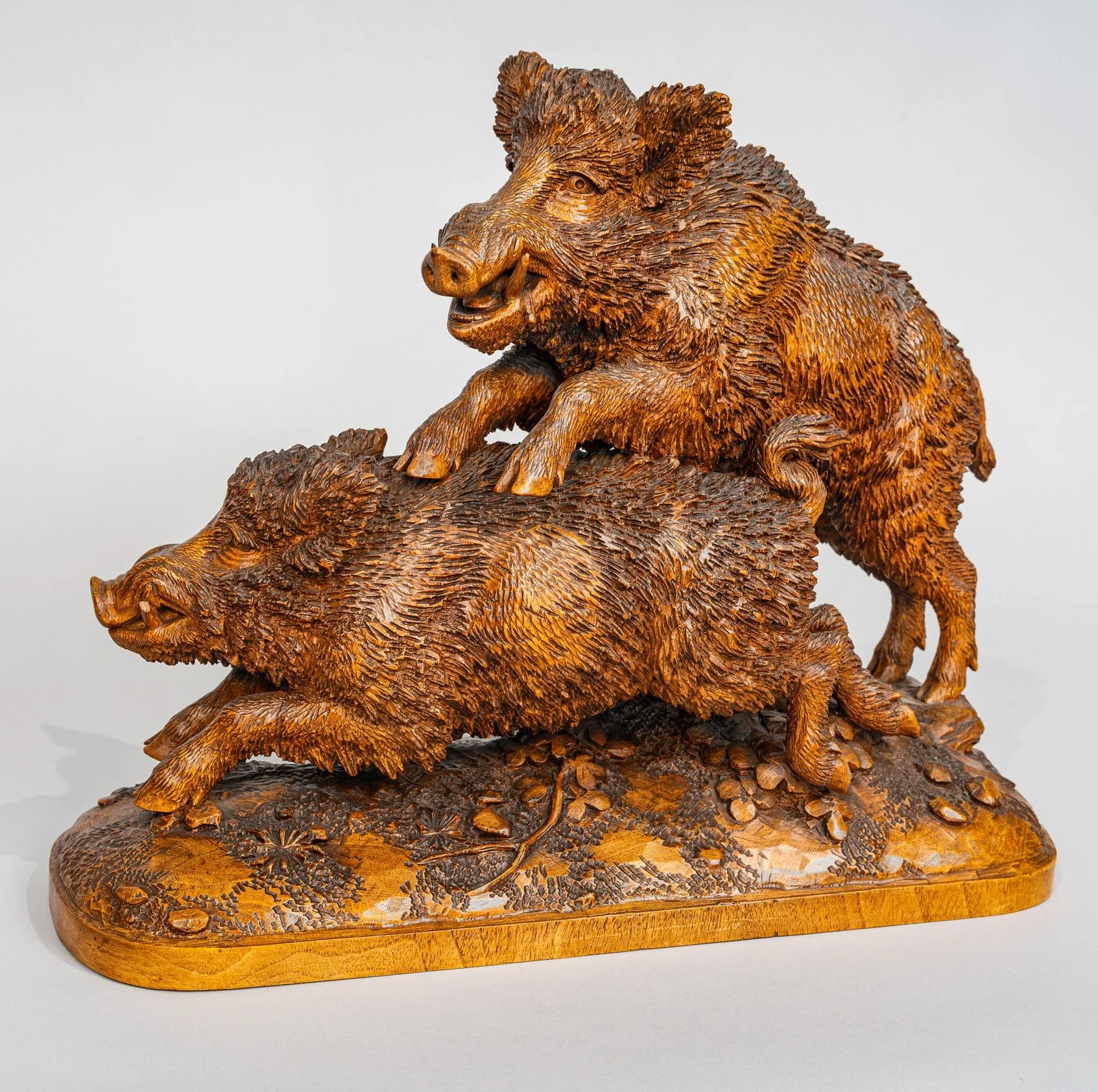
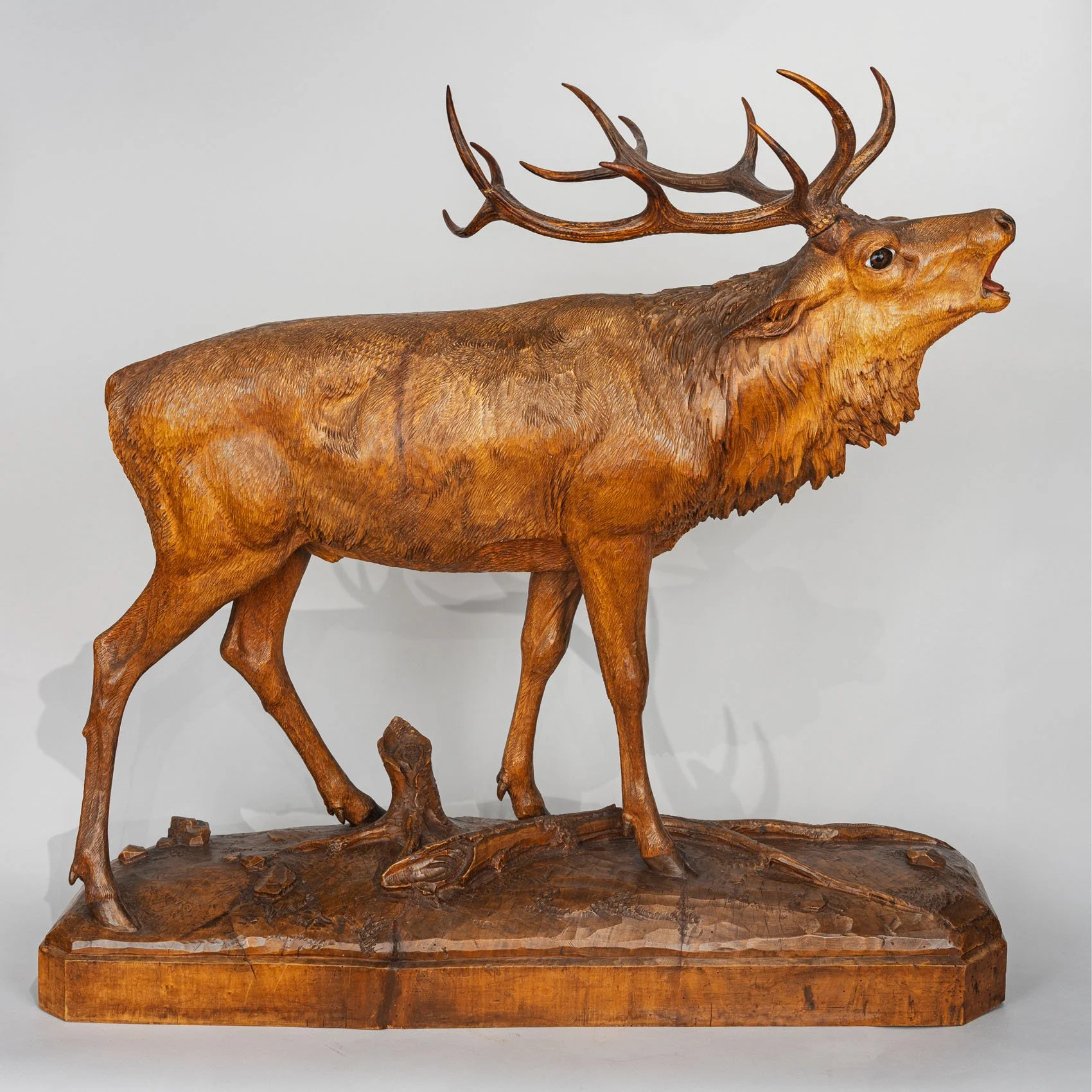
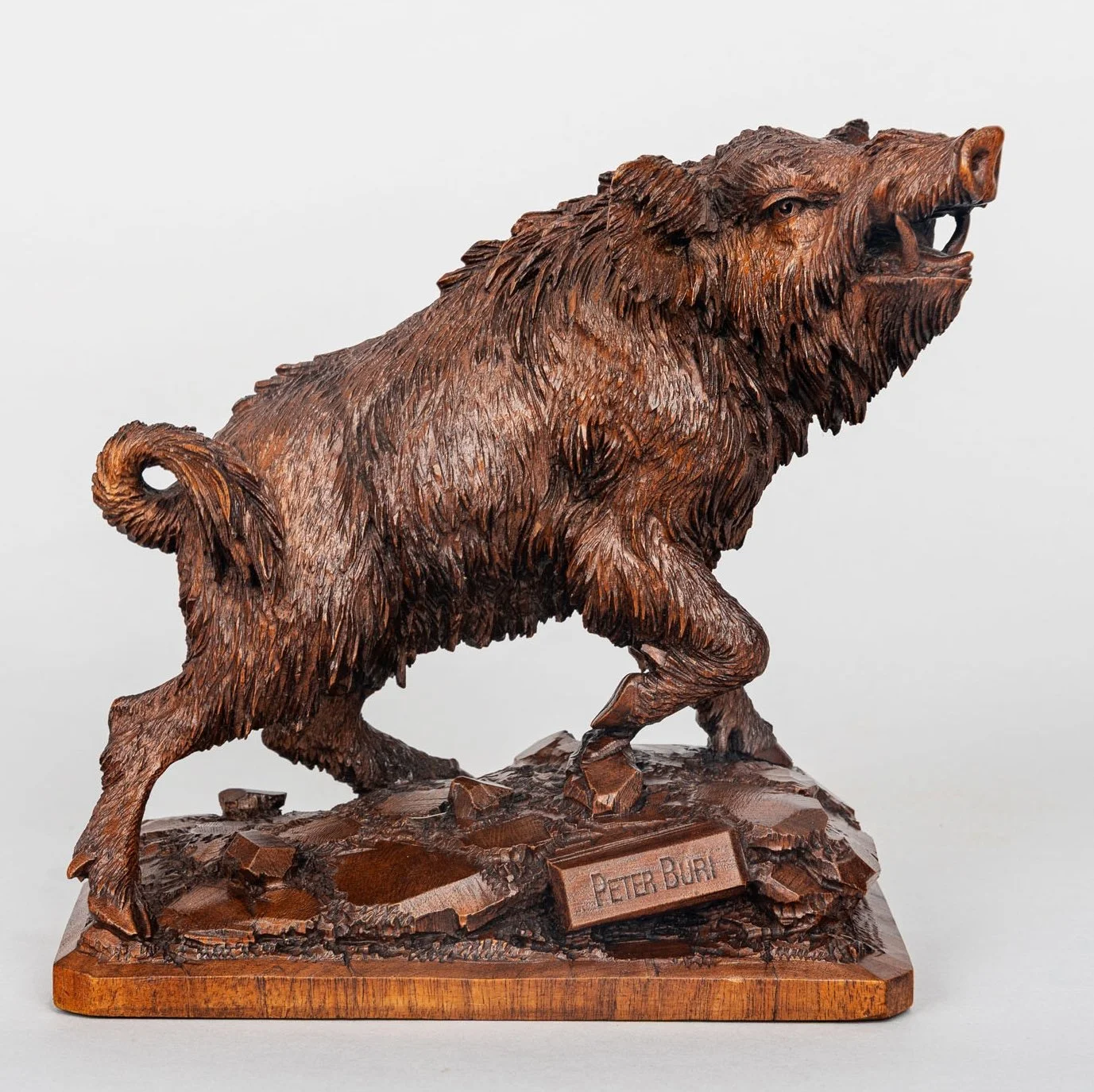
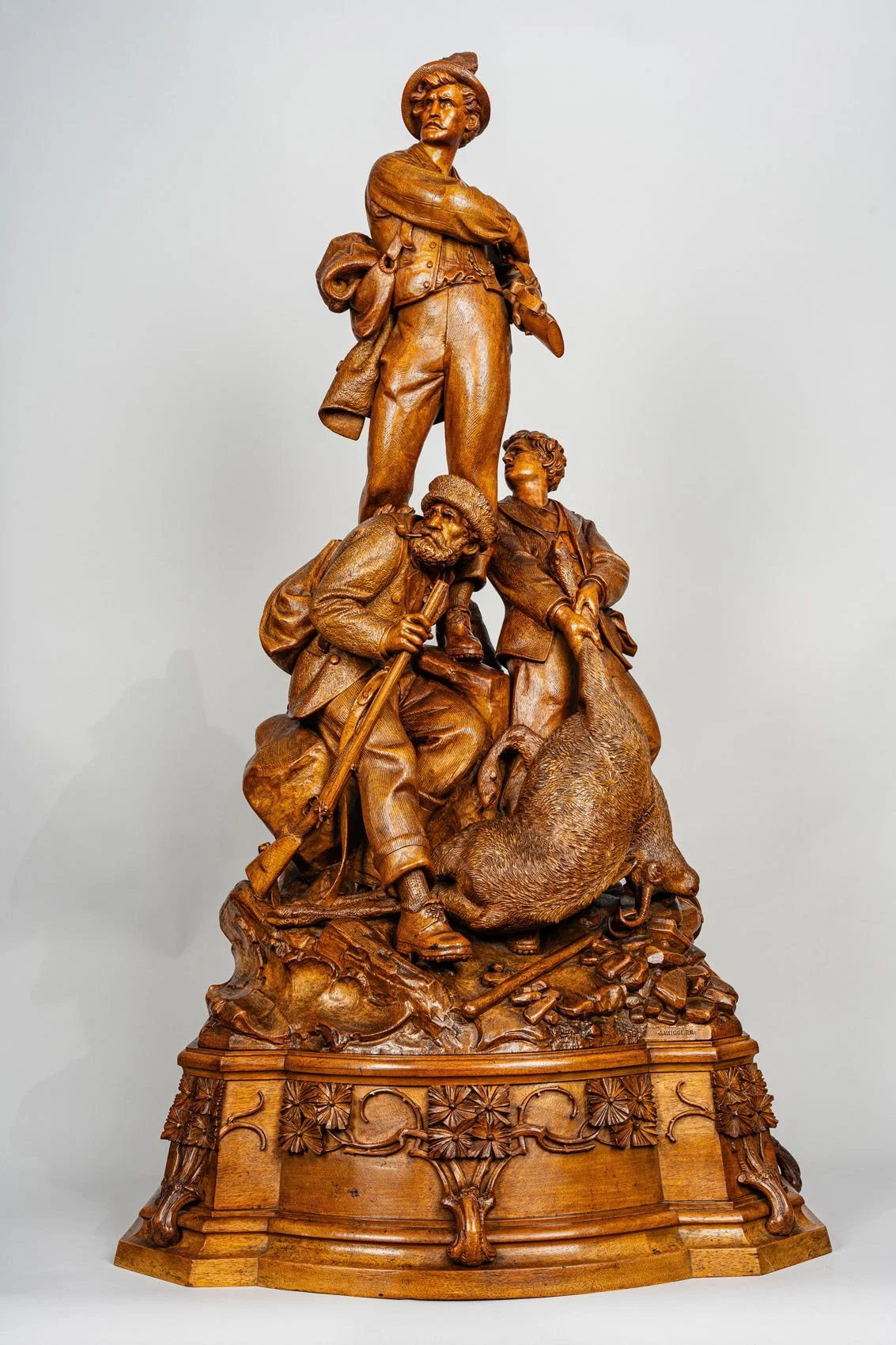
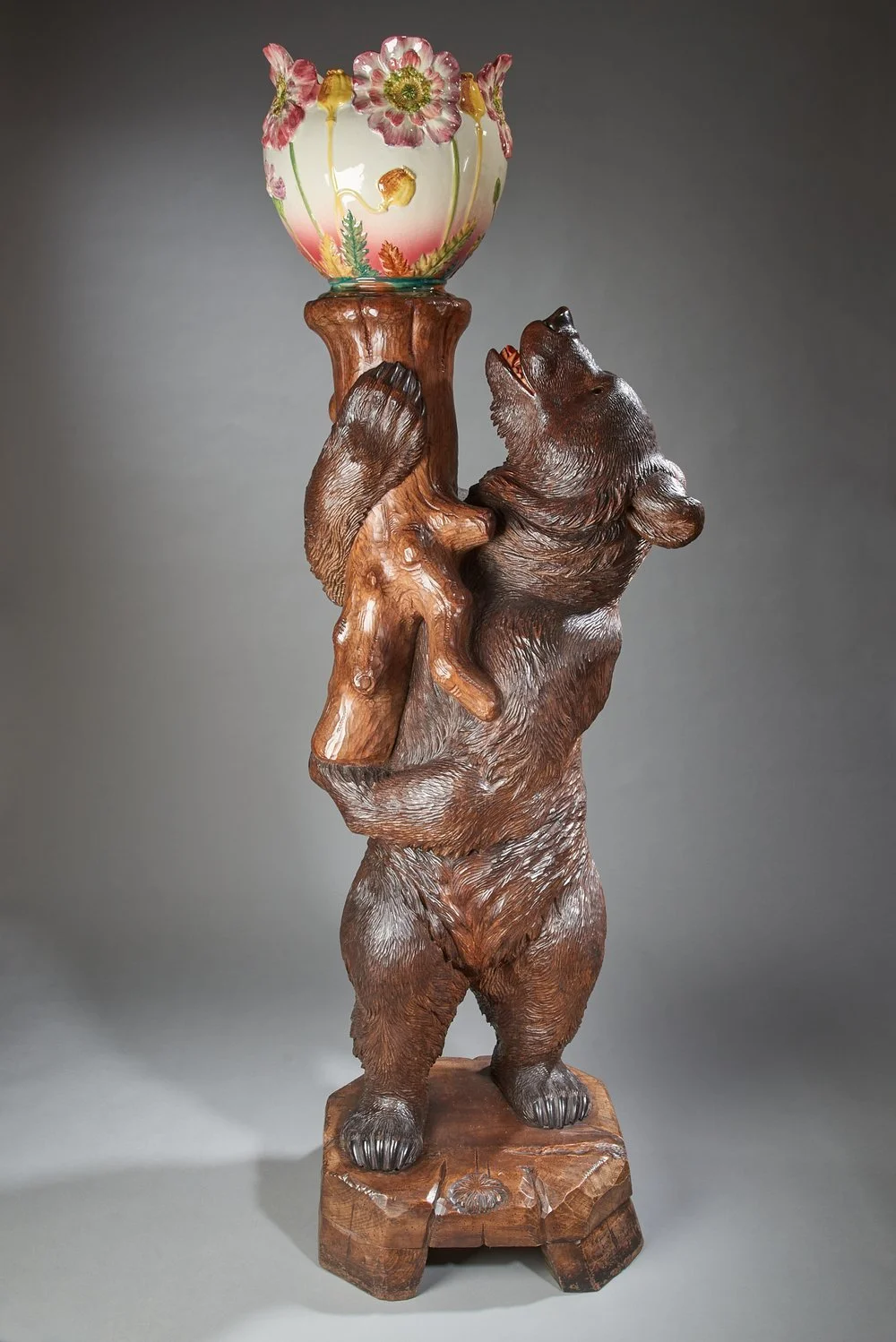
The Brienz carvers worked in the natural world they knew. They were mountain people first, men who hunted and fished the valleys and high pastures of the Bernese Oberland, and they carved at the outset for their own pleasure, only later for the trade. That intimacy with the subject is what raises the finest Brienz work above mere souvenir production, and it shows in the choice of subjects: the stag standing watchful on a rocky outcrop, the chamois, the hound, and the bear.
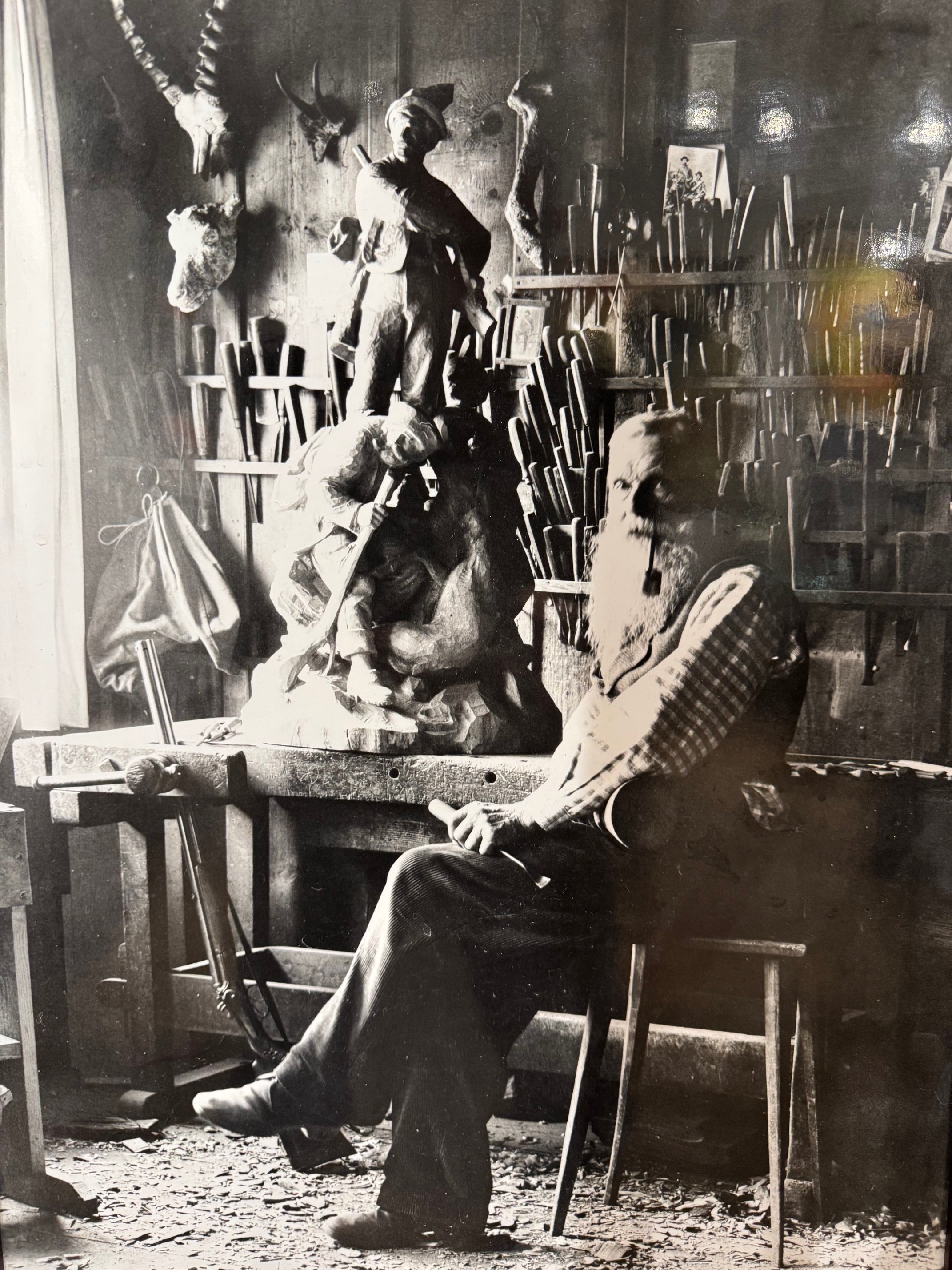
Johann Huggler at his workbench, a carved hunting group taking shape before him, his chisels ranged on the wall behind, and the trophies of the hunt above.
Each of the great carvers had his own territory. Johann Huggler's hunters are his masterpieces, rendered with a level of detail that extends to the veins on the backs of a huntsman's hands. Walter Mader understood the appeal of dogs and gave them lifelike expression; his finest are his dog groups, though they vary in quality, and distinguishing the best from the merely good is the work of a lifetime. The Ruef Brothers made the eagle their own, a subject that found a particularly strong market among American buyers.
The carvers were alert to the art of their own day, and two works in particular left their mark. Landseer's Monarch of the Glen of 1851, the most reproduced animal image of the century, established the pose of the stag in command of his outcrop that the Brienz workshops took up almost line for line, carried to them, as to everyone, through cheap steel engravings. The second came to them in person. When the Brienz carvers exhibited at the World's Columbian Exposition in Chicago in 1893, Rodin's Kiss was shown there too, the sensation of the fair, set apart in a private room and viewed by application for the boldness of its subject. A carver who stood before it did not forget it, and to my eye, the new freedom of movement in Huggler's later figures begins here.
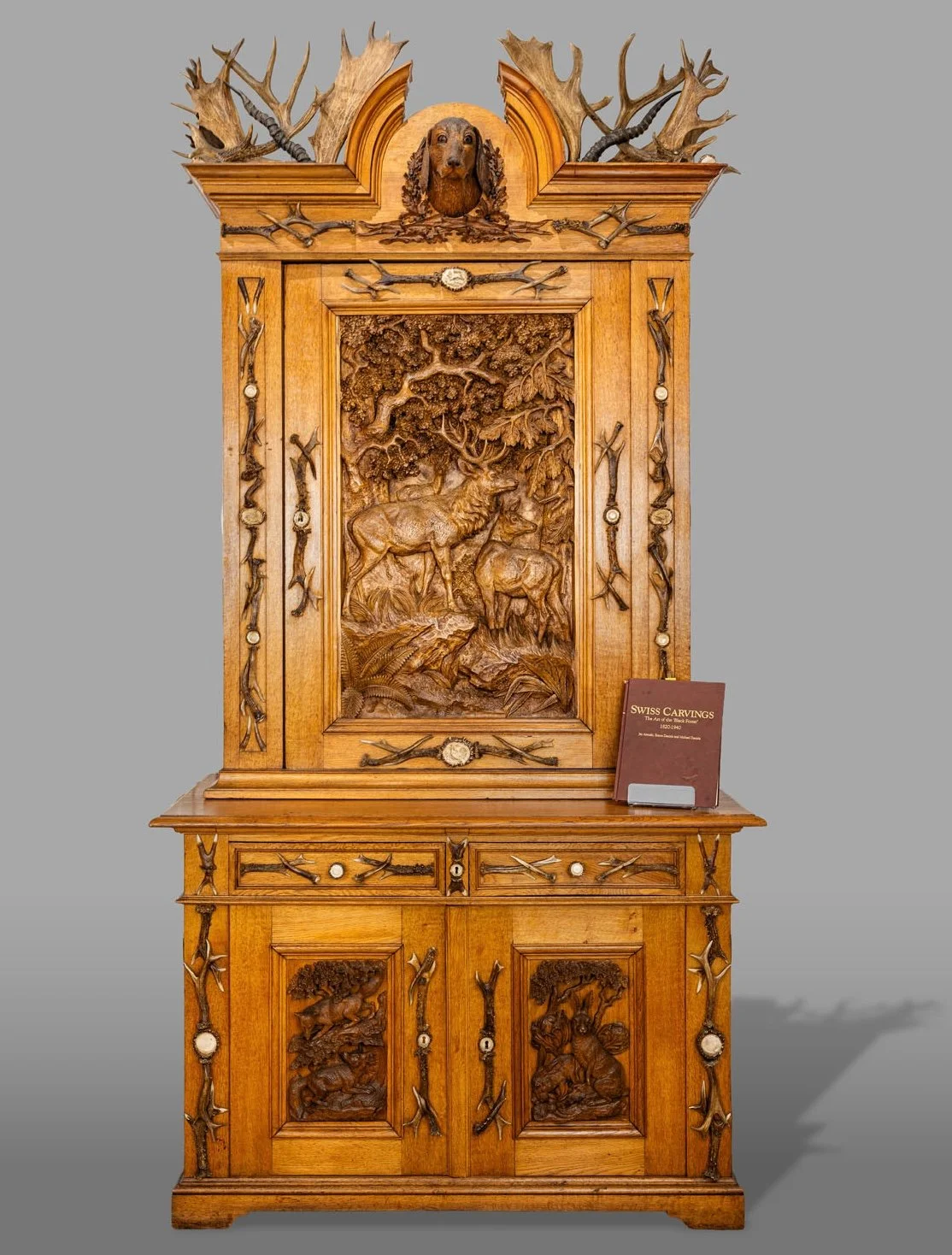
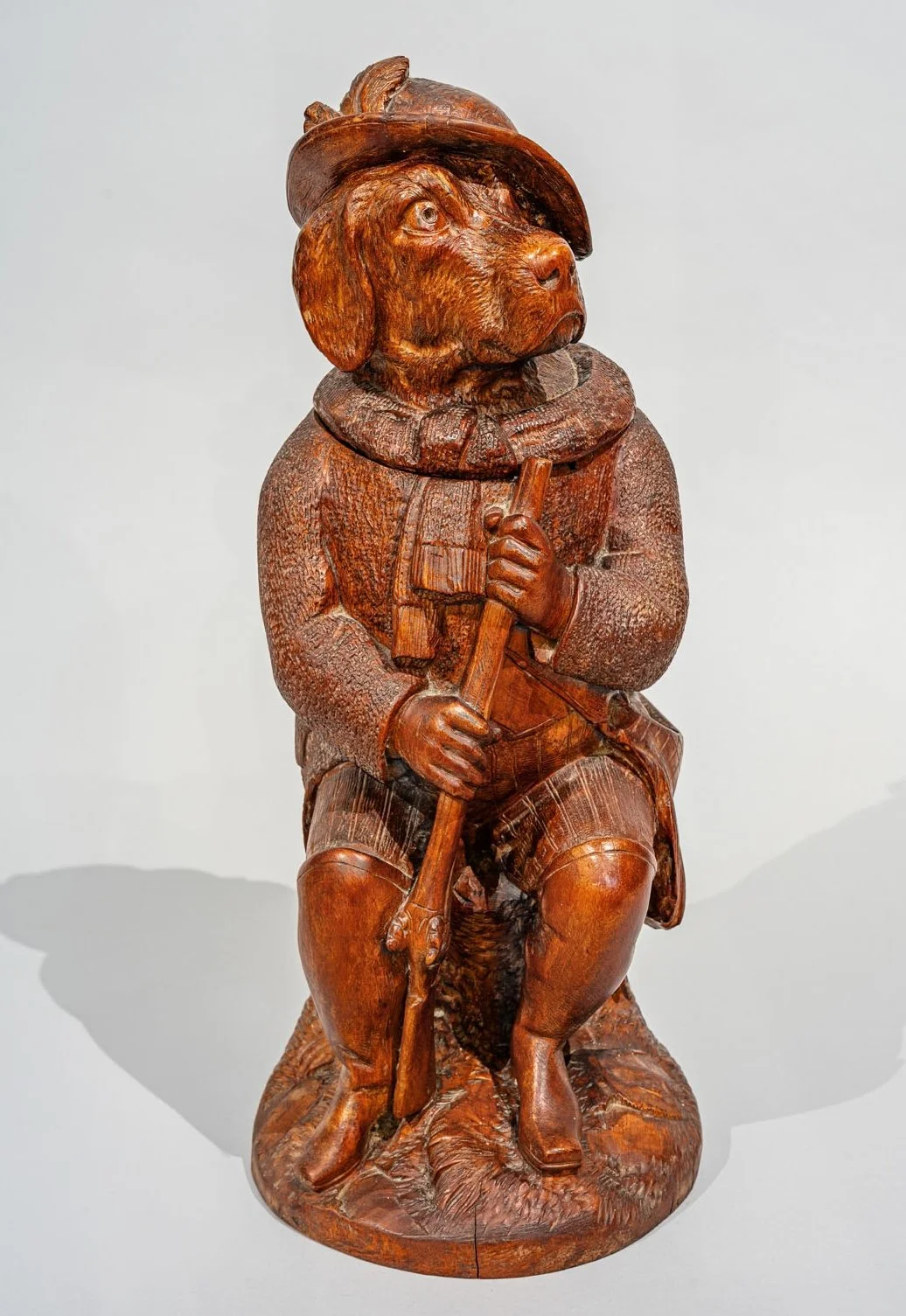
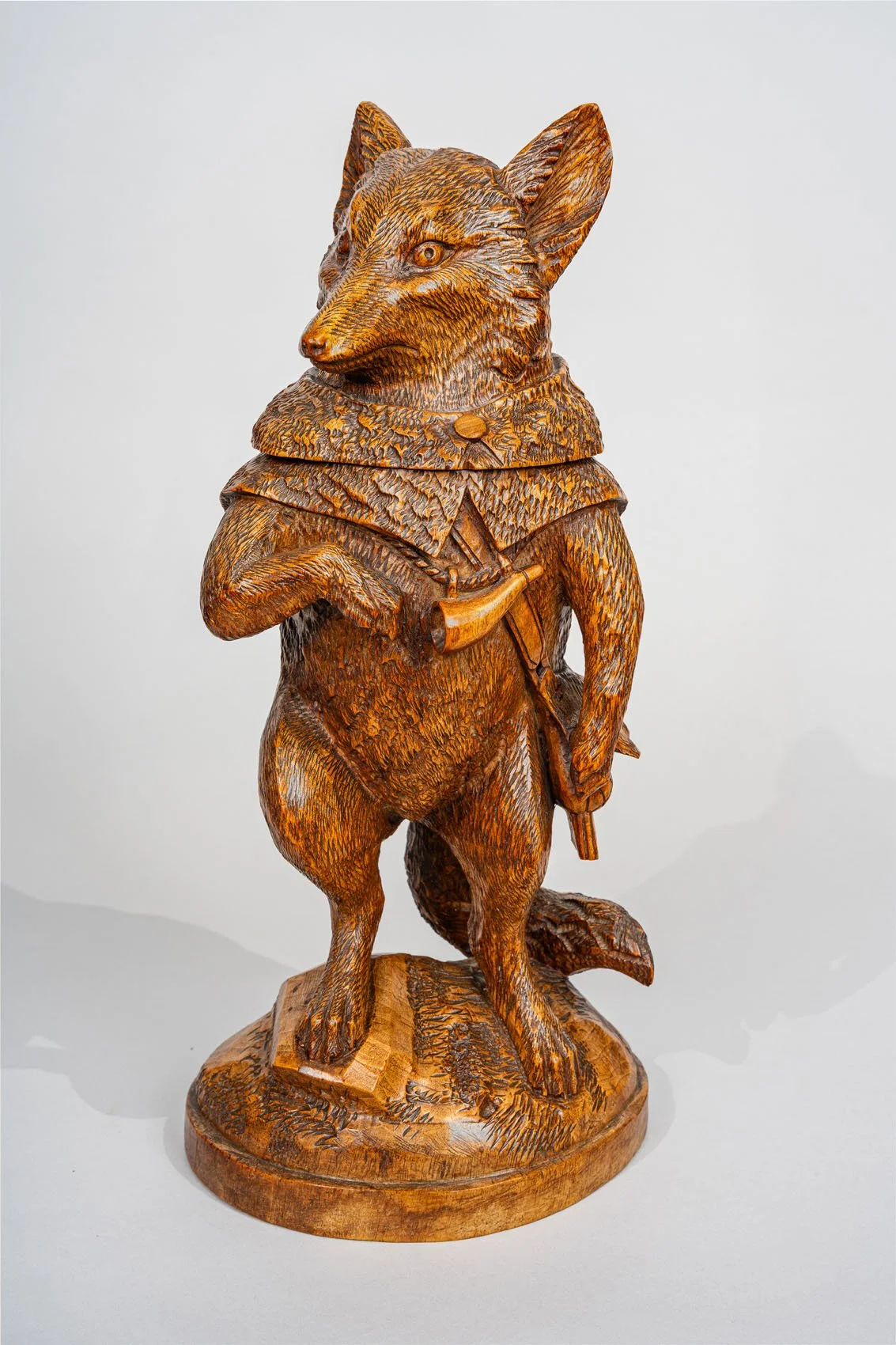
Beyond the animals lies a strand of wit that sets the best Brienz work apart, an anthropomorphic tradition descended from the medieval fables of Reynard the Fox. Here, foxes and hounds stand upright in hunting dress, tobacco jars and smokers' companions carved as creatures aping their human pursuers, sly and beautifully made. The workshops also turned their skill to useful and domestic objects of every description, hall stands and brackets, inkwells and boxes, chairs and tables, and the carved clocks for which the region is justly known.
Materials and Care
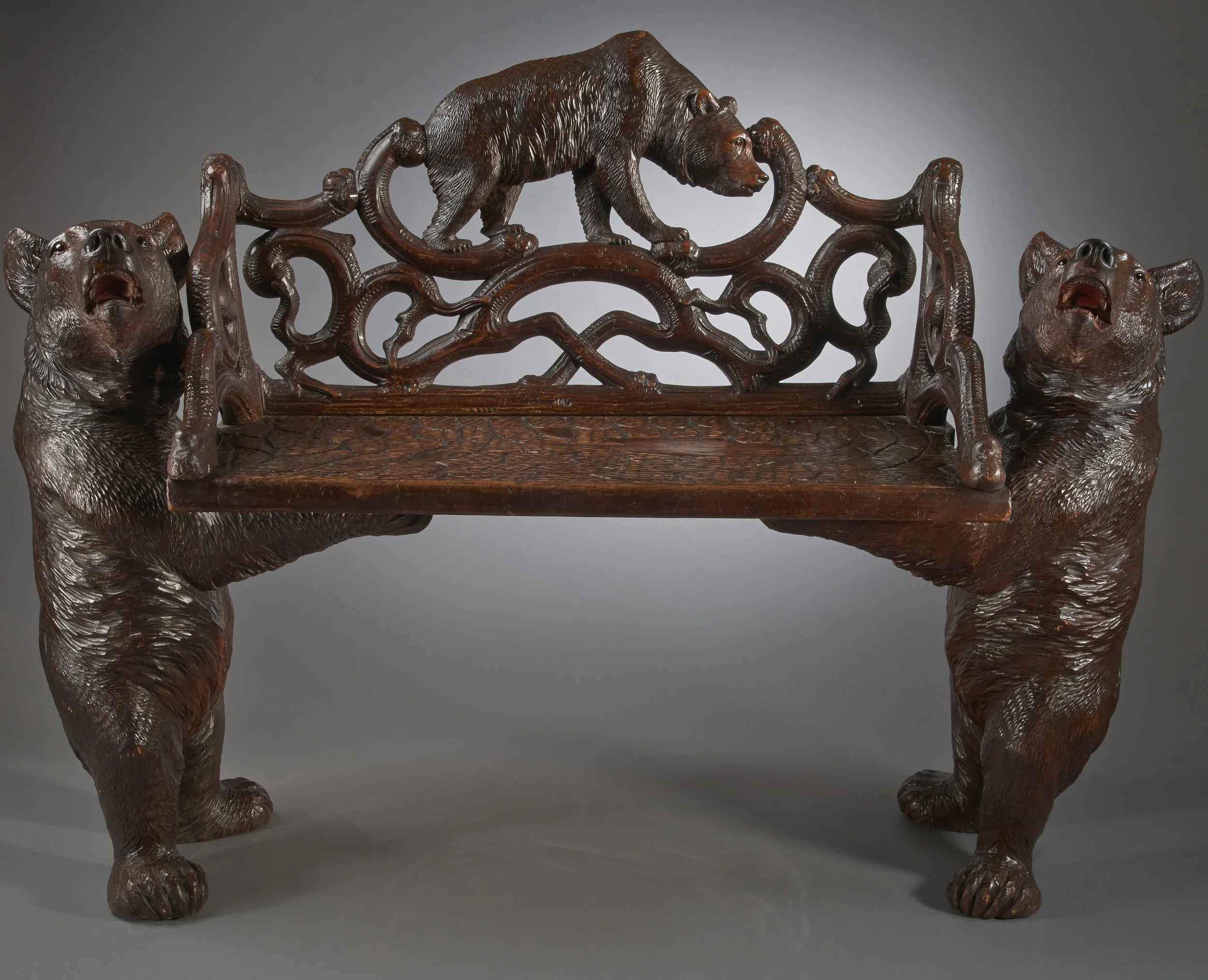
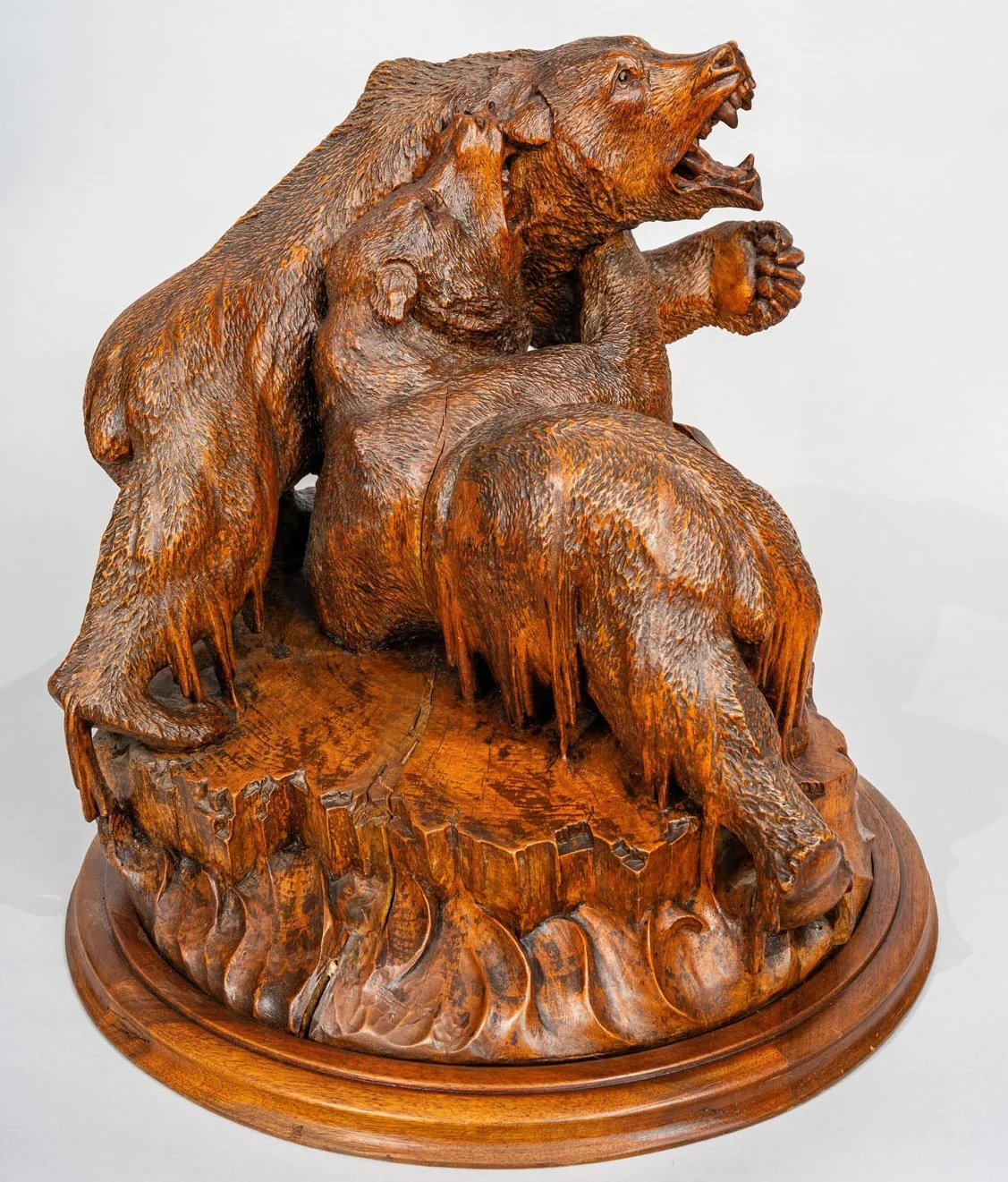
Two timbers carry the tradition. Linden, or lime, is soft and even-grained, and was used for the larger pieces and for work that did not call for the finest detail, the big bears among them. Walnut was the more valuable wood, denser and harder, and it holds a sharp edge where linden will not, which made it the choice for crisp, finely cut carving. It was often only lightly stained, enough to bring up the grain and the natural color of the wood rather than to disguise it. Both are stable in good conditions and vulnerable in poor ones.
The care of a Black Forest carving is simple and easily done wrong. Dust it gently and keep it away from direct heat, strong sun, and the parching air of a radiator or a fireplace, which can open the grain and lift old surfaces. A little natural beeswax, sparingly applied once or twice a year, is all the wood needs. For my own pieces, I use Harrell's traditional wax polish. Never use oil. Oil darkens unevenly, never fully dries, and traps dirt in the carving, and it is among the commonest causes of avoidable damage to otherwise good pieces.
Value, Attribution, and Authenticity
Several things govern what a carving is worth. The maker matters most, a documented Huggler or Mader standing well above an anonymous piece of similar size. Subject matters next, with the rare and the unusual outpacing the commonplace. Then comes the quality of carving, condition, and any exhibition or retail provenance that can be established. A modest subject carved with exceptional skill will often outrun an ambitious one carved indifferently, and learning to see that difference is the work of years.
Authenticity deserves particular care, because the market has long been troubled by reproductions. The most obvious are the resin and plastic casts that imitate the popular forms, including the hunter rabbit and the begging bear. They give themselves away quickly to anyone who knows the originals. A genuine carving is built up from separate elements, with horns of real antler set into drilled sockets and eyes of glass bedded in carved hollows, while a cast reproduction is a single continuous piece with molded eyes and no joins. Weight, surface, and the crispness of the cutting tell the rest of the story. When a piece is important, or when its attribution is uncertain, a second opinion from someone who handles the genuine article regularly is worth seeking before any decision is made.
Related Antiques from our Shops






Frequently Asked Questions
What are Black Forest carvings?
Black Forest carvings are finely carved wood animals, figures, furniture, and clocks made in and around the Swiss village of Brienz between about 1820 and 1940. Despite the name, they are Swiss rather than German, and the best of them rank among the finest decorative wood sculptures of the nineteenth century.
Which German town is known for wood carving?
The carvings collectors call Black Forest are not German but Swiss, made in Brienz on Lake Brienz in the Bernese Oberland. Within Germany, Triberg in the actual Black Forest is the home of the cuckoo clock, and Oberammergau in Bavaria is long renowned for carved religious figures, but the animals, figures, and clocks that bear the trade label Black Forest are the work of Swiss carvers and have been from the start.
Who is the most famous Black Forest wood carver?
The Huggler family stands first among the Brienz carvers, Johann Huggler and Albert Huggler above all, whose signed animal and figural groups command the highest prices. Walter Mader follows, remembered for his dogs, and Christian Fischer holds his place as the founder of the tradition. Because retailers generally forbade open signing, much fine work passed unsigned, and recovering a maker's concealed initials can transform both a piece's interest and its worth.
Which city is famous for wood carving today?
Brienz remains the living center of Swiss woodcarving. The village on Lake Brienz holds the only School of Woodcarving in Switzerland, founded in 1884 and teaching still, and professional workshops continue to carve there. The tradition the trade calls Black Forest has been worked in and around Brienz for two hundred years, and it is still worked.
What makes a Black Forest carving valuable?
Value rests on the maker, the subject, the quality of the carving, the condition, and any documented exhibition or retail history. A signed piece by a celebrated carver such as Johann Huggler or Walter Mader, an unusual or finely observed subject, and a recorded exhibition provenance all raise a carving well above the common run, while the ubiquitous bear, competently but not exceptionally carved, remains modest.
How much is an antique Black Forest bear worth?
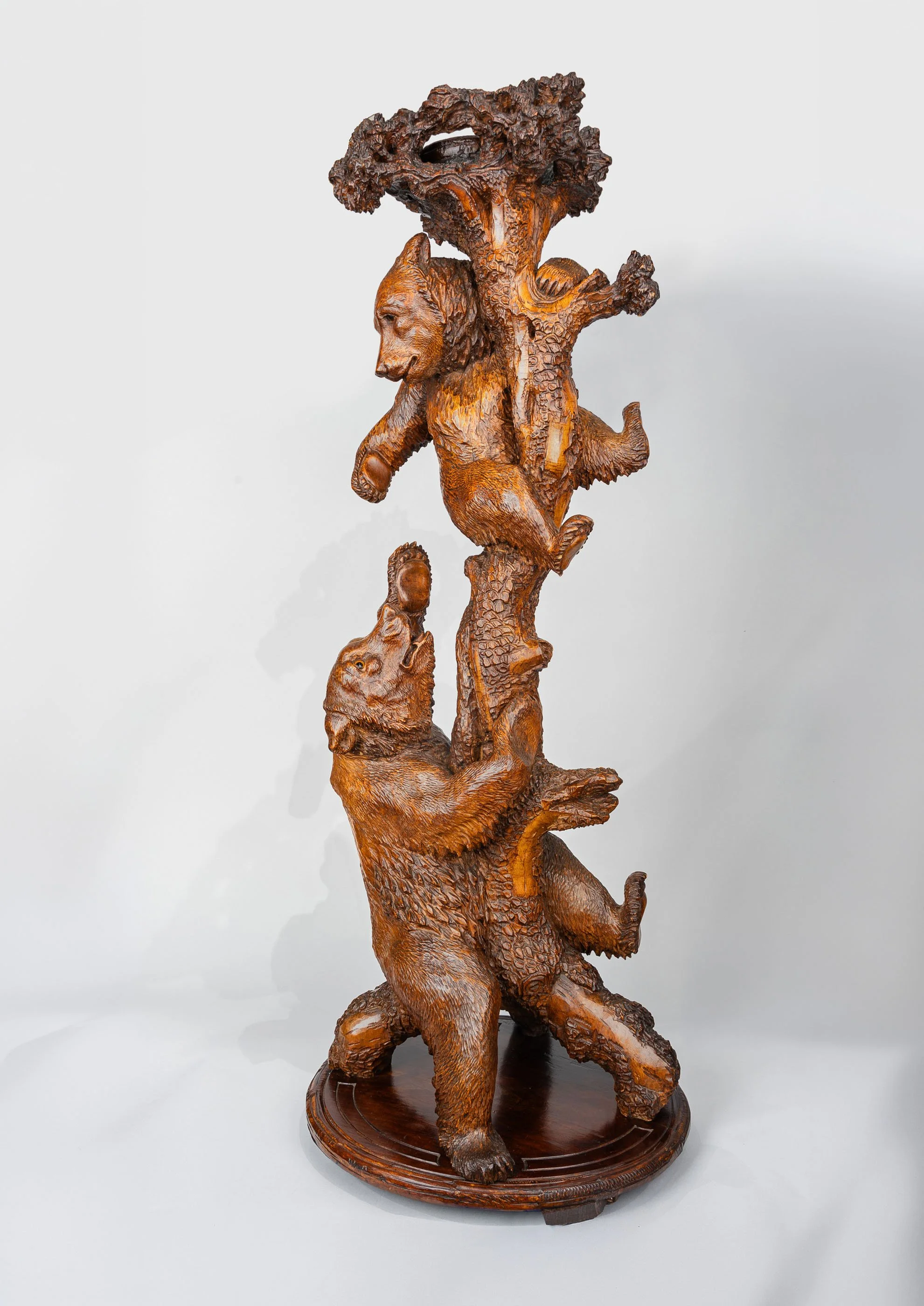
It depends entirely on the bear. Bears were carved in greater numbers than any other subject, so the range is wide. A small strolling bear of three or four inches can be found for a few hundred dollars, while at the other extreme, a rare and important piece can reach well into six figures. I acquired a fine carved bear clock from a private collection in 2003 for $120,000. Between those poles, scale, the crispness of the carving, condition, an unusual posture or function such as a hall or umbrella stand, and any attribution to a known workshop or exhibition history all weigh on the value. The surest course is to have a piece examined by a specialist who can assess its current market value.
How can I tell whether a Black Forest carving is genuine?
The market carries a good deal of reproduction, much of it resin or plastic cast from the popular forms, and the casts betray themselves to a practiced eye. An original is assembled rather than molded, its antler horns pegged into drilled sockets and its glass eyes set into carved hollows, whereas a cast is a single continuous piece without joins. The weight in the hand and the sharpness of the cut confirm the rest. For an important or uncertain piece, an opinion from someone who handles genuine examples regularly is the safeguard worth having.
How do I find out what my Black Forest carving is worth?
Have it examined by a specialist who can identify the maker, judge the quality, and set it against the current market. If you own a piece you would like to understand or are considering selling, you can request a free valuation, and I am glad to provide my assessment.
A Note for Owners
Many of the best Black Forest carvings still in private hands arrived generations ago as Grand Tour souvenirs and have sat quietly in families ever since, their quality and their makers long forgotten. If you have inherited or acquired a piece and wish to understand what it is, what it may be worth, or whether it carries a maker's hand worth recovering, I am always glad to look. Whether you are building a collection or considering selling, a conversation with a specialist is the right place to begin, and you are welcome to tell me about your carving.
Sources and Further Reading
The principal reference on this subject is Swiss Carvings: The Art of the Black Forest, 1820–1940 by Jay Arenski, Simon Daniels, and Michael Daniels (Antique Collectors' Club, 2006), which remains the standard work in English. The research behind it drew on private collectors' notes and records assembled over many years, and on the holdings of Brienz itself, including the Jobin Museum in Brienz, Switzerland, which preserves the workshop history and the carved record of the trade. Collectors wishing to go further will find Brienz and the School of Woodcarving, founded there in 1884, the natural starting point.
A life-sized carved eagle owl, attributed to the Ruef Brothers of Brienz, Switzerland, circa 1880, standing 28 inches high. The bird is carved in linden wood and perched upright on a cut branch rising from a rocky outcrop, the whole cut from a single block with a turned circular base. Ear tufts raised, wings folded, talons gripping the branch, it fixes the viewer with yellow glass eyes set into deeply carved facial discs.
What distinguishes this owl is the treatment of the plumage. Every feather is carved individually and then worked with a heated iron, the edges and barring scorched into the wood so that the graduated breast, the mottled crown, and the darker flight feathers read in tone as well as relief. This burning of the surface is the technique most closely associated with the Ruef workshop, whose birds of prey were a specialty of the Brienz trade, and the attribution rests on that handling together with the composition and the scale. The piece is unsigned.
The head is made separately and lifts off at the neck, a construction the carver has concealed within the ruff of feathers at the throat. It is not hinged, and the body is not hollowed out for use as a tobacco jar or humidor, which is consistent with the piece's size. The separate head allowed the carver to work the face and the body from blocks of different grain, and it is a feature worth knowing when a piece of this model is examined.
Carving of this ambition came out of Brienz in the Bernese Oberland, where the Ruef Brothers worked alongside Johann Huggler, Hans Huggler-Wyss, and Walter Mader in the decades when the international exhibitions at Vienna, Philadelphia, Paris, and Chicago carried Swiss carving to an American and English clientele. We discuss the Ruef workshop and the scorching technique in our article on the masters of the Black Forest, and in the reference we co-authored on the subject, Swiss Carvings: The Art of the Black Forest, 1820 to 1940.