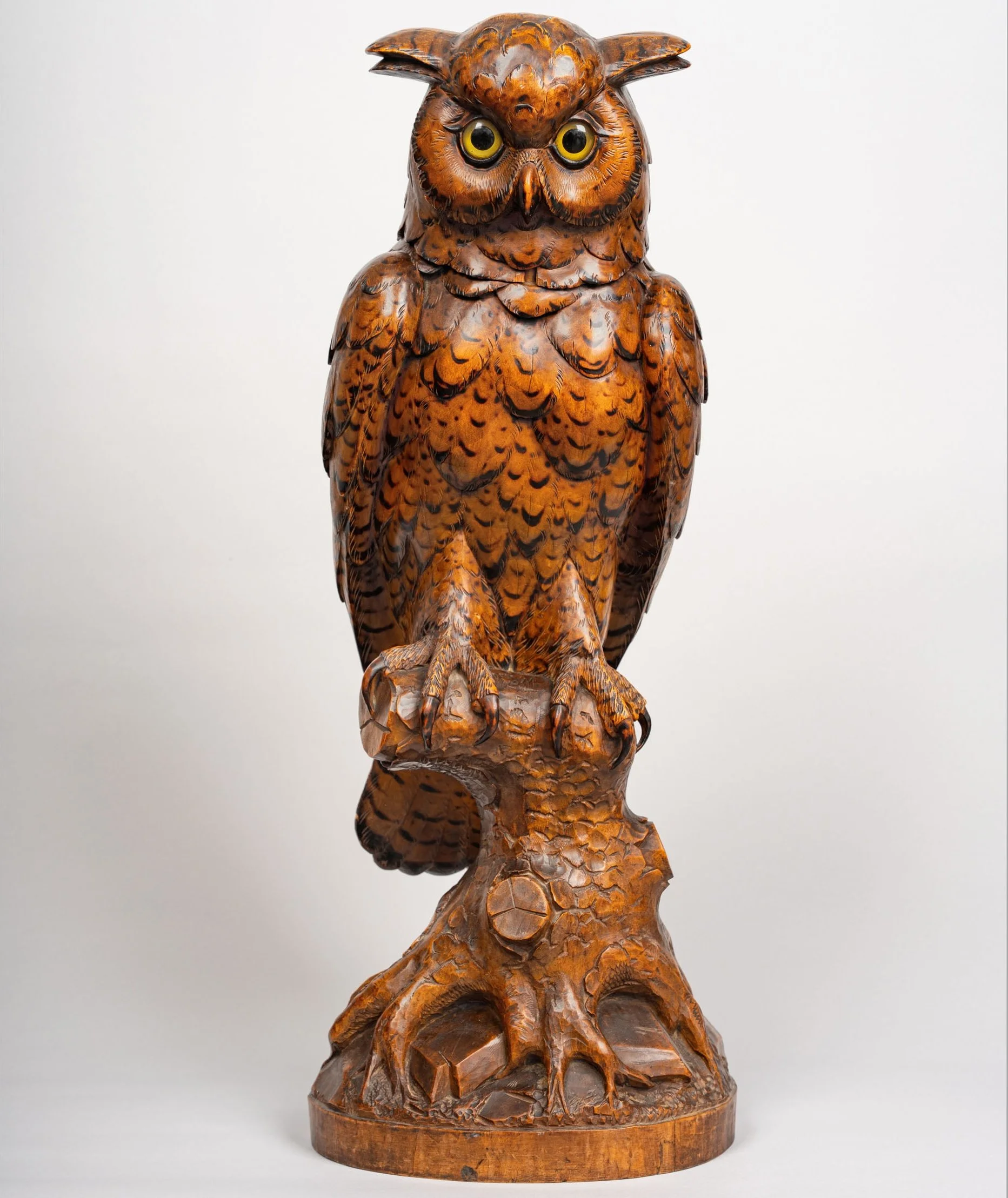
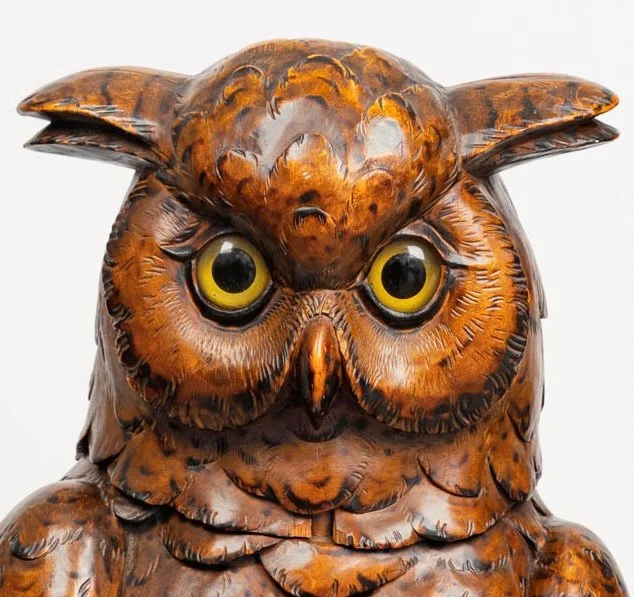
A large and powerfully modeled Swiss Black Forest carving of a golden eagle, attributed to the Ruef Brothers of Brienz and carved from linden wood, the bird shown alighting on a rocky outcrop with wings raised and head turned, with inset glass eyes. The eagle ranks with the bear and the owl among the defining subjects of the Brienz tradition, demanding both anatomical command and sustained technical control across a single block of work, and stands among the most ambitious forms the workshops produced.
The carving is worked with exceptional attention to the plumage, each feather individually defined and layered from the fine covert feathers of the breast to the broad primaries of the outstretched wings. The graduated coloring of the plumage was achieved not by applied stain but by scorching the surface of the wood with heated irons, a characteristic Brienz technique that produced the warm tonal transitions seen across the wings and body. The head is finely detailed, with a sharply hooked beak and inset glass eyes that lend the bird its alert, arresting expression, and the figure is raised on a naturalistically carved base of rocky strata.
The Ruef Brothers were among the most accomplished of the Brienz carvers, recorded alongside the Huggler family among the workshops whose work defined the finest period of the tradition and documented in the standard literature, including Swiss Carvings: The Art of the Black Forest, 1820–1940. The present eagle is attributed to them on the strength of its scale, the confidence of its modeling, and the quality of its finish, each consistent with their documented work in this subject.
The carving is in excellent original condition, retaining its surface and glass eyes, with the crisp definition of the featherwork fully preserved and the warm coloring undisturbed. Wear is minor and consistent with age.
A large and powerfully modeled Swiss Black Forest carving of a golden eagle, attributed to the Ruef Brothers of Brienz and carved from linden wood, the bird shown alighting on a rocky outcrop with wings raised and head turned, with inset glass eyes. The eagle ranks with the bear and the owl among the defining subjects of the Brienz tradition, demanding both anatomical command and sustained technical control across a single block of work, and stands among the most ambitious forms the workshops produced.
The carving is worked with exceptional attention to the plumage, each feather individually defined and layered from the fine covert feathers of the breast to the broad primaries of the outstretched wings. The graduated coloring of the plumage was achieved not by applied stain but by scorching the surface of the wood with heated irons, a characteristic Brienz technique that produced the warm tonal transitions seen across the wings and body. The head is finely detailed, with a sharply hooked beak and inset glass eyes that lend the bird its alert, arresting expression, and the figure is raised on a naturalistically carved base of rocky strata.
The Ruef Brothers were among the most accomplished of the Brienz carvers, recorded alongside the Huggler family among the workshops whose work defined the finest period of the tradition and documented in the standard literature, including Swiss Carvings: The Art of the Black Forest, 1820–1940. The present eagle is attributed to them on the strength of its scale, the confidence of its modeling, and the quality of its finish, each consistent with their documented work in this subject.
The carving is in excellent original condition, retaining its surface and glass eyes, with the crisp definition of the featherwork fully preserved and the warm coloring undisturbed. Wear is minor and consistent with age.

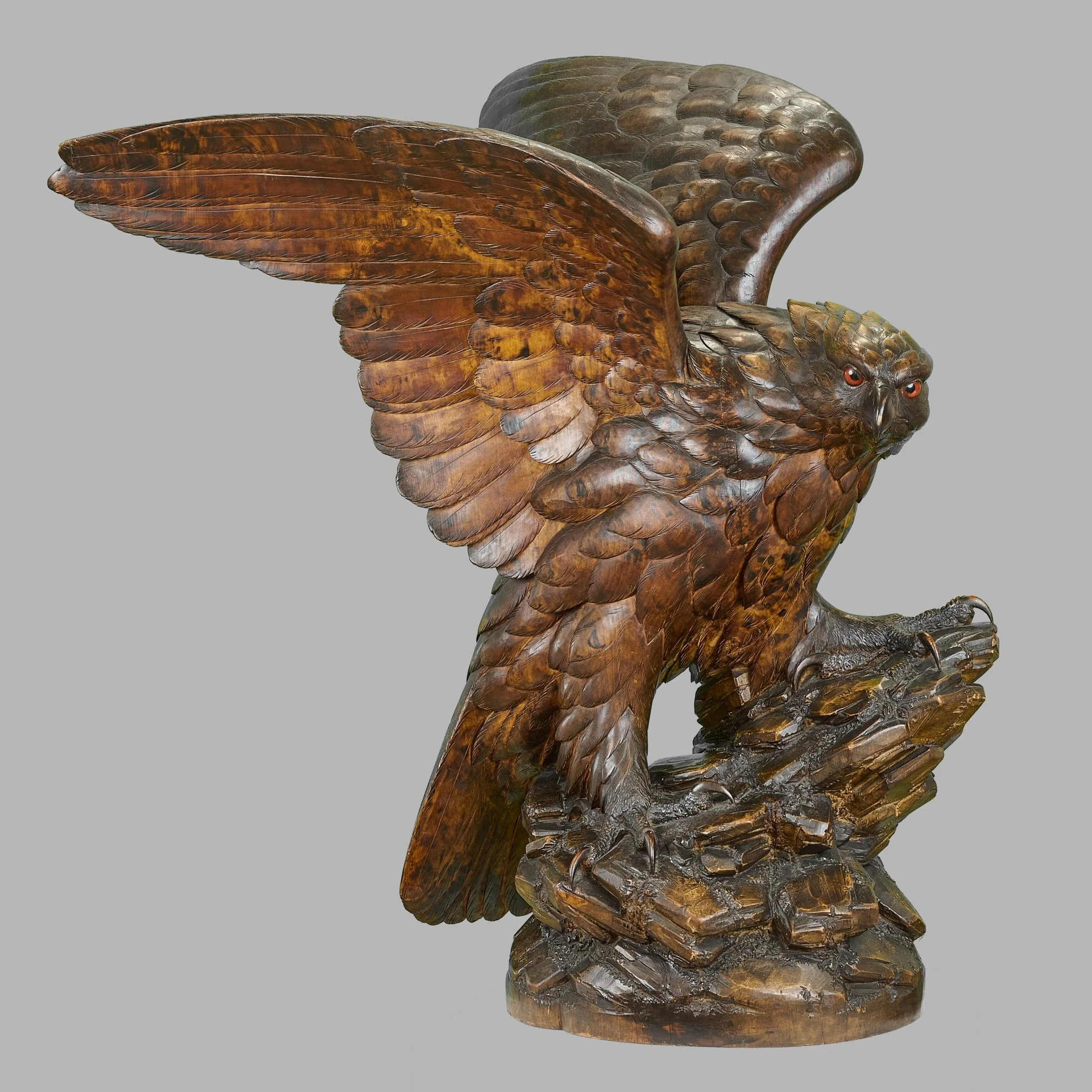 Image 1 of 2
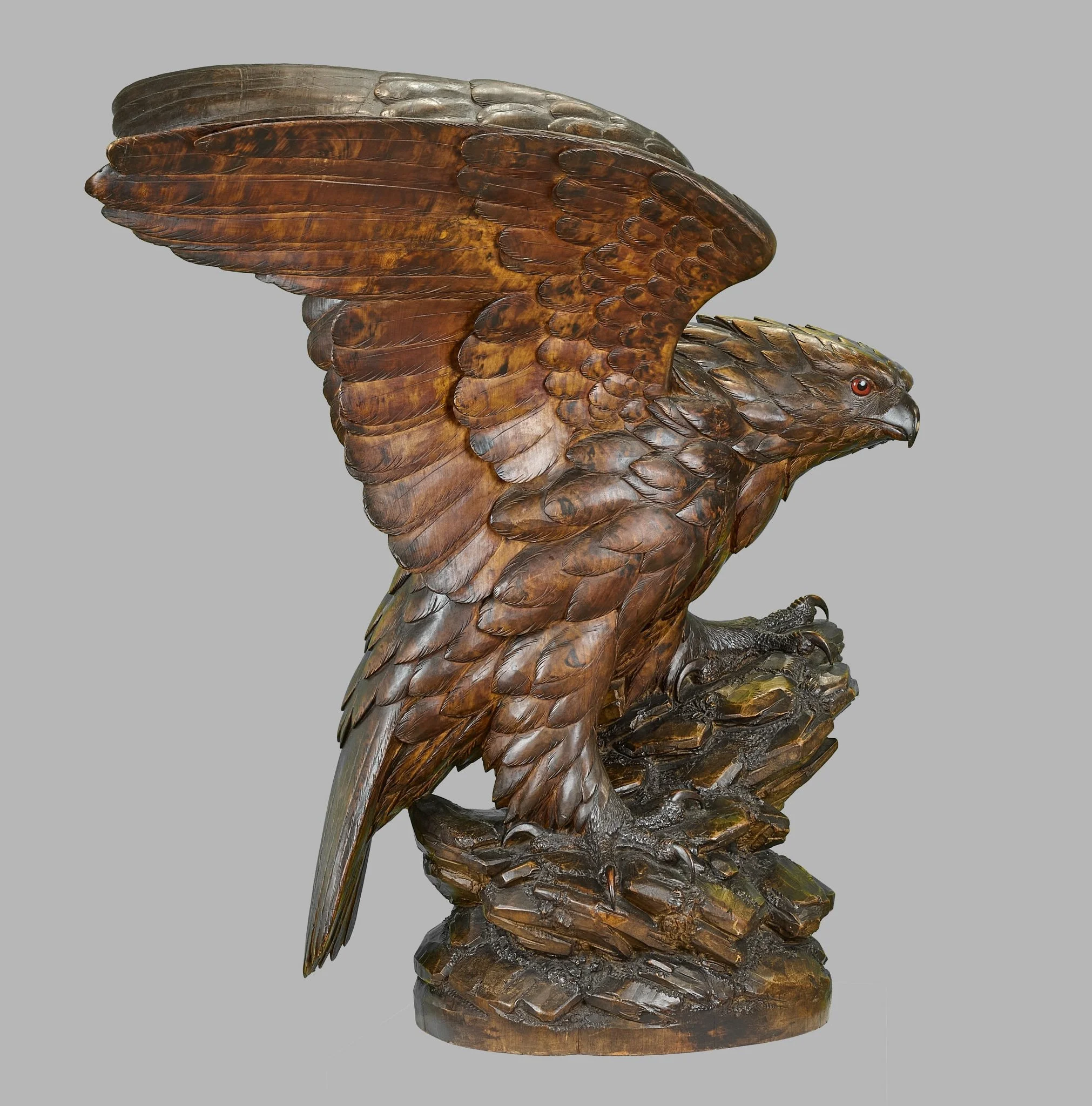 Image 2 of 2