There is a point at which Swiss Black Forest carving ceases to be a decorative art and becomes architecture — where the scale of the object demands not a cabinet or a mantelpiece but a hall, a staircase, a gallery, or the entrance rotunda of a great house. The present eagle stands at that threshold. At almost eight feet in height, with wings fully outstretched in the posture of an eagle that has just taken its summit perch, this is not a carving that inhabits a space — it is a carving that defines one. It was made for a specific kind of client, in a specific kind of house, and its original context — the châteaux and mansions of the American Northeast that received the grandest commissions of the Swiss carving workshops in the final decades of the nineteenth century — was entirely equal to its ambition.
The subject is the American eagle — the bald eagle of the United States, the bird of national symbolism whose selection as subject speaks directly to the American market for which pieces of this scale and character were produced. The Brienz workshops understood their international clientele with precision, and a life-size American eagle at nearly eight feet was a statement that only one category of American patron could make: the industrialist, the financier, the railroad magnate, the man for whom a house in the Hudson Valley or the Adirondacks was itself a declaration of position. An eagle of this scale, commissioned from the finest Swiss carvers and installed in the entrance hall, was the sculptural equivalent of a Vanderbilt staircase or a Carnegie library wing.
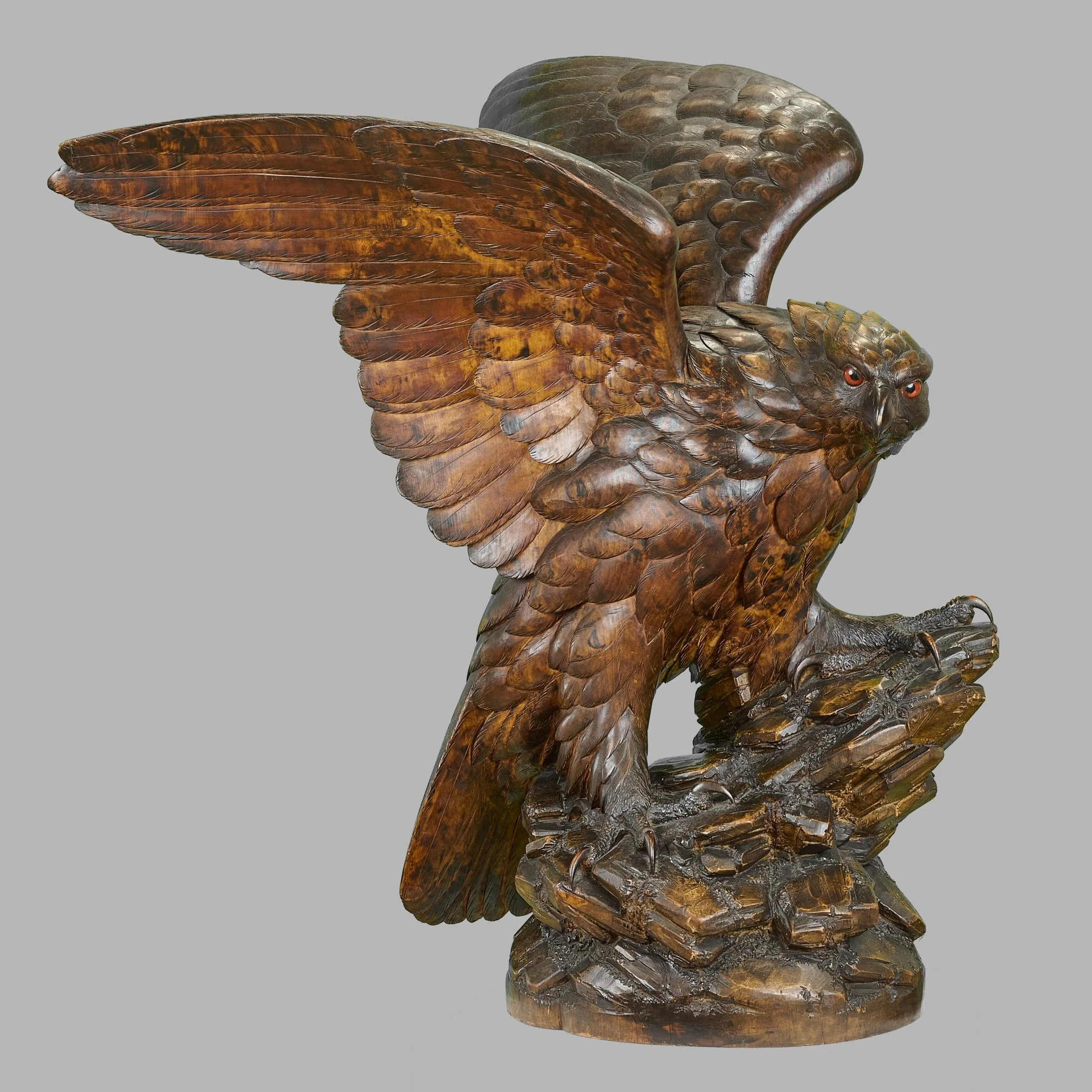
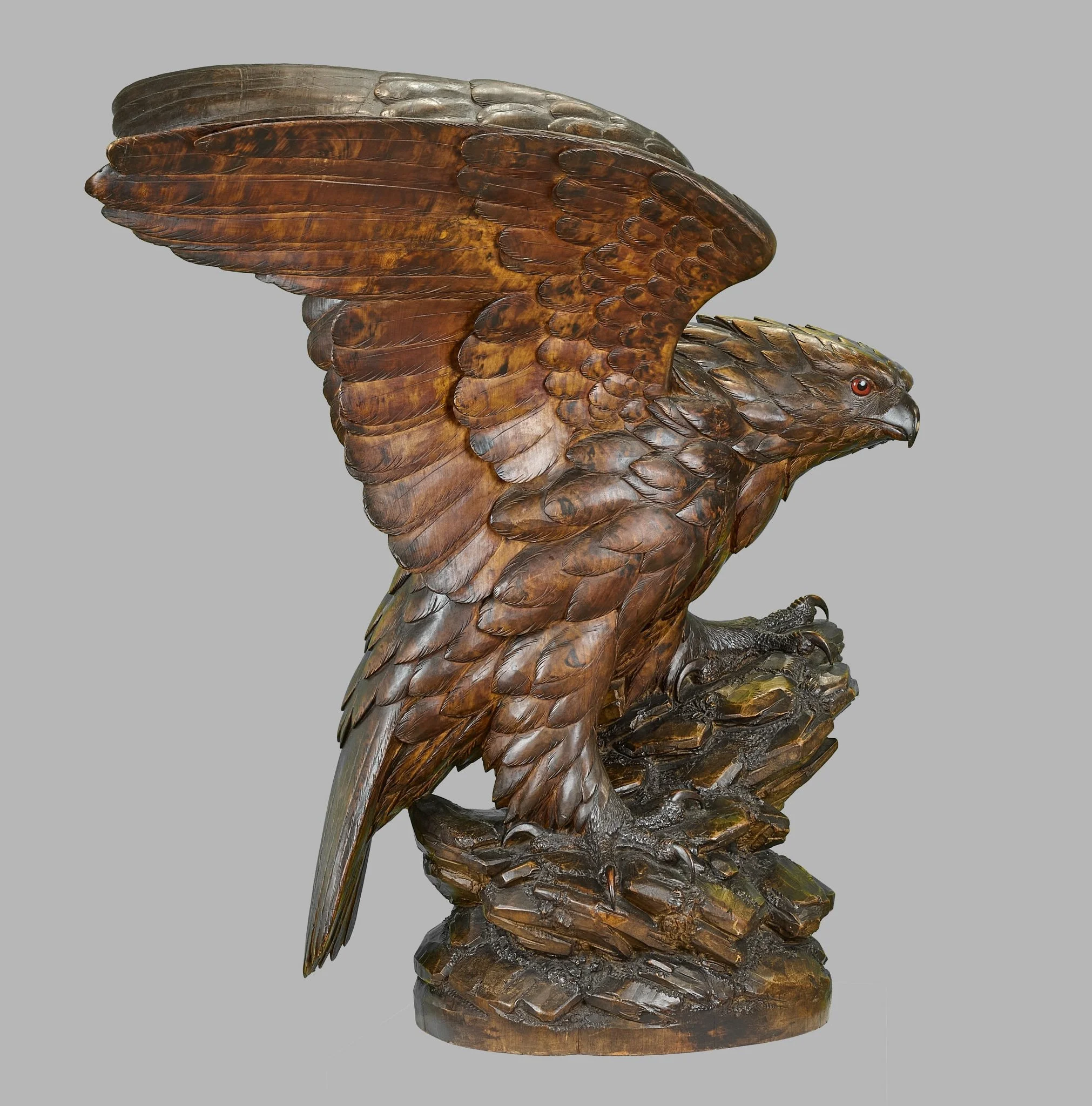
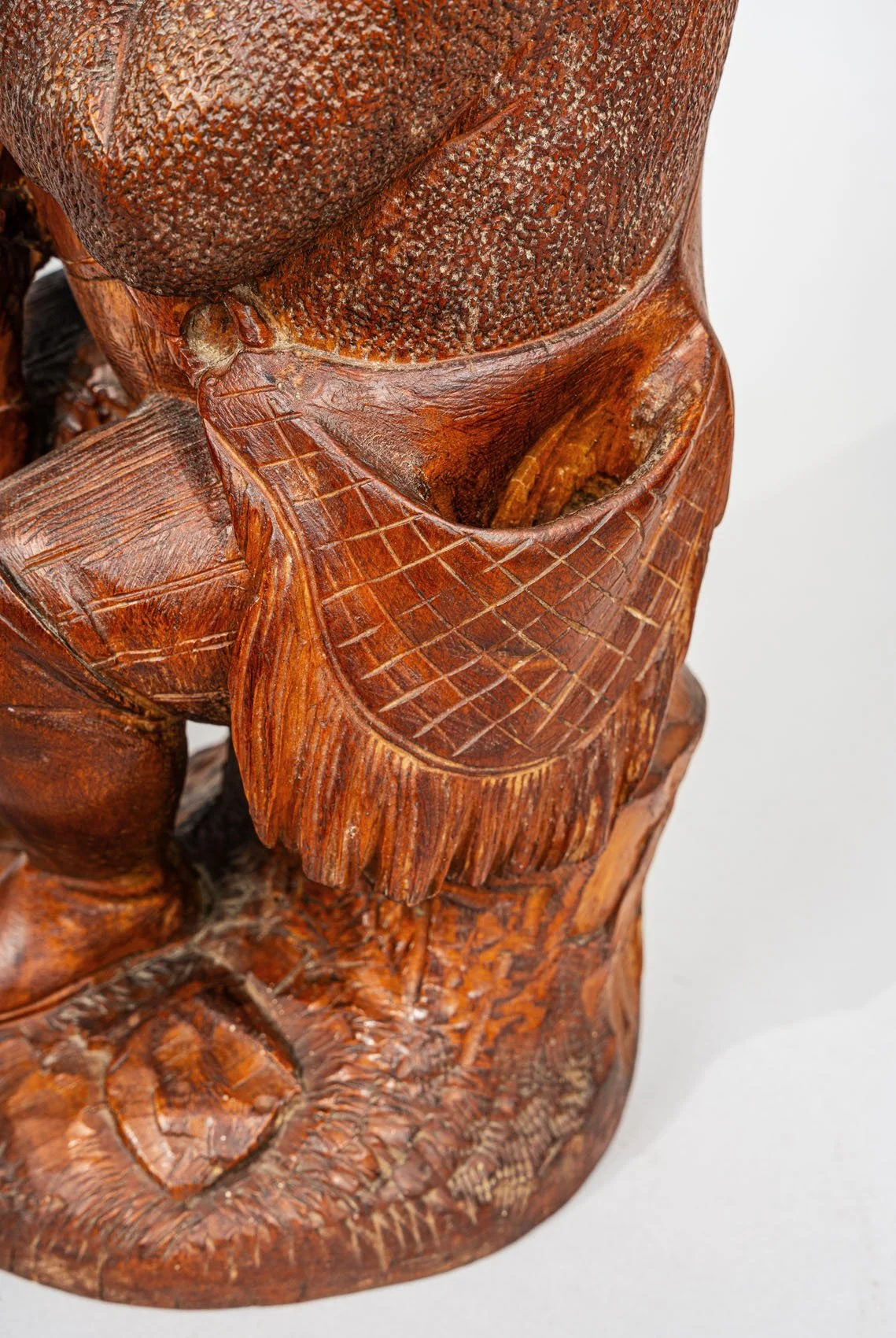
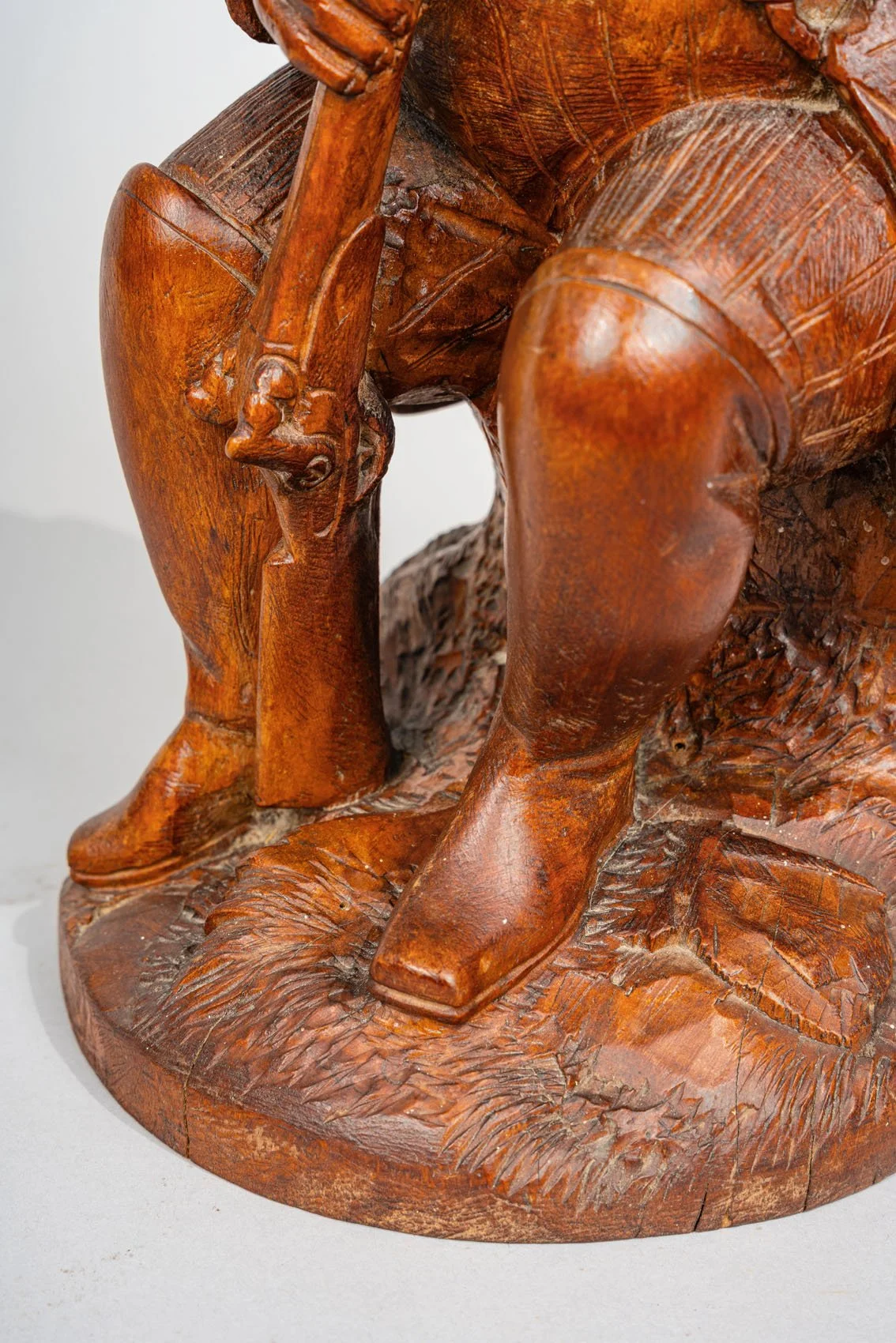
The eagle is carved fully in the round in linden wood, perched at the summit of a monumentally conceived rocky outcrop — the angled rock slabs rendered in the bold, confident manner of the finest Brienz rockwork, the surfaces broken and stratified, the junctions between the rock planes animated with carved alpine flora. The whole base rises in a dramatic diagonal thrust that gives the composition its ascending energy, the bird at the apex the inevitable resolution of a movement that begins at the floor and ends eight feet above it.
The wings are outstretched and swept back in the posture of the moment of landing or the moment before launch — the position of maximum span and maximum tension, in which every feather is fully displayed. The individual flight feathers are deeply undercut and rhythmically layered across the full extent of both wings, the carving maintaining its quality and precision to the outermost tips. The head is turned slightly, the beak open, the eye alert — the expression of the apex predator entirely at ease with its own dominance. The talons grip the rocky summit with the conviction of a bird that has perched on this particular crag many times before.
As illustrated in Swiss Carvings: The Art of the Black Forest, 1820–1940 by Jay Arenski, Simon Daniels, and Michael Daniels (pp. 88–90), monumental eagle carvings of this type represent some of the most ambitious productions of the Brienz workshops — objects conceived for exhibition and for the grandest private commissions of the period. An example of this scale, in this condition, is without meaningful parallel in the current market.
Height: Approximately 8 feet (circa 244 cm) Provenance: Commissioned for American private collection; châteaux and mansions, upstate New York Circa: 1890
Condition: Very good overall for a work of this scale and age. Linden wood structurally sound throughout — no cracks or losses of significance to the main figure. Wings fully intact — flight feather carving crisp and complete across the full extent of both wings with no losses to tips or extremities. Head with open beak intact. Talons gripping summit intact. Rocky outcrop base structurally sound throughout — rock plane carving and alpine flora at junctions intact. Rich, warm honey-brown patina consistent with age and quality of original surface.
Literature:
Jay Arenski, Simon Daniels, and Michael Daniels, Swiss Carvings: The Art of the Black Forest, 1820–1940, 2006, pp. 88–90.
There is a point at which Swiss Black Forest carving ceases to be a decorative art and becomes architecture — where the scale of the object demands not a cabinet or a mantelpiece but a hall, a staircase, a gallery, or the entrance rotunda of a great house. The present eagle stands at that threshold. At almost eight feet in height, with wings fully outstretched in the posture of an eagle that has just taken its summit perch, this is not a carving that inhabits a space — it is a carving that defines one. It was made for a specific kind of client, in a specific kind of house, and its original context — the châteaux and mansions of the American Northeast that received the grandest commissions of the Swiss carving workshops in the final decades of the nineteenth century — was entirely equal to its ambition.
The subject is the American eagle — the bald eagle of the United States, the bird of national symbolism whose selection as subject speaks directly to the American market for which pieces of this scale and character were produced. The Brienz workshops understood their international clientele with precision, and a life-size American eagle at nearly eight feet was a statement that only one category of American patron could make: the industrialist, the financier, the railroad magnate, the man for whom a house in the Hudson Valley or the Adirondacks was itself a declaration of position. An eagle of this scale, commissioned from the finest Swiss carvers and installed in the entrance hall, was the sculptural equivalent of a Vanderbilt staircase or a Carnegie library wing.
The eagle is carved fully in the round in linden wood, perched at the summit of a monumentally conceived rocky outcrop — the angled rock slabs rendered in the bold, confident manner of the finest Brienz rockwork, the surfaces broken and stratified, the junctions between the rock planes animated with carved alpine flora. The whole base rises in a dramatic diagonal thrust that gives the composition its ascending energy, the bird at the apex the inevitable resolution of a movement that begins at the floor and ends eight feet above it.
The wings are outstretched and swept back in the posture of the moment of landing or the moment before launch — the position of maximum span and maximum tension, in which every feather is fully displayed. The individual flight feathers are deeply undercut and rhythmically layered across the full extent of both wings, the carving maintaining its quality and precision to the outermost tips. The head is turned slightly, the beak open, the eye alert — the expression of the apex predator entirely at ease with its own dominance. The talons grip the rocky summit with the conviction of a bird that has perched on this particular crag many times before.
As illustrated in Swiss Carvings: The Art of the Black Forest, 1820–1940 by Jay Arenski, Simon Daniels, and Michael Daniels (pp. 88–90), monumental eagle carvings of this type represent some of the most ambitious productions of the Brienz workshops — objects conceived for exhibition and for the grandest private commissions of the period. An example of this scale, in this condition, is without meaningful parallel in the current market.
Height: Approximately 8 feet (circa 244 cm) Provenance: Commissioned for American private collection; châteaux and mansions, upstate New York Circa: 1890
Condition: Very good overall for a work of this scale and age. Linden wood structurally sound throughout — no cracks or losses of significance to the main figure. Wings fully intact — flight feather carving crisp and complete across the full extent of both wings with no losses to tips or extremities. Head with open beak intact. Talons gripping summit intact. Rocky outcrop base structurally sound throughout — rock plane carving and alpine flora at junctions intact. Rich, warm honey-brown patina consistent with age and quality of original surface.
Literature:
Jay Arenski, Simon Daniels, and Michael Daniels, Swiss Carvings: The Art of the Black Forest, 1820–1940, 2006, pp. 88–90.

 Image 1 of 4
 Image 2 of 4
 Image 3 of 4
 Image 4 of 4