A hunting cabinet of exceptional ambition, nine feet tall, in two parts — among the most complete expressions of the Black Forest Jagdschrank to appear on the market in recent years.
The upper case is dominated by a deeply carved high-relief panel of a stag, hind and fawn in a dense Alpine forest, the composition built in layered planes — foreground undergrowth, mid-ground figures, a receding canopy of oak and pine — that draw the eye continuously through the scene. The stag stands alert and full-antlered, the hind attentive at his shoulder, the fawn part-sheltered in the undergrowth, and the surface textures of coat, bark, leaf and mossy ground are achieved through the fine, varied tool work that separates the best Brienz production from the broader regional trade.
The surround matches the panel. Antler-mounted columns frame the case, set at intervals with carved bone medallions of miniature wildlife subjects, among them a capercaillie. The cornice carries a hound's head with glass eyes within an arched pediment, flanked by two pairs of full stag antlers, and a further antler branch between cornice and panel bears one more medallion. Below, two cupboard doors carry their own relief panels — foxes in woodland to the left, hares beneath a tree to the right — framed by antler handles, with a pair of drawers above set with bone escutcheons to match.
The Jagdschrank — the Black Forest gun cabinet — was purpose-built to house firearms and hunting equipment, and served equally as a prestige display in the hunting lodges and great interiors of the late nineteenth century — the meeting point of fine furniture-making and sculptural carving. The most ambitious examples were made for a clientele of European aristocracy and American collectors, and shown at the international exhibitions in Paris, Vienna and Chicago; demand for them has never lapsed.
Condition: Very good for the scale and age; warm original patina to the oak, carved panels complete and crisp, antler and horn mounts intact, glass eyes to the hound's head present, minor age-consistent wear, no significant losses or restorations noted.
Dimensions: 52 in. width x 26 in. depth x 108 in. height
Literature: Jay Arenski, Simon Daniels, and Michael Daniels, Swiss Carvings: The Art of the Black Forest, 1820–1940 (2006).
A hunting cabinet of exceptional ambition, nine feet tall, in two parts — among the most complete expressions of the Black Forest Jagdschrank to appear on the market in recent years.
The upper case is dominated by a deeply carved high-relief panel of a stag, hind and fawn in a dense Alpine forest, the composition built in layered planes — foreground undergrowth, mid-ground figures, a receding canopy of oak and pine — that draw the eye continuously through the scene. The stag stands alert and full-antlered, the hind attentive at his shoulder, the fawn part-sheltered in the undergrowth, and the surface textures of coat, bark, leaf and mossy ground are achieved through the fine, varied tool work that separates the best Brienz production from the broader regional trade.
The surround matches the panel. Antler-mounted columns frame the case, set at intervals with carved bone medallions of miniature wildlife subjects, among them a capercaillie. The cornice carries a hound's head with glass eyes within an arched pediment, flanked by two pairs of full stag antlers, and a further antler branch between cornice and panel bears one more medallion. Below, two cupboard doors carry their own relief panels — foxes in woodland to the left, hares beneath a tree to the right — framed by antler handles, with a pair of drawers above set with bone escutcheons to match.
The Jagdschrank — the Black Forest gun cabinet — was purpose-built to house firearms and hunting equipment, and served equally as a prestige display in the hunting lodges and great interiors of the late nineteenth century — the meeting point of fine furniture-making and sculptural carving. The most ambitious examples were made for a clientele of European aristocracy and American collectors, and shown at the international exhibitions in Paris, Vienna and Chicago; demand for them has never lapsed.
Condition: Very good for the scale and age; warm original patina to the oak, carved panels complete and crisp, antler and horn mounts intact, glass eyes to the hound's head present, minor age-consistent wear, no significant losses or restorations noted.
Dimensions: 52 in. width x 26 in. depth x 108 in. height
Literature: Jay Arenski, Simon Daniels, and Michael Daniels, Swiss Carvings: The Art of the Black Forest, 1820–1940 (2006).

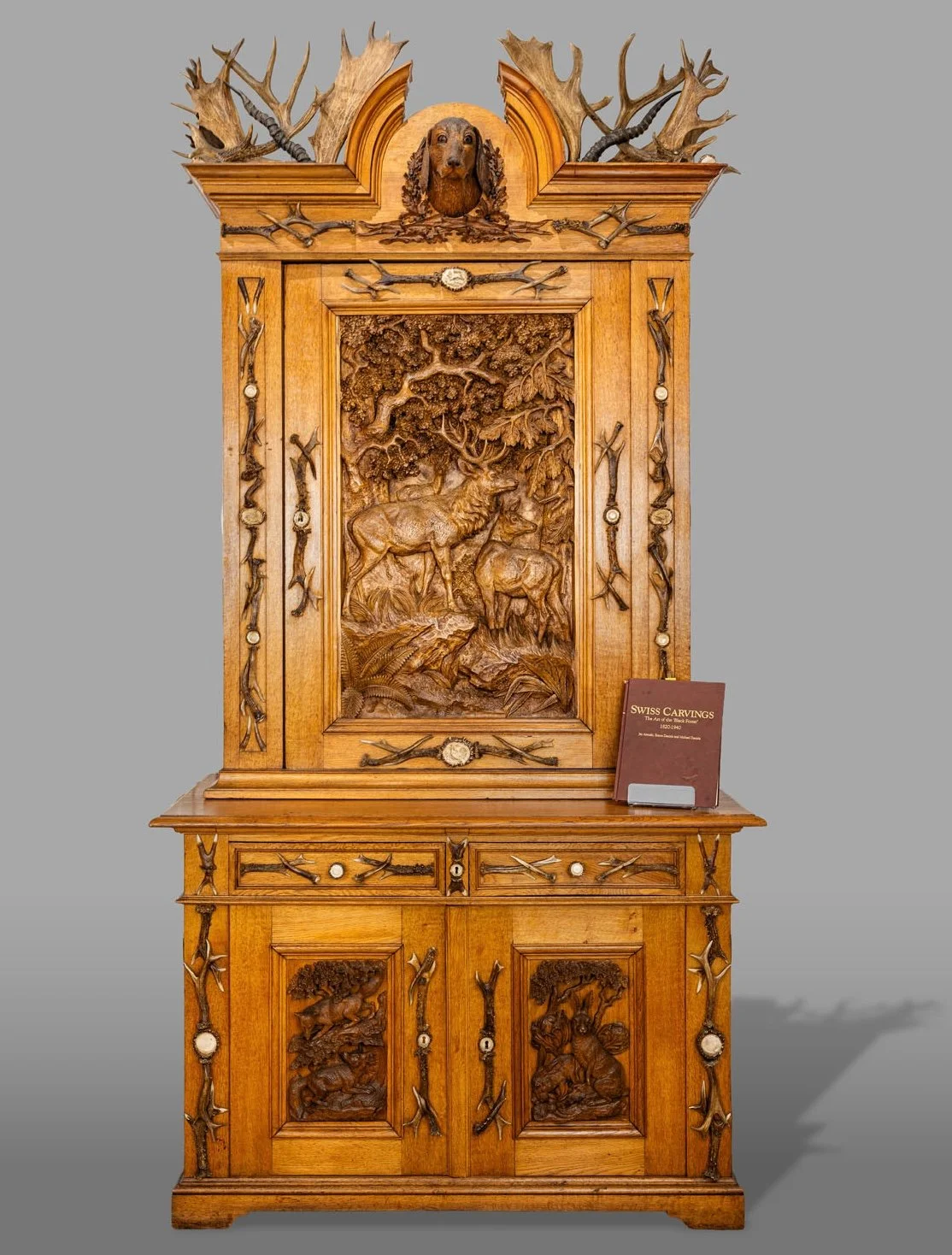 Image 1 of 8
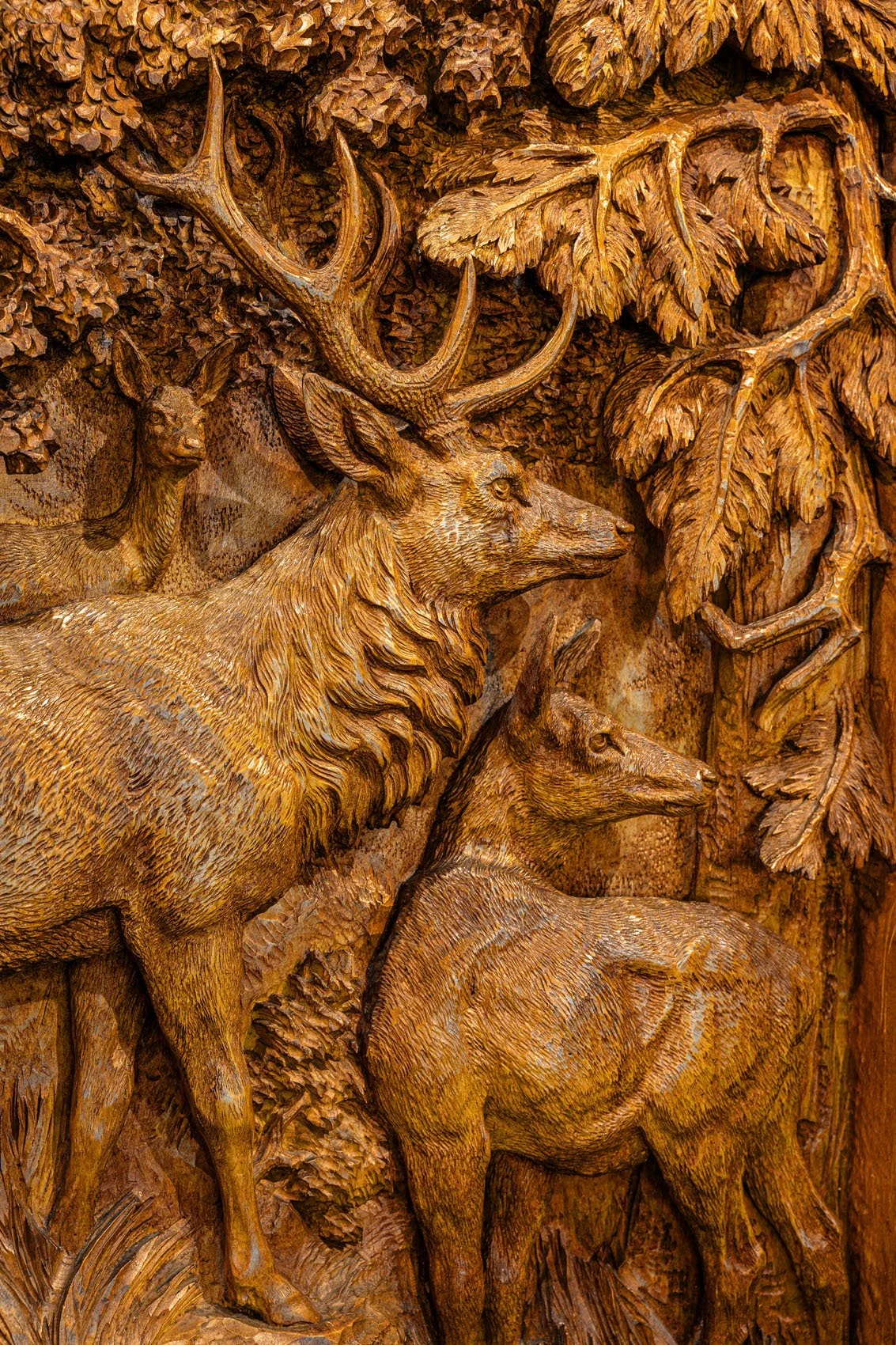 Image 2 of 8
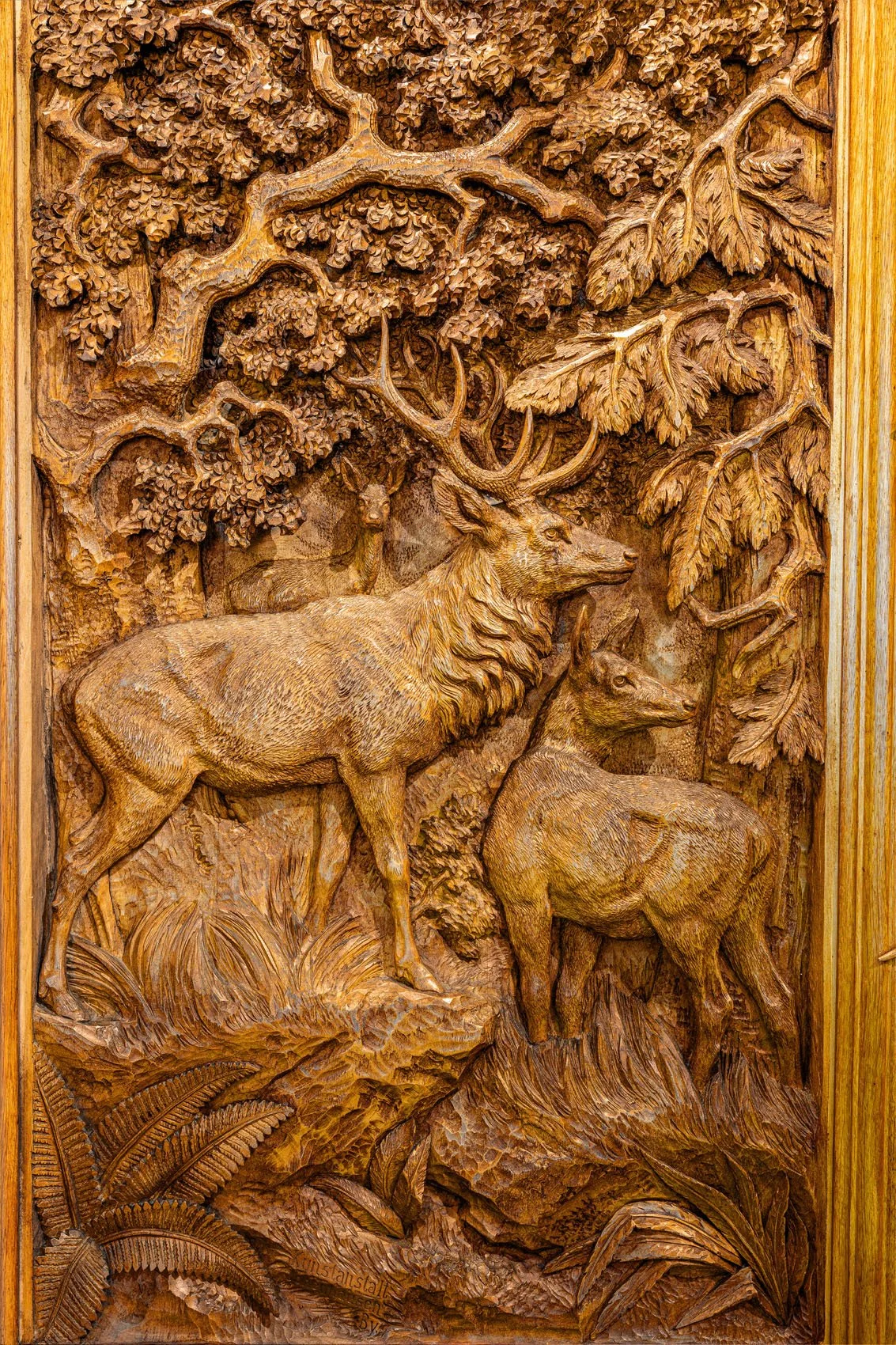 Image 3 of 8
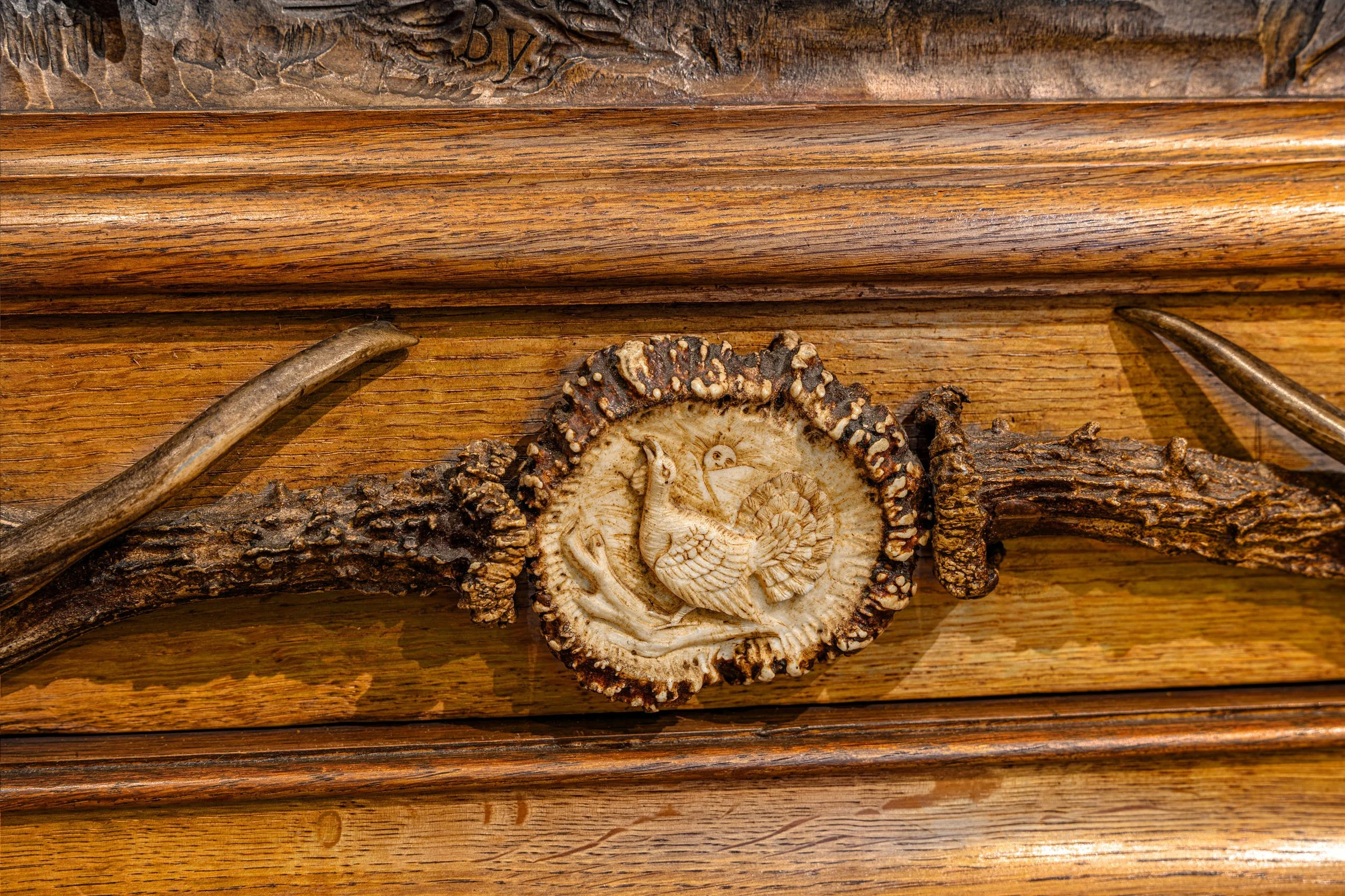 Image 4 of 8
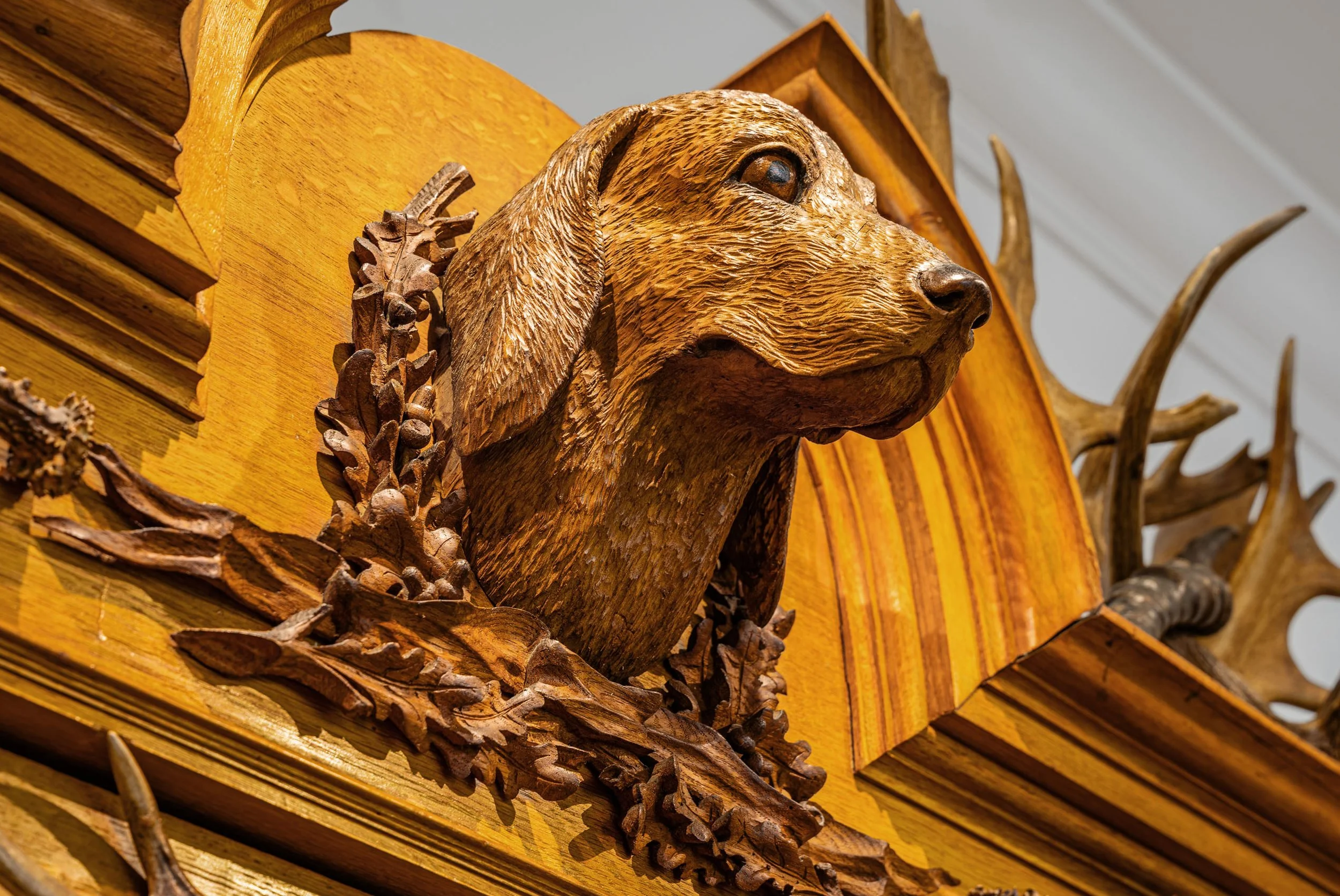 Image 5 of 8
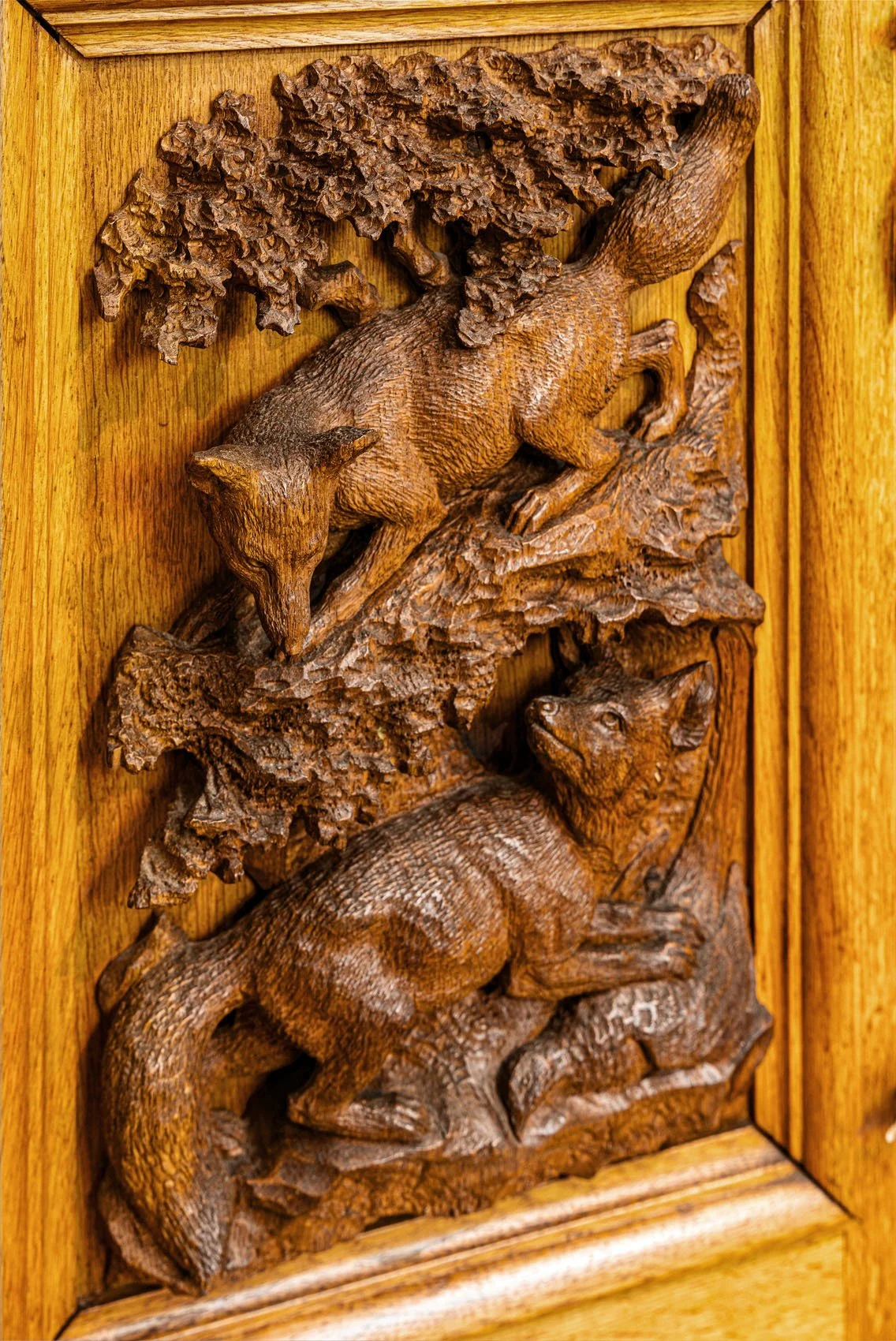 Image 6 of 8
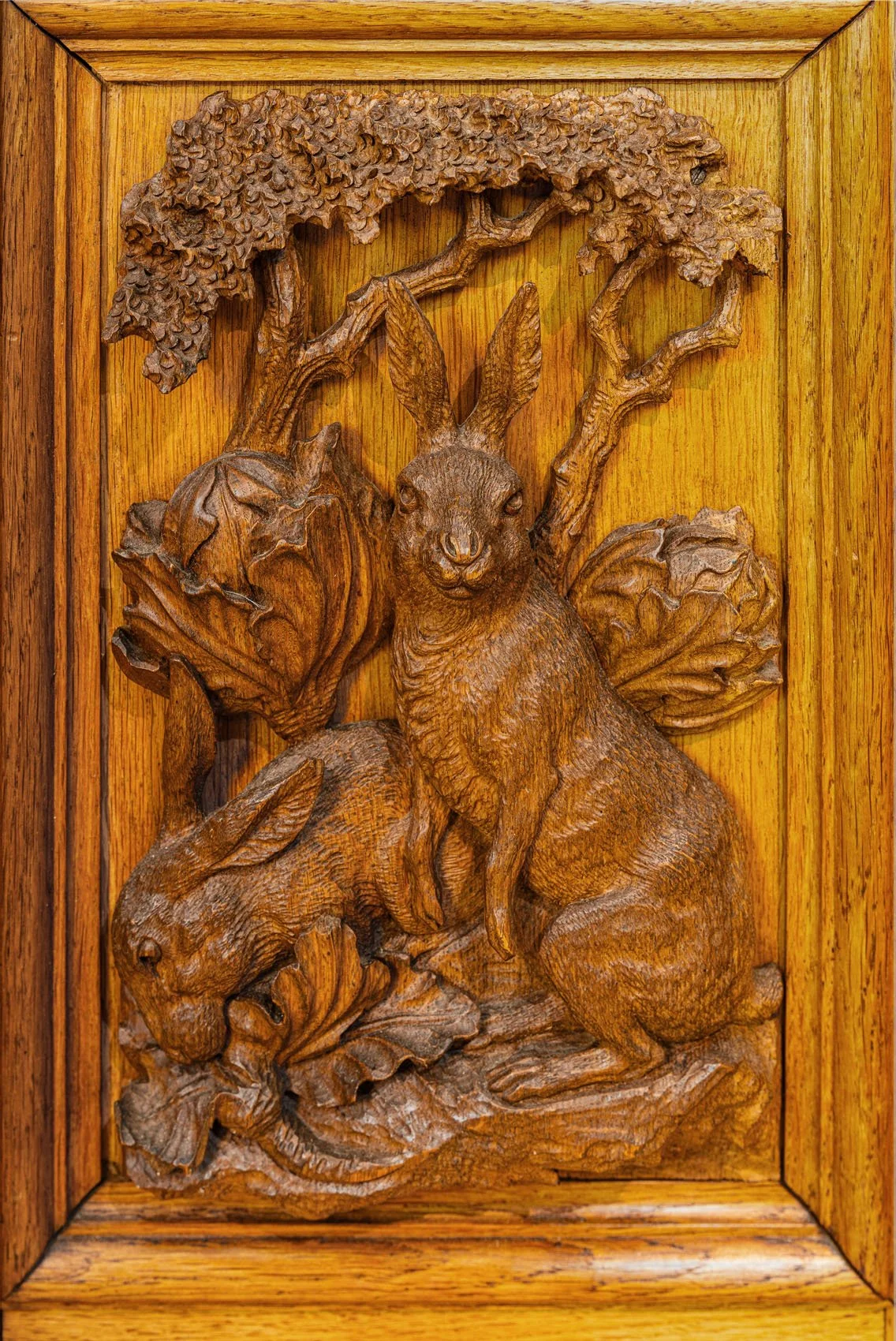 Image 7 of 8
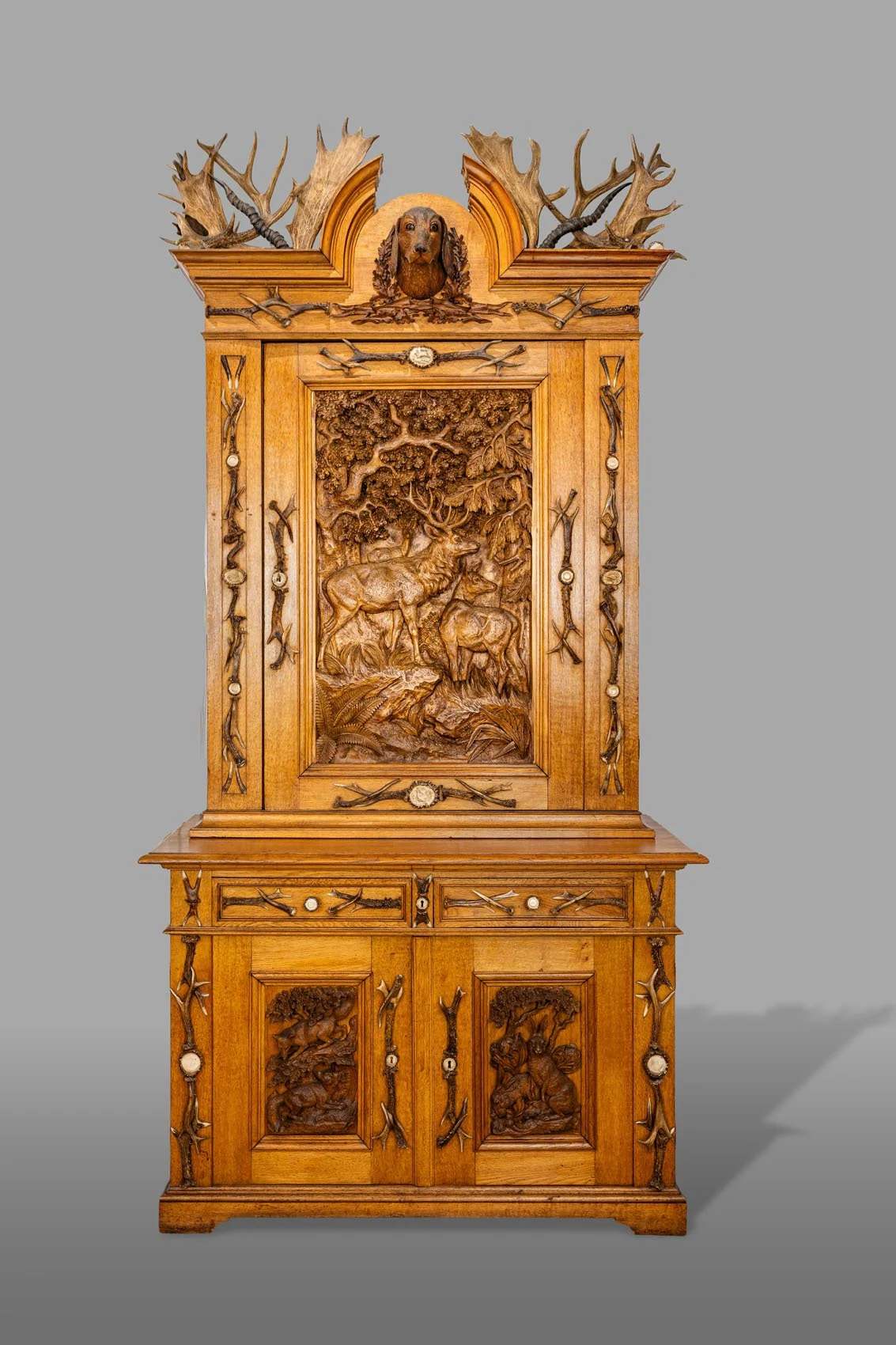 Image 8 of 8