Among the most celebrated productions of the Brienz workshops, the bear bench stands as a supreme test of the carver's art — at once functional and entirely sculptural. This fine linden wood example, circa 1870, meets both demands with distinction.
At either end, a standing bear, carved fully in the round with commanding anatomical authority, rises on its hind legs to receive the seat rail — head thrown back, mouth open, the teeth and red-stained tongue rendered with disconcerting naturalism, the dense fur differentiated to follow the musculature and the coat's directional growth. Between them, the seat is carved to simulate woven cane.
The back is a tour de force of pierced work: deeply undercut, interlaced branches forming a scrolling openwork panel, presided over by a strolling bear in high relief along the crest rail — head lowered, weight forward, utterly self-possessed. The contrast between the energy of his stride and the fluid ornament beneath shows genuine sophistication.
Benches of this quality drew sustained attention at the international exhibitions of the late 19th century, where Swiss carvers demonstrated their technical supremacy to collectors and institutional buyers across Europe and America. Comparable examples are illustrated in Swiss Carvings: The Art of the Black Forest, 1820–1940.
Condition: Excellent, commensurate with age. Linden wood mellowed to a deep, even tone. Glass eyes intact on all three bears. Pierced back and branch-work complete with no losses. Teeth and stained tongues intact on both supporting bears. No restoration noted.
Literature: Jay Arenski, Simon Daniels and Michael Daniels, Swiss Carvings: The Art of the Black Forest, 1820–1940, Antique Collectors' Club, Woodbridge, Suffolk, 2006 — see fig. 225 (p. 140) and fig. 241 (p. 146) for closely comparable examples.
Among the most celebrated productions of the Brienz workshops, the bear bench stands as a supreme test of the carver's art — at once functional and entirely sculptural. This fine linden wood example, circa 1870, meets both demands with distinction.
At either end, a standing bear, carved fully in the round with commanding anatomical authority, rises on its hind legs to receive the seat rail — head thrown back, mouth open, the teeth and red-stained tongue rendered with disconcerting naturalism, the dense fur differentiated to follow the musculature and the coat's directional growth. Between them, the seat is carved to simulate woven cane.
The back is a tour de force of pierced work: deeply undercut, interlaced branches forming a scrolling openwork panel, presided over by a strolling bear in high relief along the crest rail — head lowered, weight forward, utterly self-possessed. The contrast between the energy of his stride and the fluid ornament beneath shows genuine sophistication.
Benches of this quality drew sustained attention at the international exhibitions of the late 19th century, where Swiss carvers demonstrated their technical supremacy to collectors and institutional buyers across Europe and America. Comparable examples are illustrated in Swiss Carvings: The Art of the Black Forest, 1820–1940.
Condition: Excellent, commensurate with age. Linden wood mellowed to a deep, even tone. Glass eyes intact on all three bears. Pierced back and branch-work complete with no losses. Teeth and stained tongues intact on both supporting bears. No restoration noted.
Literature: Jay Arenski, Simon Daniels and Michael Daniels, Swiss Carvings: The Art of the Black Forest, 1820–1940, Antique Collectors' Club, Woodbridge, Suffolk, 2006 — see fig. 225 (p. 140) and fig. 241 (p. 146) for closely comparable examples.

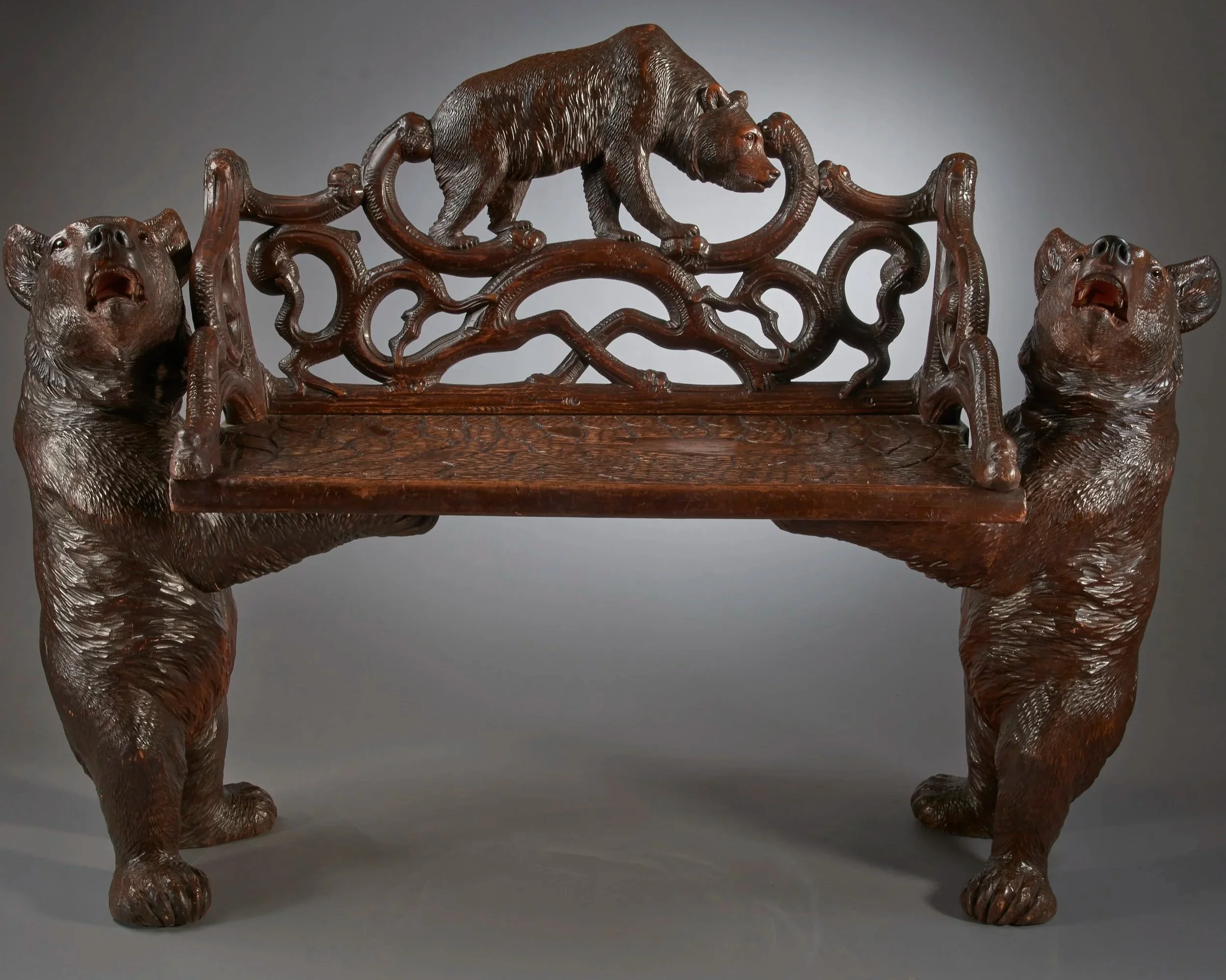 Image 1 of 3
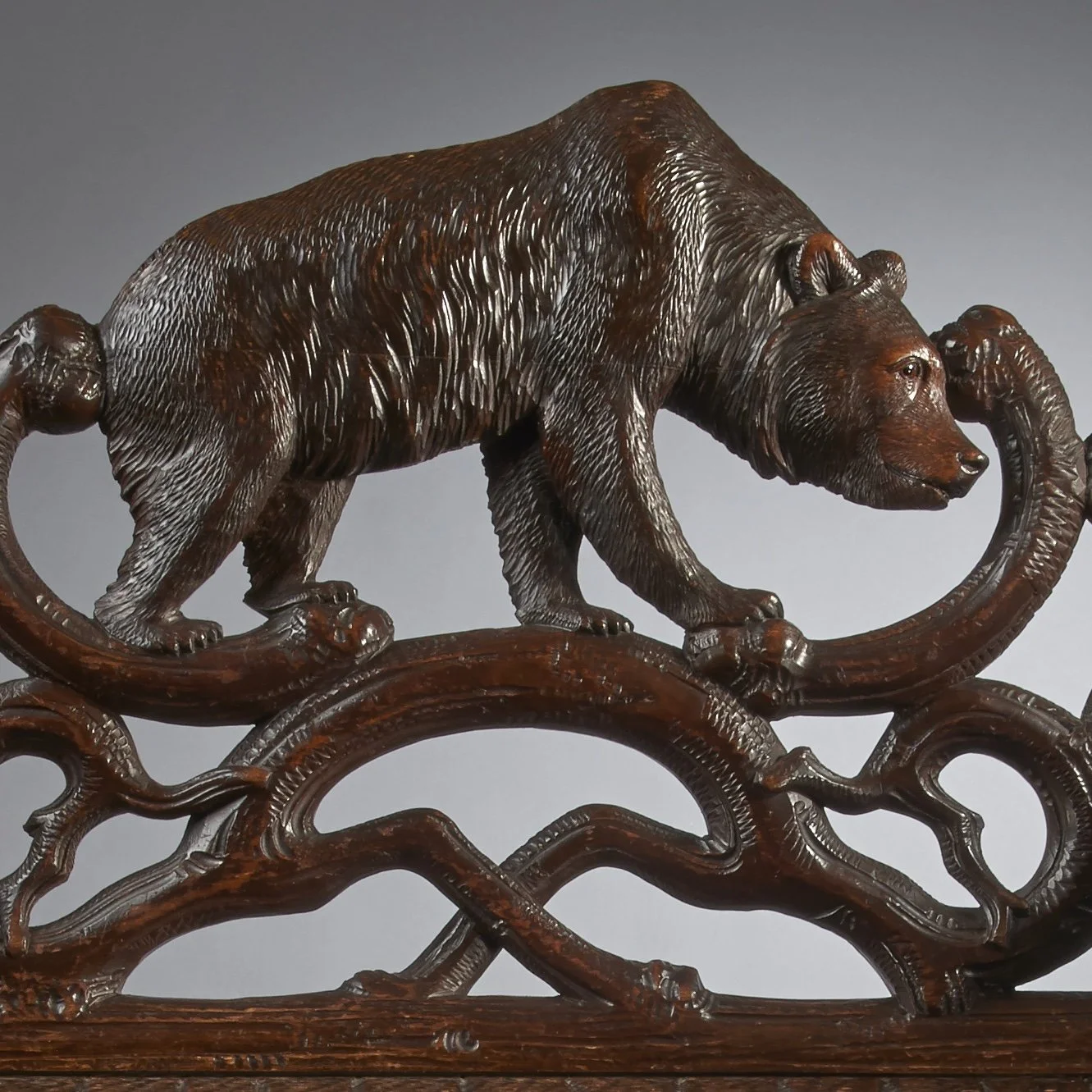 Image 2 of 3
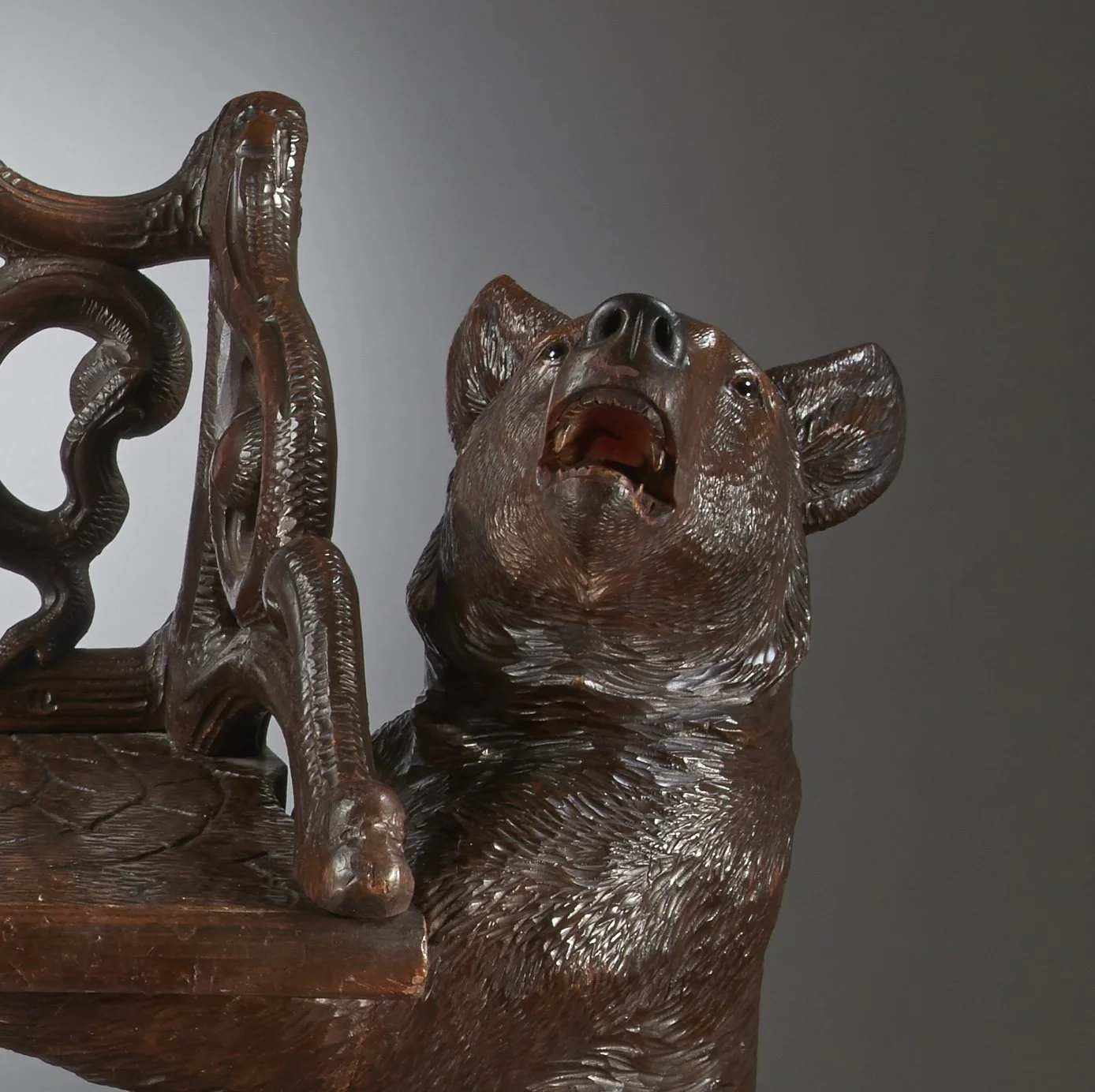 Image 3 of 3