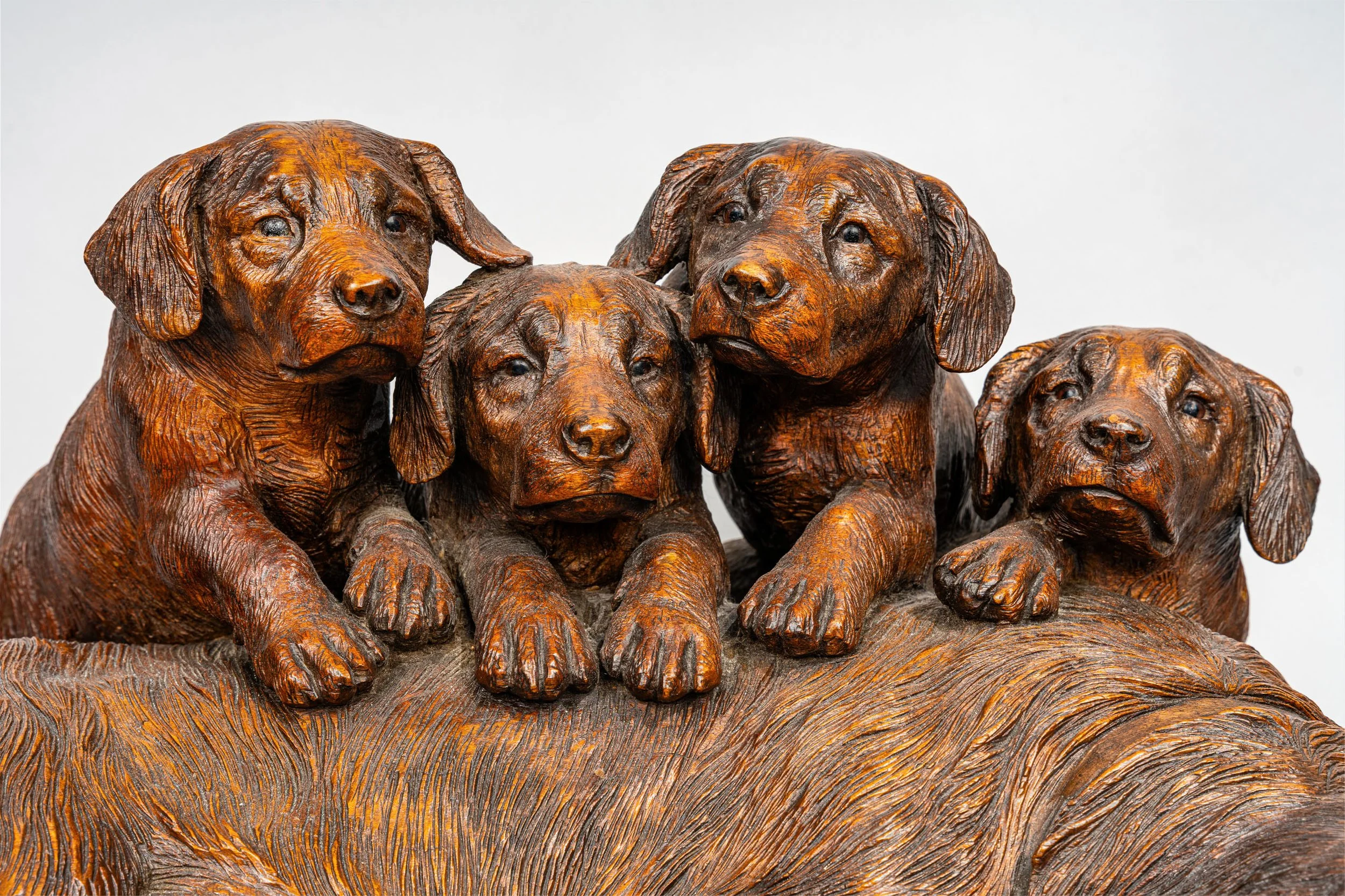
Among the carvers of the Brienz school, Walter Mader occupied a position of particular distinction in the rendering of dogs — a subject that demands from the sculptor not only technical command of fur and anatomy but a quality of psychological observation that separates the merely accomplished from the genuinely great. The dog is not a decorative subject in the way that a bear or an eagle is decorative: it is a subject that invites — indeed requires — a portrait, in the fullest sense of that word. The finest dog carvings by Mader are recognised immediately by specialists for precisely this quality: the sense that one is looking at a specific animal, observed with care and rendered with affection, rather than a generalised type.
The present umbrella stand is among the most accomplished examples of Mader's work in this subject. The dog — a large, long-coated gundog of the setter or retriever type, depicted seated and alert — is carved in mountain maple, a material whose fine, close grain permits a precision of surface detail that linden wood cannot match, and whose warm, honey-brown tone provides the ideal ground for the polychrome surface treatment that distinguishes Mader's finest animal work. The face is handled with exceptional sensitivity: the grey of the muzzle, rendered in polychrome surface work, contrasts with the warm auburn of the coat; the nose is black and precisely modeled; the glass eyes — dark, deep, and direct — give the face a quality of attentive presence that is, quite simply, without parallel in the Black Forest dog carving tradition.
The dog is leashed to a naturalistically carved tree stump, the chain — original iron, hanging freely from the carved collar — a detail of extraordinary survival that connects the sculptural figure to the working world from which it comes. The collar itself is carved with the precision of a craftsman who has studied the object it represents. The chain, individually linked and fully functional in its movement, speaks to the same standard of observation and execution that characterises every other detail of this piece.
The tree stump, which forms both the compositional anchor and the functional element of the stand, is handled with the bold, confident naturalism of the best Brienz workshop production — the bark texture, root formations, and branch stubs rendered with the same attention to surface as the dog itself. Integrated within the stump base is the original umbrella receptacle, its circular metal liner present and intact. The whole stands on an oval naturalistic base carved with pebbles, roots, and forest-floor detail of considerable delicacy.
As illustrated in Swiss Carvings: The Art of the Black Forest, 1820–1940 by Jay Arenski, Simon Daniels, and Michael Daniels (p. 114), closely related examples by Mader confirm both the rarity and the desirability of sculptural umbrella stands of this quality — objects produced for the most demanding clientele of the period and recognised today as among the finest functional sculptures the Swiss tradition produced.
Carver: Walter Mader, Brienz, Switzerland Material: Mountain maple with polychrome surface detail Eyes: Glass Chain & Collar: Original iron, present and intact Umbrella Receptacle: Original metal liner, present Circa: 1870
Condition: Very good overall. Mountain maple structurally sound throughout — no cracks or losses. Dog figure fully intact with polychrome surface treatment present — grey muzzle, warm coat tones, and black nose all well-preserved. Glass eyes present and secure in both sockets. Fur carving crisp and fully intact across all surfaces. Original iron collar and chain present and intact — chain hanging freely. Tree stump structurally sound with bark and root detail crisp throughout. Umbrella receptacle with original metal liner present. Oval naturalistic base intact. Rich, deep patina consistent with age.
42”height
Literature:
Jay Arenski, Simon Daniels, and Michael Daniels, Swiss Carvings: The Art of the Black Forest, 1820–1940, 2006, p. 114
Among the carvers of the Brienz school, Walter Mader occupied a position of particular distinction in the rendering of dogs — a subject that demands from the sculptor not only technical command of fur and anatomy but a quality of psychological observation that separates the merely accomplished from the genuinely great. The dog is not a decorative subject in the way that a bear or an eagle is decorative: it is a subject that invites — indeed requires — a portrait, in the fullest sense of that word. The finest dog carvings by Mader are recognised immediately by specialists for precisely this quality: the sense that one is looking at a specific animal, observed with care and rendered with affection, rather than a generalised type.
The present umbrella stand is among the most accomplished examples of Mader's work in this subject. The dog — a large, long-coated gundog of the setter or retriever type, depicted seated and alert — is carved in mountain maple, a material whose fine, close grain permits a precision of surface detail that linden wood cannot match, and whose warm, honey-brown tone provides the ideal ground for the polychrome surface treatment that distinguishes Mader's finest animal work. The face is handled with exceptional sensitivity: the grey of the muzzle, rendered in polychrome surface work, contrasts with the warm auburn of the coat; the nose is black and precisely modeled; the glass eyes — dark, deep, and direct — give the face a quality of attentive presence that is, quite simply, without parallel in the Black Forest dog carving tradition.
The dog is leashed to a naturalistically carved tree stump, the chain — original iron, hanging freely from the carved collar — a detail of extraordinary survival that connects the sculptural figure to the working world from which it comes. The collar itself is carved with the precision of a craftsman who has studied the object it represents. The chain, individually linked and fully functional in its movement, speaks to the same standard of observation and execution that characterises every other detail of this piece.
The tree stump, which forms both the compositional anchor and the functional element of the stand, is handled with the bold, confident naturalism of the best Brienz workshop production — the bark texture, root formations, and branch stubs rendered with the same attention to surface as the dog itself. Integrated within the stump base is the original umbrella receptacle, its circular metal liner present and intact. The whole stands on an oval naturalistic base carved with pebbles, roots, and forest-floor detail of considerable delicacy.
As illustrated in Swiss Carvings: The Art of the Black Forest, 1820–1940 by Jay Arenski, Simon Daniels, and Michael Daniels (p. 114), closely related examples by Mader confirm both the rarity and the desirability of sculptural umbrella stands of this quality — objects produced for the most demanding clientele of the period and recognised today as among the finest functional sculptures the Swiss tradition produced.
Carver: Walter Mader, Brienz, Switzerland Material: Mountain maple with polychrome surface detail Eyes: Glass Chain & Collar: Original iron, present and intact Umbrella Receptacle: Original metal liner, present Circa: 1870
Condition: Very good overall. Mountain maple structurally sound throughout — no cracks or losses. Dog figure fully intact with polychrome surface treatment present — grey muzzle, warm coat tones, and black nose all well-preserved. Glass eyes present and secure in both sockets. Fur carving crisp and fully intact across all surfaces. Original iron collar and chain present and intact — chain hanging freely. Tree stump structurally sound with bark and root detail crisp throughout. Umbrella receptacle with original metal liner present. Oval naturalistic base intact. Rich, deep patina consistent with age.
42”height
Literature:
Jay Arenski, Simon Daniels, and Michael Daniels, Swiss Carvings: The Art of the Black Forest, 1820–1940, 2006, p. 114

 Image 1 of 5
 Image 2 of 5
 Image 3 of 5
 Image 4 of 5
 Image 5 of 5