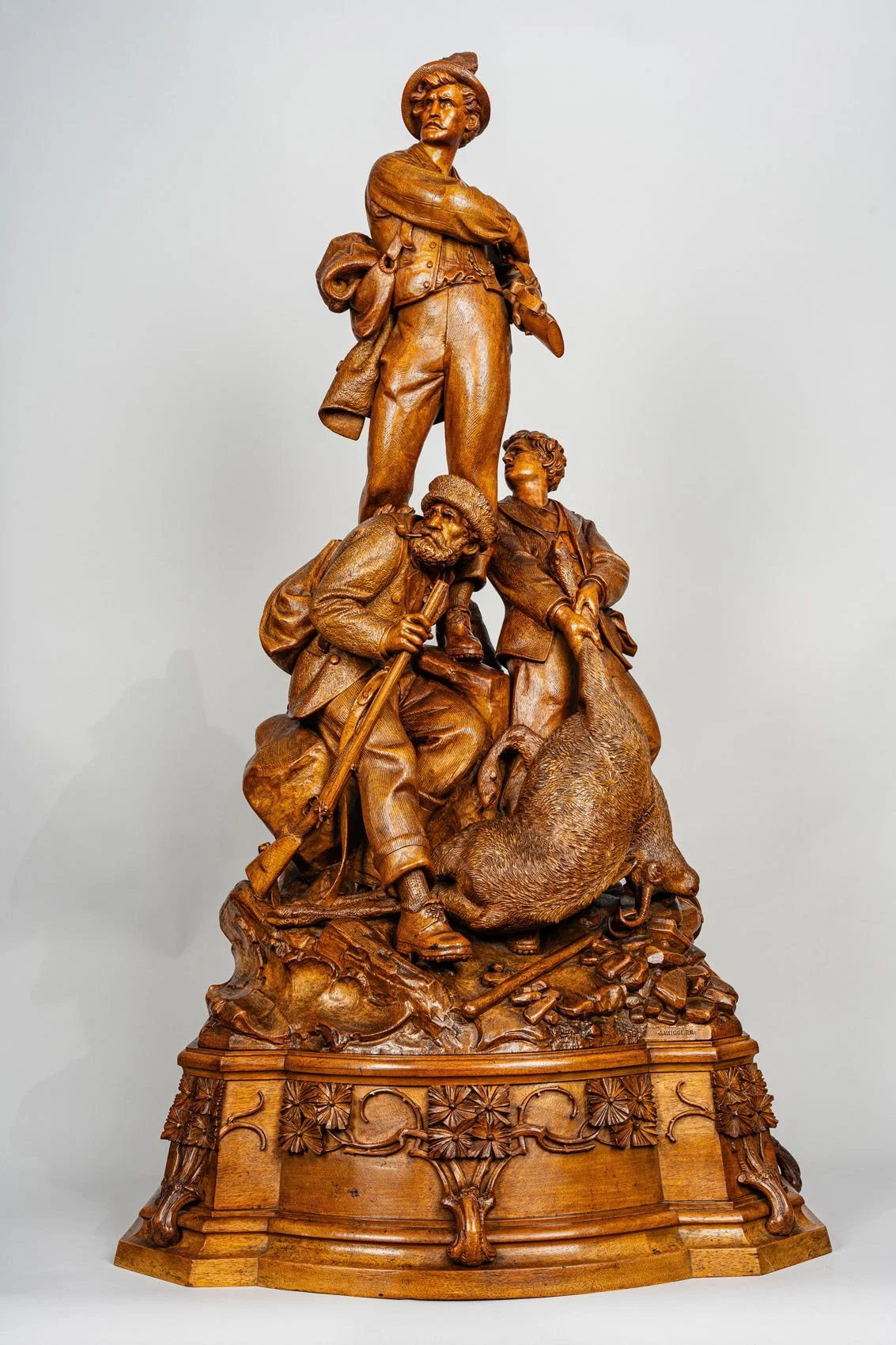
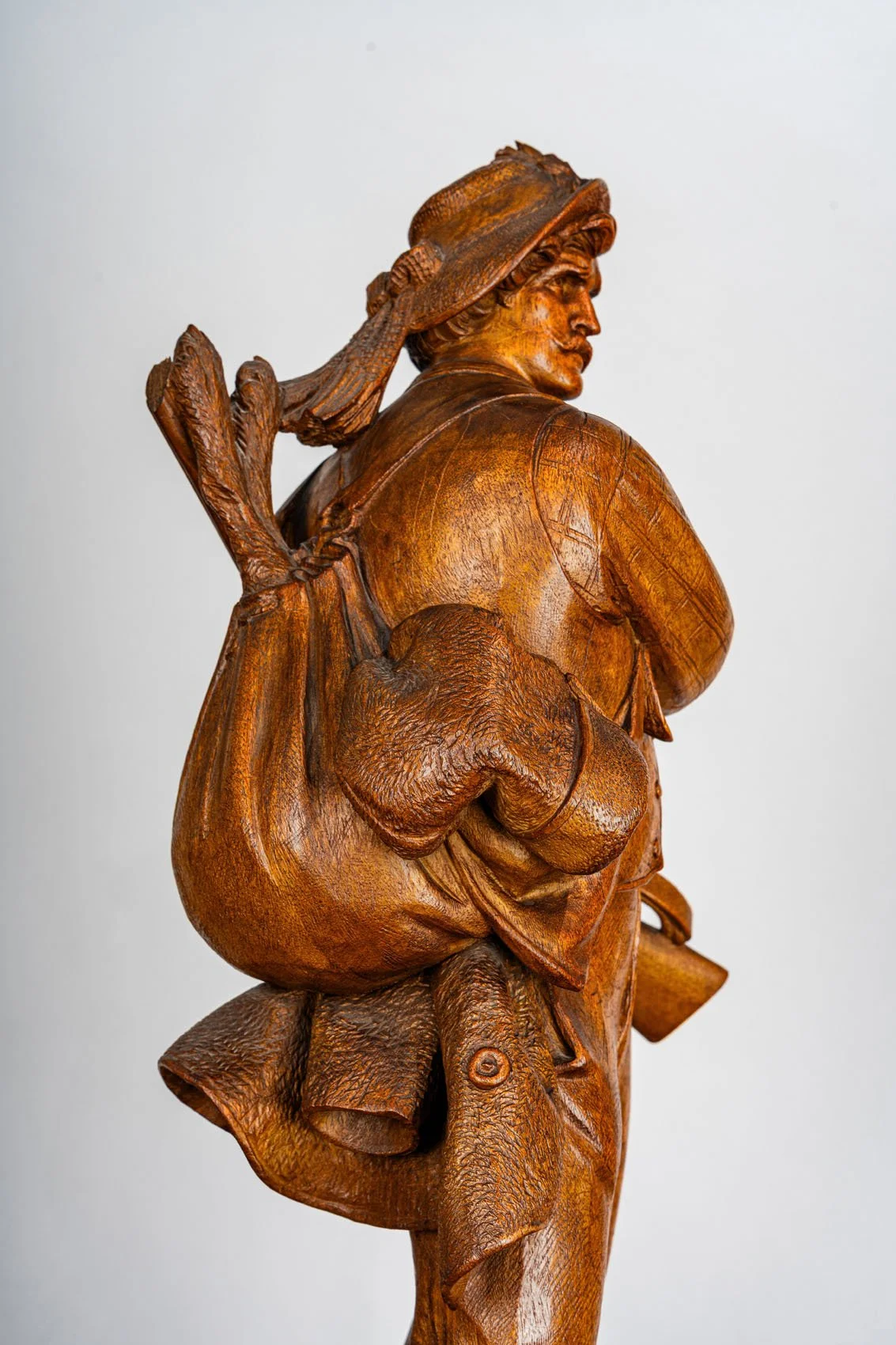
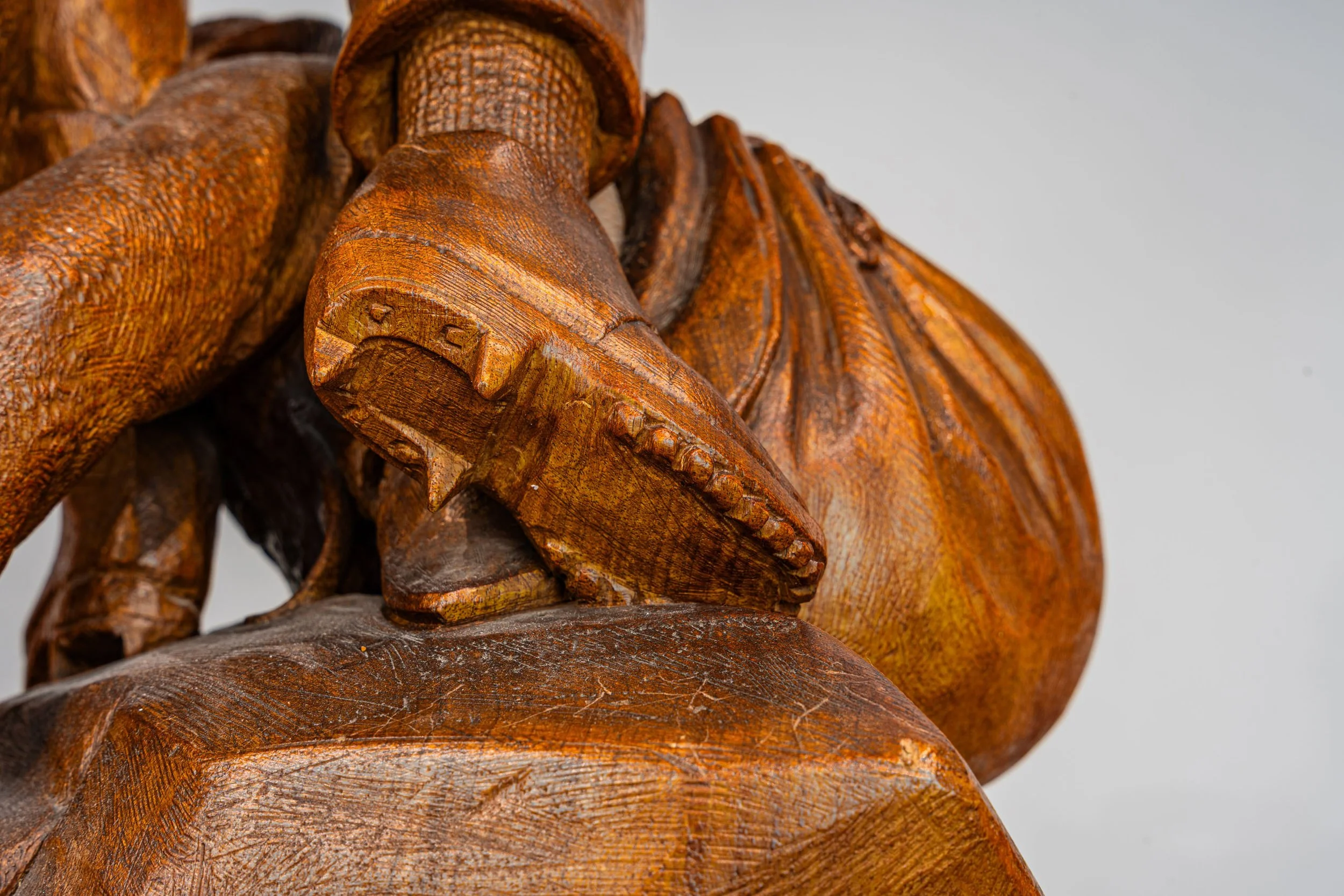
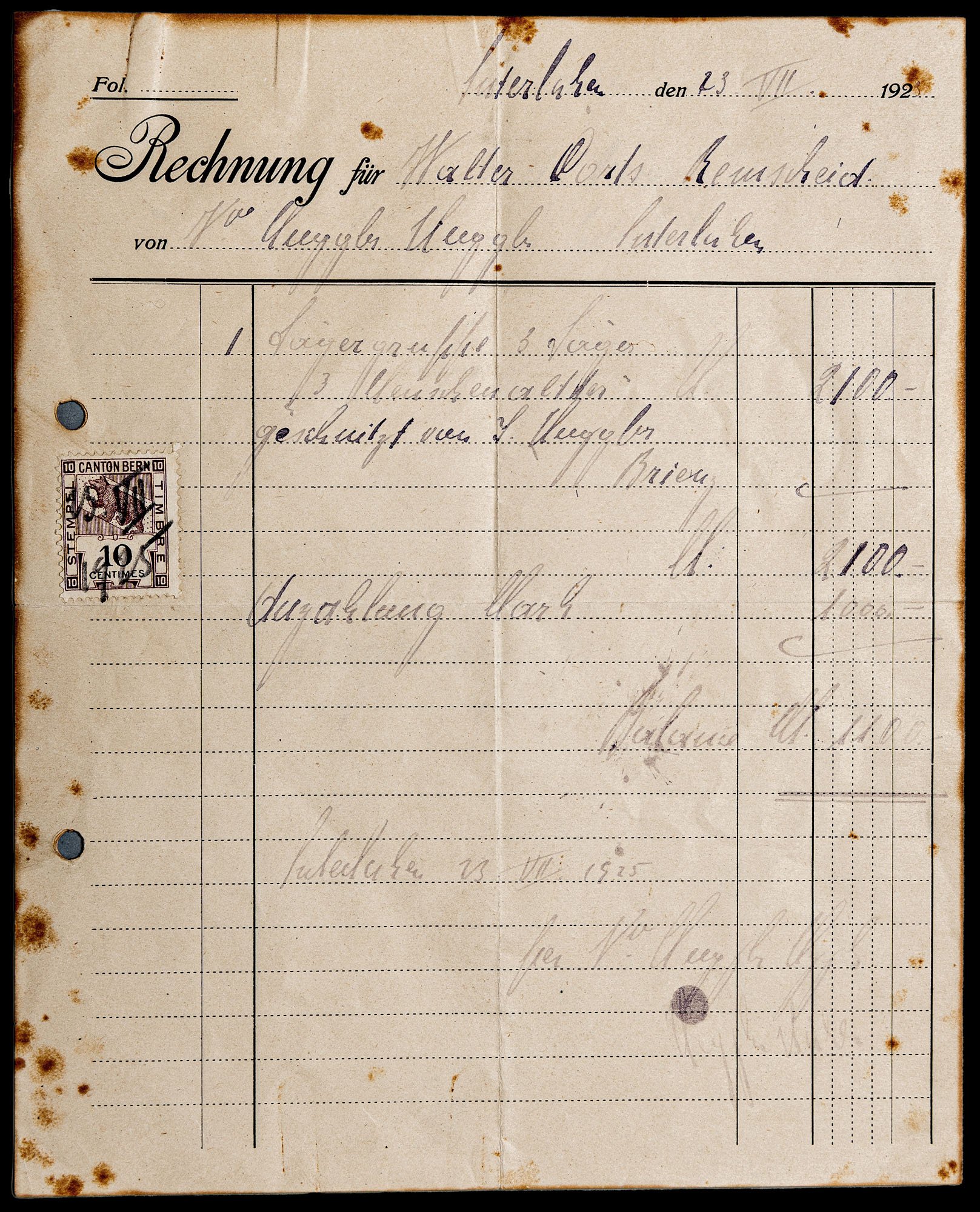
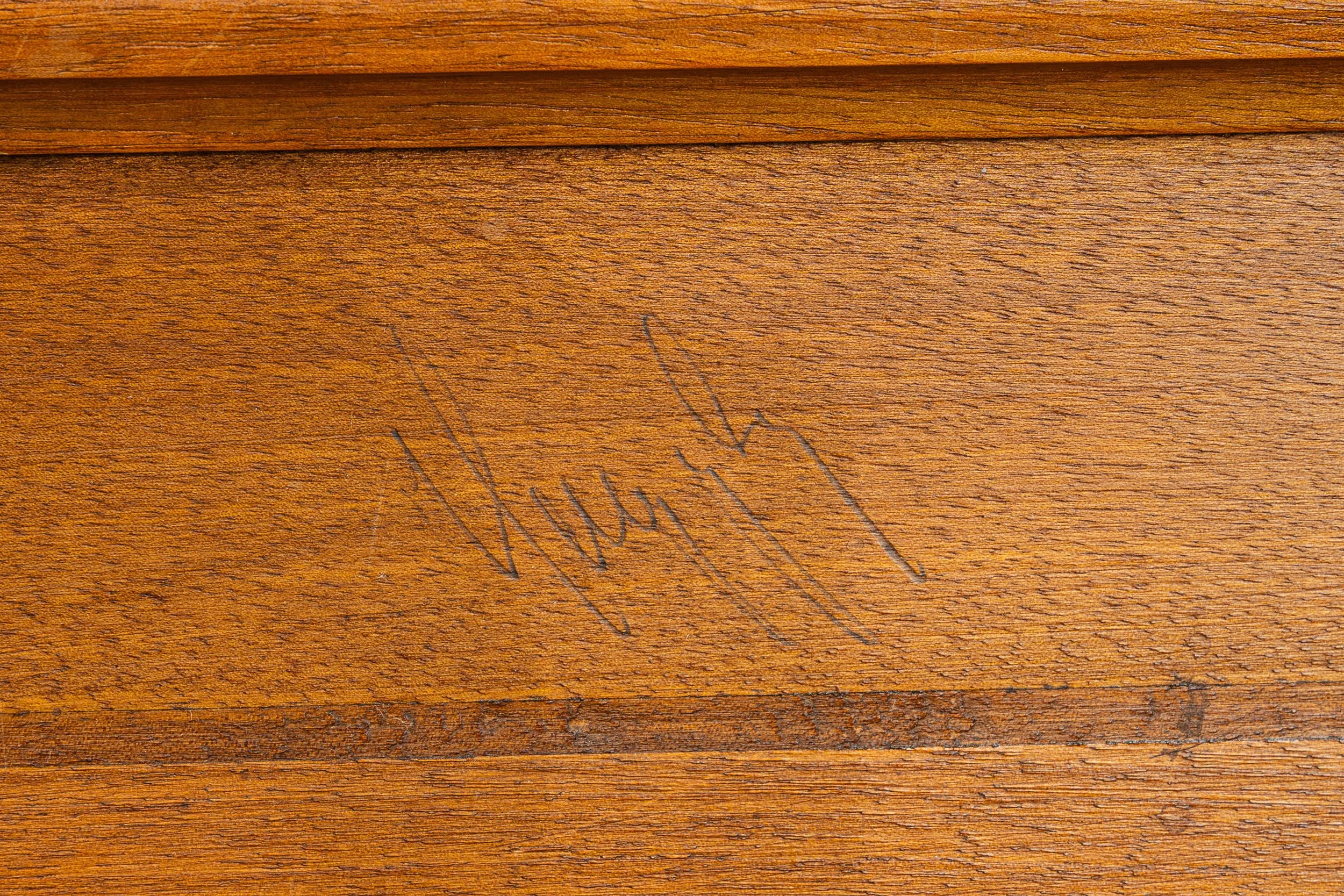
A fine and rare sculptural group by Walter Mader of Brienz, depicting a recumbent hound with four puppies clambering across her back, carved in mountain maple with the refined naturalism that defines his finest work.
The mother lies at rest, her weight settled fully into the ground, forelegs extended, head lowered with the patient, weary calm of an animal that has given everything. Her coat is rendered in long, flowing tool strokes that follow the natural lie of the fur, a braided rope lead is carved at her neck with the same attention given to the figures themselves, and her teats are visible along the underside — the carver recording the full physical truth of a nursing mother without sentiment or evasion.
Across her back the four puppies tumble in an overlapping group, no two faces alike: one gazes forward with open curiosity, another tilts its head in mild bewilderment, a third presses close beside its sibling, a fourth peers sideways in drowsy contentment. The soft, rounded faces with the slightly oversized features of young animals, the paws draped over the mother's back, the ears falling at different angles — all speak to sustained, affectionate observation rather than formula.
Mader stands among the foremost figures of the Brienz school in its golden period, and his dog groups are regarded as among the most accomplished expressions of the tradition, combining deeply undercut multi-figure composition with a sensitivity to animal character few carvers matched. Work of this rank was shown at the great international exhibitions in London, Paris and the United States, where the carvers of the Bernese Oberland won their international audience.
Condition: Very good; rich original patina, carving complete and crisp across all figures including the lead and base, minor wear consistent with age, no significant losses or restorations noted.
Dimensions: 30 in. length x 18 in. depth x 11 in. height
Literature: Jay Arenski, Simon Daniels, and Michael Daniels, Swiss Carvings: The Art of the Black Forest, 1820–1940 (2006).
A fine and rare sculptural group by Walter Mader of Brienz, depicting a recumbent hound with four puppies clambering across her back, carved in mountain maple with the refined naturalism that defines his finest work.
The mother lies at rest, her weight settled fully into the ground, forelegs extended, head lowered with the patient, weary calm of an animal that has given everything. Her coat is rendered in long, flowing tool strokes that follow the natural lie of the fur, a braided rope lead is carved at her neck with the same attention given to the figures themselves, and her teats are visible along the underside — the carver recording the full physical truth of a nursing mother without sentiment or evasion.
Across her back the four puppies tumble in an overlapping group, no two faces alike: one gazes forward with open curiosity, another tilts its head in mild bewilderment, a third presses close beside its sibling, a fourth peers sideways in drowsy contentment. The soft, rounded faces with the slightly oversized features of young animals, the paws draped over the mother's back, the ears falling at different angles — all speak to sustained, affectionate observation rather than formula.
Mader stands among the foremost figures of the Brienz school in its golden period, and his dog groups are regarded as among the most accomplished expressions of the tradition, combining deeply undercut multi-figure composition with a sensitivity to animal character few carvers matched. Work of this rank was shown at the great international exhibitions in London, Paris and the United States, where the carvers of the Bernese Oberland won their international audience.
Condition: Very good; rich original patina, carving complete and crisp across all figures including the lead and base, minor wear consistent with age, no significant losses or restorations noted.
Dimensions: 30 in. length x 18 in. depth x 11 in. height
Literature: Jay Arenski, Simon Daniels, and Michael Daniels, Swiss Carvings: The Art of the Black Forest, 1820–1940 (2006).

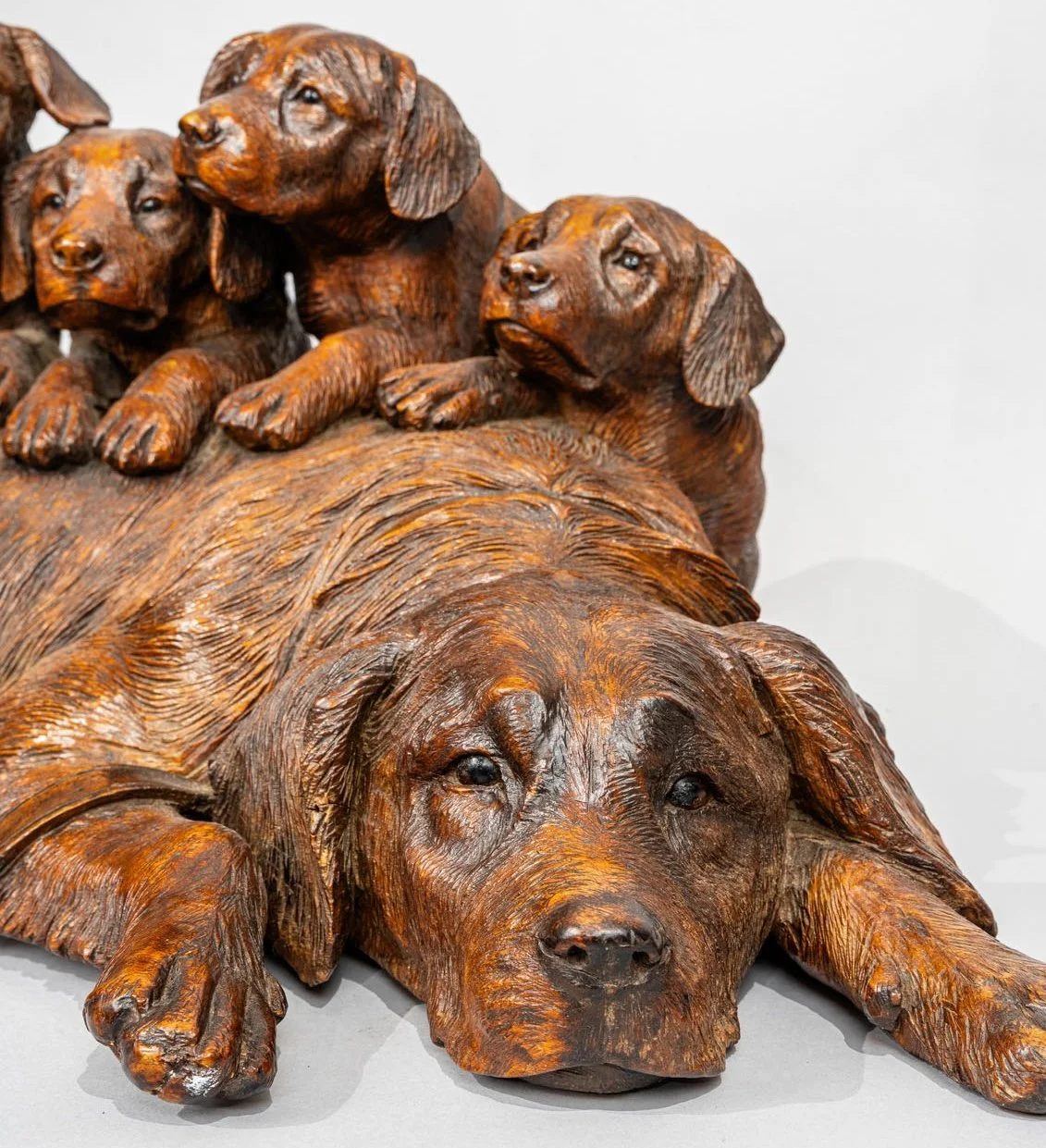 Image 1 of 4
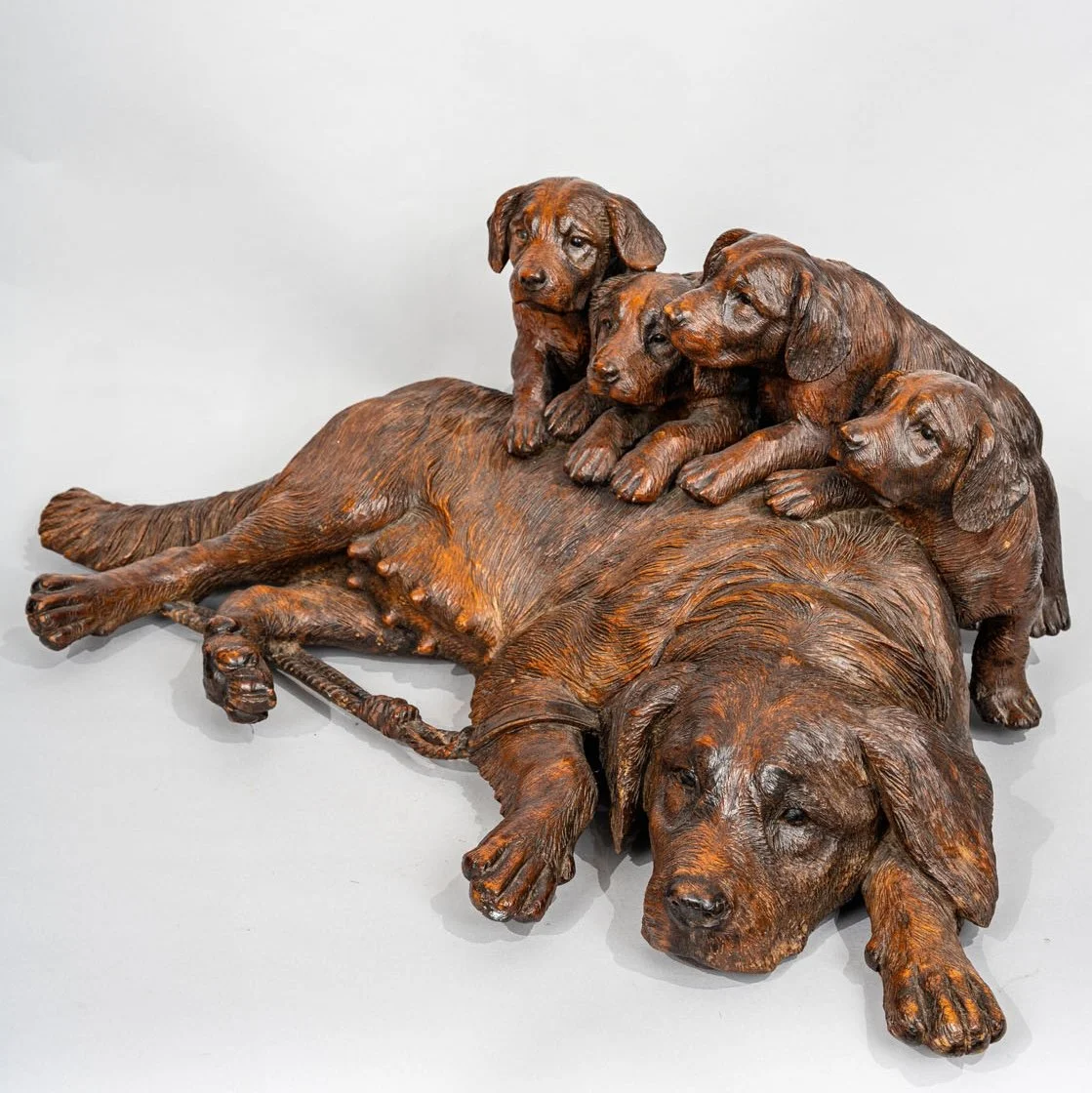 Image 2 of 4
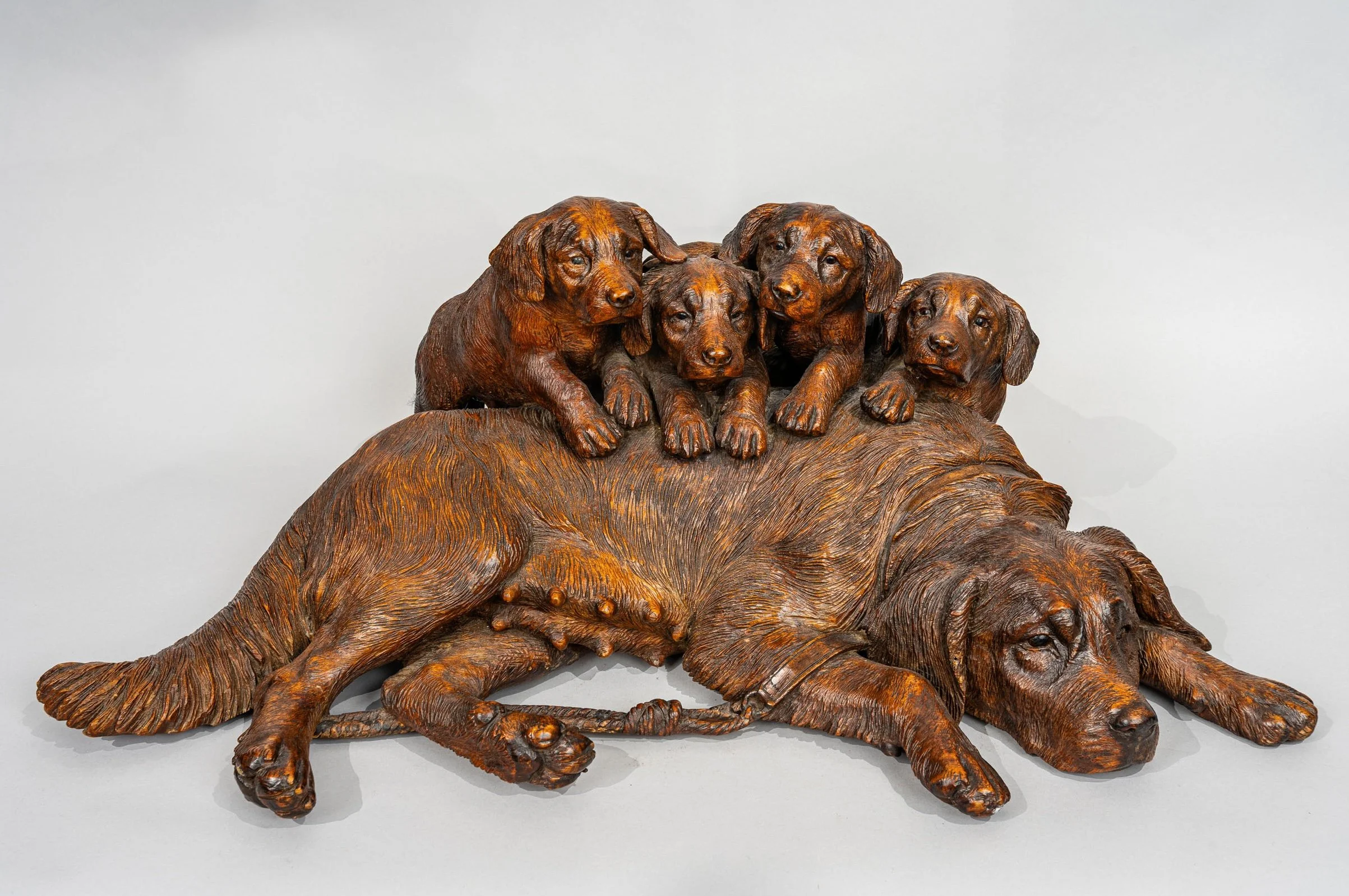 Image 3 of 4
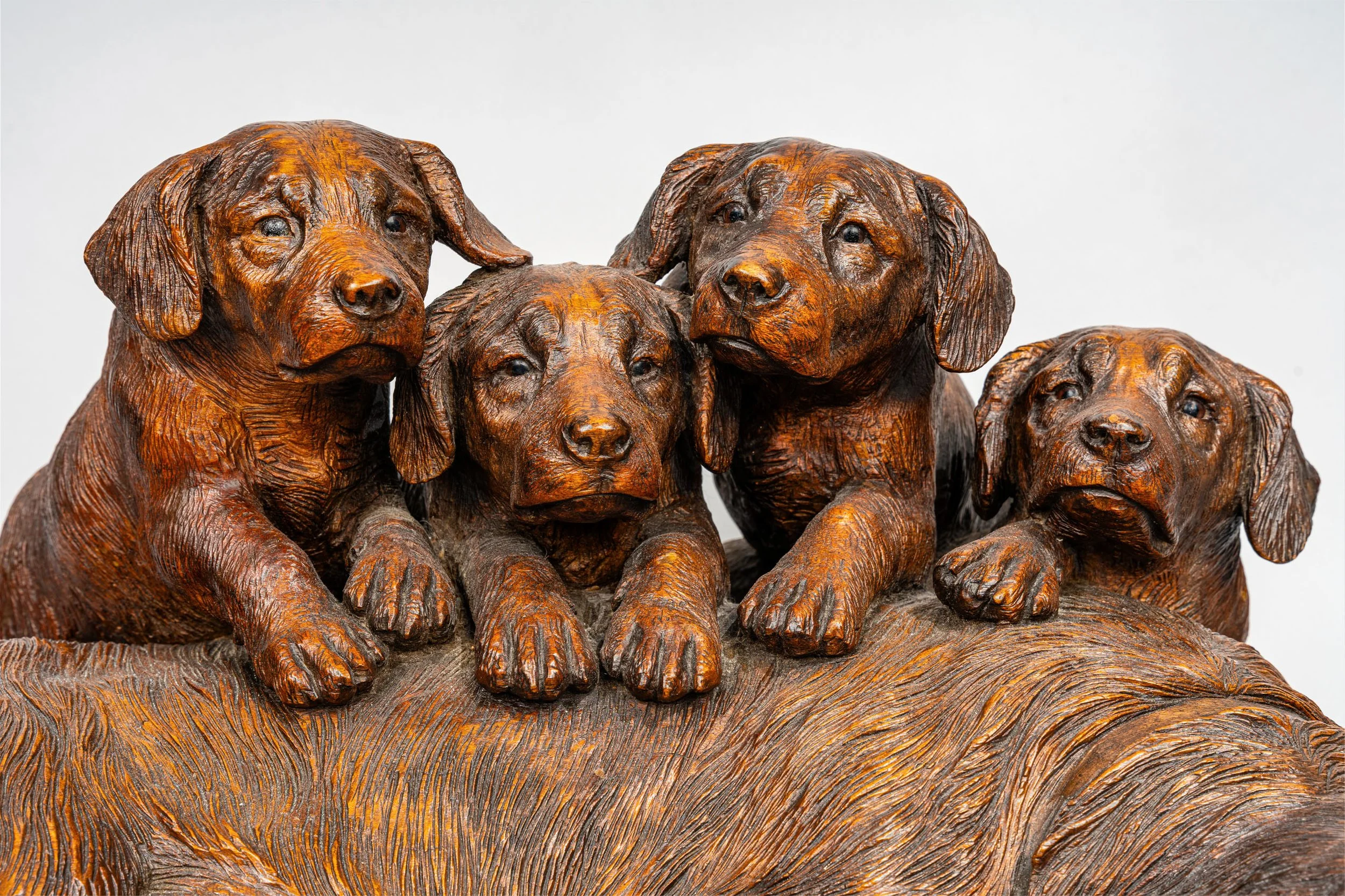 Image 4 of 4