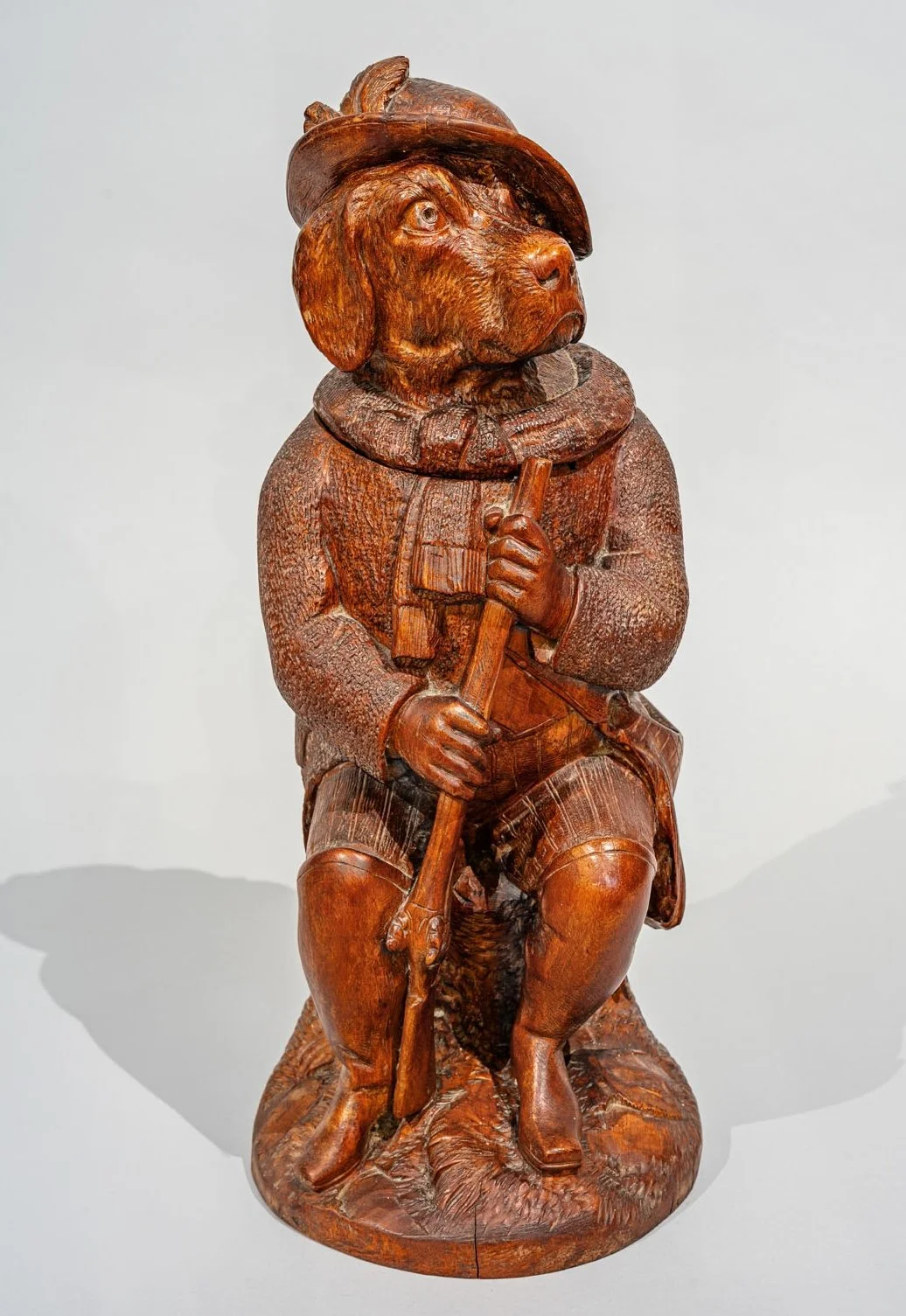
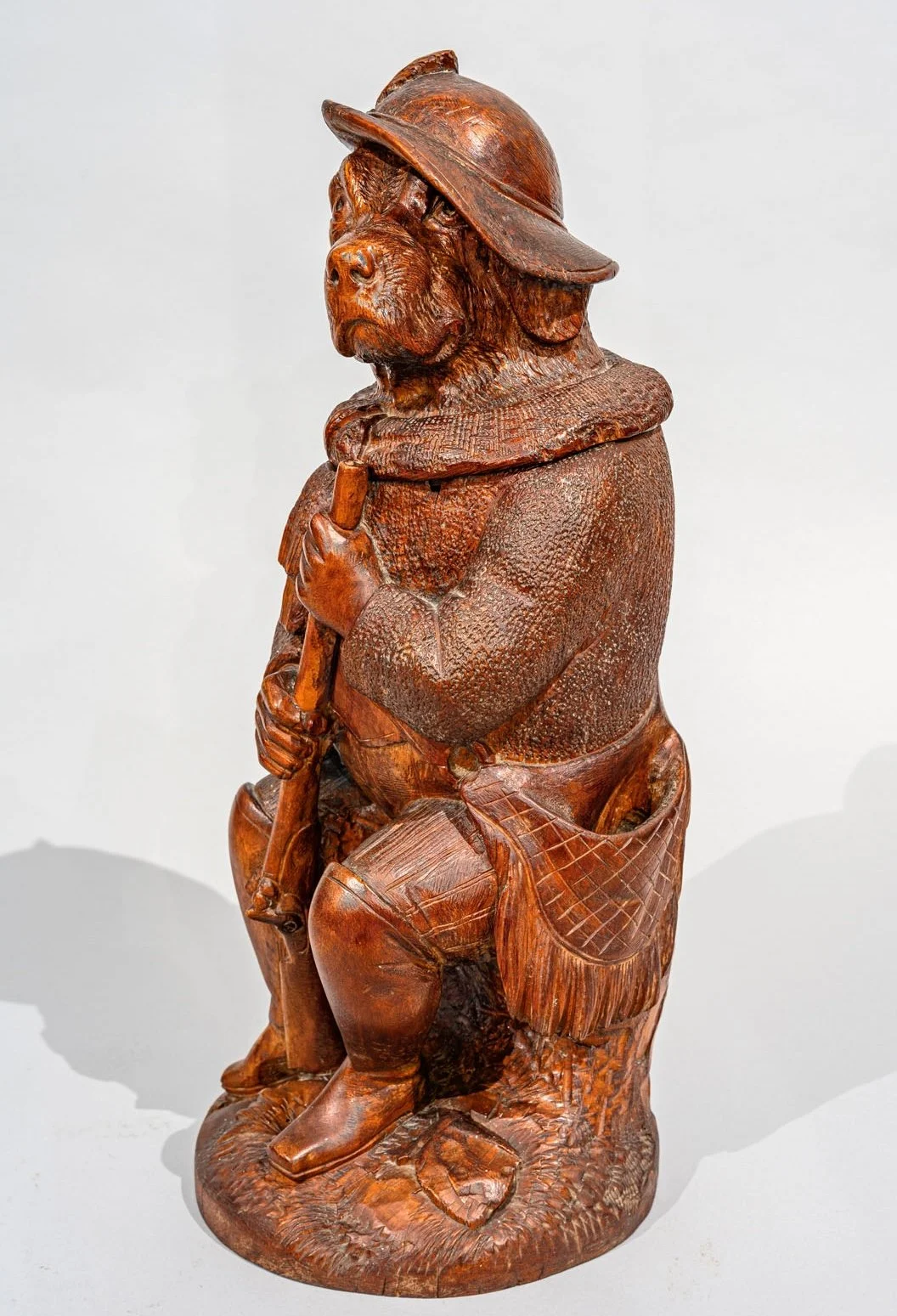
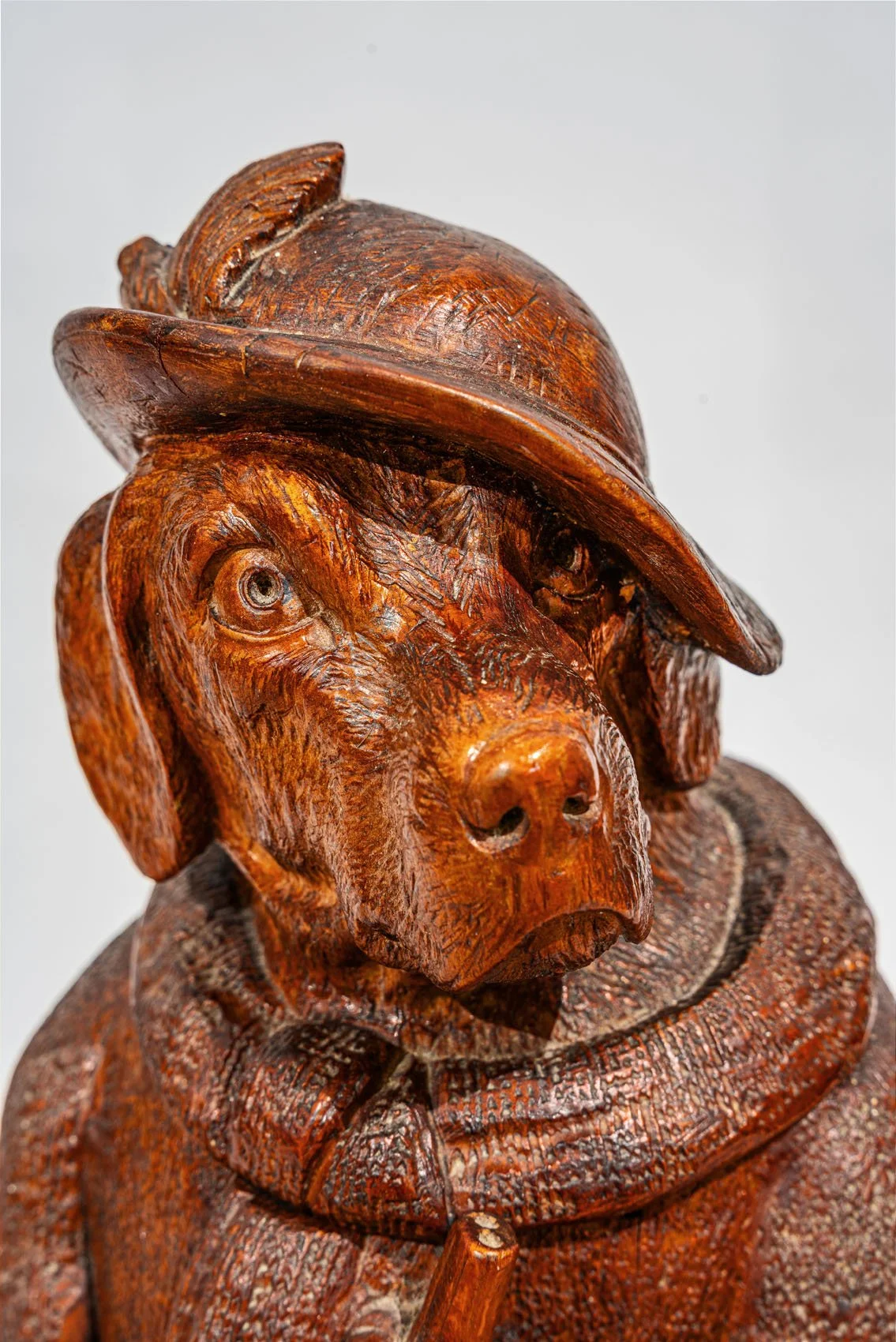
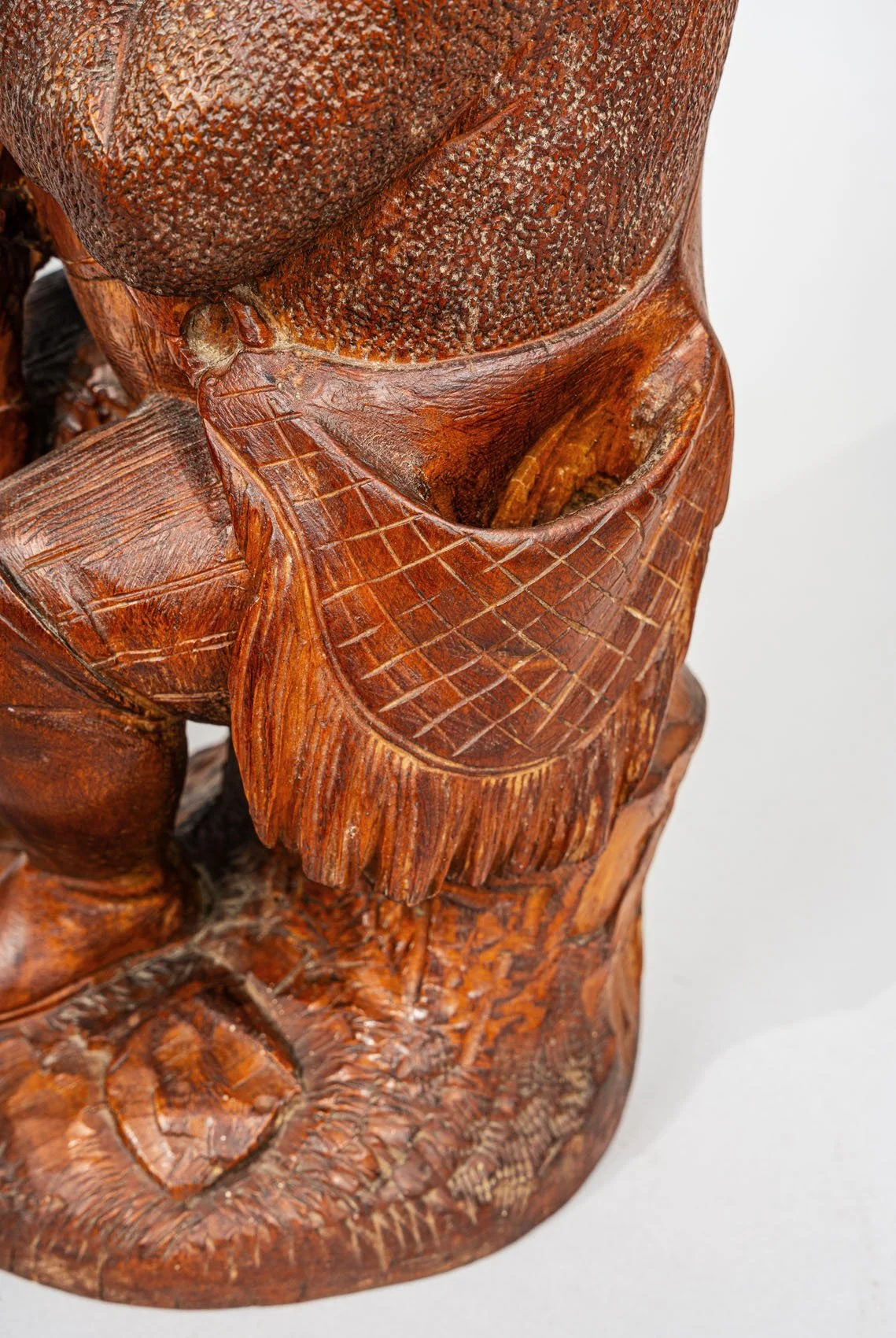
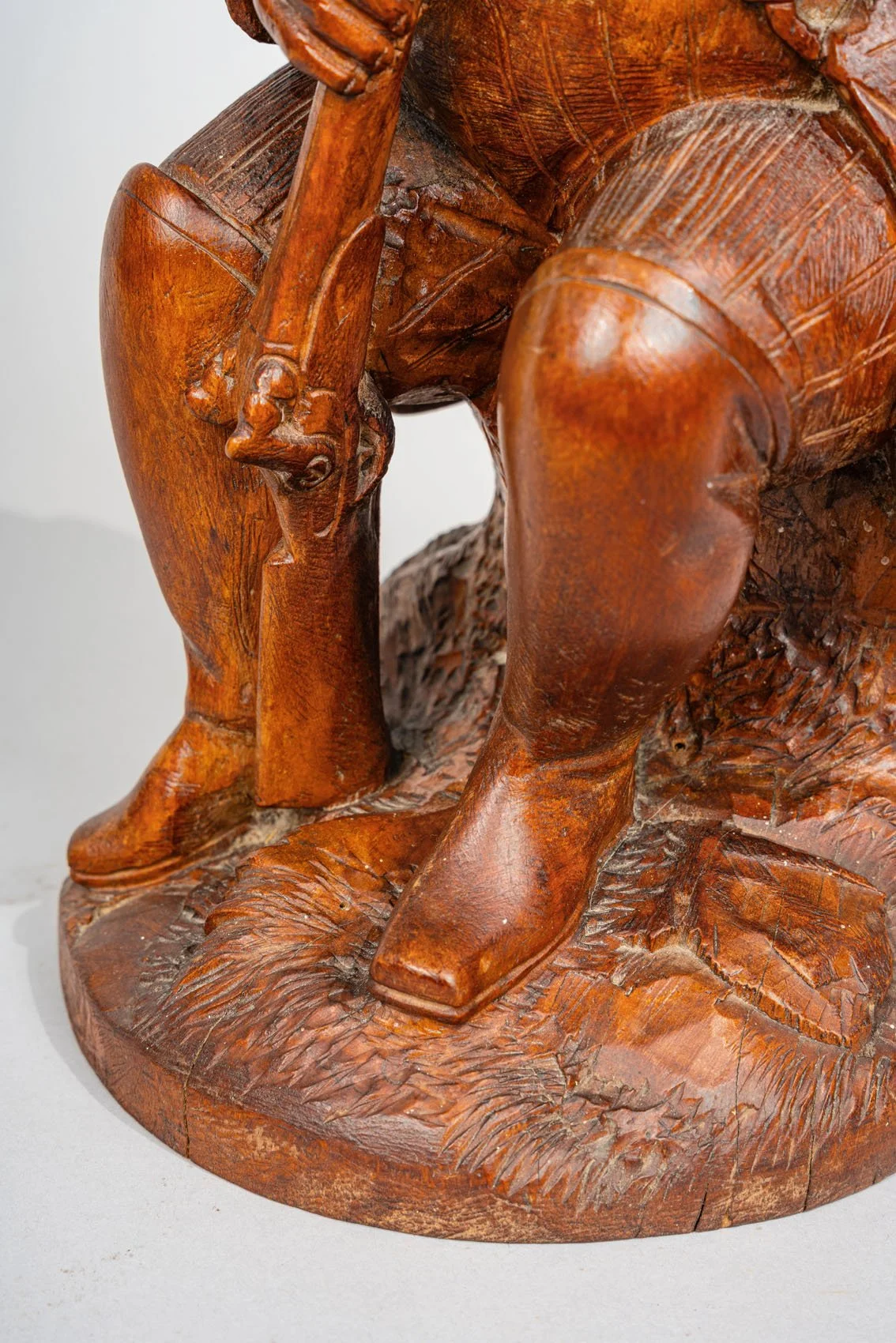
A rare and entirely captivating example of Black Forest carving at its most inventive: an anthropomorphic fox dressed as a hunter, standing upright as a figural tobacco jar, the head forming a hinged lid, carved in walnut at Brienz and dated 1870.
The fox stands on a circular naturalistic base in a short hunter's cape, a hunting horn at his side, the accessories of the chase rendered in miniature with the same precision as the figure itself. The posture is composed and self-possessed, the weight carried with the easy authority of a carver who understood both animals and human movement. The fur is worked in dense, directional tool marks that convey texture and underlying volume, the garments differentiated through smoother, more restrained modeling — the contrast between cloth and fur handled with the subtlety that marks the best Brienz work. The face is sharply individualized: alert, watchful, carrying the knowing character the fox owes to the medieval cycle of Reynard, whose cunning protagonist gave nineteenth-century collectors the imaginative context for figures like this one, produced at Brienz for both the domestic market and for export to Britain and America, where the hunting culture that animates the piece was equally well understood.
The head opens on a hinge at the collar to reveal the tobacco compartment, the join disguised in the modeled fur of the cape collar so that, closed, the figure reads as a seamless sculptural whole; the hinge is original and fully functional, a detail that speaks to the construction as much as the carving. The walnut retains a warm patina developed over a century and a half. Dated 1870, the piece comes from the height of the Brienz industry's reputation, when the workshops of Huggler, Binder and their contemporaries were exhibiting at the great world's fairs.
A companion piece, an anthropomorphic hound-hunter tobacco jar also dated 1870, is available separately; the two share the subject, date, and evident workshop origin.
Condition: Very good; rich original patina, carving complete and crisp, hinged head lid fully functional, eyes original, all elements original, interior in original unlined state, minor wear consistent with age, no restorations noted.
Height: 16 in.
Literature: Jay Arenski, Simon Daniels, and Michael Daniels, Swiss Carvings: The Art of the Black Forest, 1820–1940 (2006).
A rare and entirely captivating example of Black Forest carving at its most inventive: an anthropomorphic fox dressed as a hunter, standing upright as a figural tobacco jar, the head forming a hinged lid, carved in walnut at Brienz and dated 1870.
The fox stands on a circular naturalistic base in a short hunter's cape, a hunting horn at his side, the accessories of the chase rendered in miniature with the same precision as the figure itself. The posture is composed and self-possessed, the weight carried with the easy authority of a carver who understood both animals and human movement. The fur is worked in dense, directional tool marks that convey texture and underlying volume, the garments differentiated through smoother, more restrained modeling — the contrast between cloth and fur handled with the subtlety that marks the best Brienz work. The face is sharply individualized: alert, watchful, carrying the knowing character the fox owes to the medieval cycle of Reynard, whose cunning protagonist gave nineteenth-century collectors the imaginative context for figures like this one, produced at Brienz for both the domestic market and for export to Britain and America, where the hunting culture that animates the piece was equally well understood.
The head opens on a hinge at the collar to reveal the tobacco compartment, the join disguised in the modeled fur of the cape collar so that, closed, the figure reads as a seamless sculptural whole; the hinge is original and fully functional, a detail that speaks to the construction as much as the carving. The walnut retains a warm patina developed over a century and a half. Dated 1870, the piece comes from the height of the Brienz industry's reputation, when the workshops of Huggler, Binder and their contemporaries were exhibiting at the great world's fairs.
A companion piece, an anthropomorphic hound-hunter tobacco jar also dated 1870, is available separately; the two share the subject, date, and evident workshop origin.
Condition: Very good; rich original patina, carving complete and crisp, hinged head lid fully functional, eyes original, all elements original, interior in original unlined state, minor wear consistent with age, no restorations noted.
Height: 16 in.
Literature: Jay Arenski, Simon Daniels, and Michael Daniels, Swiss Carvings: The Art of the Black Forest, 1820–1940 (2006).

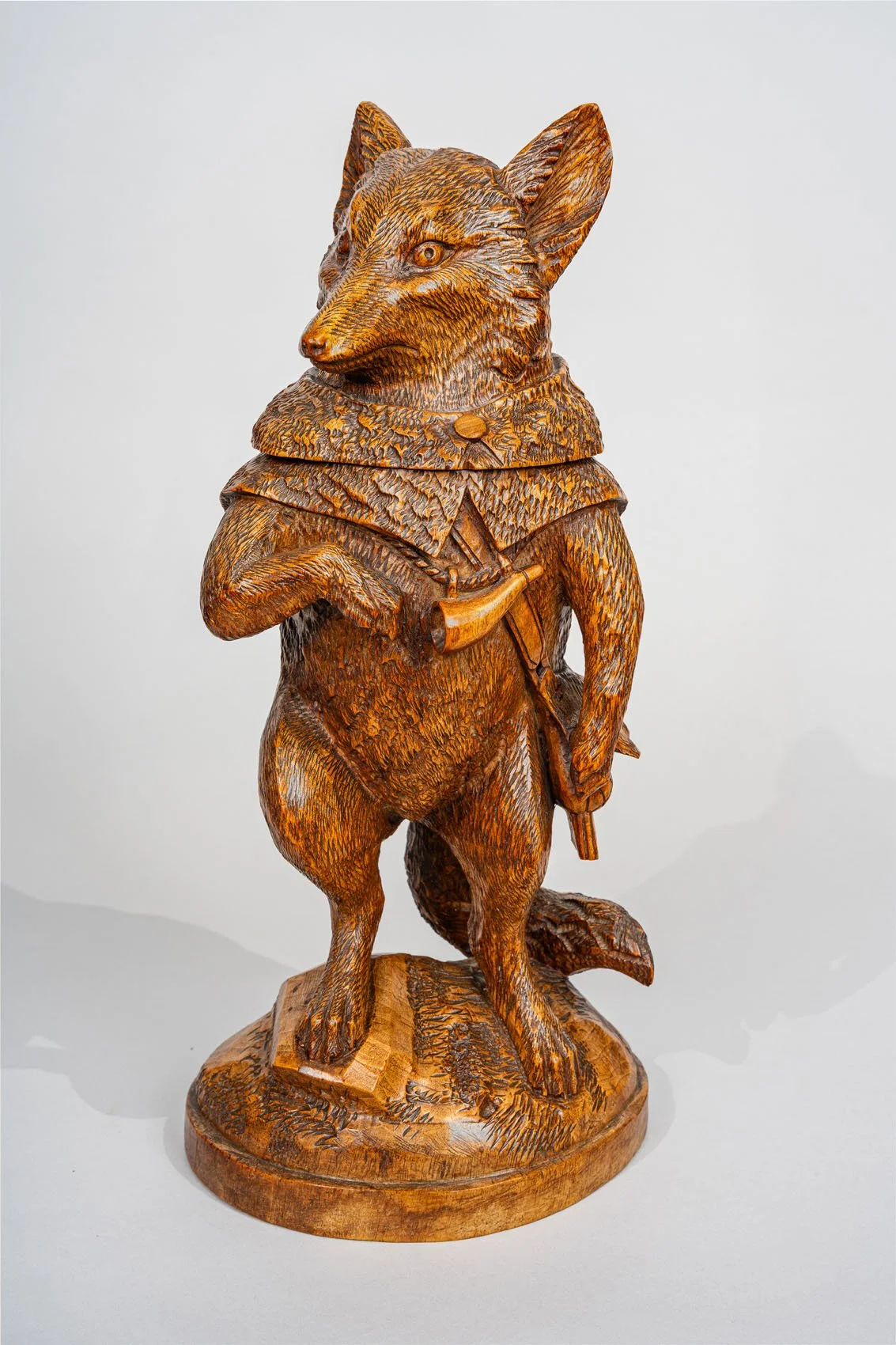 Image 1 of 3
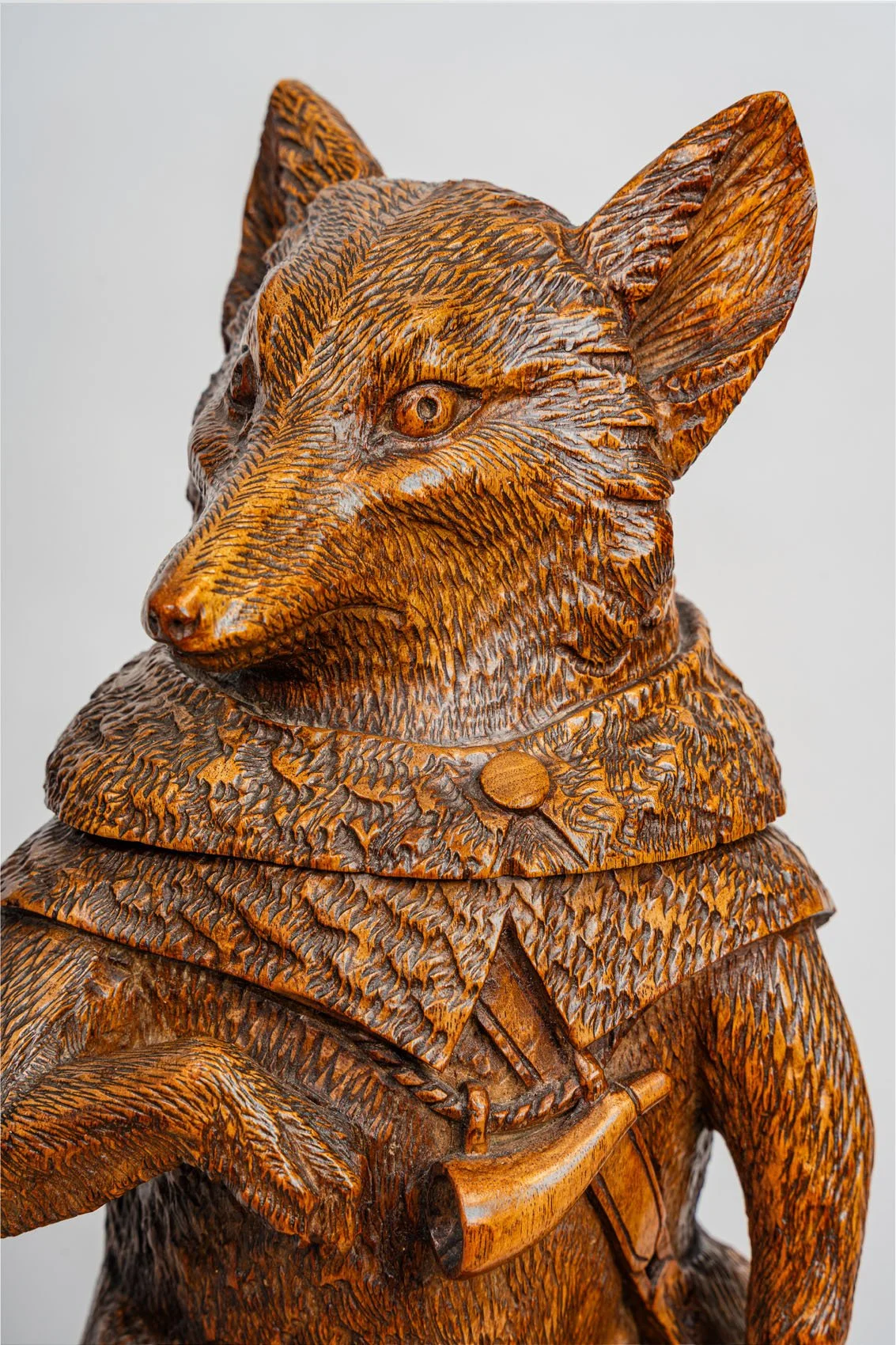 Image 2 of 3
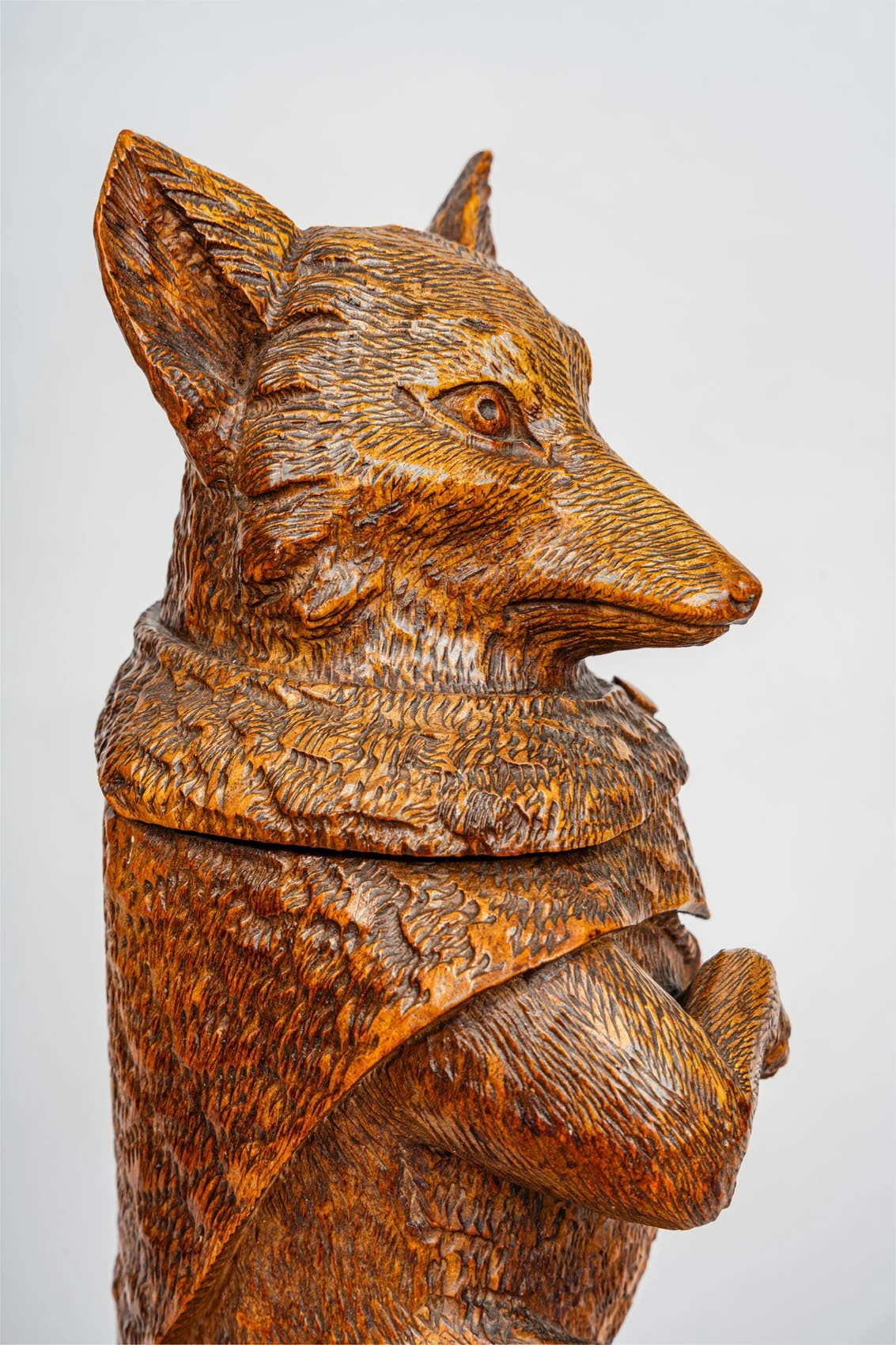 Image 3 of 3