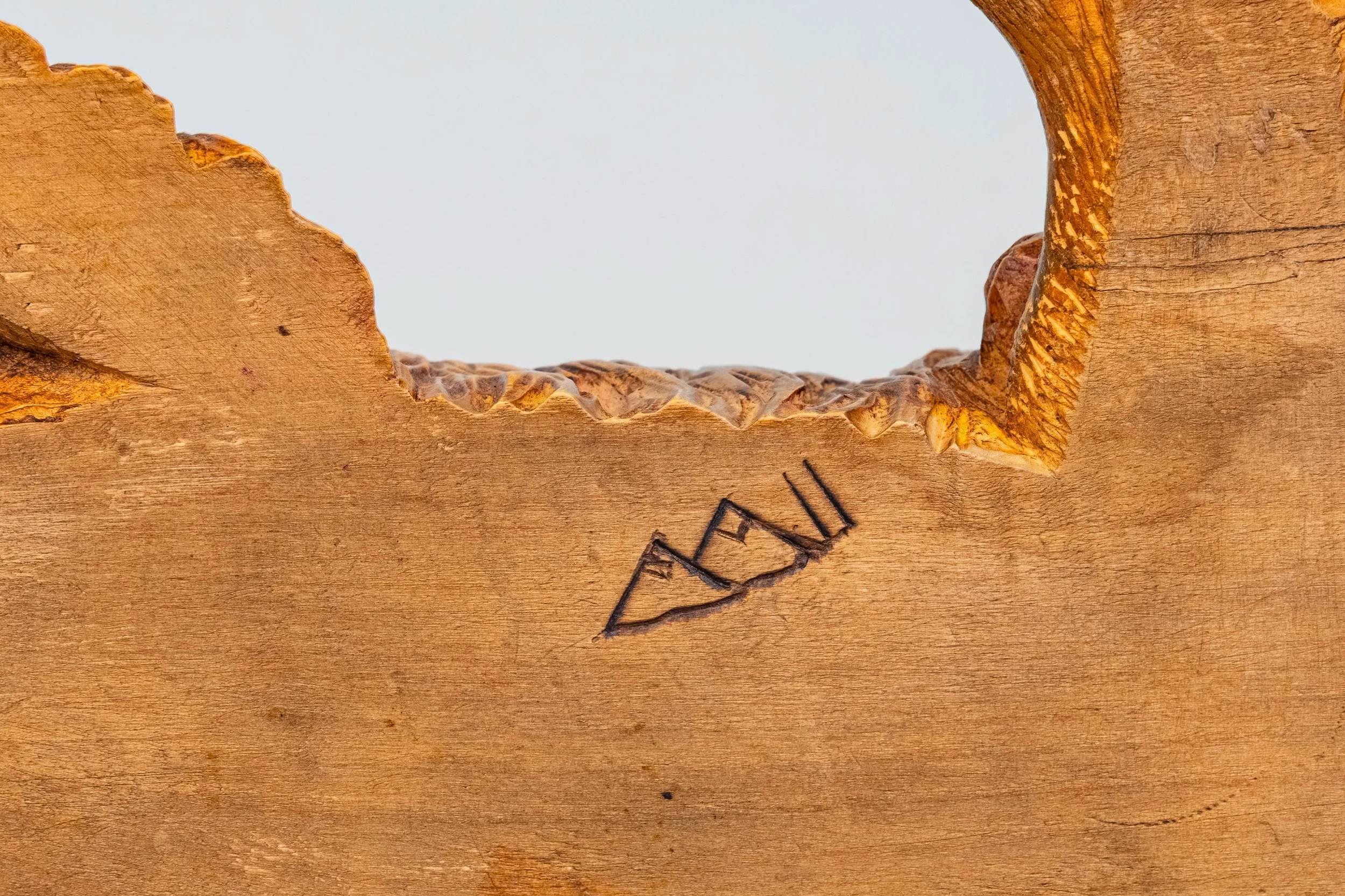
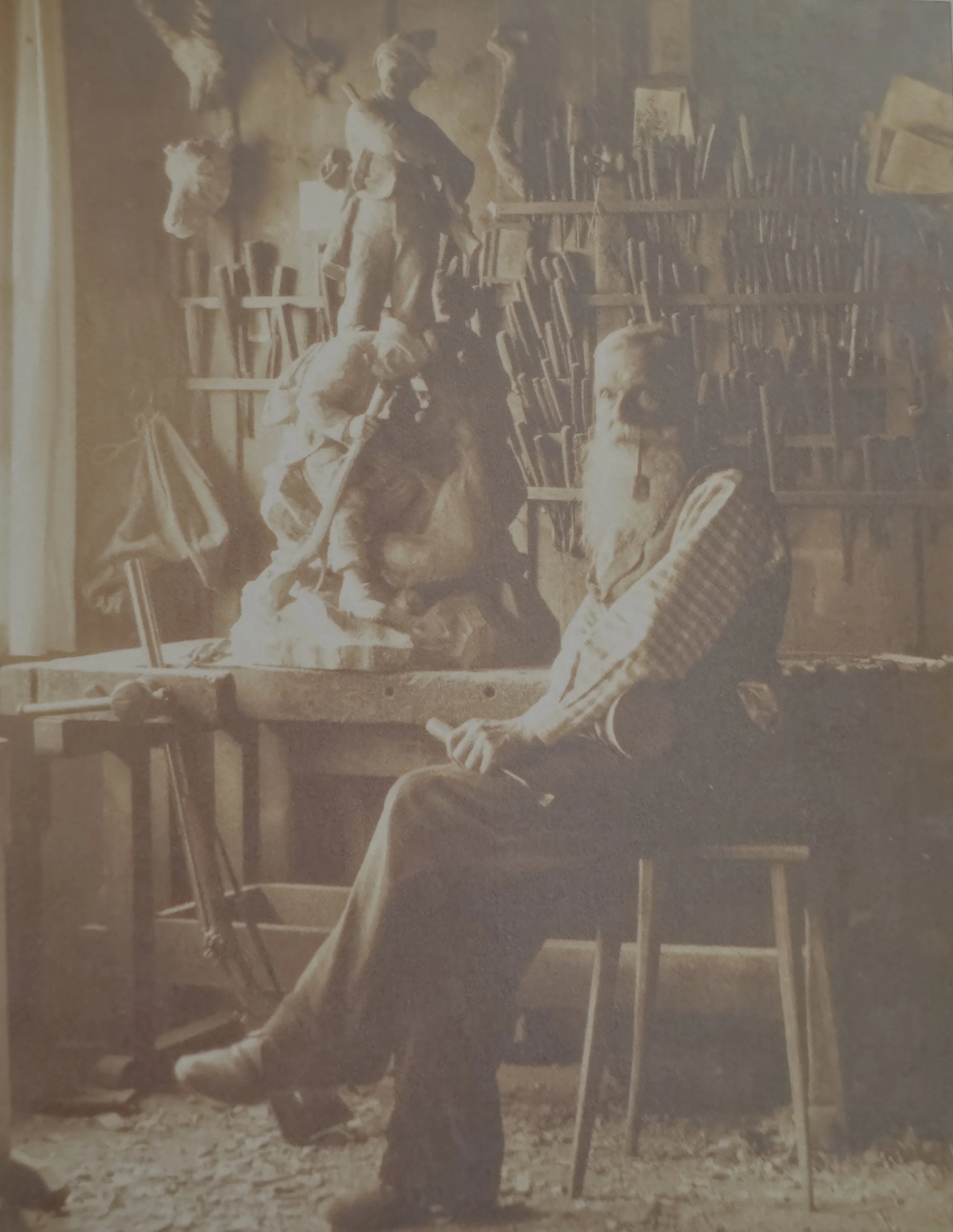
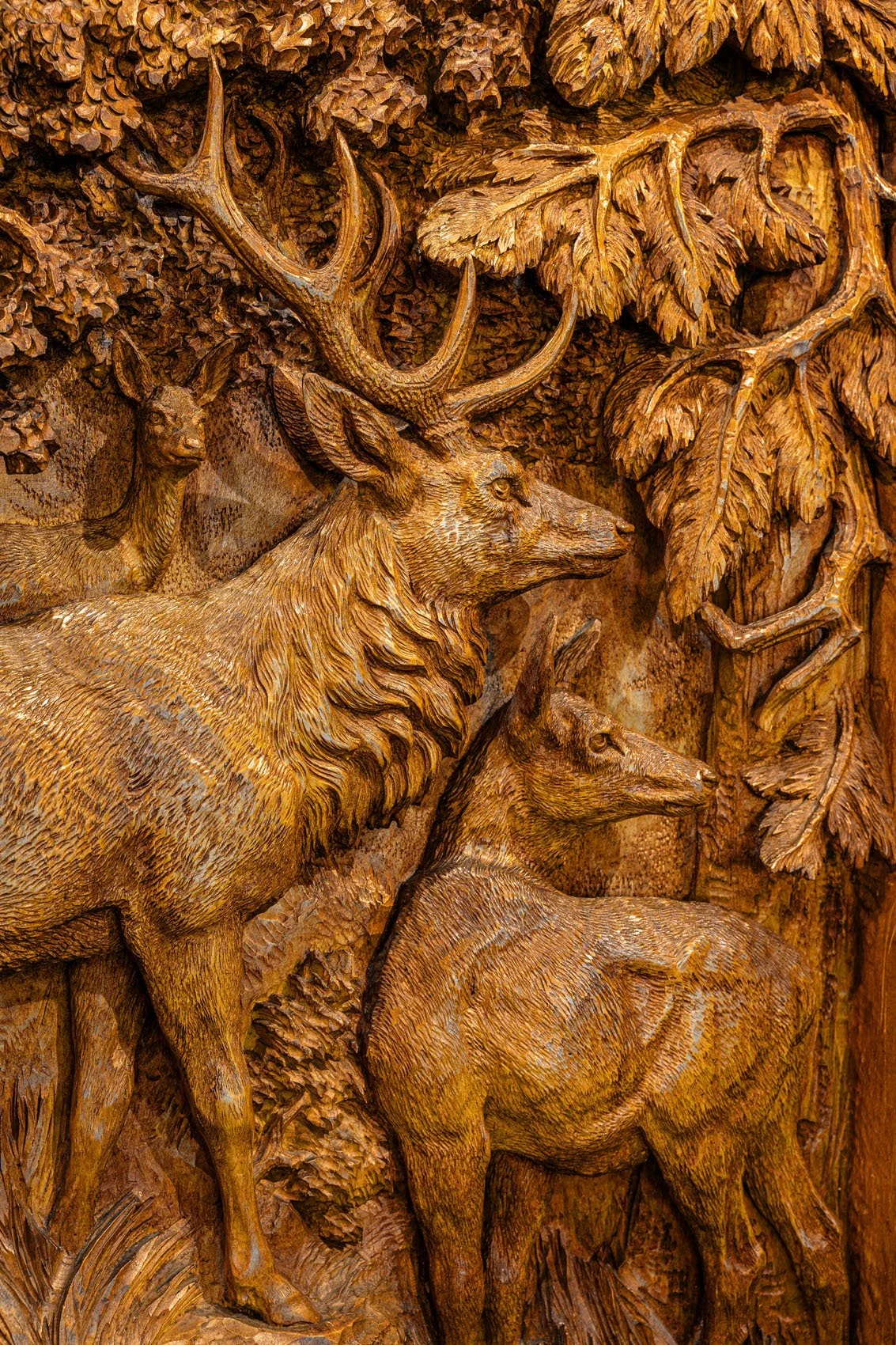
Few subjects engaged the master carvers of Brienz with greater ambition than the cattle of the Swiss alpine pastures — the Simmental and Eringer breeds that defined the agrarian life of the Bernese Oberland and whose forms challenged the carver's skill in rendering weight, musculature, and presence in lindenwood. This exceptional pair, attributed to Johann Huggler of Brienz, represents the category at its very finest: a bull and a bell cow, naturalistically carved in the round, standing in easy counterpoint on shaped elliptical bases enriched with finely observed alpine flora and broken timber.
The bull is rendered with commanding authority. His broad shoulders, powerful neck, and short curved horns are carved with anatomical precision, the surface of the coat rendered in subtly differentiated textures that distinguish the smooth flanks from the rougher, curling growth around the poll and ears. The glass-inset eyes — a hallmark of the finest Brienz workshops — lend the figure an arresting vitality, fixing the viewer with an expression of quiet self-possession. The base is enriched with carved pine cones, alpine grasses, and fragments of fallen timber, providing a naturalistic setting without distracting from the animal himself.
The cow presents a complementary study in feminine temperament. She stands in easy repose, her neck extended, a carved cowbell suspended at her throat — the defining mark of the leading animal in an alpine herd. Her musculature is rendered with equal precision, the ribbing of her flanks and the gentle sway of her body speaking to a carver intimately familiar with his subject. The surface patination of both figures has mellowed to a rich warm walnut tone, consistent with age and handling across more than a century.
Together, the pair forms a composition of rare completeness and balance. Huggler's cattle subjects were among the most admired in the Brienz trade, sought by international visitors and exported in quantity to Britain, America, and the Continent following the Swiss national and international exhibitions of the later 19th century. Examples of this quality and scale — carved fully in the round with inset eyes, naturalistic bases, and the bell cow detail intact — are seldom encountered today outside institutional collections.
Condition: Both figures in excellent condition commensurate with age. The surfaces display an even, warm patination throughout. Glass eyes intact on both figures. Bases complete with no losses to the carved flora or timber detail. Minor surface wear consistent with age and handling; no restoration or repair observed.
Dimensions: 16”width x 13”height x 5.5”depth
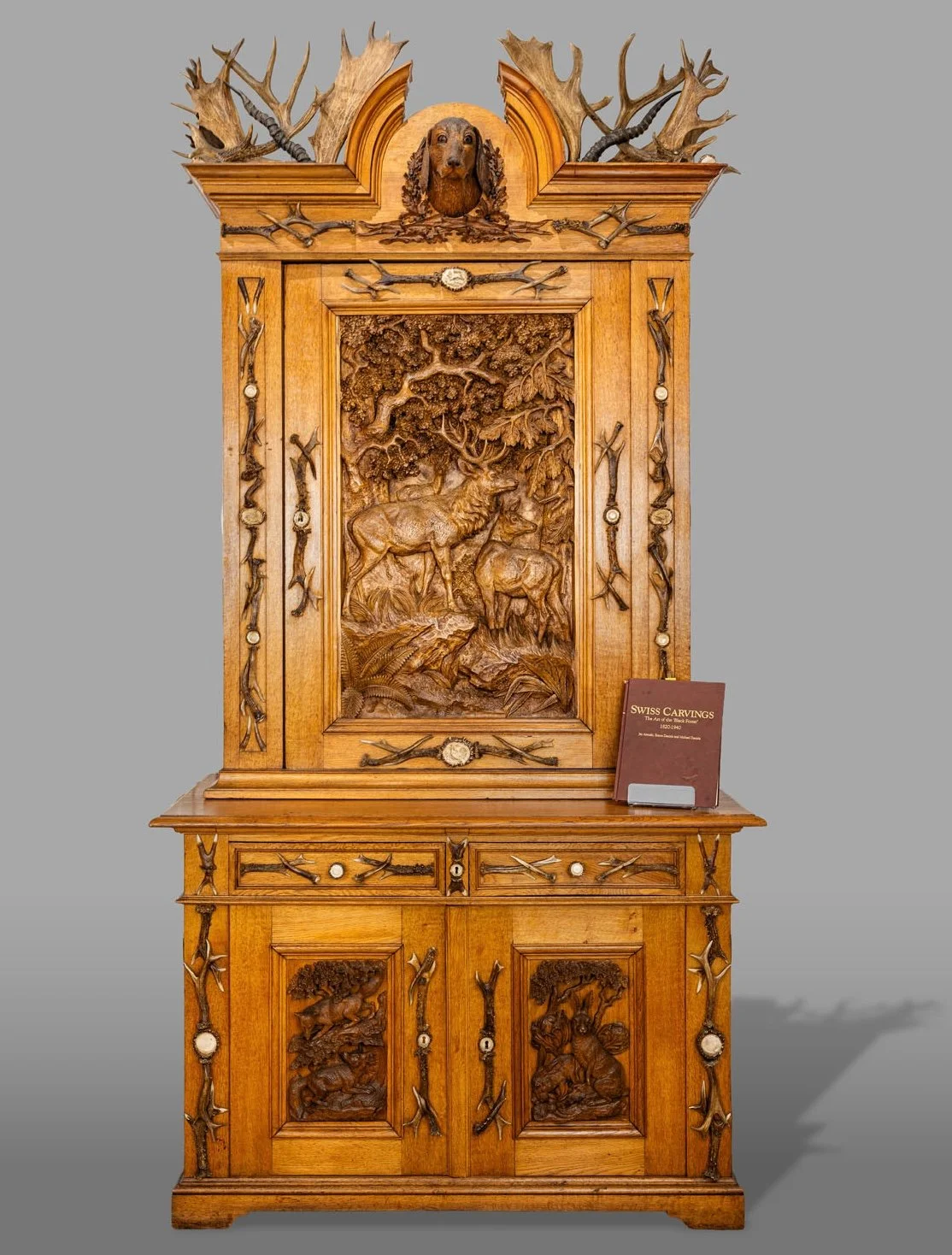
Literature: Jay Arenski, Simon Daniels and Michael Daniels, Swiss Carvings: The Art of the Black Forest, 1820–1940, 2006 — see relevant entries on Huggler cattle subjects and Brienz naturalistic carving.
Few subjects engaged the master carvers of Brienz with greater ambition than the cattle of the Swiss alpine pastures — the Simmental and Eringer breeds that defined the agrarian life of the Bernese Oberland and whose forms challenged the carver's skill in rendering weight, musculature, and presence in lindenwood. This exceptional pair, attributed to Johann Huggler of Brienz, represents the category at its very finest: a bull and a bell cow, naturalistically carved in the round, standing in easy counterpoint on shaped elliptical bases enriched with finely observed alpine flora and broken timber.
The bull is rendered with commanding authority. His broad shoulders, powerful neck, and short curved horns are carved with anatomical precision, the surface of the coat rendered in subtly differentiated textures that distinguish the smooth flanks from the rougher, curling growth around the poll and ears. The glass-inset eyes — a hallmark of the finest Brienz workshops — lend the figure an arresting vitality, fixing the viewer with an expression of quiet self-possession. The base is enriched with carved pine cones, alpine grasses, and fragments of fallen timber, providing a naturalistic setting without distracting from the animal himself.
The cow presents a complementary study in feminine temperament. She stands in easy repose, her neck extended, a carved cowbell suspended at her throat — the defining mark of the leading animal in an alpine herd. Her musculature is rendered with equal precision, the ribbing of her flanks and the gentle sway of her body speaking to a carver intimately familiar with his subject. The surface patination of both figures has mellowed to a rich warm walnut tone, consistent with age and handling across more than a century.
Together, the pair forms a composition of rare completeness and balance. Huggler's cattle subjects were among the most admired in the Brienz trade, sought by international visitors and exported in quantity to Britain, America, and the Continent following the Swiss national and international exhibitions of the later 19th century. Examples of this quality and scale — carved fully in the round with inset eyes, naturalistic bases, and the bell cow detail intact — are seldom encountered today outside institutional collections.
Condition: Both figures in excellent condition commensurate with age. The surfaces display an even, warm patination throughout. Glass eyes intact on both figures. Bases complete with no losses to the carved flora or timber detail. Minor surface wear consistent with age and handling; no restoration or repair observed.
Dimensions: 16”width x 13”height x 5.5”depth
Literature: Jay Arenski, Simon Daniels and Michael Daniels, Swiss Carvings: The Art of the Black Forest, 1820–1940, 2006 — see relevant entries on Huggler cattle subjects and Brienz naturalistic carving.

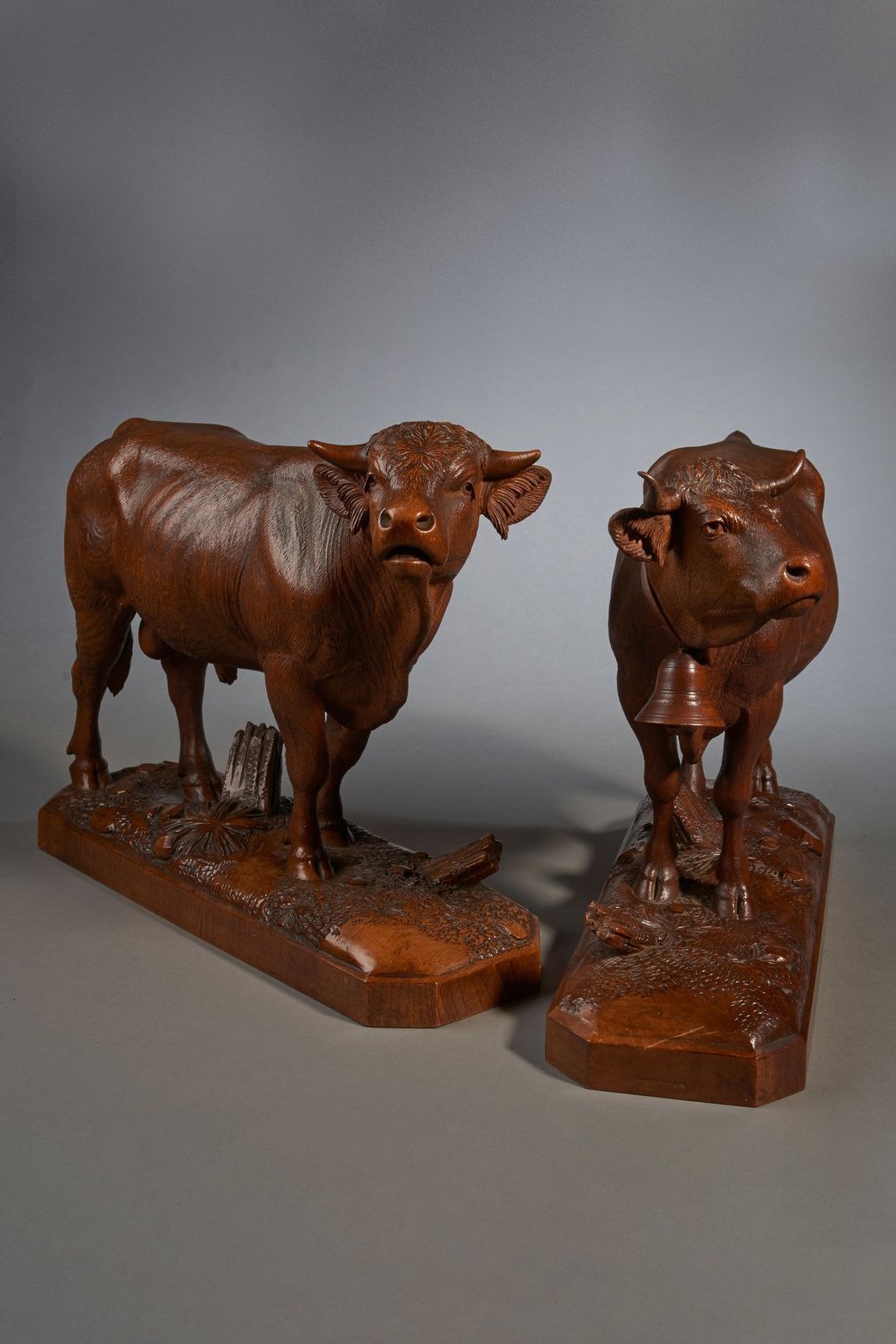 Image 1 of 3
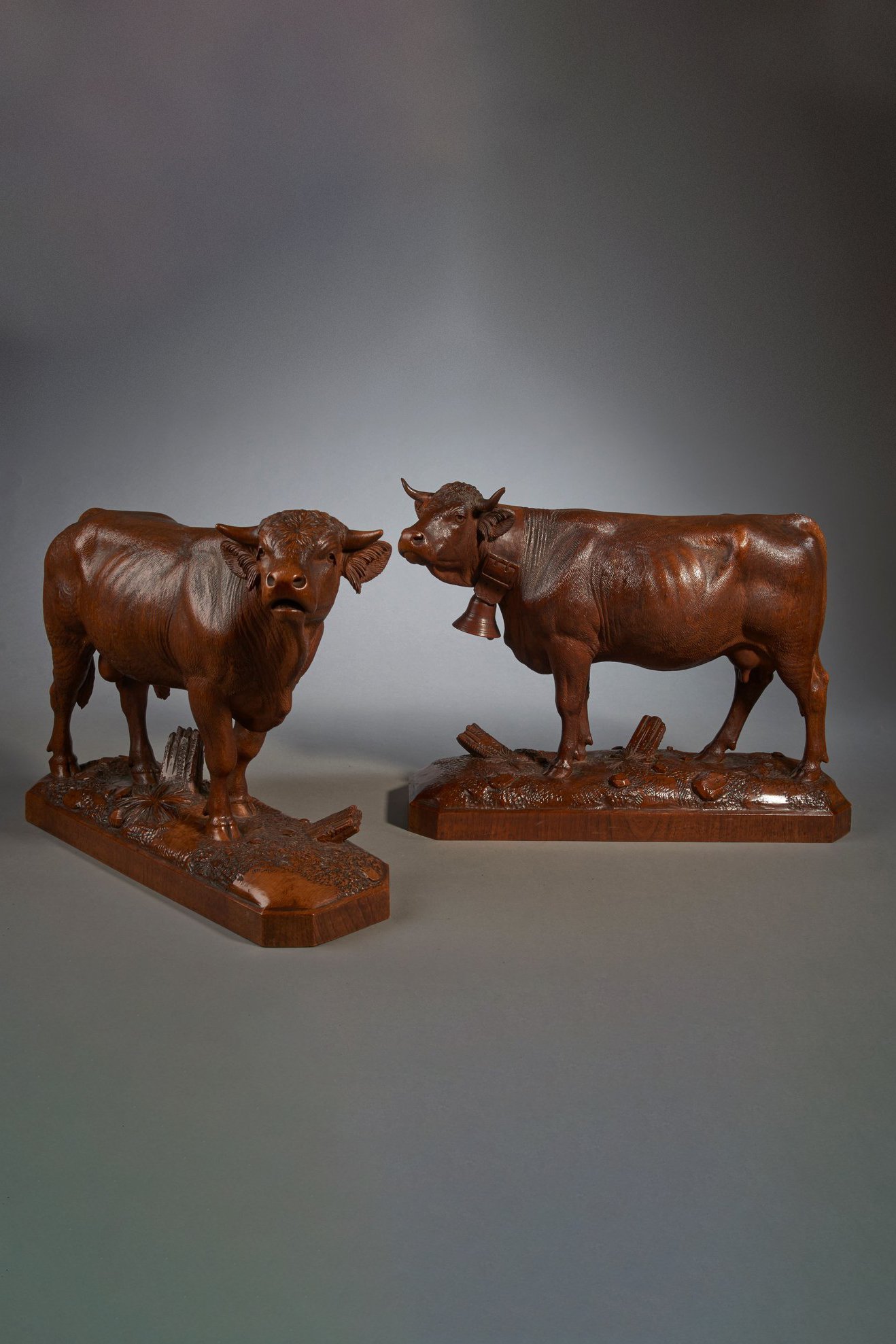 Image 2 of 3
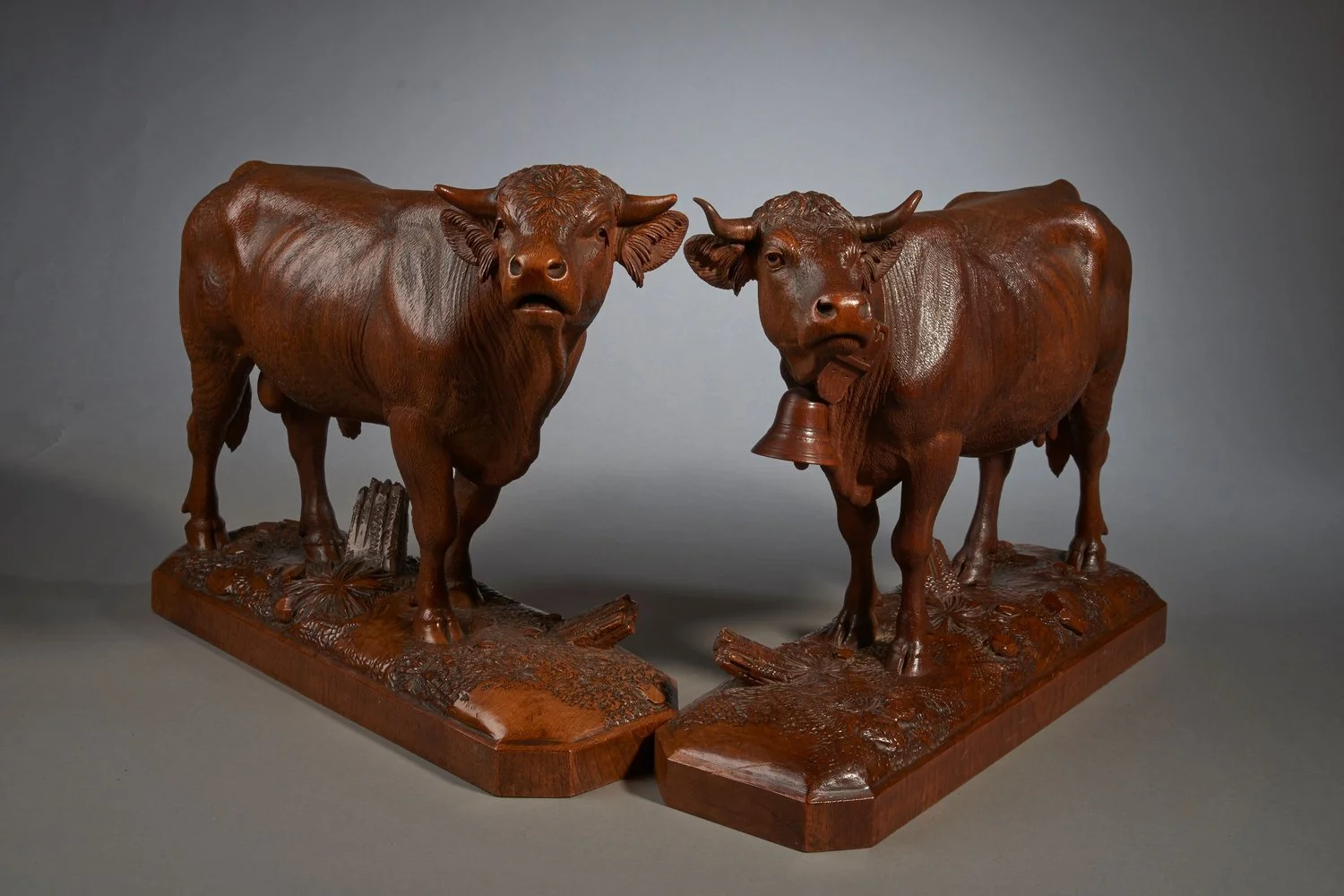 Image 3 of 3