The Three Ages of Man: Monumental Swiss Black Forest Carved Walnut Hunter Group, Signed J. Huggler, Brienz, circa 1870

$0.00

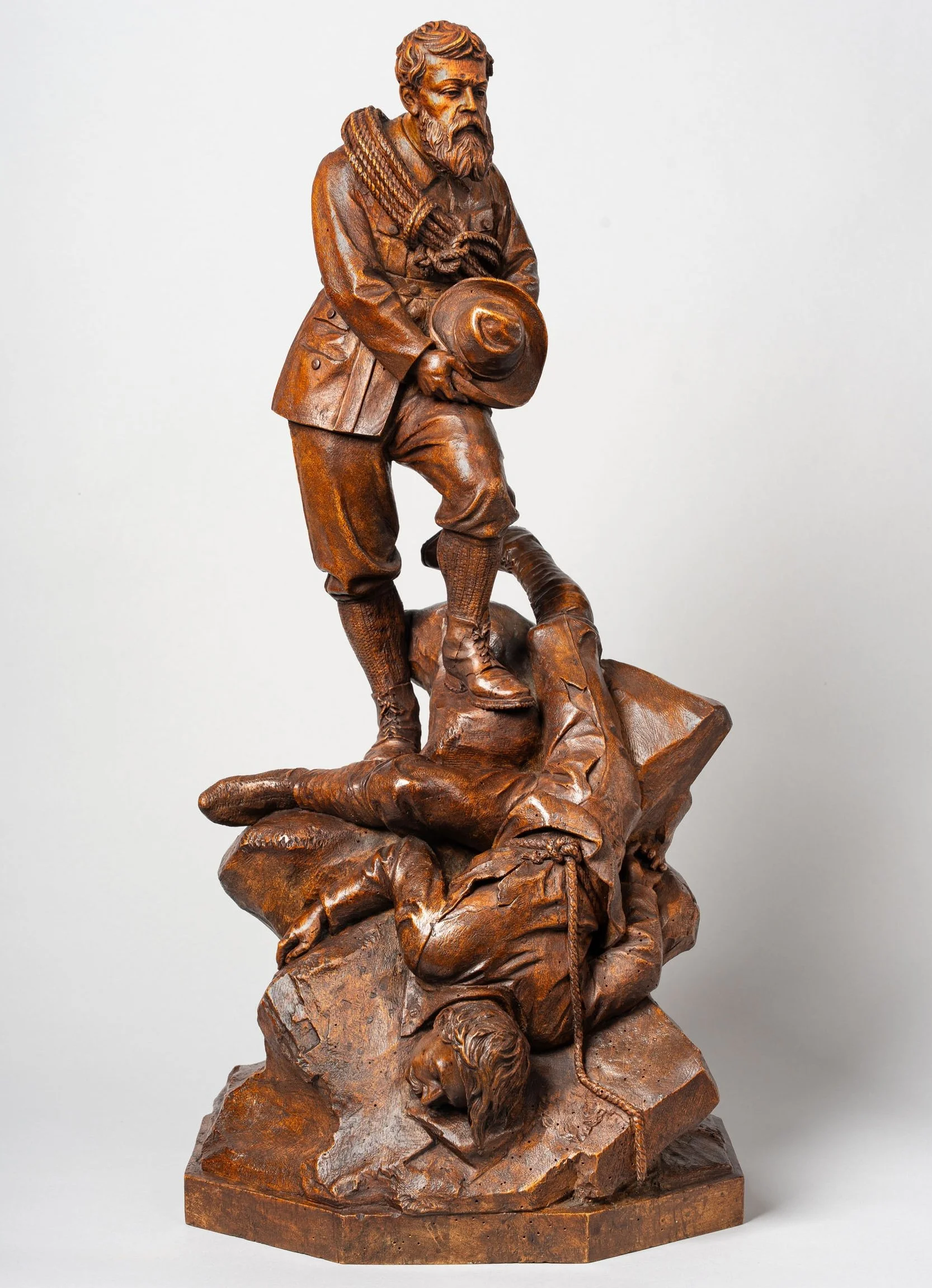
The Three Ages of Man Monumental Swiss Black Forest Carved Walnut Hunter Group Johann Huggler (1834–1912), Brienz, Switzerland, circa 1870. Signed J. HUGGLER; with original receipt from Huggler, Huggler, Interlaken, 1925. Walnut. Height: 48 inches (122 cm)

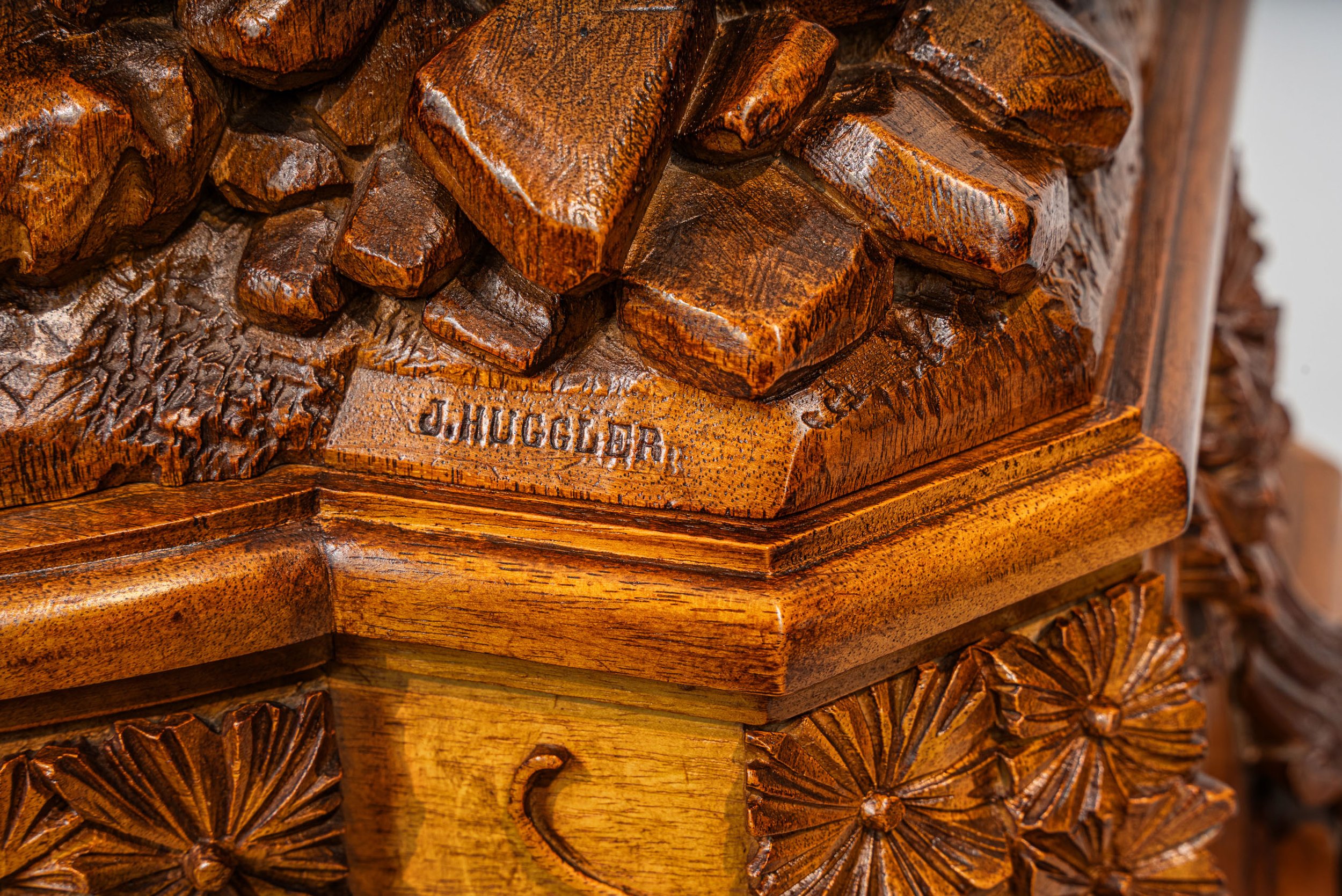
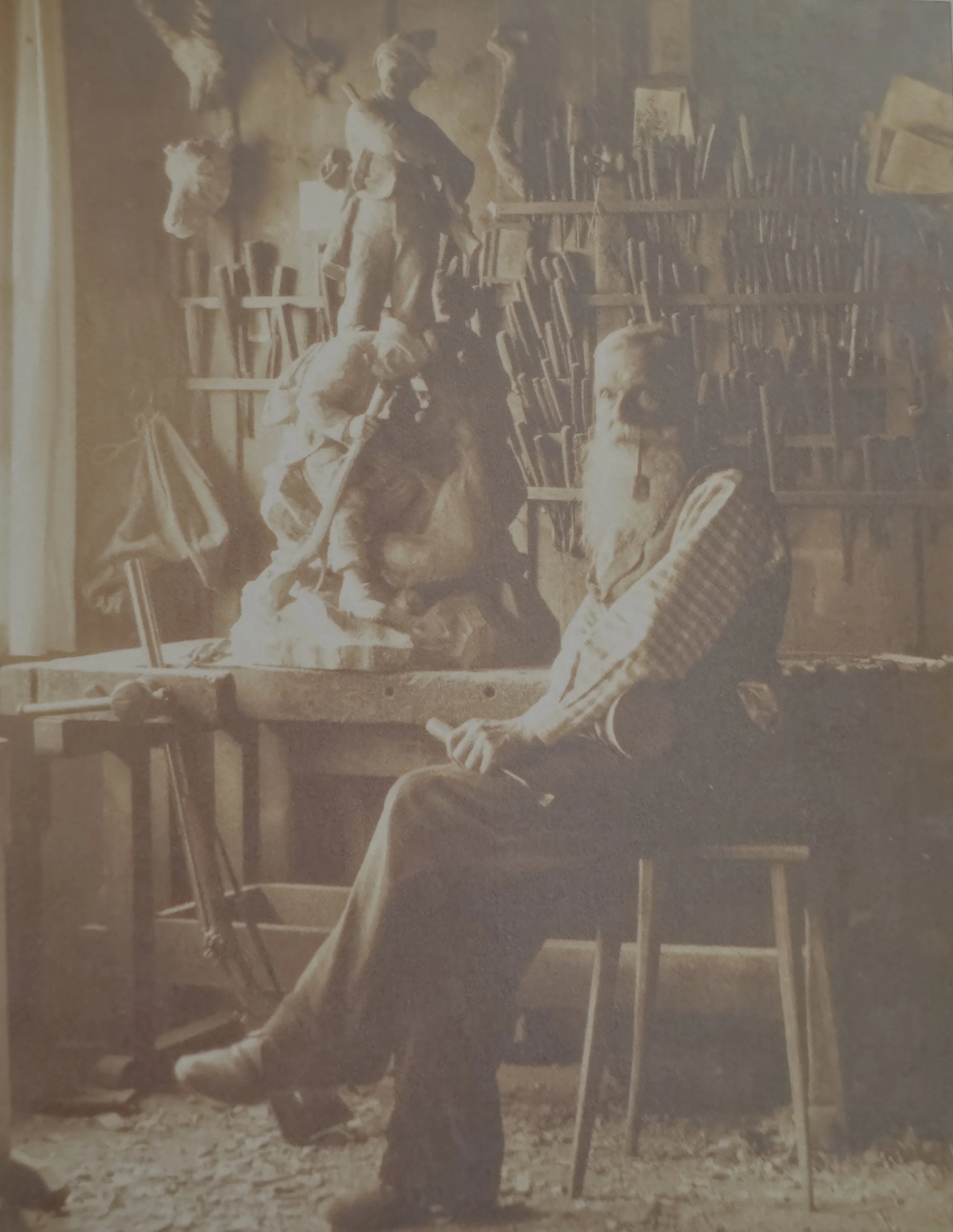
A monumental and deeply considered work by Johann Huggler — the pre-eminent master of the Swiss Black Forest carving tradition — conceived as a meditation on the three ages of man within a dynamic Alpine chamois hunting composition, and bearing both the stamped signature J. HUGGLER on the plinth and Huggler's own cursive signature on the underside of the base.

The Composition

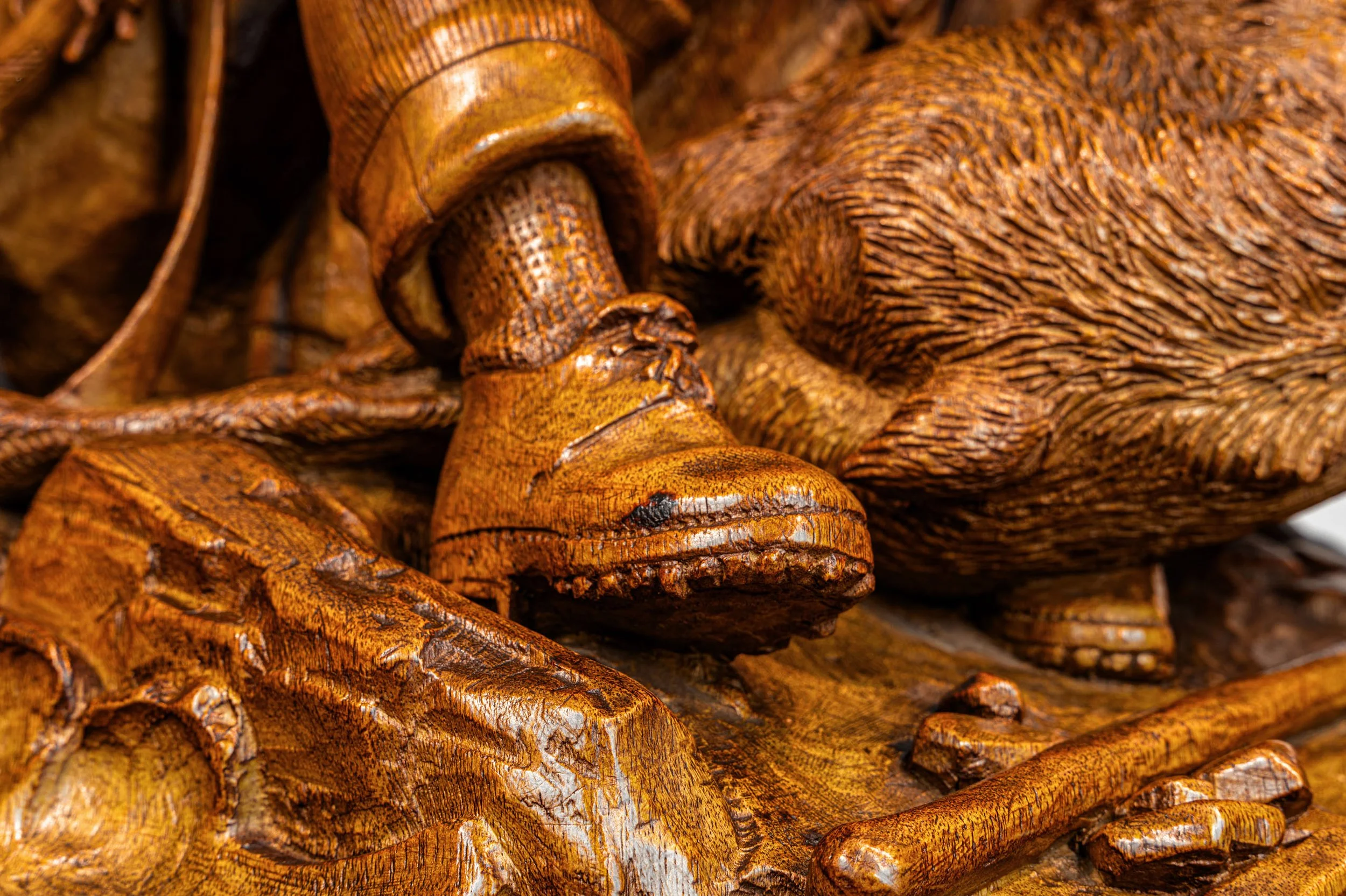
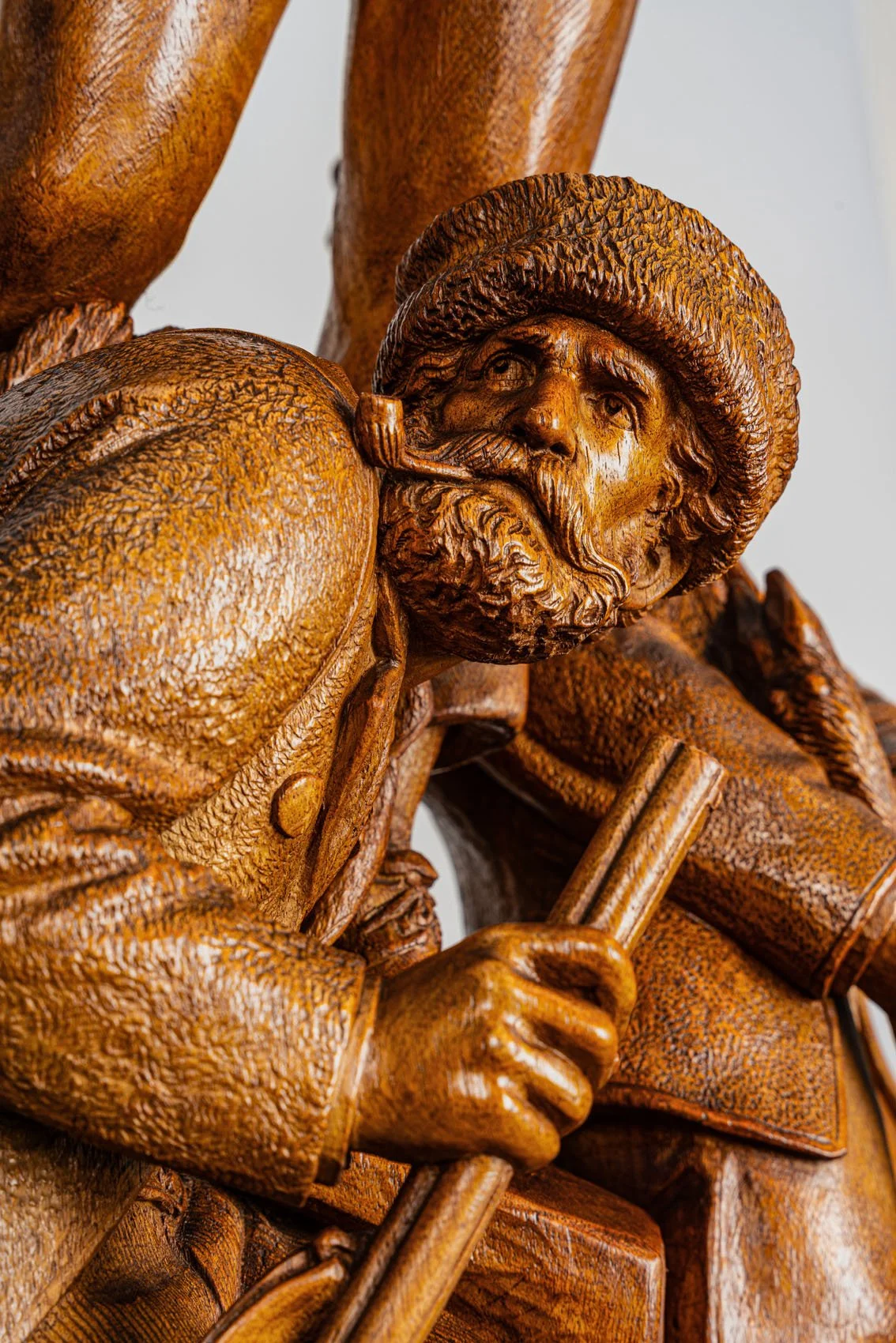
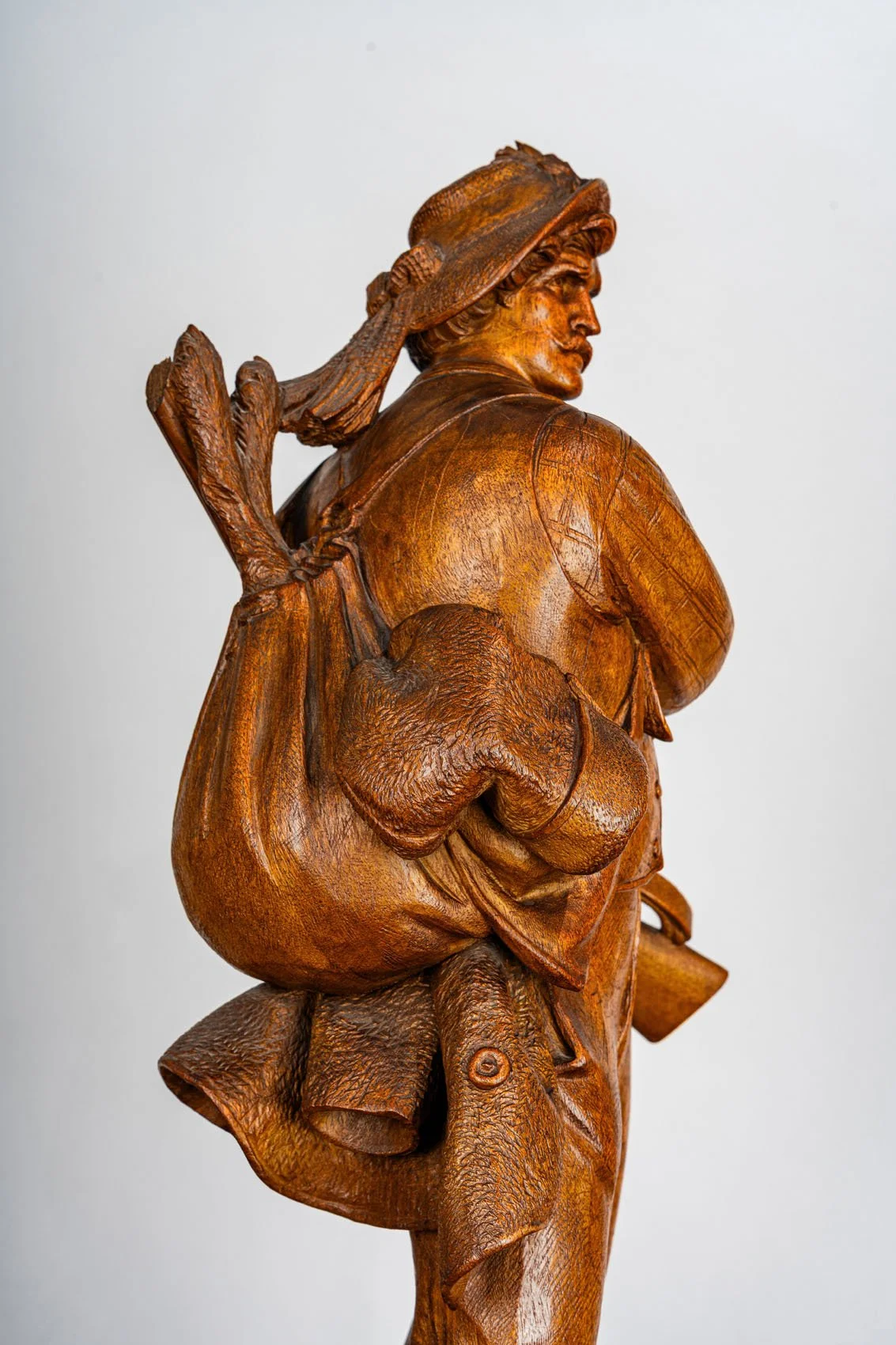
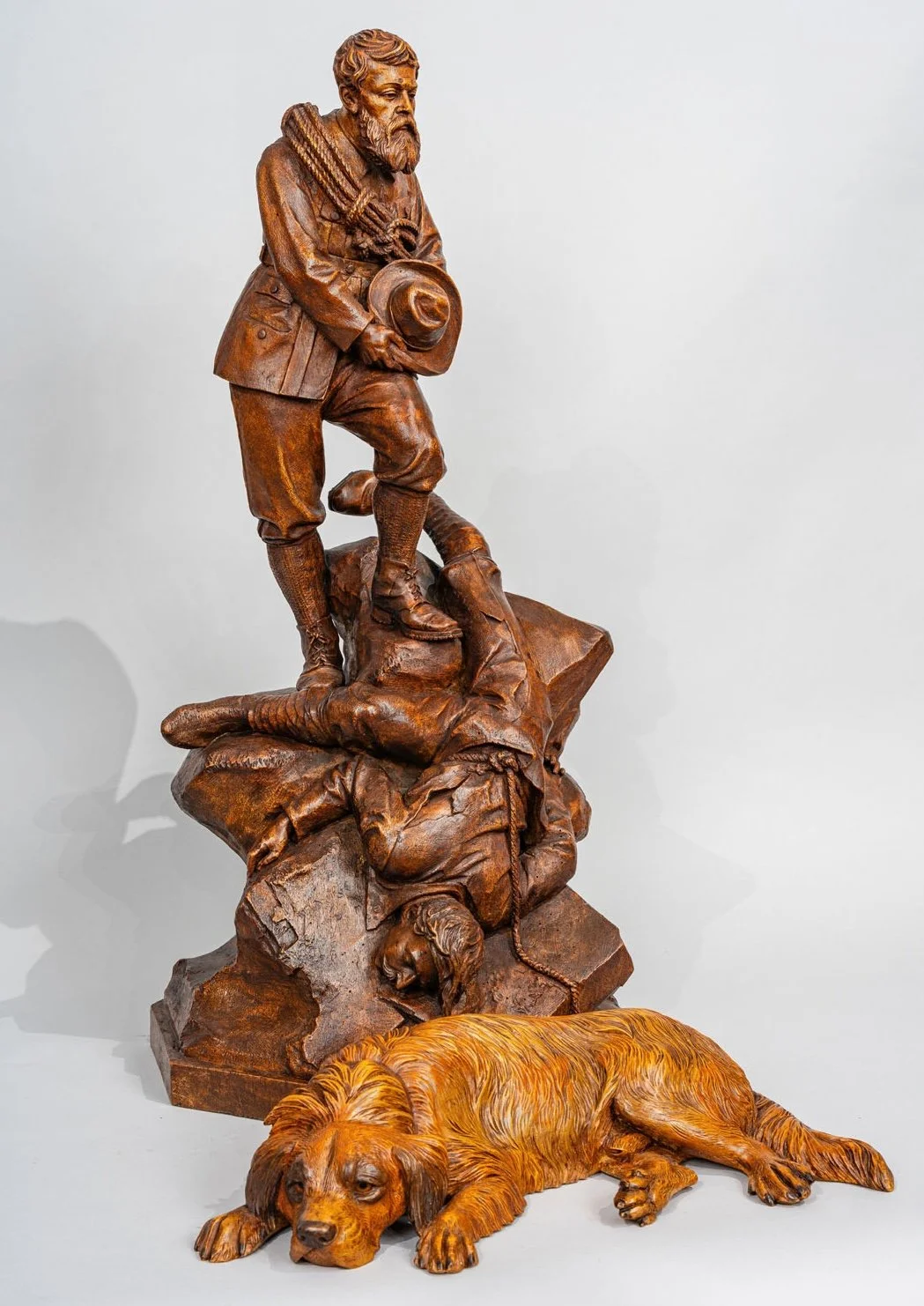
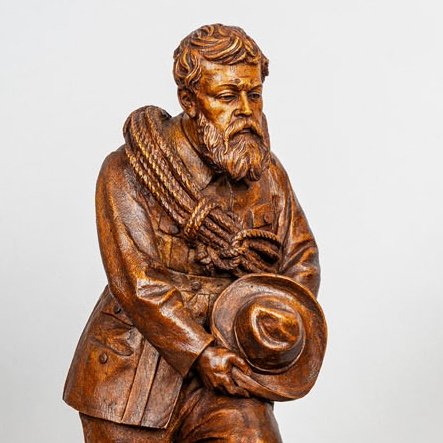
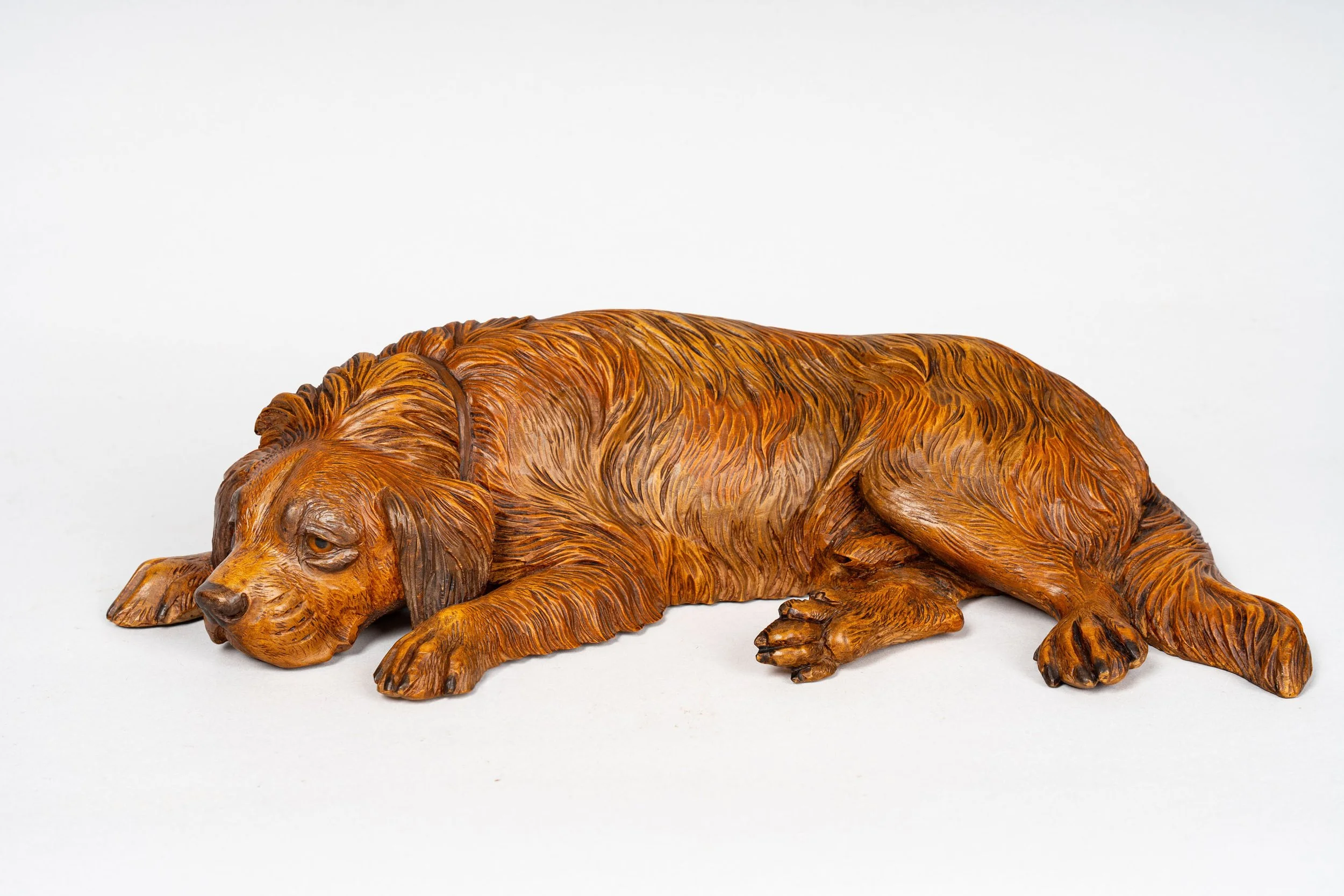
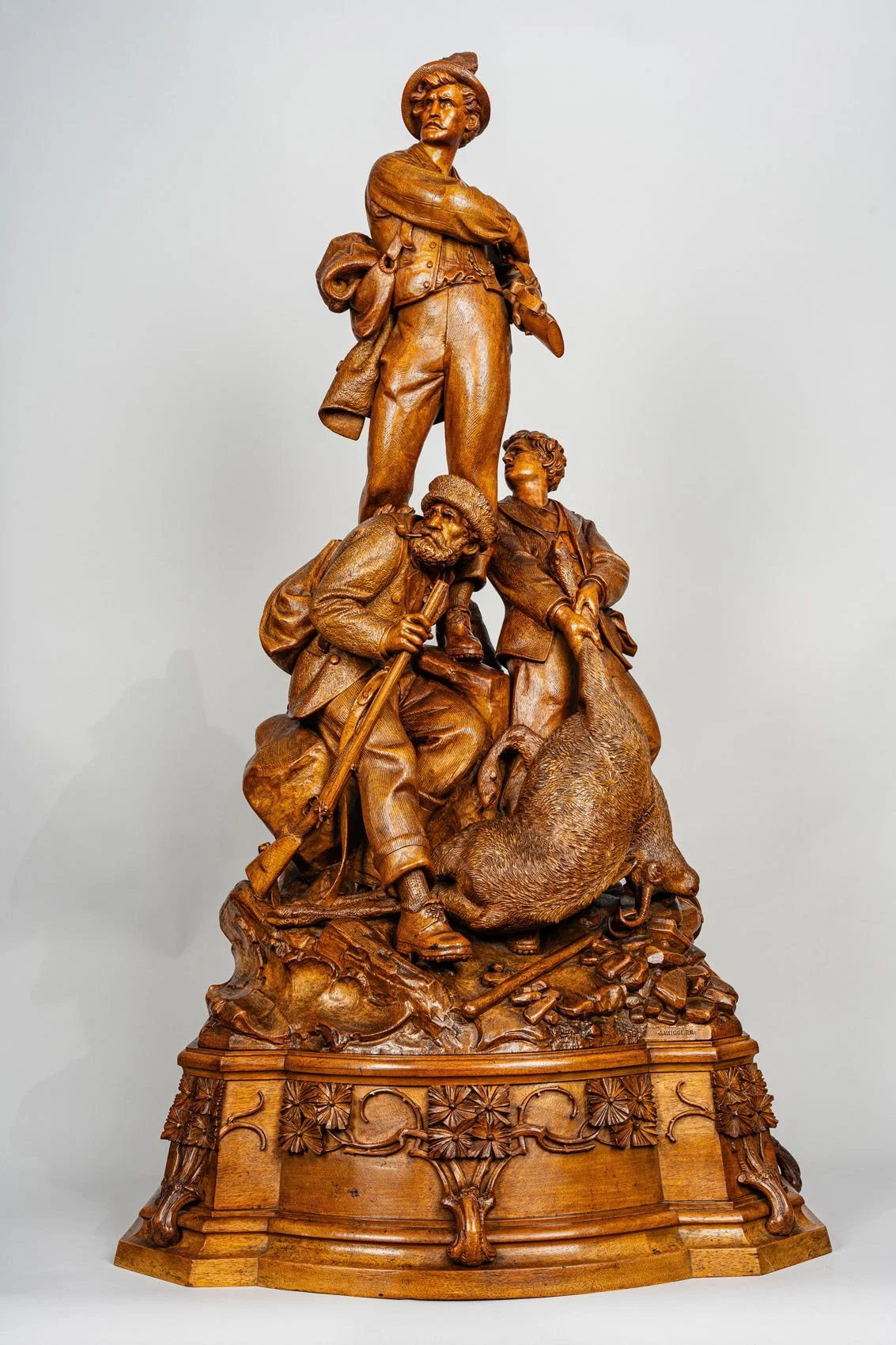
The group unfolds as a vertical narrative rising 48 inches from base to summit. At the apex, a young hunter stands triumphant, arms crossed, with a feathered hat, a full game bag at his back, with birds clearly visible — the confidence of youth and a successful hunt. Below him to the left, an older bearded figure crouches with pipe at his lips and rifle in hand, looking upward with the watchful, experienced eye of a man who has spent a lifetime on the mountain. To the right, a second younger figure assists, completing the generational triangle. At the base, the quarry — a chamois, the quintessential prey of the Alpine hunter — lies fallen among rocks, scattered hunting equipment, and a carved woodcock, the whole naturalistic ground rendered with the sustained detail that characterizes Huggler's finest work.

The composition is ambitious in its vertical ambition and complex in its figural relationships. Each of the three hunters is individually characterized — in posture, expression, age, and the particular quality of their engagement with the scene — and together they form what Huggler conceived as a reflection on the three ages of man: youth, maturity, and the accumulated weight of experience. It is a subject that carries personal meaning. Huggler was known locally not only as the master carver of Brienz but as an unapologetic poacher — a man who knew the Alpine hunting culture from the inside — and it is believed he cast himself and his companions in the composition, embedding autobiography within artistic statement. The figures glance outward with an alertness that has been read as characteristic Huggler wit: hunters who remain aware of authority even in their moment of triumph.

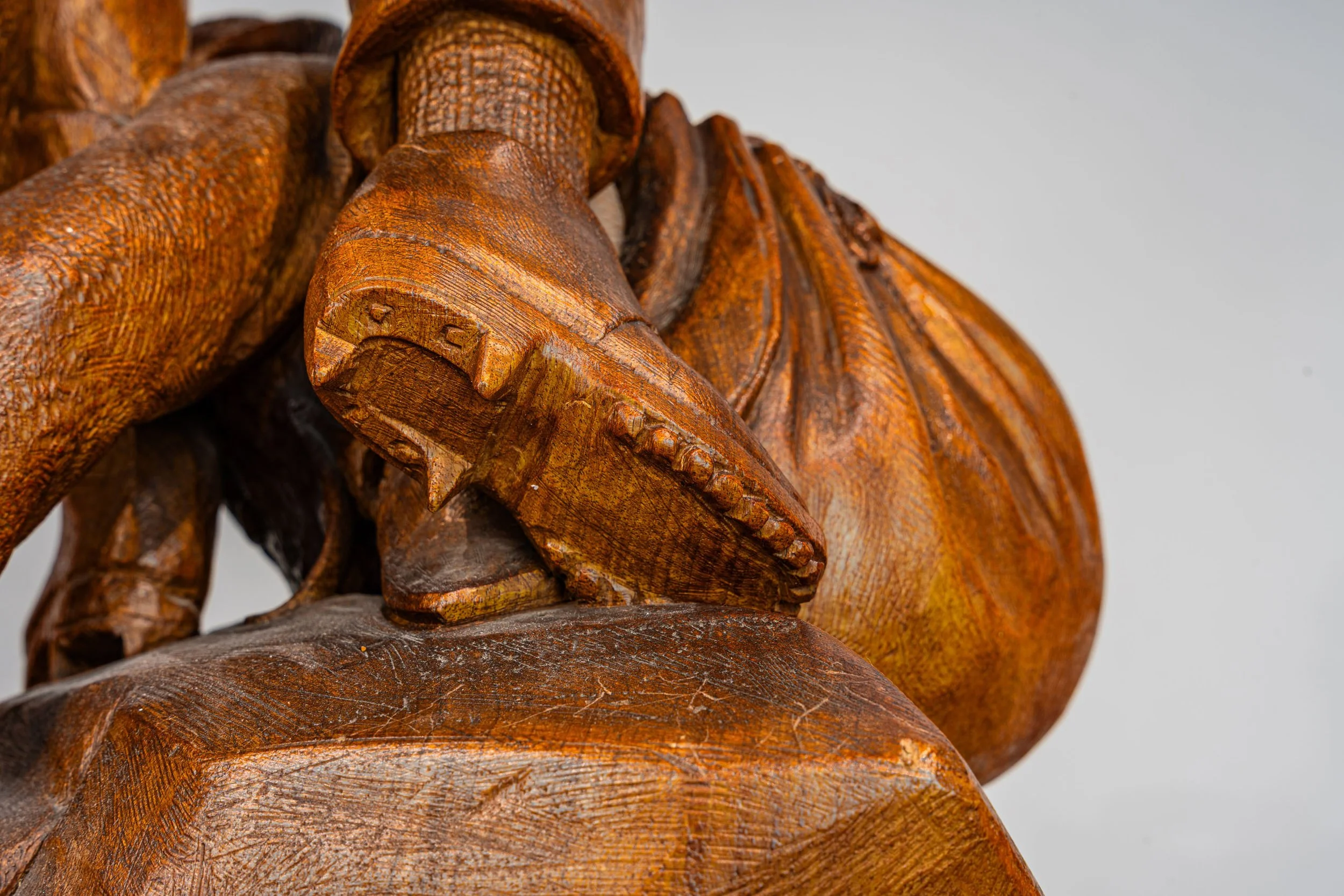
The technical execution throughout is of the highest order. The figural modeling is confident and fully three-dimensional, each figure readable from every angle. The surface treatment varies with complete command — the knitted stocking of the elder hunter's leg, the soft fur of the chamois, the feathers of the birds in the game bag, the grain of the rock face — each material given its own tool treatment, each surface individually observed. The architectural plinth below, with its carved rosette and scrollwork, provides a formal base that elevates the composition and signals its exhibition-level ambition.

The Signatures

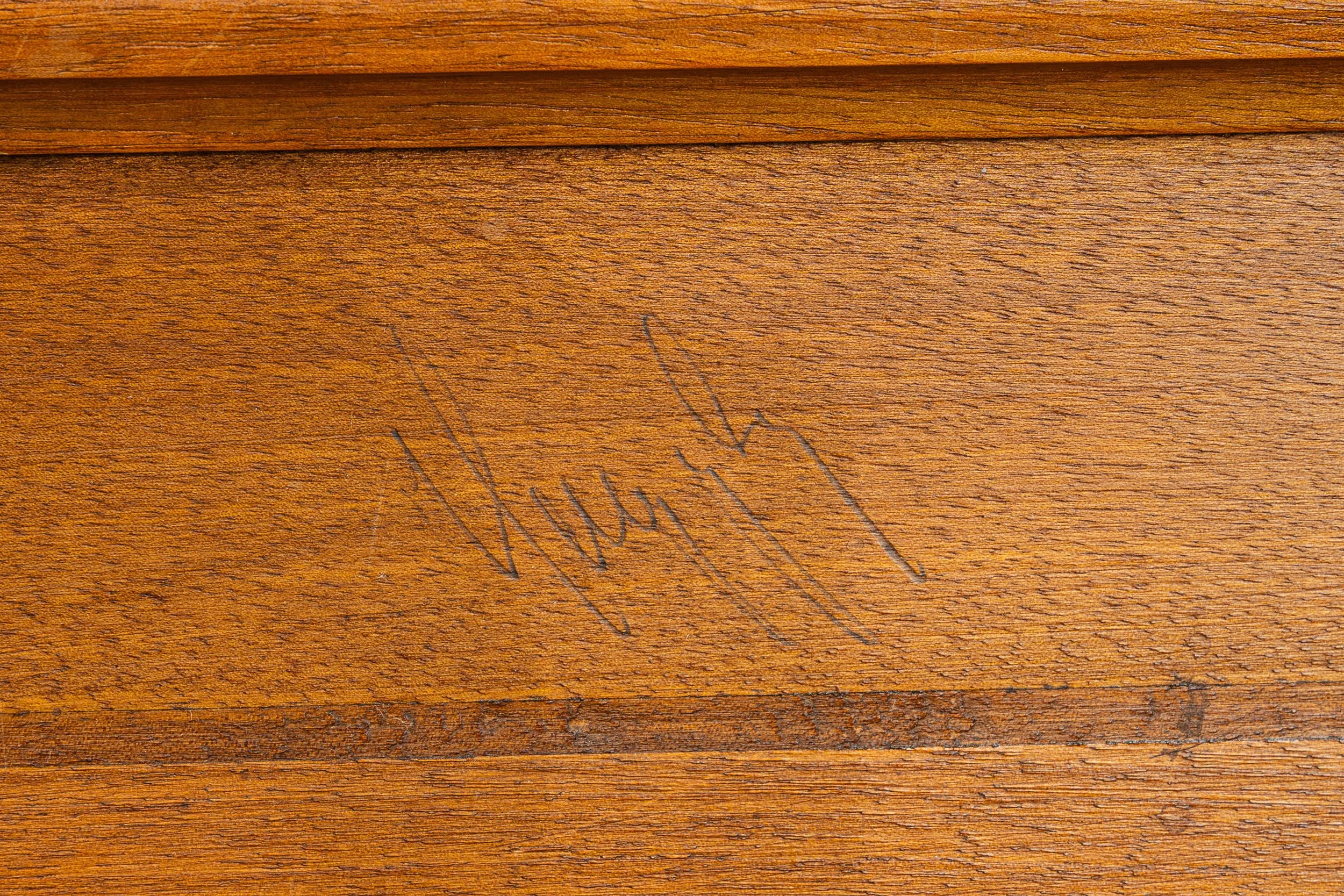
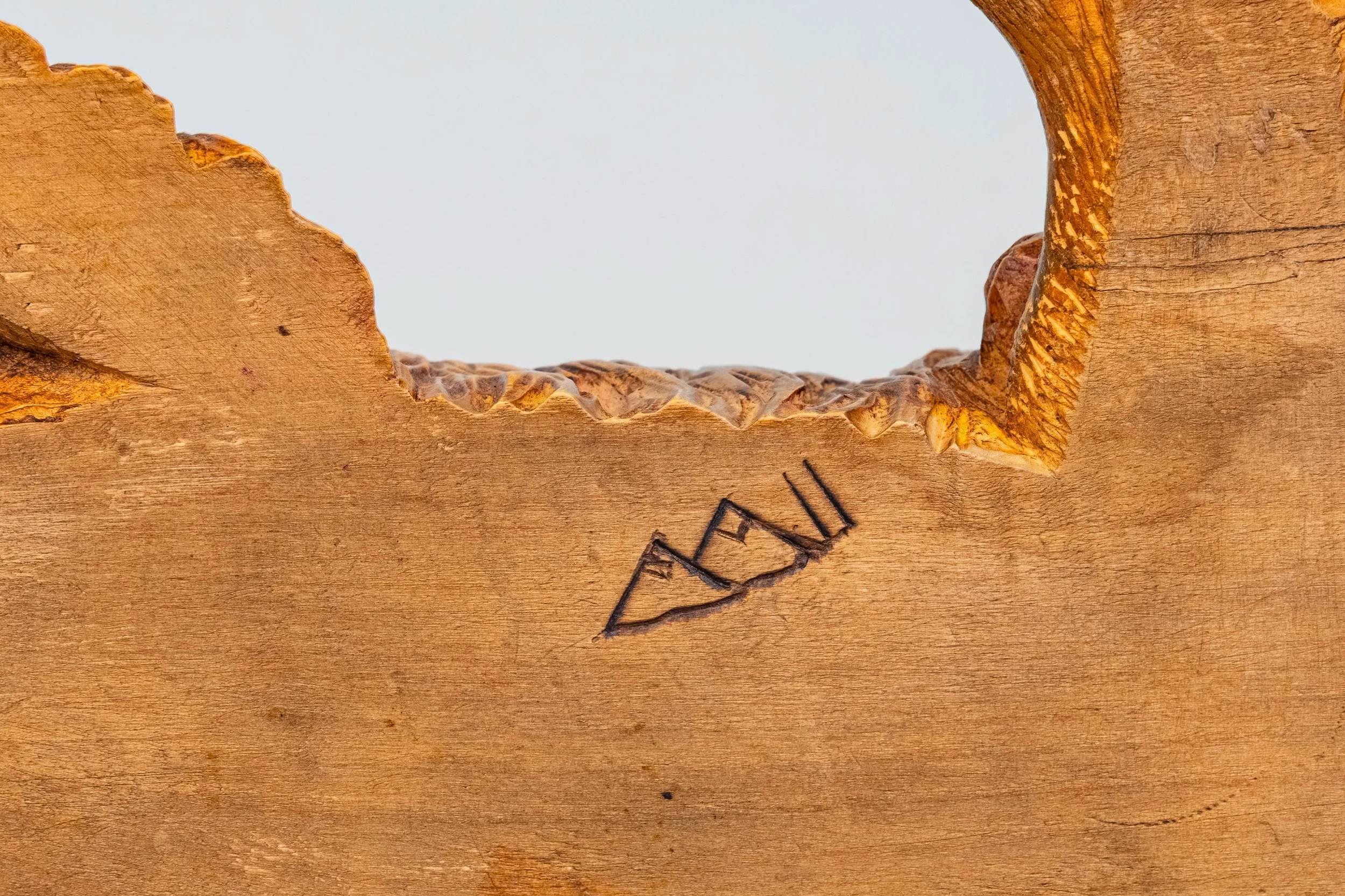
The present work carries two forms of Huggler's signature. The stamped mark J. HUGGLER appears clearly on the edge of the plinth — the form of marking associated with the master and his workshop. On the underside of the base, Huggler's cursive autograph signature is scratched directly into the wood — a personal mark, distinct from the workshop stamp, and one that speaks to the particular significance this work held for its maker.

The Provenance

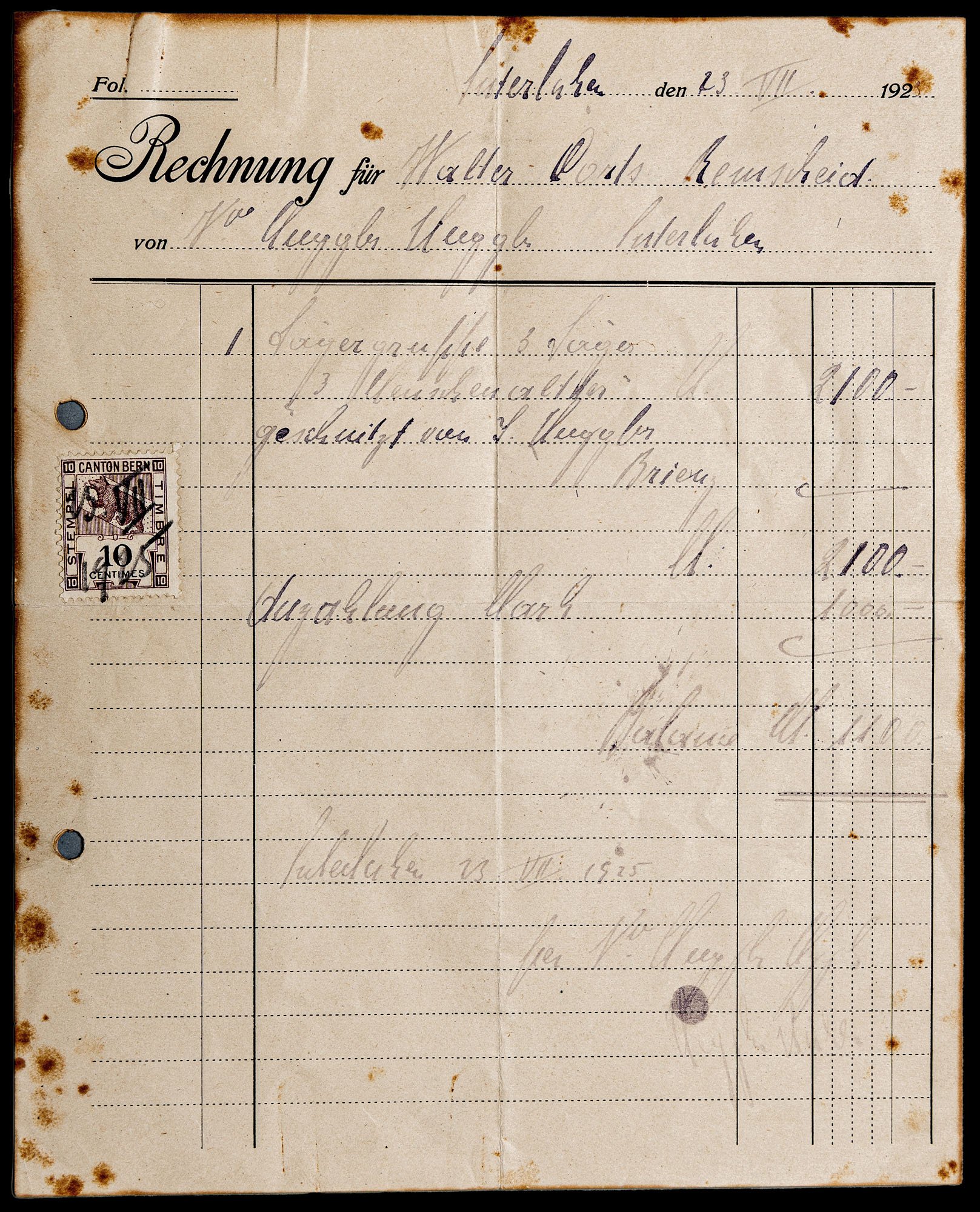
The carving was purchased directly from the Huggler family firm — Huggler Huggler, Interlaken — on 14 March 1925 by Herr Walter Ords of Remscheid, Germany. The original receipt survives and accompanies the work. It records the piece as catalog number H.H. 468, described as Jägergruppe 3 Jäger — hunter group with three hunters — carved by J.J. Huggler, and sold for 1,000 Swiss Francs. The Canton Bern revenue stamp is present and intact. The carving has remained in the same family for three generations, passing by direct descent from the original purchaser.

This is among the most completely documented provenances recorded for any work of Swiss Black Forest carving.

The Context

Johann Huggler (1834–1912) is widely regarded as the pre-eminent master of the Brienz carving tradition. His works were exhibited at the great international exhibitions of the late nineteenth century — the Exposition Universelle in Paris, the World's Columbian Exposition in Chicago in 1893 — where Swiss Black Forest carving was judged not merely as craft but as sculpture of the highest order. American collectors played a central role in establishing the international market for Brienz carving, and large-scale figural groups of this ambition and personal significance remain among the most sought-after works in the tradition.

The present group — monumental in scale, complex in composition, deeply personal in subject, doubly signed, and accompanied by its original receipt from the Huggler family — stands as one of the most fully realized and completely documented examples of Huggler's art to appear on the market.

Provenance Purchased directly from Huggler Huggler, Interlaken, by Herr Walter Ords, Remscheid, Germany, 14 March 1925 (original receipt present, catalog number H.H. 468, 1,000 Swiss Francs). Thence by direct family descent through three generations to the present owner.

Condition: Very good overall for a work of this scale and age. Walnut retains a warm original patina throughout. All three figures are complete and crisply preserved. Chamois and naturalistic base intact. Both signatures are present and legible. The plinth with carved decoration is complete. Minor wear consistent with age and honest use; no significant losses or restorations noted.

Literature Jay Arenski, Simon Daniels, and Michael Daniels, Swiss Carvings: The Art of the Black Forest, 1820–1940 (2006).

The Three Ages of Man Monumental Swiss Black Forest Carved Walnut Hunter Group Johann Huggler (1834–1912), Brienz, Switzerland, circa 1870. Signed J. HUGGLER; with original receipt from Huggler, Huggler, Interlaken, 1925. Walnut. Height: 48 inches (122 cm)

A monumental and deeply considered work by Johann Huggler — the pre-eminent master of the Swiss Black Forest carving tradition — conceived as a meditation on the three ages of man within a dynamic Alpine chamois hunting composition, and bearing both the stamped signature J. HUGGLER on the plinth and Huggler's own cursive signature on the underside of the base.

The Composition

The group unfolds as a vertical narrative rising 48 inches from base to summit. At the apex, a young hunter stands triumphant, arms crossed, with a feathered hat, a full game bag at his back, with birds clearly visible — the confidence of youth and a successful hunt. Below him to the left, an older bearded figure crouches with pipe at his lips and rifle in hand, looking upward with the watchful, experienced eye of a man who has spent a lifetime on the mountain. To the right, a second younger figure assists, completing the generational triangle. At the base, the quarry — a chamois, the quintessential prey of the Alpine hunter — lies fallen among rocks, scattered hunting equipment, and a carved woodcock, the whole naturalistic ground rendered with the sustained detail that characterizes Huggler's finest work.

The composition is ambitious in its vertical ambition and complex in its figural relationships. Each of the three hunters is individually characterized — in posture, expression, age, and the particular quality of their engagement with the scene — and together they form what Huggler conceived as a reflection on the three ages of man: youth, maturity, and the accumulated weight of experience. It is a subject that carries personal meaning. Huggler was known locally not only as the master carver of Brienz but as an unapologetic poacher — a man who knew the Alpine hunting culture from the inside — and it is believed he cast himself and his companions in the composition, embedding autobiography within artistic statement. The figures glance outward with an alertness that has been read as characteristic Huggler wit: hunters who remain aware of authority even in their moment of triumph.

The technical execution throughout is of the highest order. The figural modeling is confident and fully three-dimensional, each figure readable from every angle. The surface treatment varies with complete command — the knitted stocking of the elder hunter's leg, the soft fur of the chamois, the feathers of the birds in the game bag, the grain of the rock face — each material given its own tool treatment, each surface individually observed. The architectural plinth below, with its carved rosette and scrollwork, provides a formal base that elevates the composition and signals its exhibition-level ambition.

The Signatures

The present work carries two forms of Huggler's signature. The stamped mark J. HUGGLER appears clearly on the edge of the plinth — the form of marking associated with the master and his workshop. On the underside of the base, Huggler's cursive autograph signature is scratched directly into the wood — a personal mark, distinct from the workshop stamp, and one that speaks to the particular significance this work held for its maker.

The Provenance

The carving was purchased directly from the Huggler family firm — Huggler Huggler, Interlaken — on 14 March 1925 by Herr Walter Ords of Remscheid, Germany. The original receipt survives and accompanies the work. It records the piece as catalog number H.H. 468, described as Jägergruppe 3 Jäger — hunter group with three hunters — carved by J.J. Huggler, and sold for 1,000 Swiss Francs. The Canton Bern revenue stamp is present and intact. The carving has remained in the same family for three generations, passing by direct descent from the original purchaser.

This is among the most completely documented provenances recorded for any work of Swiss Black Forest carving.

The Context

Johann Huggler (1834–1912) is widely regarded as the pre-eminent master of the Brienz carving tradition. His works were exhibited at the great international exhibitions of the late nineteenth century — the Exposition Universelle in Paris, the World's Columbian Exposition in Chicago in 1893 — where Swiss Black Forest carving was judged not merely as craft but as sculpture of the highest order. American collectors played a central role in establishing the international market for Brienz carving, and large-scale figural groups of this ambition and personal significance remain among the most sought-after works in the tradition.

The present group — monumental in scale, complex in composition, deeply personal in subject, doubly signed, and accompanied by its original receipt from the Huggler family — stands as one of the most fully realized and completely documented examples of Huggler's art to appear on the market.

Provenance Purchased directly from Huggler Huggler, Interlaken, by Herr Walter Ords, Remscheid, Germany, 14 March 1925 (original receipt present, catalog number H.H. 468, 1,000 Swiss Francs). Thence by direct family descent through three generations to the present owner.

Condition: Very good overall for a work of this scale and age. Walnut retains a warm original patina throughout. All three figures are complete and crisply preserved. Chamois and naturalistic base intact. Both signatures are present and legible. The plinth with carved decoration is complete. Minor wear consistent with age and honest use; no significant losses or restorations noted.

Literature Jay Arenski, Simon Daniels, and Michael Daniels, Swiss Carvings: The Art of the Black Forest, 1820–1940 (2006).