Swiss Black Forest furniture occupies a category of its own within the decorative arts of the nineteenth century — objects that transform the functional into the fully sculptural, in which every structural element becomes an opportunity for carving and every surface a field for narrative. The bear armchair is the supreme expression of this ambition: a form in which the chair itself disappears into a composition of branches, foliage, climbing cubs, and the presiding figure of the bear, and in which the act of sitting becomes an act of inhabiting a carved forest.
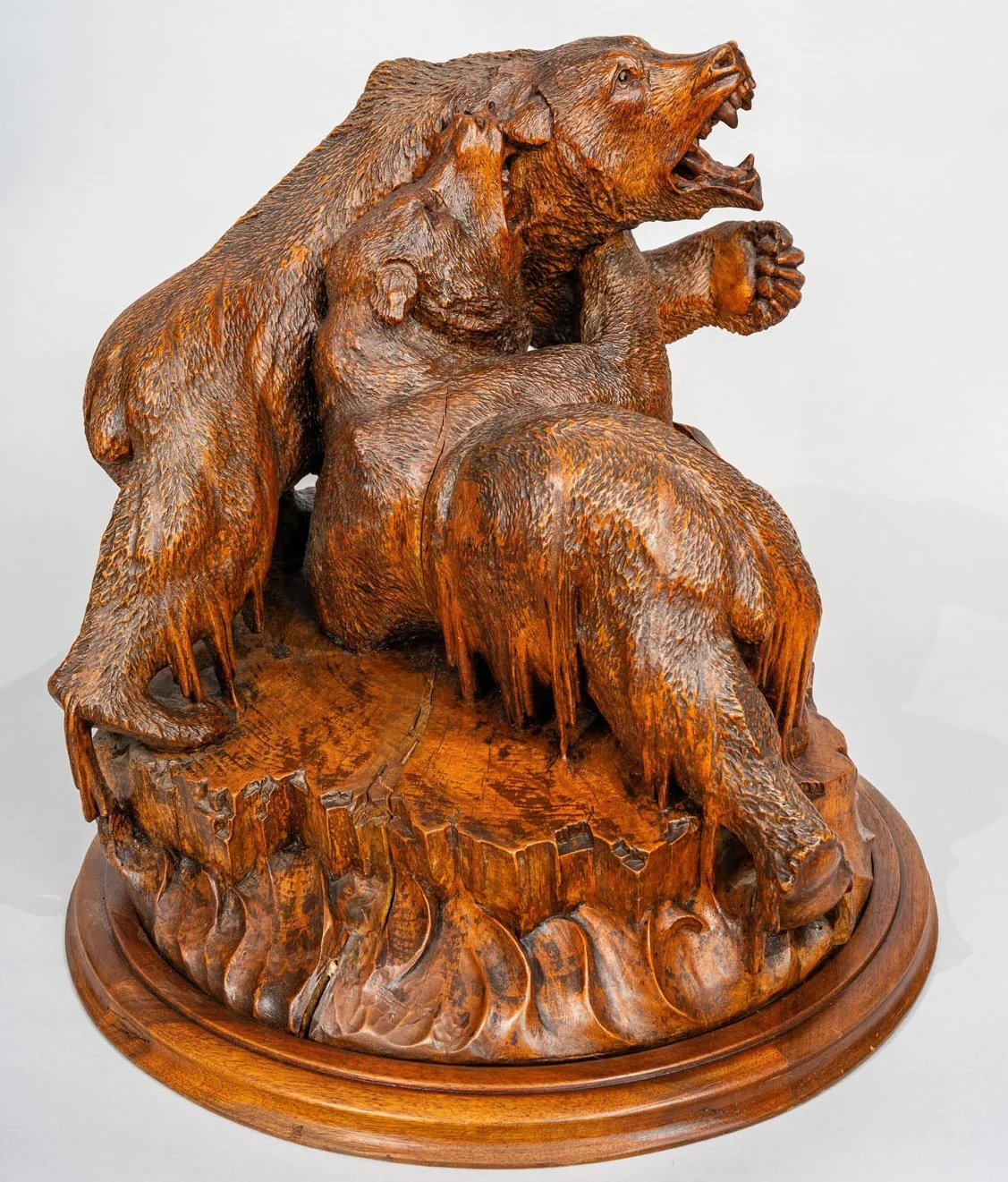
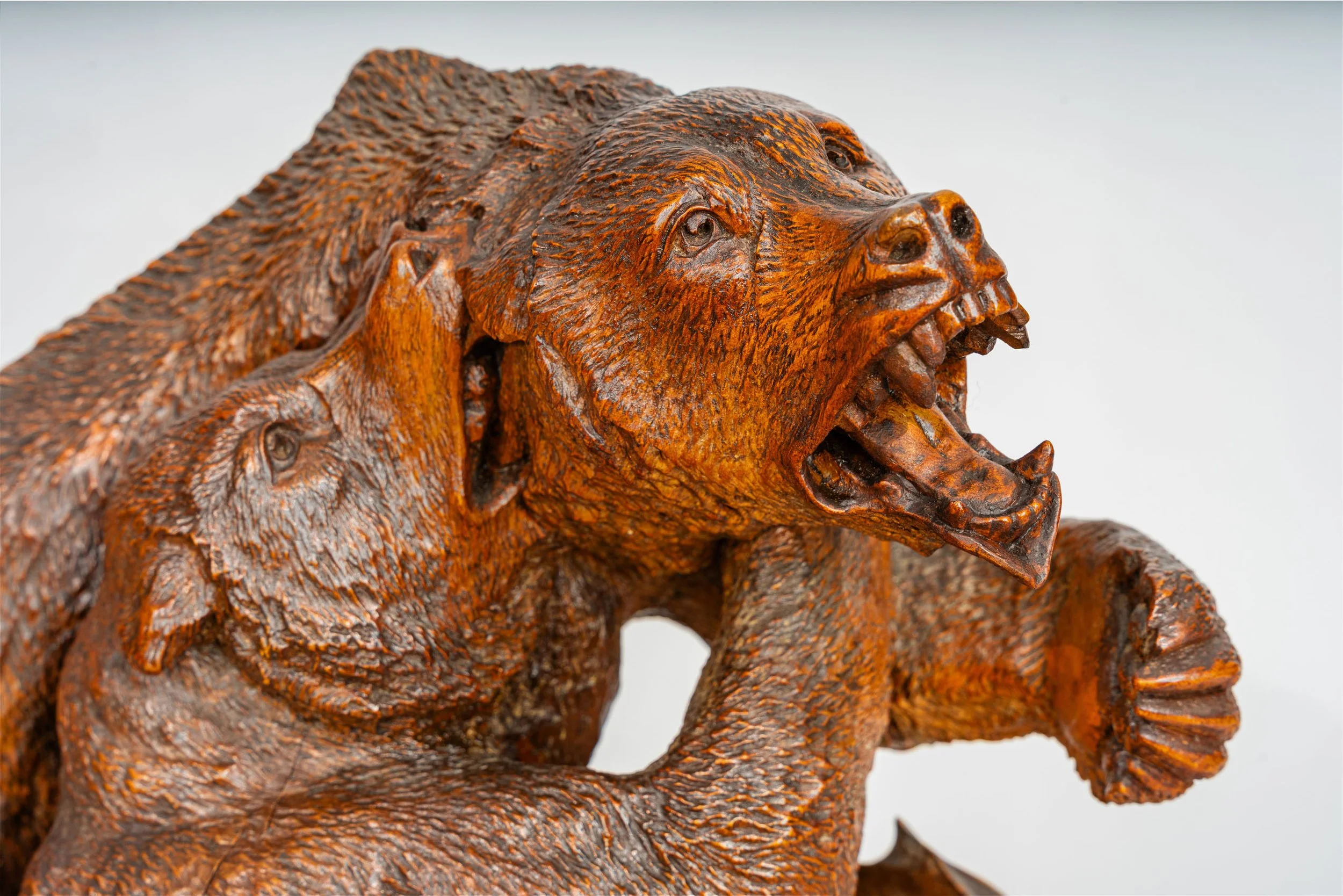
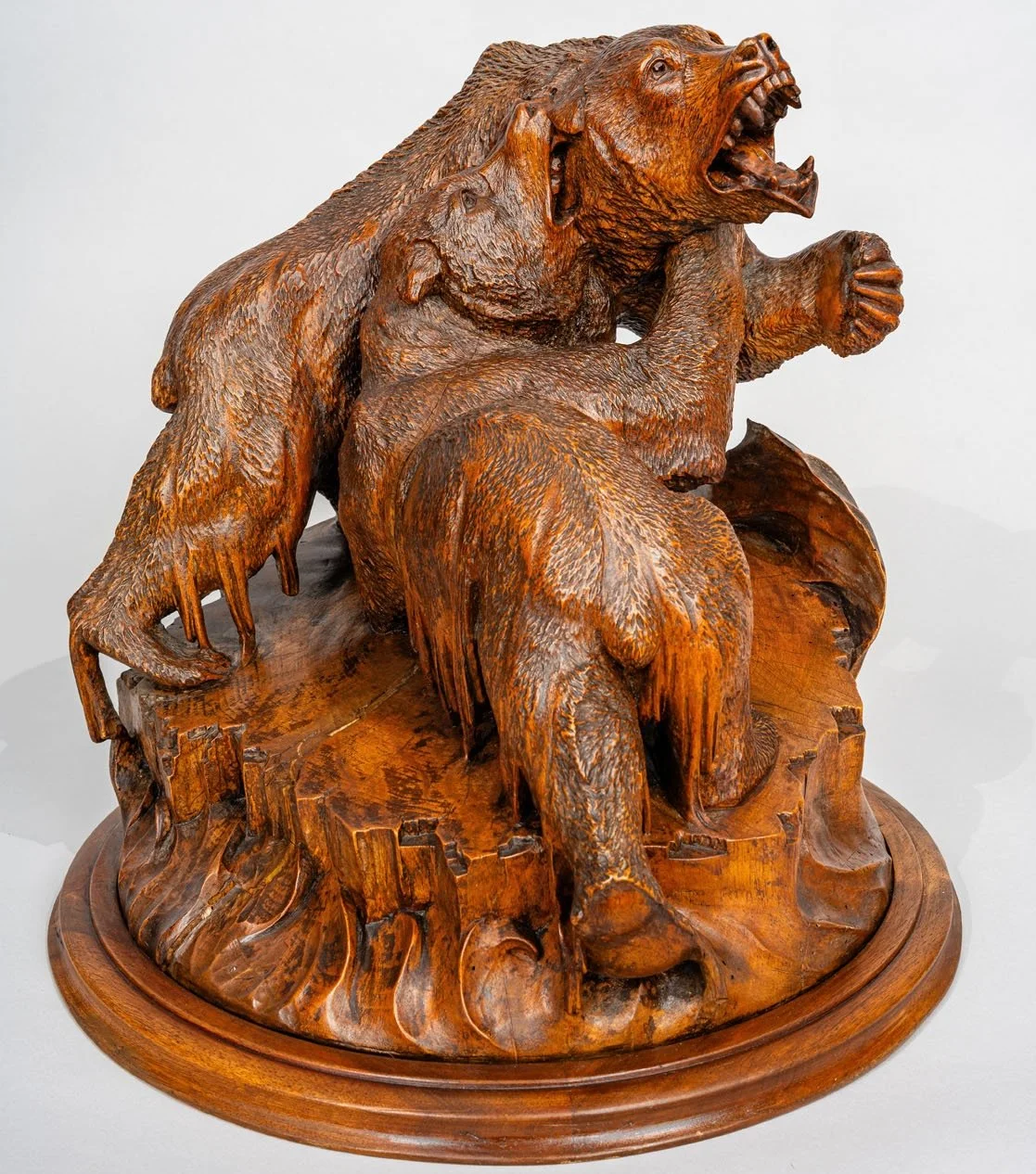
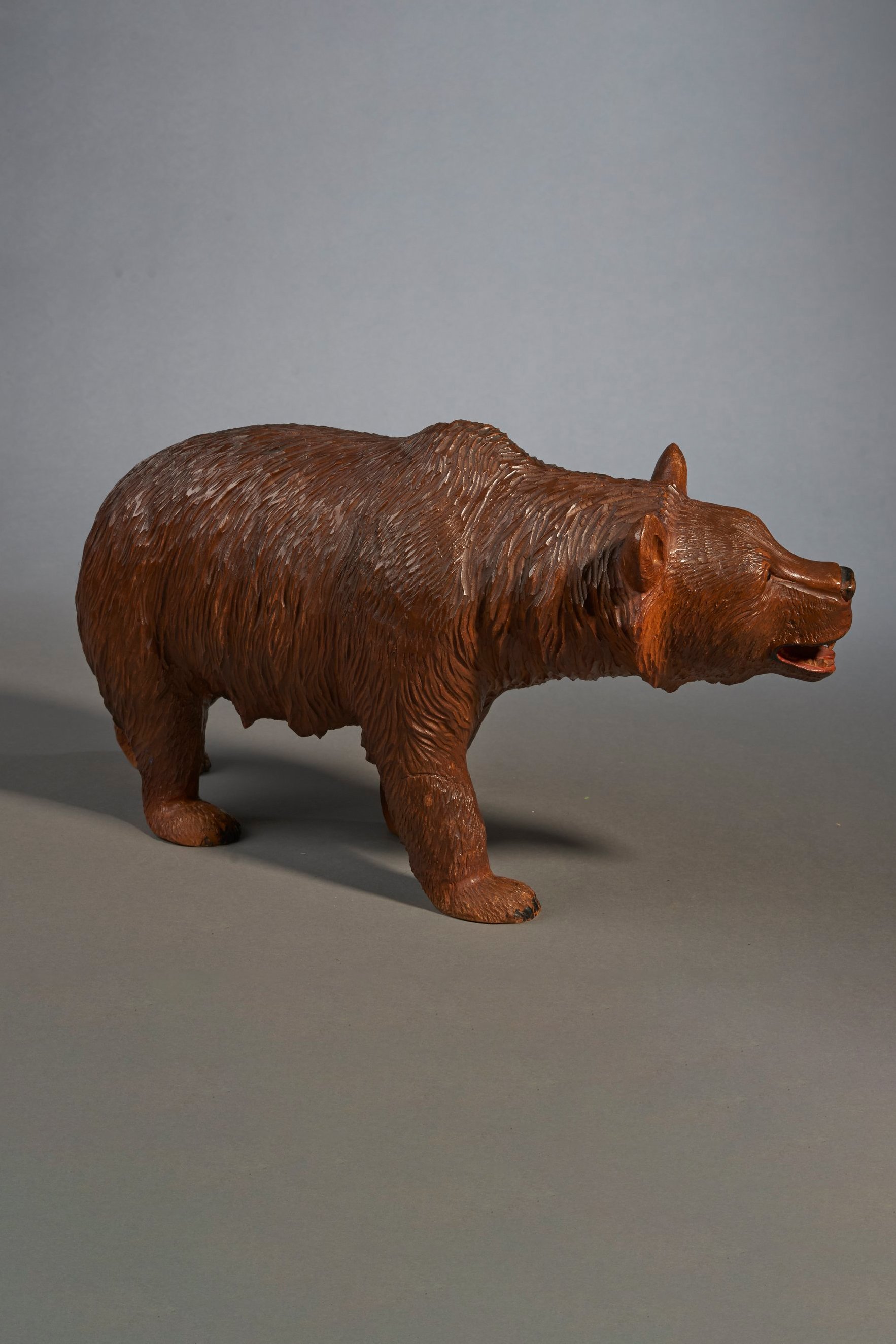
The present example, dating to circa 1880 and executed in linden wood by the Brienz workshops at the height of their powers, is a piece of exceptional quality and completeness. The back is centred by a standing bear, carved fully in the round and raised on the back splat as though emerging from the forest behind — his fur deeply worked in the characteristic incised and layered technique of the finest Brienz carving, his posture confident and alert. Around him, the back is framed within an arched canopy of intertwined branches and deeply undercut oak leaves, the acorns and foliage rendered with the botanical precision that distinguishes the best workshop production from the merely competent. The crest rail is a composition in its own right — gnarled timber, carved branches crossing and recrossing, the whole forming a naturalistic arch that provides the standing bear with a setting of complete conviction.
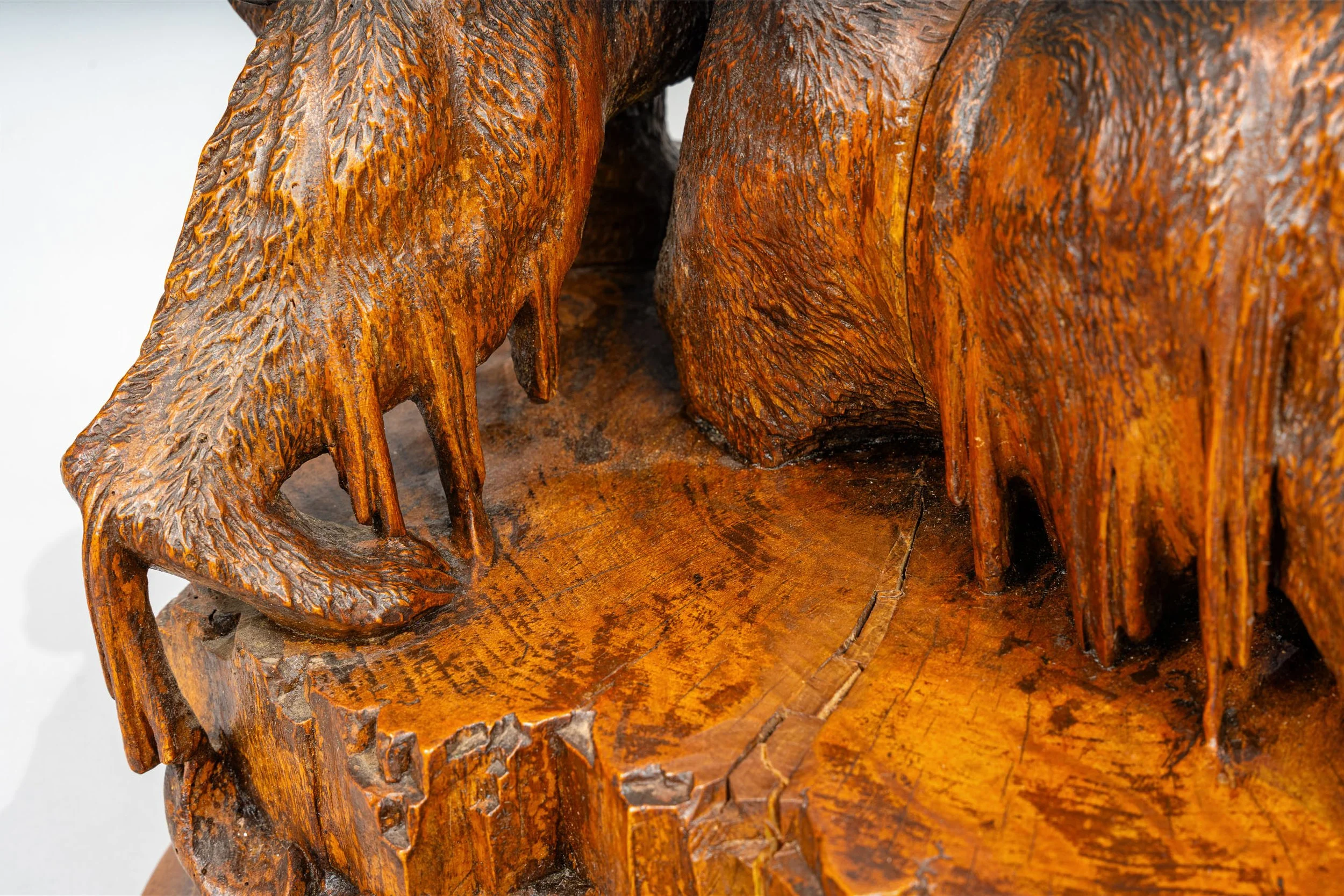
The arms are fashioned as gnarled tree limbs — the branch-work handled with the same confidence as the back, the surface texture of bark and knots rendered throughout with an attention to naturalistic detail that makes the structural elements inseparable from the decorative. The front legs carry the composition's most charming narrative detail: a bear cub climbing each leg, the small figures carved with the same quality of observation as the presiding bear above, their paws gripping the timber of the legs with the concentrated effort of young animals entirely absorbed in the business of ascent.
The seat is carved with a landscape or forest floor scene in low relief — a detail that ensures every surface of the chair participates in the overall composition. The seat rail is carved with oak leaf and foliate ornament in the characteristic Brienz manner. The rear legs are simpler in treatment, providing a resolved and stable base for the elaborately carved front.
A closely related example is illustrated in Swiss Carvings: The Art of the Black Forest, 1820–1940 by Jay Arenski, Simon Daniels, and Michael Daniels (p. 142), confirming the rarity and desirability of elaborate figural furniture of this type — objects produced for the great exhibitions and for the most ambitious private commissions of the late nineteenth century, and collected today as among the most distinctive and characterful pieces that the Swiss tradition produced.
Material: Linden wood Circa: 1880
Condition: Very good overall. Linden wood structurally sound and fully functional as a seat. Central standing bear on back splat fully intact — fur carving crisp and complete. Arched canopy of branches and oak leaves intact throughout — no losses to foliage, acorns, or branch elements. Branch-work arms structurally sound. Climbing bear cubs on front legs present and intact on both legs. Carved seat landscape scene present and legible. Seat rail foliate carving intact. Rich, deep patina consistent with age and quality of original surface.
Literature:
Jay Arenski, Simon Daniels, and Michael Daniels, Swiss Carvings: The Art of the Black Forest, 1820–1940, 2006, p. 142
Swiss Black Forest furniture occupies a category of its own within the decorative arts of the nineteenth century — objects that transform the functional into the fully sculptural, in which every structural element becomes an opportunity for carving and every surface a field for narrative. The bear armchair is the supreme expression of this ambition: a form in which the chair itself disappears into a composition of branches, foliage, climbing cubs, and the presiding figure of the bear, and in which the act of sitting becomes an act of inhabiting a carved forest.
The present example, dating to circa 1880 and executed in linden wood by the Brienz workshops at the height of their powers, is a piece of exceptional quality and completeness. The back is centred by a standing bear, carved fully in the round and raised on the back splat as though emerging from the forest behind — his fur deeply worked in the characteristic incised and layered technique of the finest Brienz carving, his posture confident and alert. Around him, the back is framed within an arched canopy of intertwined branches and deeply undercut oak leaves, the acorns and foliage rendered with the botanical precision that distinguishes the best workshop production from the merely competent. The crest rail is a composition in its own right — gnarled timber, carved branches crossing and recrossing, the whole forming a naturalistic arch that provides the standing bear with a setting of complete conviction.
The arms are fashioned as gnarled tree limbs — the branch-work handled with the same confidence as the back, the surface texture of bark and knots rendered throughout with an attention to naturalistic detail that makes the structural elements inseparable from the decorative. The front legs carry the composition's most charming narrative detail: a bear cub climbing each leg, the small figures carved with the same quality of observation as the presiding bear above, their paws gripping the timber of the legs with the concentrated effort of young animals entirely absorbed in the business of ascent.
The seat is carved with a landscape or forest floor scene in low relief — a detail that ensures every surface of the chair participates in the overall composition. The seat rail is carved with oak leaf and foliate ornament in the characteristic Brienz manner. The rear legs are simpler in treatment, providing a resolved and stable base for the elaborately carved front.
A closely related example is illustrated in Swiss Carvings: The Art of the Black Forest, 1820–1940 by Jay Arenski, Simon Daniels, and Michael Daniels (p. 142), confirming the rarity and desirability of elaborate figural furniture of this type — objects produced for the great exhibitions and for the most ambitious private commissions of the late nineteenth century, and collected today as among the most distinctive and characterful pieces that the Swiss tradition produced.
Material: Linden wood Circa: 1880
Condition: Very good overall. Linden wood structurally sound and fully functional as a seat. Central standing bear on back splat fully intact — fur carving crisp and complete. Arched canopy of branches and oak leaves intact throughout — no losses to foliage, acorns, or branch elements. Branch-work arms structurally sound. Climbing bear cubs on front legs present and intact on both legs. Carved seat landscape scene present and legible. Seat rail foliate carving intact. Rich, deep patina consistent with age and quality of original surface.
Literature:
Jay Arenski, Simon Daniels, and Michael Daniels, Swiss Carvings: The Art of the Black Forest, 1820–1940, 2006, p. 142

 Image 1 of 2
 Image 2 of 2