A powerful and technically accomplished sculptural group depicting two yoked oxen straining in harness, their shared effort conveyed through the pronounced forward lean of both animals, the taut lines of the wooden yoke between them, and the carver's acute observation of musculature under tension. The composition is animated by contrast: the rear ox stands with head raised, neck extended beneath the yoke bar, while the lead ox drives forward with head lowered and legs braced, the strain of the load registered across every surface of his body. A carved cart wheel and chain complete the working context, grounding the group in the agricultural life of the Swiss alpine valleys that the Brienz carvers knew intimately.
The carving throughout is of exceptional quality. The coats of both animals are rendered through dense, directional tool marks that differentiate the smooth flanks from the rougher growth around the poll, dewlap, and ears. The hooves, muzzles, and horn forms are precisely observed, and the facial expressions — one straining forward, one upturned and alert — convey individual character within a unified composition. The naturalistic oval base is carved with field grasses and ground texture, situating the animals in their working environment without distracting from the figures themselves.
The group is attributed to Johann Huggler of Brienz (1834–1912), the foremost figure in the Brienz carving tradition, based on its close correspondence with documented examples of his work. Huggler's yoked cattle subjects are among the most closely studied of his works. In Swiss Carvings: The Art of the Black Forest, 1820–1940, a directly comparable group of yoked cattle on a naturalistic base — stamped J. Huggler of Brienz, c.1870 — is illustrated at fig. 121, p. 85, alongside an original preparatory charcoal sketch attributed to Huggler himself (fig. 120), demonstrating the discipline of study and design that underpinned his finest work. The present group, larger in scale and more elaborate in composition than the published example, represents the subject at a higher level of ambition.
Huggler exhibited at the great international expositions of the era — the Exposition Universelle in Paris in 1867 and 1900, and the World's Columbian Exposition in Chicago in 1893 — where his work attracted the attention of collectors and institutions worldwide. His cattle subjects are among the most sought-after of his productions, and examples of this quality and scale are seldom encountered on the market.
Condition: Very good overall. Walnut retains a warm, even original patina throughout. Carving is complete and crisply preserved across both figures, the yoke, cart wheel, chain, and naturalistic base. Minor surface wear consistent with age and handling; no significant losses or restorations observed.
Dimensions: 17”width x 15”depth x 15.5”height
Literature: Jay Arenski, Simon Daniels, and Michael Daniels, Swiss Carvings: The Art of the Black Forest, 1820–1940 (2006), figs. 120–121, pp. 84–85 (comparable group and preparatory sketch illustrated).
A powerful and technically accomplished sculptural group depicting two yoked oxen straining in harness, their shared effort conveyed through the pronounced forward lean of both animals, the taut lines of the wooden yoke between them, and the carver's acute observation of musculature under tension. The composition is animated by contrast: the rear ox stands with head raised, neck extended beneath the yoke bar, while the lead ox drives forward with head lowered and legs braced, the strain of the load registered across every surface of his body. A carved cart wheel and chain complete the working context, grounding the group in the agricultural life of the Swiss alpine valleys that the Brienz carvers knew intimately.
The carving throughout is of exceptional quality. The coats of both animals are rendered through dense, directional tool marks that differentiate the smooth flanks from the rougher growth around the poll, dewlap, and ears. The hooves, muzzles, and horn forms are precisely observed, and the facial expressions — one straining forward, one upturned and alert — convey individual character within a unified composition. The naturalistic oval base is carved with field grasses and ground texture, situating the animals in their working environment without distracting from the figures themselves.
The group is attributed to Johann Huggler of Brienz (1834–1912), the foremost figure in the Brienz carving tradition, based on its close correspondence with documented examples of his work. Huggler's yoked cattle subjects are among the most closely studied of his works. In Swiss Carvings: The Art of the Black Forest, 1820–1940, a directly comparable group of yoked cattle on a naturalistic base — stamped J. Huggler of Brienz, c.1870 — is illustrated at fig. 121, p. 85, alongside an original preparatory charcoal sketch attributed to Huggler himself (fig. 120), demonstrating the discipline of study and design that underpinned his finest work. The present group, larger in scale and more elaborate in composition than the published example, represents the subject at a higher level of ambition.
Huggler exhibited at the great international expositions of the era — the Exposition Universelle in Paris in 1867 and 1900, and the World's Columbian Exposition in Chicago in 1893 — where his work attracted the attention of collectors and institutions worldwide. His cattle subjects are among the most sought-after of his productions, and examples of this quality and scale are seldom encountered on the market.
Condition: Very good overall. Walnut retains a warm, even original patina throughout. Carving is complete and crisply preserved across both figures, the yoke, cart wheel, chain, and naturalistic base. Minor surface wear consistent with age and handling; no significant losses or restorations observed.
Dimensions: 17”width x 15”depth x 15.5”height
Literature: Jay Arenski, Simon Daniels, and Michael Daniels, Swiss Carvings: The Art of the Black Forest, 1820–1940 (2006), figs. 120–121, pp. 84–85 (comparable group and preparatory sketch illustrated).

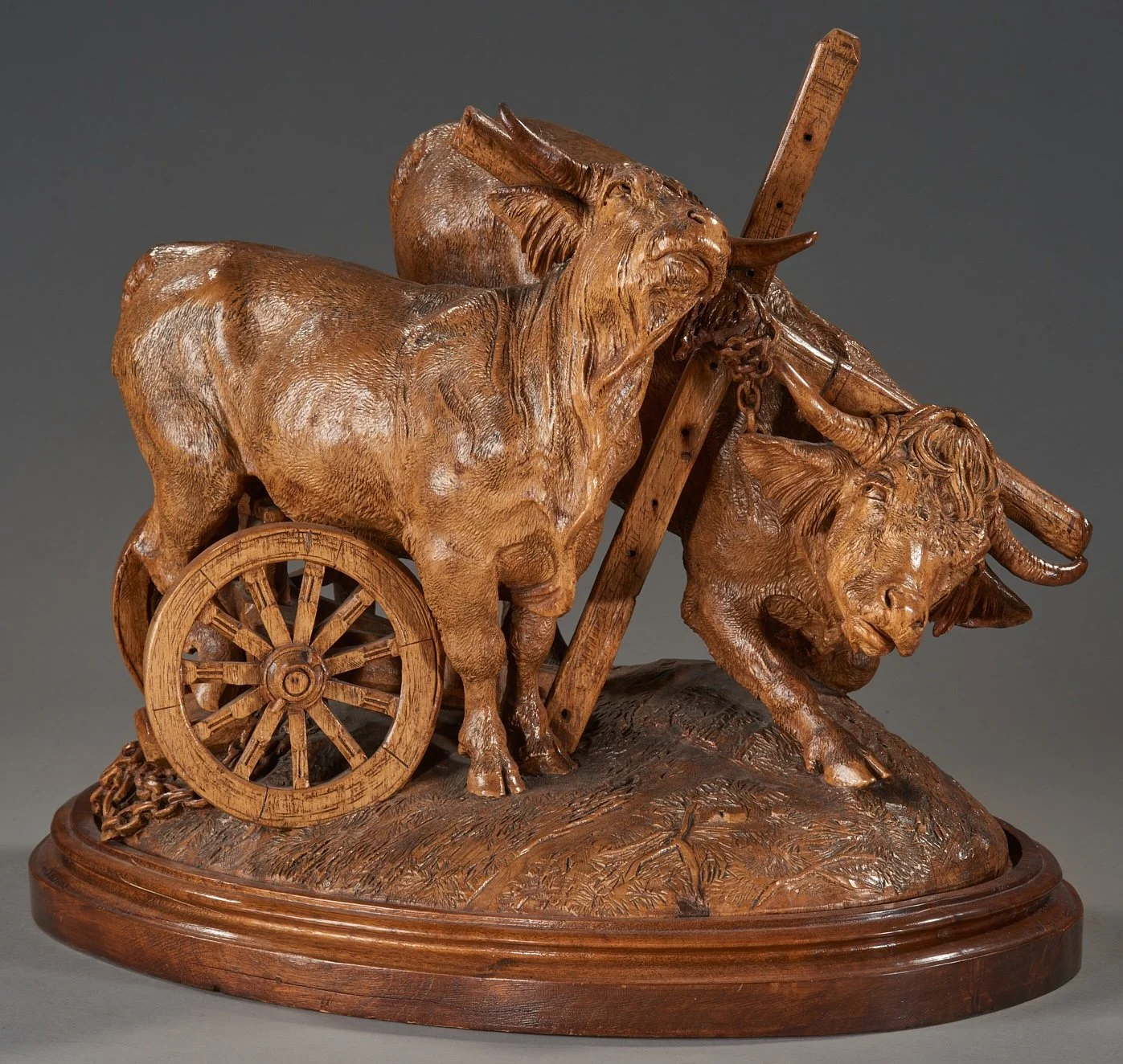 Image 1 of 5
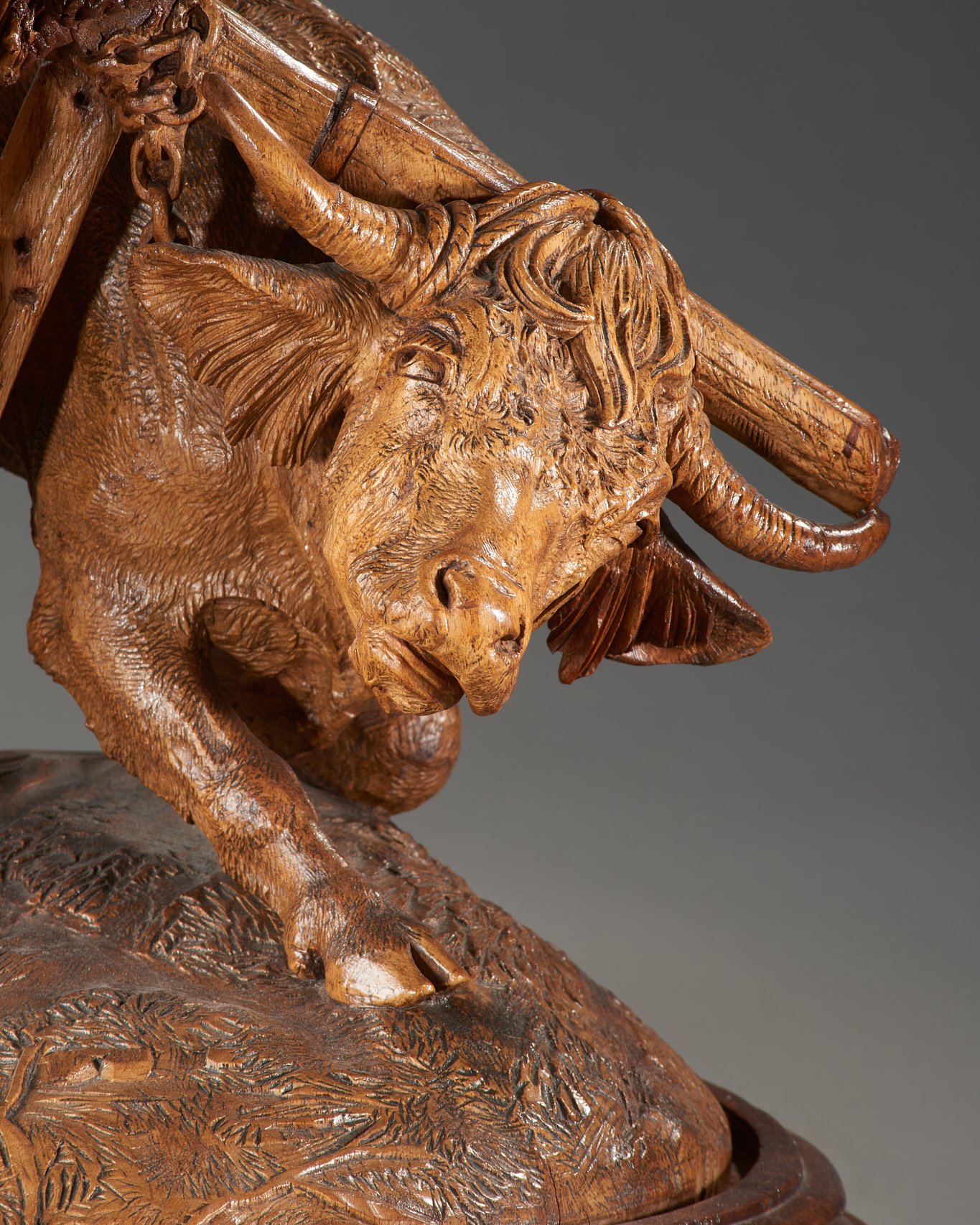 Image 2 of 5
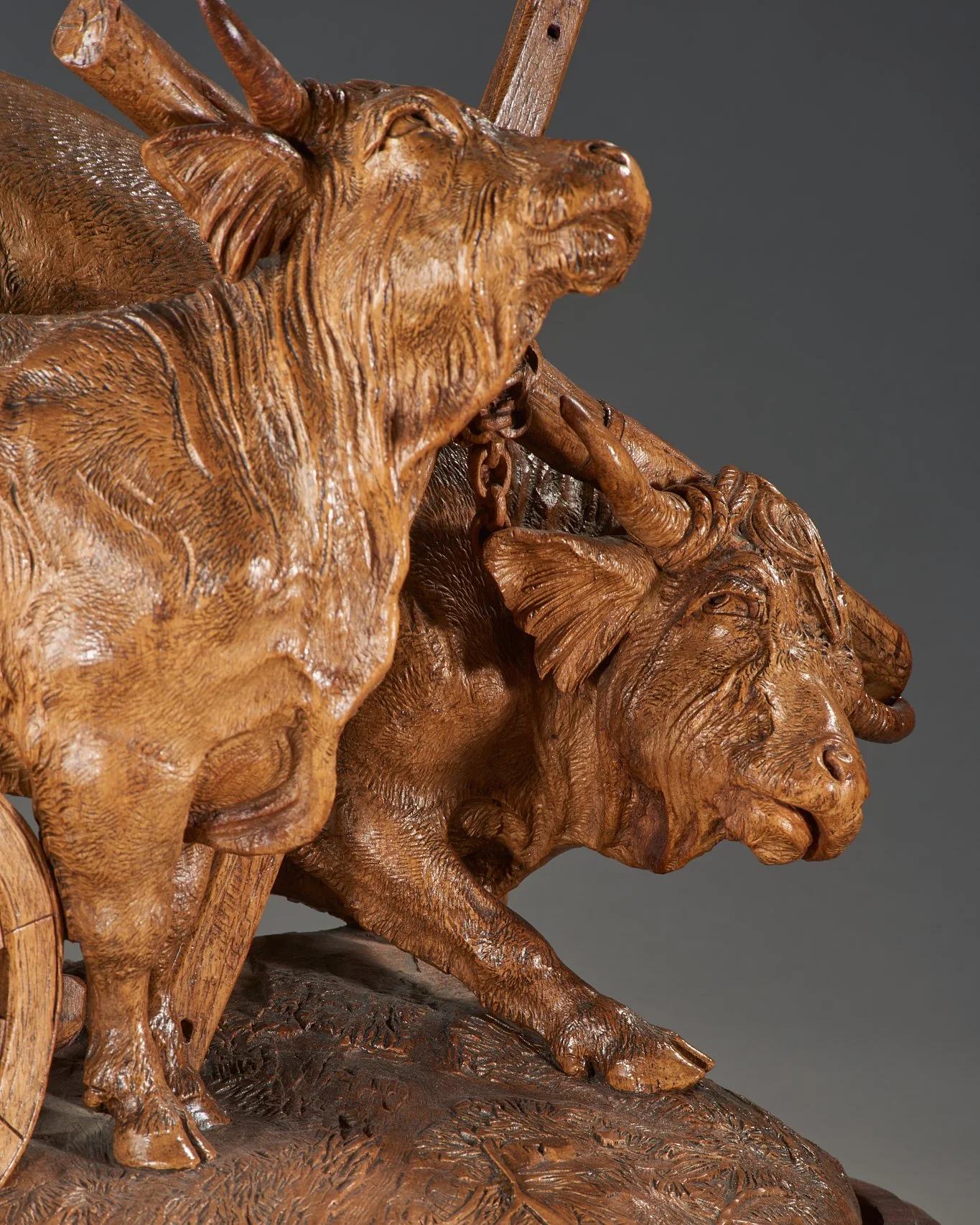 Image 3 of 5
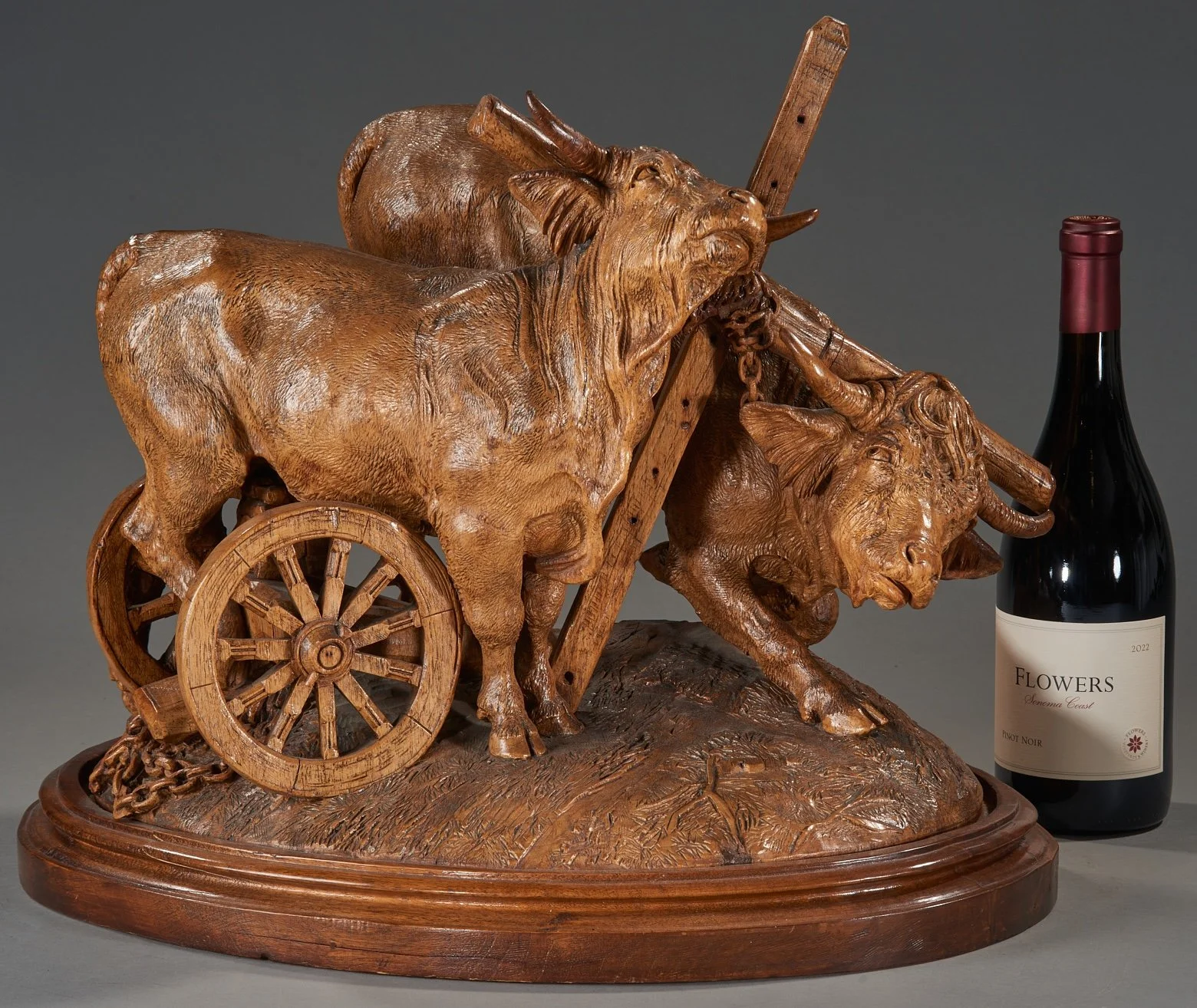 Image 4 of 5
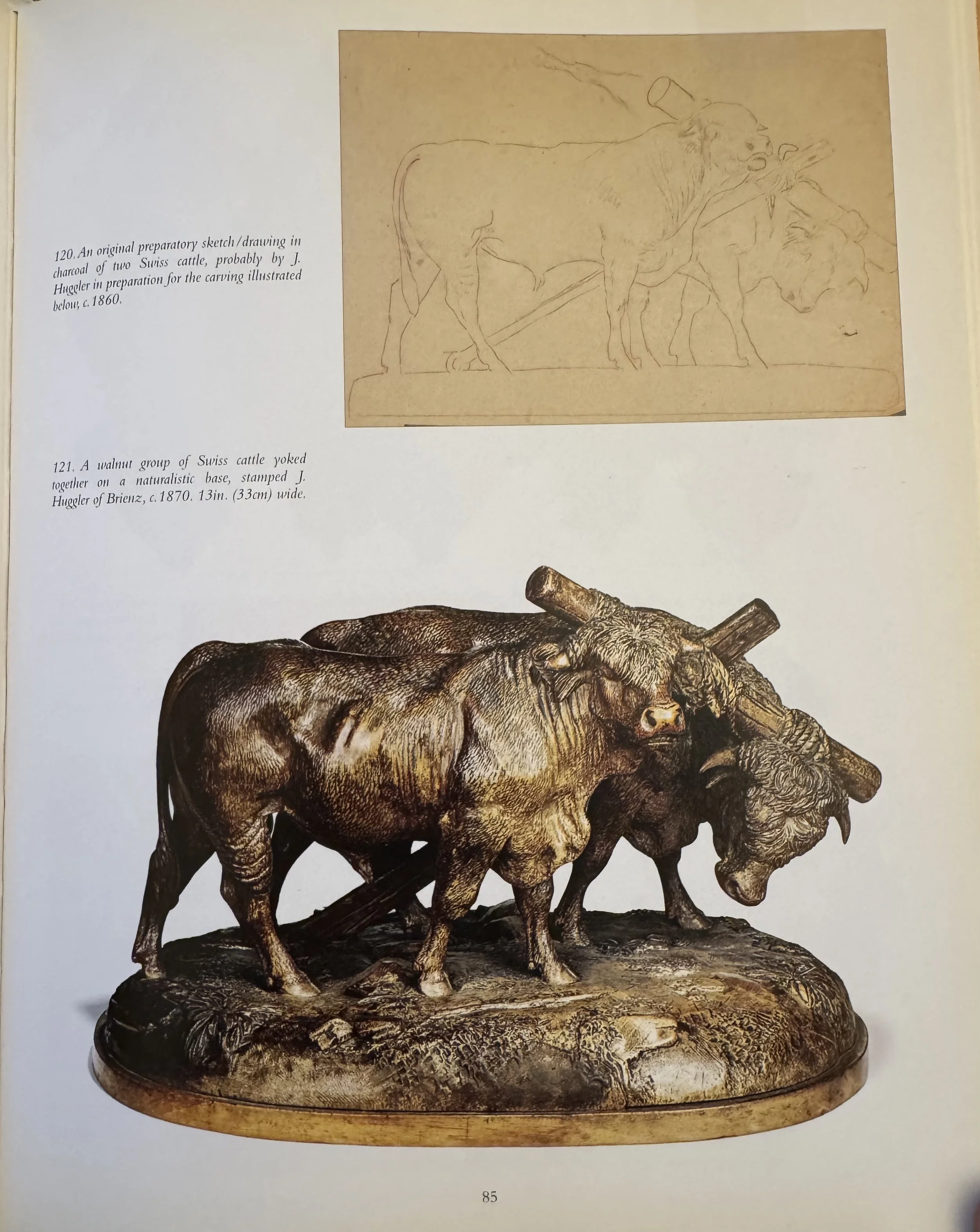 Image 5 of 5