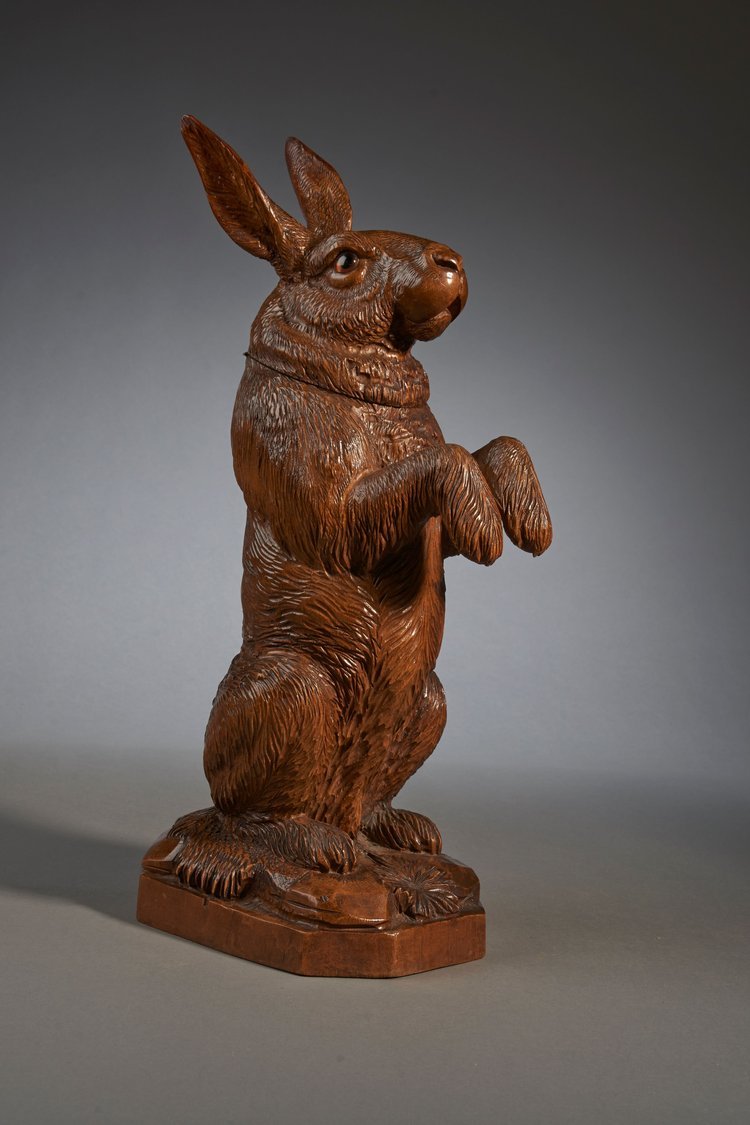
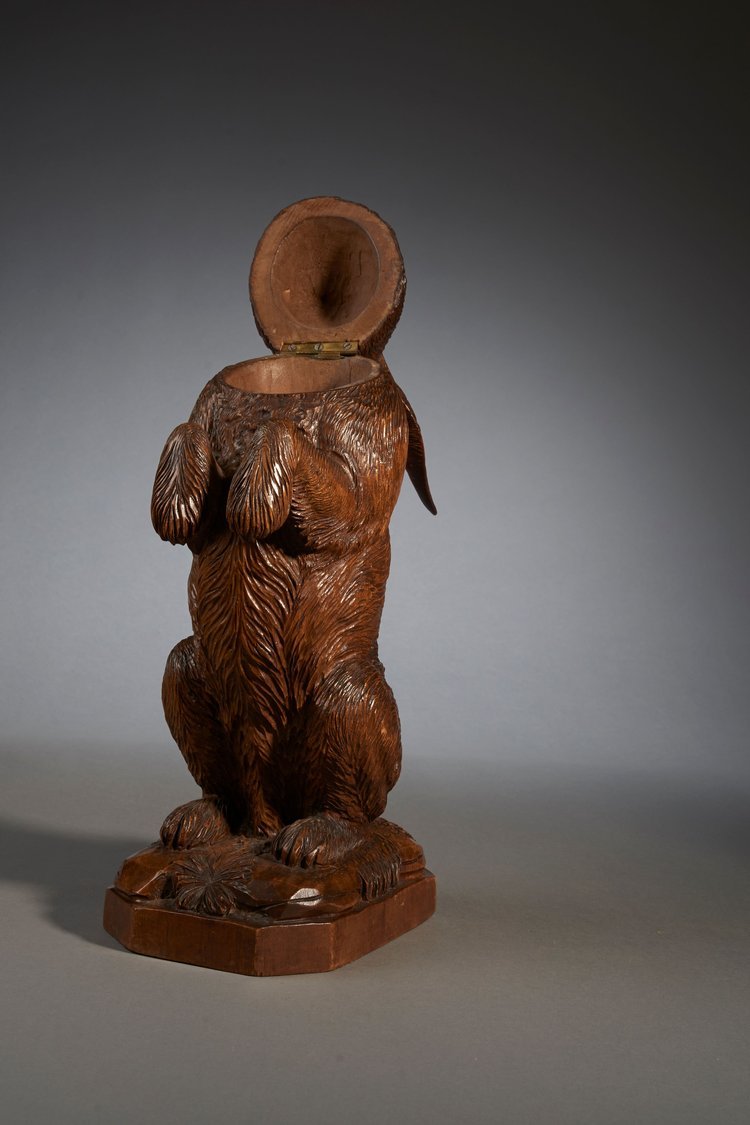
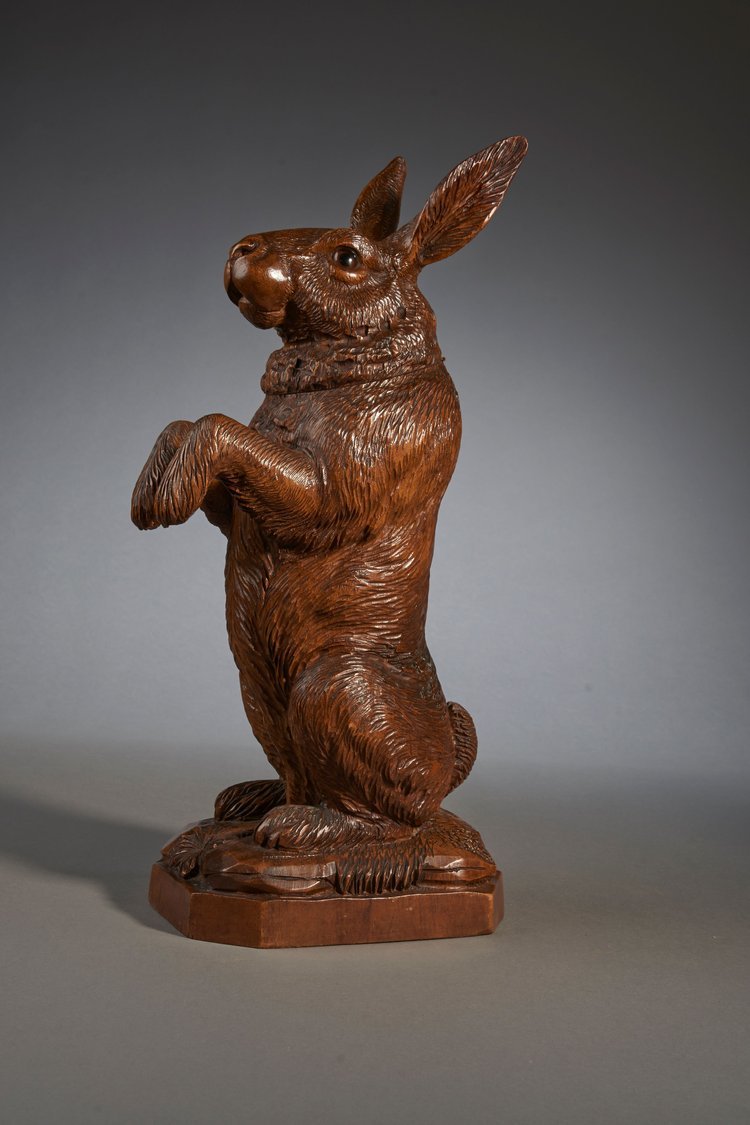
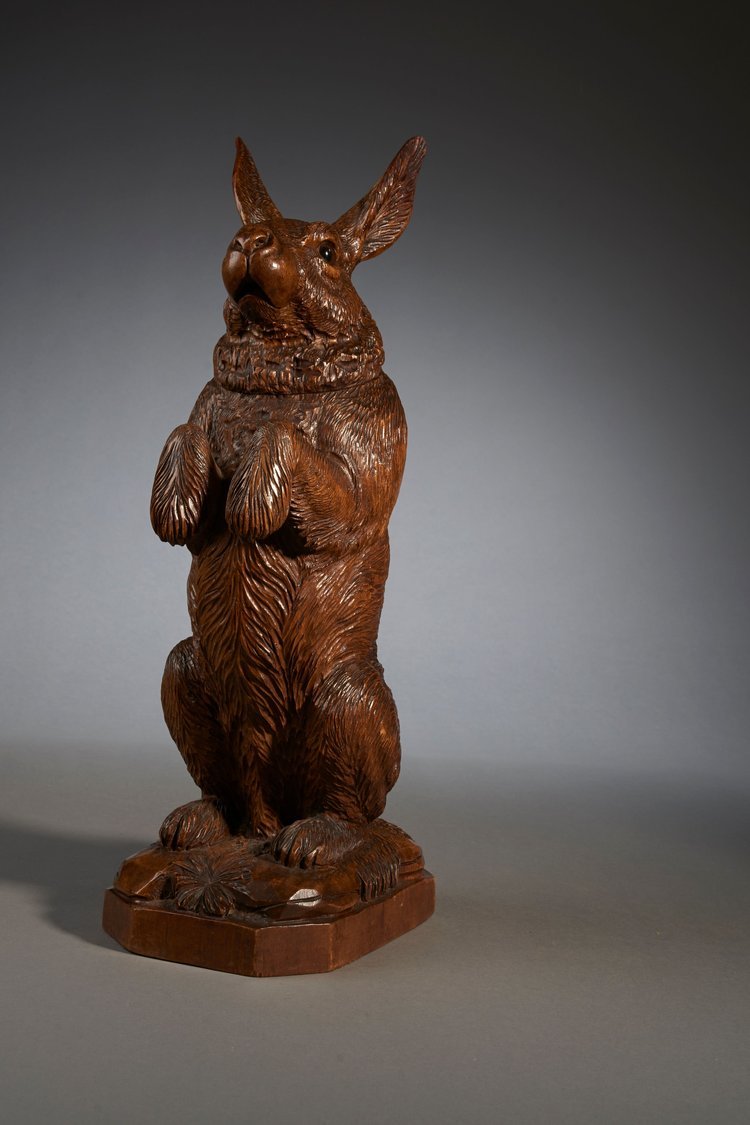
A life-sized carved mountain maple St. Bernard umbrella stand by Walter Mader of Brienz, circa 1870, is among the most accomplished examples of his celebrated dog carvings.
Walter Mader and his son Heinrich were the pre-eminent dog carvers of the entire Black Forest tradition, their understanding of canine anatomy, character, and expression placing their work in a category apart from all contemporaries. As noted in Swiss Carvings: The Art of the Black Forest, 1820–1940, their ability to capture a dog's expression and movement compares favorably with that of the great French bronze animalier sculptors Mêne, Barye, and Jaquemart. The St. Bernard — the great rescue animal of the Alpine passes, whose combination of massive physical presence and legendary gentleness had made it one of the most celebrated animals in the world by the second half of the nineteenth century — was a natural subject for a carver of Mader's ambitions and Alpine sensibility.
The figure depicts a life-sized St. Bernard standing alert on a naturalistic rocky base, head turned with the watchful, attentive readiness characteristic of the working breed. The massive head is rendered with exceptional anatomical precision — the heavy jowls, broad muzzle, and the breed's characteristic facial markings rendered through Mader's distinctive polychrome staining technique, bringing the dog's expression to life with exceptional naturalism. The long coat of the flanks and hindquarters is worked in flowing, directional strokes, while the shorter fur of the muzzle and forelegs is handled with corresponding precision. The collar is carved and rendered in a naturalistic style throughout.
Mountain maple — chosen by Mader for its fine, close grain and its capacity for sustained precision on a large scale — provides both the material authority and the warm, rich surface that his staining technique demanded. A gnarled tree stump forms the compositional backdrop, its branch structure wrapping above to support the umbrellas, the functional receptacle integrated into the base with characteristic ingenuity. The naturalistic base is carved with rocky ground, roots, and alpine flora of considerable delicacy.
Condition: Very good, commensurate with age. Mountain maple is structurally sound throughout. Polychrome staining present and well-preserved, reflecting the originality of the piece. Fur carving is crisp across all surfaces. Collar, raised foreleg, and tree stump backdrop with branch structure all intact. Umbrella receptacle present at the base. Rocky naturalistic base with alpine flora intact. Rich warm patina consistent with Mader workshop production.
Literature: Jay Arenski, Simon Daniels and Michael Daniels, Swiss Carvings: The Art of the Black Forest, 1820–1940, Antique Collectors' Club, Woodbridge, Suffolk, 2006 — see pp. 114–117 for comparable Mader dog umbrella stands and extended discussion of the Mader workshop.
A life-sized carved mountain maple St. Bernard umbrella stand by Walter Mader of Brienz, circa 1870, is among the most accomplished examples of his celebrated dog carvings.
Walter Mader and his son Heinrich were the pre-eminent dog carvers of the entire Black Forest tradition, their understanding of canine anatomy, character, and expression placing their work in a category apart from all contemporaries. As noted in Swiss Carvings: The Art of the Black Forest, 1820–1940, their ability to capture a dog's expression and movement compares favorably with that of the great French bronze animalier sculptors Mêne, Barye, and Jaquemart. The St. Bernard — the great rescue animal of the Alpine passes, whose combination of massive physical presence and legendary gentleness had made it one of the most celebrated animals in the world by the second half of the nineteenth century — was a natural subject for a carver of Mader's ambitions and Alpine sensibility.
The figure depicts a life-sized St. Bernard standing alert on a naturalistic rocky base, head turned with the watchful, attentive readiness characteristic of the working breed. The massive head is rendered with exceptional anatomical precision — the heavy jowls, broad muzzle, and the breed's characteristic facial markings rendered through Mader's distinctive polychrome staining technique, bringing the dog's expression to life with exceptional naturalism. The long coat of the flanks and hindquarters is worked in flowing, directional strokes, while the shorter fur of the muzzle and forelegs is handled with corresponding precision. The collar is carved and rendered in a naturalistic style throughout.
Mountain maple — chosen by Mader for its fine, close grain and its capacity for sustained precision on a large scale — provides both the material authority and the warm, rich surface that his staining technique demanded. A gnarled tree stump forms the compositional backdrop, its branch structure wrapping above to support the umbrellas, the functional receptacle integrated into the base with characteristic ingenuity. The naturalistic base is carved with rocky ground, roots, and alpine flora of considerable delicacy.
Condition: Very good, commensurate with age. Mountain maple is structurally sound throughout. Polychrome staining present and well-preserved, reflecting the originality of the piece. Fur carving is crisp across all surfaces. Collar, raised foreleg, and tree stump backdrop with branch structure all intact. Umbrella receptacle present at the base. Rocky naturalistic base with alpine flora intact. Rich warm patina consistent with Mader workshop production.
Literature: Jay Arenski, Simon Daniels and Michael Daniels, Swiss Carvings: The Art of the Black Forest, 1820–1940, Antique Collectors' Club, Woodbridge, Suffolk, 2006 — see pp. 114–117 for comparable Mader dog umbrella stands and extended discussion of the Mader workshop.

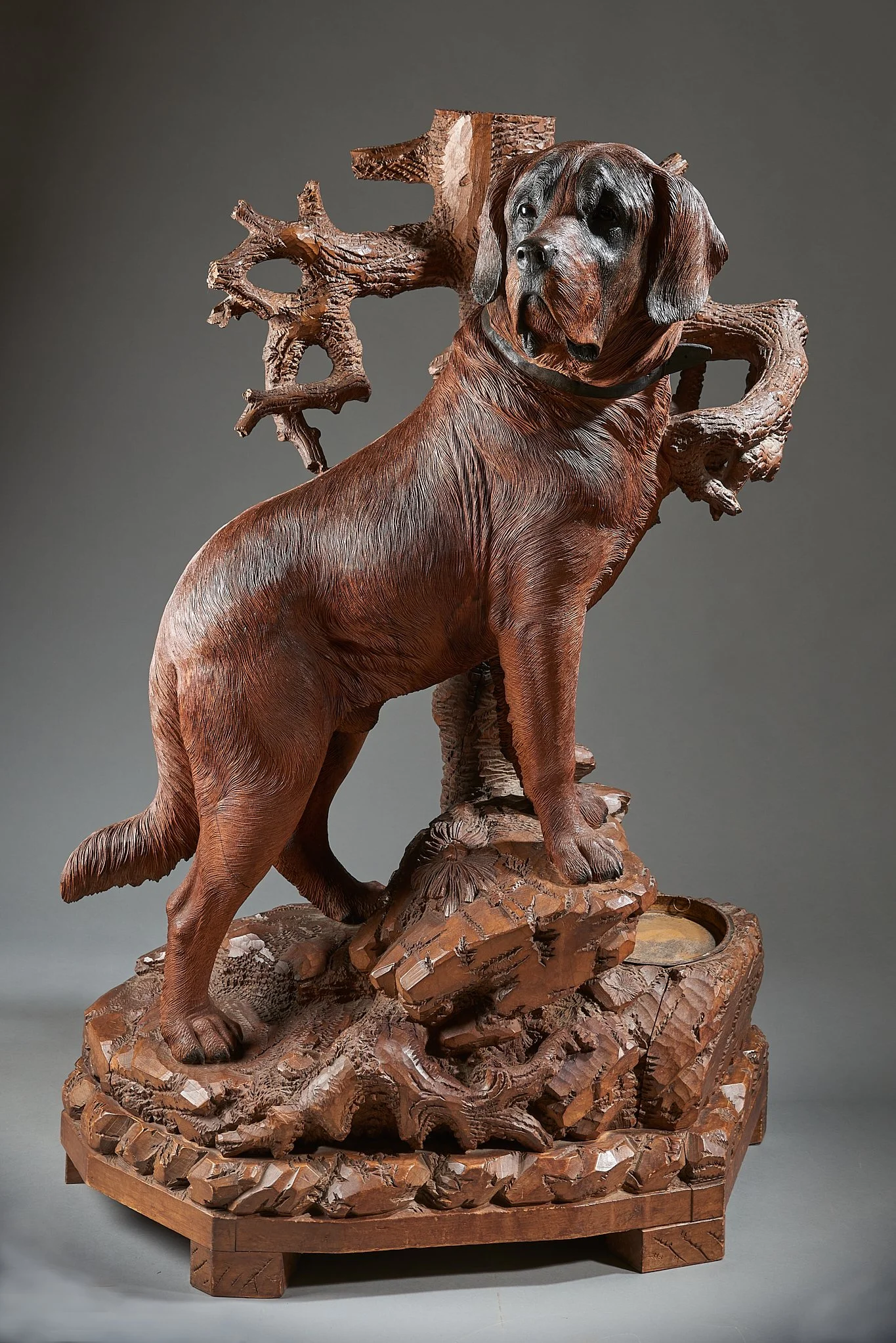 Image 1 of 3
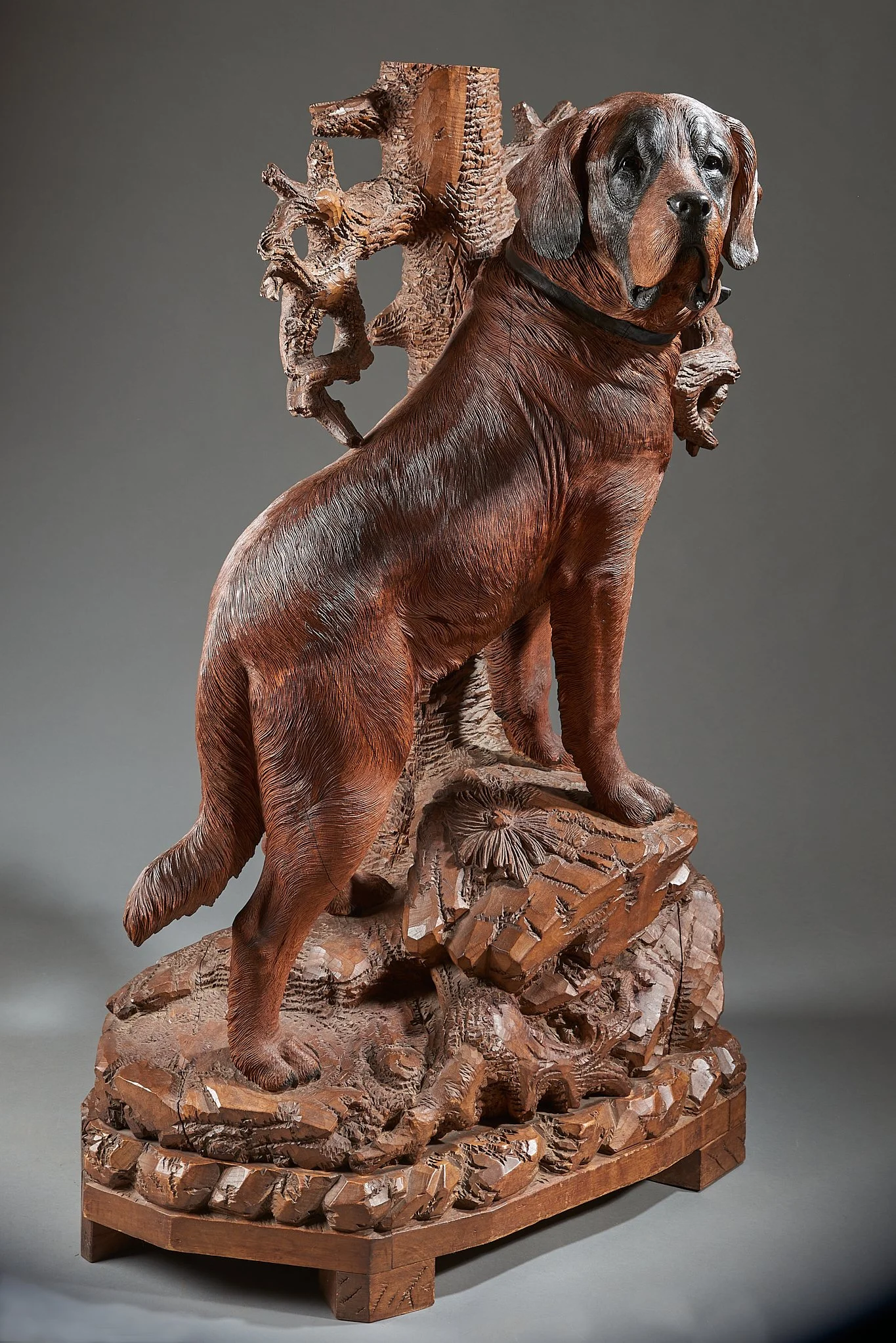 Image 2 of 3
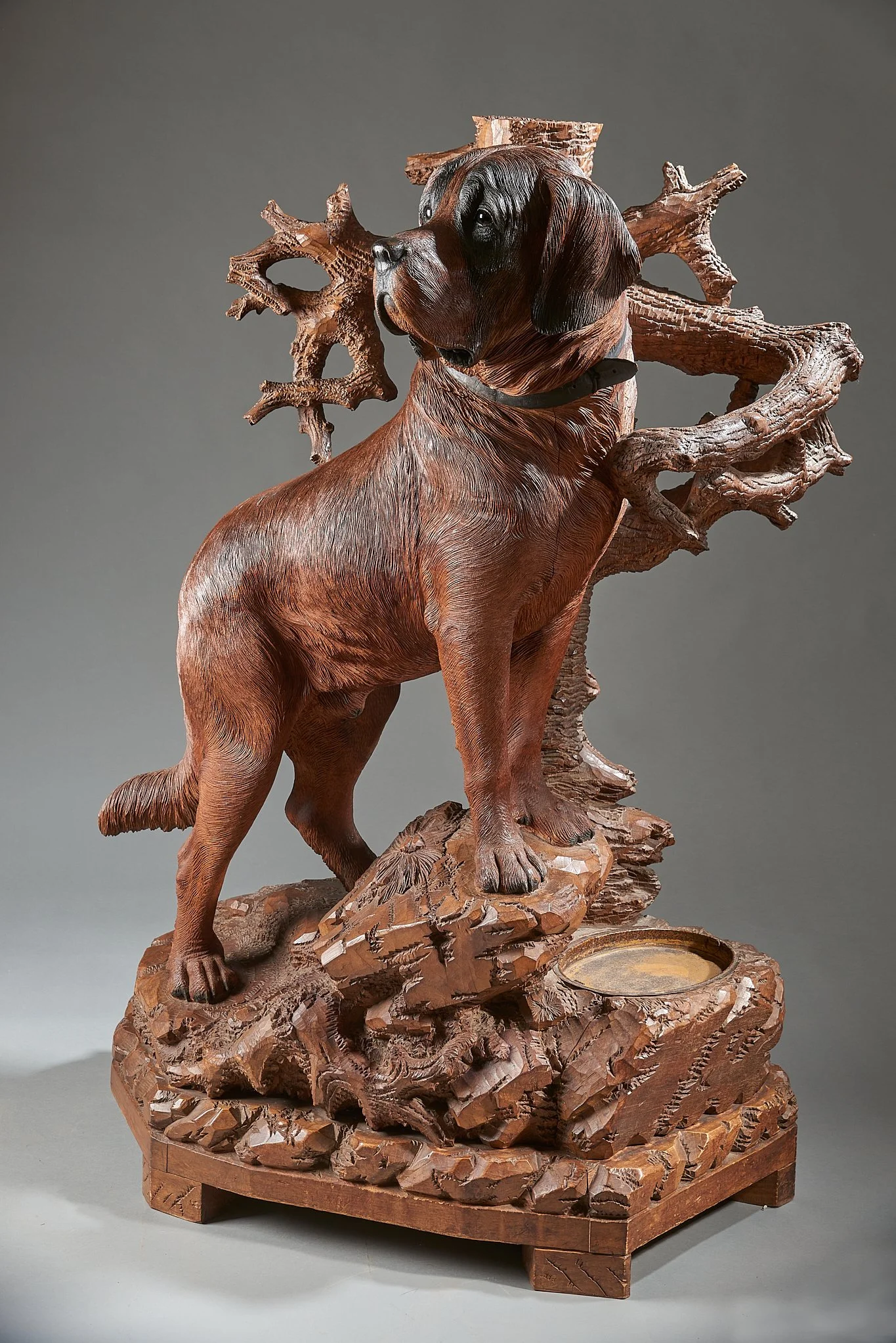 Image 3 of 3