A monumental carving of a bellowing red deer stag, standing in full arrest with head raised and mouth open at the height of the rut, one of the most demanding subjects in the Brienz repertoire. It is worked in linden wood on a base of rocky Alpine terrain, the coat articulated across the entire surface in dense, directional tool marks that shift in depth and orientation from the neck mane to the flank, the musculature of the shoulders and haunches modeled with sculptural authority. The eyes are inset glass, a hallmark of the finest Brienz work; the open mouth has a painted interior, and the separately made antlers render each tine, burr, and beam with naturalistic precision.
The pose is one of three through which the workshops defined the red deer, alongside the startled stag, alert upon detecting danger, and the Monarch of the Glen, statant after Landseer's painting of 1851. All three are documented in the standard reference on the subject: Huggler Frères exhibited both a Monarch of the Glen and a stag of the present pose at the Paris international exhibition of 1900, reproduced in The Art Journal Illustrated Catalog of that year, and a life-size example of the startled pose, c.1870, completes the record. The present carving invites direct comparison with that exhibited stag, singled out by contemporary reviewers as a quite remarkable piece of realistic work.
Though unsigned, it is consistent with the leading Brienz workshops of the closing decades of the nineteenth century, when firms of this rank, Ed. Binder & Co. among them, supplied the great country houses of Britain and the collectors of the Gilded Age. Carvings of this scale and quality are rarely encountered today.
Condition: Excellent. Minor historic repairs to the antlers, consistent with age and handling. Warm, even patina throughout.
Dimensions: 35 in. length x 10 in. depth x 34 in. height
Literature: Jay Arenski, Simon Daniels and Michael Daniels, Swiss Carvings: The Art of the Black Forest, 1820–1940, 2006, cf. figs. 51–52, p. 54 (Huggler Frères, Paris 1900); fig. 115, p. 82 (life-size startled stag, c.1870)
A monumental carving of a bellowing red deer stag, standing in full arrest with head raised and mouth open at the height of the rut, one of the most demanding subjects in the Brienz repertoire. It is worked in linden wood on a base of rocky Alpine terrain, the coat articulated across the entire surface in dense, directional tool marks that shift in depth and orientation from the neck mane to the flank, the musculature of the shoulders and haunches modeled with sculptural authority. The eyes are inset glass, a hallmark of the finest Brienz work; the open mouth has a painted interior, and the separately made antlers render each tine, burr, and beam with naturalistic precision.
The pose is one of three through which the workshops defined the red deer, alongside the startled stag, alert upon detecting danger, and the Monarch of the Glen, statant after Landseer's painting of 1851. All three are documented in the standard reference on the subject: Huggler Frères exhibited both a Monarch of the Glen and a stag of the present pose at the Paris international exhibition of 1900, reproduced in The Art Journal Illustrated Catalog of that year, and a life-size example of the startled pose, c.1870, completes the record. The present carving invites direct comparison with that exhibited stag, singled out by contemporary reviewers as a quite remarkable piece of realistic work.
Though unsigned, it is consistent with the leading Brienz workshops of the closing decades of the nineteenth century, when firms of this rank, Ed. Binder & Co. among them, supplied the great country houses of Britain and the collectors of the Gilded Age. Carvings of this scale and quality are rarely encountered today.
Condition: Excellent. Minor historic repairs to the antlers, consistent with age and handling. Warm, even patina throughout.
Dimensions: 35 in. length x 10 in. depth x 34 in. height
Literature: Jay Arenski, Simon Daniels and Michael Daniels, Swiss Carvings: The Art of the Black Forest, 1820–1940, 2006, cf. figs. 51–52, p. 54 (Huggler Frères, Paris 1900); fig. 115, p. 82 (life-size startled stag, c.1870)

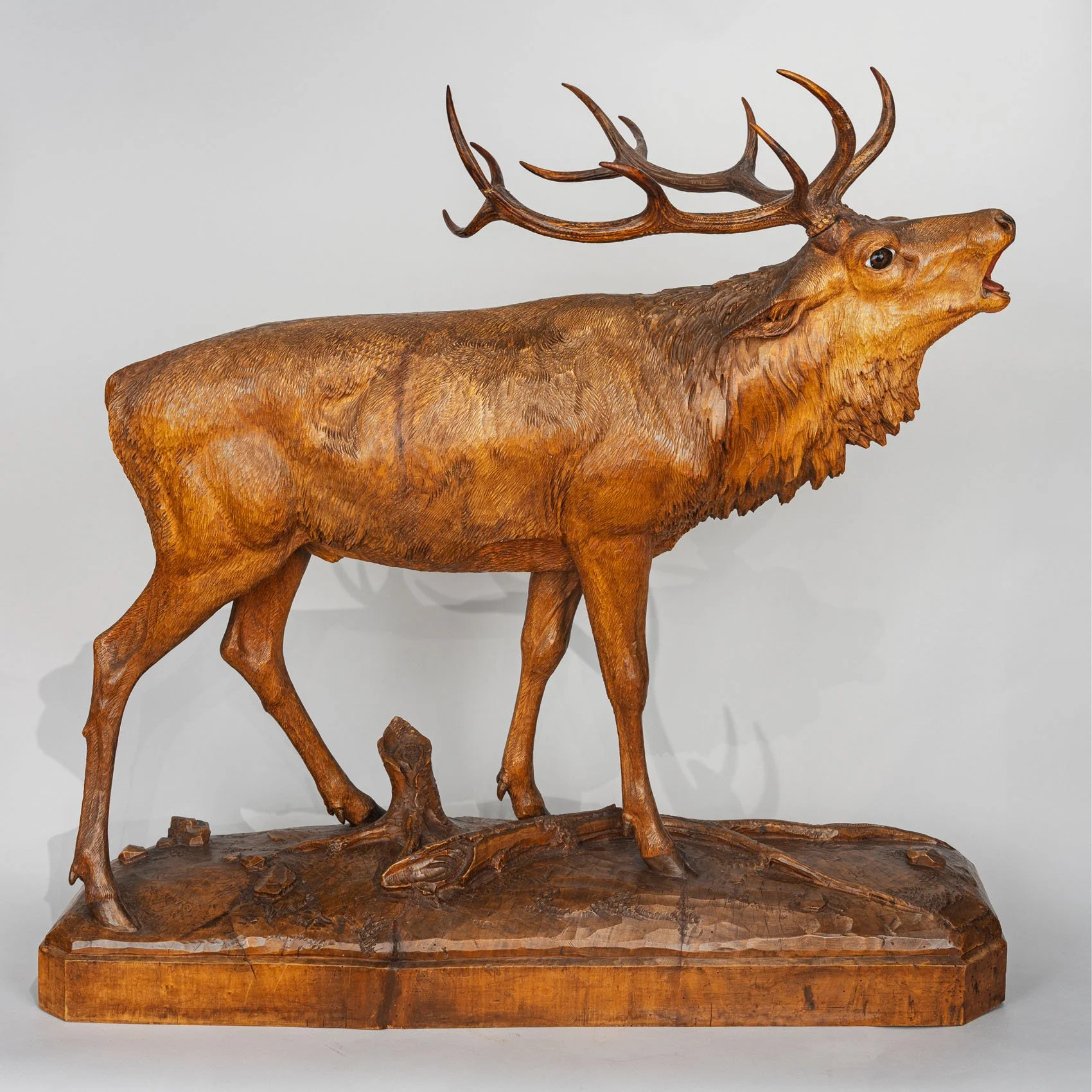 Image 1 of 3
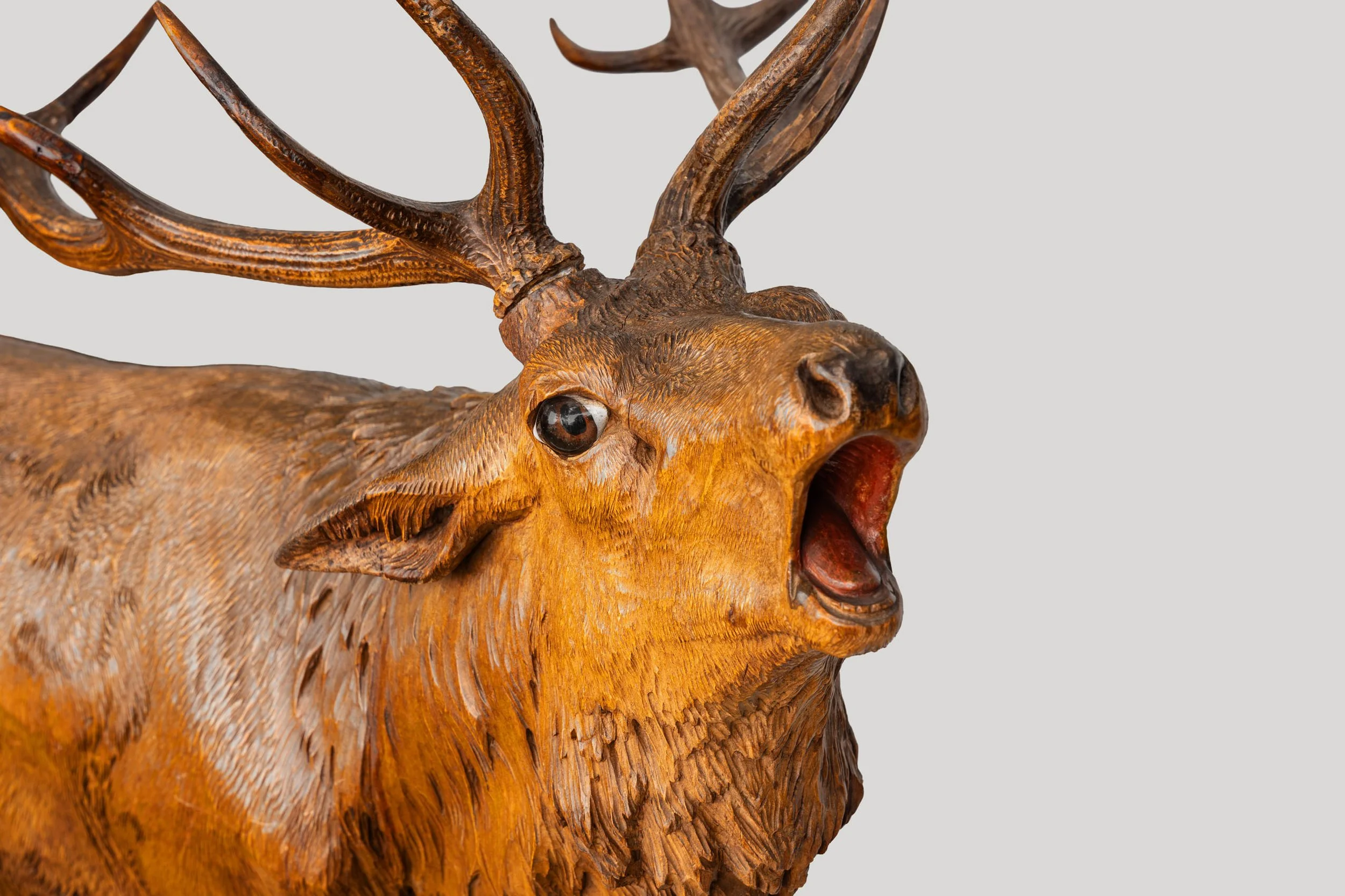 Image 2 of 3
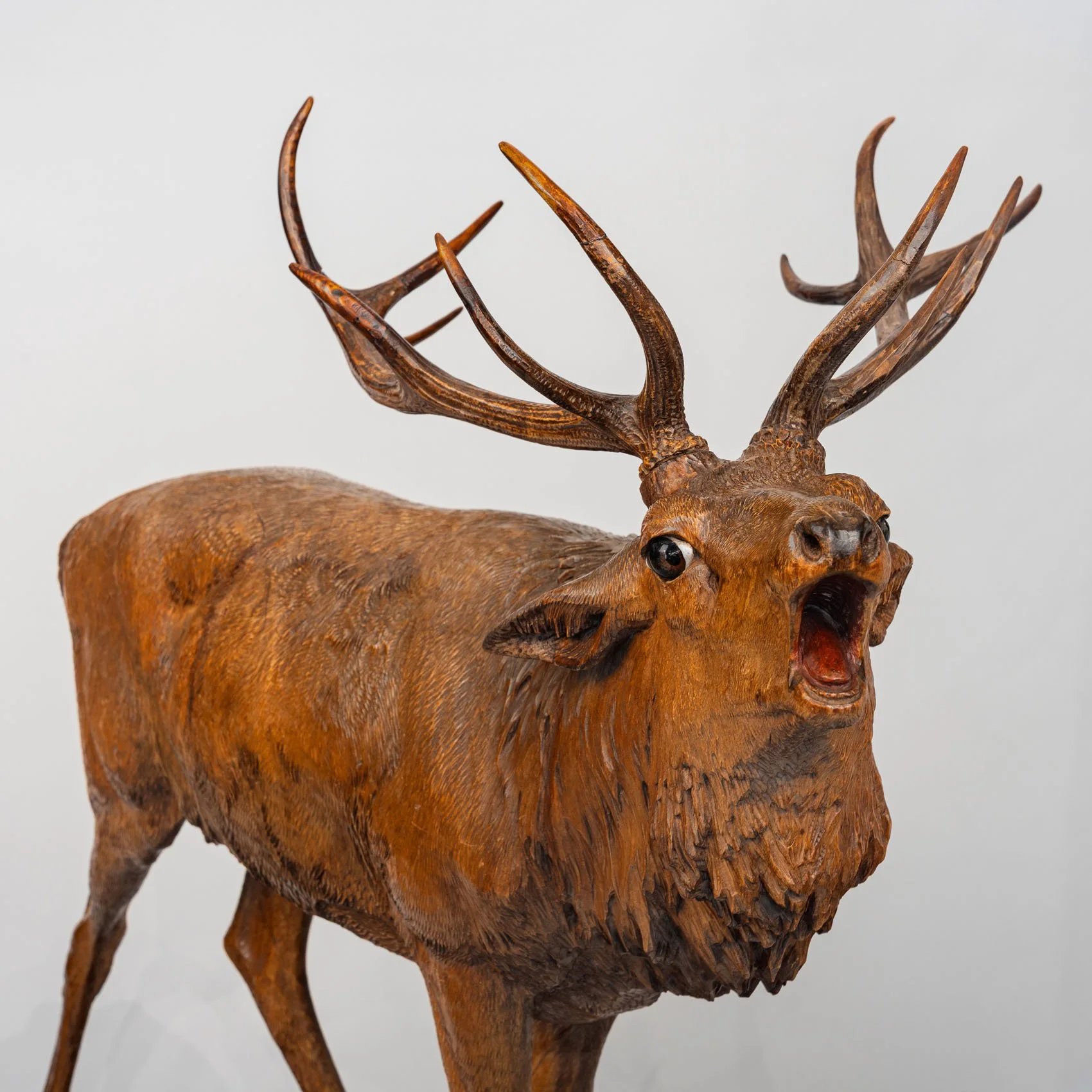 Image 3 of 3