If the standing bear on his hind legs represents Swiss Black Forest carving in its most theatrical register — the animal at the moment of maximum drama — then the walking bear is its counterpart in restraint: a subject that asks more of the carver, not less. Here the challenge is not power or confrontation but movement, weight, and the quiet truth of an animal at ease in its own landscape. The bear in mid-stride, head slightly extended, jaws just parted as if scenting the air, is a composition that rewards the eye in proportion to the skill with which it is observed — and the present example is observed with considerable skill.
The figure is carved fully in the round in linden wood, the bear depicted in a natural walking pose with the characteristic rolling gait of the species conveyed through the displacement of weight between the fore and hind quarters. The head is turned very slightly, the nose raised, the mouth parted just enough to reveal the tongue — a detail that animates the face without tipping the composition into drama. It is a moment of attentive movement, caught and held in wood with the assurance of a carver who has studied his subject closely.
The surface is worked throughout in finely incised fur, the strokes controlled and rhythmic, following the natural contours of the body — shorter and tighter across the muzzle and legs, longer and more fluid across the shoulders and flanks — in a manner that demonstrates both technical command and genuine anatomical understanding. The patina is a warm, honey-brown tone, lighter and less worked than the deep burnish of the exhibition-scale pieces, and entirely consistent with an unrestored example of this period in fine original condition. The four paws are well-resolved, the claws individually delineated, and the bear stands with a stability that speaks to the structural intelligence of the carver's approach to the pose.
As illustrated in Swiss Carvings: The Art of the Black Forest, 1820–1940 by Jay Arenski, Simon Daniels, and Michael Daniels (p. 75), walking bear studies of this type formed a core and consistently celebrated element of the Black Forest tradition — works prized by the international clientele who visited the Brienz workshops and the great exhibitions of the period for their realism, their craftsmanship, and the quiet authority with which the finest examples rendered the most iconic animal of the Swiss Alps. This example, in its restraint and its quality of observation, is characteristic of the tradition at its most accomplished.
Condition: Very good. Linden wood structurally sound throughout with no cracks or losses. Fur carving fully intact and crisp — incised strokes clean and well-preserved across all surfaces. Muzzle, tongue, and mouth detail intact. Claws individually delineated and intact on all four paws. Patina warm, even, and unrestored — the characteristic honey-brown tone of a well-preserved Brienz walking bear in original condition.
Literature:
Jay Arenski, Simon Daniels, and Michael Daniels, Swiss Carvings: The Art of the Black Forest, 1820–1940, 2006, p. 75
If the standing bear on his hind legs represents Swiss Black Forest carving in its most theatrical register — the animal at the moment of maximum drama — then the walking bear is its counterpart in restraint: a subject that asks more of the carver, not less. Here the challenge is not power or confrontation but movement, weight, and the quiet truth of an animal at ease in its own landscape. The bear in mid-stride, head slightly extended, jaws just parted as if scenting the air, is a composition that rewards the eye in proportion to the skill with which it is observed — and the present example is observed with considerable skill.
The figure is carved fully in the round in linden wood, the bear depicted in a natural walking pose with the characteristic rolling gait of the species conveyed through the displacement of weight between the fore and hind quarters. The head is turned very slightly, the nose raised, the mouth parted just enough to reveal the tongue — a detail that animates the face without tipping the composition into drama. It is a moment of attentive movement, caught and held in wood with the assurance of a carver who has studied his subject closely.
The surface is worked throughout in finely incised fur, the strokes controlled and rhythmic, following the natural contours of the body — shorter and tighter across the muzzle and legs, longer and more fluid across the shoulders and flanks — in a manner that demonstrates both technical command and genuine anatomical understanding. The patina is a warm, honey-brown tone, lighter and less worked than the deep burnish of the exhibition-scale pieces, and entirely consistent with an unrestored example of this period in fine original condition. The four paws are well-resolved, the claws individually delineated, and the bear stands with a stability that speaks to the structural intelligence of the carver's approach to the pose.
As illustrated in Swiss Carvings: The Art of the Black Forest, 1820–1940 by Jay Arenski, Simon Daniels, and Michael Daniels (p. 75), walking bear studies of this type formed a core and consistently celebrated element of the Black Forest tradition — works prized by the international clientele who visited the Brienz workshops and the great exhibitions of the period for their realism, their craftsmanship, and the quiet authority with which the finest examples rendered the most iconic animal of the Swiss Alps. This example, in its restraint and its quality of observation, is characteristic of the tradition at its most accomplished.
Condition: Very good. Linden wood structurally sound throughout with no cracks or losses. Fur carving fully intact and crisp — incised strokes clean and well-preserved across all surfaces. Muzzle, tongue, and mouth detail intact. Claws individually delineated and intact on all four paws. Patina warm, even, and unrestored — the characteristic honey-brown tone of a well-preserved Brienz walking bear in original condition.
Literature:
Jay Arenski, Simon Daniels, and Michael Daniels, Swiss Carvings: The Art of the Black Forest, 1820–1940, 2006, p. 75

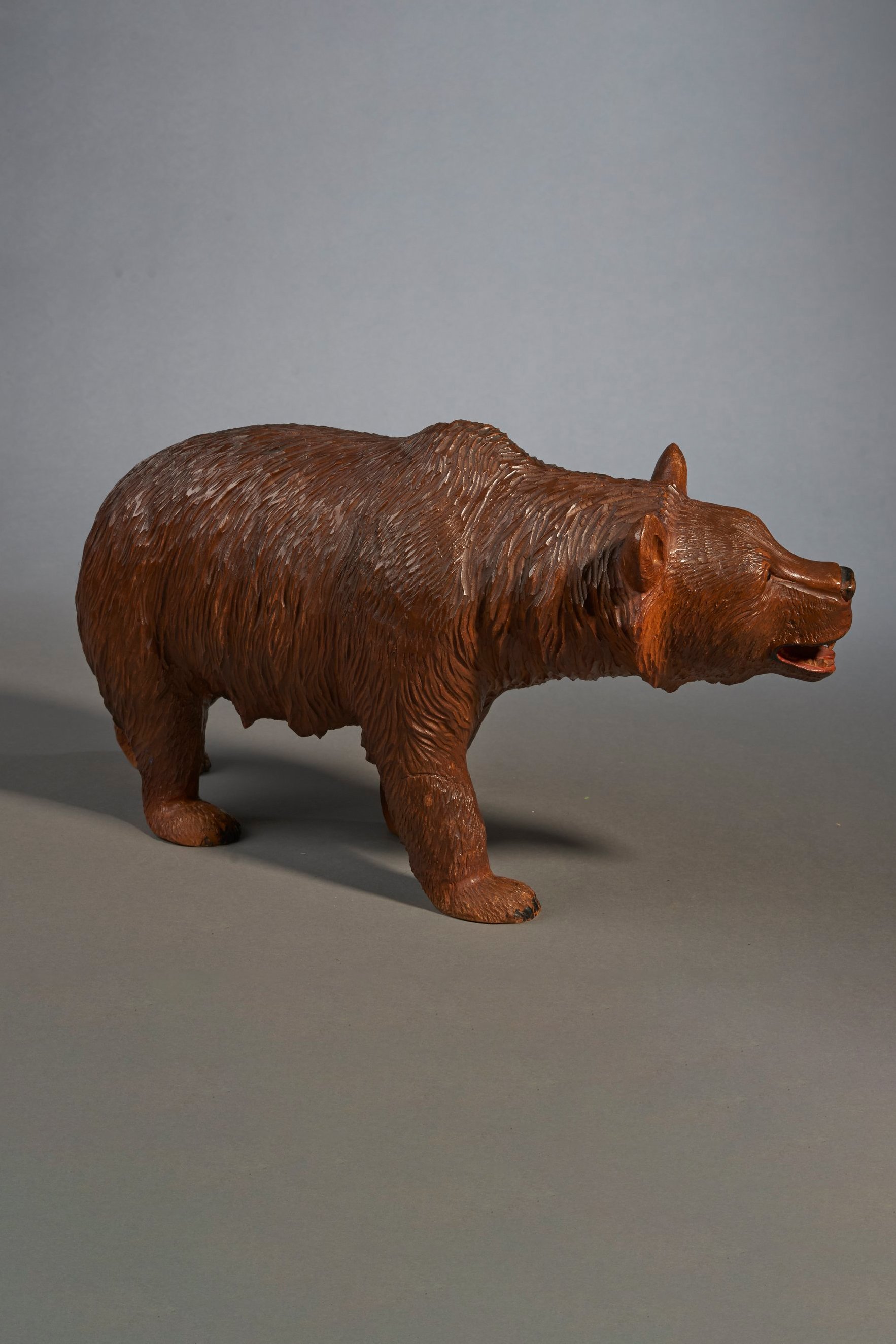 Image 1 of 1