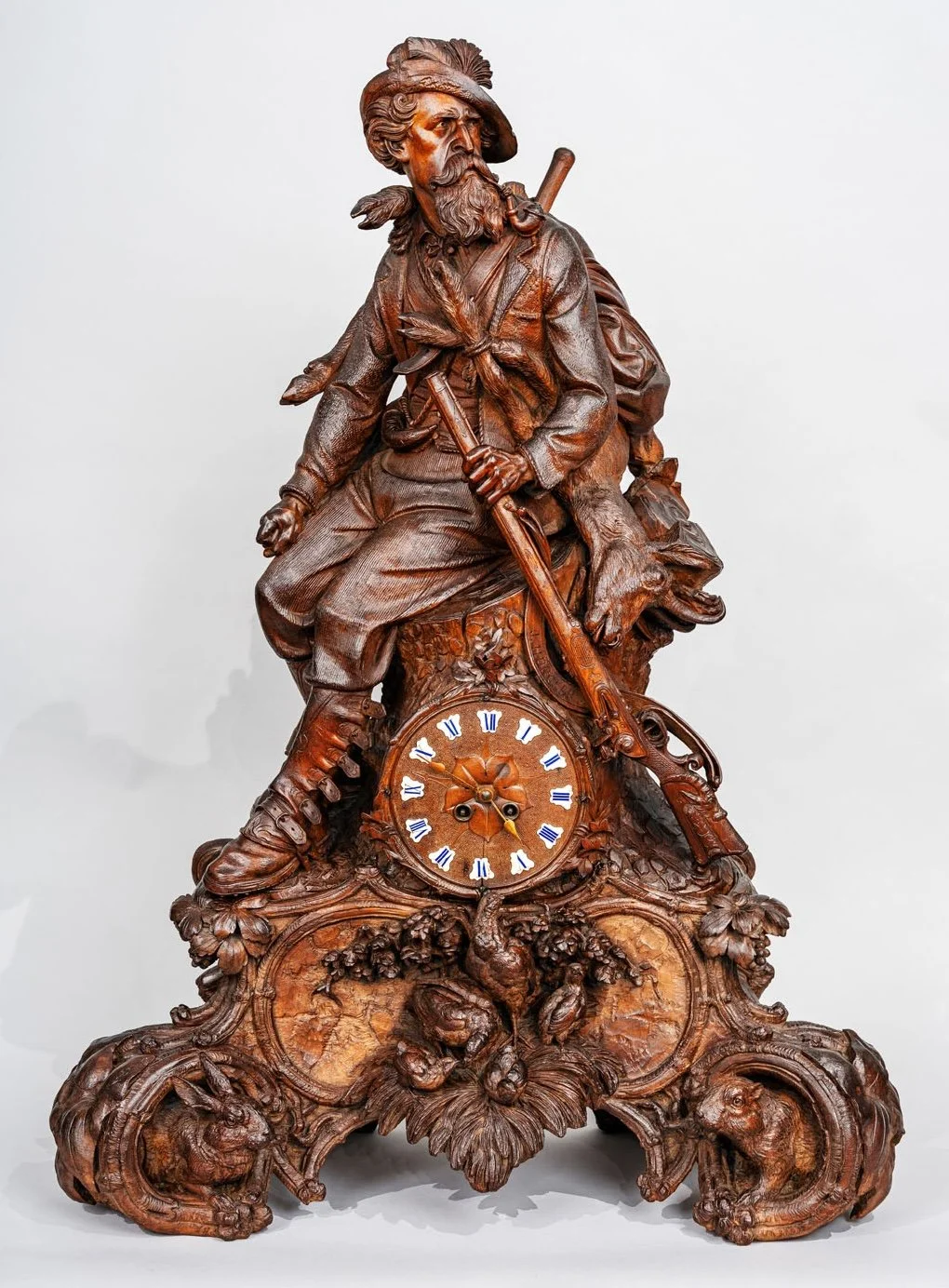
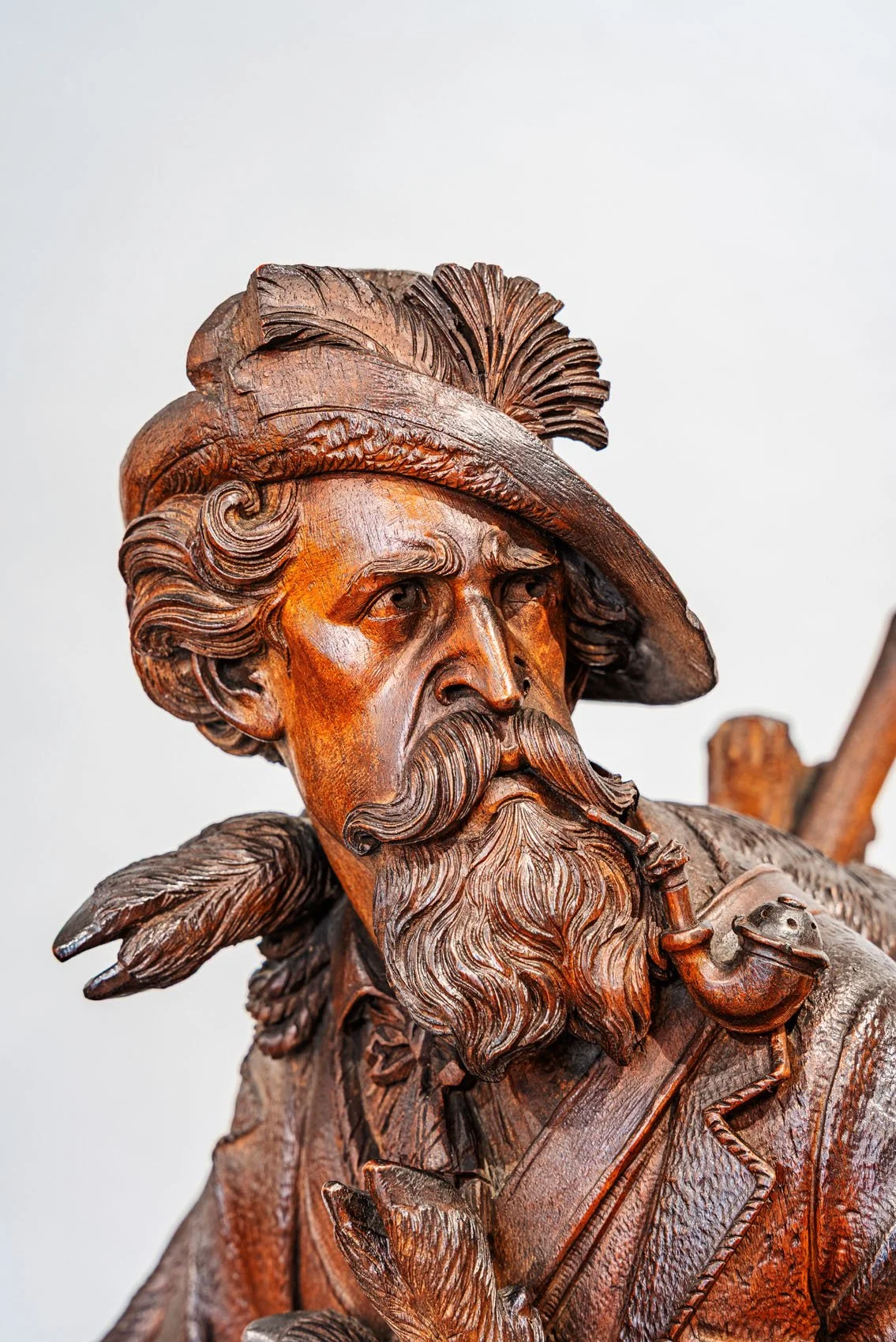
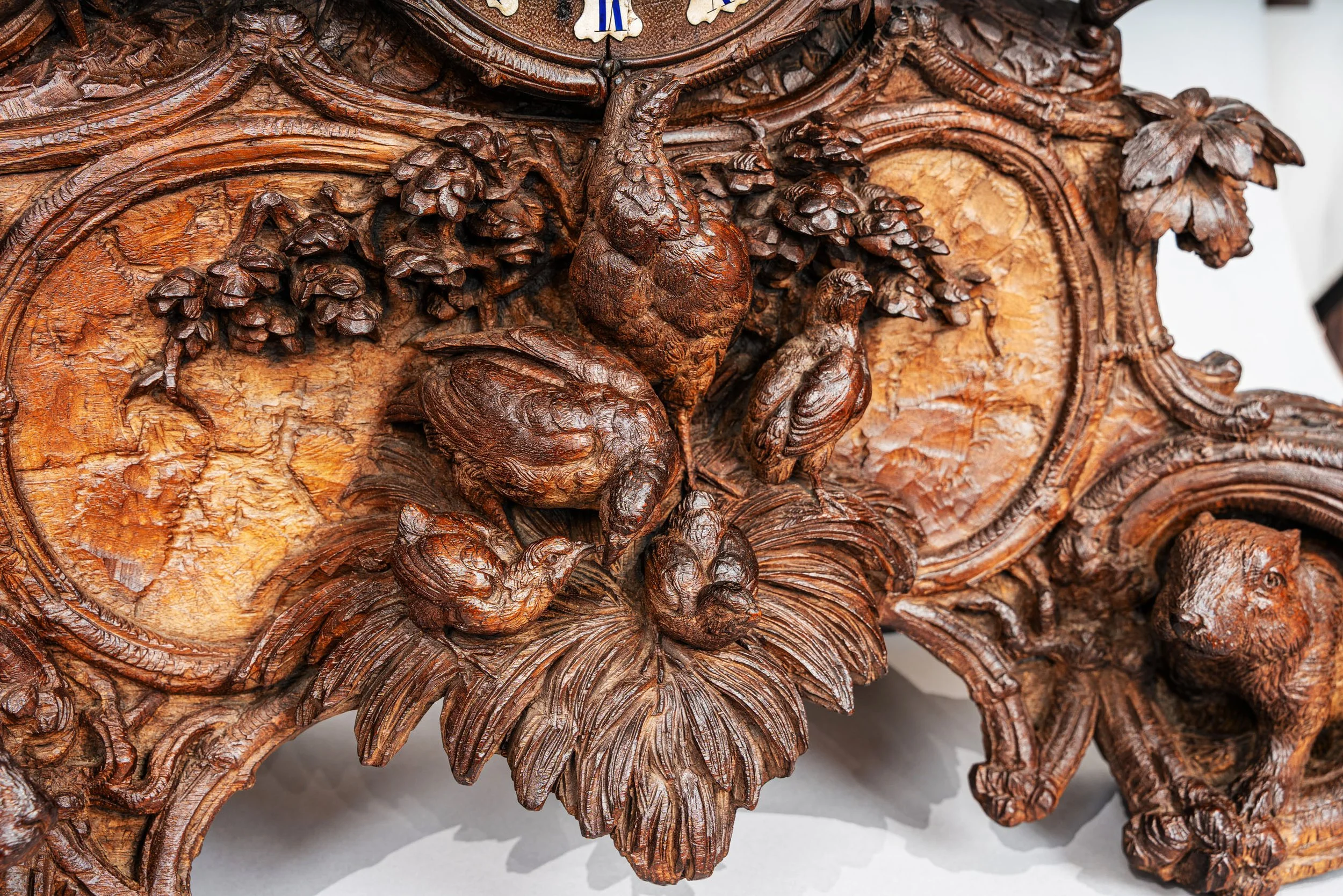
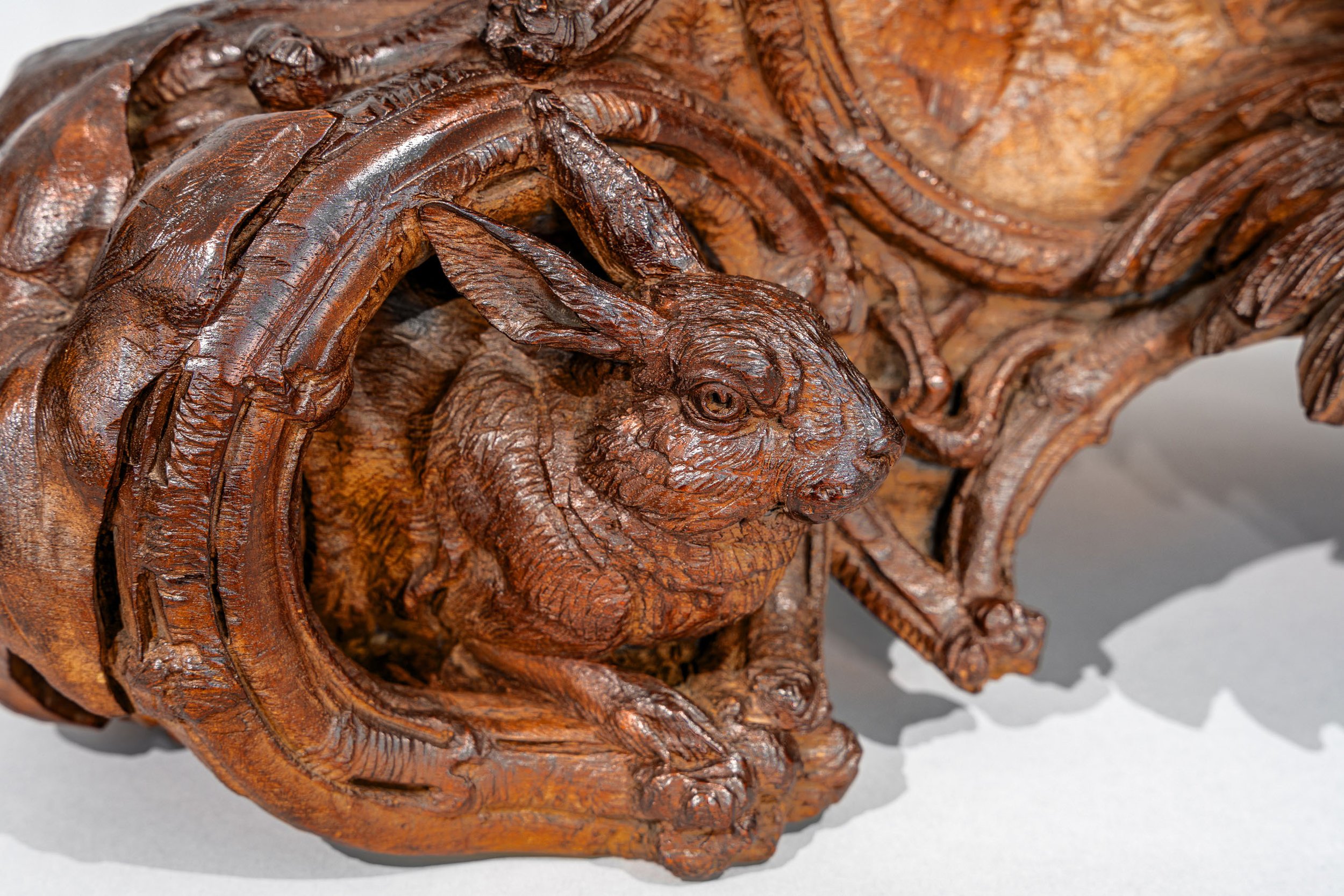
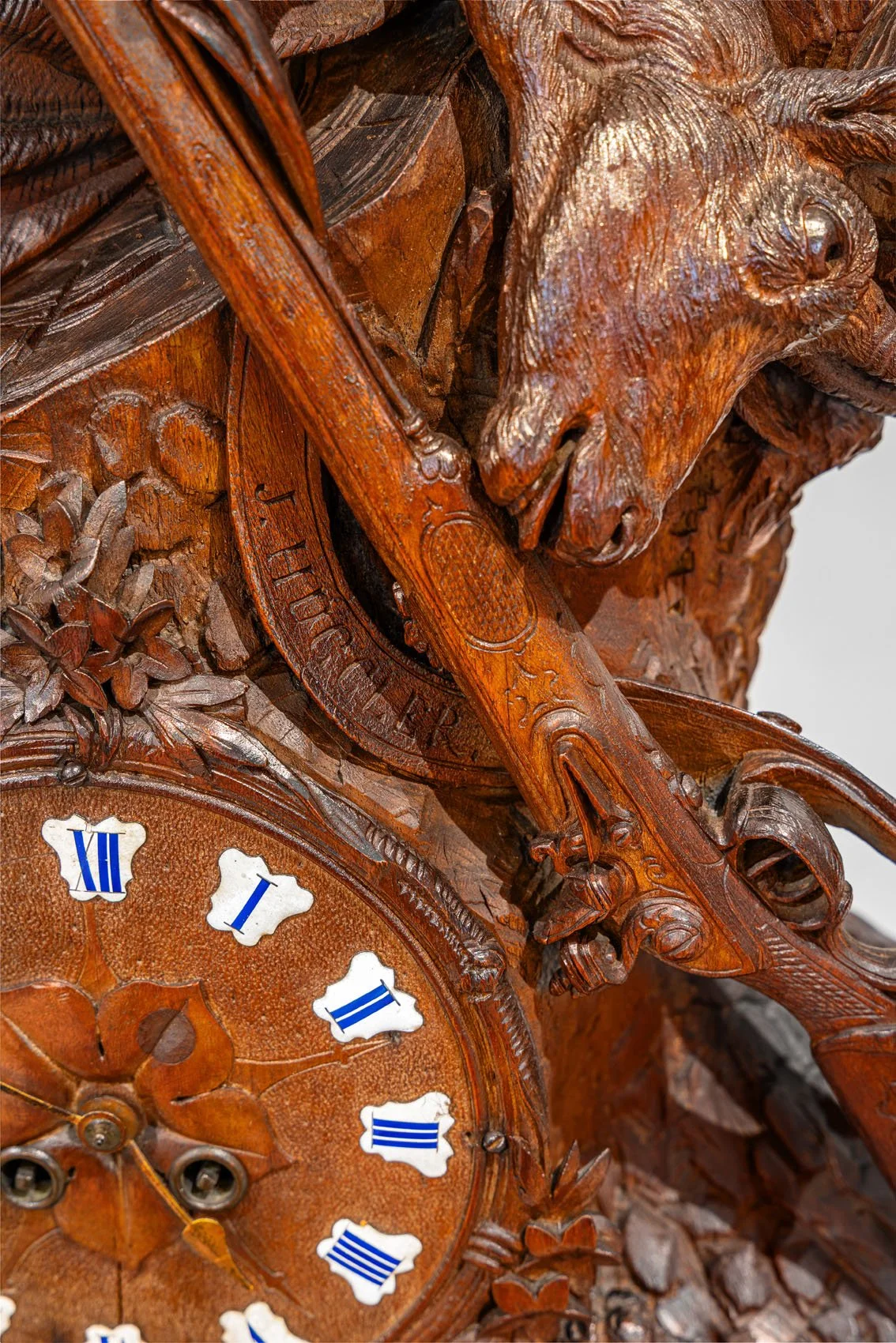
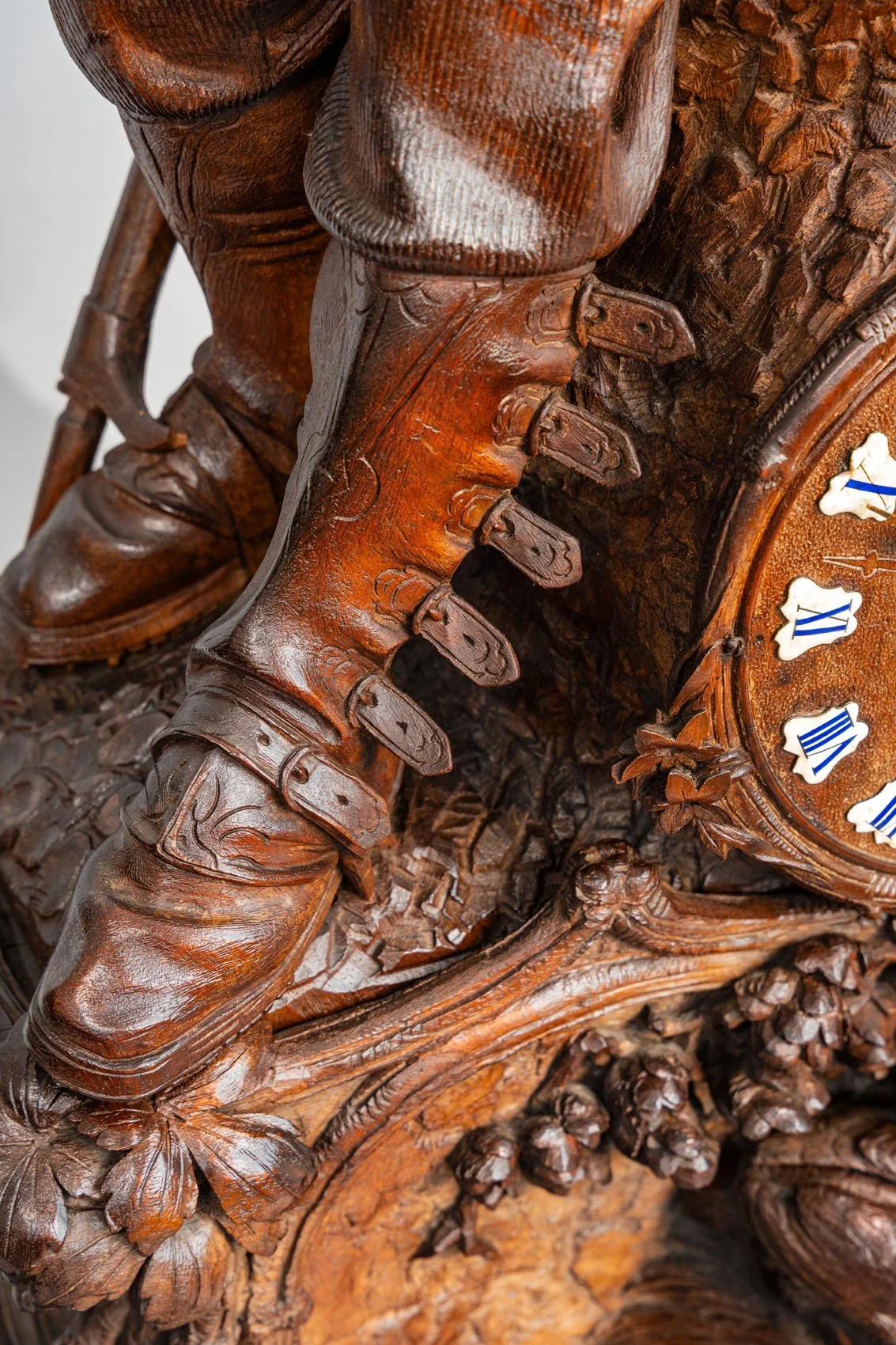
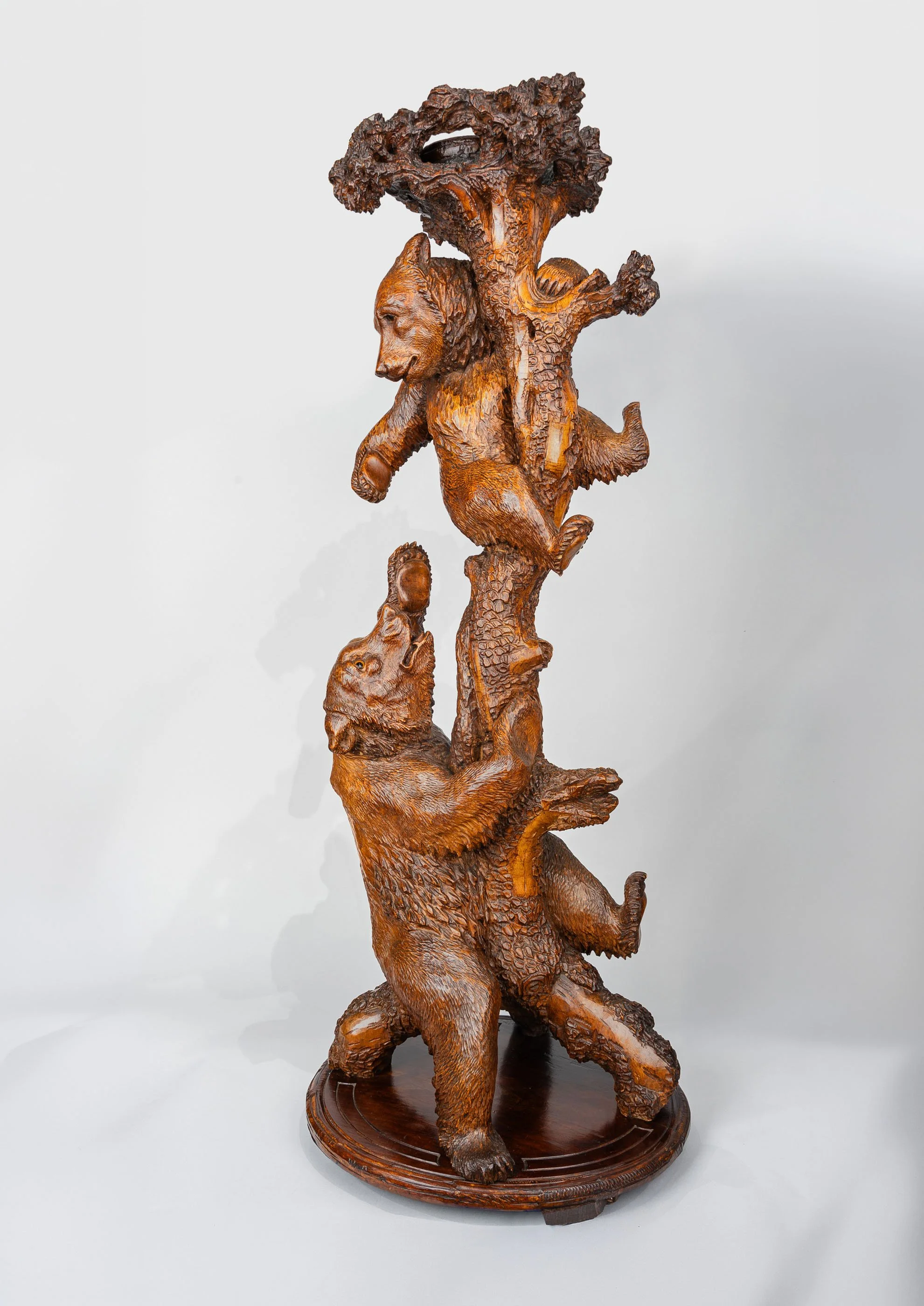
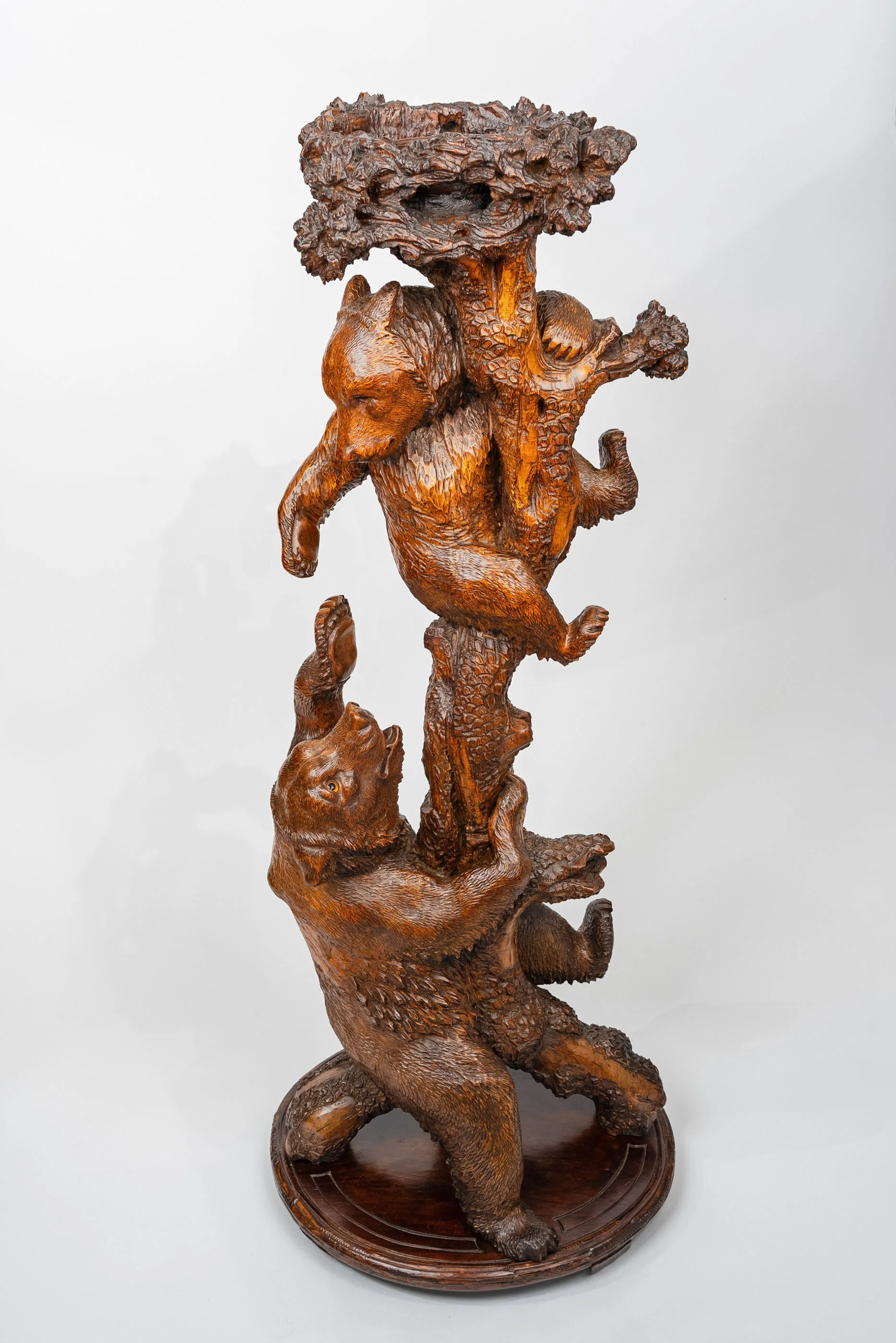
The great mantel clock was the supreme test of the Brienz carver's ambition — a form in which the functional object disappeared entirely within a sculptural programme of such complexity and invention that the clock itself became almost incidental. The finest examples were conceived not as timepieces with decorative surrounds but as complete narrative compositions, in which every figure, every passage of rockwork, every sprig of edelweiss and pine cone was part of a story being told in wood. The present clock, depicting a party of bears as alpine mountaineers in the full drama of an ascent, is among the most richly conceived and technically accomplished examples of the form that it is possible to encounter.
The composition is built around a rugged alpine rockface — the steeply angled outcrop rendered in deeply worked linden wood, the stratified stone conveyed through the bold diagonal planes of the carving — from which the circular clock dial emerges, framed by carved edelweiss and alpine flowers. Around and upon this central structure, a cast of bears pursues its mountaineering adventure with a specificity of characterisation that speaks to the finest tradition of Swiss Black Forest narrative carving.
At the upper right, a bear sits with a pack upon his back, peering intently through a pair of carved binoculars — utterly absorbed in whatever lies in the distance, entirely oblivious to the exertions of his companions. This single figure, with his expression of concentrated self-importance and his miniature carved binoculars rendered in perfect detail, encapsulates the comic genius that distinguishes the greatest Black Forest carvings from mere technical exercises. To his left, a second bear on the summit extends assistance — a rope, carved in the round and hanging freely — to a companion below who is evidently in need of it. On the mid-left face of the rockface, a young bear rears up on his hind legs in the effort of the climb, head thrown back. At the lower left, a smaller bear prowls the base of the formation. And at the front of the composition, a large bear strains forward with a pack across his haunches, the beast of burden of the party, his weight and effort conveyed with remarkable anatomical conviction.
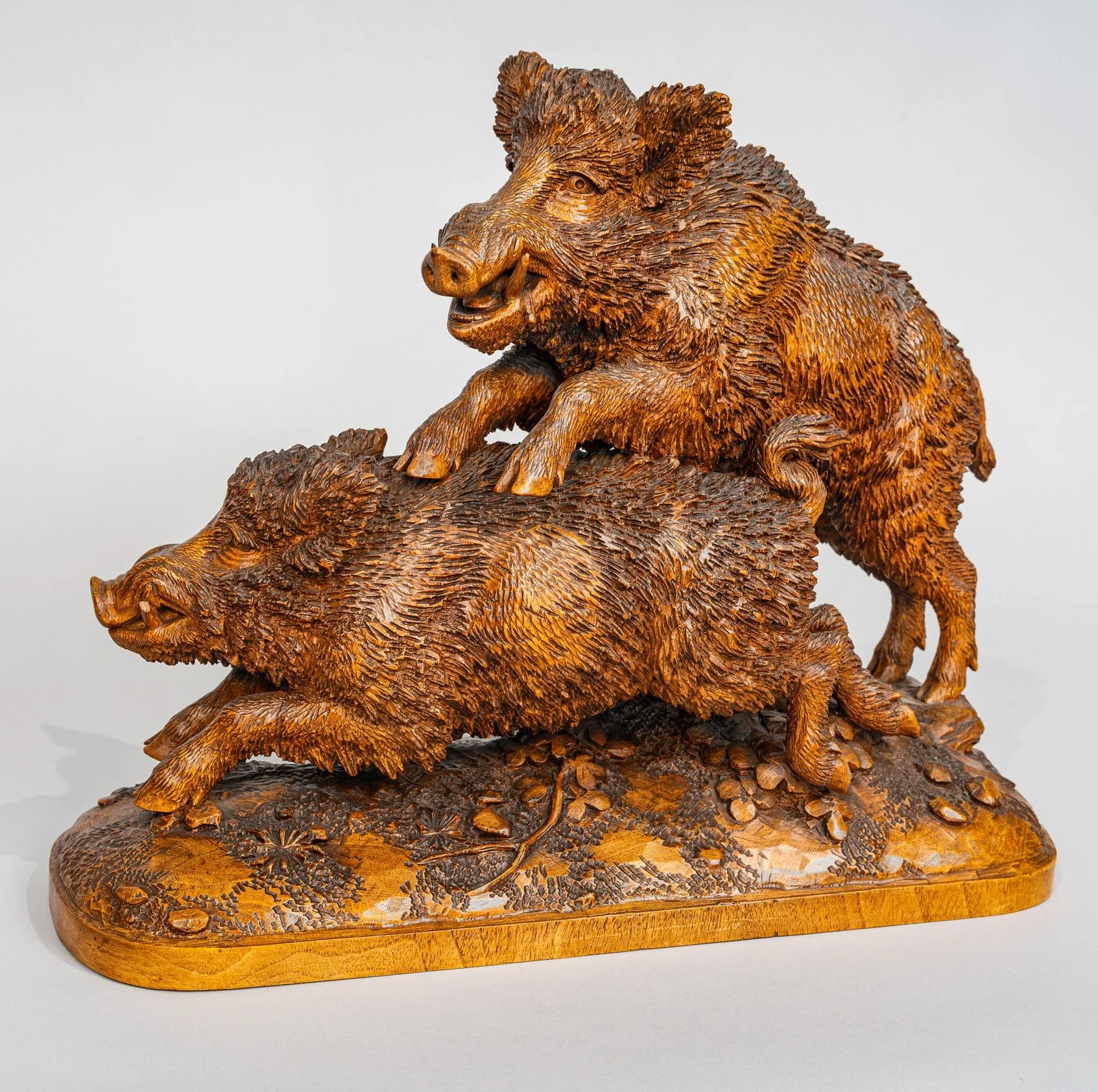
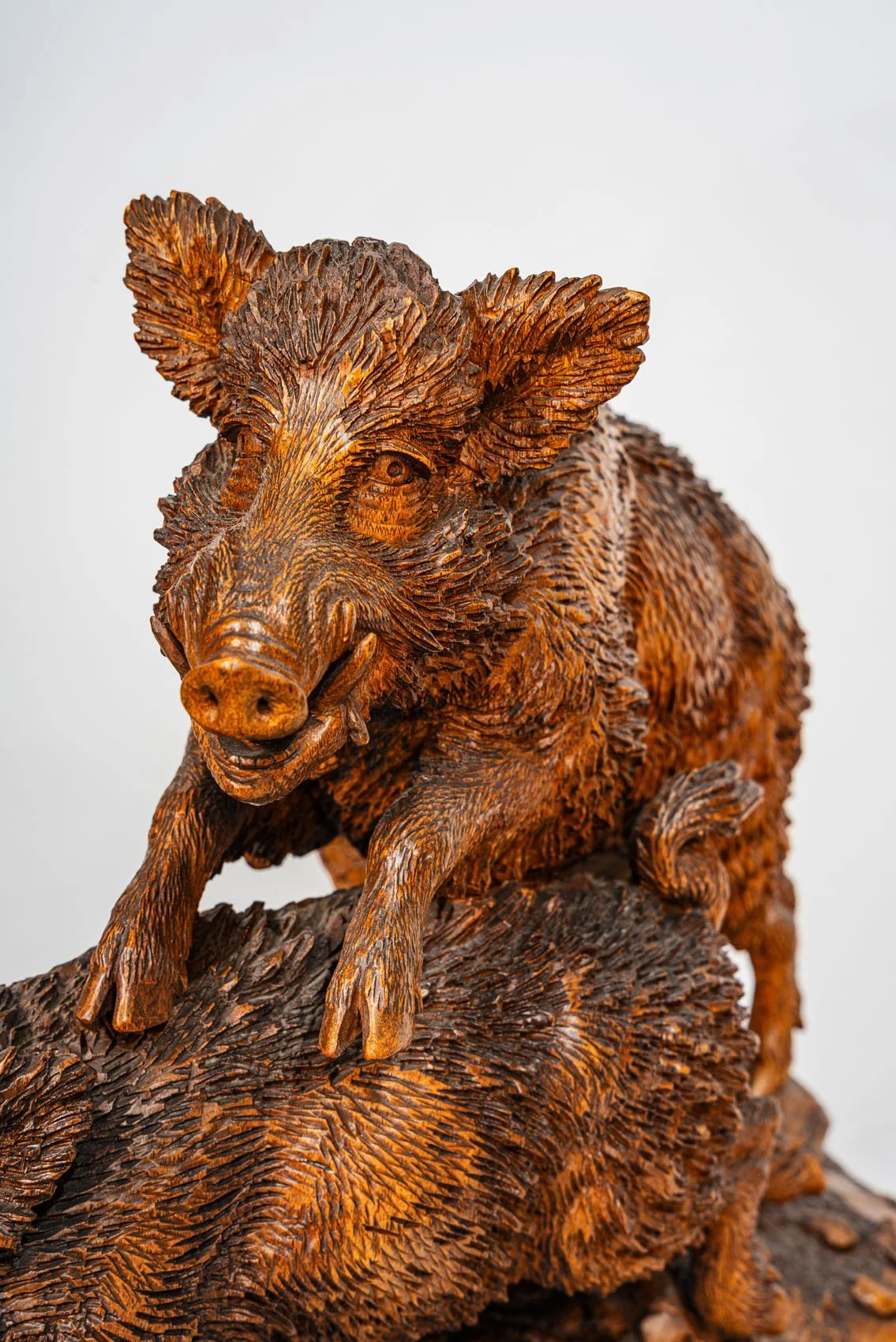
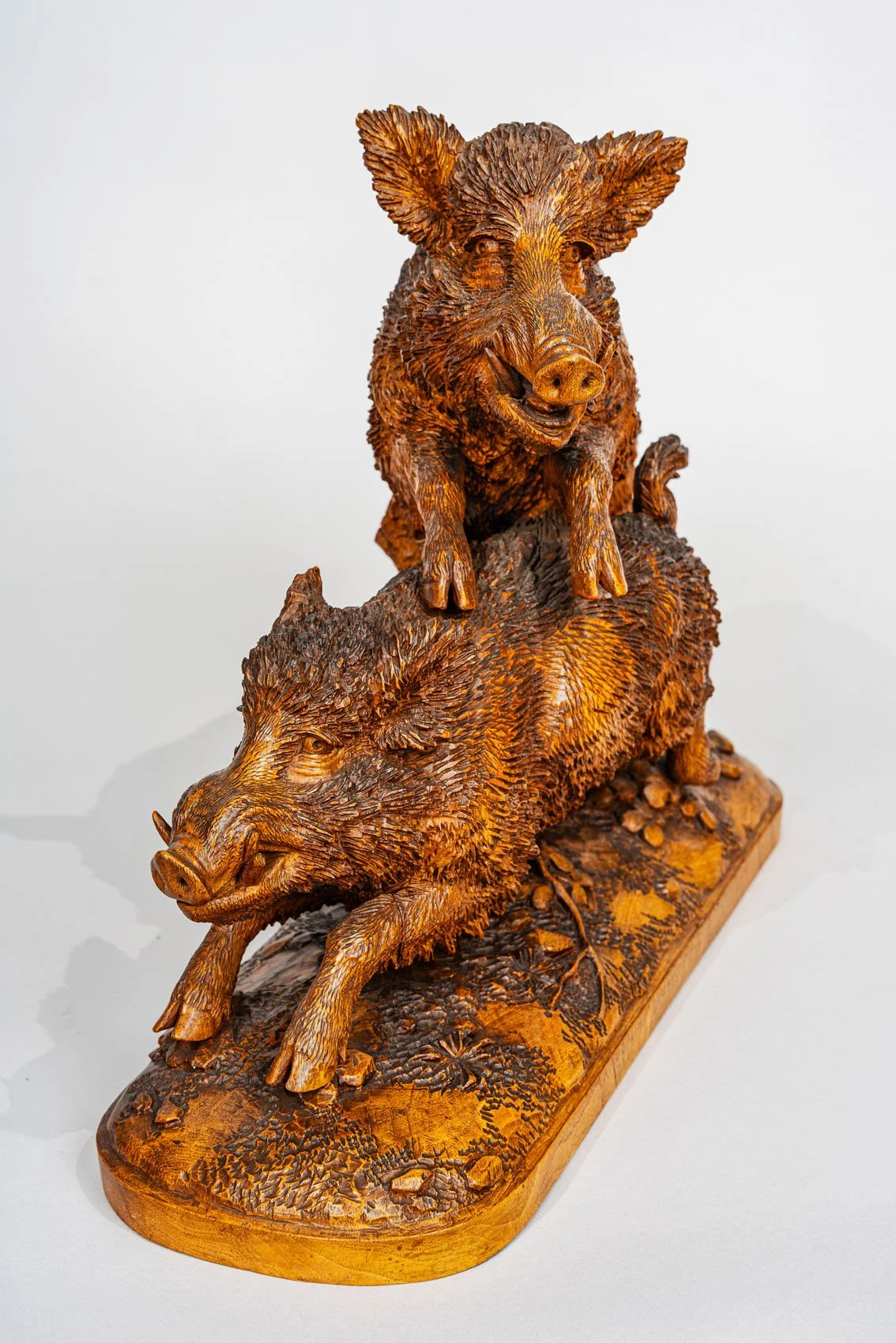
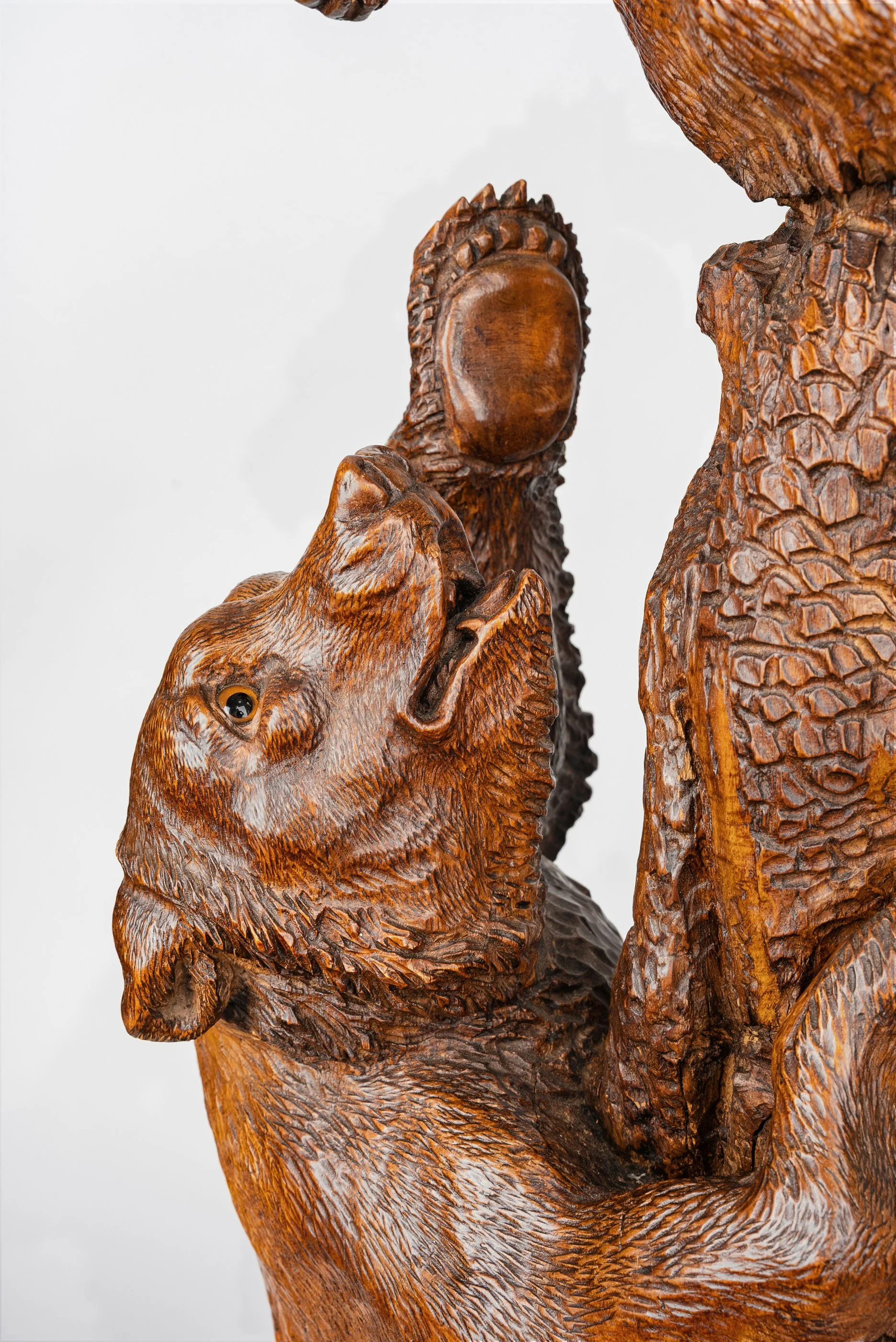
The carving throughout is of outstanding quality. The fur of each figure is deeply and individually worked, the texture varying between the different bears and between the different parts of each animal's body with a naturalistic precision that demonstrates both observation and technical command. The rockwork is handled with the bold, confident chisel work that characterises the best Brienz workshop production of the 1870s. The base is carved with ferns, pine cones, and forest-floor detail of considerable delicacy, providing a naturalistic ground for the entire composition.
As illustrated in Swiss Carvings: The Art of the Black Forest, 1820–1940 by Jay Arenski, Simon Daniels, and Michael Daniels (p. 160), elaborate figural clocks of this type represent some of the most imaginative and technically demanding productions of the Brienz workshops — objects conceived for exhibition at the great international fairs of the period and for the grandest domestic interiors of the age. A clock of this scale, complexity, and narrative richness, with original movement and dial intact, is of exceptional rarity in the current market.
Condition: Very good overall for a work of this complexity and age. Linden wood structurally sound throughout. Carving fully intact across all figures — fur texturing, facial expressions, rockwork, and base flora all crisp and well-preserved. Bear with binoculars: binoculars present and intact. Rope element present and intact. All individual bears structurally sound with no losses to ears, paws, or extremities. Clock dial present with original Roman numeral chapter ring and original hands. Movement present. Rich, warm patina throughout consistent with age.
Literature:
Jay Arenski, Simon Daniels, and Michael Daniels, Swiss Carvings: The Art of the Black Forest, 1820–1940, 2006, p. 160
The great mantel clock was the supreme test of the Brienz carver's ambition — a form in which the functional object disappeared entirely within a sculptural programme of such complexity and invention that the clock itself became almost incidental. The finest examples were conceived not as timepieces with decorative surrounds but as complete narrative compositions, in which every figure, every passage of rockwork, every sprig of edelweiss and pine cone was part of a story being told in wood. The present clock, depicting a party of bears as alpine mountaineers in the full drama of an ascent, is among the most richly conceived and technically accomplished examples of the form that it is possible to encounter.
The composition is built around a rugged alpine rockface — the steeply angled outcrop rendered in deeply worked linden wood, the stratified stone conveyed through the bold diagonal planes of the carving — from which the circular clock dial emerges, framed by carved edelweiss and alpine flowers. Around and upon this central structure, a cast of bears pursues its mountaineering adventure with a specificity of characterisation that speaks to the finest tradition of Swiss Black Forest narrative carving.
At the upper right, a bear sits with a pack upon his back, peering intently through a pair of carved binoculars — utterly absorbed in whatever lies in the distance, entirely oblivious to the exertions of his companions. This single figure, with his expression of concentrated self-importance and his miniature carved binoculars rendered in perfect detail, encapsulates the comic genius that distinguishes the greatest Black Forest carvings from mere technical exercises. To his left, a second bear on the summit extends assistance — a rope, carved in the round and hanging freely — to a companion below who is evidently in need of it. On the mid-left face of the rockface, a young bear rears up on his hind legs in the effort of the climb, head thrown back. At the lower left, a smaller bear prowls the base of the formation. And at the front of the composition, a large bear strains forward with a pack across his haunches, the beast of burden of the party, his weight and effort conveyed with remarkable anatomical conviction.
The carving throughout is of outstanding quality. The fur of each figure is deeply and individually worked, the texture varying between the different bears and between the different parts of each animal's body with a naturalistic precision that demonstrates both observation and technical command. The rockwork is handled with the bold, confident chisel work that characterises the best Brienz workshop production of the 1870s. The base is carved with ferns, pine cones, and forest-floor detail of considerable delicacy, providing a naturalistic ground for the entire composition.
As illustrated in Swiss Carvings: The Art of the Black Forest, 1820–1940 by Jay Arenski, Simon Daniels, and Michael Daniels (p. 160), elaborate figural clocks of this type represent some of the most imaginative and technically demanding productions of the Brienz workshops — objects conceived for exhibition at the great international fairs of the period and for the grandest domestic interiors of the age. A clock of this scale, complexity, and narrative richness, with original movement and dial intact, is of exceptional rarity in the current market.
Condition: Very good overall for a work of this complexity and age. Linden wood structurally sound throughout. Carving fully intact across all figures — fur texturing, facial expressions, rockwork, and base flora all crisp and well-preserved. Bear with binoculars: binoculars present and intact. Rope element present and intact. All individual bears structurally sound with no losses to ears, paws, or extremities. Clock dial present with original Roman numeral chapter ring and original hands. Movement present. Rich, warm patina throughout consistent with age.
Literature:
Jay Arenski, Simon Daniels, and Michael Daniels, Swiss Carvings: The Art of the Black Forest, 1820–1940, 2006, p. 160

 Image 1 of 7
 Image 2 of 7
 Image 3 of 7
 Image 4 of 7
 Image 5 of 7
 Image 6 of 7
 Image 7 of 7