A gold aureus of the emperor Marcus Aurelius, struck at the mint of Rome in AD 172, at the height of the Marcomannic Wars on the Danube frontier. The obverse carries the laureate, draped portrait of the mature, bearded emperor with the legend M ANTONINVS AVG TR P XXVI. The reverse, reading IMP VI COS III, shows one of the boldest images in his coinage: the emperor standing in military dress, a reversed spear in his left hand and the thunderbolt of Jupiter gripped in his raised right, while Victory advances behind him with a palm frond to crown him with laurel.
The thunderbolt is the weapon of the supreme god, and an emperor shown wielding it is being assimilated to Jupiter himself, a step beyond the conventional imagery of divine favor. The type belongs to the years of the celebrated miracles of the northern wars, the lightning that destroyed an enemy siege engine and the rainstorm that saved a surrounded Roman army, both later carved on the Column of Marcus Aurelius in Rome. These are also the seasons in which the emperor, in winter quarters on the Danube, was writing the private notebook the world now knows as the Meditations.
The coin is graded Choice Mint State by NGC, Strike 4 of 5, Surface 5 of 5, with the Fine Style designation, certification 2100934-002, weight 7.19 grams. Scarcely circulated in eighteen centuries, it preserves the reverse composition with unusual clarity, the thunderbolt fully legible in the emperor's hand.
The type is cited as RIC III 265, with Calicó 1872, BMCRE 566 var., Biaggi 856 and Mazzini 308. Examples rest in the British Museum, the American Numismatic Society in New York, and the Kunsthistorisches Museum in Vienna, the last from the Bachofen collection, and the type is absent from the great published cabinets of Adda and Jameson. It is a coin found in the finest institutional collections and seldom in the market.
The aureus is exhibited in our Aspen gallery alongside a bronze reduction of the equestrian Marcus Aurelius of the Capitoline, cast in Rome in 1866, the emperor in gold and in bronze side by side.
The coin is considered at greater length, together with the equestrian bronze, in our article The Philosopher Emperor: Marcus Aurelius in Bronze, Gold, and Ink.
A gold aureus of the emperor Marcus Aurelius, struck at the mint of Rome in AD 172, at the height of the Marcomannic Wars on the Danube frontier. The obverse carries the laureate, draped portrait of the mature, bearded emperor with the legend M ANTONINVS AVG TR P XXVI. The reverse, reading IMP VI COS III, shows one of the boldest images in his coinage: the emperor standing in military dress, a reversed spear in his left hand and the thunderbolt of Jupiter gripped in his raised right, while Victory advances behind him with a palm frond to crown him with laurel.
The thunderbolt is the weapon of the supreme god, and an emperor shown wielding it is being assimilated to Jupiter himself, a step beyond the conventional imagery of divine favor. The type belongs to the years of the celebrated miracles of the northern wars, the lightning that destroyed an enemy siege engine and the rainstorm that saved a surrounded Roman army, both later carved on the Column of Marcus Aurelius in Rome. These are also the seasons in which the emperor, in winter quarters on the Danube, was writing the private notebook the world now knows as the Meditations.
The coin is graded Choice Mint State by NGC, Strike 4 of 5, Surface 5 of 5, with the Fine Style designation, certification 2100934-002, weight 7.19 grams. Scarcely circulated in eighteen centuries, it preserves the reverse composition with unusual clarity, the thunderbolt fully legible in the emperor's hand.
The type is cited as RIC III 265, with Calicó 1872, BMCRE 566 var., Biaggi 856 and Mazzini 308. Examples rest in the British Museum, the American Numismatic Society in New York, and the Kunsthistorisches Museum in Vienna, the last from the Bachofen collection, and the type is absent from the great published cabinets of Adda and Jameson. It is a coin found in the finest institutional collections and seldom in the market.
The aureus is exhibited in our Aspen gallery alongside a bronze reduction of the equestrian Marcus Aurelius of the Capitoline, cast in Rome in 1866, the emperor in gold and in bronze side by side.
The coin is considered at greater length, together with the equestrian bronze, in our article The Philosopher Emperor: Marcus Aurelius in Bronze, Gold, and Ink.

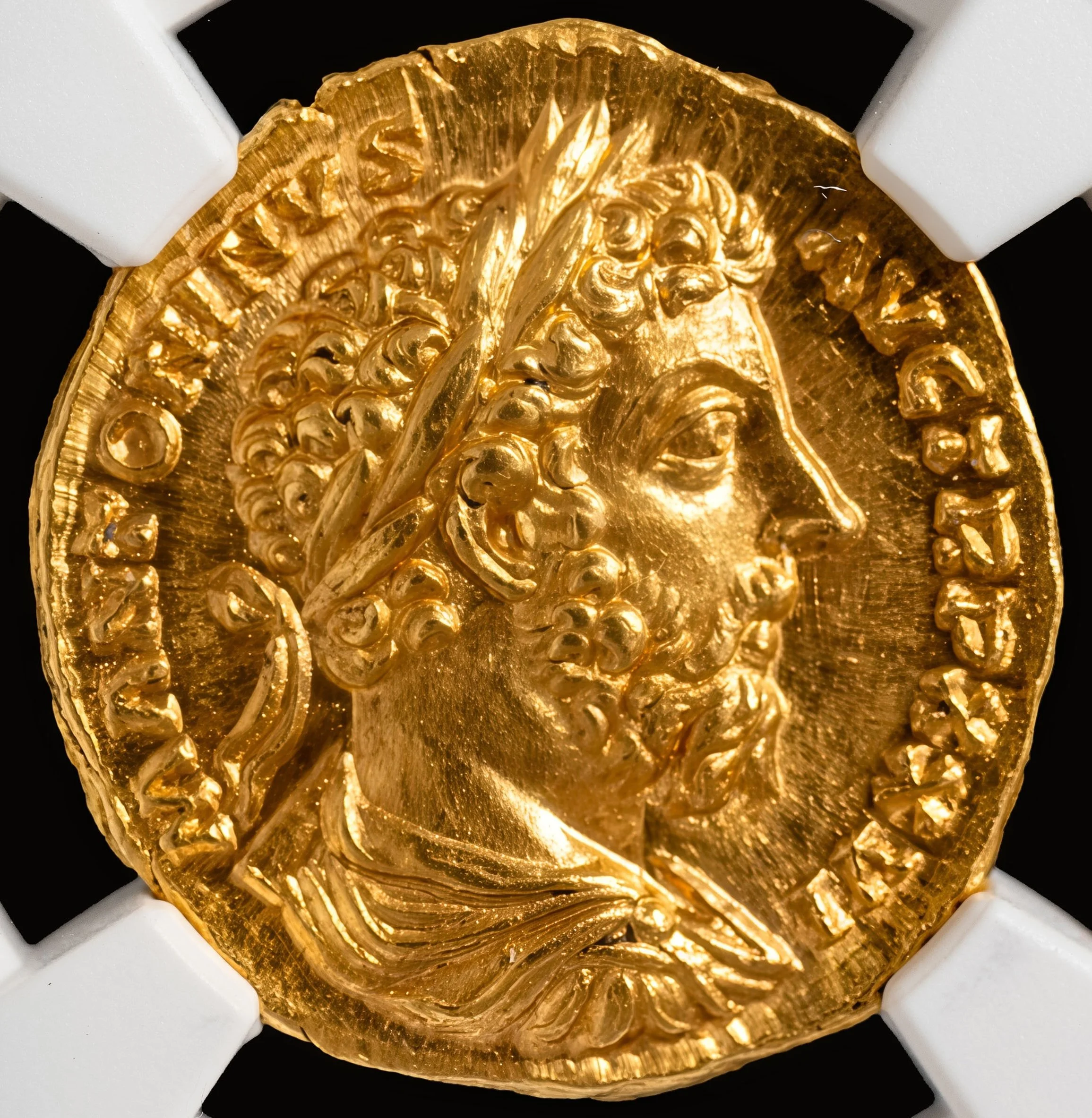 Image 1 of 2
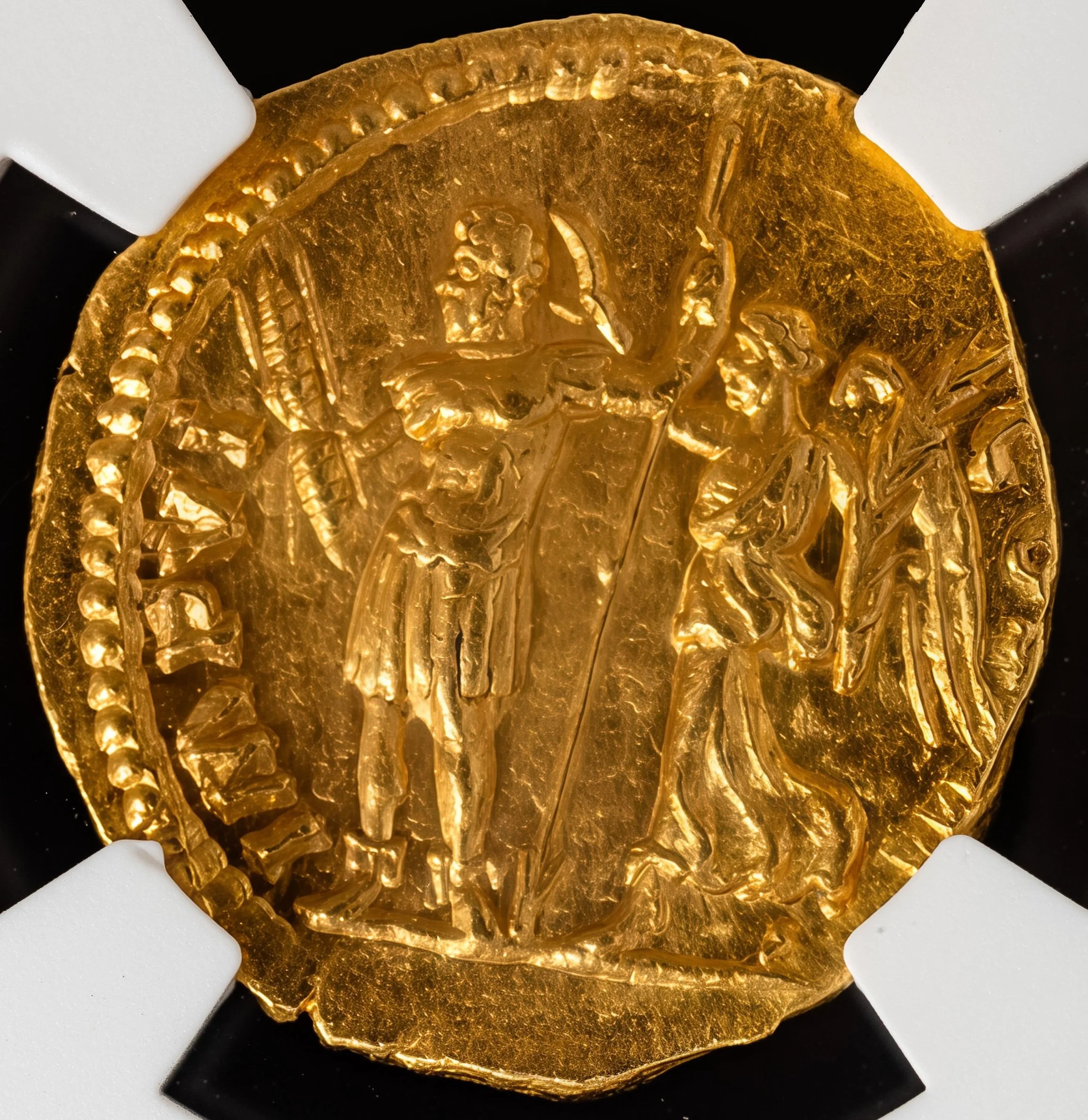 Image 2 of 2