A fire-gilt bronze figure of Mars, the god of war, shown bound in chains and disarmed. The youthful, powerfully built god kneels on one knee upon his grounded arms, in a classical muscled cuirass with lappets at the shoulders and a pteruges skirt, his head turned down and to the side, his wrists fastened behind his back in finely wrought links. Around and beneath him lies the trophy of his weapons: a horn, a spear, a scabbard terminating in a scrolled chape, an oval shield with a lined border on which he partly rests, the doffed helmet, and the sword whose pommel is finished as a ram's head.
The subject is war restrained. The armor and attributes are the standard language of Mars in antiquity, as preserved in the life-size Roman stone statue of the god from Eboracum, now in the Yorkshire Museum, and the ram's-head pommel reinforces the identification, the ram being the animal of Aries, the god's own sign. What gives the group its meaning is that he is pressed down upon the very weapons he has surrendered, the helmet lifted from the head, the hands pinioned away from them. A Mars parted from his arms is an established emblem of peace.
That reading carries a particular weight here. The bronze was made in Augsburg in the first half of the 17th century, in the German lands that bore the worst of the Thirty Years' War. A god of war brought to his knees and bound upon his own arms, made in that place and at that moment, would have been understood not as a generic classical conceit but as peace longed for and war laid down. The heroic, idealized body argues for the god rather than a defeated mortal captive, though the pose plays knowingly on both readings.
The composition descends from the most famous seated Mars of antiquity, the Ludovisi Ares, the marble now in the Palazzo Altemps in Rome. Rediscovered in 1622 and restored by the young Bernini, it became the defining model of the war god in repose and was quickly copied in bronze reductions for collectors, so sculptors in the decades that followed would have known it well. The present figure belongs to that attribute-rich tradition rather than to the striding, stripped-down Mars of Giambologna, whose god carries nothing but his sword. Here the panoply is kept and set down, every piece rendered with care, and the god himself in chains upon it.
The bronze is a thin-walled lost-wax cast, worked directly in the wax, the gilding laid over a warm ground and now rubbed to a reddish underlayer on the high points through handling. It is raised on an ebonized wood socle with an inset giallo marble panel of the kind supplied for the cabinet of a serious collector. The definition of the hair, the chains, the chased scabbard, and the pommel is that of a fine metalworker, consistent with the goldsmiths' tradition of Augsburg, then the leading center of the craft in Europe.
A fire-gilt bronze figure of Mars, the god of war, shown bound in chains and disarmed. The youthful, powerfully built god kneels on one knee upon his grounded arms, in a classical muscled cuirass with lappets at the shoulders and a pteruges skirt, his head turned down and to the side, his wrists fastened behind his back in finely wrought links. Around and beneath him lies the trophy of his weapons: a horn, a spear, a scabbard terminating in a scrolled chape, an oval shield with a lined border on which he partly rests, the doffed helmet, and the sword whose pommel is finished as a ram's head.
The subject is war restrained. The armor and attributes are the standard language of Mars in antiquity, as preserved in the life-size Roman stone statue of the god from Eboracum, now in the Yorkshire Museum, and the ram's-head pommel reinforces the identification, the ram being the animal of Aries, the god's own sign. What gives the group its meaning is that he is pressed down upon the very weapons he has surrendered, the helmet lifted from the head, the hands pinioned away from them. A Mars parted from his arms is an established emblem of peace.
That reading carries a particular weight here. The bronze was made in Augsburg in the first half of the 17th century, in the German lands that bore the worst of the Thirty Years' War. A god of war brought to his knees and bound upon his own arms, made in that place and at that moment, would have been understood not as a generic classical conceit but as peace longed for and war laid down. The heroic, idealized body argues for the god rather than a defeated mortal captive, though the pose plays knowingly on both readings.
The composition descends from the most famous seated Mars of antiquity, the Ludovisi Ares, the marble now in the Palazzo Altemps in Rome. Rediscovered in 1622 and restored by the young Bernini, it became the defining model of the war god in repose and was quickly copied in bronze reductions for collectors, so sculptors in the decades that followed would have known it well. The present figure belongs to that attribute-rich tradition rather than to the striding, stripped-down Mars of Giambologna, whose god carries nothing but his sword. Here the panoply is kept and set down, every piece rendered with care, and the god himself in chains upon it.
The bronze is a thin-walled lost-wax cast, worked directly in the wax, the gilding laid over a warm ground and now rubbed to a reddish underlayer on the high points through handling. It is raised on an ebonized wood socle with an inset giallo marble panel of the kind supplied for the cabinet of a serious collector. The definition of the hair, the chains, the chased scabbard, and the pommel is that of a fine metalworker, consistent with the goldsmiths' tradition of Augsburg, then the leading center of the craft in Europe.

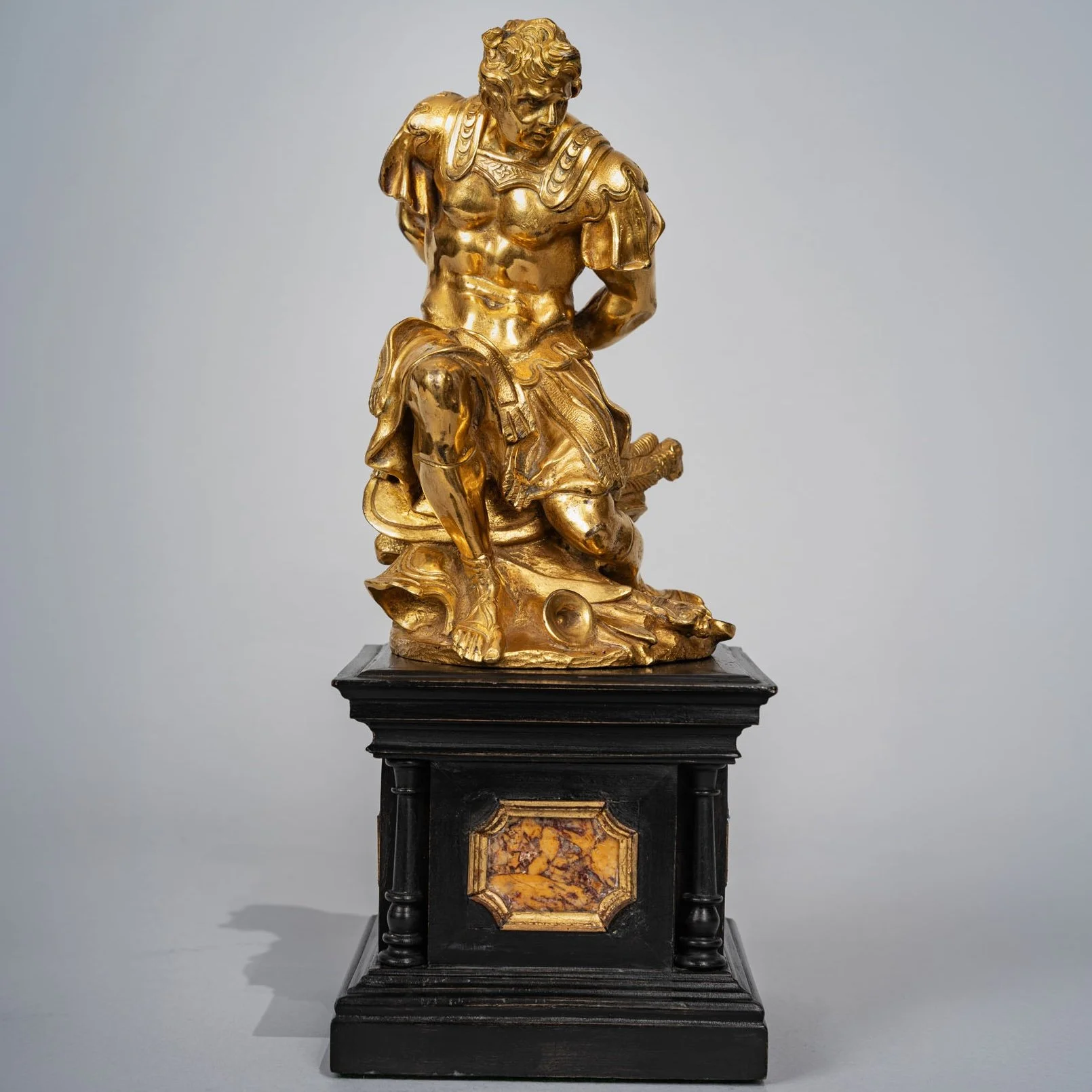 Image 1 of 5
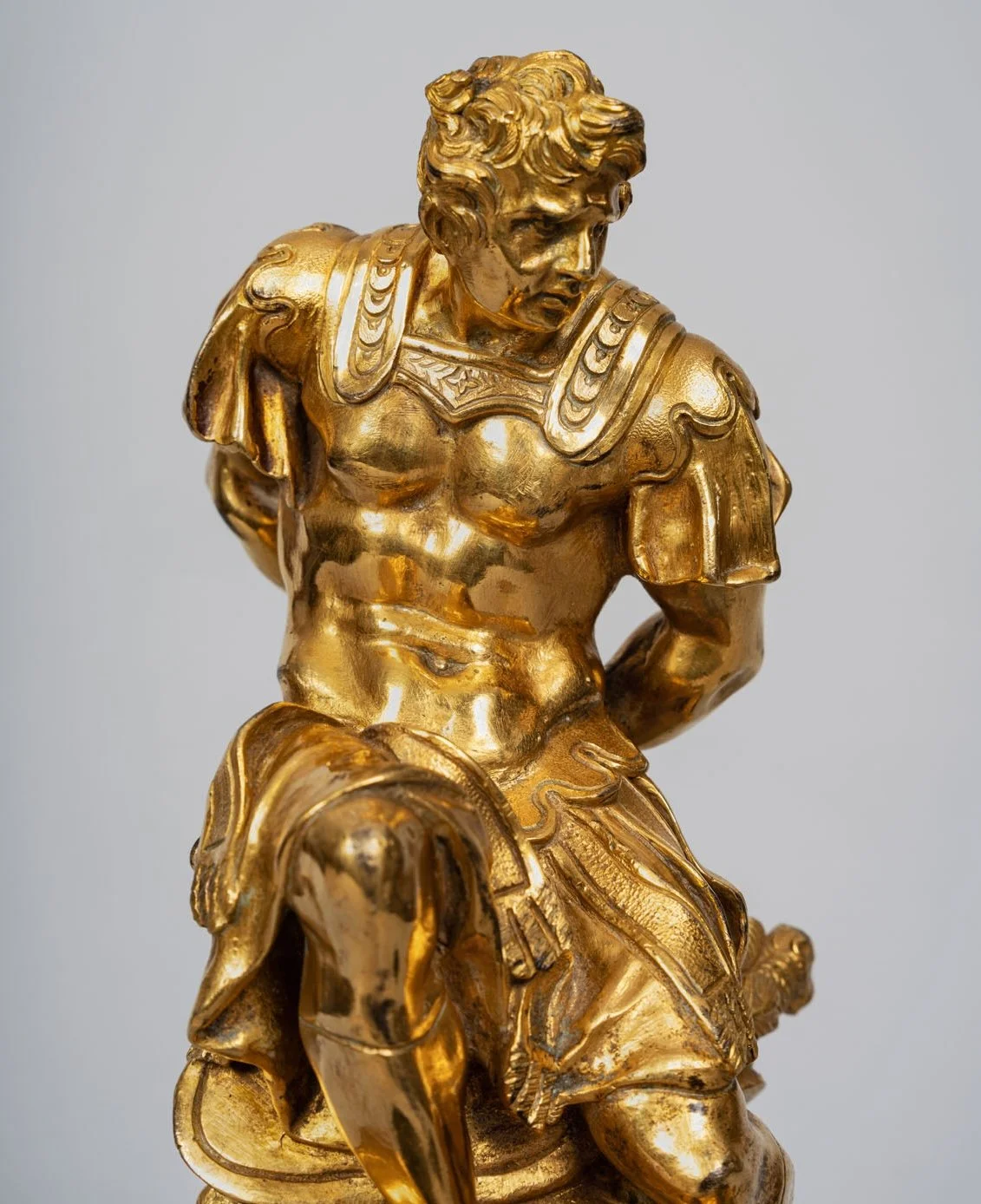 Image 2 of 5
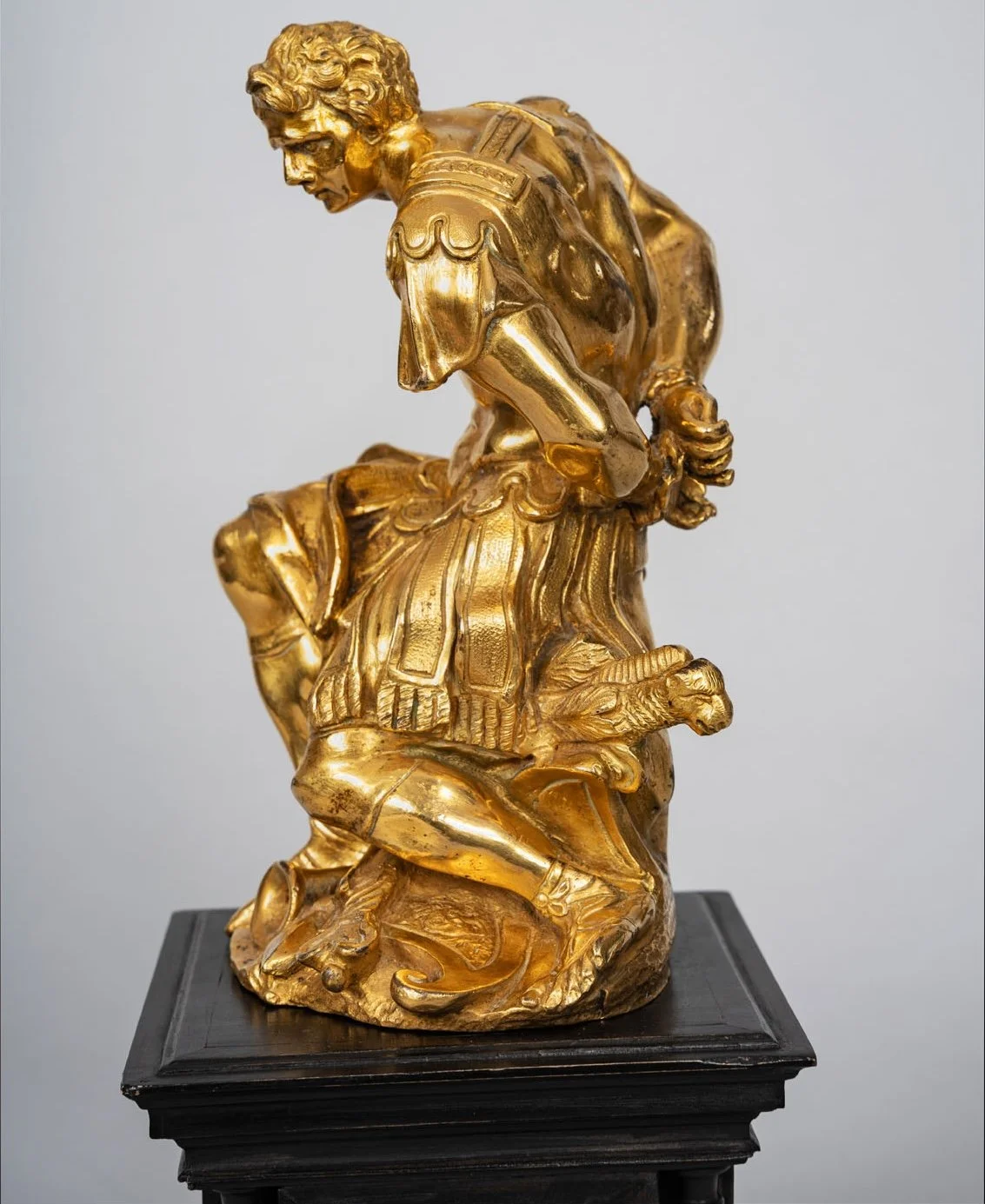 Image 3 of 5
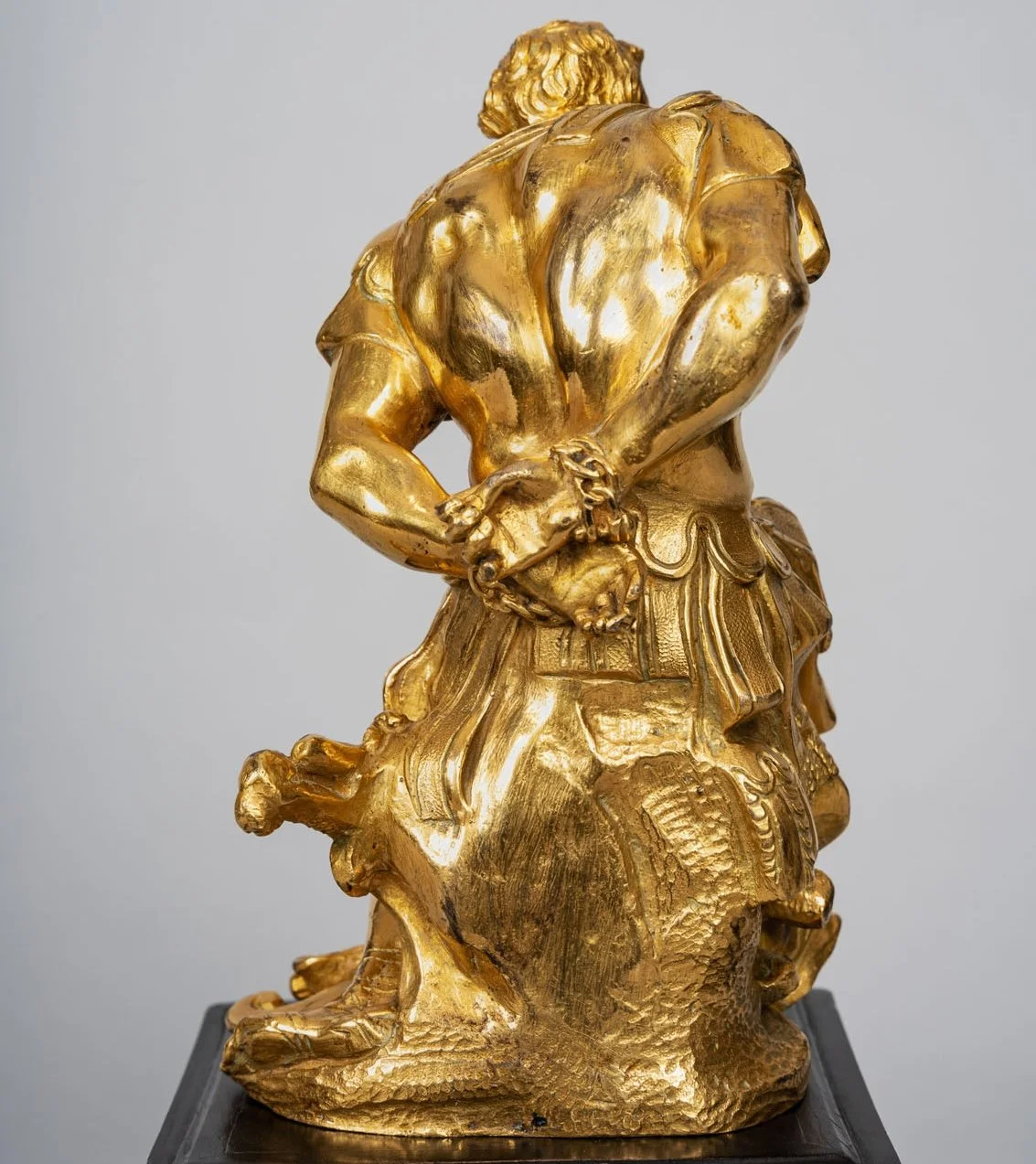 Image 4 of 5
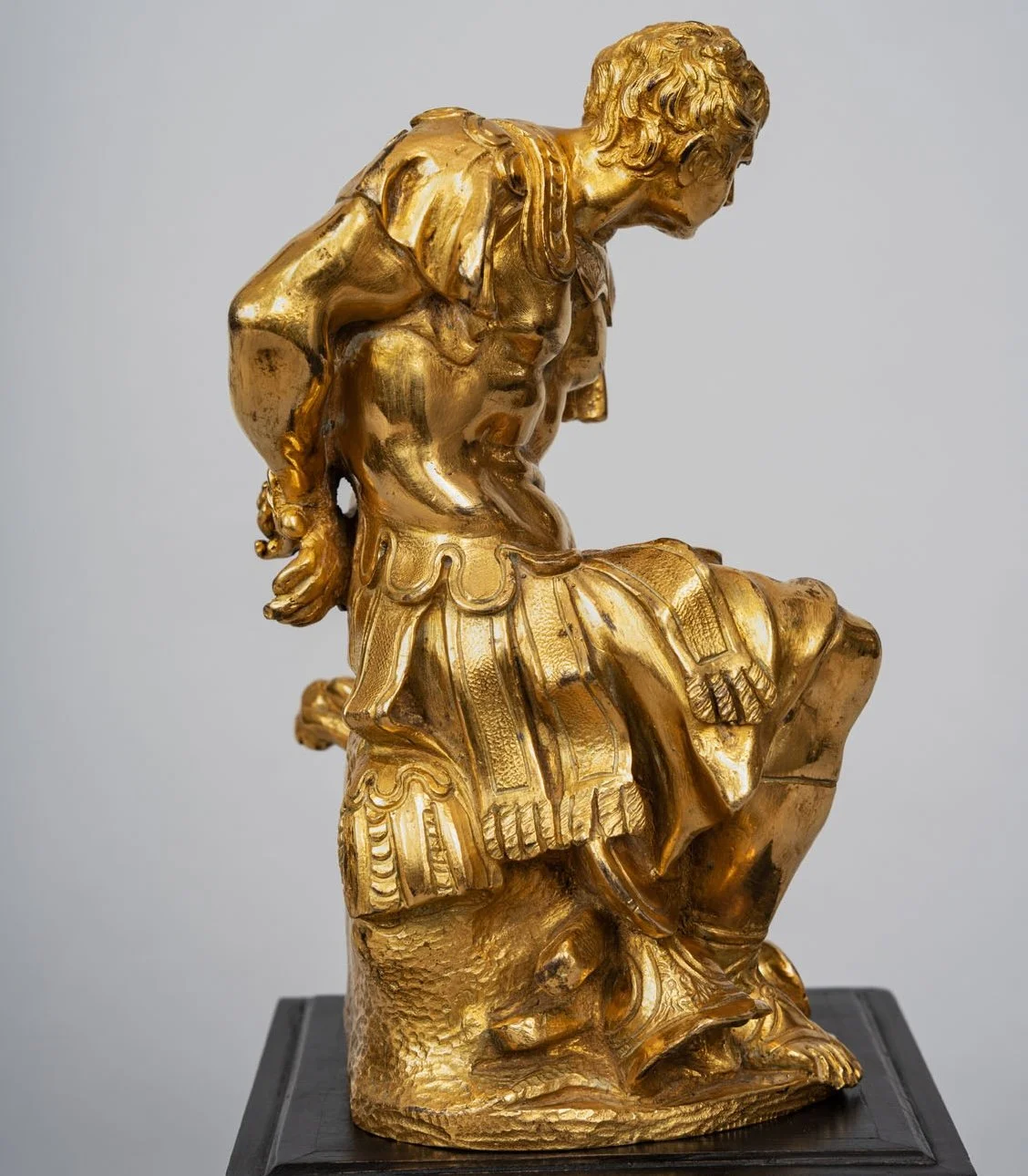 Image 5 of 5