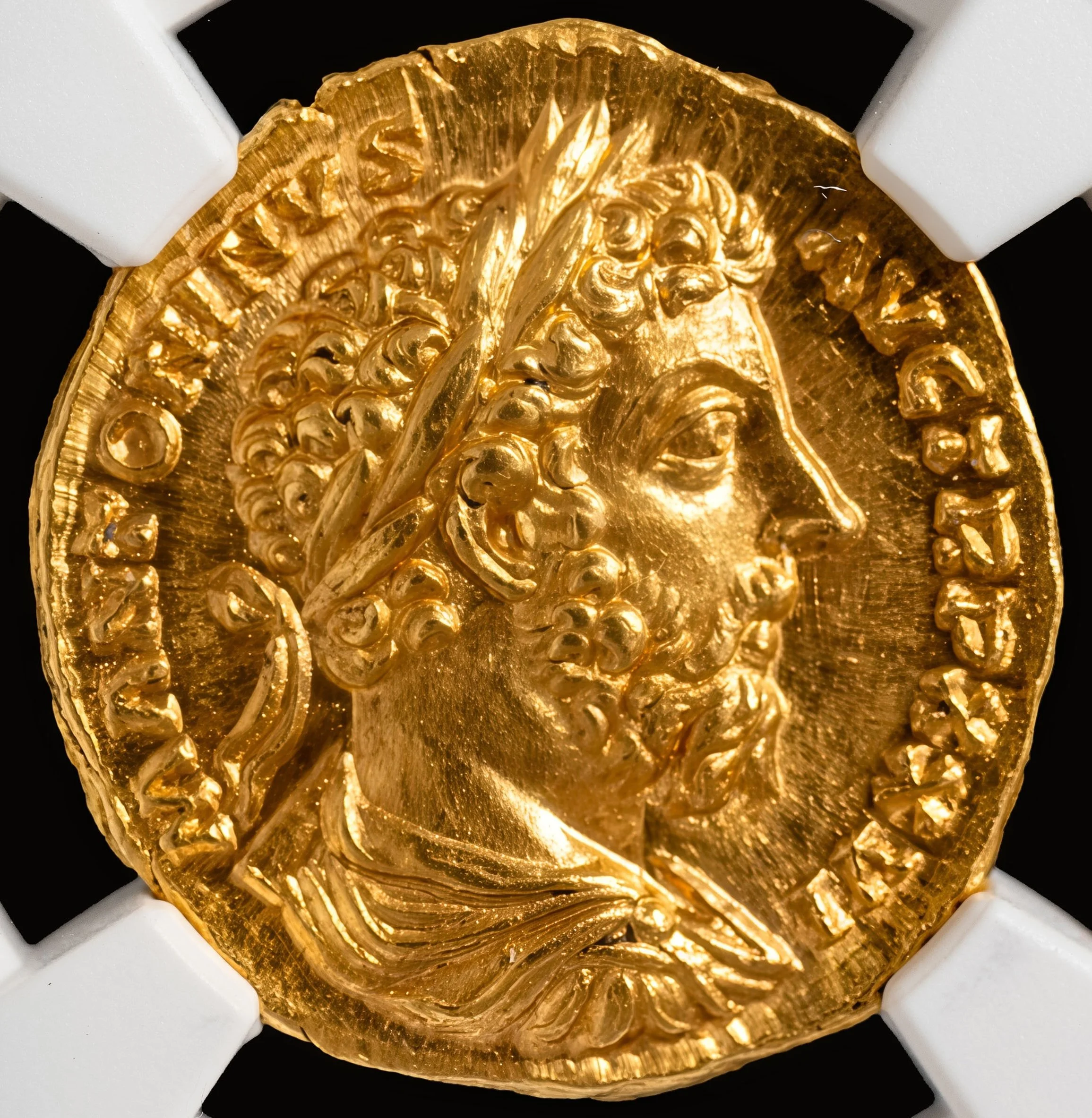
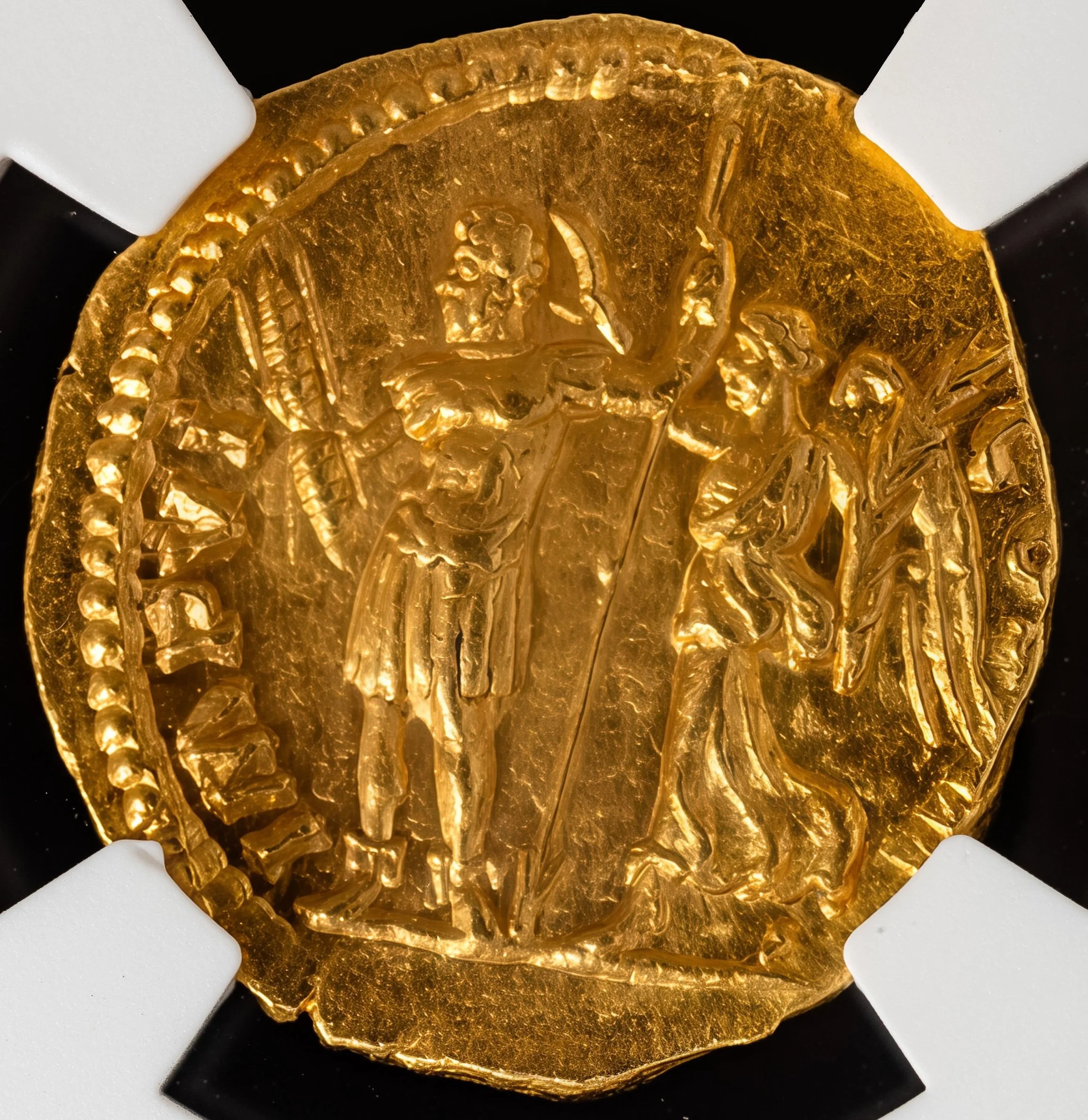
This sculptural bust represents the Roman emperor Marcus Salvius Otho (AD 32–69), portrayed with his head turned to the left. The finely carved Carrara marble head is set upon a polychrome bust veneered in an array of decorative stones, including Spanish Brocatello, Languedoc Rouge, Grey Lez Breccia, Noir de Sablé, Brèche d'Aste, and Giallo Antico. These veneers are applied to a grey volcanic stone composite core and supported by a socle of Grey Lez Breccia. The work reflects the late Baroque fascination with color, texture, and the revival of antique Roman marble revetment.
Born into a distinguished Etruscan family, Otho belonged to Rome's highest aristocratic circles and was closely associated in his youth with the future emperor Nero. Their friendship ended when Nero appropriated Otho's wife, Poppaea Sabina, after which Otho was removed from court and appointed governor of the province of Lusitania (modern Portugal). There he ruled with notable competence and restraint for approximately ten years (AD 58–68), establishing a reputation for effective provincial administration.
Following Nero's suicide in AD 68, Otho initially supported Galba's claim against rival contenders for power. When Galba failed to reward him with the expected succession, Otho turned against him, securing the allegiance of the Praetorian Guard. Galba was assassinated in January AD 69, and Otho was proclaimed emperor, inaugurating one of the most turbulent episodes in Roman imperial history, the so-called "Year of the Four Emperors."
Otho's reign lasted little more than three months and was dominated by civil war. Opposing him was Vitellius, commander of the legions in Germany, whose forces advanced into northern Italy. Despite efforts to negotiate and to consolidate support, Otho suffered defeat at the First Battle of Bedriacum. Rather than prolong the conflict and subject the empire to further bloodshed, Otho chose to take his own life, declaring that it was better for one man to die than for many to perish in continued civil war. His suicide was widely regarded by ancient authors as an act of moral courage and political responsibility.
In subsequent Roman literature, Otho's decision earned him admiration. Writers such as Tacitus emphasized the dignity of his death, while Martial praised his self-sacrifice, contrasting it favorably with the ambitions of other civil war protagonists. This posthumous reassessment transformed Otho from a figure initially associated with courtly excess into an emblem of honorable restraint.
As one of the Twelve Caesars of Suetonius, Otho was most often carved for a series of imperial busts assembled for learned display, and the present head belongs to that tradition. By combining an imperial likeness with a richly polychrome body, this bust reflects early modern interest in Roman history and exemplifies the Baroque reinterpretation of ancient portraiture, evoking both the authority of the Roman emperors and the cultivated taste for antiquity characteristic of elite collectors in late 17th- and early 18th-century Italy.
This sculptural bust represents the Roman emperor Marcus Salvius Otho (AD 32–69), portrayed with his head turned to the left. The finely carved Carrara marble head is set upon a polychrome bust veneered in an array of decorative stones, including Spanish Brocatello, Languedoc Rouge, Grey Lez Breccia, Noir de Sablé, Brèche d'Aste, and Giallo Antico. These veneers are applied to a grey volcanic stone composite core and supported by a socle of Grey Lez Breccia. The work reflects the late Baroque fascination with color, texture, and the revival of antique Roman marble revetment.
Born into a distinguished Etruscan family, Otho belonged to Rome's highest aristocratic circles and was closely associated in his youth with the future emperor Nero. Their friendship ended when Nero appropriated Otho's wife, Poppaea Sabina, after which Otho was removed from court and appointed governor of the province of Lusitania (modern Portugal). There he ruled with notable competence and restraint for approximately ten years (AD 58–68), establishing a reputation for effective provincial administration.
Following Nero's suicide in AD 68, Otho initially supported Galba's claim against rival contenders for power. When Galba failed to reward him with the expected succession, Otho turned against him, securing the allegiance of the Praetorian Guard. Galba was assassinated in January AD 69, and Otho was proclaimed emperor, inaugurating one of the most turbulent episodes in Roman imperial history, the so-called "Year of the Four Emperors."
Otho's reign lasted little more than three months and was dominated by civil war. Opposing him was Vitellius, commander of the legions in Germany, whose forces advanced into northern Italy. Despite efforts to negotiate and to consolidate support, Otho suffered defeat at the First Battle of Bedriacum. Rather than prolong the conflict and subject the empire to further bloodshed, Otho chose to take his own life, declaring that it was better for one man to die than for many to perish in continued civil war. His suicide was widely regarded by ancient authors as an act of moral courage and political responsibility.
In subsequent Roman literature, Otho's decision earned him admiration. Writers such as Tacitus emphasized the dignity of his death, while Martial praised his self-sacrifice, contrasting it favorably with the ambitions of other civil war protagonists. This posthumous reassessment transformed Otho from a figure initially associated with courtly excess into an emblem of honorable restraint.
As one of the Twelve Caesars of Suetonius, Otho was most often carved for a series of imperial busts assembled for learned display, and the present head belongs to that tradition. By combining an imperial likeness with a richly polychrome body, this bust reflects early modern interest in Roman history and exemplifies the Baroque reinterpretation of ancient portraiture, evoking both the authority of the Roman emperors and the cultivated taste for antiquity characteristic of elite collectors in late 17th- and early 18th-century Italy.

 Image 1 of 1