France, second half of the 19th century
Memento mori, remember that you must die, is among the oldest disciplines in Western art, and its purpose was never morbidity. Scholars kept a skull on the desk for the reason Jerome is painted with one, and fraternal orders seated initiates before this precise emblem in a chamber of reflection, where the point was not to frighten but to clarify. Marcus Aurelius, writing on campaign to no reader but himself, put the whole tradition into a line: soon thou wilt have forgotten all things, and soon all things will have forgotten thee.
Cast life-size, the skull is modeled with its jaw fallen open over two crossed long bones, their shafts deliberately broken and finished with splintered ends. The anatomy is observed rather than emblematic, the cranial sutures wandering across the dome as they do on a real specimen, and the gilding is concentrated on the raised surfaces, falling away into the hollows against the dark patina beneath. The bronze is sand cast, the reverse hollow and left as cast, with four integrally cast pads at the bone ends, dressed flat and tapped to take screws from behind; their irregular spacing shows the piece was fitted to one particular object rather than made to a repeatable pattern.
Condition: Sand-casting texture and minor surface irregularities consistent with period production. Gilding worn in the hollows and rubbed at the extremities. A later lead patch and wire have been applied to the reverse for wall hanging, an adaptation from a subsequent life; the four original fixing pads and their threads are intact and unaltered. No foundry mark.
Dimensions: Width 11½ in (29 cm), height 8 in (20 cm), depth 3 in (7.5 cm)
Provenance: French private collection
France, second half of the 19th century
Memento mori, remember that you must die, is among the oldest disciplines in Western art, and its purpose was never morbidity. Scholars kept a skull on the desk for the reason Jerome is painted with one, and fraternal orders seated initiates before this precise emblem in a chamber of reflection, where the point was not to frighten but to clarify. Marcus Aurelius, writing on campaign to no reader but himself, put the whole tradition into a line: soon thou wilt have forgotten all things, and soon all things will have forgotten thee.
Cast life-size, the skull is modeled with its jaw fallen open over two crossed long bones, their shafts deliberately broken and finished with splintered ends. The anatomy is observed rather than emblematic, the cranial sutures wandering across the dome as they do on a real specimen, and the gilding is concentrated on the raised surfaces, falling away into the hollows against the dark patina beneath. The bronze is sand cast, the reverse hollow and left as cast, with four integrally cast pads at the bone ends, dressed flat and tapped to take screws from behind; their irregular spacing shows the piece was fitted to one particular object rather than made to a repeatable pattern.
Condition: Sand-casting texture and minor surface irregularities consistent with period production. Gilding worn in the hollows and rubbed at the extremities. A later lead patch and wire have been applied to the reverse for wall hanging, an adaptation from a subsequent life; the four original fixing pads and their threads are intact and unaltered. No foundry mark.
Dimensions: Width 11½ in (29 cm), height 8 in (20 cm), depth 3 in (7.5 cm)
Provenance: French private collection

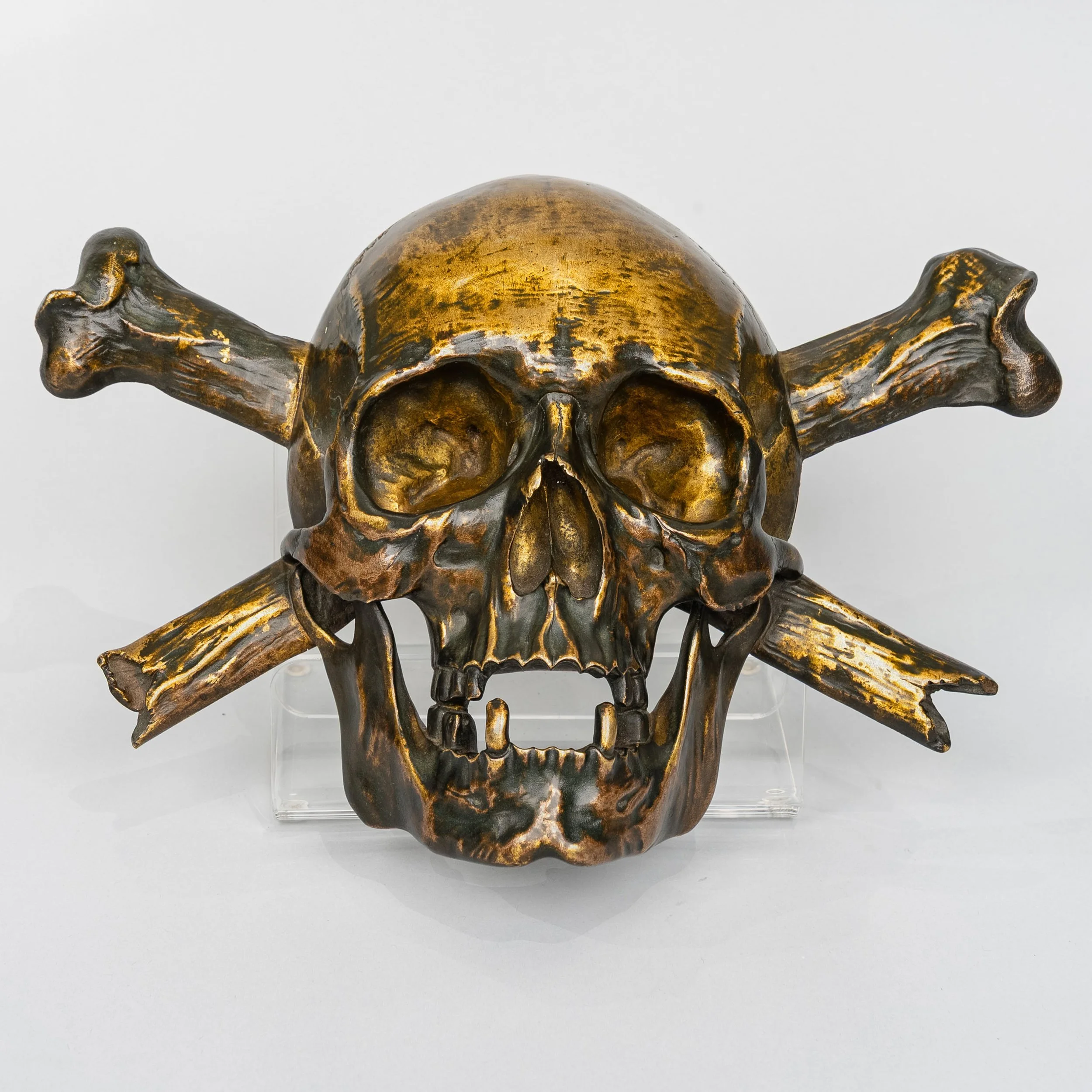 Image 1 of 3
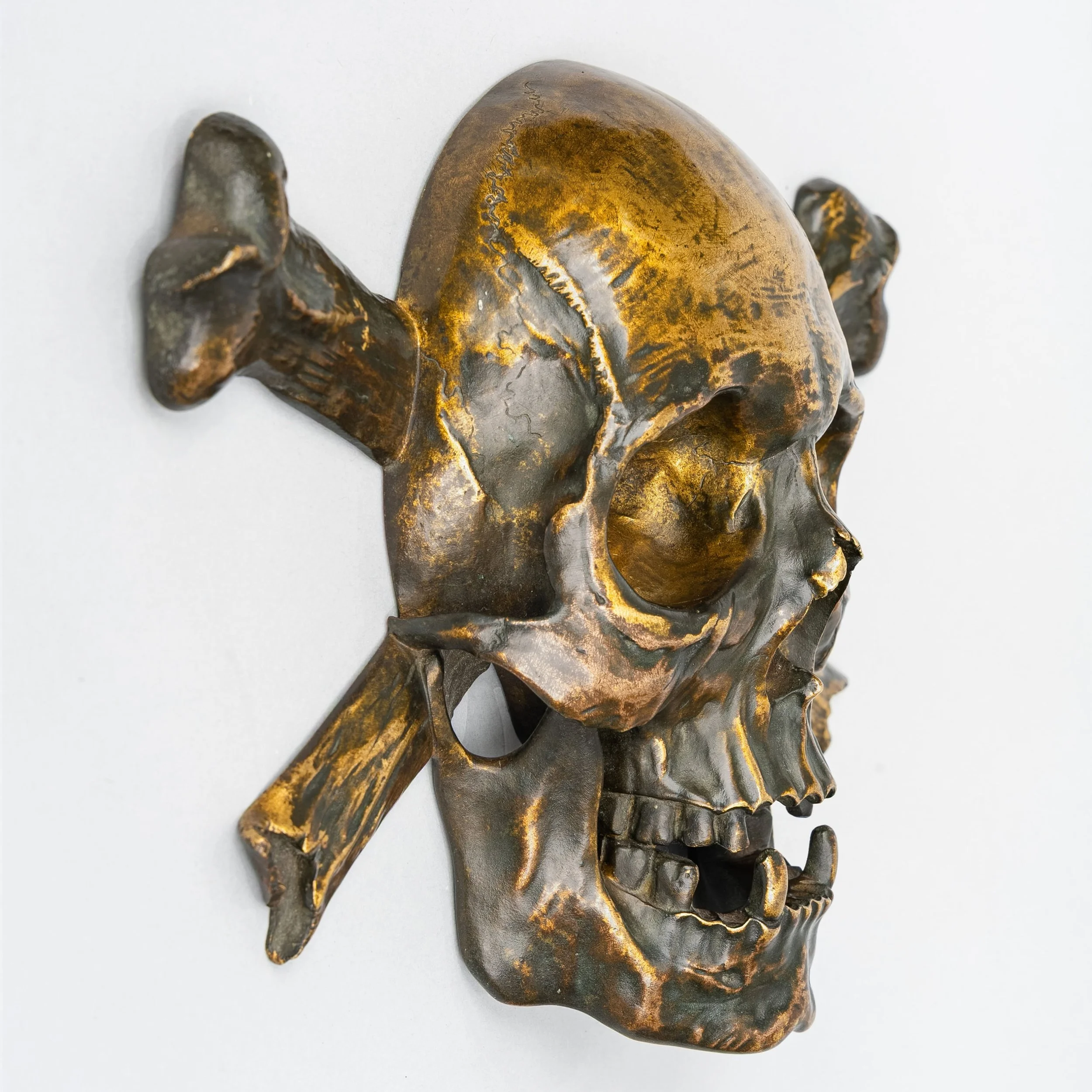 Image 2 of 3
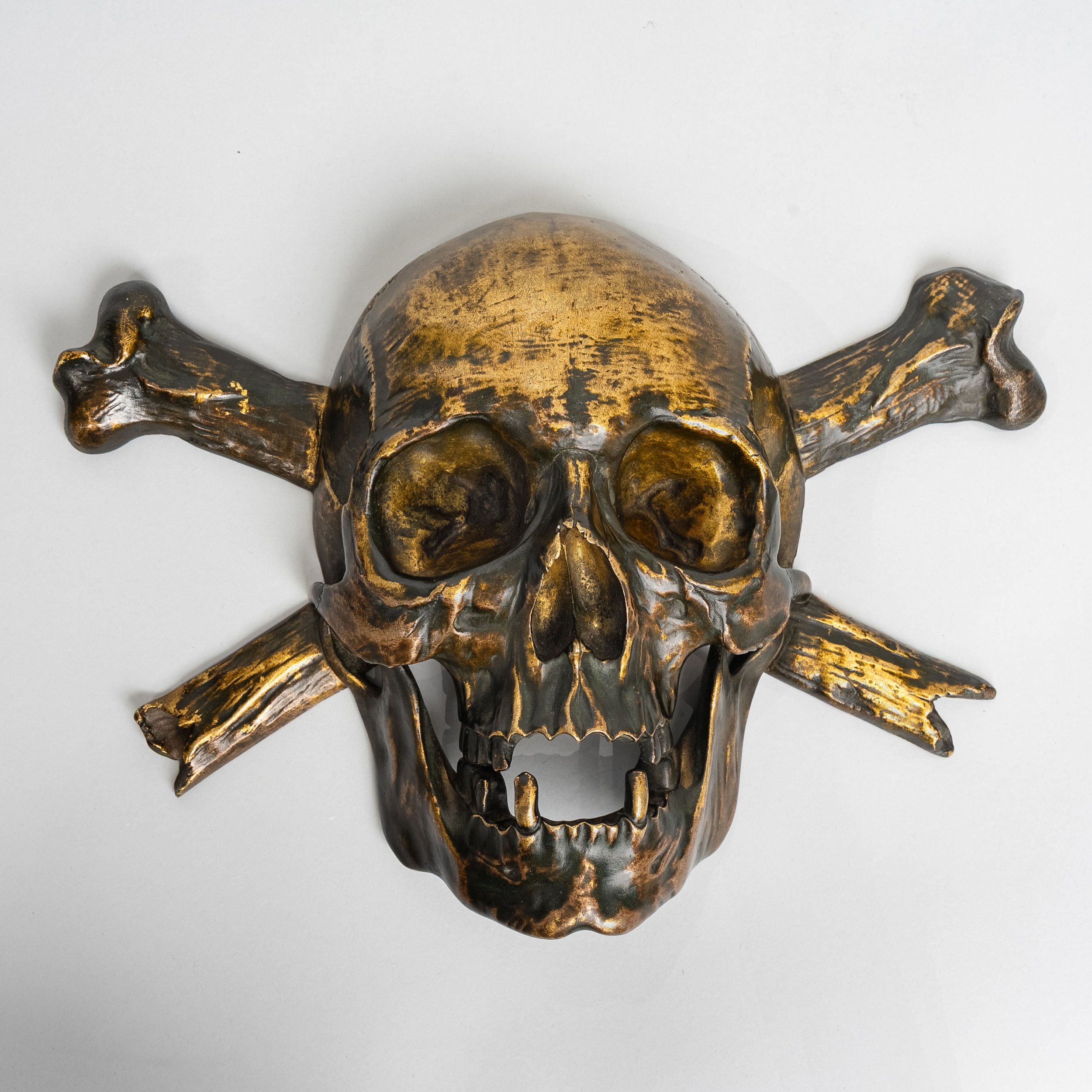 Image 3 of 3