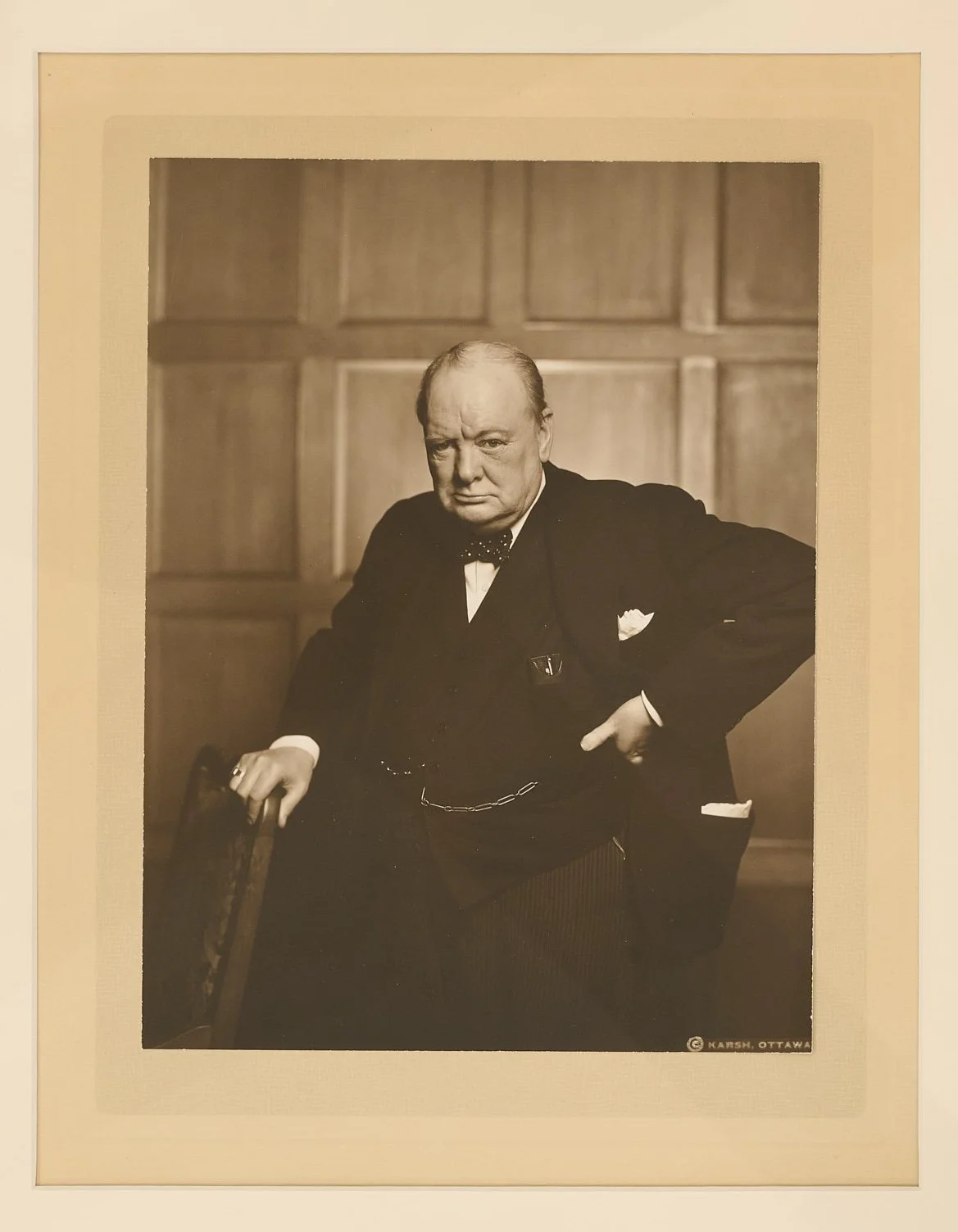
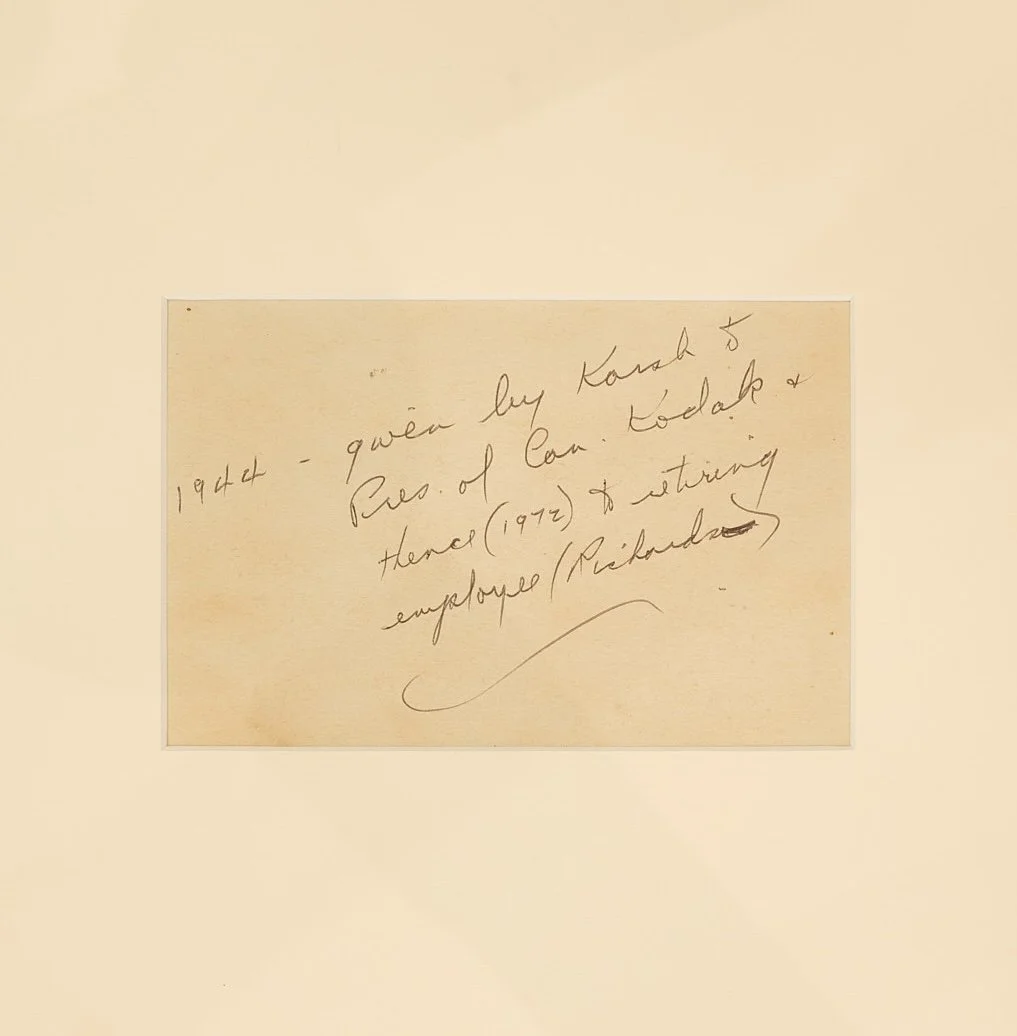
A vintage silver gelatin print of Yousuf Karsh's portrait of Sir Winston Churchill, signed in pencil by Karsh at the lower left of the print margin, with the photographer's Karsh, Ottawa copyright stamp at the lower right of the image, and signed "Winston S. Churchill" and dated 1954 in ink by Churchill on the mount below.
The portrait was taken in the Speaker's Chamber of the Canadian Parliament in Ottawa on December 30, 1941, minutes after Churchill's "Some chicken! Some neck!" address to the House of Commons. Three weeks after Pearl Harbor, Churchill had crossed the Atlantic aboard the battleship HMS Duke of York to confer with President Roosevelt, spending Christmas at the White House before traveling north to address the Canadian Parliament. Karsh was granted two minutes with the Prime Minister, who arrived scowling, cigar in his teeth. Judging the cigar wrong for the occasion, Karsh plucked it from Churchill's mouth, and the glower that followed became the defining image of British defiance in the Second World War. Churchill, his mood turning as quickly as it had darkened, told the photographer he could make a roaring lion stand still to be photographed, and the portrait has carried the name ever since.
Churchill signed and dated this print in 1954, during his final visit to Canada as Prime Minister. Examples of The Roaring Lion bearing the signatures of both photographer and sitter are of the greatest rarity.
A vintage silver gelatin print of Yousuf Karsh's portrait of Sir Winston Churchill, signed in pencil by Karsh at the lower left of the print margin, with the photographer's Karsh, Ottawa copyright stamp at the lower right of the image, and signed "Winston S. Churchill" and dated 1954 in ink by Churchill on the mount below.
The portrait was taken in the Speaker's Chamber of the Canadian Parliament in Ottawa on December 30, 1941, minutes after Churchill's "Some chicken! Some neck!" address to the House of Commons. Three weeks after Pearl Harbor, Churchill had crossed the Atlantic aboard the battleship HMS Duke of York to confer with President Roosevelt, spending Christmas at the White House before traveling north to address the Canadian Parliament. Karsh was granted two minutes with the Prime Minister, who arrived scowling, cigar in his teeth. Judging the cigar wrong for the occasion, Karsh plucked it from Churchill's mouth, and the glower that followed became the defining image of British defiance in the Second World War. Churchill, his mood turning as quickly as it had darkened, told the photographer he could make a roaring lion stand still to be photographed, and the portrait has carried the name ever since.
Churchill signed and dated this print in 1954, during his final visit to Canada as Prime Minister. Examples of The Roaring Lion bearing the signatures of both photographer and sitter are of the greatest rarity.

 Image 1 of 4
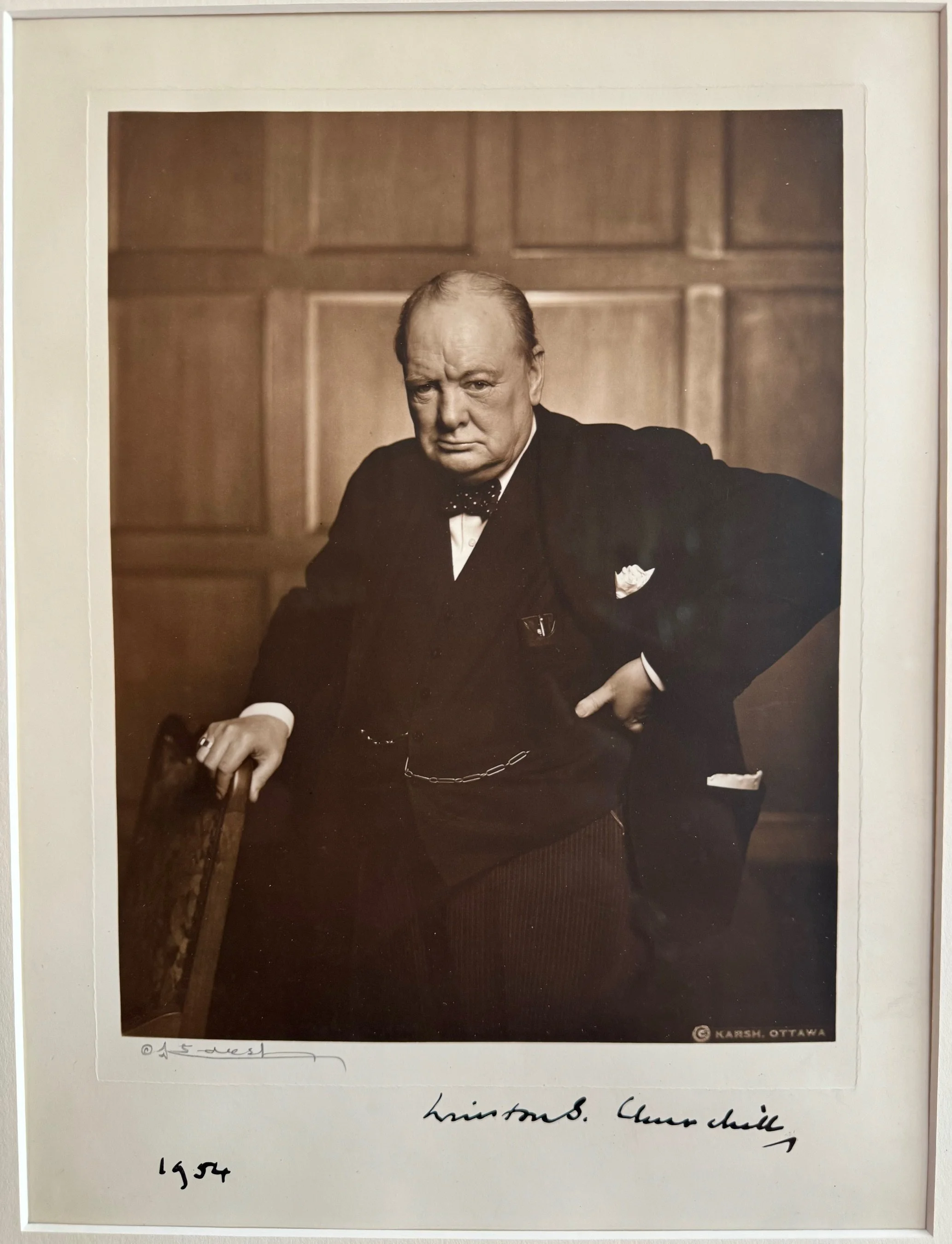 Image 2 of 4
 Image 3 of 4
 Image 4 of 4