"The glorious events of the last fortnight"
Written nine days after D-Day, this autograph letter signed by Winston S. Churchill represents a document of exceptional historical importance — composed at the height of Allied operations in France, from the desk of the Prime Minister, and marked "SECRET" for reasons that speak directly to the grand strategic situation of June 1944.
The recipient, Emanuel Shinwell (1884–1986), was a Labour MP and persistent — though always patriotic — critic of Churchill's wartime coalition government. He had declined a post in that government, yet wrote to Churchill on 8 June in a spirit of national unity, praising the success of the landings. Churchill's Private Secretary advised that no reply was necessary. Churchill responded nonetheless.
In acknowledging Shinwell's letter, Churchill writes with characteristic clarity and measured confidence:
"Thank you so much for your kind letter. I know well that your patriotic sentiments have been profoundly stirred by the glorious events of the last fortnight. Very heavy fighting lies ahead in France, but I expect our power to reinforce is greater than the enemy's — at any rate for some time to come. Meanwhile, Stalin is sure to get on the move."
The final sentence — "Meanwhile, Stalin is sure to get on the move" — illuminates the SECRET designation. The Soviet summer offensive agreed at the Tehran Conference was imminent, its timing known only to the highest levels of Allied command. That Churchill committed this to paper, in a private letter to a political opponent, underscores both the trust implied and the strategic confidence with which he approached the campaign.
Letters of this period, written from Downing Street during active operations and touching on the broadest dimensions of Allied strategy, are of the greatest historical significance. That Churchill chose to write personally — overriding his Private Secretary's advice — lends the document an additional human and political dimension.
Provenance: The collection of Steve Forbes, chairman of Forbes Magazine and presidential candidate in the 1996 and 2000 US elections.
Reference: Martin Gilbert, Winston S. Churchill, Vol. VII, 1986, p. 800.
Physical description: Single sheet on official 10 Downing Street letterhead (191 × 121 mm), typed one side, signed "Winston S. Churchill." Hole punch, light toning, and handling soiling consistent with age. Overall condition is very good.
"The glorious events of the last fortnight"
Written nine days after D-Day, this autograph letter signed by Winston S. Churchill represents a document of exceptional historical importance — composed at the height of Allied operations in France, from the desk of the Prime Minister, and marked "SECRET" for reasons that speak directly to the grand strategic situation of June 1944.
The recipient, Emanuel Shinwell (1884–1986), was a Labour MP and persistent — though always patriotic — critic of Churchill's wartime coalition government. He had declined a post in that government, yet wrote to Churchill on 8 June in a spirit of national unity, praising the success of the landings. Churchill's Private Secretary advised that no reply was necessary. Churchill responded nonetheless.
In acknowledging Shinwell's letter, Churchill writes with characteristic clarity and measured confidence:
"Thank you so much for your kind letter. I know well that your patriotic sentiments have been profoundly stirred by the glorious events of the last fortnight. Very heavy fighting lies ahead in France, but I expect our power to reinforce is greater than the enemy's — at any rate for some time to come. Meanwhile, Stalin is sure to get on the move."
The final sentence — "Meanwhile, Stalin is sure to get on the move" — illuminates the SECRET designation. The Soviet summer offensive agreed at the Tehran Conference was imminent, its timing known only to the highest levels of Allied command. That Churchill committed this to paper, in a private letter to a political opponent, underscores both the trust implied and the strategic confidence with which he approached the campaign.
Letters of this period, written from Downing Street during active operations and touching on the broadest dimensions of Allied strategy, are of the greatest historical significance. That Churchill chose to write personally — overriding his Private Secretary's advice — lends the document an additional human and political dimension.
Provenance: The collection of Steve Forbes, chairman of Forbes Magazine and presidential candidate in the 1996 and 2000 US elections.
Reference: Martin Gilbert, Winston S. Churchill, Vol. VII, 1986, p. 800.
Physical description: Single sheet on official 10 Downing Street letterhead (191 × 121 mm), typed one side, signed "Winston S. Churchill." Hole punch, light toning, and handling soiling consistent with age. Overall condition is very good.

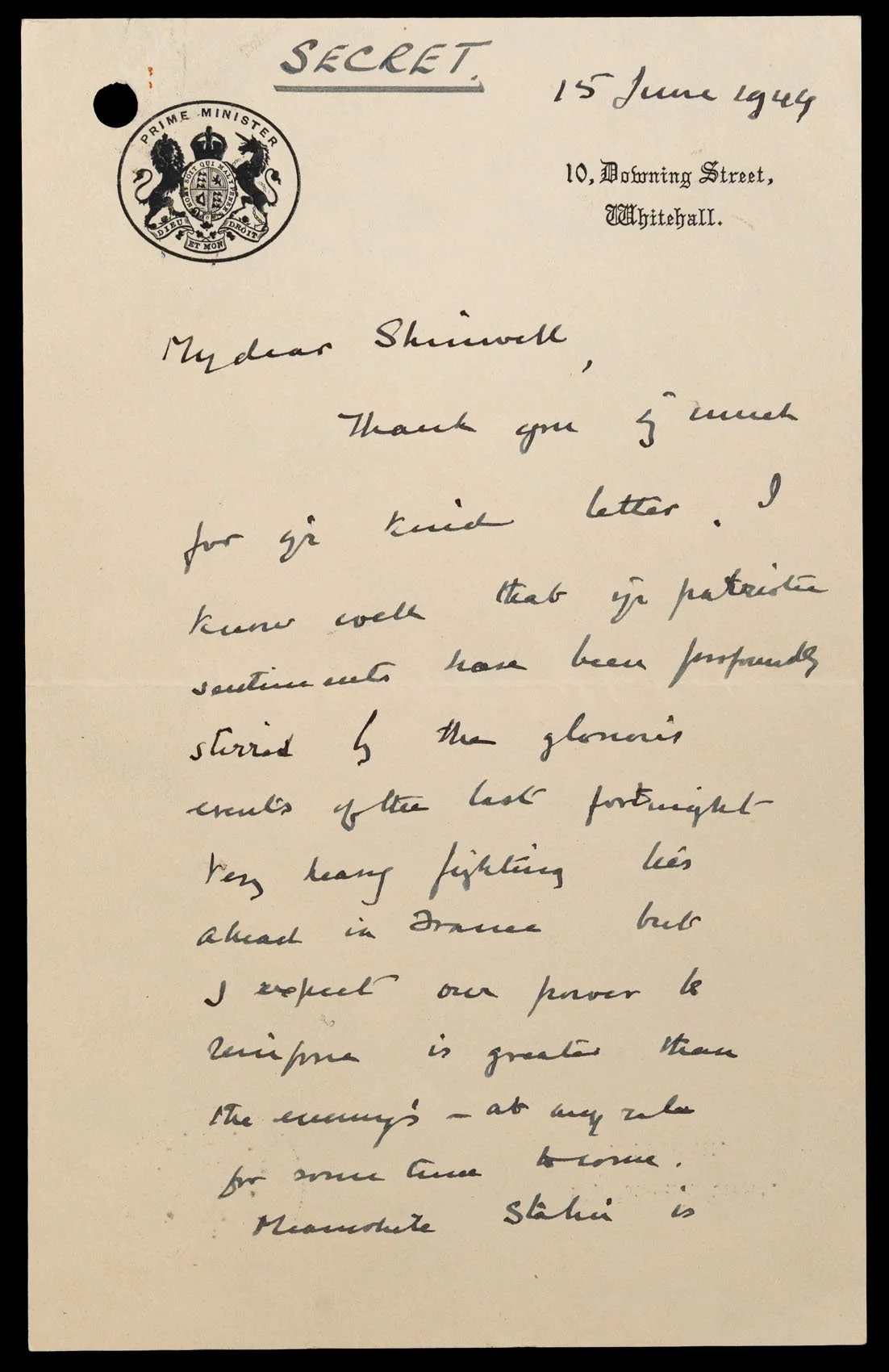 Image 1 of 2
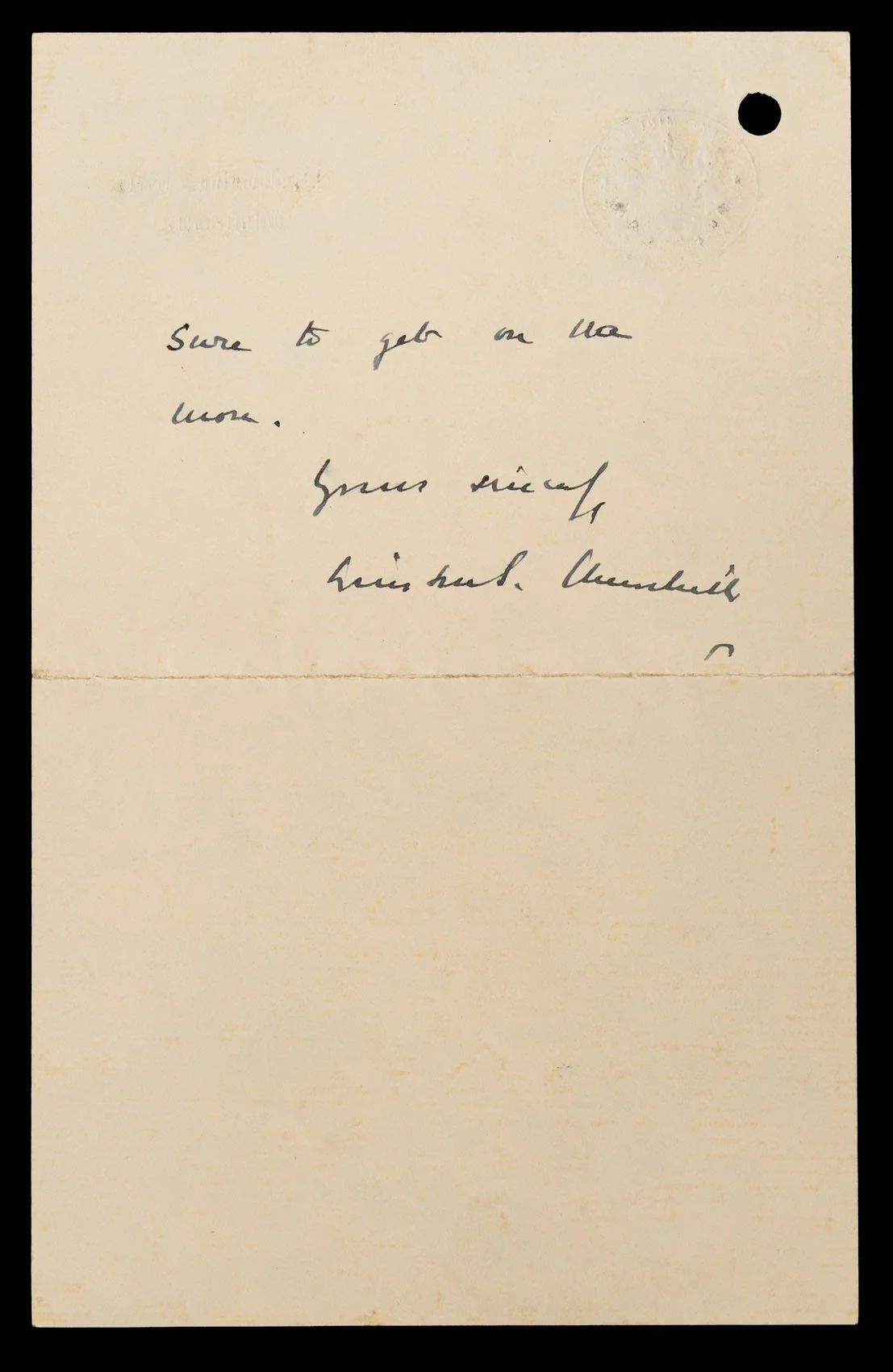 Image 2 of 2