A vintage gelatin silver print of The Roaring Lion, Yousuf Karsh's portrait of Winston Churchill. This is an early printing, made circa 1944 within a few years of the 1941 negative.
Karsh made the portrait in the first weeks after Pearl Harbor, with the United States newly drawn into the war and its outcome far from certain. Churchill had crossed the Atlantic aboard HMS Duke of York to confer with Roosevelt, and traveled on from Washington to Ottawa, where on December 30, 1941, he addressed the Canadian Parliament in the speech remembered for his scorn of the prediction that Britain would have her neck wrung like a chicken. Karsh was waiting in the Speaker's Chamber. Allowed two minutes, and faced with a subject who would not set down his cigar, he stepped forward, said "Forgive me, sir," and drew it from Churchill's mouth. The expression that followed was caught in the instant the photographer returned to his camera, and it became the face of British resistance. Churchill, his composure recovered, told him he could even make a roaring lion stand still for a portrait.
Prints of this image reach the market at a rate of only a few each year, and the great majority of those are later printings. Having followed them for many years, and compared this example directly against another early print in this collection, I place it among the earliest to come from the negative. The composition retains the fuller field above the sitter's head, the area Karsh reduced in later years to concentrate the eye on Churchill, and his copyright credit appears in the early form, in white at the lower right within the image.
A manuscript note at the reverse records the print as given by Karsh in 1944 to the president of Canadian Kodak, and passed in 1972 to a retiring employee of the company. Provenance recording a gift from the photographer himself is of real importance for a print of this period.
The image has appeared on the Bank of England five-pound note since 2016, and is among the most widely reproduced portraits ever made. This example is in excellent original condition, clear and well contrasted, and distinguished by an unusually rich sepia tonality. It is not signed, and is presented in its period mount.
A vintage gelatin silver print of The Roaring Lion, Yousuf Karsh's portrait of Winston Churchill. This is an early printing, made circa 1944 within a few years of the 1941 negative.
Karsh made the portrait in the first weeks after Pearl Harbor, with the United States newly drawn into the war and its outcome far from certain. Churchill had crossed the Atlantic aboard HMS Duke of York to confer with Roosevelt, and traveled on from Washington to Ottawa, where on December 30, 1941, he addressed the Canadian Parliament in the speech remembered for his scorn of the prediction that Britain would have her neck wrung like a chicken. Karsh was waiting in the Speaker's Chamber. Allowed two minutes, and faced with a subject who would not set down his cigar, he stepped forward, said "Forgive me, sir," and drew it from Churchill's mouth. The expression that followed was caught in the instant the photographer returned to his camera, and it became the face of British resistance. Churchill, his composure recovered, told him he could even make a roaring lion stand still for a portrait.
Prints of this image reach the market at a rate of only a few each year, and the great majority of those are later printings. Having followed them for many years, and compared this example directly against another early print in this collection, I place it among the earliest to come from the negative. The composition retains the fuller field above the sitter's head, the area Karsh reduced in later years to concentrate the eye on Churchill, and his copyright credit appears in the early form, in white at the lower right within the image.
A manuscript note at the reverse records the print as given by Karsh in 1944 to the president of Canadian Kodak, and passed in 1972 to a retiring employee of the company. Provenance recording a gift from the photographer himself is of real importance for a print of this period.
The image has appeared on the Bank of England five-pound note since 2016, and is among the most widely reproduced portraits ever made. This example is in excellent original condition, clear and well contrasted, and distinguished by an unusually rich sepia tonality. It is not signed, and is presented in its period mount.

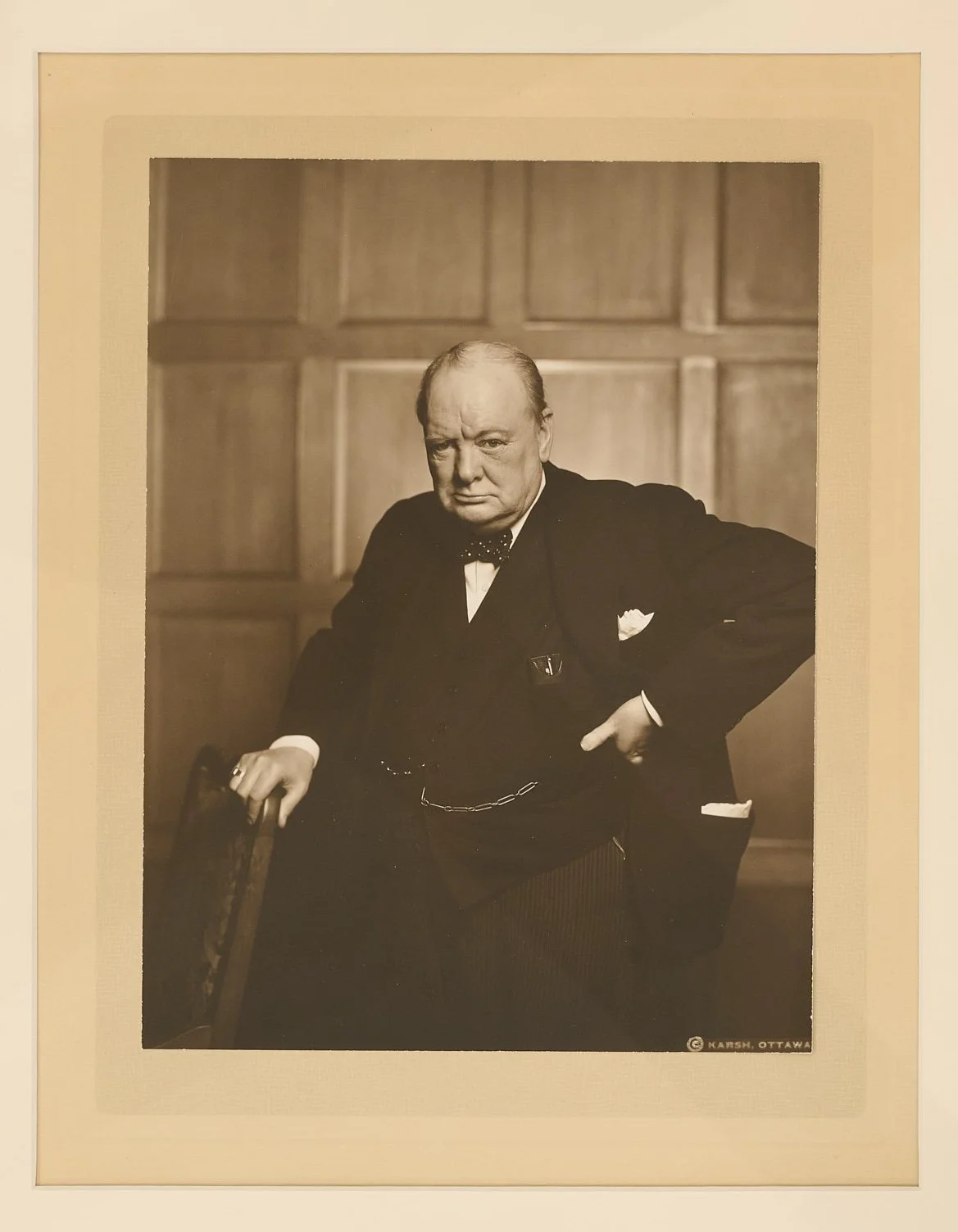 Image 1 of 2
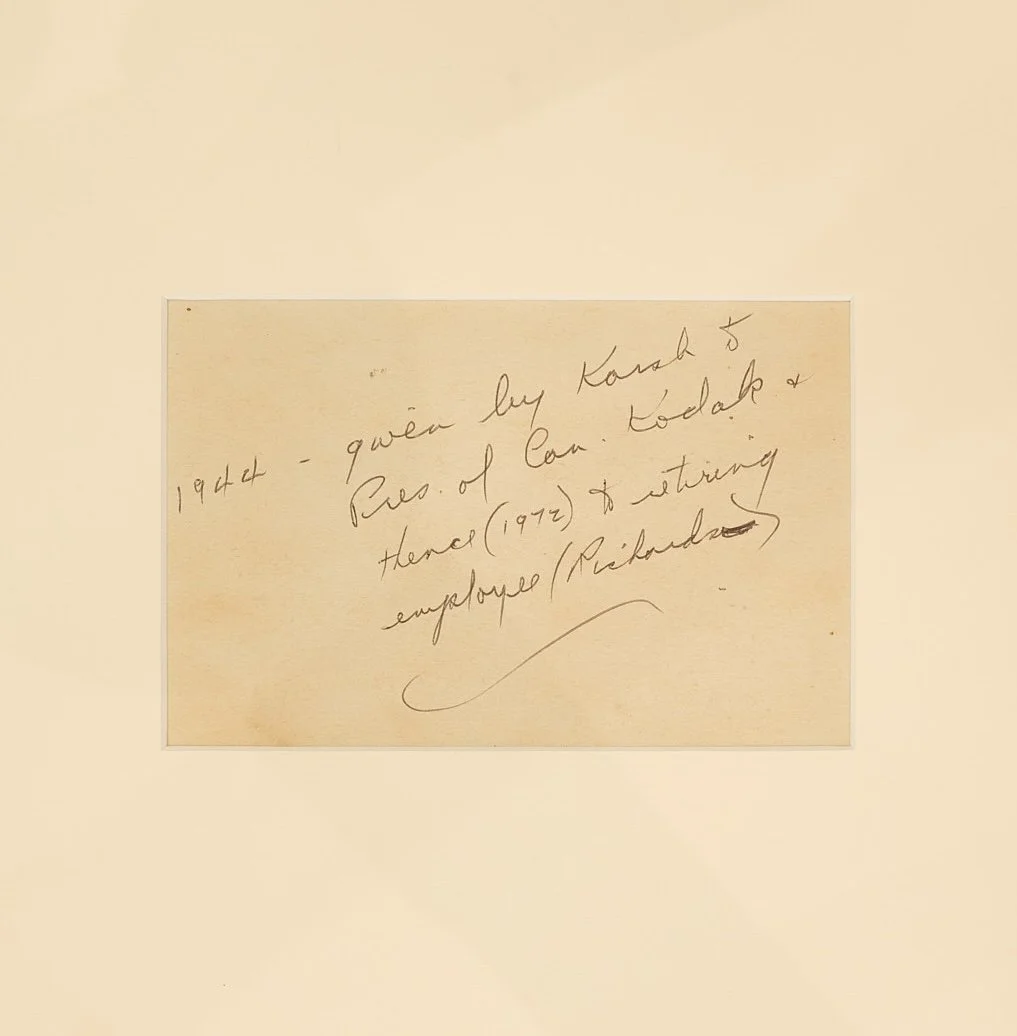 Image 2 of 2