A manuscript letter signed by Winston S. Churchill, dated 13 December 1926, to Max Beaverbrook, thanking him for the gift of a Frigidaire refrigerator and reflecting on its use in domestic life.
CHURCHILL ON MODERN CONVENIENCE AND “BEAUTIFUL ICE EGGS”
A delighted and highly personal letter to Beaverbrook—one of Churchill’s closest friends and political allies—in which he expresses his enthusiasm for the newly installed refrigerator, then still a modern luxury in elite households. Writing with characteristic humor and vividness, Churchill observes:
“The Frigidaire laid beautiful ice eggs all yesterday. But even more important it reduces soda water & champagne to exactly the right level, & no dilution by ice of the latter is required. Thank you once more for installing it. It is a most welcome gift.”
The striking phrase “beautiful ice eggs” captures both the novelty of early refrigeration and Churchill’s distinctive gift for language, transforming a domestic appliance into a moment of charm and personality. His immediate focus on cooling champagne is equally characteristic, reflecting his well-known appreciation for food and drink.
Churchill continues with a brief note on political and personal matters, mentioning that the young Robert Boothby is to join him as parliamentary private secretary, adding a glimpse into his working life during this period. The letter closes on a convivial note, reflecting the warmth and familiarity that marked his long-standing relationship with Beaverbrook, signing simply “W,” as was his custom in correspondence with close friends.
Max Beaverbrook (1879–1964), the powerful press magnate and later Minister of Aircraft Production, was among Churchill’s most important allies, providing crucial media support throughout his career. Correspondence between the two is of particular interest for the insight it offers into both personal and political dimensions of Churchill’s life.
Written while Churchill was out of office yet actively engaged in political and social life, the letter offers a rare and intimate perspective distinct from his formal statesmanlike correspondence. It stands as a vivid example of Churchill’s private voice—witty, appreciative, and deeply human.
Single sheet on House of Commons blind-embossed letterhead (187 × 118 mm), handwritten on both sides in black ink. Signed “W.”
Two filing holes, light toning; overall in very good condition.
Provenance
Collection of Steve Forbes.
Sotheby’s, 5 July 1977, lot 163 (from a group of Churchill letters to Beaverbrook).
Literature
Published in Martin Gilbert, Winston S. Churchill, Vol. V, Companion Part 1 (1979), p. 894.
A manuscript letter signed by Winston S. Churchill, dated 13 December 1926, to Max Beaverbrook, thanking him for the gift of a Frigidaire refrigerator and reflecting on its use in domestic life.
CHURCHILL ON MODERN CONVENIENCE AND “BEAUTIFUL ICE EGGS”
A delighted and highly personal letter to Beaverbrook—one of Churchill’s closest friends and political allies—in which he expresses his enthusiasm for the newly installed refrigerator, then still a modern luxury in elite households. Writing with characteristic humor and vividness, Churchill observes:
“The Frigidaire laid beautiful ice eggs all yesterday. But even more important it reduces soda water & champagne to exactly the right level, & no dilution by ice of the latter is required. Thank you once more for installing it. It is a most welcome gift.”
The striking phrase “beautiful ice eggs” captures both the novelty of early refrigeration and Churchill’s distinctive gift for language, transforming a domestic appliance into a moment of charm and personality. His immediate focus on cooling champagne is equally characteristic, reflecting his well-known appreciation for food and drink.
Churchill continues with a brief note on political and personal matters, mentioning that the young Robert Boothby is to join him as parliamentary private secretary, adding a glimpse into his working life during this period. The letter closes on a convivial note, reflecting the warmth and familiarity that marked his long-standing relationship with Beaverbrook, signing simply “W,” as was his custom in correspondence with close friends.
Max Beaverbrook (1879–1964), the powerful press magnate and later Minister of Aircraft Production, was among Churchill’s most important allies, providing crucial media support throughout his career. Correspondence between the two is of particular interest for the insight it offers into both personal and political dimensions of Churchill’s life.
Written while Churchill was out of office yet actively engaged in political and social life, the letter offers a rare and intimate perspective distinct from his formal statesmanlike correspondence. It stands as a vivid example of Churchill’s private voice—witty, appreciative, and deeply human.
Single sheet on House of Commons blind-embossed letterhead (187 × 118 mm), handwritten on both sides in black ink. Signed “W.”
Two filing holes, light toning; overall in very good condition.
Provenance
Collection of Steve Forbes.
Sotheby’s, 5 July 1977, lot 163 (from a group of Churchill letters to Beaverbrook).
Literature
Published in Martin Gilbert, Winston S. Churchill, Vol. V, Companion Part 1 (1979), p. 894.

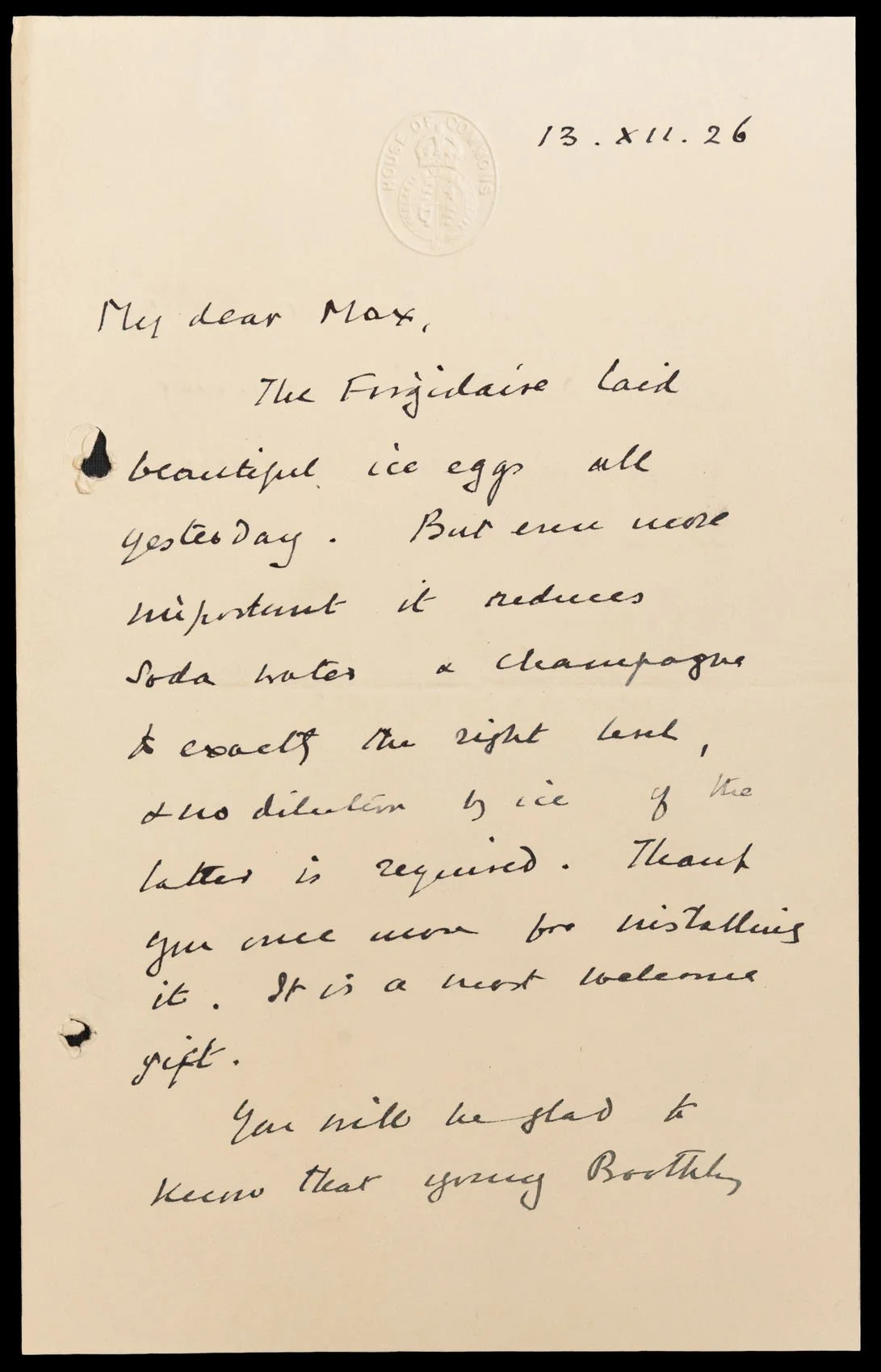 Image 1 of 2
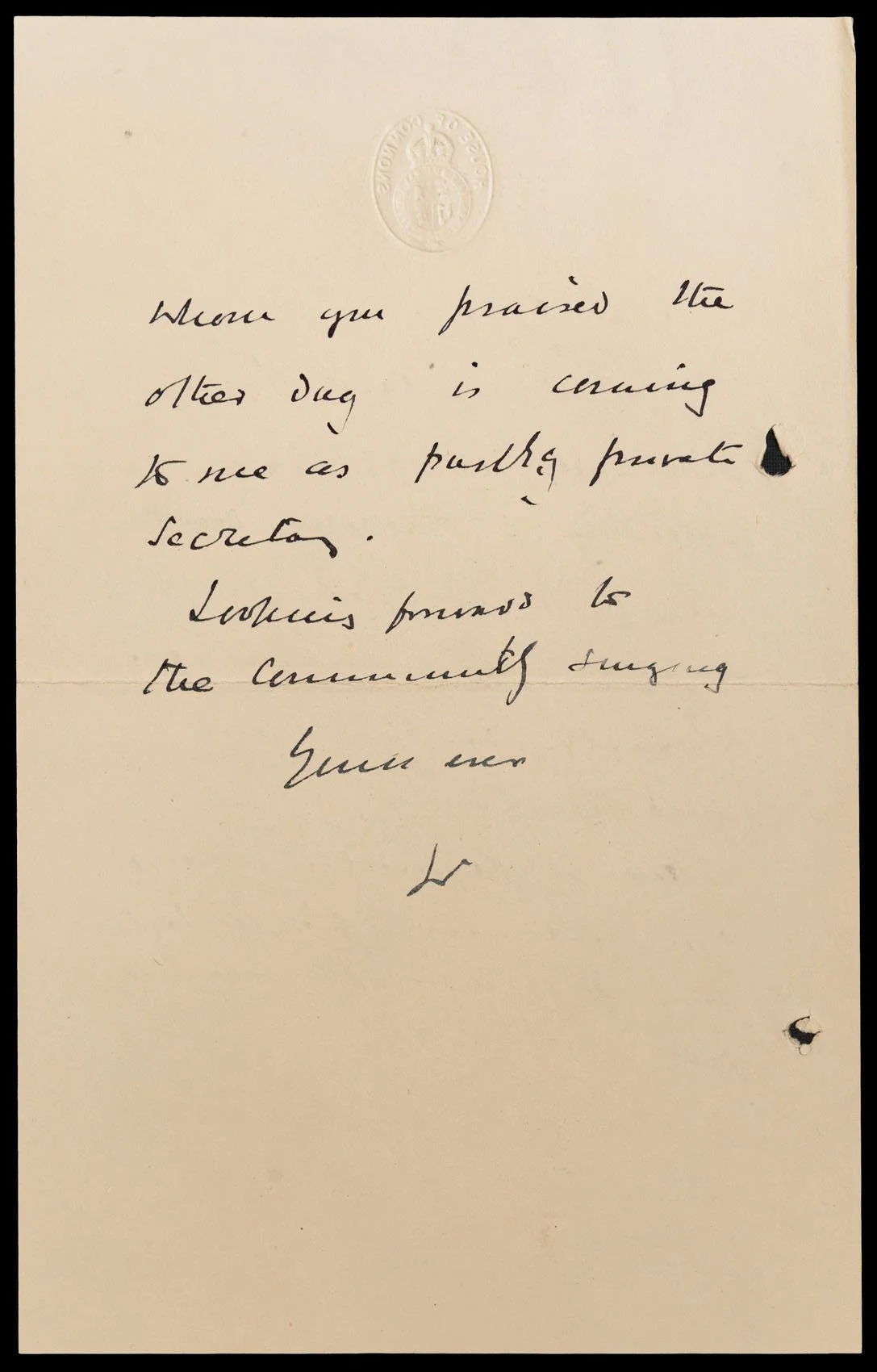 Image 2 of 2