A typed letter signed by Winston S. Churchill on Chartwell letterhead, 16 June 1937, to Prince Hubertus zu Löwenstein-Wertheim-Freudenberg, one of the most prominent German opponents of Hitler. Löwenstein, an aristocrat who had fled Germany in 1933, had written on 11 June, warning that National Socialism would lead to "an international catastrophe" and appealing to Churchill for help in assembling British trustees and funds to take over the failing Paris émigré newspaper, Pariser Tageszeitung, as a center of resistance in exile.
Churchill declines: "I do not see how I can assist you in the object you have in view, as my time and influence at the present are fully engaged." Then, in an autograph continuation in his own hand, he adds: "But I thank you for laying the matter before me in so courteous a form."
The exchange shows Churchill's direct contact with the German opposition during the Wilderness Years, when, still out of office, he was emerging as the leading British voice against Nazi expansion — sympathetic to the cause, careful with his commitments. Löwenstein survived the war and returned to Germany, later serving in the Bundestag.
Single sheet, typed on one side and signed Winston S. Churchill, with autograph continuation. Two filing holes to the inner margin, folds from handling, light toning and scattered spotting; good overall.
Archive: Löwenstein's letter to Churchill of 11 June 1937 is preserved in the Churchill Archives Center (CHAR 2/296A–B).
A typed letter signed by Winston S. Churchill on Chartwell letterhead, 16 June 1937, to Prince Hubertus zu Löwenstein-Wertheim-Freudenberg, one of the most prominent German opponents of Hitler. Löwenstein, an aristocrat who had fled Germany in 1933, had written on 11 June, warning that National Socialism would lead to "an international catastrophe" and appealing to Churchill for help in assembling British trustees and funds to take over the failing Paris émigré newspaper, Pariser Tageszeitung, as a center of resistance in exile.
Churchill declines: "I do not see how I can assist you in the object you have in view, as my time and influence at the present are fully engaged." Then, in an autograph continuation in his own hand, he adds: "But I thank you for laying the matter before me in so courteous a form."
The exchange shows Churchill's direct contact with the German opposition during the Wilderness Years, when, still out of office, he was emerging as the leading British voice against Nazi expansion — sympathetic to the cause, careful with his commitments. Löwenstein survived the war and returned to Germany, later serving in the Bundestag.
Single sheet, typed on one side and signed Winston S. Churchill, with autograph continuation. Two filing holes to the inner margin, folds from handling, light toning and scattered spotting; good overall.
Archive: Löwenstein's letter to Churchill of 11 June 1937 is preserved in the Churchill Archives Center (CHAR 2/296A–B).

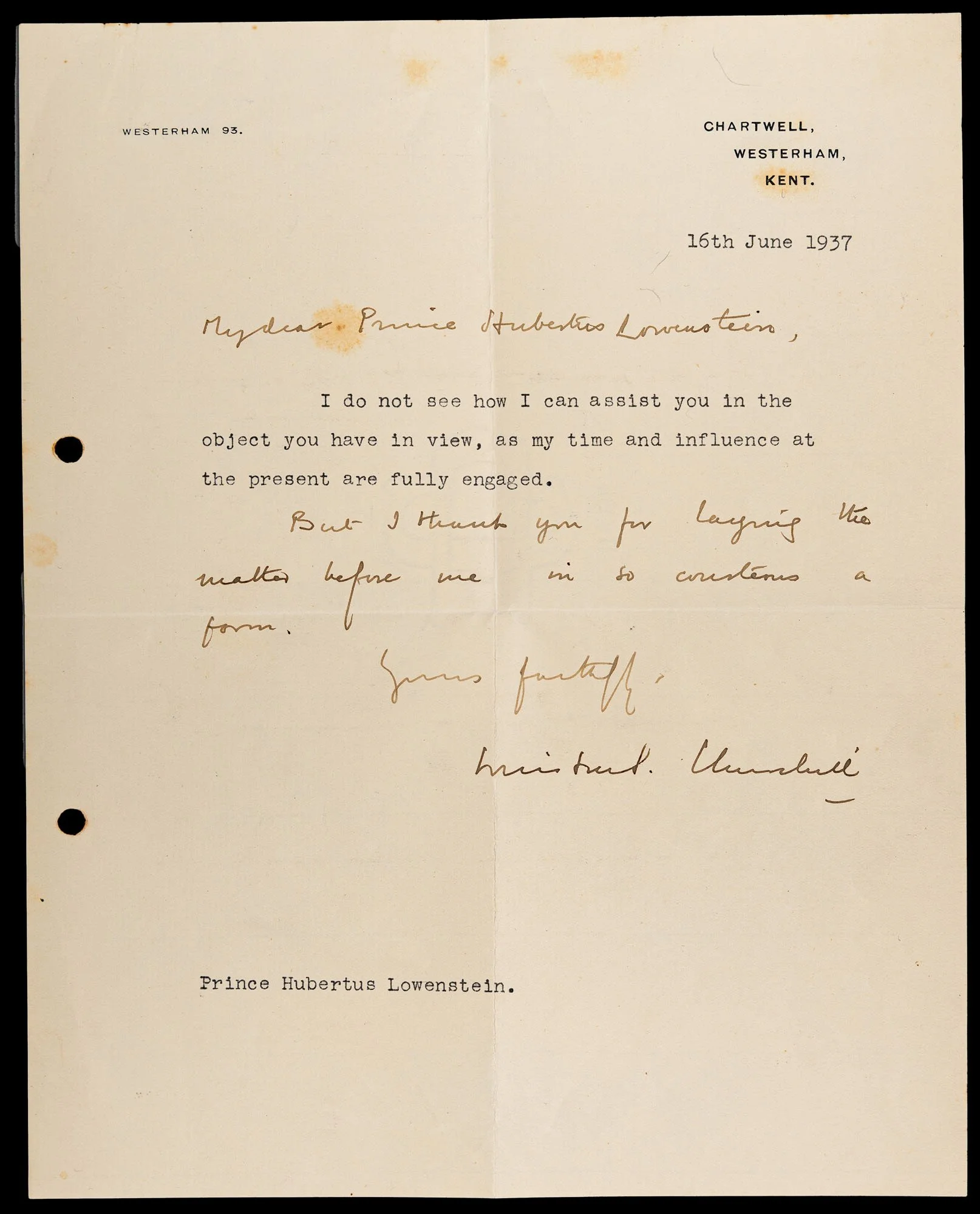 Image 1 of 1