
The Pulse of Wall Street: Thomas Edison, the Universal Stock Ticker, and the Birth of Modern Finance.
The stock ticker transformed Wall Street overnight. From Edward Calahan's first instrument in 1867 to the Edison Universal Stock Ticker that became the nervous system of American finance, these machines made modern markets possible — and on October 29, 1929, met their limit. The Edison Universal Stock Ticker in the Daniels Antiques collection is among the finest surviving examples of the instrument that changed everything.
The instruments illustrated in this article are drawn from the Daniels Antiques collection, and those currently available may be seen on our stock ticker page.
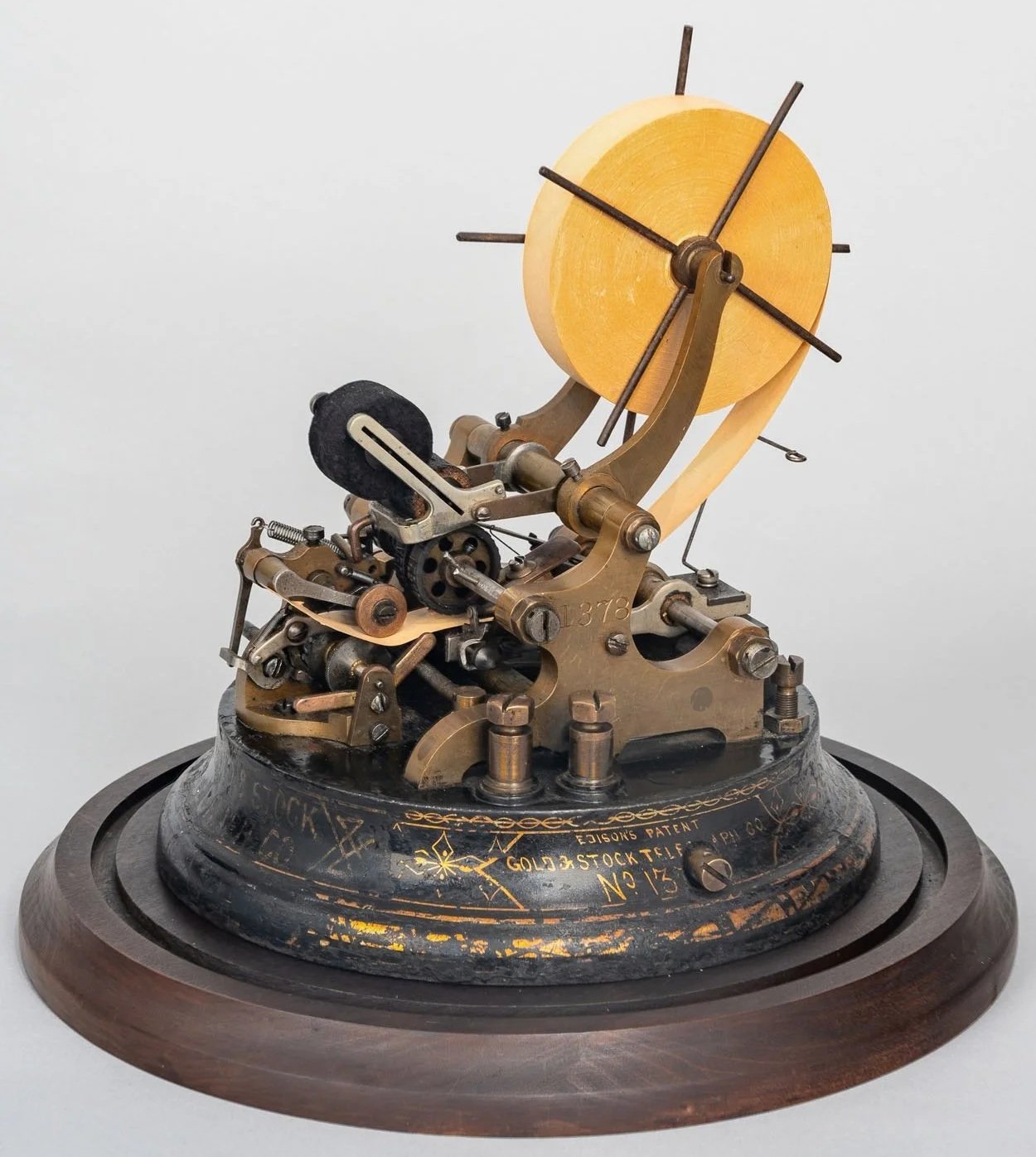
An Edison Universal Stock Ticker for the Gold & Stock Telegraph Company, c.1870s, serial no. 1378, with original cast-iron base bearing gold "Edison's Patent / Gold & Stock Telegraph Co." inscription — Daniels Antiques
Before the stock ticker, Wall Street ran on legs.
In the 1860s, the brokers and bankers of lower Manhattan depended on an army of young men known, in the slang of the day, as "pad shovers" — clerks who recorded the latest stock prices and ran them by hand from the floor of the New York Stock Exchange to the offices of their employers. The broker who received a quotation first could act on it; the broker who received it last was already behind. One particularly fast runner, William Heath, became so celebrated for his speed between the Exchange and the brokerage houses that he earned the nickname the "American Deer" — until the morning in December 1867 when he arrived breathless at the office of David Groesbeck & Co. on Wall Street and found a crowd standing six deep around a small machine that had already printed every price on a ribbon of paper tape.
The American Deer had been outrun by a wire.
E.A. Calahan and the first ticker
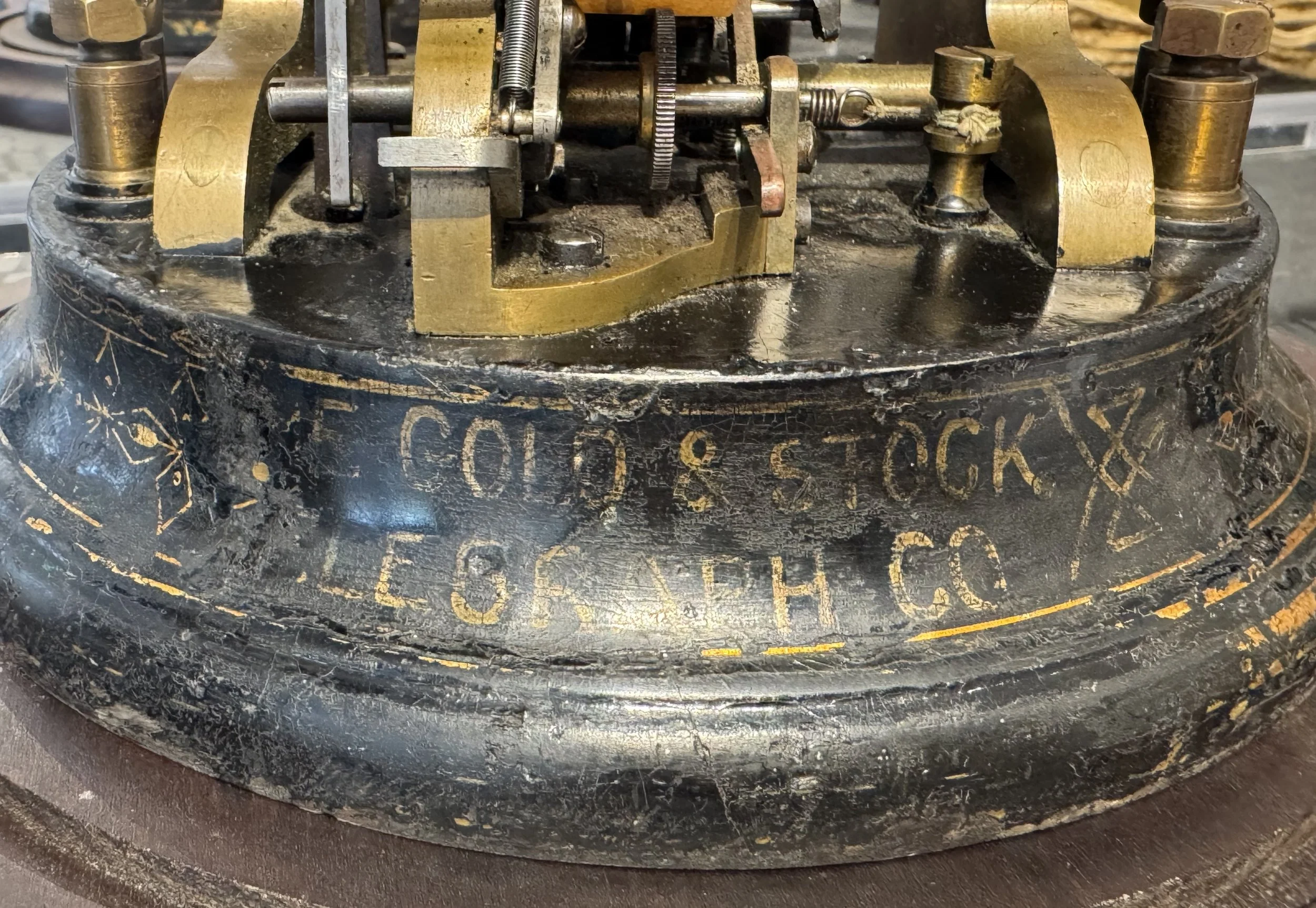
The original cast-iron base of a Gold & Stock Telegraph Company stock ticker, bearing the period gold-painted inscription — Daniels Antiques
The machine at Groesbeck & Co. was the invention of Edward A. Calahan, a telegraph operator who devised a printing instrument that could automatically transmit the names of securities and their selling prices simultaneously to every subscriber on the circuit. The Gold & Stock Telegraph Company was incorporated on September 19, 1867, to bring the system to market. Calahan had 100 clients before the year was out, all acquired by word of mouth. The clicking of the escapement as characters advanced across the paper tape gave the device its name. The world's first stock ticker had arrived.
The problem of unison, and the acid in the pails
The early system was imperfect in ways that tested the patience of everyone involved. The instruments had an unpleasant tendency to fall "out of unison" — to lose synchronization with the transmitter and begin printing a jumble of unintelligible characters on the tape. Correcting the problem required a visit from a company employee, and calls for service were so frequent that it often fell to the treasurer, the superintendent, and even the office boys to respond. More damaging still was the local battery required in each subscriber's office — four glass jars of sulphuric acid, renewed twice a week in the early morning, carried in pails through the financial district. Carpets were ruined. Furniture was damaged. Clothing was destroyed. At times, the "infernal battery," as it was known, seemed likely to defeat the entire enterprise. Calahan eventually solved that problem by centralizing all batteries in a single dedicated building, eliminating the acid pails forever.
The unison problem was solved not by Calahan but by a young inventor who had recently arrived in New York from Boston. His name was Thomas Edison.
Edison and the Universal
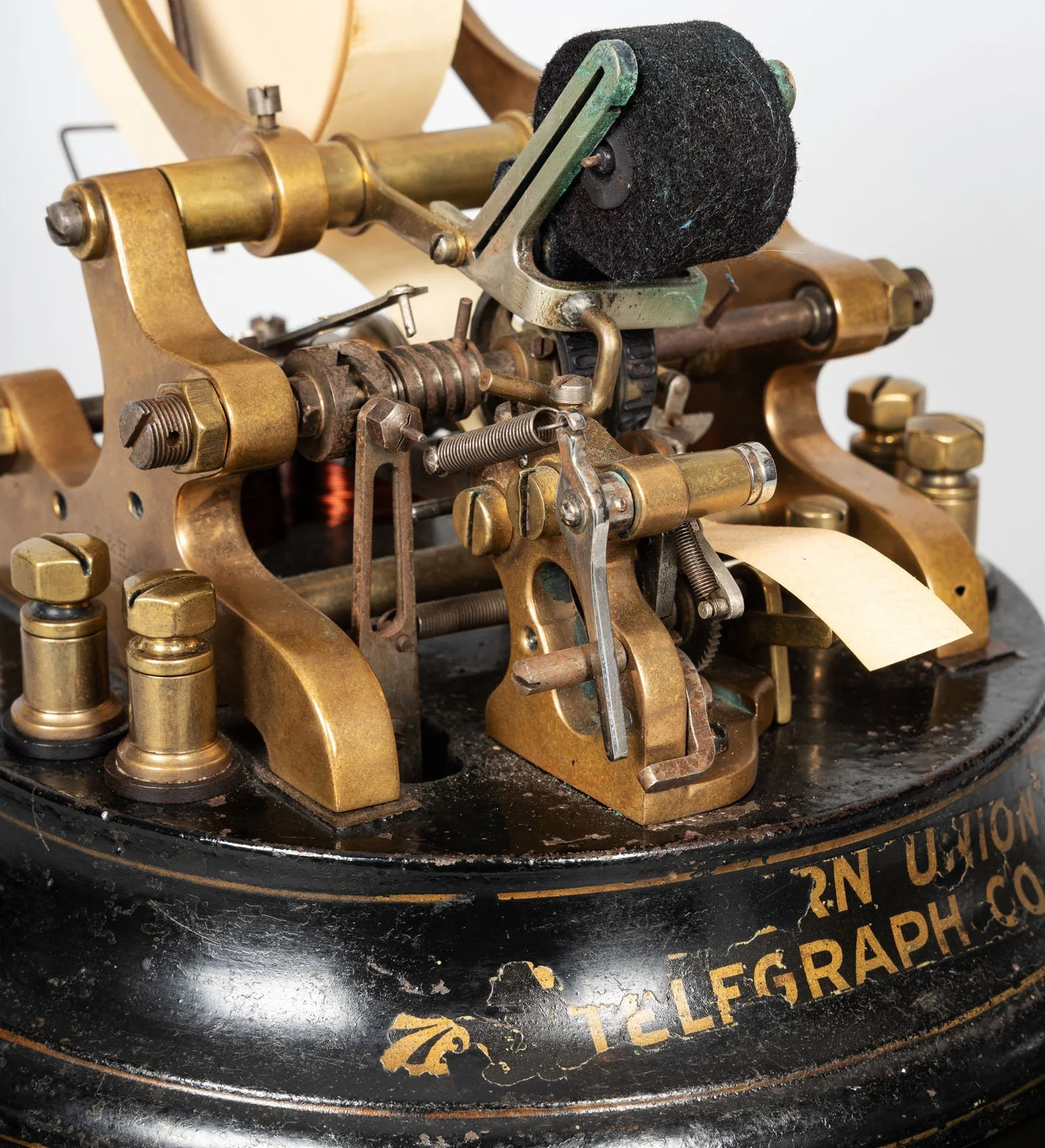
Brass mechanism detail of a Western Union Telegraph Company antique stock ticker, showing escapement, ink roller, and paper tape feed — Daniels Antiques
Edison had arrived in New York with almost nothing — sleeping on the floor of a battery room in the financial district while he looked for work. His opportunity came when he walked into the offices of Samuel S. Laws's Gold Indicator Company at the moment a central transmitter broke down. Edison located the fault, made the repair on the spot, and was offered a position the following day. He was present on the Gold Exchange floor on Black Friday — September 24, 1869 — when Jay Gould and Jim Fisk's attempt to corner the gold market collapsed, the central transmitter overheated, and the reporting system failed. Edison repaired that, too. It was while working for Laws and subsequently for the Gold & Stock Telegraph Company that he began developing the improvements that would define his early career, eventually selling his ticker patents and business interests to Western Union for $40,000.
His most important contribution was the screw-thread unison device, patented in the spring of 1871. The mechanism worked by sending electrical impulses from the transmitting operator to turn the type-wheel shafts of every instrument on the line simultaneously, until a peg seated in the screw thread reached its stop, locking all wheels at the zero point in perfect synchronization. Every mechanical ticker manufactured after this point incorporated Edison's unison device. It made the entire system commercially viable.
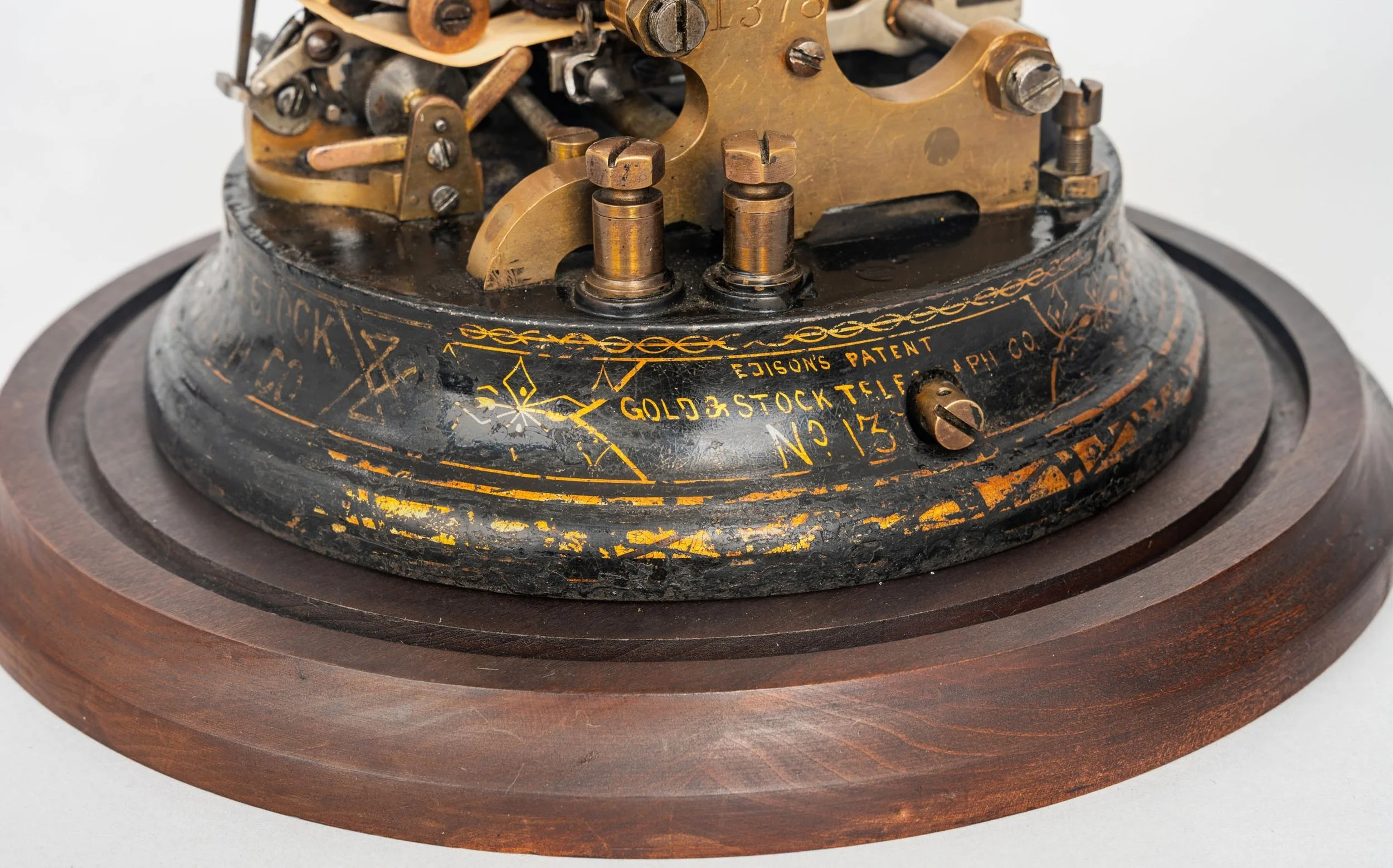
The cast-iron base of an Edison Universal Stock Ticker for the Gold & Stock Telegraph Company, c.1870s, bearing the original gold-painted inscription "Edison's Patent / Gold & Stock Telegraph Co. / No. 1378" — Daniels Antiques.
The Universal Stock Ticker that followed was Edison's masterpiece of telegraphic engineering. Patented in 1872 (US Patents 128,608; 131,337; and 131,342), it dispensed entirely with the weights and clockwork gearing that had driven earlier printers, operating instead on pulsatory electrical currents transmitted from a central office. Two type-wheels — one carrying letters, one figures — were mounted on a single shaft and shifted endwise by an electromagnet, allowing either letters or numbers to be printed at will. The compound electromagnet, the double-acting escapement pawls, the hollow perforated inking drum, and the automatic paper feed each carried separate patents. Together they formed a system of such elegance and reliability that it would remain in active service for decades.
The $40,000 from the ticker sale financed Edison's manufacturing workshop in Newark. The Quadruplex Telegraph of 1874 brought a further windfall — Edison asked Western Union for a bid and was stunned when they offered $10,000. It was this accumulated capital that made possible his purchase of thirty-four acres in Menlo Park in 1876, where he built the laboratory he had long imagined, stocked with "almost every conceivable material." Menlo Park produced the phonograph, the incandescent electric light, and much else besides. It was Wall Street money — ticker money — that made it possible.
A Universal Stock Ticker of 1872 — inscribed "Edison's Patent / Gold & Stock Telegraph Co. / No. 1060" and manufactured at Edison's Newark workshop — is preserved in the collections of The Henry Ford museum in Dearborn, Michigan, a gift of the Edison Pioneers. The serial numbers of known examples establish a clear sequence: the Ford Museum instrument at No. 1060, followed by examples in private collections, including those held by Daniels Antiques, with the auction record showing instruments well into the 1800s of the sequence. Each number represents a machine that once sat beneath a glass dome in a Wall Street brokerage, clicking out the prices that moved markets.
The competitive wars.
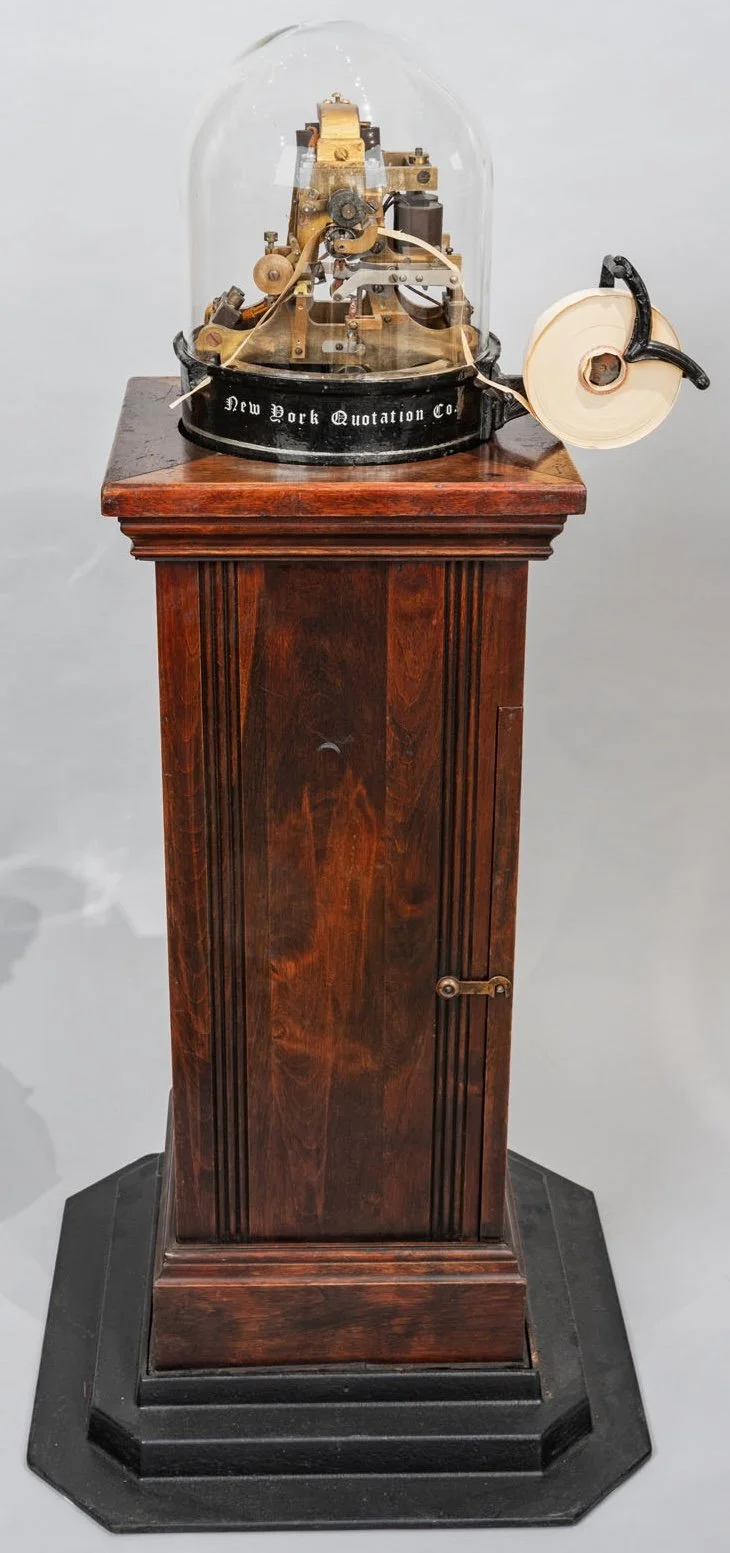
A New York Quotation Company stock ticker, c.1880s–1890s, with original cast-iron base bearing the period script inscription "New York Quotation," brass mechanism with exposed tape feed — Daniels Antiques
Success drew competition. Through the 1870s and 1880s, a succession of rival companies — the Manhattan Quotation Telegraph Company, then the Commercial Telegram Company — entered the field, forcing subscription rates down and up in cycles of price war and absorption. By 1890 the New York Stock Exchange had grown sufficiently alarmed by the commercial chaos to take matters into its own hands. It secured a majority interest in the Commercial Telegram Company, reorganized it as the New York Quotation Company, and made its ticker the exclusive instrument on the floor of the Exchange. The New York Quotation Company ticker became the voice of Wall Street. The example pictured, complete with its walnut pedestal, cast-iron base, and external paper-tape spool, is currently available at our galleries.
Western Union, which had come into practical control of the Gold & Stock Telegraph Company in 1871, continued to manufacture and service Universal Stock Tickers — deployed not only at the major exchanges but at the Cotton Exchange, the Produce Exchange, and eventually at baseball stadiums and radio stations as sports and news tickers. The Universal and the New York Quotation Company instrument thus served complementary roles: one on the floor of the Exchange, the other wiring the financial world beyond it.
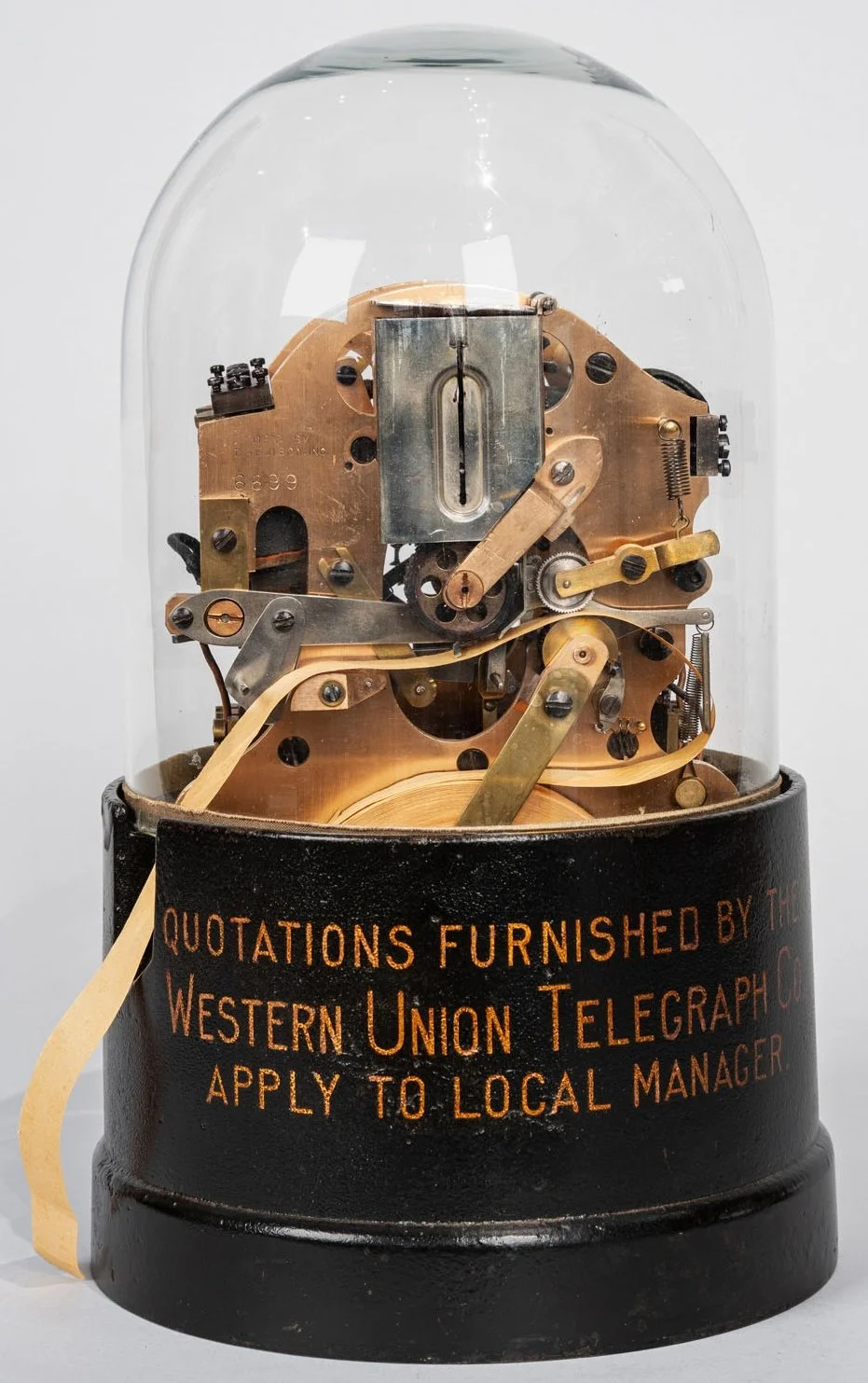
A Western Union Telegraph Company self-winding stock ticker, manufactured by T.A. Edison Inc., c.1905, complete with original glass dome, base inscribed "Quotations Furnished by the Western Union Telegraph Co. Apply to Local Manager" — Daniels Antiques
As the technology matured, so did the machines. The self-winding stock ticker, manufactured by T.A. Edison Inc. for Western Union in the early twentieth century, represented a significant mechanical advance over the Universals it succeeded — These later instruments remained in active service on the New York Stock Exchange until the Wall Street Crash of 1929, when the volume of trading on Black Thursday overwhelmed even the improved machines, leaving the tape running hours behind the market at the moment of its greatest crisis.
Why these instruments matter
After the Civil War, the volume of stocks traded rose sharply as American corporations sought investment capital on an unprecedented scale. The stock ticker — transmitting up-to-the-minute share prices over telegraph lines to subscribers across the country — was the technology that made a modern national market possible. Before it, financial information was a function of physical proximity; the man closest to the floor knew the price first. After it, every subscriber on the circuit received the same quotation at the same moment. The business of price discovery was permanently transformed.
The instruments themselves were ingenious machines. Powered initially by local batteries — four glass jars of acid per office, as the early subscribers knew too well — and later by centralized electrical supply, they received stock information via telegraph line and printed the company's abbreviated name and share price on a continuous spool of paper tape. Edison's screw-thread unison, incorporated into every machine manufactured after 1871, is the mechanical invention that made the whole network function. A New York Stock Exchange Western Union stock ticker, dated 1887 and featuring Edison's unison device, represents the mature form of the technology at the height of its importance. A similar instrument is exhibited at the Smithsonian Institution's National Museum of American History (catalog number 332283).
The Universal Stock Ticker survived into the collector market in very small numbers. Many were scrapped for metal during the Second World War. Others were sold off to businesses in South America as they were retired from service. Western Union's destruction order in 1960 eliminated most of those that remained. Today, a complete example — mechanism intact, original cast-iron base bearing the gold-painted inscription, glass dome present — represents one of the rarest and most historically significant survivals in the field of American industrial antiques. The great financial infrastructure of the twentieth century — the trading floors, the wire services, the electronic networks, and eventually the internet itself — traces its ancestry to the clicking machine that silenced the American Deer in December 1867.
Selling your antique stock ticker
Daniels Antiques is an active buyer of antique stock tickers and related financial telegraphy instruments — Edison Universal Stock Tickers, Western Union tickers, New York Quotation Company tickers, Gold & Stock Telegraph Company instruments, and early printing telegraph apparatus of all kinds, with or without glass dome or original pedestal, in working or non-working condition. Our specialist knowledge of production history, serial-number dating, and current collector market values enables us to assess instruments accurately and make offers that reflect genuine rarity and historical significance. Inquiries are welcome at Daniels Antiques — please contact Simon Daniels directly.
Literature & Sources
Primary Patents Thomas A. Edison, Improvement in Printing-Telegraph Instruments, US Patent No. 128,608, patented July 2, 1872. Thomas A. Edison, Improvement in Printing-Telegraphs, US Patent No. 131,337, patented September 17, 1872. Thomas A. Edison, Improvement in Printing-Telegraph Instruments, US Patent No. 131,342, patented September 17, 1872.
Manufacturer's Documentation Western Union Telegraph Company, Ticker Equipment Catalog: Universal Ticker 3-A, Catalog of Piece Parts, Section 11.
Period Technical Literature William Maver Jr., American Telegraphy: Systems, Apparatus, Operation. Maver Publishing Company, New York, 1892, pp. 407–412. Ralph W. Pope, "The Rise of the Stock Reporting Telegraph," The Electrical World, Vol. XXXIII, No. 9 (March 4, 1899), pp. 268–269. J.E. Selden, "Some Reminiscences of the House Printing Telegraph," The Electrical World, Vol. XXXIII, No. 9 (March 4, 1899), p. 270.
Period Institutional History Horace L. Hotchkiss, "The Stock Ticker," in Edmund Clarence Stedman (ed.), The New York Stock Exchange. Greenwood Press, New York, pp. 434–441.
Auction Records, Owls Head Transportation Museum, Auction Catalog, 1997. Lots 116–117.
Museum & Institutional Sources Smithsonian Institution, National Museum of American History. Catalog no. 332283. americanenterprise.si.edu. The Henry Ford Museum & Greenfield Village, Dearborn, Michigan. Object ID: 29.1980.529.1326. thehenryford.org.
Digital Archives Thomas A. Edison Papers, Rutgers University. "Stock Ticker." edison.rutgers.edu, accessed April 27, 2026.
Daniels Antiques specializes in objects of exceptional historical significance and rarity. Inquiries regarding our inventory of scientific instruments and telecommunications antiquities are welcomed at both our Aspen and Fort Lauderdale galleries.