
Stock Tickers

Antique Stock Tickers & Ticker Tape Machines
The stock ticker was one of the defining inventions of the Gilded Age — the instrument that brought the real-time pulse of Wall Street out of the exchange floor and into the offices, hotels, and private clubs of American finance. Developed in the 1860s and transformed by Thomas Edison into a precision instrument of extraordinary reliability, the stock ticker translated market movements into paper tape through a mechanism of remarkable delicacy: a brass movement housed beneath a hand-blown glass dome, printing stock symbols and prices on a continuous ribbon that brokers and speculators across the country read as it emerged. Edison's involvement was central — his improvements to the Gold & Stock Telegraph Company ticker in the early 1870s, his Universal Stock Ticker of 1869, and the subsequent decades of development through Western Union and the New York Quotation Company produced a succession of instruments that grew progressively more refined, culminating in the self-winding models of the early twentieth century. Original examples in complete condition — with functioning movements intact — are among the most sought-after artifacts of American industrial and financial history.
Daniels Antiques holds one of the finest collections of antique stock tickers available on the private market, spanning the Edison era from the 1870s through to 1915 and including examples by Gold & Stock Telegraph Co. made by T.A. Edison in Newark, Western Union Universal Stock Ticker models bearing Edison patents, and New York Quotation Company instruments on original pedestals. Each piece is selected for the integrity of its movement and mechanism, and described with full provenance and historical context. Pieces are available for viewing by appointment at our galleries in Aspen, Colorado, and Fort Lauderdale, Florida.
We are always interested in acquiring important stock tickers, whether a single instrument or a collection.
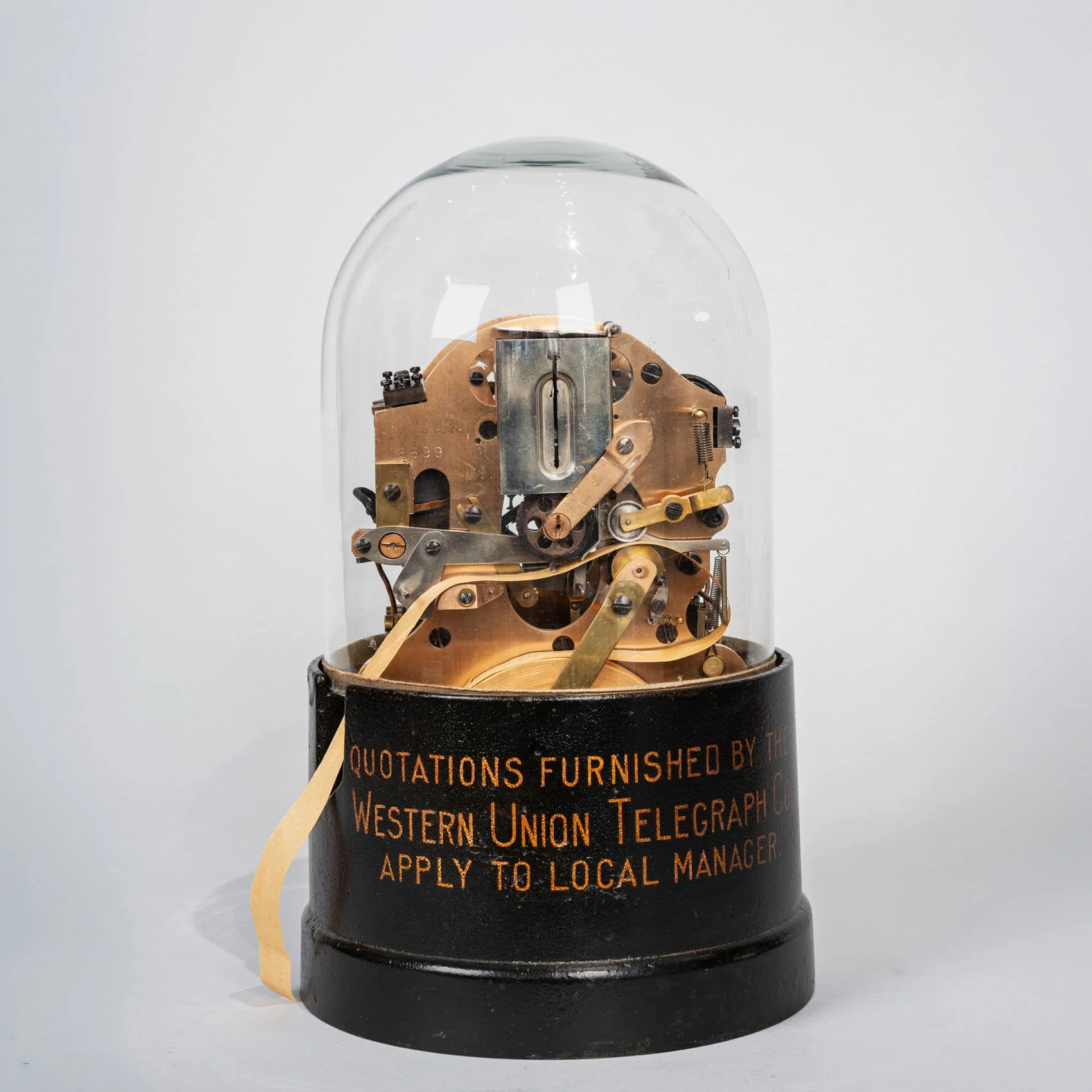
A self-winding electromechanical stock ticker manufactured by Thomas A. Edison, Inc. for the Western Union Telegraph Company, circa 1915, with a brass-and-steel mechanism, stamped MFD. BY T.A. EDISON, INC., enclosed beneath its original glass dome on a japanned base carrying the period service inscription "QUOTATIONS FURNISHED BY THE WESTERN UNION TELEGRAPH CO. APPLY TO LOCAL MANAGER."
The self-winding mechanism, the defining advance of this ticker generation, was developed by George B. Scott and W. P. Phelps and refined in 1903 by J. C. Barclay and Jay R. Page, producing a more compact and efficient instrument than its predecessors. The present machine incorporates the later dual-roller ink system within a hinged enclosure, replacing the earlier single-roller arrangement. Nine principal variants were produced across the series: 1-C, 21-C, 22-A, 30-A, 31-A, 32-A, 34-A, 35-A, and 41-A, though machines were routinely modified during active service, and surviving examples frequently combine later components without corresponding changes in designation.
The Edison stamp denotes manufacture by his incorporated company rather than personal invention, Edison's direct involvement in ticker design having ended decades earlier, though the association with his name remained commercially significant.
Operating within Western Union's nationwide quotation network, the instrument received telegraphic impulses from centralized exchanges and printed company abbreviations and prices on a continuous paper tape, delivering near real-time market information to subscribers across the country. Service inscriptions of this kind were applied to instruments placed in client premises and were routinely removed, painted over, or lost as machines passed through service and storage; the survival of the full inscription here is notable.
For the broader history of these instruments and their role on Wall Street, see our article "The Pulse of Wall Street”
Condition”
Condition: Excellent original condition throughout. Mechanism complete, with rich original patina. MFD. BY T.A. EDISON, INC. stamp clearly legible.
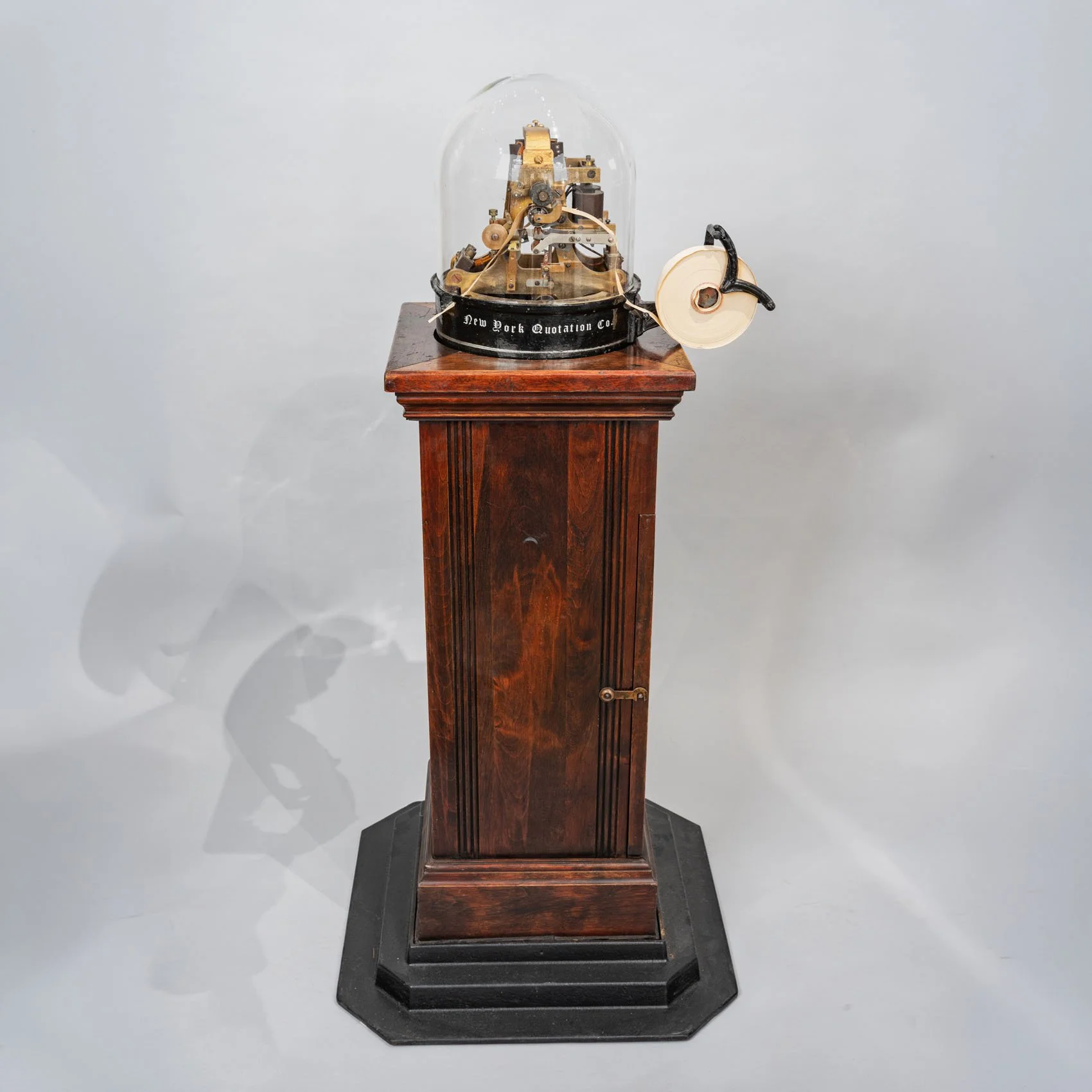
An electromechanical stock ticker manufactured for the New York Quotation Company, circa 1890, complete with its glass dome, original walnut pedestal, cast iron octagonal base, and external paper tape spool.
The brass-and-steel mechanism is mounted on a japanned circular base inscribed in period script "New York Quotation Co." and enclosed beneath a hand-blown glass dome. The tape spool, carried on a cast iron arm beside the pedestal, retains its original paper tape, a detail seldom found in surviving examples.
In 1890, the New York Stock Exchange consolidated control of market data transmission under the newly formed New York Quotation Company, the foundation of centralized and standardized market reporting. Connected to a dedicated telegraph network, these instruments translated electrical impulses into printed abbreviations on a continuous paper tape, delivering near real-time prices to Wall Street offices. Unlike the widely distributed tickers of the Western Union Telegraph Company, New York Quotation Company instruments were installed only in offices directly connected to the Exchange.
Pedestals and stands were integral to daily operation but were routinely discarded as equipment was replaced, and complete examples with their original mounts are now scarce.
The instrument stands 44 inches overall on a base 20 inches square. Condition is excellent for its age: the mechanism is complete, with rich original patina throughout; the glass dome is free of cracks or chips; and the walnut pedestal and cast-iron base are structurally sound. The instrument is entirely unrestored.
This instrument is featured in The Pulse of Wall Street, our article on the stock ticker and the origins of modern market reporting.
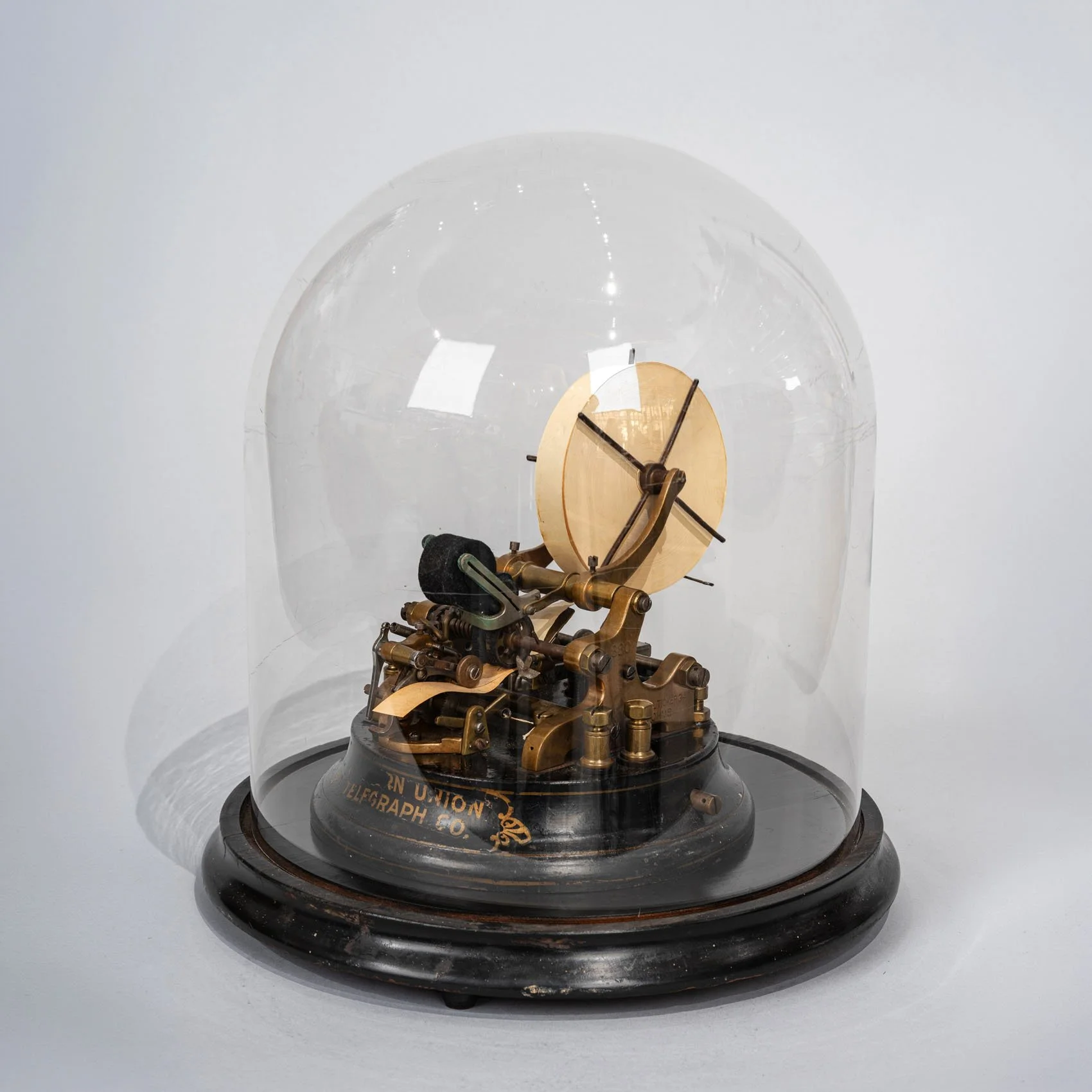
A rare and historically significant instrument of American financial and technological history — the Western Union Universal Stock Ticker, Model 3A, produced in 1887 under the patent system developed by Thomas Edison, whose 1872 patent established the universal standard for the electrical transmission of financial data and transformed the infrastructure of American markets.
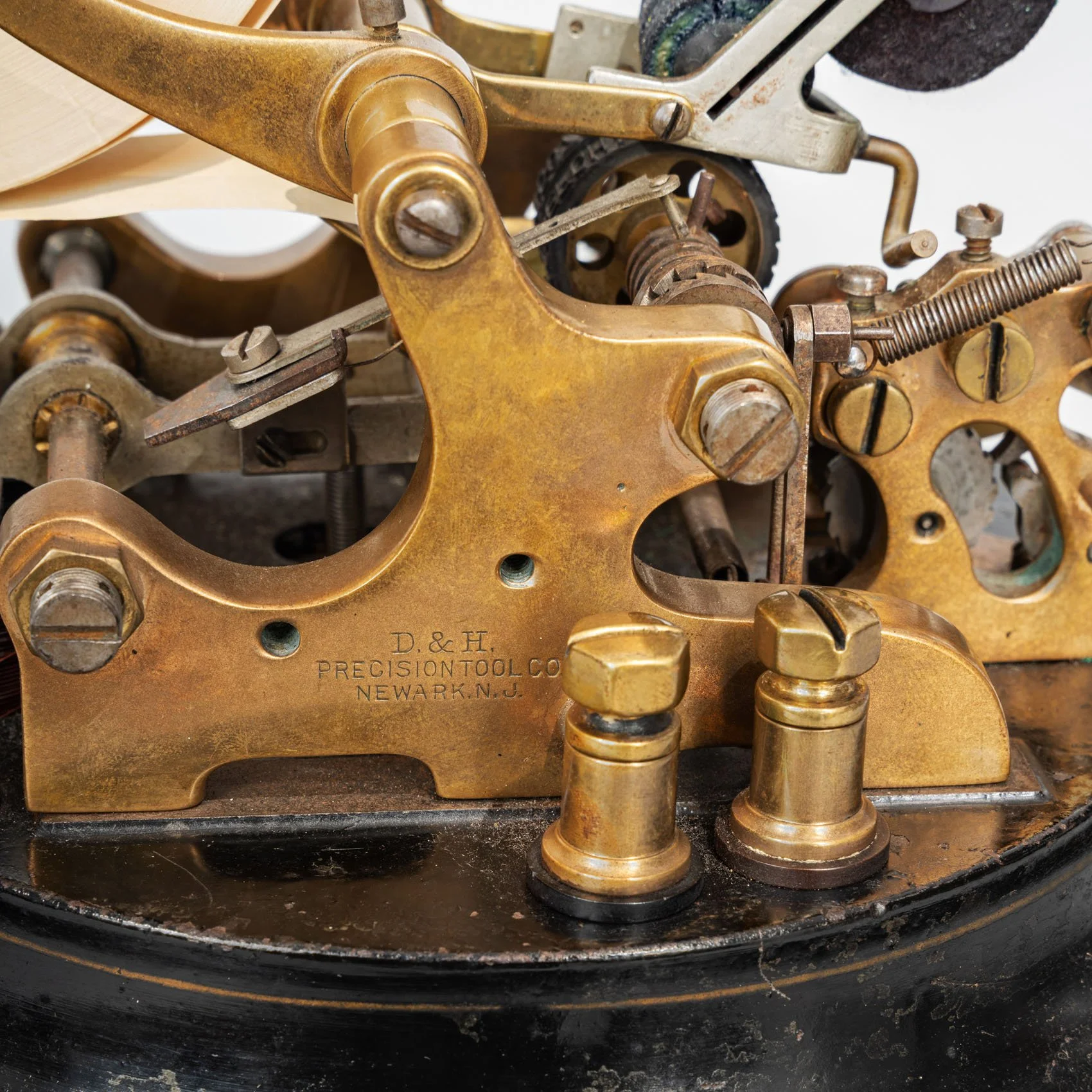
The mechanism is constructed in brass and steel throughout, stamped UNIVERSAL TICKER 3A – 22 OHMS and D. & H. PRECISION TOOL CO., NEWARK, N.J., and mounted on its original japanned circular base with gilt "Western Union Telegraph Co." lettering. The instrument is preserved beneath its original protective glass dome. Serial number 4880 is visible on the brass frame. The mechanism is complete and fully intact, with electro-magnetic actuation governing a horizontal escapement and twin type wheel system — translating telegraphic impulses into printed sequences of stock symbols and prices on a continuous paper tape, the defining technology of nineteenth-century market reporting.
The technical refinements embodied in the Model 3A — including the screw-thread unison mechanism associated with Edison's improvements — addressed the critical problem of synchronization between transmitting and receiving instruments, ensuring accuracy and reliability across extended telegraph networks. This was not a peripheral improvement but a decisive engineering solution that made coordinated national market reporting possible for the first time.
By the final decades of the nineteenth century, instruments of this type formed the communications backbone of American financial markets. Installed in brokerage offices and financial institutions across the country, they received transmitted quotations from centralized exchanges including the New York Stock Exchange, enabling a degree of synchronicity in market activity previously unattainable. The adoption of the Universal Ticker marked the definitive transition from localized and delayed reporting toward a coordinated national system of real-time information exchange.
Beyond its functional role, the stock ticker occupies a singular place in the history of communications technology. It stands among the earliest instruments to automate the transmission and recording of data over distance, anticipating every subsequent development in electronic communication and real-time information systems. Its output — an unbroken stream of printed financial data — created the visual and temporal language of modern markets that persisted well into the twentieth century.
The manufacturer's stamp — D. & H. Precision Tool Co., Newark, New Jersey — identifies the instrument as a product of one of the leading precision engineering firms supplying the telegraph industry in this period, and adds a further layer of industrial provenance to an already richly documented piece.
A comparable example is held in the permanent collection of the Smithsonian Institution's National Museum of American History (Collection Record No. 332283), confirming the Model 3A's established place in the canon of American communications history and the significance of the type as an object of national historical importance.
Condition: Very good to excellent. Brass and steel mechanism complete and fully intact, all components present, with rich original patina throughout. Serial number 4880 stamped clearly. Original glass dome in excellent condition, no cracks or chips. Japanned base retains original gilt "Western Union Telegraph Co." lettering with some loss to painted surface consistent with age and use. Presented unrestored in honest original condition.
References
Thomas Edison, Improvement in Printing Telegraphs, U.S. Patent No. 126,532 (1872).
George B. Prescott, History, Theory, and Practice of the Electric Telegraph, Boston, 1860 (expanded later editions discussing ticker systems).
Robert Sobel, The Big Board: A History of the New York Stock Market, New York, 1965.
Thomas P. Hughes, American Genesis: A Century of Invention and Technological Enthusiasm, New York, 1989.
James W. Carey, Communication as Culture: Essays on Media and Society, Boston, 1989.
Smithsonian National Museum of American History, Collection Record No. 332283.
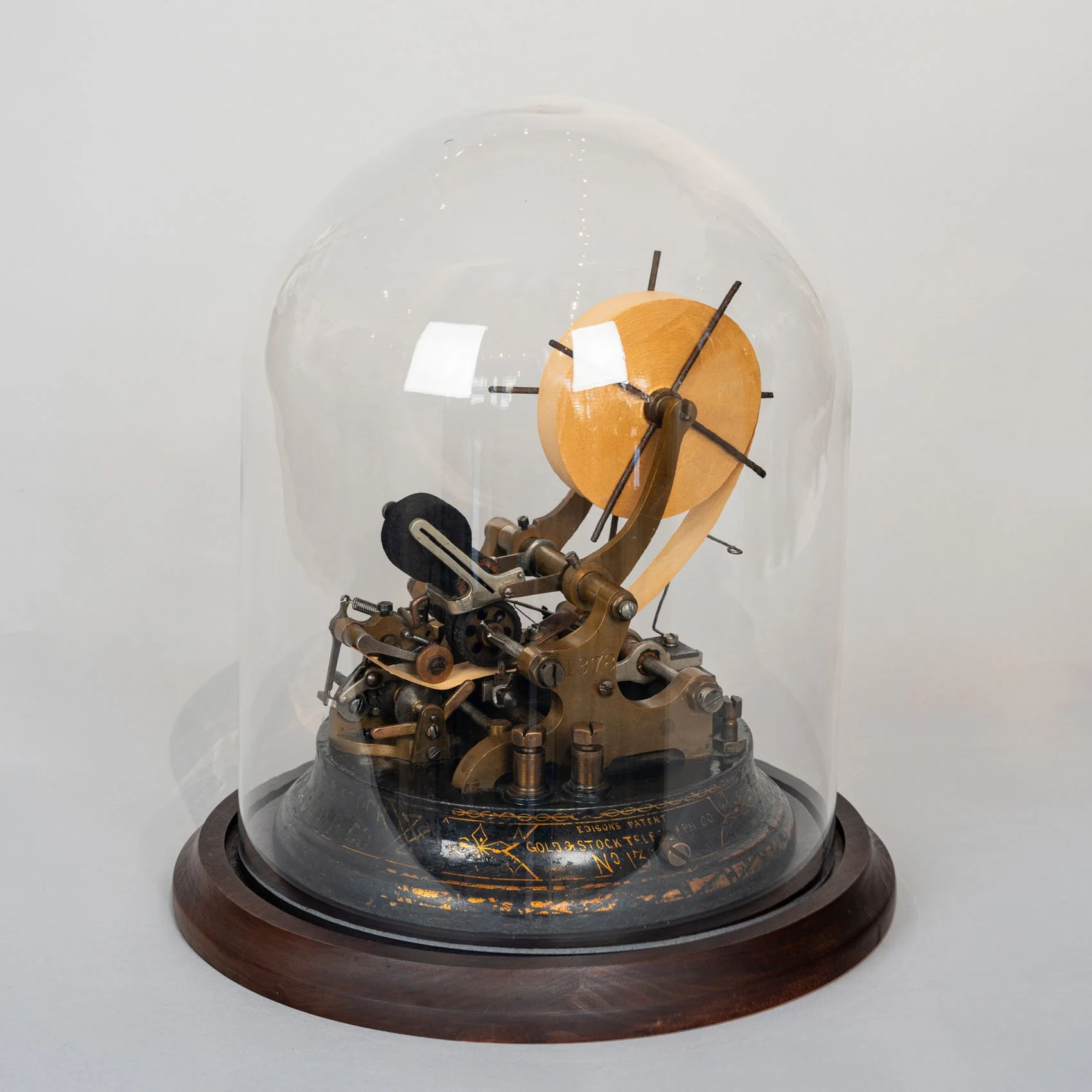
Among the rarest and most historically resonant instruments of American financial and technological history — an early universal stock ticker manufactured directly by Thomas A. Edison at his Newark, New Jersey workshop, produced for the Gold & Stock Telegraph Company in the 1870s and bearing the original gilt inscriptions "T.A. EDISON, MAKER, NEWARK N.J." and "GOLD & STOCK TELEGRAPH CO. NO. 13" on its japanned cast iron base.
This is not an instrument manufactured under Edison's patent by a later corporate successor, nor a product of the industrial-scale production that characterised later ticker generations. This is a machine made by Edison himself, in his own workshop, at the moment when the universal stock ticker was being developed and refined — one of the most consequential technological achievements of the nineteenth century.
The mechanism is finely engineered in brass throughout, with dual ink rollers and a clockwork-driven transmission system surmounted by a paper spool issuing the continuous printed tape of stock quotations that gave these instruments their defining character. The cast iron base retains its original black japanned finish with gilt stenciled lettering and decorative ornamental borders, and the instrument is mounted on a turned wooden display base and preserved beneath its glass dome.
The Gold & Stock Telegraph Company, whose name appears prominently on the base alongside Edison's patent credit, was the dominant distributor of financial data in New York during the post-Civil War period. Its network of tickers — installed in brokerage houses and financial institutions across the city — formed the communications infrastructure through which American capital markets operated in real time for the first time in history. Edison's relationship with the company was transformative: his improvements to the ticker mechanism in the late 1860s and early 1870s established the universal standard that defined the technology for decades, and his sale of those patents to the Gold & Stock Telegraph Company — and subsequently to Western Union — provided the capital that funded his later, even more celebrated inventions.
Unlike the standardized instruments of later decades, produced in large quantities by corporate manufacturers, these early Newark-made tickers were produced in relatively small numbers and were largely confined to Wall Street and the major financial institutions directly connected to the Gold & Stock network. Their survival is consequently rare — and survival in complete, visually compelling condition, with clear original inscriptions and original surface decoration intact, is rarer still.
The present example, numbered No. 13, stands as a direct physical artifact from one of the most consequential chapters in both American technological history and the history of global financial markets — the moment when the transmission of financial data moved from the realm of the approximate and delayed into something approaching the real-time, coordinated, and continuous.
Literature: Edison Stock Ticker Patent No. 13, illustrating the early development of the universal stock ticker mechanism.
Condition: Good overall. Brass mechanism complete and intact with original patina. Cast iron japanned base retains original gilt lettering — "T.A. Edison, Maker, Newark N.J." and "Gold & Stock Telegraph Co. No. 13" — with wear to japanned surface consistent with age and honest use. Original decorative gilt borders partially legible. Glass dome present and intact. Turned wooden display base present and structurally sound. All principal components present in unrestored original condition.
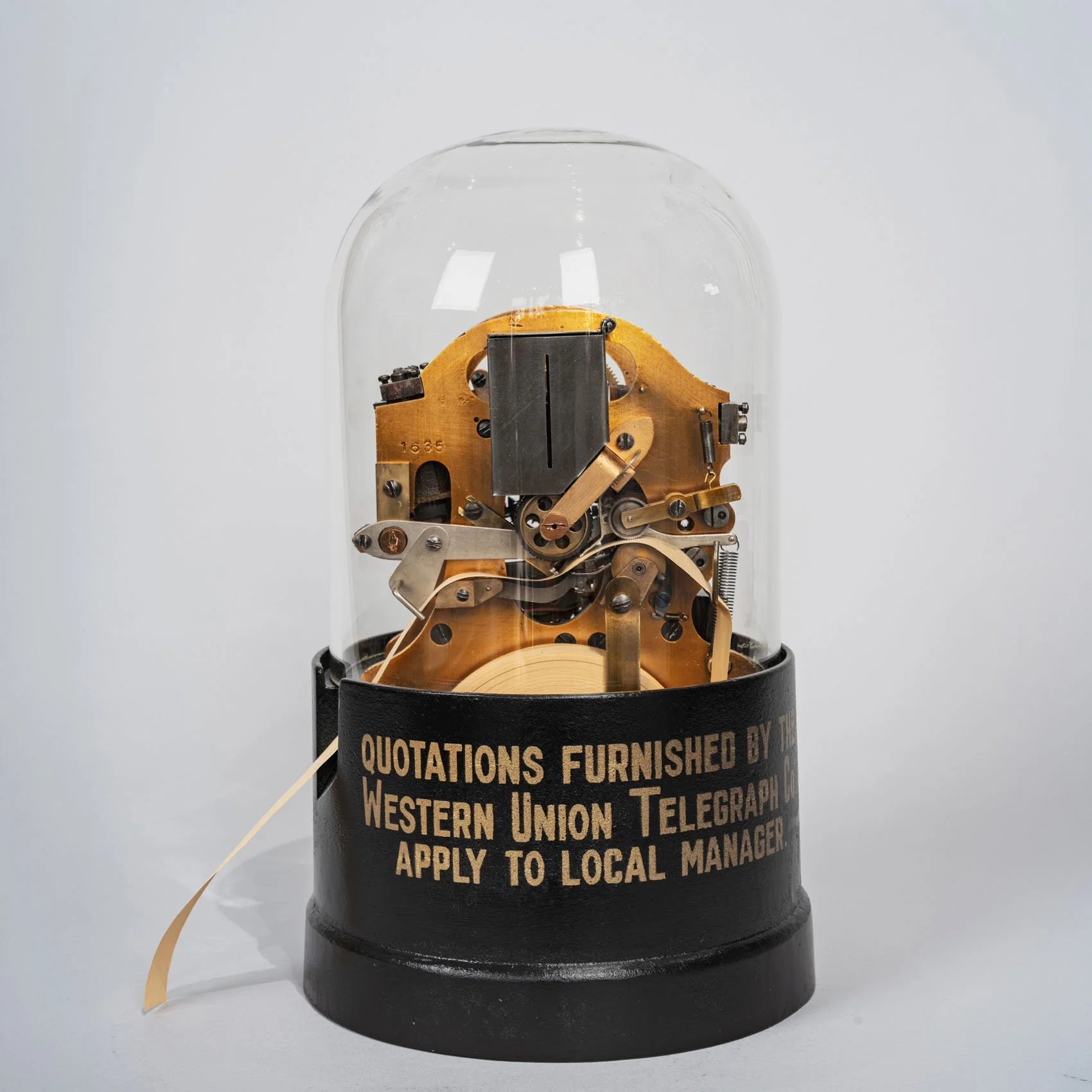
A genuine and characterful example of the self-winding electromechanical stock ticker that formed the operational backbone of American financial market communications in the early twentieth century — supplied as part of the nationwide quotation network operated by the Western Union Telegraph Company and preserved here in good original condition with its glass dome and base intact.
The mechanism is constructed in brass and steel, the frame unsigned — a detail consistent with a number of period Western Union tickers produced by manufacturers operating under contract to the company, whose instruments were frequently supplied without individual maker's stamps. It is mounted on its original japanned circular cast iron base bearing the period printed service inscription in gilt lettering: "QUOTATIONS FURNISHED BY THE WESTERN UNION TELEGRAPH CO. — APPLY TO LOCAL MANAGER" — the standard notice applied to instruments placed in brokerage offices and financial institutions as part of Western Union's commercial subscription service. The mechanism is enclosed beneath its original glass dome.
The self-winding system represented the defining technological advance of this generation of tickers, developed by George B. Scott and W. P. Phelps with subsequent refinements by J. C. Barclay and Jay R. Page in 1903, producing a more compact and reliable instrument than earlier manually-wound predecessors. As part of the Western Union network, the ticker received telegraphic impulses transmitting stock quotations from centralized exchanges and translated them into printed sequences of company abbreviations and prices on a continuous paper tape, delivering near real-time market information to subscribers and enabling the coordinated national market activity that characterised the early twentieth-century financial landscape.
The Western Union service inscription on the base is a notable survival. Applied to instruments installed in client premises, such inscriptions were routinely removed, painted over, or lost as machines passed through service, maintenance, and eventual decommissioning. Its clear retention here gives this example a directness and authenticity as a working object of American financial history.
The unsigned mechanism invites further research into its specific manufacture — a number of contractors supplied Western Union with ticker mechanisms during this period, and identification of the maker from mechanical characteristics remains an area of active interest among specialist collectors.
Condition: Good. Brass and steel mechanism present and intact with original patina consistent with age and use. Original glass dome present, no cracks or chips. Japanned cast iron base retains period "Western Union Telegraph Co." service inscription in good condition. All principal components present in honest unrestored condition.
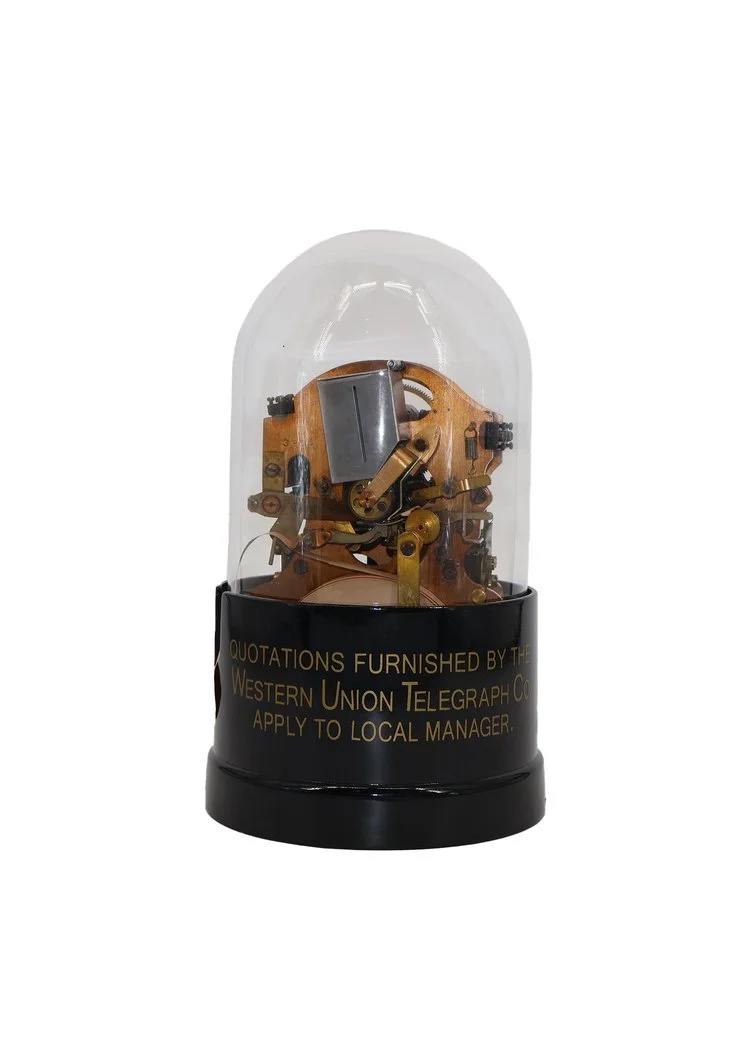
The self-winding stock ticker manufactured by Thomas A. Edison, Inc. represented the height of financial communications technology of its day, the instrument that formed the backbone of American market reporting in the early twentieth century, and operated within the nationwide ticker network of the Western Union Telegraph Company. For the broader history of these instruments and their role on Wall Street, see our article, "The Pulse
The mechanism”
The mechanism is constructed throughout in brass and steel, stamped MFD. BY T.A. EDISON, INC., and stands beneath its original glass dome on a japanned circular base. The base carries the period Western Union service inscription, "QUOTATIONS FURNISHED BY THE WESTERN UNION TELEGRAPH CO. APPLY TO LOCAL MANAGER," a survival of exceptional rarity. Such instructions were applied to machines placed in brokerage offices and financial institutions served by Western Union's quotation service, and were routinely removed, painted over, or lost as the instruments passed through service and storage. Its retention here speaks directly to the original working context and lends the piece real immediacy.
The self-winding mechanism was developed by George B. Scott and W. P. Phelps, with refinements in 1903 by J. C. Barclay and Jay R. Page that produced a more compact instrument than its predecessors, the design reaching its final form between 1915 and 1923. A late production machine, the present example incorporates a dual-roller ink system within a hinged enclosure, replacing the earlier single-roller arrangement and reflecting the continual engineering refinement that characterized these instruments throughout their working lives. While examples of this type are frequently stamped for Thomas Edison, the mark denotes manufacture by his incorporated company rather than personal invention, Edison's direct involvement in ticker design having ceased decades earlier, though the association with his name is historically authentic and remained commercially significant.
Nine principal variants were produced across the series: the 1-C, 21-C, 22-A, 30-A, 31-A, 32-A, 34-A, 35-A, and 41-A. Many machines were modified during active service, and surviving examples frequently incorporate later components without corresponding changes in their designations, reflecting the pragmatic maintenance culture of the telegraph industry.
In service, an instrument of this type received telegraphic impulses carrying quotations from the centralized exchanges and translated them into printed sequences of company abbreviations and prices on a continuous paper tape, delivering near real-time market information to subscribers across the country. Tickers of this generation remained in use on the New York Stock Exchange through the crash of October 1929, when record volume overwhelmed the system and the tape ran more than two and a half hours behind the floor, a delay that deepened the panic and hastened the faster tickers that replaced them in the following decade.
The instrument is in excellent original condition throughout. The brass-and-steel mechanism is complete and fully intact, with rich original patina, and the MFD. BY T.A. EDISON, INC. stamp remains clearly legible. The original glass dome is present and free of cracks or chips, and the japanned base retains the full Western Union service inscription in excellent condition. All components are present and unrestored.
The self-winding stock ticker manufactured by Thomas A. Edison, Inc. represented the height of financial communications technology of its day, the instrument that formed the backbone of American market reporting in the early twentieth century, and operated within the nationwide ticker network of the Western Union Telegraph Company. For the broader history of these instruments and their role on Wall Street, see our article, The Pulse of Wall Street.
The mechanism is constructed throughout in brass and steel, stamped MFD. BY T.A. EDISON, INC., and stands beneath its original glass dome on a japanned circular base. The base carries the period Western Union service inscription, "QUOTATIONS FURNISHED BY THE WESTERN UNION TELEGRAPH CO. APPLY TO LOCAL MANAGER," a survival of exceptional rarity. Such instructions were applied to machines placed in brokerage offices and financial institutions served by Western Union's quotation service, and were routinely removed, painted over, or lost as the instruments passed through service and storage. Its retention here speaks directly to the original working context and lends the piece real immediacy.
The self-winding mechanism was developed by George B. Scott and W. P. Phelps, with refinements in 1903 by J. C. Barclay and Jay R. Page that produced a more compact instrument than its predecessors, the design reaching its final form between 1915 and 1923. A late production machine, the present example incorporates a dual-roller ink system within a hinged enclosure, replacing the earlier single-roller arrangement and reflecting the continual engineering refinement that characterized these instruments throughout their working lives. While examples of this type are frequently stamped for Thomas Edison, the mark denotes manufacture by his incorporated company rather than personal invention, Edison's direct involvement in ticker design having ceased decades earlier, though the association with his name is historically authentic and remained commercially significant.
Nine principal variants were produced across the series: the 1-C, 21-C, 22-A, 30-A, 31-A, 32-A, 34-A, 35-A, and 41-A. Many machines were modified during active service, and surviving examples frequently incorporate later components without corresponding changes in their designations, reflecting the pragmatic maintenance culture of the telegraph industry.
In service, an instrument of this type received telegraphic impulses carrying quotations from the centralized exchanges and translated them into printed sequences of company abbreviations and prices on a continuous paper tape, delivering near real-time market information to subscribers across the country. Tickers of this generation remained in use on the New York Stock Exchange through the crash of October 1929, when record volume overwhelmed the system and the tape ran more than two and a half hours behind the floor, a delay that deepened the panic and hastened the faster tickers that replaced them in the following decade.
The instrument is in excellent original condition throughout. The brass-and-steel mechanism is complete and fully intact, with rich original patina, and the MFD. BY T.A. EDISON, INC. stamp remains clearly legible. The original glass dome is present and free of cracks or chips, and the japanned base retains the full Western Union service inscription in excellent condition.