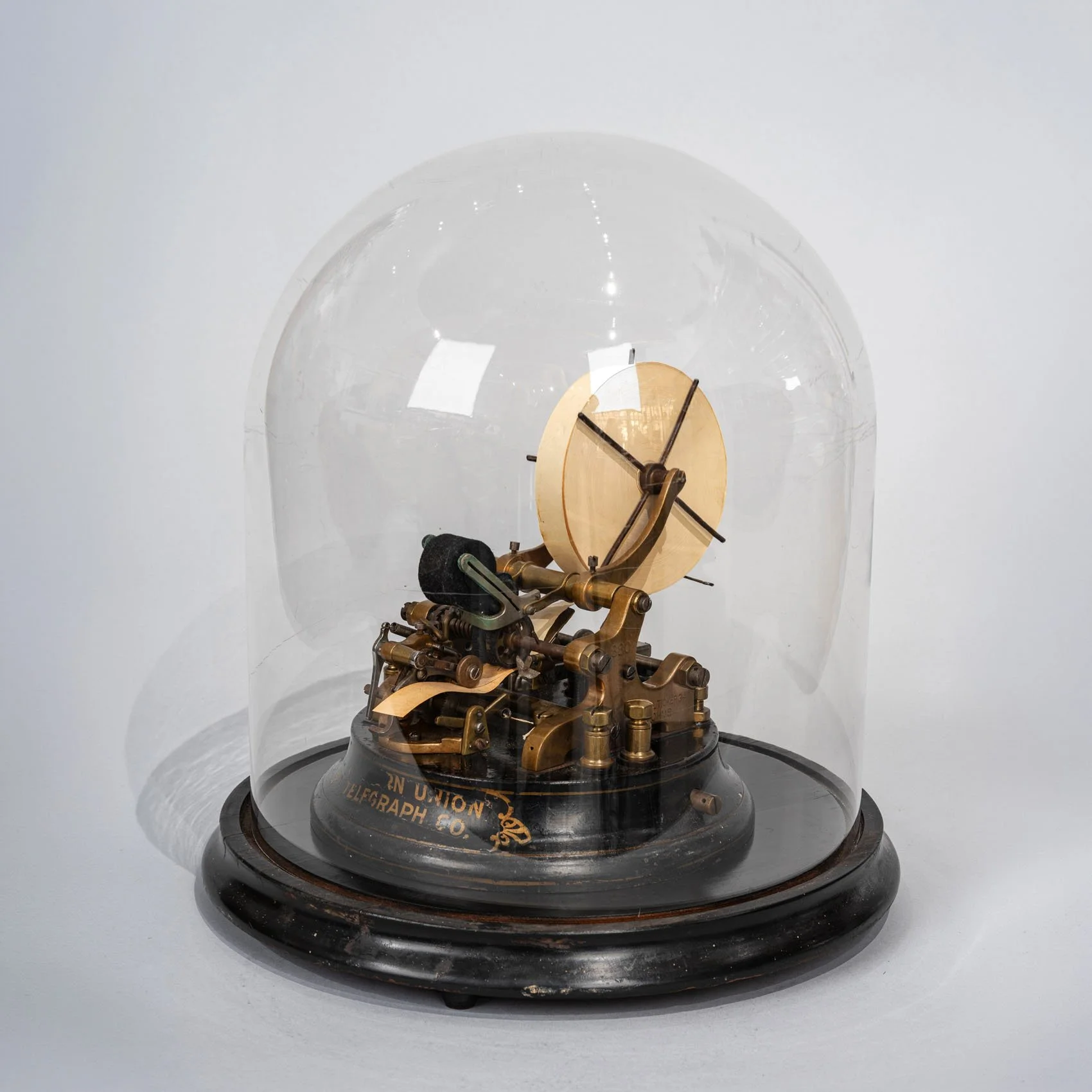
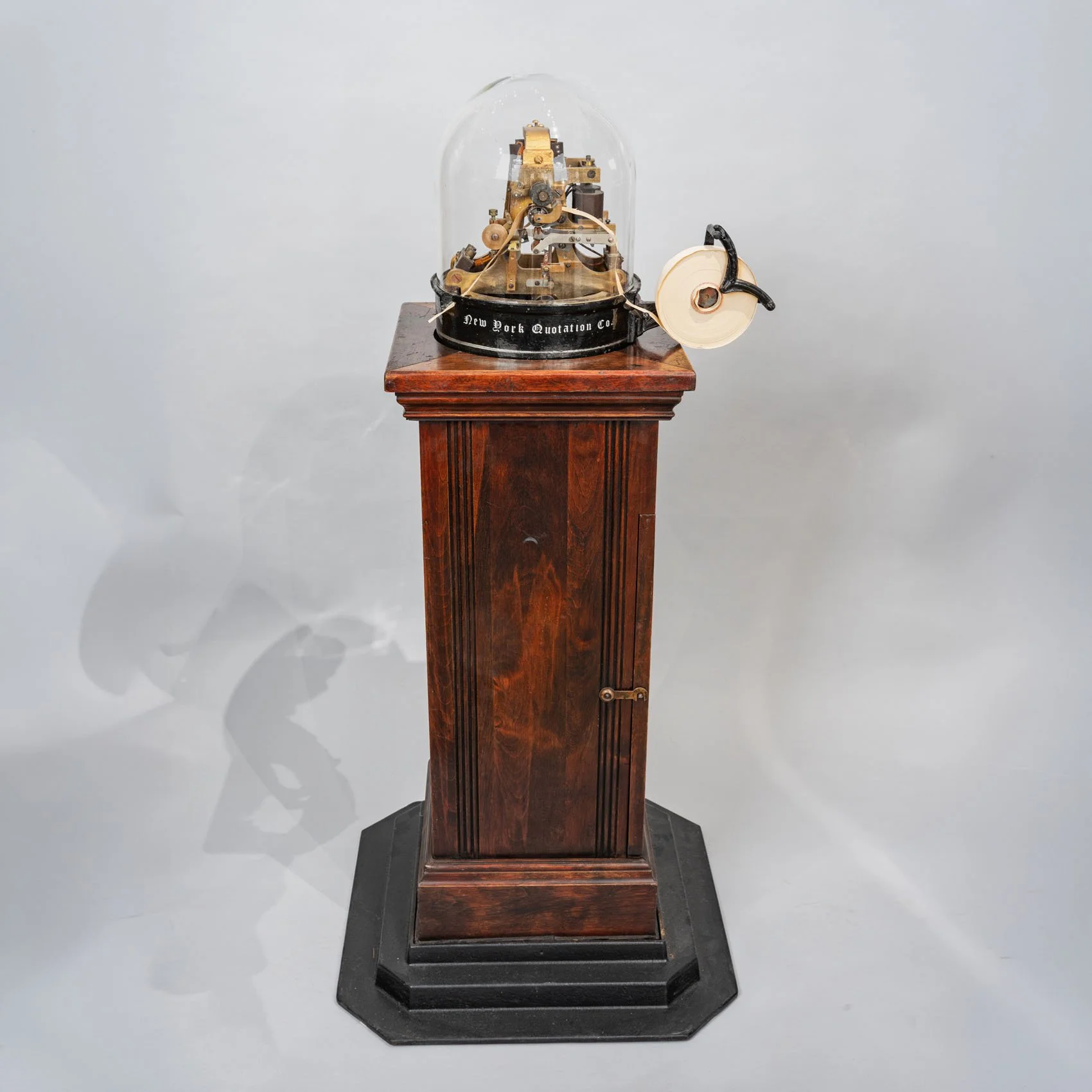
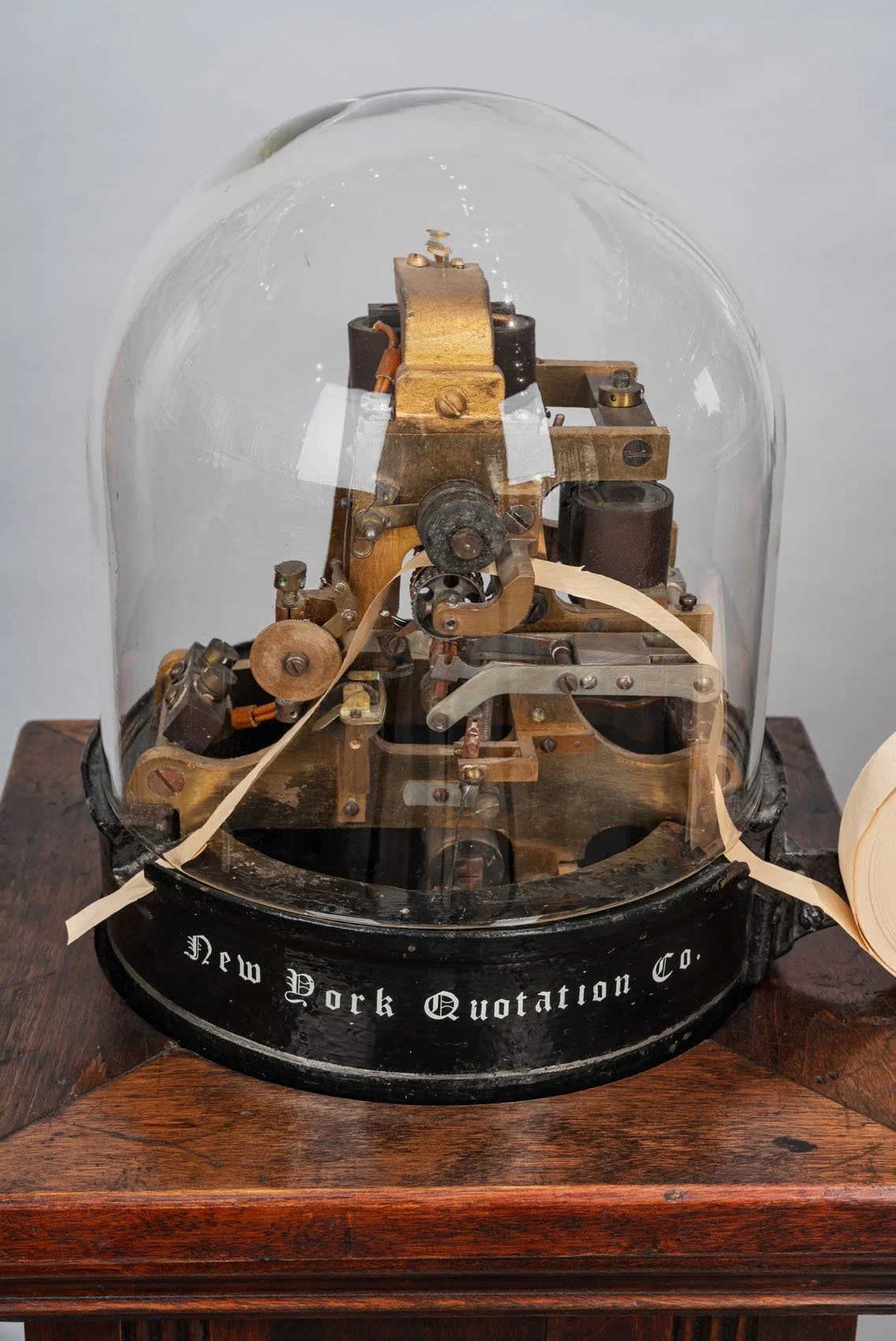
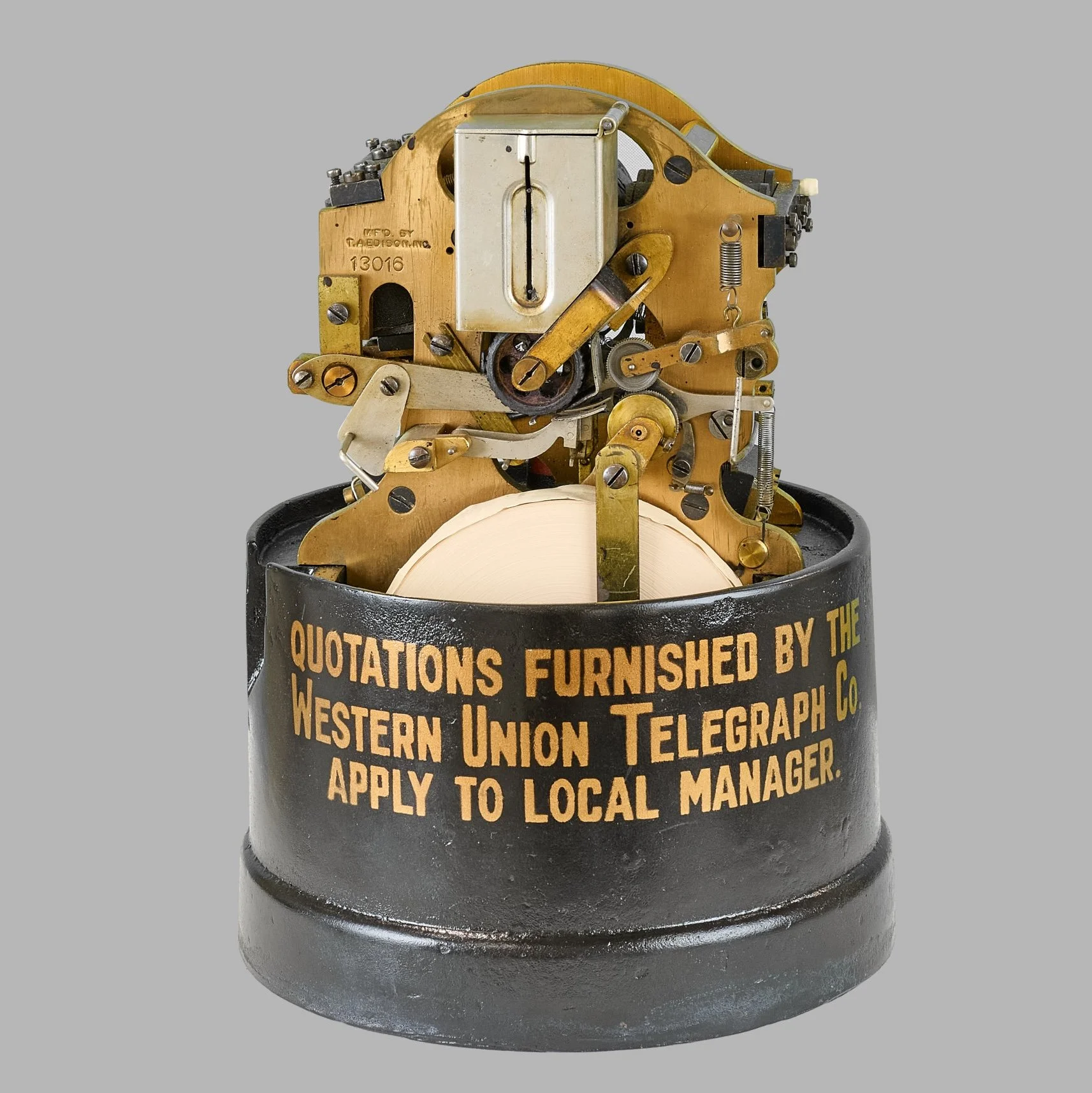
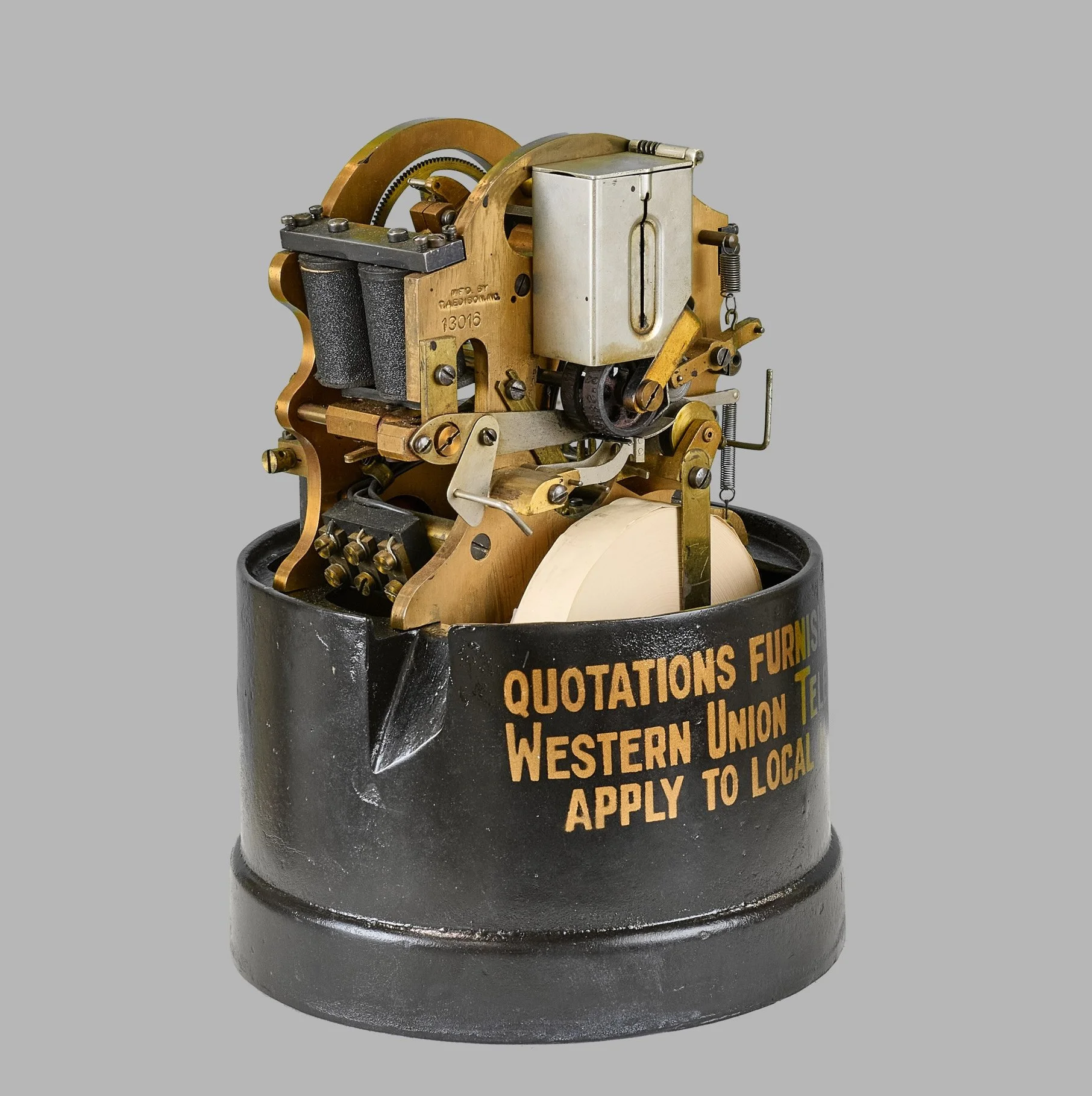
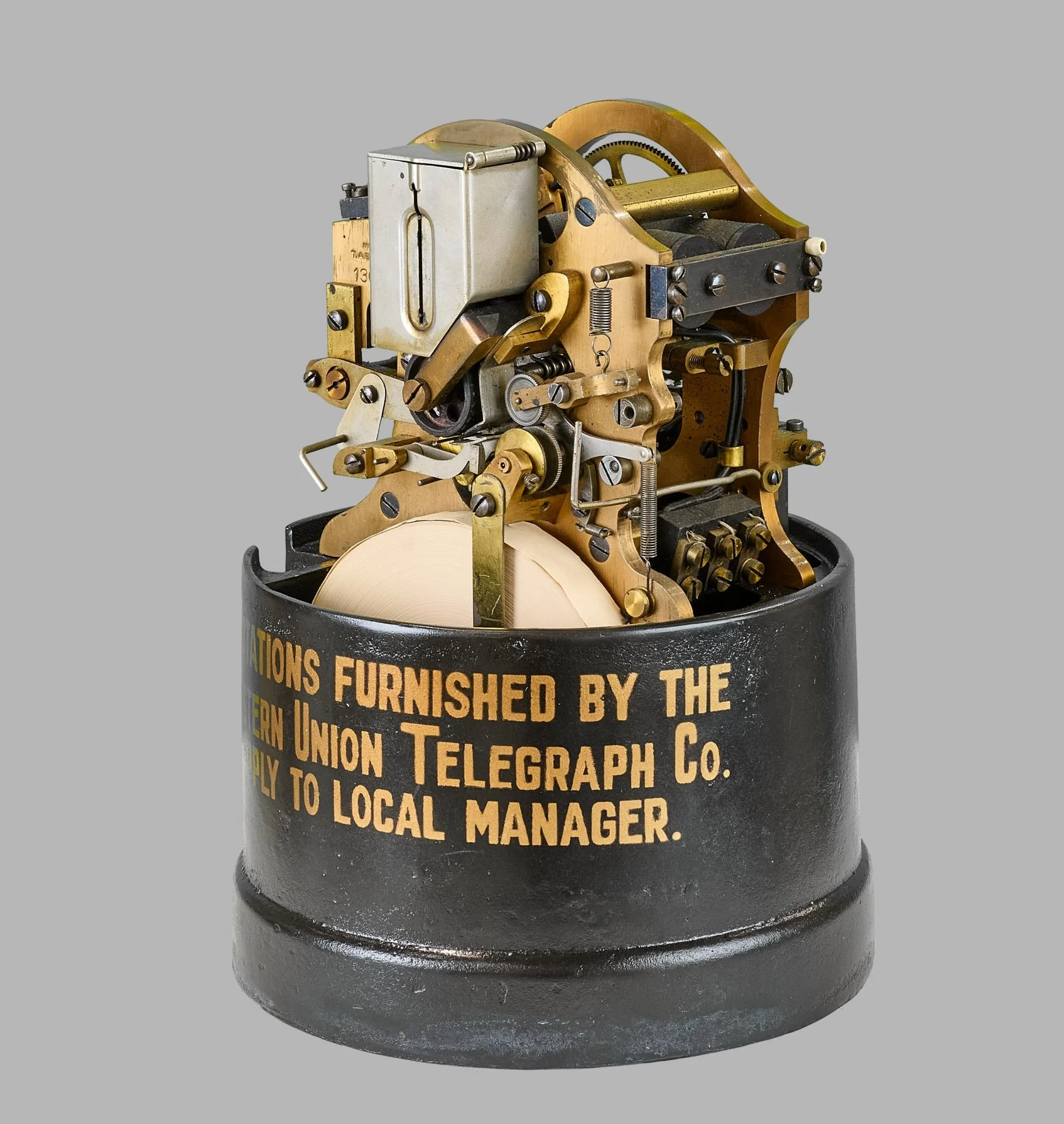
Among the rarest and most historically resonant instruments of American financial and technological history — an early universal stock ticker manufactured directly by Thomas A. Edison at his Newark, New Jersey workshop, produced for the Gold & Stock Telegraph Company in the 1870s and bearing the original gilt inscriptions "T.A. EDISON, MAKER, NEWARK N.J." and "GOLD & STOCK TELEGRAPH CO. NO. 13" on its japanned cast iron base.
This is not an instrument manufactured under Edison's patent by a later corporate successor, nor a product of the industrial-scale production that characterised later ticker generations. This is a machine made by Edison himself, in his own workshop, at the moment when the universal stock ticker was being developed and refined — one of the most consequential technological achievements of the nineteenth century.
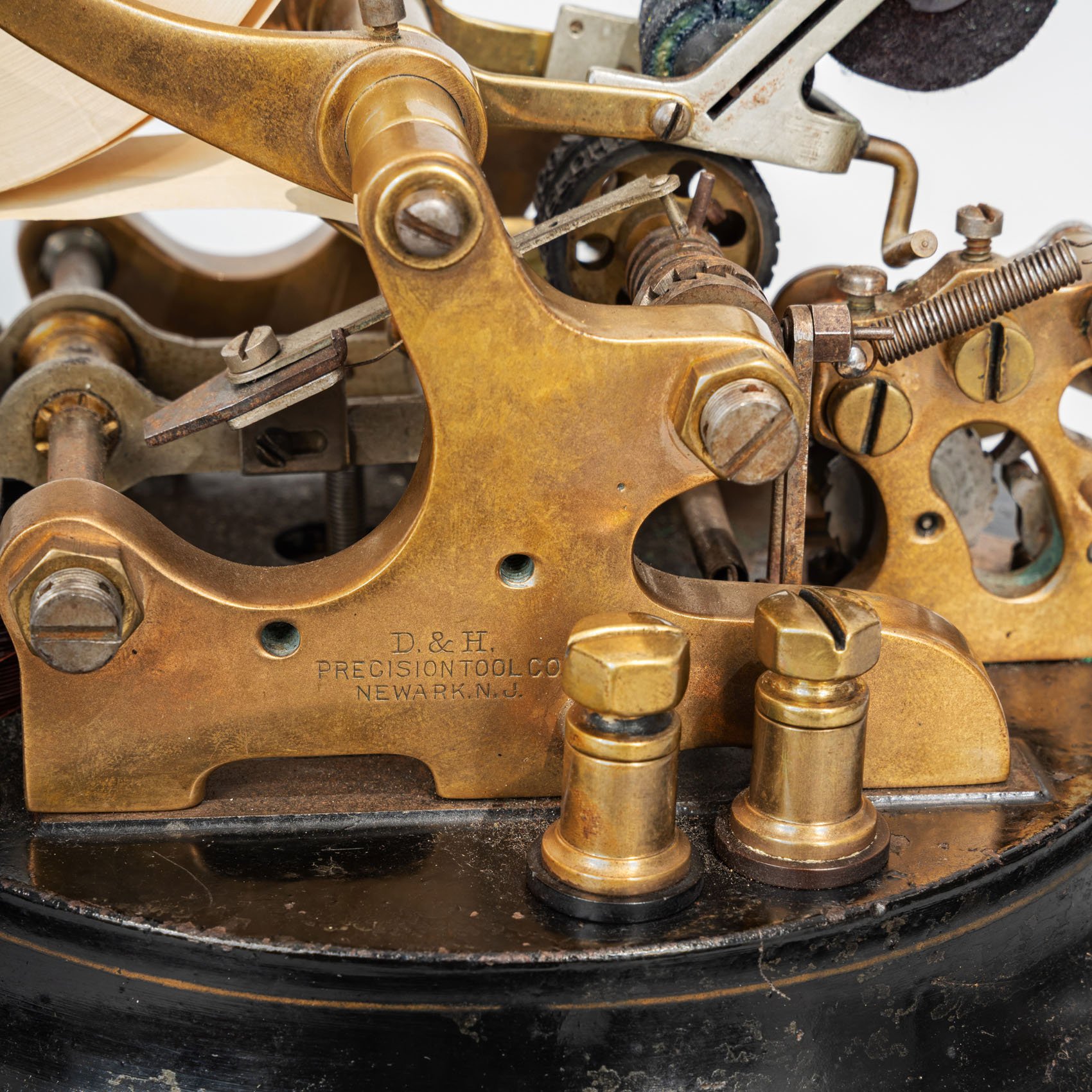
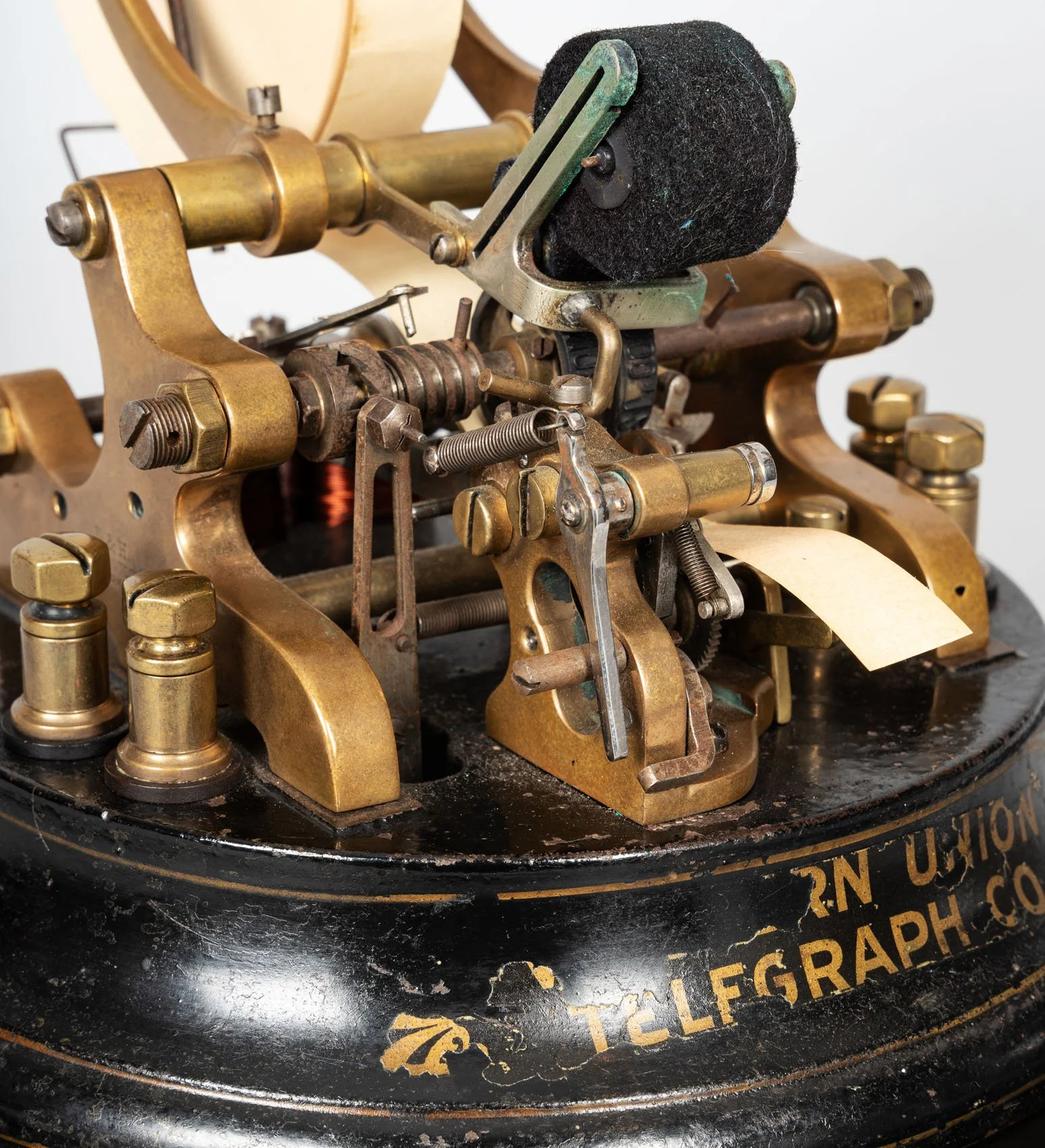
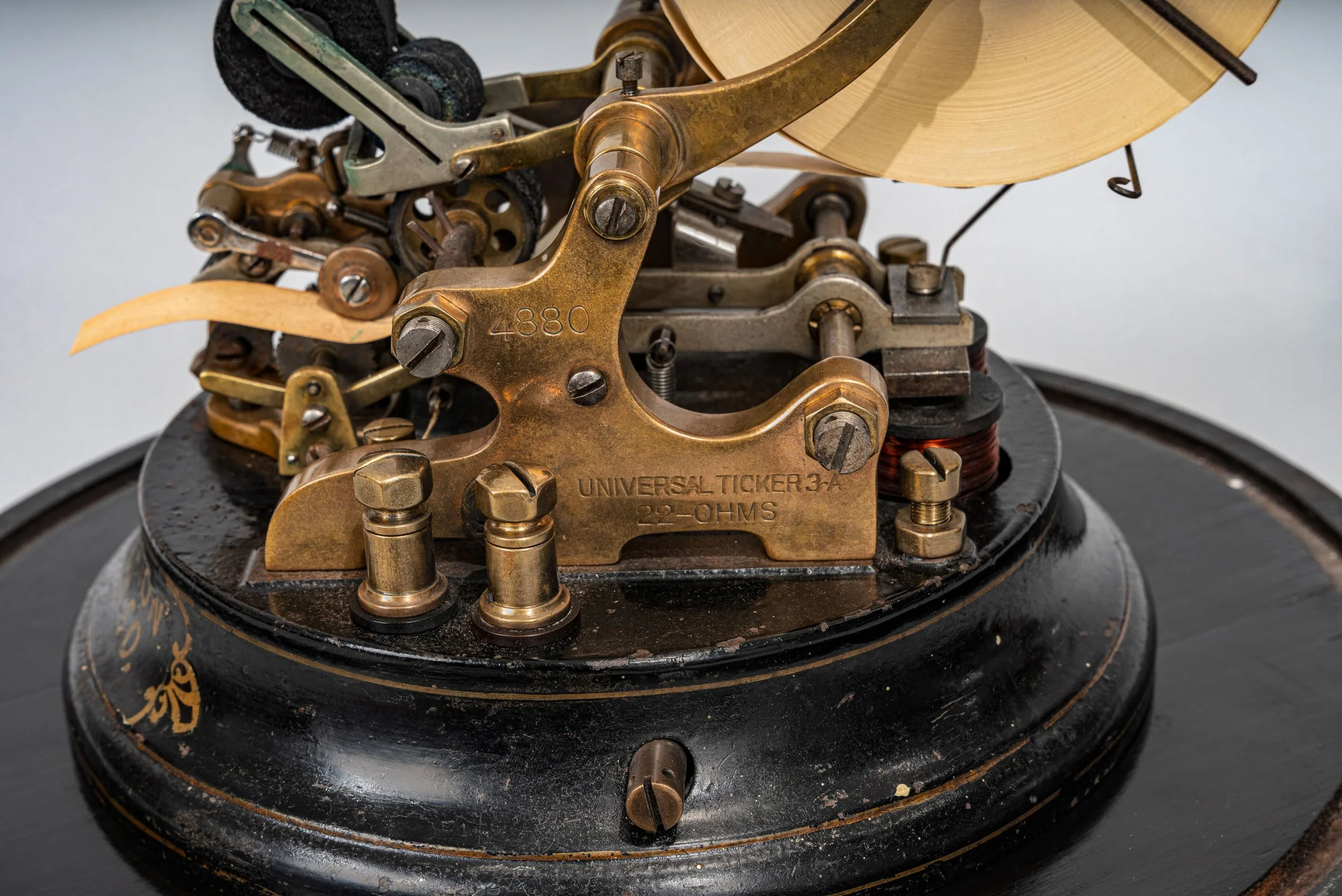
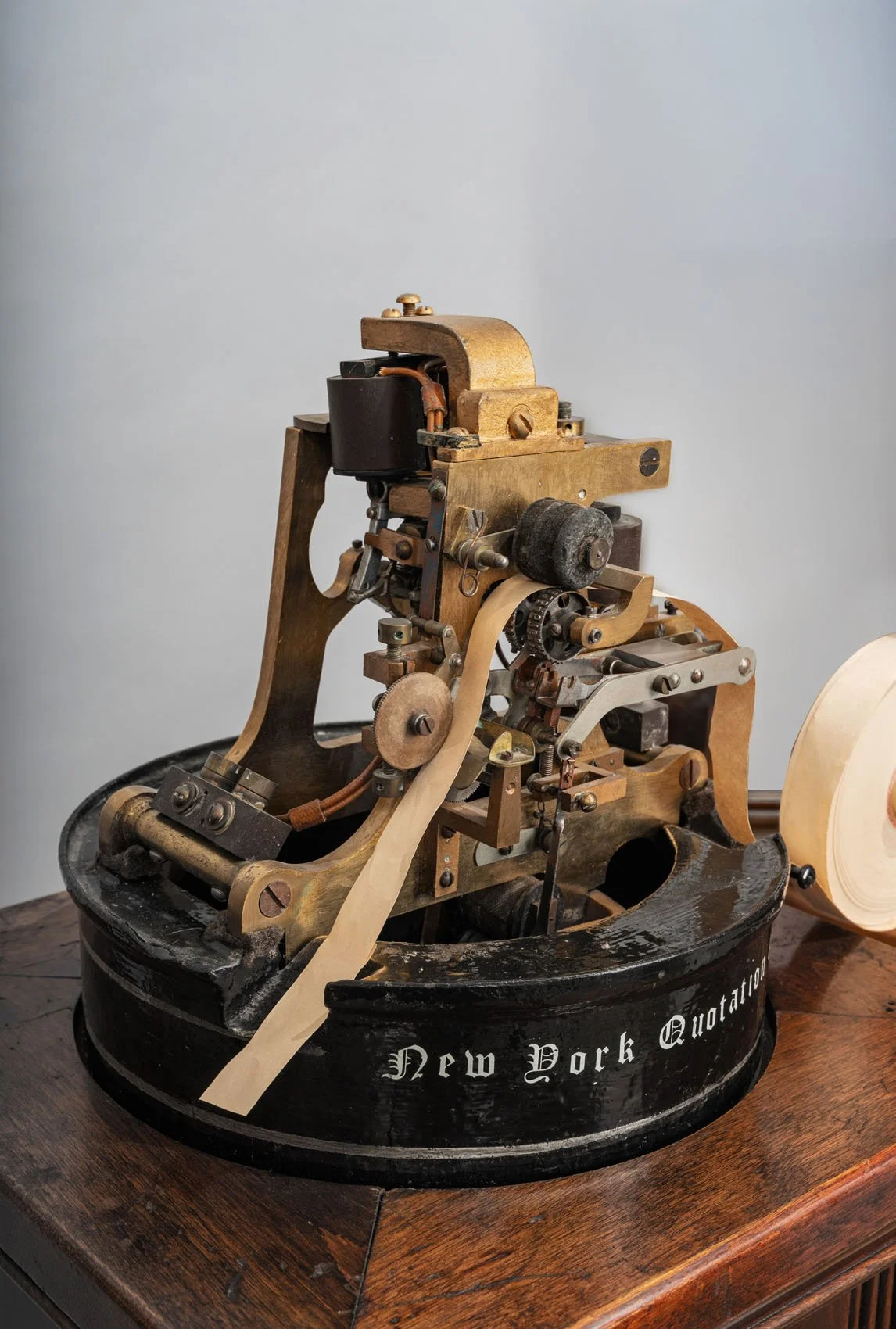
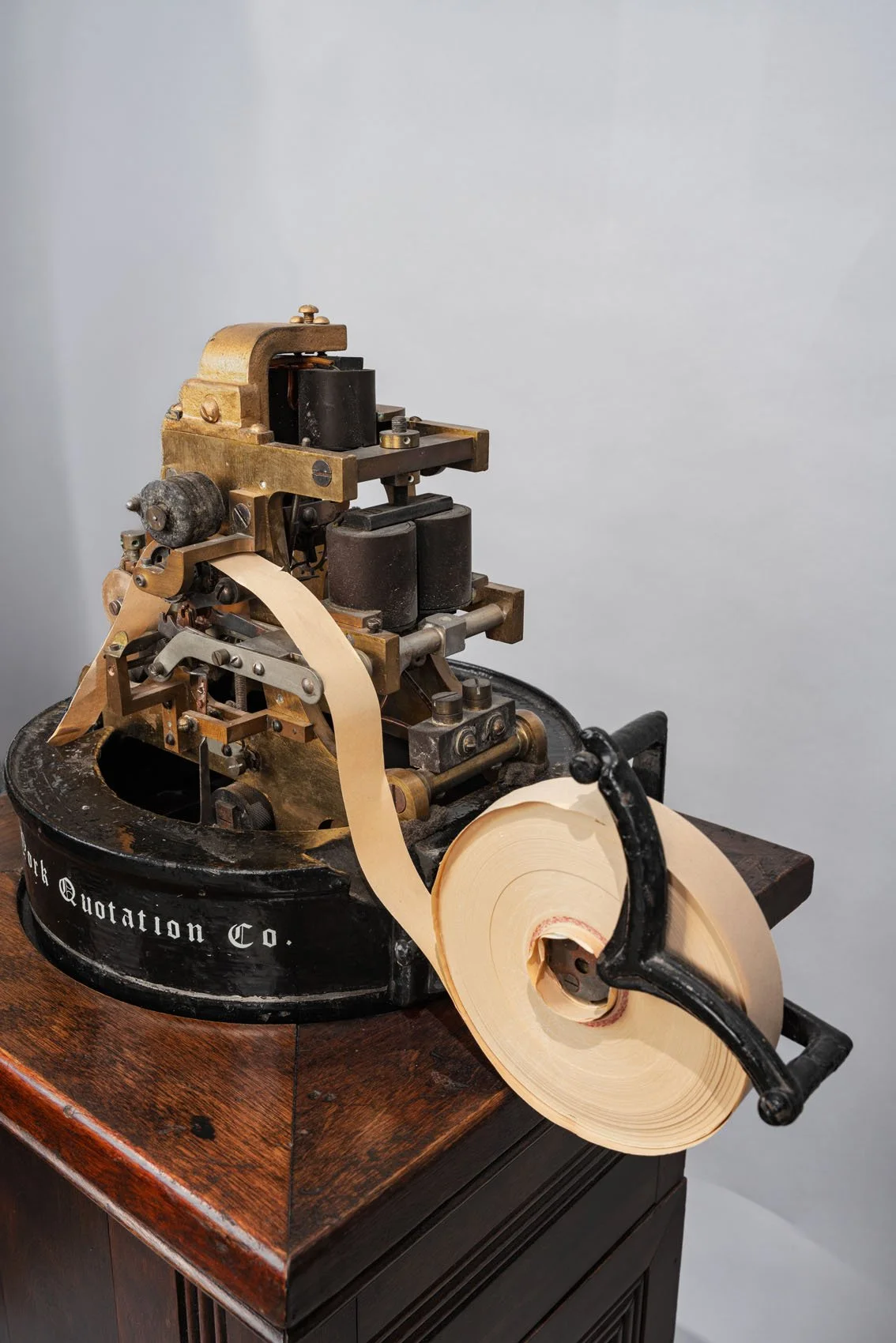
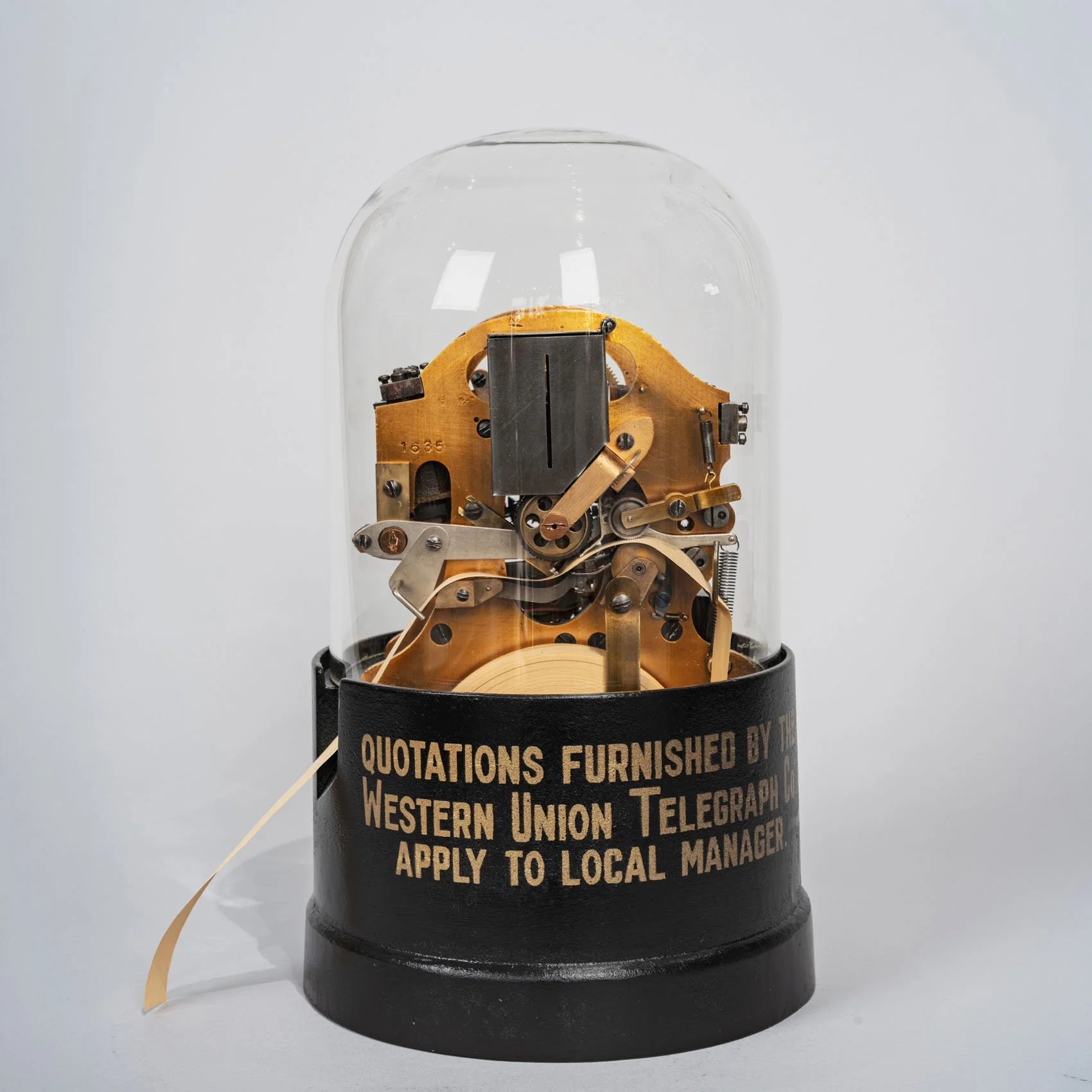
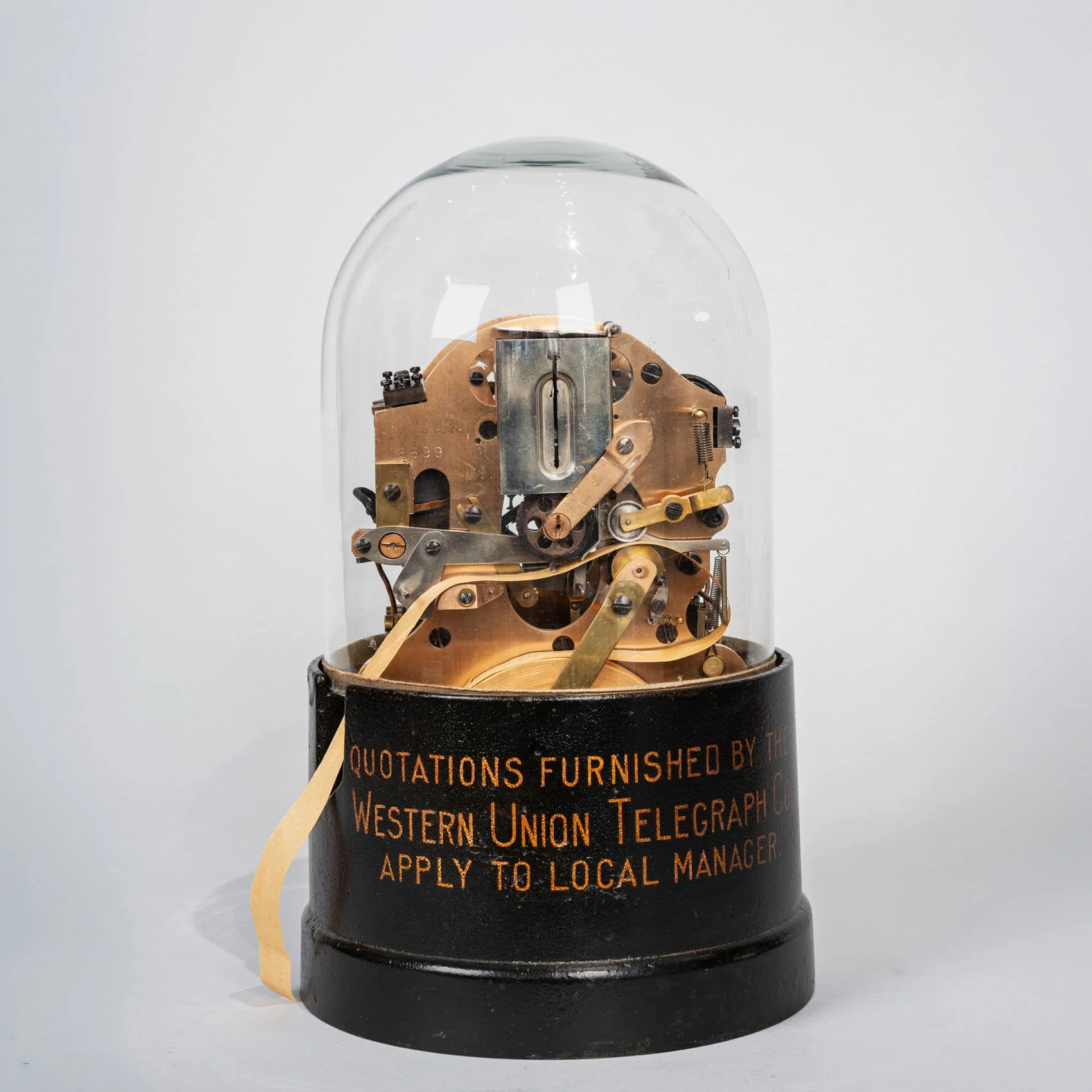
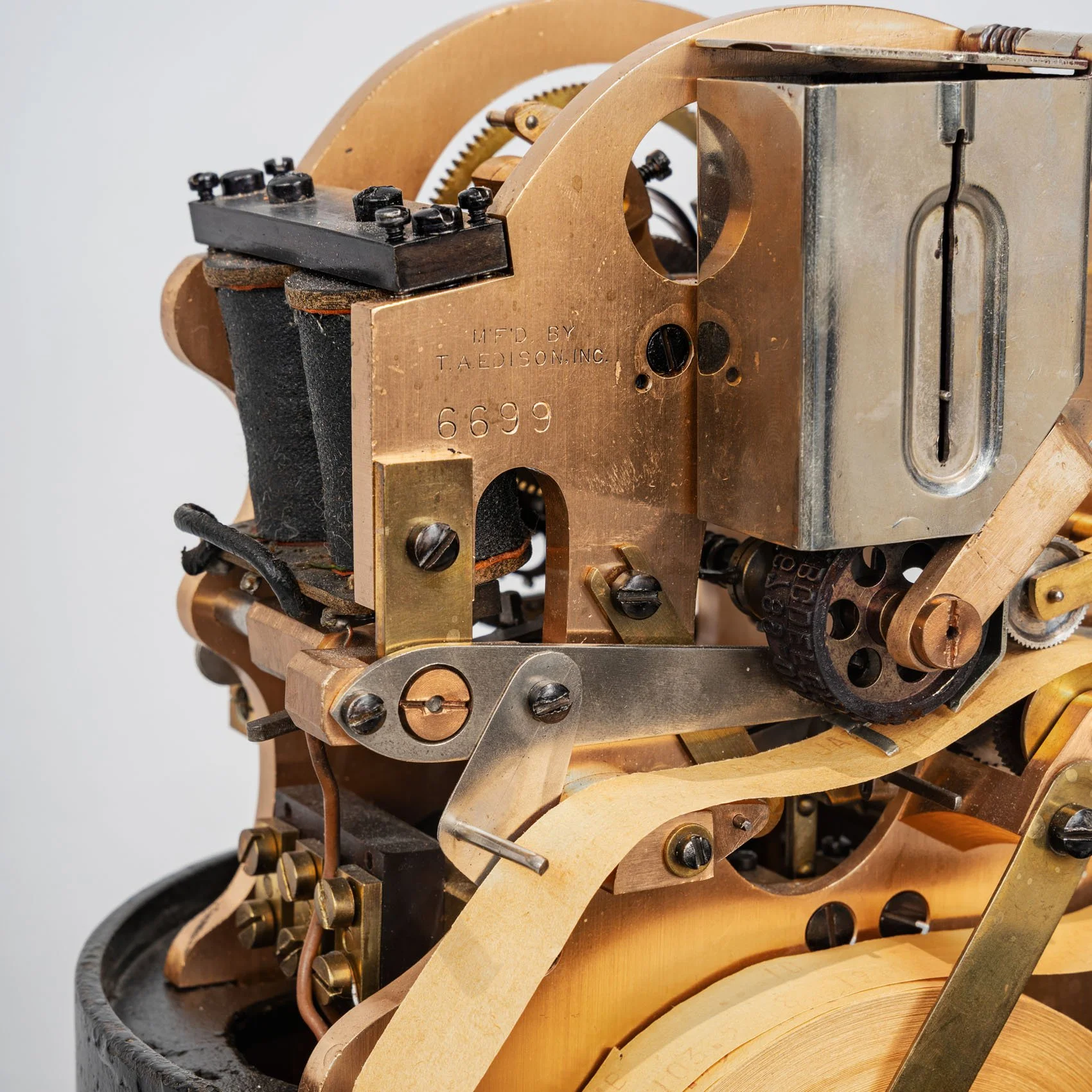
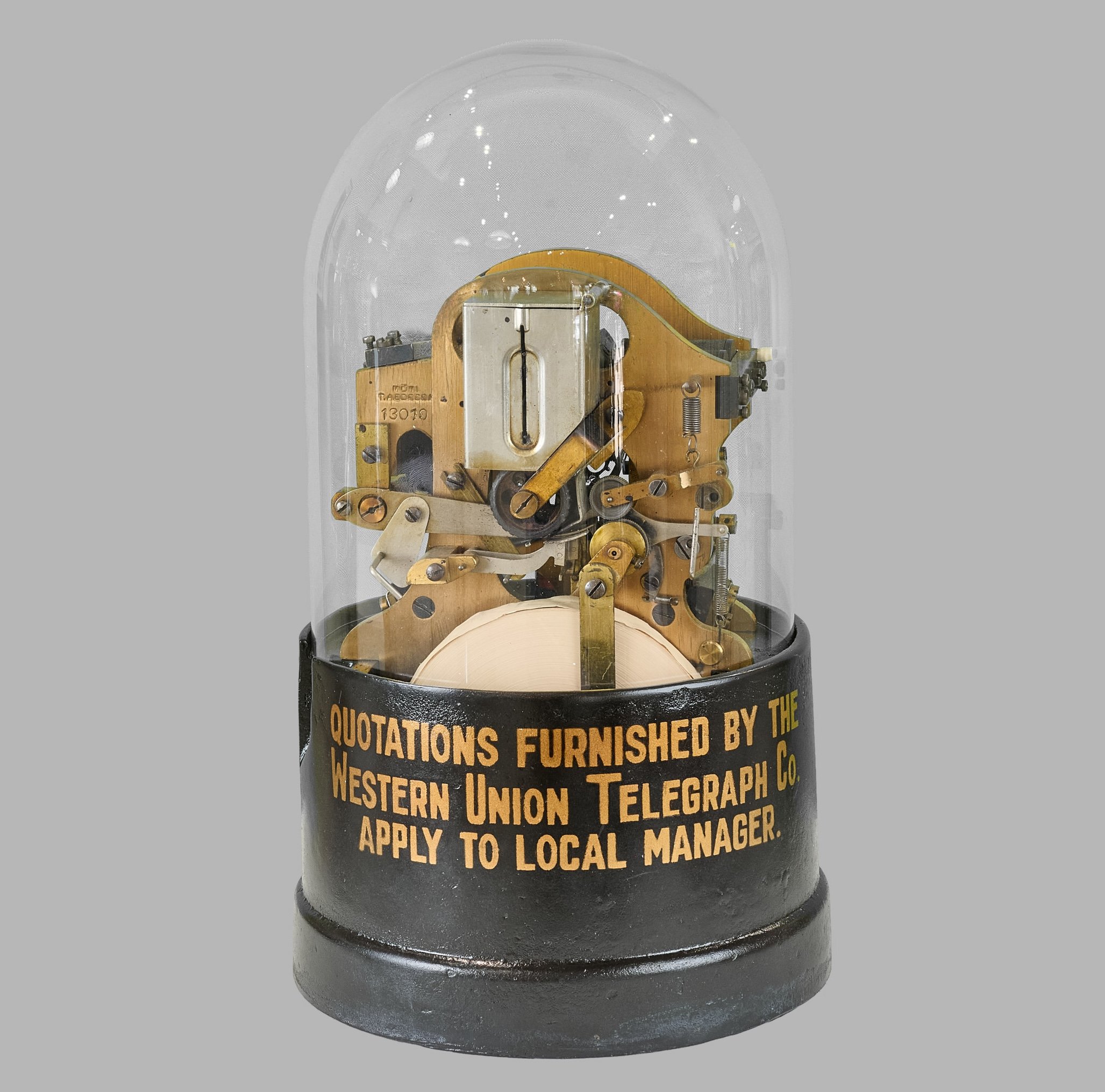
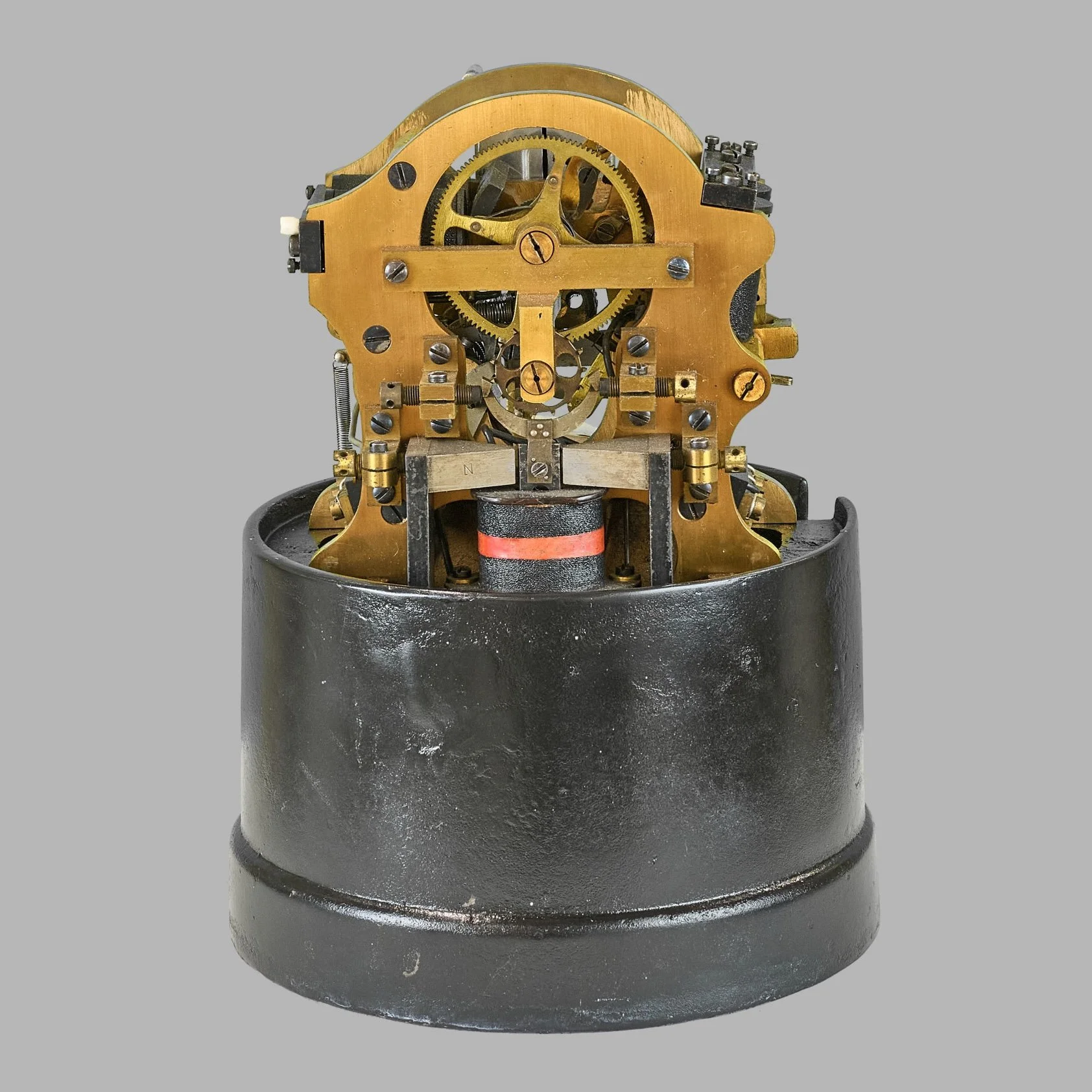
The mechanism is finely engineered in brass throughout, with dual ink rollers and a clockwork-driven transmission system surmounted by a paper spool issuing the continuous printed tape of stock quotations that gave these instruments their defining character. The cast iron base retains its original black japanned finish with gilt stenciled lettering and decorative ornamental borders, and the instrument is mounted on a turned wooden display base and preserved beneath its glass dome.
The Gold & Stock Telegraph Company, whose name appears prominently on the base alongside Edison's patent credit, was the dominant distributor of financial data in New York during the post-Civil War period. Its network of tickers — installed in brokerage houses and financial institutions across the city — formed the communications infrastructure through which American capital markets operated in real time for the first time in history. Edison's relationship with the company was transformative: his improvements to the ticker mechanism in the late 1860s and early 1870s established the universal standard that defined the technology for decades, and his sale of those patents to the Gold & Stock Telegraph Company — and subsequently to Western Union — provided the capital that funded his later, even more celebrated inventions.
Unlike the standardized instruments of later decades, produced in large quantities by corporate manufacturers, these early Newark-made tickers were produced in relatively small numbers and were largely confined to Wall Street and the major financial institutions directly connected to the Gold & Stock network. Their survival is consequently rare — and survival in complete, visually compelling condition, with clear original inscriptions and original surface decoration intact, is rarer still.
The present example, numbered No. 13, stands as a direct physical artifact from one of the most consequential chapters in both American technological history and the history of global financial markets — the moment when the transmission of financial data moved from the realm of the approximate and delayed into something approaching the real-time, coordinated, and continuous.
Literature: Edison Stock Ticker Patent No. 13, illustrating the early development of the universal stock ticker mechanism.
Condition: Good overall. Brass mechanism complete and intact with original patina. Cast iron japanned base retains original gilt lettering — "T.A. Edison, Maker, Newark N.J." and "Gold & Stock Telegraph Co. No. 13" — with wear to japanned surface consistent with age and honest use. Original decorative gilt borders partially legible. Glass dome present and intact. Turned wooden display base present and structurally sound. All principal components present in unrestored original condition.
Among the rarest and most historically resonant instruments of American financial and technological history — an early universal stock ticker manufactured directly by Thomas A. Edison at his Newark, New Jersey workshop, produced for the Gold & Stock Telegraph Company in the 1870s and bearing the original gilt inscriptions "T.A. EDISON, MAKER, NEWARK N.J." and "GOLD & STOCK TELEGRAPH CO. NO. 13" on its japanned cast iron base.
This is not an instrument manufactured under Edison's patent by a later corporate successor, nor a product of the industrial-scale production that characterised later ticker generations. This is a machine made by Edison himself, in his own workshop, at the moment when the universal stock ticker was being developed and refined — one of the most consequential technological achievements of the nineteenth century.
The mechanism is finely engineered in brass throughout, with dual ink rollers and a clockwork-driven transmission system surmounted by a paper spool issuing the continuous printed tape of stock quotations that gave these instruments their defining character. The cast iron base retains its original black japanned finish with gilt stenciled lettering and decorative ornamental borders, and the instrument is mounted on a turned wooden display base and preserved beneath its glass dome.
The Gold & Stock Telegraph Company, whose name appears prominently on the base alongside Edison's patent credit, was the dominant distributor of financial data in New York during the post-Civil War period. Its network of tickers — installed in brokerage houses and financial institutions across the city — formed the communications infrastructure through which American capital markets operated in real time for the first time in history. Edison's relationship with the company was transformative: his improvements to the ticker mechanism in the late 1860s and early 1870s established the universal standard that defined the technology for decades, and his sale of those patents to the Gold & Stock Telegraph Company — and subsequently to Western Union — provided the capital that funded his later, even more celebrated inventions.
Unlike the standardized instruments of later decades, produced in large quantities by corporate manufacturers, these early Newark-made tickers were produced in relatively small numbers and were largely confined to Wall Street and the major financial institutions directly connected to the Gold & Stock network. Their survival is consequently rare — and survival in complete, visually compelling condition, with clear original inscriptions and original surface decoration intact, is rarer still.
The present example, numbered No. 13, stands as a direct physical artifact from one of the most consequential chapters in both American technological history and the history of global financial markets — the moment when the transmission of financial data moved from the realm of the approximate and delayed into something approaching the real-time, coordinated, and continuous.
Literature: Edison Stock Ticker Patent No. 13, illustrating the early development of the universal stock ticker mechanism.
Condition: Good overall. Brass mechanism complete and intact with original patina. Cast iron japanned base retains original gilt lettering — "T.A. Edison, Maker, Newark N.J." and "Gold & Stock Telegraph Co. No. 13" — with wear to japanned surface consistent with age and honest use. Original decorative gilt borders partially legible. Glass dome present and intact. Turned wooden display base present and structurally sound. All principal components present in unrestored original condition.

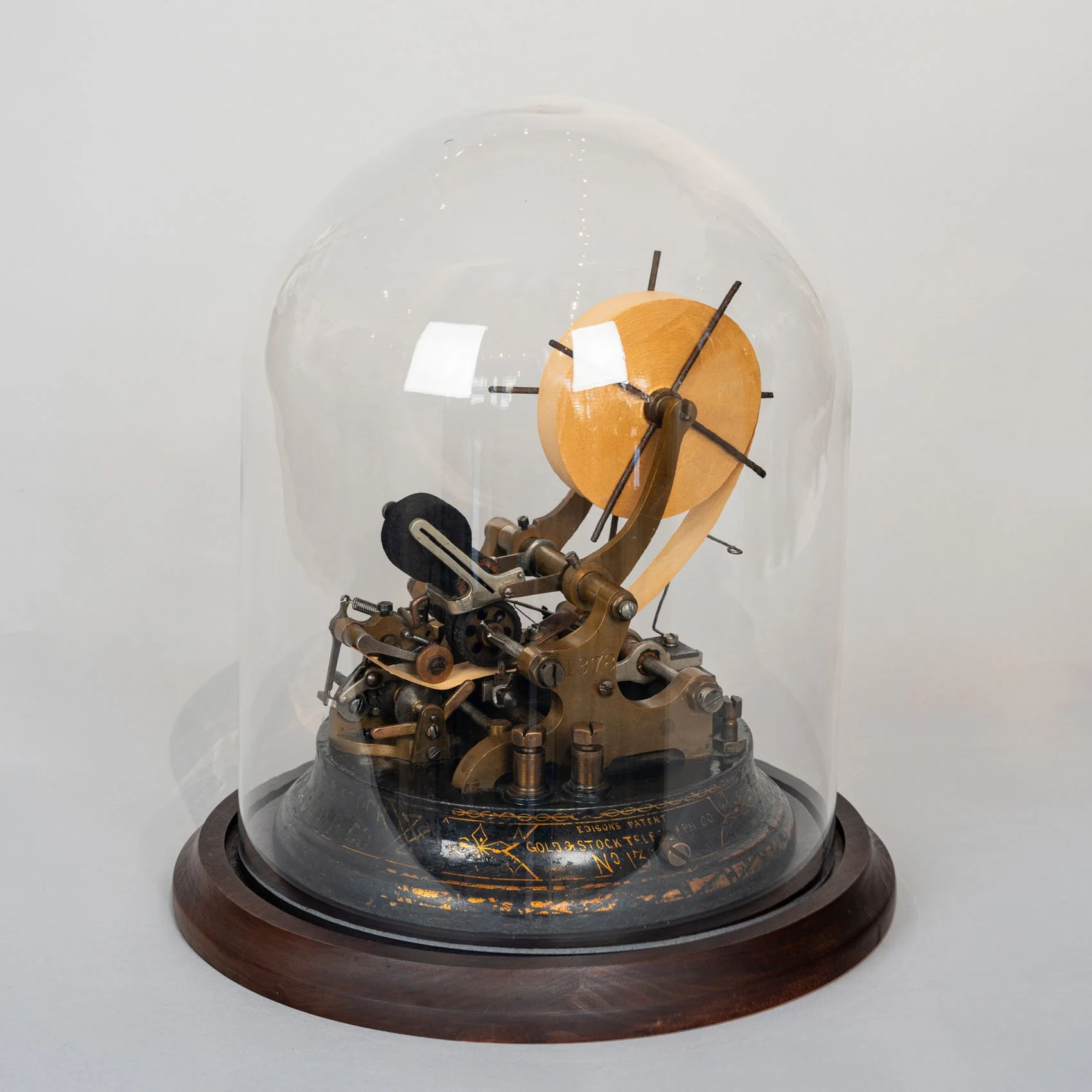 Image 1 of 4
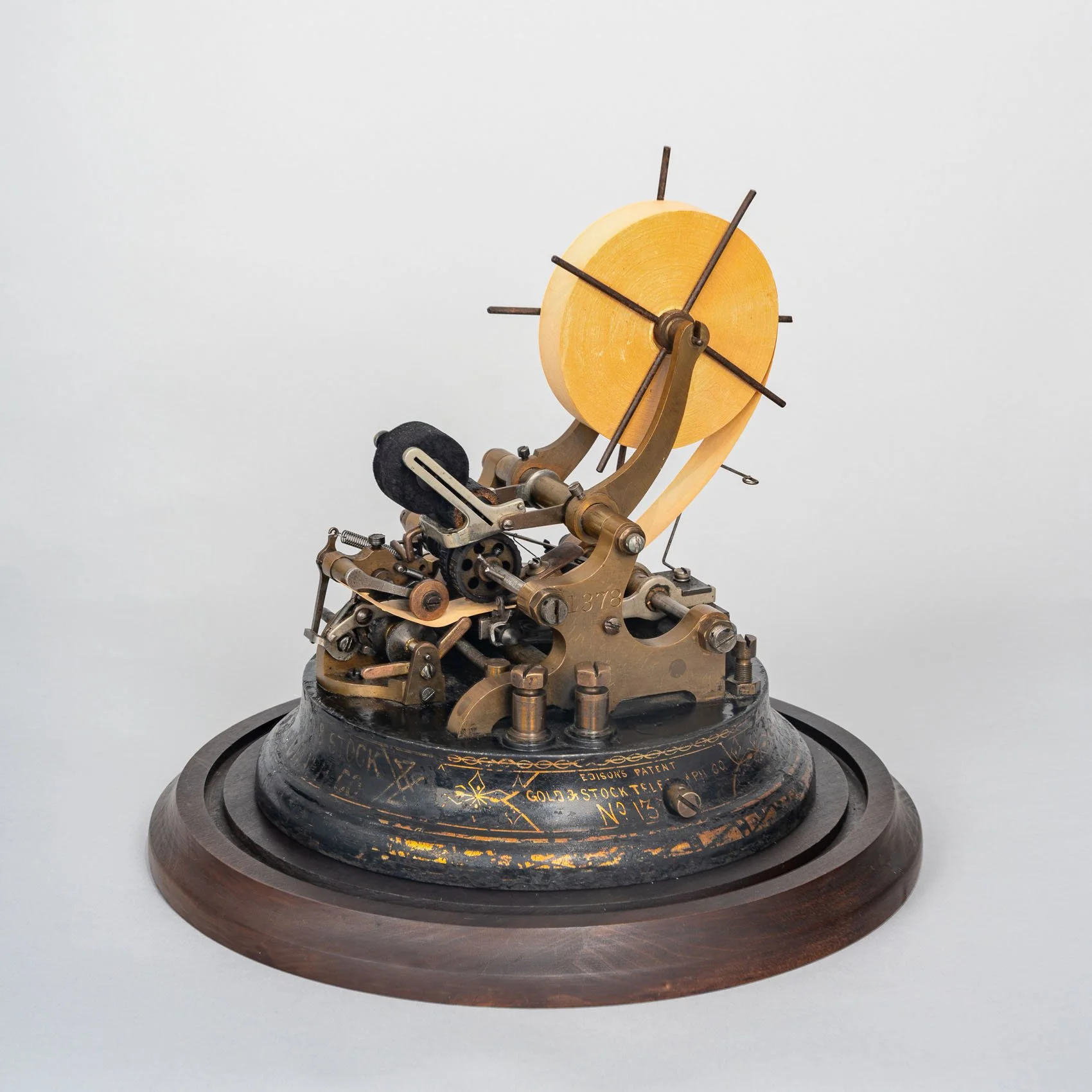 Image 2 of 4
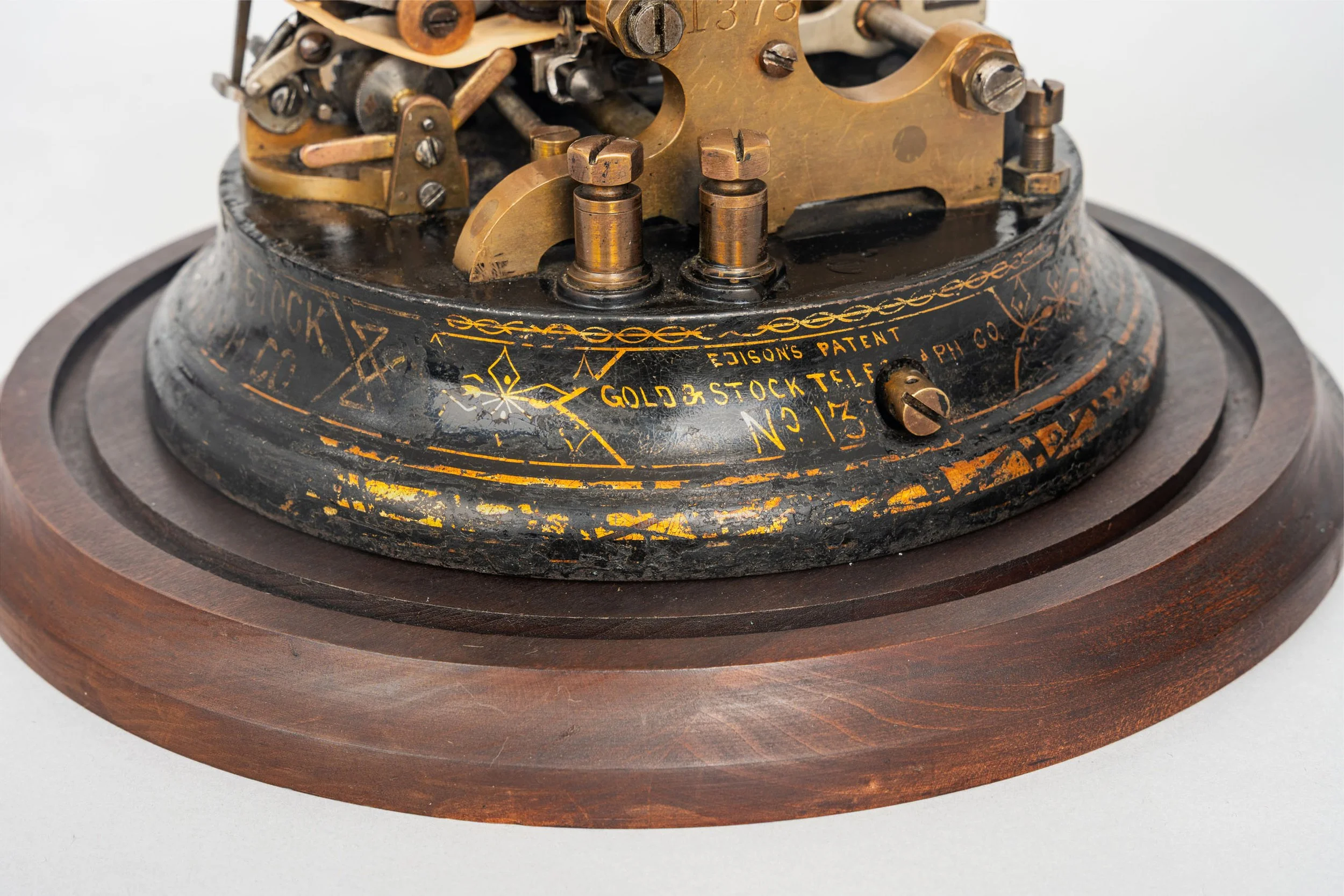 Image 3 of 4
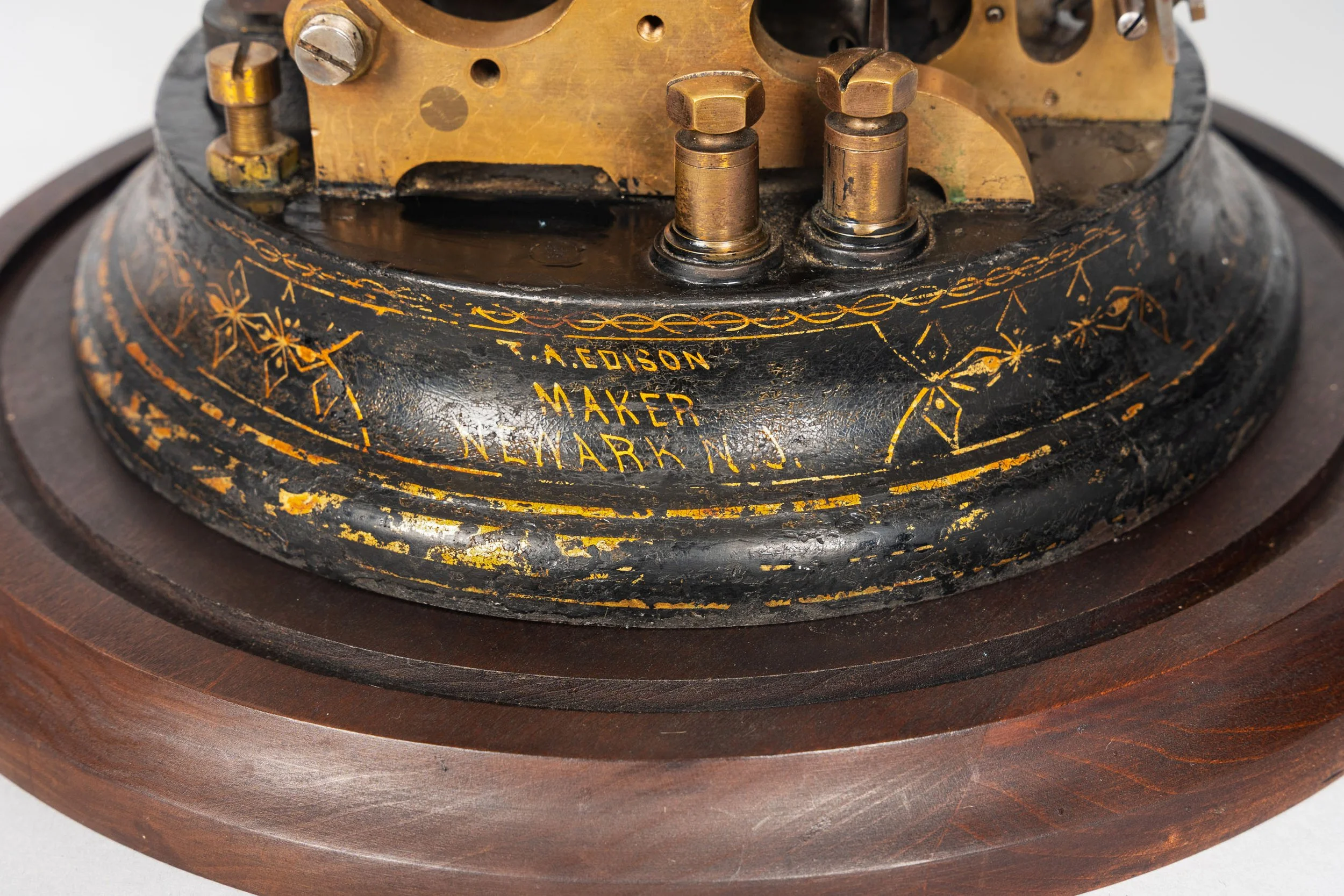 Image 4 of 4