A cased pair of flintlock dueling pistols by John Manton of Dover Street, London, 1794, illustrated in Neal and Back's standard work on the Mantons. Each browned octagonal barrel is signed in inlaid gold MANTON LONDON, with finely checkered butts, silver oval escutcheons at the wrists, and the restrained, perfectly balanced architecture for which Manton duellers were prized: instruments built for a steady hand at first light, without ornament to distract from function.
The pair carries Manton's "secret" scratch rifling — the grooving of the bore is too shallow to be seen at the muzzle, giving the accuracy of a rifled barrel while the pistol passes as a smoothbore. A dueling pistol with visible rifling was considered unsporting; the scratch-rifled Manton was the connoisseur's quiet advantage, and surviving pairs are keenly sought.
The pistols are housed in their mahogany case, lined in green baize, the lid bearing the trade label of John Manton & Son, Gun Makers to the Prince Regent and the Duke of York, No. 6 Dover Street — the firm's later label — the case having remained in service with the pistols. The case retains its loading rod with brass worm, two lidded compartments with turned bone pulls, and bone diamond escutcheons to the front. Dueling pistols by the Manton brothers stand at the summit of English gunmaking, and a published, cased pair of this completeness ranks among the most desirable of all antique arms.
Condition: exceptional.
Literature: W. Keith Neal and D.H.L. Back, The Mantons: Gunmakers, London, 1966, this pair illustrated.
A cased pair of flintlock dueling pistols by John Manton of Dover Street, London, 1794, illustrated in Neal and Back's standard work on the Mantons. Each browned octagonal barrel is signed in inlaid gold MANTON LONDON, with finely checkered butts, silver oval escutcheons at the wrists, and the restrained, perfectly balanced architecture for which Manton duellers were prized: instruments built for a steady hand at first light, without ornament to distract from function.
The pair carries Manton's "secret" scratch rifling — the grooving of the bore is too shallow to be seen at the muzzle, giving the accuracy of a rifled barrel while the pistol passes as a smoothbore. A dueling pistol with visible rifling was considered unsporting; the scratch-rifled Manton was the connoisseur's quiet advantage, and surviving pairs are keenly sought.
The pistols are housed in their mahogany case, lined in green baize, the lid bearing the trade label of John Manton & Son, Gun Makers to the Prince Regent and the Duke of York, No. 6 Dover Street — the firm's later label — the case having remained in service with the pistols. The case retains its loading rod with brass worm, two lidded compartments with turned bone pulls, and bone diamond escutcheons to the front. Dueling pistols by the Manton brothers stand at the summit of English gunmaking, and a published, cased pair of this completeness ranks among the most desirable of all antique arms.
Condition: exceptional.
Literature: W. Keith Neal and D.H.L. Back, The Mantons: Gunmakers, London, 1966, this pair illustrated.

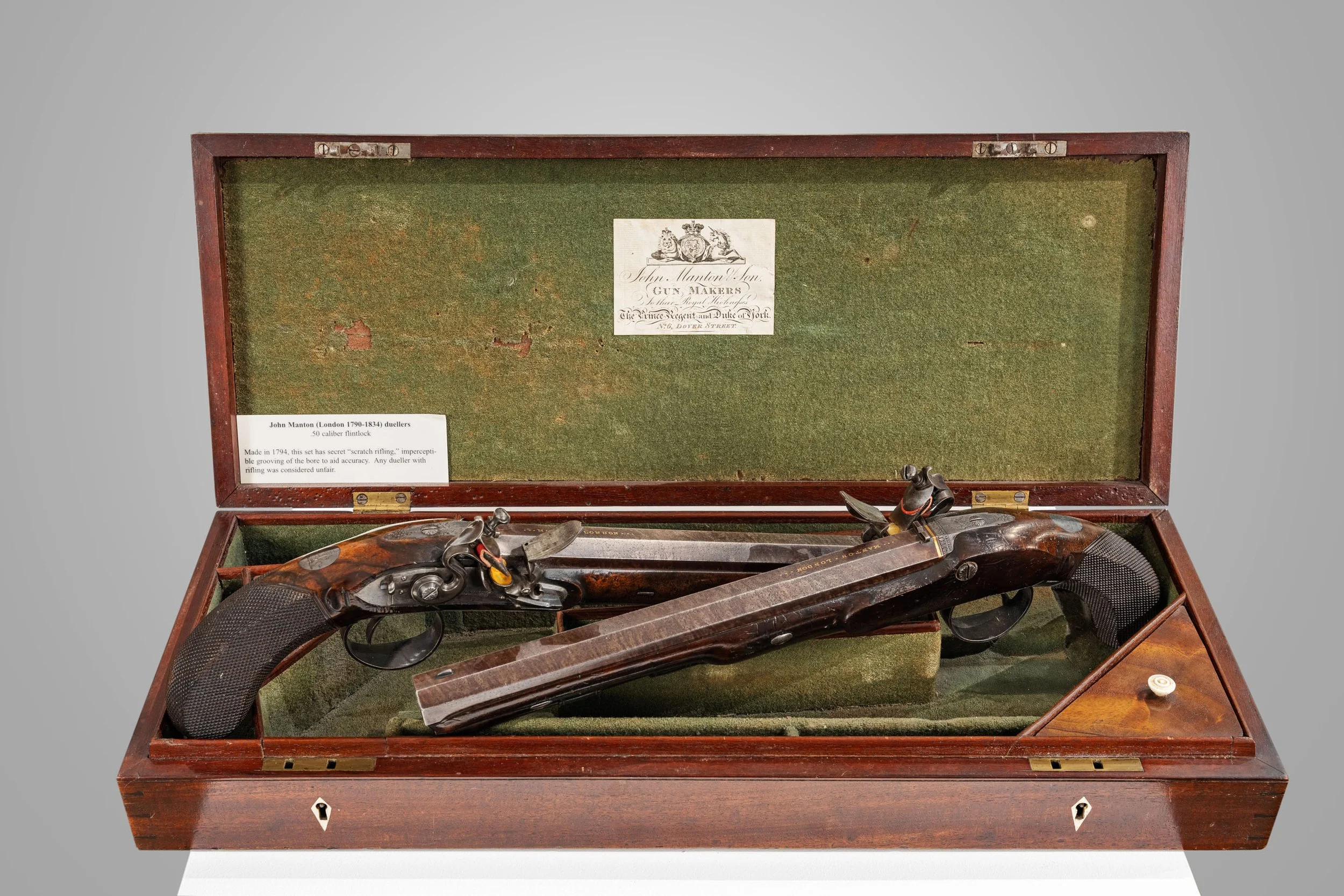 Image 1 of 2
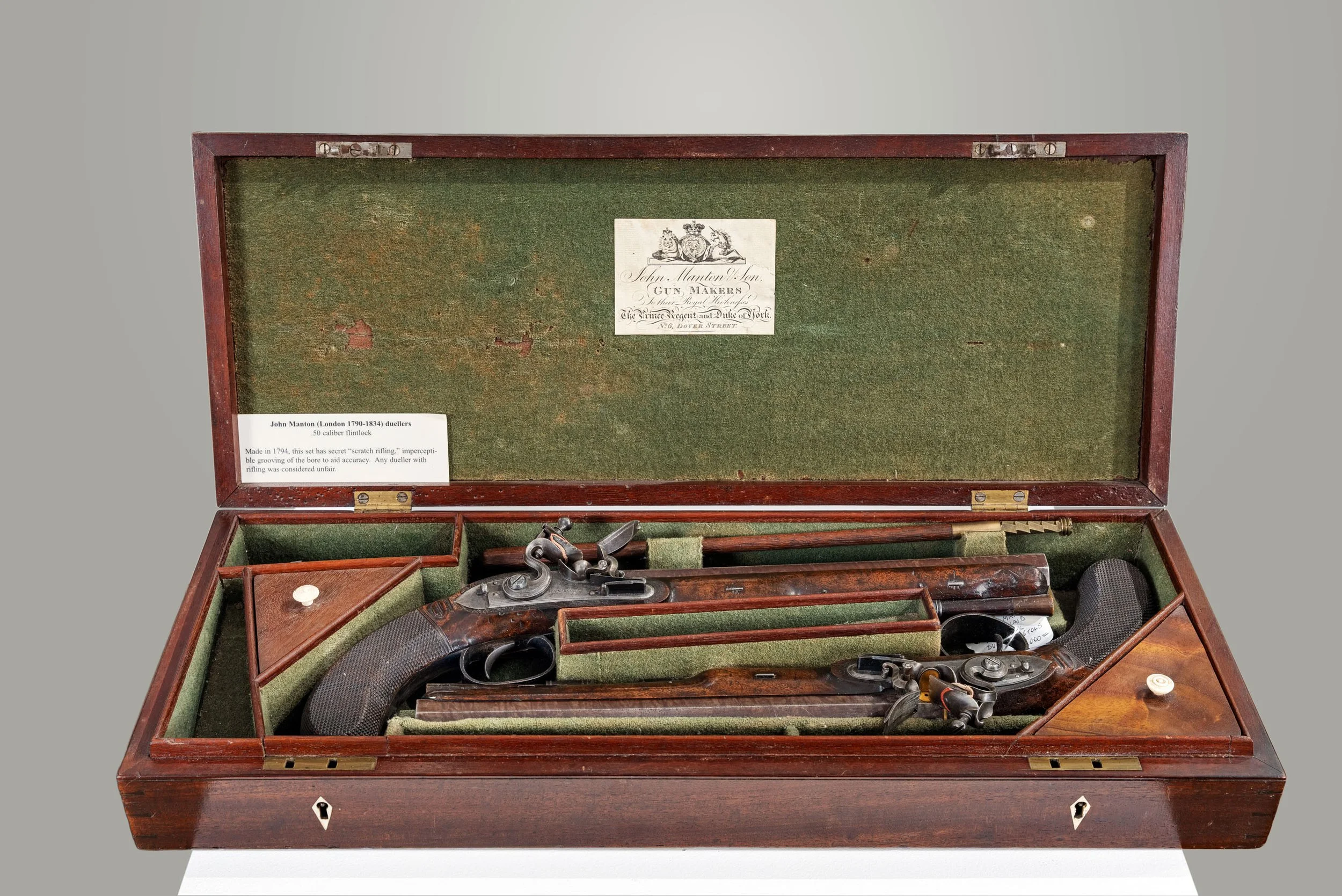 Image 2 of 2