A fine and rare sculptural group by Walter Mader of Brienz, one of the most accomplished masters of the Swiss Black Forest carving tradition, depicting a recumbent hound with four puppies clambering across her back, carved in mountain maple on an exceptional scale.
The mother lies stretched at rest, her head sunk between extended forelegs with the patient, weary calm of a nursing animal. Her coat is built up in long, sweeping tool strokes that follow the lie of the fur, and a studded collar is carved at her neck with the same care given to the figures themselves, placing her firmly in the working life of a real dog. Her teats are visible along the underside, the carver recording the plain truth of a mother with a litter, without sentiment or evasion.
Across her back the four puppies pile and jostle, each with inset glass eyes and each individually observed: one rests its chin drowsily against her shoulder, another braces a forepaw and noses forward mid-climb, a third stares out with wide, unguarded curiosity, and the fourth cocks its head as if deciding whether to join the game. The soft modeling of their faces, the paws and ears falling every which way, all speak to observation from life rather than workshop formula.
The group is unsigned, as is common for Brienz work of this period; the attribution rests on its direct correspondence in model, composition, and handling to Mader's documented dog groups, including a closely related example of the same subject previously sold by Daniels Antiques. Mader's feeling for dogs was no workshop convention: his lifelong friendship with Johann Huggler, the pre-eminent master of the Brienz school, was bound up with the loss of his own beloved dog, Nase, in the Alpine tragedy of 1871, commemorated in Huggler's carved portrait of the animal, which we have also had the privilege of handling. That intimacy with his subject carried Mader's dog groups to the international exhibitions of the nineteenth century in London, Paris, and the United States, and it is felt in every figure of the present work, among the most compelling dog subjects of the Black Forest tradition.
Dimensions: 36"length x 20"depth x 15"height
Literature
Jay Arenski, Simon Daniels, and Michael Daniels, Swiss Carvings: The Art of the Black Forest, 1820–1940 (2006).
A fine and rare sculptural group by Walter Mader of Brienz, one of the most accomplished masters of the Swiss Black Forest carving tradition, depicting a recumbent hound with four puppies clambering across her back, carved in mountain maple on an exceptional scale.
The mother lies stretched at rest, her head sunk between extended forelegs with the patient, weary calm of a nursing animal. Her coat is built up in long, sweeping tool strokes that follow the lie of the fur, and a studded collar is carved at her neck with the same care given to the figures themselves, placing her firmly in the working life of a real dog. Her teats are visible along the underside, the carver recording the plain truth of a mother with a litter, without sentiment or evasion.
Across her back the four puppies pile and jostle, each with inset glass eyes and each individually observed: one rests its chin drowsily against her shoulder, another braces a forepaw and noses forward mid-climb, a third stares out with wide, unguarded curiosity, and the fourth cocks its head as if deciding whether to join the game. The soft modeling of their faces, the paws and ears falling every which way, all speak to observation from life rather than workshop formula.
The group is unsigned, as is common for Brienz work of this period; the attribution rests on its direct correspondence in model, composition, and handling to Mader's documented dog groups, including a closely related example of the same subject previously sold by Daniels Antiques. Mader's feeling for dogs was no workshop convention: his lifelong friendship with Johann Huggler, the pre-eminent master of the Brienz school, was bound up with the loss of his own beloved dog, Nase, in the Alpine tragedy of 1871, commemorated in Huggler's carved portrait of the animal, which we have also had the privilege of handling. That intimacy with his subject carried Mader's dog groups to the international exhibitions of the nineteenth century in London, Paris, and the United States, and it is felt in every figure of the present work, among the most compelling dog subjects of the Black Forest tradition.
Dimensions: 36"length x 20"depth x 15"height
Literature
Jay Arenski, Simon Daniels, and Michael Daniels, Swiss Carvings: The Art of the Black Forest, 1820–1940 (2006).

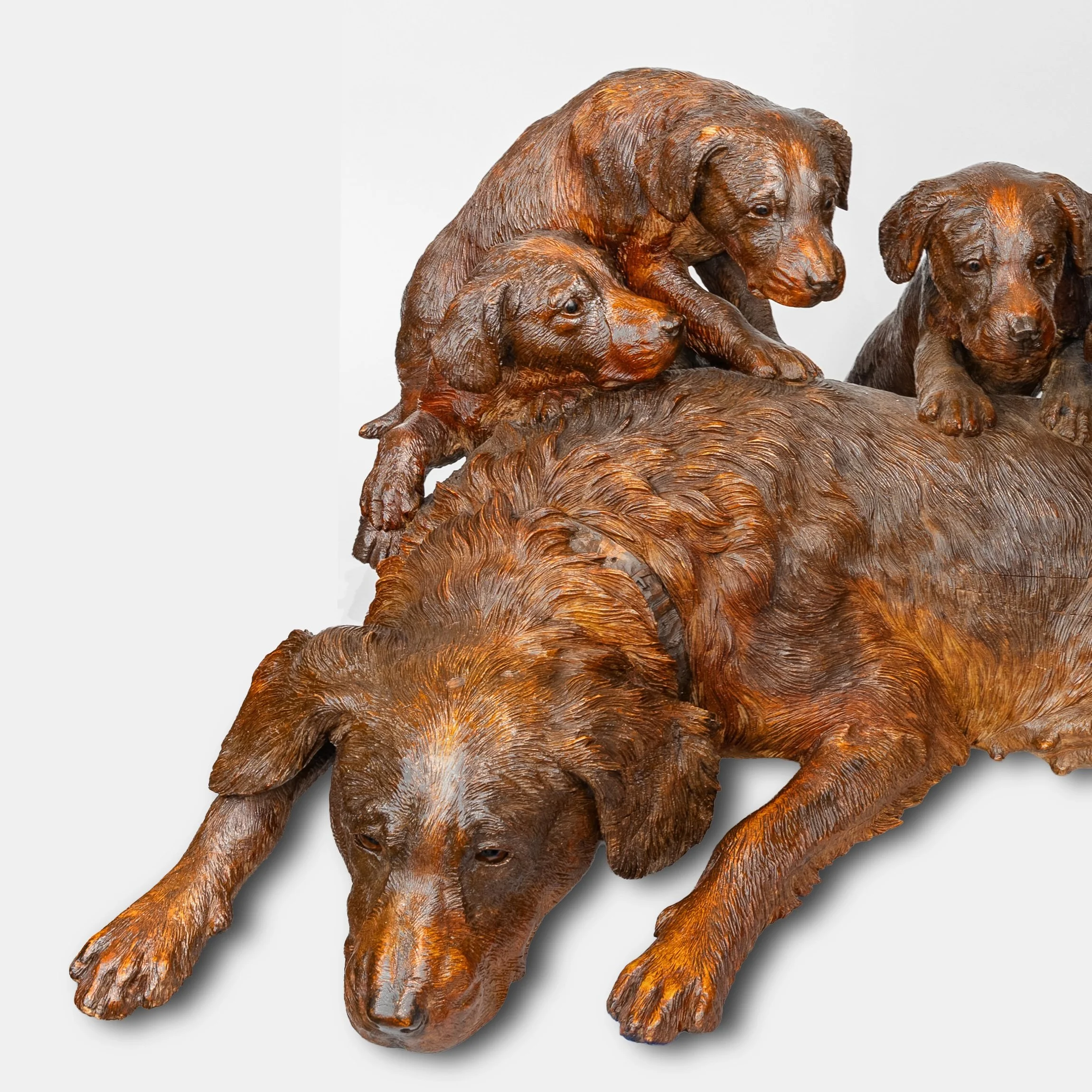 Image 1 of 3
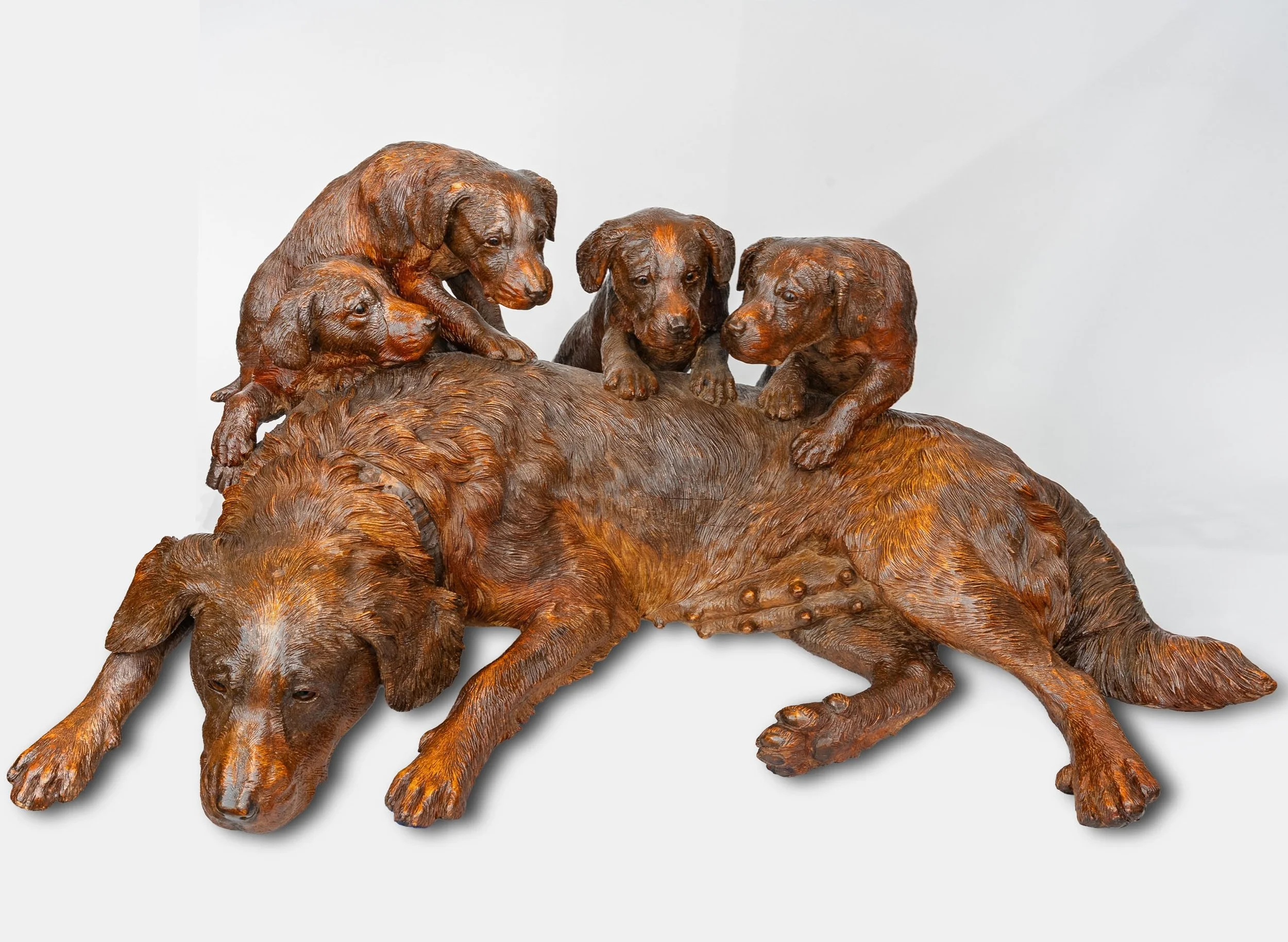 Image 2 of 3
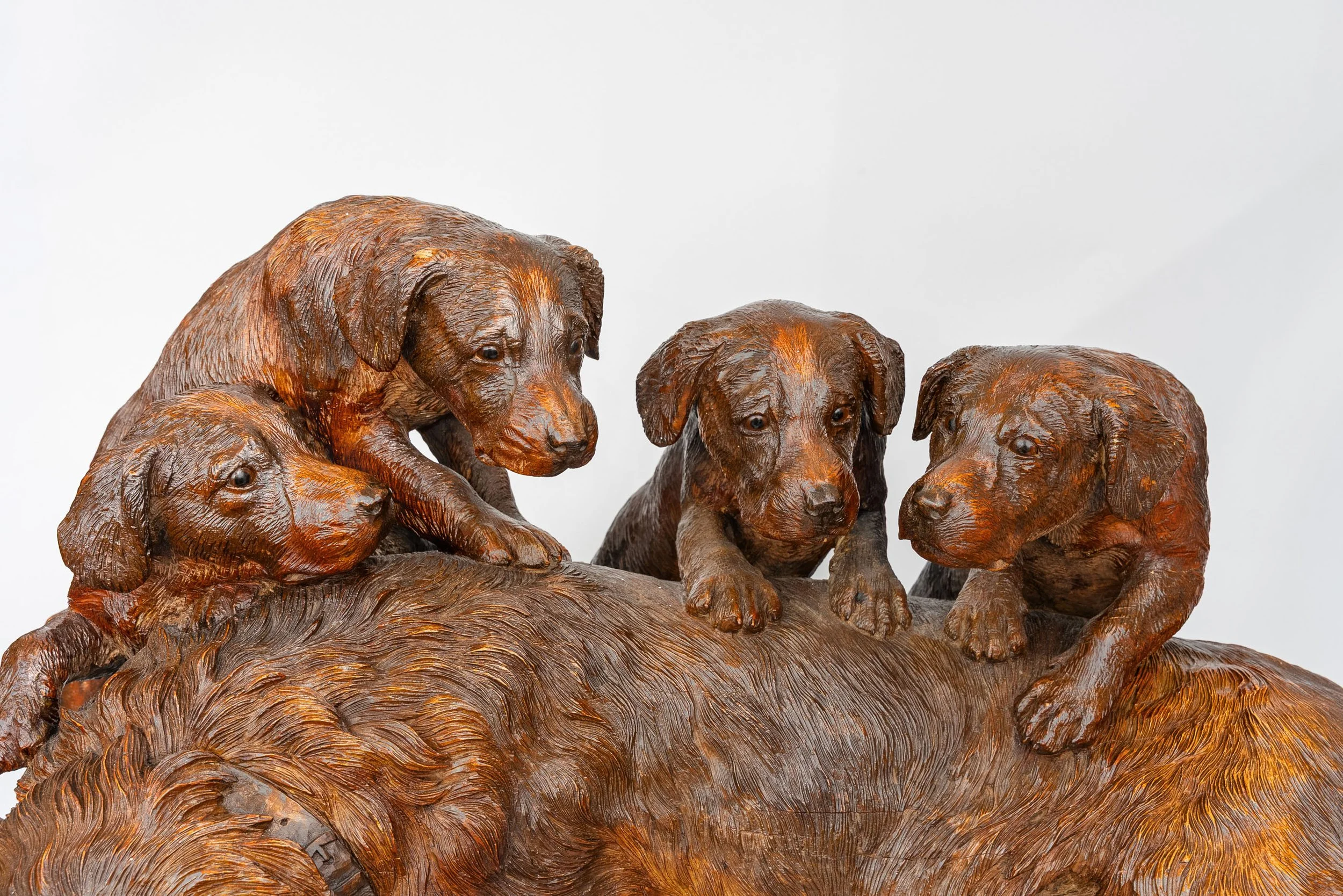 Image 3 of 3